









Stackify Retrace is a full-stack monitoring platform that offers application performance monitoring and code-level transaction tracing to help identify performance issues. However, some end-users find the interface complex and report challenges when configuring integrations such as data connectors and application triggers.
CubeAPM is the best alternative to Stackify Retrace, offering full-stack observability across metrics, logs, traces, and errors with flexible self-hosted and BYOC deployment options. It is designed to simplify operational complexity and deliver predictable, scalable observability as teams expand.
In this article, we’ll explore the top 8 Stackify Retrace alternatives—comparing features, pricing, support, and use cases. Whether you’re looking for better OpenTelemetry support, lower costs, or faster support, this guide will help you find the right fit.
Top 8 Stackify Retrace Alternatives
- CubeAPM
- Elastic Observability
- Dynatrace
- New Relic
- Datadog
- Sumo Logic
- SolarWinds
Why Look for Stackify Retrace Alternatives?
While Stackify Retrace excels in providing developer-friendly APM with robust logging and error tracking, several factors drive users to explore alternatives:
1. Complex Interface and Configuration Overhead
While Stackify Retrace offers strong monitoring capabilities, some teams report that the interface can feel complex and difficult to work with, especially when navigating across features. Users also highlight challenges when configuring integrations such as data connectors and application triggers, noting that setup and ongoing management can require more effort than expected as environments grow.
“Complicated interface, hard working on it” (G2)
2. Operational Complexity as Environments Scale
As applications and integrations grow, managing multiple configurations, triggers, and connectors in Retrace can become operationally heavy. Teams running larger or more dynamic environments often look for platforms that offer simpler workflows and easier scalability.
“Integrating our data connectors and application triggers is quite challenging to establish between our cloud platforms and the Retrace environment.”(G2)
3. Steep Learning Curve for Everyday Use
Although Retrace provides detailed insights, some teams find it takes time to become productive due to the learning curve across its interface and workflows. This can slow down troubleshooting for new users or teams without dedicated monitoring expertise.
Criteria for Suggesting Stackify Retrace Alternatives
When evaluating alternatives to Stackify Retrace, the following criteria ensure a comprehensive comparison tailored to diverse organizational needs:
1. Full MELT Observability
Support for Metrics, Events, Logs, and Traces (MELT) in a unified platform, providing end-to-end visibility with seamless correlation.
2. OTEL Support
We prioritized tools with native integration with OpenTelemetry for standardized, interoperable telemetry collection (metrics, logs, traces).
3. Collaboration & Integrations
Prioritized tools with seamless integrations with DevOps tools like Slack, Jira, PagerDuty, and GitHub Actions are essential to streamline incident management workflows.
4. User Experience and Operational Simplicity
Prioritized tools with fast onboarding, a low learning curve, intuitive dashboards, and easy setup are critical for developer adoption.
Stackify Retrace Overview
Known For
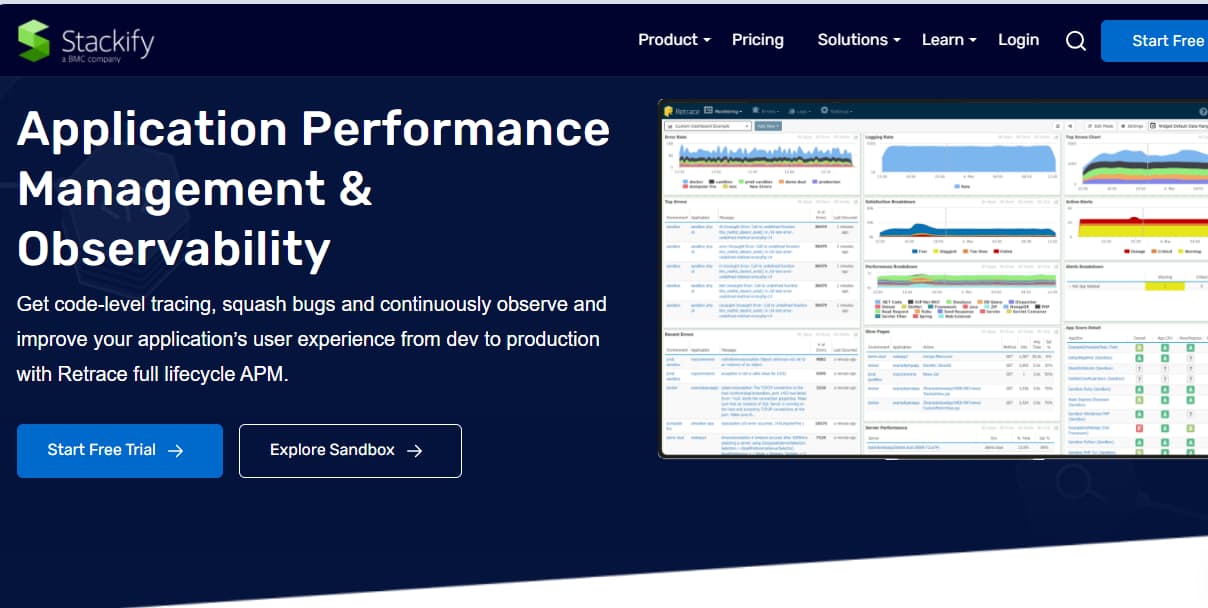
Retrace is primarily known for its full-lifecycle APM, enabling developers and DevOps teams to monitor application performance, identify bottlenecks, and resolve issues quickly through code-level tracing, integrated logging, and error tracking. It excels in providing actionable insights for optimizing .NET and Java applications, particularly in cloud environments like AWS and Azure, with a focus on reducing mean time to resolution (MTTR) for performance issues and bugs.
Standout Features
- Code-Level Tracing: Lightweight profiling delivers detailed transaction traces, pinpointing performance bottlenecks in methods, SQL queries, and HTTP calls.
- Integrated Logging and Errors: Combines logs, errors, and traces in a single platform, allowing seamless navigation from log statements to full transaction traces.
- Custom Dashboards: Role-based, user-defined dashboards with real-time metrics like Apdex scores and user satisfaction for tailored monitoring.
- Deployment Tracking: Integrates with CI/CD tools to correlate performance changes with specific deployments, enhancing troubleshooting efficiency.
- Real User Monitoring (RUM): Merges client and server-side traces to optimize end-user experience with resource breakdown reports.
Key Features
- APM+ Tab: Interactive graphs for aggregated application performance data, supporting advanced search and drill-down capabilities.
- Structured Logging: Supports log tags and JSON parsing for efficient log search and analysis across multiple environments.
- Error Tracking: Automatically captures exceptions with detailed stack traces, linked to logs and traces for rapid root cause analysis.
- Infrastructure Monitoring: Tracks server health (CPU, memory, disk) and supports cloud platforms (AWS, Azure) and containers (Docker, Kubernetes for PHP).
- Alerting: Granular, customizable alerts for proactive issue detection, integrated with tools like Slack and Jira.
- Prefix Integration: Free code profiler for pre-production debugging, ensuring high-quality code before deployment.
Pros
- Easy setup with minimal configuration, especially for .NET and Java applications
- Comprehensive log aggregation and error tracking reduce troubleshooting time
- Strong integration with DevOps tools (e.g., Slack, Jira, Visual Studio) streamlines workflows.
- Responsive support team, praised for setup assistance and feature guidance.
- Lightweight profiling minimizes performance overhead, ideal for production environments.
Cons
- Complex and unintuitive interface.
- Steep learning curve.
- Challenging configuration of integrations.
Best For
Stackify Retrace is best for small to mid-sized development teams, startups, and enterprises using .NET or Java applications in cloud environments (AWS, Azure). It’s ideal for DevOps teams seeking an affordable, developer-friendly APM tool with strong logging and error tracking, particularly those prioritizing rapid issue resolution without complex setup. However, teams requiring advanced synthetic monitoring, OpenTelemetry support, or on-premises deployment may need alternatives.
Pricing & Customer Reviews
- Tier 1: $80/month billed annually
- Tier 2: $249/month billed annually
- Enterprise: Custom
- G2 Rating: Retrace scores 4.2/5.
Top 8 Stackify Retrace Alternatives
1. CubeAPM

Known For
CubeAPM is a full-stack, OpenTelemetry-native APM platform designed to optimize cost efficiency and provide smart sampling. It is perfect for DevOps and SRE teams who require reliable observability without the risk of overpaying or losing control. Unlike legacy tools or open-source alternatives, CubeAPM uses AI-powered Smart Sampling to intelligently retain the most valuable traces, reducing trace volume by up to 70% and thus lowering storage and compute costs. CubeAPM also offers flexible deployment models, supporting cloud and on-premise installations, which helps organizations comply with data localization regulations such as GDPR.
Key Features
- Full MELT Support: CubeAPM supports Metrics, Events, Logs, and Traces (MELT), along with Real User Monitoring (RUM), synthetics, and error tracking, all within a unified platform.
- Smart Sampling: Unlike Signoz, CubeAPM uses context-aware sampling, ensuring that only the most critical telemetry (e.g., slow or erroring traces) is retained, improving visibility while reducing unnecessary data noise.
- Compliance-Ready Hosting: CubeAPM can be deployed either in the cloud or on-premises to comply with local data residency laws.
- 1-Hour Setup & Agent Compatibility: CubeAPM supports drop-in agents from Datadog, Prometheus, OpenTelemetry, and New Relic, making migration seamless
Standout Features
- $0.15/GB flat pricing—no hidden user or host fees. Zero cloud egress costs.
- Real-time Slack support directly from engineers.
- Prebuilt AWS/Kubernetes dashboards.
- Flexible self-hosting and cloud-hosting options.
- 800+ integrations
Pros
- Full-stack observability with OTEL-native ingestion.
- Cost predictability with flat-rate pricing.
- 2–4x faster ingestion performance.
- Ideal for data localization and compliance use cases.
- Works out of the box for AWS, K8s, Redis, Kafka, etc.
Cons
- Not suitable for teams looking for off-prem solutions.
- Strictly an observability platform, it does not support cloud security management.
Best For
- Engineering teams seeking lower costs and greater control over telemetry.
- Startups and mid-sized teams scaling quickly but with limited budgets.
Pricing & Customer Reviews
- Pricing: $0.15/GB flat ingestion rate, no per-user fees.
- Rating: 4.7 / 5 (based on pilot programs, Slack feedback, and demos).
- Praised for: Developer-friendly UX, transparent pricing, and powerful trace sampling.
- Criticized for: Growing ecosystem, fewer marketplace plugins than Datadog.
CubeAPM vs Stackify Retrace
Stackify Retrace provides application performance monitoring and code-level transaction tracing with logging and error tracking to help teams diagnose performance issues. CubeAPM expands on these capabilities with unified observability across metrics, logs, traces, and errors, flexible self-hosted or BYOC deployment options, and simpler configuration and extensibility, making it a strong alternative for teams looking for broader visibility and easier scalability.
2. Elastic Observability
Known For
Elastic Observability is renowned for its powerful log analytics and centralized monitoring capabilities, built on the widely used ELK Stack (Elasticsearch, Logstash, Kibana). It is popular among teams dealing with large volumes of machine data, particularly logs and metrics, across distributed systems. Elastic Observability excels at offering deep insights into machine data while providing advanced querying and visualization capabilities for logs and metrics.
Key Features
- Centralized Log Management: Efficient ingestion, indexing, and querying of logs from various sources.
- Metrics Monitoring: Collects and monitors time-series metrics for infrastructure, services, and containers.
- Elastic APM: Distributed tracing support for backend services with service maps and latency breakdowns.
- Uptime Monitoring: Provides basic synthetic checks to monitor service availability.
- Basic RUM Support: JavaScript agent for browser monitoring (limited depth compared to other tools).
- Alerting and Anomaly Detection: Offers both threshold-based and ML-driven alerting on metrics and logs.
Standout Features
- Sampling: Elastic Observability offers tail-based sampling, allowing for ingest filters (e.g., trace duration, error status) to be applied during sampling. This ensures only high-value traces are kept while optimizing storage costs.
- Kibana Dashboards: Kibana provides rich visualizations for logs, metrics, and traces with custom-built charts and drilldowns, offering powerful visual monitoring for distributed systems.
- Elasticsearch Query Language (KQL): KQL enables complex, full-text search and filtering across massive telemetry datasets, making it easier to analyze large volumes of logs quickly.
- Elastic Common Schema (ECS): ECS is a flexible schema for normalizing data across various sources, making it easier to analyze different types of telemetry data in a standardized way.
- Index Lifecycle Management (ILM): Manages data retention and optimizes storage costs by tiering data into hot/warm/cold phases based on data importance and age.
Pros
- Highly scalable architecture, suitable for managing massive volumes of logs and metrics.
- Core components of the ELK stack are open-source and widely adopted.
- Powerful search and query capabilities enable fast queries even on large datasets.
- Kibana for custom dashboards and in-depth visual tools for monitoring.
Cons
- Steep learning curve; requires familiarity with Elasticsearch, KQL, and Kibana to build effective observability workflows.
- The complex configuration is burdensome to users.
- Costs can scale quickly as data volumes grow.
Best For
- Large enterprises with deep Elasticsearch expertise or teams prioritizing log analytics and centralized logging over full-stack observability.
- Organizations already invested in the Elastic ecosystem can dedicate engineers to manage and tune it.
Pricing & Customer Reviews
- Standard: $99/month
- Gold: $114/month
- Platinum: $131/month
- Enterprise: $184/monthG2 Rating: 4.2/5
Praised for: Strong logging and analytics, powerful dashboards, and a rich query engine.
Criticized for: Complexity of use, pricing unpredictability, and limited support for modern observability needs.
Elastic Observability vs Stackify Retrace
Elastic Observability offers comprehensive observability across logs, metrics, and traces, powered by a robust search and analytics framework built on the Elastic Stack, making it well-suited for large-scale data analysis. Stackify Retrace focuses on core APM and code-level tracing, offering simpler, integrated workflows for troubleshooting.
3. Dynatrace
Known For
Dynatrace is an AI-powered enterprise observability platform known for its deep infrastructure monitoring, application security, and real-time analytics. It’s favored by large organizations running complex microservices and cloud-native workloads. Dynatrace stands out with its Davis AI engine, which automates anomaly detection and root cause analysis.
Key Features
- Davis AI Engine: Automates anomaly detection and root-cause analysis in complex systems.
- OneAgent Deployment: Reduces manual configuration by auto-discovering all services and dependencies.
- Security + Observability: Combines runtime application protection (RASP) with observability insights.
- Cloud Automation: Integrates with AWS, Azure, GCP, and Kubernetes for intelligent workload placement.
Standout Features
- AI-driven anomaly detection and root cause automation.
- Auto-instrumentation with OneAgent.
- Built-in digital experience monitoring and session replay.
Pros
- Enterprise-grade scalability and resilience.
- No sampling—captures 100% of transactions.
- Powerful AI analytics and auto-baselining.
Cons
- Very expensive with pricing complexity.
- Steep learning curve for new users.
- Costly for startups, especially when data volumes grow.
- High pricing issues limit accessibility.
Best For
- Large enterprises with high observability maturity.
- Teams running massive multi-cloud microservices.
- Enterprises needing observability and security in one platform.
Pricing & Customer Reviews
- Infrastructure Monitoring: $29 / mo per host.
- Full-Stack Monitoring: $58 / mo per 8 GiB host.
- Rating: 4.5 / 5.
- Praised for: Automation, AI capabilities, and breadth of coverage.
- Criticized for: High cost, complexity, and limited flexibility for smaller teams.
Dynatrace vs Stackify Retrace
Dynatrace is an enterprise-grade observability platform with AI-driven monitoring across full-stack infrastructure, applications, and user experience at large scale. Stackify Retrace focuses on core APM and code-level transaction tracing with logging and error tracking, offering simpler setup and workflows for performance troubleshooting.
4. New Relic
Known For
New Relic is a comprehensive cloud-based observability platform that provides real-time telemetry collection, analysis, and visualization across the MELT stack. Known for its powerful query interface and customizable dashboards, New Relic integrates APM, infrastructure monitoring, logs, traces, synthetics, and real-user insights in one unified platform. Its flexible telemetry and wide range of integrations make it popular with teams managing cloud-native environments and microservices.
Key Features
- All-in-One Telemetry Platform: New Relic unifies metrics, events, logs, and traces (MELT) into a single interface, offering comprehensive monitoring across applications and infrastructure.
- Auto Instrumentation & APM: New Relic offers native agents and auto-instrumentation for popular programming languages like Java, Node.js, Python, and Ruby, making it easier to monitor application performance with minimal setup.
- Distributed Tracing and Service Maps: New Relic offers distributed tracing and visual service maps, helping teams pinpoint latency and dependency issues.
- OpenTelemetry Support: It supports OTEL, but ingestion requires extra configuration, and OTEL traces may lack the same visibility as those captured by New Relic’s proprietary agents.
- Head-based Sampling: New Relic uses predefined head-based sampling (e.g., 1%, 5%) to reduce data volume. However, this approach may miss rare traces unless manually adjusted.
Standout Features
- Unified observability across MELT with real-time dashboards.
- Anomaly detection powered by machine learning.
- Customizable dashboards and advanced query language (NRQL).
- Supports both OTEL and proprietary agents.
- Integrates seamlessly with cloud-native tools like AWS, GCP, and Azure.
Pros
- Easy onboarding with agents and prebuilt integrations.
- Comprehensive visibility from backend services to frontend interactions.
- Strong documentation and robust support ecosystem.
Cons
- Expensive at scale due to usage-based pricing.
- A steep learning curve is required to understand NRQL queries.
- Initial setup is complex and time-consuming.
Best For
- Mid-to-large teams needing fast setup and full-stack visibility.
- Companies with multi-language microservices and SRE workflows.
- Teams comfortable with SaaS-only, vendor-managed telemetry pipelines.
Pricing & Customer Reviews
- Free: 100GB/month ingested
- Data ingested: $0.40/GB beyond the free 100 GB
- Full Platform User: $349/user.
- Rating: 4.4 / 5.
- Praised for: Out-of-the-box UX, wide language support, powerful UI.
- Criticized for: Pricing complexity, sampling limitations, and limited control over data flow.
New Relic vs Stackify Retrace
New Relic offers a comprehensive observability platform with unified metrics, traces, logs, and real-user monitoring, plus advanced analytics and alerting at scale. Stackify Retrace focuses on core APM and code-level transaction tracing with integrated logging and error tracking, providing simpler workflows for performance troubleshooting.
5. Splunk AppDynamics
Known For
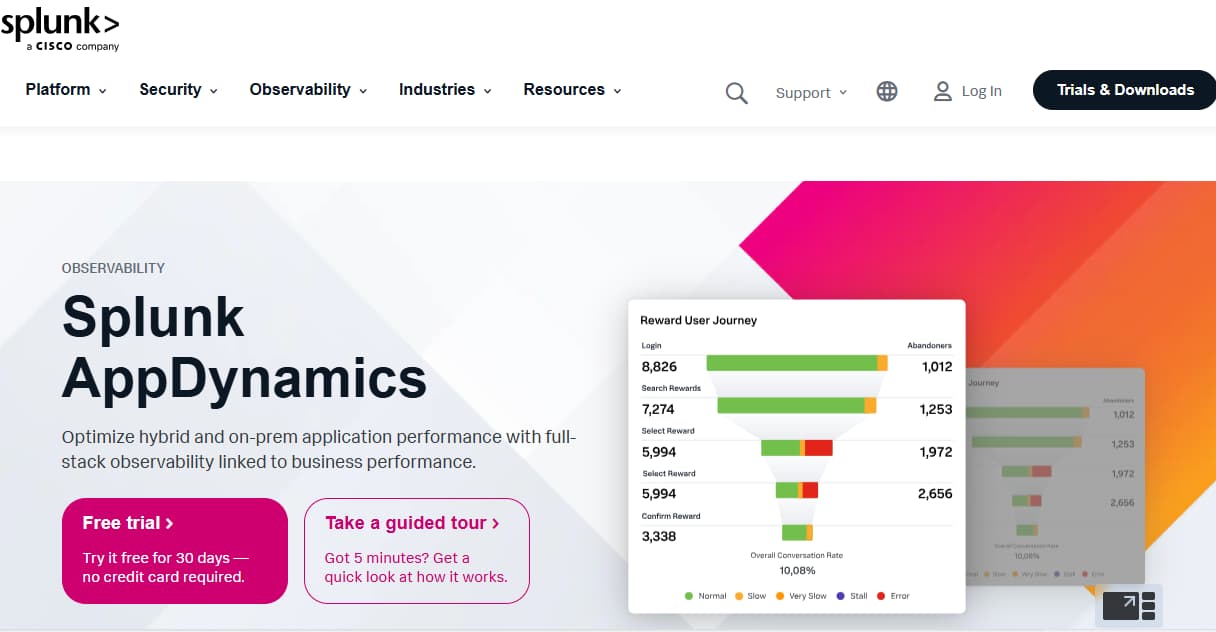
Originally developed by AppDynamics (now part of Cisco and integrated into Splunk), AppDynamics specializes in business transaction monitoring and deep performance diagnostics. It’s an enterprise-grade APM solution known for its highly detailed diagnostics, AI-powered root cause analysis, and full-stack observability across both hybrid and legacy infrastructures. It’s often used in regulated industries like banking, insurance, and telecom.
Key Features
- Business Transaction Monitoring: AppDynamics structures observability around business transactions such as checkout or order processing, making it easier for engineering and business teams to align on service health.
- Deep Code-Level Diagnostics: AppDynamics offers stack traces, database call visibility, and execution timing breakdowns to help backend teams debug issues quickly in JVM, .NET, Node.js, PHP, and more.
- Root Cause Analysis with AI: Machine learning is used to detect performance anomalies and correlate across layers, surfacing the root cause.
- Hybrid Deployment Flexibility: AppDynamics offers SaaS, self-hosted, or hybrid deployments, making it ideal for organizations with strict data residency requirements.
- Full-Stack Infrastructure Integration: Now part of Splunk Observability Cloud, AppDynamics offers enhanced infrastructure metrics, log enrichment, and security monitoring through tighter integration with Splunk.
Standout Features
- Transaction-based observability based on business workflows.
- Line-level performance tracing with real-time flamegraphs.
- AI-powered root cause detection.
- Supports hybrid/on-prem deployments.
Pros
- Enterprise-ready with strong SLAs and compliance certifications.
- Highly detailed stack and database visibility.
- Flexible deployment options (on-prem, hybrid, SaaS).
Cons
- Expensive and modular pricing based on APM units.
- Overwhelming UI hinders navigation and usability.
- Steep learning curve, especially for beginners.
Best For
- Large enterprises with legacy infrastructure or compliance constraints.
- Teams needing business-transaction-level monitoring.
- Organizations that prioritize performance diagnostics over MELT stack unification.
Pricing & Customer Reviews
- AppDynamics APM: starts at $33/month/CPU core
- Infra Monitoring: starts at $6/month/CPU core
- Rating: 4.3 / 5.
- Praised for: Deep diagnostics, deployment flexibility, and business alignment.
- Criticised for: High cost, overwhelming UI, and complex setup and scaling.
Splunk AppDynamics vs Stackify Retrace
Splunk AppDynamics is often considered as an alternative to Stackify Retrace for organizations that require deeper application performance analytics and support for large, complex enterprise environments. Compared to Retrace’s focus on core APM and code-level tracing, AppDynamics offers broader visibility across applications and business transactions, which appeals to teams operating at greater scale.
6. Sumo Logic

Known For
Sumo Logic is a cloud-native log management and SIEM platform designed for security-conscious organizations. It offers real-time telemetry ingestion, log analytics, and security monitoring in one unified dashboard, making it particularly suitable for DevSecOps teams. Sumo Logic is known for its scalability and multi-cloud support, catering to large organizations that need to handle massive data volumes.
Key Features
- Unified Log and Metrics Platform: Sumo Logic combines log management, metrics, and security analytics in one platform, offering powerful monitoring and anomaly detection for security teams.
- Cloud-Native Architecture: Fully SaaS with support for multi-cloud environments (AWS, Azure, GCP), Sumo Logic scales effortlessly for enterprises without requiring on-prem infrastructure.
- Flexible Query Language & Dashboards: It offers a proprietary query language, PowerQuery, and real-time dashboards that are highly customizable for both engineers and security analysts.
- Security & Compliance Analytics: Sumo Logic offers compliance templates and threat detection for PCI, HIPAA, SOC 2, and other standards.
Standout Features
- Built-in compliance and security analytics.
- Multi-tenant SaaS deployment.
- Live dashboards with alerting and anomaly detection.
- Scalable ingestion with cloud-native elasticity.
Pros
- No infrastructure management overhead.
- Deep log analytics with live query capability.
- Strong integration with Kubernetes and AWS.
Cons
- High costs at scale due to tiered data plans.
- Steep learning curve to understand proprietary language.
- UI feels overwhelming for new users.
Best For
- Enterprises needing compliance, SIEM, and log-driven observability in a single platform.
- Teams looking for cloud-native solutions that combine DevOps observability with security analytics.
Pricing & Customer Reviews
- Pricing: $3.14 estimated per TB scan.
- Rating: 4.2 / 5.
- Praised for: Prebuilt dashboards, log depth, and security integrations.
- Criticized for: SaaS-only deployment, steep learning curve for queries, and cost unpredictability.
Sumo Logic vs Stackify Retrace
Stackify Retrace focuses on core APM with code-level performance monitoring, tracing, and integrated logging to support application troubleshooting. In contrast, Sumo Logic is a cloud-native observability platform designed for large-scale log and metric analytics, offering broader data analysis and correlation capabilities for teams operating at scale.
7. SolarWinds
Known For
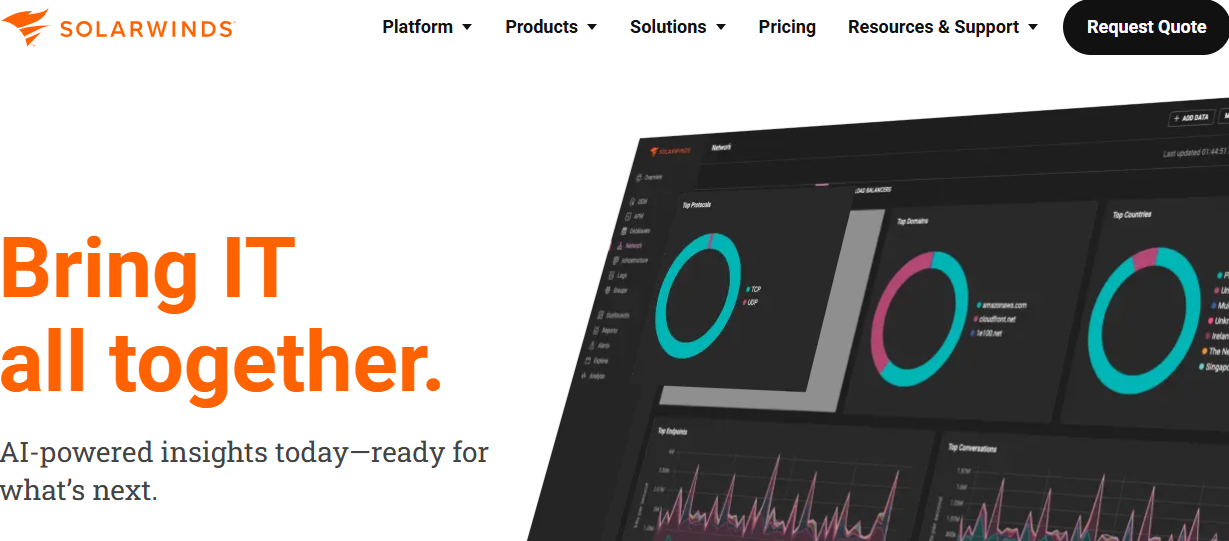
SolarWinds is a longstanding vendor known for its IT infrastructure monitoring, network performance analysis, and on-premise observability tooling. SolarWinds is primarily used by enterprises and public sector organizations to monitor a wide range of assets, including servers, applications, databases, and IT operations. Its key products include Network Performance Monitor (NPM), Server & Application Monitor (SAM), and the SolarWinds Observability suite.
Key Features
- Infrastructure & Network Monitoring: Tools like NPM and SAM provide visibility into server health, bandwidth usage, hardware faults, and uptime.
- Database Performance Analyzer: Deep insights into SQL execution plans, query performance, and database load, particularly for MSSQL and Oracle environments.
- Service Management: Built-in ticketing, technician assignment, SLAs, and email-based support workflows.
- Incident Response & Alerting: A centralized alerting engine with role-based notifications and integrations with collaboration tools like Slack and Teams.
- On-Premise Deployment: Full self-hosting for organizations with data residency or compliance restrictions.
Standout Features
- Modular Product Suite: Offers a range of specialized tools for monitoring, database management, service desk, and incident response, which can be customized to specific business needs.
- Network-Centric Monitoring: Strong capabilities in SNMP-based network monitoring, bandwidth usage, and topology mapping, making it ideal for network performance monitoring.
- ITSM Integration: Includes built-in service desk modules for asset management, ticketing, and technician workflows, which enhances its utility for IT operations teams.
- Hybrid Environment Support: SolarWinds can monitor both cloud and on-premise assets in distributed environments, offering a comprehensive view of infrastructure regardless of location.
- Custom Alerts & Reports: Offers customizable dashboards, performance baselines, and alert rules based on thresholds, allowing users to tailor monitoring to their needs.
Pros
- Strong in traditional IT infrastructure and network monitoring use cases.
- Offers a wide array of specialized tools—ITSM, DB monitoring, observability—all in one ecosystem.
- On-premise deployment options make it appealing for government and regulated sectors.
- SNMP monitoring and NetFlow analysis are mature and battle-tested.
Cons
- Users find the pricing to be expensive.
- Users face integration issues that complicate setup.
- The steep learning curve makes the utilization of full features challenging.
Best For
- Enterprises with large on-premise networks and traditional IT operations.
- Government agencies or regulated sectors with self-hosting mandates.
- Teams focused on asset discovery, server health, and infrastructure alerting rather than full-stack observability.
Pricing & Customer Reviews
- Monitoring & Observability: $6/node/month
- Database Monitoring: $117/database/month
- ITSM: $39/technician/month
- Incident Response: $9/user/month
- Rating: 4.4 / 5
- Praised for: Breadth of features, network performance, and customization options.
- Criticized for: Poor support, UI complexity, scaling issues, and lack of OpenTelemetry-native integration.
SolarWinds vs Stackify Retrace
Stackify Retrace focuses on application performance management with integrated APM, centralized logging, error tracking, and code-level profiling to help developers quickly find and fix issues in their apps. SolarWinds provides unified observability across applications, infrastructure, networks, and logs with rich analytics and a broader operational context. For teams that want detailed developer-centric APM with lightweight profiling and error insights, Stackify Retrace is often chosen as an alternative to SolarWinds.
Conclusion: Choosing the Right Stackify Retrace Alternative
As engineering and SRE teams continue to modernize their observability stacks, many are moving beyond legacy tools like Stackify Retrace in favor of solutions that are OpenTelemetry-native, cost-efficient, and built for real-time, full-stack visibility. Stackify Retrace, while offering basic APM and error tracking, often struggles to meet the needs of fast-scaling, cloud-native environments due to its lack of deep telemetry support, sampling limitations, and pricing complexities.
Teams seeking flexibility and scalability need observability tools that offer more than just basic APM features—tools that provide comprehensive visibility across metrics, logs, traces, synthetics, and RUM, and that can scale with their infrastructure without escalating costs. As such, finding the right alternative is crucial for maintaining both performance and budget control.
Why CubeAPM Leads the Pack
Among all Stackify Retrace alternatives, CubeAPM stands out with its OpenTelemetry-first architecture, smart sampling, and complete MELT observability. It delivers comprehensive visibility across metrics, logs, traces, synthetics, and real-user monitoring (RUM). CubeAPM’s performance is enhanced by blazing-fast dashboards, compliance-ready self-hosting, and cost predictability, offering up to 80% lower cost compared to traditional tools. CubeAPM provides full-stack observability without the need for user-based fees, vendor lock-in, or fragmented billing.
If you’re ready to embrace the next level of observability, CubeAPM offers a powerful and scalable solution designed to meet today’s demands and accelerate your journey to enhanced performance monitoring.
Disclaimer: The information in this article reflects the latest details available at the time of publication and may change as technologies and products evolve.