









Observability bills have quietly become one of the largest recurring infrastructure costs for engineering teams. As telemetry volumes grow across logs, metrics, traces, Kubernetes, and user-facing applications, teams often discover that observability spend scales faster than expected.
That cost pressure is one reason many teams are re-evaluating their APM and observability platforms in 2026. This review takes an independent look at Uptrace pricing and reviews, including its current pricing structure, core product capabilities, deployment model, user sentiment, practical limitations, and the alternatives worth comparing before making a final decision.
What Is Uptrace?
Platform Overview
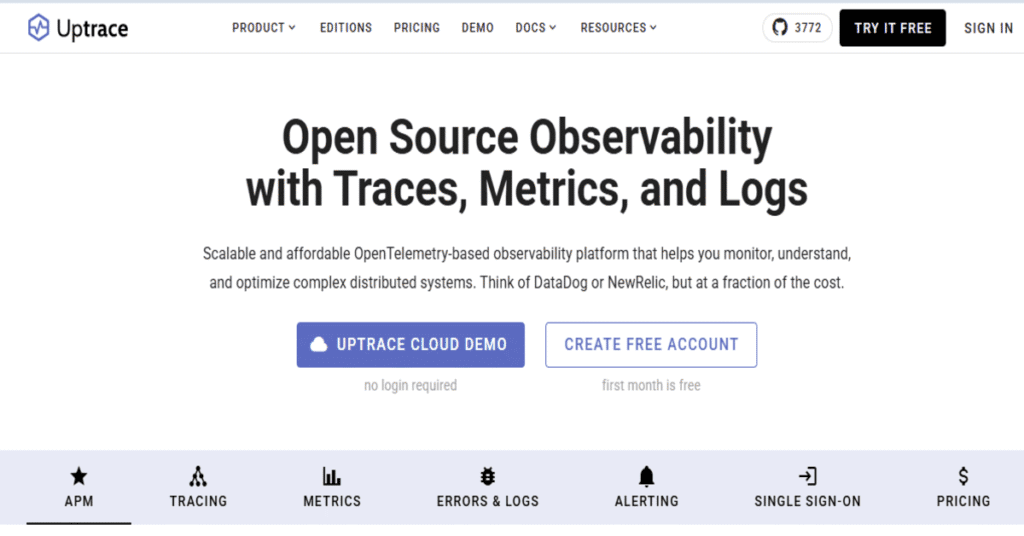
Uptrace is an OpenTelemetry-native APM and observability platform for teams that want to monitor traces, metrics, logs, errors, and service performance in one place. It is built around ClickHouse for high-volume telemetry storage and is available both as a paid SaaS product, called Uptrace Cloud, and as a self-hosted option for teams that want more control over their observability stack.
Uptrace is open source, with its codebase available on GitHub under the AGPL-3.0 license. The company is based in Chisinau, Moldova. Its core positioning is simple: give teams OpenTelemetry-based observability without the heavy per-host or per-seat pricing model used by many larger APM vendors.
The platform is built around three main ideas:
- OpenTelemetry-native data collection
- Cost-efficient telemetry storage using ClickHouse
- Flexible deployment through SaaS, self-hosted Docker/Kubernetes, and managed on-premises options
Core capabilities include:
- Distributed tracing with service graphs, RED metrics, latency percentiles, top errors, and slow endpoint visibility
- Unified traces, metrics, logs, and errors in one interface
- Data ingestion from OpenTelemetry, Prometheus, Vector, Fluent Bit, CloudWatch, and more
- Alerting through email, Slack, webhooks, and AlertManager
- SQL-like querying for spans and logs, plus PromQL-style querying for metrics
- SSO through OpenID Connect integrations such as Keycloak, Google Cloud, and Cloudflare
- Deployment through Uptrace Cloud, self-hosted Docker/Kubernetes, and managed on-premises options
Uptrace’s Market Positioning in 2026
The observability market in 2026 can be viewed in three broad layers.
At the high end are large commercial platforms such as Datadog, Dynatrace, and New Relic. They offer deep feature sets, large ecosystems, and strong enterprise support, but their pricing can become difficult to predict as telemetry volume, hosts, users, and add-ons grow.
In the middle are cost-conscious, OpenTelemetry-friendly platforms such as SgNoz and Grafana Cloud. These tools focus on open standards, broader signal coverage, and more usage-based pricing, but the main caveat is the operational overhead that teams deal with, especially when using the open-source, self-hosted option.
At the lower end are open-source, self-managed tools such as Jaeger, Apache SkyWalking, Prometheus, and Loki. These can reduce license costs, but teams still need to deploy, scale, secure, and maintain the stack themselves.
Uptrace sits in the middle tier. Its main strengths are unified traces, metrics, and logs, OpenTelemetry-native collection, ClickHouse-based storage, and predictable usage-based pricing with no per-seat, per-host, or per-service limits listed on its pricing page.
CubeAPM fits a similar buyer need, especially for teams that want self-hosted APM with lower operational overhead and do not want to manage a complex multi-component open-source stack themselves.
Key Features of Uptrace
Uptrace provides end-to-end request tracing across services, databases, and external calls. Its APM views include service graphs, RED metrics, latency percentiles, slow endpoints, top errors, and trace-level drilldowns for debugging performance issues. Uptrace is built around OpenTelemetry, so teams can instrument applications without relying on proprietary agents.
Uptrace ingests metrics through OpenTelemetry Collector, Prometheus, Vector, and cloud sources such as CloudWatch. Metrics can be queried, visualized, and correlated with traces and logs. In April 2026, Uptrace moved metrics billing from active timeseries to ingested datapoints, with a minimum supported collection interval of 10 seconds.
Uptrace supports log ingestion through OpenTelemetry Collector and tools such as Fluent Bit and Vector. Logs can be correlated with traces and errors, helping teams move from a failing request to related log events without switching tools.
Uptrace supports alerts on metrics, traces, logs, and errors. Notifications can be sent through email, Slack, Telegram, PagerDuty, webhooks, and AlertManager. Enterprise integrations also include OpsGenie.
Uptrace Enterprise supports SSO options including SAML and OIDC, with tested SAML providers such as Okta, Auth0, OneLogin, Shibboleth, Ipsilon, and Azure AD. Uptrace pricing does not list per-seat fees, which makes user access easier to forecast.
Uptrace offers Uptrace Cloud, self-hosted deployments, and managed/on-premises options. Self-hosted teams can deploy with Docker, Docker Compose, Ansible, or Kubernetes. Managed deployments include onboarding, configuration help, integration setup, scaling, and maintenance support.
Uptrace receives telemetry through OTLP over both gRPC and HTTP. It documents SDK setup for Go, Python, Ruby, Node.js, .NET, Java, Erlang, Elixir, Rust, PHP, C++, and Swift.
How Uptrace Works: Architecture and Deployment
Uptrace Cloud
Uptrace Cloud is the paid SaaS version managed by the Uptrace team. It runs on dedicated Hetzner hardware in Germany and Finland, with telemetry data kept in EU data centers. Teams send traces, metrics, and logs through OTLP using the OpenTelemetry SDK or Collector, without managing backend infrastructure.
The main trade-off is location. Teams running workloads on AWS, GCP, Azure, or outside Europe may need to account for network egress and latency when sending telemetry to Uptrace Cloud. Uptrace itself notes that sending data from AWS or GCP can create outbound transfer fees.
Uptrace Self-Hosted
Uptrace can also be self-hosted using Docker, Docker Compose, Ansible, or Kubernetes Helm charts. The backend uses ClickHouse for telemetry data, PostgreSQL for metadata, and Redis for caching. The GitHub repo lists AGPL-3.0 licensing, with commercial licensing available for teams that need different terms.
Uptrace On-Premises
Uptrace On-Premises is a managed private installation of Uptrace Enterprise. It can run on dedicated servers or in the customer’s chosen cloud environment, and Uptrace engineers handle customization and maintenance. The plan includes custom retention, custom indexing, 16/5 support by default, a 99.95% SLA, and pricing from $1,000/month, excluding hosting costs.
Key architectural points
- ClickHouse stores traces, logs, and metrics.
- PostgreSQL stores users, projects, metric names, and alert metadata.
- Redis is used for caching.
- OTLP over gRPC and HTTP is the main ingestion path.
- OpenTelemetry Collector can be used for routing, batching, filtering, and enrichment.
- Uptrace supports unified investigation across traces, metrics, logs, and errors.
What Are Uptrace’s Pricing Options?
Uptrace uses usage-based pricing. Costs are mainly based on telemetry volume, not the number of users, hosts, or services. Its pricing page says teams can have unlimited users, services, and hosts and that the final price depends on the amount of data ingested.
Uptrace has three main options:
- Uptrace Cloud: paid SaaS, managed by Uptrace
- Uptrace Self-Hosted: open-source deployment for teams that want to run Uptrace themselves
- Uptrace On-Premises: managed private deployment, starting at $1,000/month excluding hosting costs
Uptrace has two billing dimensions:
- Traces and logs: billed by uncompressed GB ingested
- Metrics: billed by million ingested datapoints
Pricing Options
Free Trial
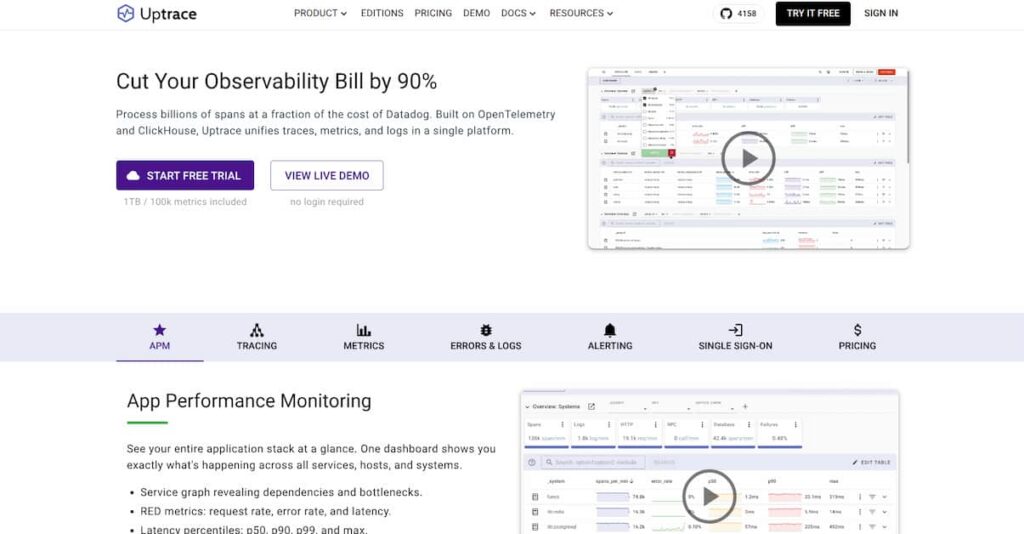
Uptrace Cloud offers a free trial with 1 TB of storage and 100,000 timeseries, with no credit card required. Uptrace’s on-premises plan also includes a 2-month free evaluation period. After the trial, Cloud pricing is based on ingested spans/logs volume and metric datapoints.
Uptrace Self-Hosted
Uptrace can be self-hosted using its open-source GitHub codebase. The current license is AGPL-3.0, with commercial licensing available for teams that need different terms. Self-hosted teams manage the Uptrace application and backend infrastructure themselves, including ClickHouse, PostgreSQL, Redis, and deployment through Docker, Docker Compose, Ansible, or Kubernetes.
There is no Uptrace Cloud per-GB fee for self-hosted deployments, but teams still need to account for infrastructure, storage, upgrades, backups, and operational maintenance. Commercial teams should review AGPL obligations or discuss a commercial license with Uptrace.
Uptrace Cloud
Uptrace Cloud is the hosted, fully managed version of Uptrace. It is the easiest option for teams that want to start quickly without running ClickHouse, PostgreSQL, Redis, or other backend infrastructure themselves.
Pricing is usage-based. Spans and logs are billed per uncompressed GB ingested, while metrics are billed per million datapoints. Uptrace does not list per-seat, per-host, or per-service fees for the cloud plan.
| Attribute | Details |
| Pricing model | Per uncompressed GB for spans/logs Per million datapoints for metrics |
| Entry price | $30/month for 300 GB of spans and logs |
| Free trial | 1TB+ spans/logs and 100,000 timeseries, no credit card required |
| Users, hosts, services | Unlimited |
| Best for | Teams that want managed observability with low ops overhead |
Uptrace Cloud: spans and logs pricing from April 10, 2026
| Data volume / month | Monthly price |
| 100 GB | $10 |
| 500 GB | $50 |
| 1 TB | $102 |
| 3 TB | $230 |
| 5 TB | $384 |
| 10 TB | $666 |
| 25 TB | $1,408 |
| 50 TB | $1,999 |
| 100 TB | $2,999 |
| 200 TB | $4,101 |
| 350 TB | $6,093 |
Uptrace On-Premises
Uptrace On-Premises is a private Uptrace Enterprise installation for teams with large telemetry volumes, strict data residency needs, or compliance requirements. It is customized and maintained by Uptrace engineers and can run on dedicated servers, the customer’s cloud account, or Uptrace-managed dedicated hardware in Germany or Finland.
| Attribute | Details |
| Minimum fee | $1,000/month, excluding hosting costs |
| Evaluation period | 2 months free evaluation |
| Hosting options | Customer infrastructure, cloud provider, or Uptrace-managed private hardware |
| Support | 16/5 standard support; 24/7 upgrade available |
| Data retention | Custom retention for traces, logs, and metrics |
| SLA | 99.95% availability, excluding hosting-provider downtime |
| Best for | Large-scale or regulated teams that need private deployment and data control |
Uptrace On-Premises: spans and logs pricing
| Monthly volume | Cloud price | On-Premises Uptrace fee | Minimum hardware |
| 30 TB | $1,500/month | $900/month | 24 vCPU, 48 GB RAM, 1 TB SSD, 6 TB HDD |
| 50 TB | $2,000/month | $1,200/month | 32 vCPU, 96 GB RAM, 2 TB SSD, 12 TB HDD |
| 100 TB | $3,000/month | $1,800/month | 64 vCPU, 160 GB RAM, 4 TB SSD, 20 TB HDD |
| 500 TB | $12,000/month | $7,000/month | 192 vCPU, 576 GB RAM, 8 TB SSD, 100 TB HDD |
What Does Uptrace Really Cost?
Scenario 1: midsized engineering team
Assumptions:
- 65 engineers
- 5 TB/month of spans and logs combined
- 2 TB/month logs + 3 TB/month traces/APM
- Uptrace Cloud pricing
- Metrics estimated using the $1,499/month metrics tier shown on Uptrace’s pricing page
- Estimates are directional, not official Uptrace quotes
| Item | Usage / tier | Estimated cost |
| Logs | 2 TB/month | Included in spans + logs tier |
| Traces/APM | 3 TB/month | Included in spans + logs tier |
| Total spans + logs | 5 TB/month | $384/month |
| Metrics | 133,240 million datapoints/month | $1,499/month |
| Estimated monthly total | Spans/logs + metrics | $1,883/month |
| Estimated annual total | $1,883 × 12 | $22,596/year |
At this scale, Uptrace Cloud comes to about $1,883/month before any network egress fees, discounts, or support-related adjustments. The spans and logs portion is relatively low at $384/month, but metrics can become a larger part of the bill depending on how many datapoints are collected and how often they are collected.
This estimate uses Uptrace’s published 5 TB spans/logs tier and the $1,499/month metrics tier shown on its pricing page. Actual costs may vary based on final telemetry volume, metric collection interval, egress fees for non-European teams, and contract terms.
Scenario 2: Mid-market engineering team
Assumptions:
- 250 hosts
- 27 TB/month of spans and logs combined
- 18 TB/month logs
- 9 TB/month traces/APM
- Uptrace Cloud pricing
- Metrics estimated using the $2,999/month metrics tier shown on Uptrace’s pricing page
- Estimates are directional, not official Uptrace quotes
| Item | Usage / tier | Estimated cost |
| Logs | 18 TB/month | Included in spans + logs tier |
| Traces/APM | 9 TB/month | Included in spans + logs tier |
| Total spans + logs | 27 TB/month | $1,408/month |
| Metrics | 479,840 million datapoints/month | $2,999/month |
| Estimated monthly total | Spans/logs + metrics | $4,407/month |
| Estimated annual total | $4,407 × 12 | $52,884/year |
For this mid-market scenario, Uptrace Cloud is estimated at $4,407/month. The spans and logs estimate uses the 25 TB published tier as the closest reference for 27 TB/month, while metrics use the $2,999/month tier from Uptrace’s pricing page.
Actual costs can vary based on exact telemetry volume, metric collection interval, egress fees for non-European teams, discounts, and contract terms.
What Actually Drives Uptrace Costs
Uptrace pricing is not driven only by the per-GB headline rate. Total cost depends on spans/logs volume, metrics datapoints, deployment model, egress fees, and support needs.
Spans and logs are billed together by uncompressed GB ingested. Teams with verbose instrumentation, high-cardinality logs, or heavy trace capture will pay more. Sampling in the OpenTelemetry Collector can reduce span volume before data reaches Uptrace.
Since April 2026, Uptrace bills metrics by ingested datapoints instead of active timeseries. At a 1-minute interval, 1,000 timeseries over 28 days produces about 40 million datapoints. A 30-second interval doubles that volume, so collection frequency becomes a direct cost lever.
Uptrace Cloud is easier to adopt because Uptrace manages the infrastructure. Uptrace On-Premises can reduce the Uptrace fee at larger volumes, but it has a $1,000/month minimum and hosting costs are separate.
Uptrace Cloud runs on EU infrastructure in Germany and Finland. Uptrace notes that sending telemetry from AWS or GCP can create outbound traffic fees, so non-European and public-cloud teams should include egress in their cost model.
On-Premises includes standard 16/5 support, with 24/7 support available as an upgrade. It also supports custom retention for traces, logs, and metrics, which may increase storage needs depending on the hosting setup.
What this shows
The biggest cost variables are telemetry volume, metrics frequency, deployment model, and egress. Teams should model Uptrace using real expected spans, logs, metrics datapoints, retention needs, and hosting location instead of relying only on the headline per-GB price.
Uptrace Pros and Cons
- Predictable usage-based pricing with no per-seat, per-host, or per-service fees
- OpenTelemetry-native architecture, so teams do not need proprietary agents
- Unified traces, metrics, logs, and errors in one interface
- Flexible deployment through Uptrace Cloud, self-hosted, and managed on-premises options
- ClickHouse storage engine for high-volume telemetry data
- Active commercial backing, not only a community-maintained project
- Custom retention, indexing, and pre-aggregation available on the on-premises plan
- Budget caps and volume discounts help reduce billing surprises
- On-premises has a $1,000/month minimum fee, excluding hosting costs
- Self-hosted Uptrace requires managing the ClickHouse backend, which adds operational overhead and costs.
- Metrics cost modeling is more complex after the April 2026 move to datapoint-based billing
Is Uptrace the right fit for your team?
When Uptrace Works Best
| Good fit scenario | Why |
| OpenTelemetry-first teams | Uptrace is built around OpenTelemetry and supports OTLP ingestion. |
| Cost-sensitive teams with growing telemetry volume | Usage-based pricing can be easier to forecast than a per-host or per-seat model. |
| Teams needing full MELT | Uptrace brings the main observability signals into one interface. |
| Teams wanting cloud or self-hosted deployment | Uptrace supports Cloud, Docker, Docker Compose, Ansible, Kubernetes, and On-Premises options. |
| Teams with private deployment needs | On-Premises supports custom hosting location, retention, indexing, and managed support. |
| Teams with many users, hosts, or services | Uptrace does not list per-user, per-host, or per-service fees. |
When Uptrace May Not Be the Right Fit
| Scenario | Why |
| Small teams needing managed on-premises | On-Premises has a $1,000/month minimum fee, excluding hosting costs. |
| Teams needing network device monitoring | Uptrace is mainly application observability, not SNMP-style network monitoring. |
| Teams deeply standardized on Grafana | Uptrace can integrate with Grafana, but it is not a Grafana-native platform. |
| US or APAC teams with strict residency needs | Uptrace Cloud runs in Germany and Finland, so egress, latency, and residency should be checked. |
| Teams wanting the largest OSS ecosystem | Grafana, SigNoz, SkyWalking, or Prometheus-based stacks may offer broader community material. |
| Teams needing ITSM or service desk workflows | Uptrace is an observability platform, not a ticketing or ITSM suite. |
Uptrace Alternatives: How It Compares to Competitors
Uptrace vs CubeAPM
Uptrace and CubeAPM both target teams that want OpenTelemetry-native, cost-efficient observability. Uptrace is stronger for teams that want a low-cost SaaS option or a managed on-premises path, while CubeAPM is built for teams that want self-hosted, vendor-managed observability with low operational overhead.
| Area | Uptrace | CubeAPM |
| Pricing | Per GB + datapoints | Flat $0.15/GB |
| On-prem minimum | $1,000/month | No minimum fee |
| Deployment | Cloud, self-hosted (ClickHouse management) | Vendor-managed self-hosted |
| OTel support | Native | Native |
| MELT coverage | Full MELT | Full MELT |
| Best fit | Low-cost SaaS or on-prem | Self-hosted with low ops overhead |
Uptrace vs Dynatrace
Dynatrace is a premium enterprise observability platform with deep automation, AI-assisted root cause analysis, and broad infrastructure coverage. Uptrace is simpler, more OpenTelemetry-focused, and usually easier to model for teams mainly comparing telemetry volume costs.
| Area | Uptrace | Dynatrace |
| Pricing | Per GB + datapoints | Usage-based DPS |
| Main cost driver | Spans, logs, metrics | Host memory, logs, traces, add-ons |
| MELT coverage | Full MELT | Full MELT |
| Deployment | Cloud, self-hosted, on-prem | SaaS-first |
| OTel support | Native | Supported |
| Best fit | Cost-conscious OTel teams | Large enterprise teams |
Uptrace vs Datadog
Datadog is a much broader enterprise platform with deeper integrations, dashboards, security products, RUM, synthetics, and incident workflows. Uptrace is narrower but simpler: it focuses on OpenTelemetry-based traces, metrics, logs, and errors with more predictable usage-based pricing.
| Area | Uptrace | Datadog |
| Pricing | Per GB + datapoints | Modular usage pricing |
| Starting price | $10/month for 100 GB | $15/host/month for Infra Pro |
| Main cost driver | Telemetry volume | Hosts, logs, spans, add-ons |
| Deployment | Cloud, self-hosted, on-prem | SaaS-first |
| OTel support | Native | Supported |
| Best fit | Cost-conscious OTel teams | Large enterprise teams |
Uptrace vs New Relic
New Relic is a broader SaaS observability platform. Uptrace is narrower, more OpenTelemetry-focused, and offers Cloud, self-hosted, and on-premises options.
| Area | Uptrace | New Relic |
| Pricing | Per GB + datapoints | Per GB + users |
| Starting price | $10/month for 100 GB | 100 GB/month free |
| Main cost driver | Spans, logs, metrics | Data ingest, users |
| MELT coverage | Full MELT | Full MELT |
| Deployment | Cloud, self-hosted, on-prem | SaaS-first |
| OTel support | Native | Supported |
| Best fit | Cost-conscious OTel teams | Broad SaaS observability |
Uptrace vs. Grafana Cloud?
Grafana Cloud is a strong fit for teams already using Grafana, Prometheus, Loki, Tempo, or Mimir. It has a larger ecosystem and was named a Leader in the 2025 Gartner Magic Quadrant for Observability Platforms. Uptrace is a simpler alternative for teams that want OpenTelemetry-native traces, logs, and metrics in one platform with usage-based pricing.
| Area | Uptrace | Grafana Cloud |
| Pricing | Per GB + datapoints | Base fee + usage |
| Starting price | $10/month for 100 GB | $19/month Pro |
| Logs | Included in GB pricing | $0.50/GB |
| Traces | Included in GB pricing | $0.50/GB |
| Metrics | Per million datapoints | $6.50/1k series |
| Main cost driver | Data volume, datapoints | Metrics series, logs, traces |
| Deployment | Cloud, self-hosted, on-prem | SaaS & Self-hosted |
| Best fit | Simple OTel observability | Grafana ecosystem teams |
Uptrace vs. SigNoz?
SigNoz is one of the closest open-source alternatives to Uptrace. Both are OpenTelemetry-native, both use ClickHouse, and both support traces, metrics, and logs. The main differences are licensing, community size, and pricing model.
| Area | Uptrace | SigNoz |
| Pricing | Per GB + datapoints | Per GB + metric samples |
| Main cost driver | Spans, logs, metrics | Logs, traces, metric samples |
| MELT coverage | Full MELT | Full MELT |
| Storage | ClickHouse | ClickHouse |
| Deployment | Cloud, self-hosted, on-prem | Cloud and self-hosted |
| OTel support | Native | Native |
| Community | Smaller GitHub footprint | Larger GitHub footprint |
| Best fit | Managed cloud or on-prem | OSS-first teams needing cloud or self-hosted |
Conclusion
Uptrace is a strong option for teams that want OpenTelemetry-native observability with simpler usage-based pricing. It brings traces, metrics, logs, and errors into one platform; supports Cloud, self-hosted, and managed on-premises deployment; and does not list per-seat, per-host, or per-service fees.
The April 2026 pricing update changed two important things: higher-volume spans/logs tiers increased, and metrics moved from active time-series billing to data point-based billing. That makes metric collection frequency an important cost factor, especially for teams collecting large volumes of infrastructure or service metrics.
Uptrace is still not ideal for every team. Its on-premises plan has a $1,000/month minimum excluding hosting; Cloud runs in Germany and Finland, and self-hosted users need to review AGPL-3.0 obligations or commercial licensing. Teams should test it with real telemetry volumes, egress costs, and retention needs and compare it with CubeAPM, SigNoz, Grafana Cloud, Datadog, New Relic, and Dynatrace before committing.
Disclaimer: This review is an independent editorial analysis based on publicly available Uptrace documentation, pricing pages, and product materials, supplemented by verified user reviews and community discussions at the time of writing. Pricing, feature availability, packaging, and licensing terms may change; readers should verify current details directly with Uptrace before making purchasing decisions.
FAQs
1. How much does Uptrace cost in 2026?
Uptrace Cloud starts at $10/month for 100 GB of spans and logs. From April 10, 2026, prices increased for volumes above 1 TB: the 3 TB tier moved from $199 to $230, the 5 TB tier from $332 to $384, and higher tiers increased by roughly 5–20% depending on volume. Metrics are billed separately per million ingested datapoints. Uptrace On-Premises has a $1,000/month minimum fee, excluding hosting costs.
2. Why did Uptrace increase prices in April 2026?
Uptrace said the April 2026 price increase was driven by Hetzner infrastructure cost increases. Hetzner announced price increases of up to 36%, citing higher RAM, NVMe SSD, and operational costs. Uptrace also said it had absorbed earlier setup-fee increases before adjusting its own pricing.
3. Does Uptrace have a free trial or free tier?
Uptrace Cloud offers a free trial with 1 TB of storage and 100,000 timeseries, with no credit card required. Uptrace Cloud does not position this as a permanent free tier. The self-hosted version can be used from GitHub under AGPL-3.0, and the On-Premises plan includes a 2-month free evaluation.
4. What changed in Uptrace’s metrics pricing in April 2026?
Uptrace changed metrics billing from active timeseries to ingested datapoints. At a 1-minute interval, 1,000 timeseries over 28 days produces about 40 million datapoints. A 30-second interval doubles that amount, so collection frequency now directly affects metrics cost.
5. What is the minimum cost for Uptrace On-Premises?
Uptrace On-Premises has a $1,000/month minimum Uptrace fee. Hosting infrastructure is not included, so the final cost also depends on the customer’s servers, cloud provider, storage, and support needs.
6. What are the best alternatives to Uptrace?
Relevant alternatives include CubeAPM for low-overhead self-hosted observability, SigNoz for OSS-first OpenTelemetry observability, Grafana Cloud for teams already using Grafana tooling, Jaeger for distributed tracing, and Apache SkyWalking for open-source APM.
7. Does Uptrace support OpenTelemetry?
Yes. Uptrace is built around OpenTelemetry and supports OTLP ingestion. It works with OpenTelemetry SDKs and the OpenTelemetry Collector for sending traces, metrics, and logs into Uptrace.