







If your organization is evaluating SolarWinds alternatives, you are far from alone. After a 700% renewal price increase reported by some enterprise customers (as seen in r/sysadmin), and the lingering trust deficit from the 2020 SUNBURST supply-chain attack that compromised thousands of organizations, IT teams are looking for alternatives for replacements.
According to Uptrace’s 2025 analysis, SolarWinds’ module-based licensing can reach $15,000 or more per year for just 100 devices, a cost structure that pushes many teams to reconsider before the next renewal cycle.
This guide compares the most widely recommended SolarWinds alternatives across network monitoring, APM, ITSM, and database monitoring. It covers open-source tools, cloud-native platforms, and commercial suites, with real-world cost scenarios and deep pricing analysis to help you understand what switching actually costs and saves.
Top 10 SolarWinds alternatives
- CubeAPM
- Zabbix
- Nagios
- PRTG Network Monitor
- Datadog
- ManageEngine OpManager
- LogicMonitor
- Checkmk
- New Relic
- Dynatrace
Quick comparison table: Best SolarWinds alternatives at a glance
Disclaimer: All pricing comparisons are calculated using standardized small/medium/large team profiles defined in our internal benchmarking sheet, based on fixed log, metric, trace, and retention assumptions. Actual pricing may vary by usage, region, and plan structure. Please confirm current pricing with each vendor.
| Tool | Pricing (Small / Mid / Large) | OTEL Native | Self-hosted? | Pricing Model |
| CubeAPM | $2,080 / $7,200 / $15,200 | Yes | Yes (vendor-managed) | $0.15/GB flat |
| Zabbix | $0 / $0 / $0 | Yes | Yes | Free (open source) |
| Nagios | ~$500 / ~$2,000 / ~$8,000 | Yes | Yes | Free Core / $2,495+ per 100 nodes |
| PRTG | ~$900 / ~$2,800 / ~$7,500 | No | Yes | Sensor-based |
| Datadog | $8,185 / $27,475 / $59,050 | Yes | No | $15/host + $0.10/GB |
| ManageEngine OpManager | ~$490 / ~$1,800 / ~$5,500 | No | Yes | From ~$245/25 devices |
| LogicMonitor | ~$4,200 / ~$12,000 / Custom | No | No | Custom enterprise |
| Checkmk | $0 / $0 / Enterprise | Yes | Yes | Free Raw / Enterprise tiers |
| New Relic | $7,896 / $25,990 / $57,970 | Yes | No | 100 GB free / $0.40/GB |
| Dynatrace | $7,740 / $21,850 / $46,000 | Partial | Limited | $29 to $58/host + $0.20/GiB |
Why teams are moving away from SolarWinds
SolarWinds is a long-established IT operations platform built around its flagship Network Performance Monitor (NPM). For many legacy on-premise environments, it still works. Review sites, Reddit threads, and analyst coverage consistently cite the following friction points as the primary reasons teams start looking elsewhere.
SolarWinds’ real limitations: What users complain about most
1. Module sprawl: How SolarWinds bills compound at renewal
SolarWinds pricing can still feel fragmented because different product areas use different billing units. Based on SolarWinds’ public pricing cards, Monitoring and Observability starts at $7 per node per month, Database at $142 per database per month, IT Service Management at $39 per technician per month, and Incident Response at $15 per user per month. That means total spend depends not just on scale, but on how many SolarWinds product areas a team ends up adopting
What the full SolarWinds stack actually costs
Disclaimer: These are directional estimates based on SolarWinds’ public pricing pages and product listings as of early 2026. Actual costs can vary based on product edition, deployment size, licensing terms, add-ons, support level, and final vendor quote. For tools shown only with a “starts at” price, the monthly figures are comparison estimates created by dividing the entry price by 12. They are not officially published monthly rates.
| Capability area | Pricing | Assumption | Estimated monthly cost | Estimated annual cost |
|---|---|---|---|---|
| Monitoring and Observability | $7/node | 100 nodes | $700 | Per node |
| Database | $142/database/month | 10 databases | $1,420 | Per node |
| IT Service Management | $39/technician/month | 10 | $390 | Per node |
| Incident Response | $15/user/month | 15 users | $225 | Flat |
| Storage Resource Monitor | $2,970 | _ | $247.50 | $2,970 |
| Dameware Mini Remote Control | $370 | _ | $30.83 | $370 |
| Dameware Remote Support | $520 | _ | $43.33 | $520 |
| Network Topology Mapper | $1,977 | _ | $164.75 | $1,977 |
| Kiwi Syslog Server NG | $999 | _ | $83.25 | $999 |
User report (r/sysadmin): “We got slammed with a 700% renewal increase for SolarWinds. We’re about 90% certain we’ll be kicking them to the curb. Every time we added a module, another license was required at the next renewal.”
2. Polling engine scaling costs: $20,000 per engine
SolarWinds NPM uses polling engines to collect metrics from monitored devices. At default polling intervals, one SolarWinds polling engine can monitor up to 12,000 elements. SolarWinds recommends reviewing scaling options earlier as environments approach 10,000 elements per polling engine. When an organization exceeds that threshold, it must purchase an additional polling engine license.
Disclaimer: The scaling thresholds below are supported by SolarWinds documentation, but SolarWinds does not publish a current official public list price for Additional Polling Engines in the sources reviewed. The estimated additional costs below are budgeting placeholders based on public reseller and renewal listings, not official SolarWinds quote pricing.
| Monitored elements | Polling engines needed | Estimated additional cost | Notes |
|---|---|---|---|
| Up to 10,000 elements | 1 polling engine included | $0 additional | Included in base license |
| 10,001 to 12,000 elements | 1 polling engine | $0 additional | One-time + annual maintenance |
| 12,001 to 24,000 elements | 2 polling engines | Budget placeholder: ~$5,000 to $10,000/yr in added renewal/maintenance + initial license cost | SolarWinds requires an additional polling engine license above 12,000 elements. |
| 24,001 to 36,000 elements | 3 polling engines | Budget placeholder: ~$10,000 to $20,000/yr added renewal/maintenance + initial license cost | Assumes one extra APE per additional ~12,000 elements at default polling intervals. |
| 36,001 to 48,000 elements | 4 polling engines | Budget placeholder: ~$15,000 to $30,000/yr in added renewal/maintenance, plus initial license cost | Same logic: each step adds another APE license requirement once you exceed another ~12,000-element block. |
| 48,001 to 60,000 elements | 5 polling engines | Budget placeholder: ~$20,000 to $40,000/year in added renewal/maintenance, + initial license cost | Large environments may also need more infrastructure and tuning, not just another license. |
| 100,000+ elements | 9+ polling engines | Budget placeholder: ~ $40,000 to $80,000+/yr in added renewal/maintenance, plus initial license cost | This is a directional planning figure only. Large SolarWinds estates often need multiple scalability layers and vendor quoting. |
For a mid-sized enterprise monitoring 40,000 elements, SolarWinds would usually need four polling engines in total. SolarWinds says one polling engine supports up to 12,000 elements at default polling intervals, and teams should start planning for scale as they approach 10,000. That means a 40,000-element environment would likely need three additional pollers beyond the base engine.
Hidden cost: Once SolarWinds environments move beyond 12,000 elements, additional polling engines become a separate licensing item. SolarWinds documents the scaling threshold but not a current public APE list price, so the cost is better shown as a budgeting range than a fixed number. In practice, each added poller can add recurring renewal and maintenance costs on top of the original purchase.
3. The 2020 SUNBURST breach left lasting procurement friction
In December 2020, SolarWinds disclosed that it had been the victim of a cyberattack affecting its Orion Platform products and internal systems. The scale of the incident made SolarWinds a long-term vendor-risk discussion point for many security and procurement teams. Even when a team is satisfied with the product itself, the breach can still add extra scrutiny during security reviews, audits, and renewal conversations.
Real-world scenarios: Which SolarWinds alternative fits your situation?
How to find your scenario
| Primary reason for evaluating alternatives | Deployment preference | Likely best fit |
|---|---|---|
| Module pricing is compounding at renewal | Any | CubeAPM, ManageEngine OpManager, Checkmk |
| Need self-hosting or on-premises data control | Self-hosted | CubeAPM (vendor-managed) or Zabbix / Nagios (self-managed) |
| Need full APM and distributed tracing alongside network monitoring | Any | CubeAPM, Datadog, or New Relic |
| Replacing SolarWinds for network-only SNMP monitoring | On-premises | Zabbix, PRTG, or Checkmk |
| MSP managing multiple client environments | Managed SaaS | Auvik or LogicMonitor |
| Need security analytics alongside observability | Managed SaaS | Splunk |
| Need enterprise AI root cause analysis | Managed SaaS | Dynatrace or Datadog |
| Data residency or compliance requirement | Self-hosted | CubeAPM (vendor-managed) or Zabbix |
Scenario 1: Growing team replacing SolarWinds after a renewal increase
The situation: Your growing team needs better visibility across infrastructure and applications, but SolarWinds costs are rising as your environment expands. You want a tool that is easier to scale, easier to price, and better suited for modern observability needs.
Reference profile
• Data ingested: ~13 TB/month (6 TB logs, 4 TB traces, 3 TB metrics)
• Infrastructure: 60 hosts
• Users: 4 (20% engineers)
• Retention: 30 days
• Scope: Core observability no security or synthetics
Approximate monthly costs for a mid-sized IT team
Directional estimates based on public rate cards and our internal sheet calculation model, early 2026. Vendor discounts may apply. For tools not covered in the pricing calculator, costs are scenario-based estimates only and may vary by edition, support, deployment size, and vendor quote.
| Tool | Est. monthly cost | vs SolarWinds NPM+SAM (~$4,024) | Self-hosted? | No per-device scaling? |
|---|---|---|---|---|
| CubeAPM | ~$2,080 | ~48% saving | Yes | No |
| SolarWinds | ~$4,024 | — | Yes | Per-node + per-module |
| Zabbix | ~600 | ~85% saving | Yes | Yes |
| Nagios | ~$900 | -78% | Yes | No |
| PRTG (3,000 sensors) | ~$1,600 | -60% saving | Yes | Yes |
| Datadog | ~$8,185 | +103% | No | Yes |
| ManageEngine OpManager | ~$1,290 | -69% | Yes | Yes |
| LogicMonitor | ~$2,890 | -28% saving | No | Custom |
| Checkmk | $~859 | ~100% saving | Yes | Yes |
| New Relic | ~$7,896 | +96% | No | No |
| Dynatrace | ~$7,740 | +92% | Yes | No |
Best fits:
- CubeAPM: Best overall fit for growing teams that want to move beyond basic infrastructure monitoring without stepping into a much heavier cost model. It addresses the main problem in this scenario by giving the team one platform for monitoring and deeper observability, while keeping pricing more predictable as usage grows.
- Zabbix or Checkmk: Best for growing teams whose main goal is to cut software cost as much as possible. They address the SolarWinds pricing problem well, but the tradeoff is that the team takes on more setup and operational work internally.
- ManageEngine OpManager: Best commercial fit for teams that still care mostly about network and server monitoring and want a simpler replacement for SolarWinds. It addresses the cost and complexity issue better than SolarWinds, but it is less aligned with teams that also want to grow into fuller observability.
Scenario 2: Mid-Market team that needs full observability, not just network monitoring
The situation: Your mid-market team already needs full-stack observability across infrastructure, logs, metrics, and traces. SolarWinds can cover that, but the bigger question is whether it is still the best fit as your environment gets larger, telemetry grows, and cost planning becomes more important. At this stage, teams are usually comparing platforms based less on feature checklists and more on pricing model, operational fit, deployment control, and how well the platform scales with modern observability needs. SolarWinds now offers full-stack observability, but mid-market buyers may still look elsewhere if they want a simpler pricing model, stronger self-hosting control, or a cleaner path as data volume grows.
Reference profile
- Data ingested: approximately 25 TB/month (10 TB logs, 8 TB traces, 7 TB metrics)
- Infrastructure: 100 hosts, 3 Kubernetes clusters
- Users: 8 platform users
- Retention: 30 days
- Scope: Full observability, APM, network metrics
Approximate monthly costs for an engineering team
Directional estimates based on public rate cards, early 2026.
| Tool | Est. monthly cost | vs SolarWinds NPM+SAM (~$10,500) | Self-hosted? | No per-device scaling? |
|---|---|---|---|---|
| CubeAPM | ~$7,200 | -31% saving | Yes | No |
| SolarWinds | ~$10,500 | — | Yes | Per-node + per-module |
| Zabbix | ~1250 | ~88% saving | Yes | Yes |
| Nagios | ~$1,850 | -82% saving | Yes | No |
| PRTG (3,000 sensors) | ~$3,250 | -75% saving | Yes | Yes |
| Datadog | ~$27,475 | +162% | No | Yes |
| ManageEngine OpManager | ~$2,650 | -69% | Yes | Yes |
| LogicMonitor | ~$11,125 | +~6% | No | Custom |
| Checkmk | $~1,750 | ~83% saving | Yes | Yes |
| New Relic | ~$25,990 | +148% | No | No |
| Dynatrace | ~21,850 | +108% | Yes | No |
Best fits:
- CubeAPM: Best overall fit for mid-market teams that already need full observability but want a more predictable pricing path than SolarWinds as data volume and platform usage grow. In this scenario, the issue is not whether SolarWinds can do observability, but whether the team wants a simpler, self-hosted model as costs rise. CubeAPM fits that well because it is positioned around unified full-stack observability and a single ingestion-based pricing model.
- Datadog or Dynatrace: Best for mid-market teams that want mature enterprise-style observability and are willing to pay more for a broad SaaS platform. In this scenario, they address the need for deeper visibility well, but the tradeoff is that cost climbs much faster than CubeAPM or the modeled SolarWinds baseline. That makes them better for teams prioritizing platform depth over budget control.
- Zabbix or Checkmk: Best for mid-market teams whose main goal is to reduce software spend sharply and keep deployment self-hosted. They address the SolarWinds cost problem well, but the tradeoff is that the team takes on more operational work and gets a more infrastructure-led path rather than the cleaner observability growth story this scenario is really about. Zabbix remains license-free, while Checkmk offers a free Community edition and paid scaling by services monitored.
- PRTG or ManageEngine OpManager: Best for mid-market teams that still lean more toward infrastructure and network monitoring than full observability. They address the need for a simpler commercial replacement better than SolarWinds’ broader stack, but they are a weaker fit if the team is already moving into telemetry-heavy application observability. PRTG scales by sensors, while OpManager is positioned as transparent, device-based monitoring.
Scenario 3: Enterprise team with hybrid cloud and compliance requirements
The situation: You run a hybrid environment across on-premises data centers, AWS, and Azure. SolarWinds can cover hybrid observability, but your team now cares more about deployment control, data residency, and long-term vendor-risk review than basic feature coverage alone. After SUNBURST and stricter internal reviews, procurement and security teams want stronger control over where monitoring data lives and how the platform is operated.
- CubeAPM: Best fit when the main issue is keeping telemetry inside your own environment while still getting full-stack observability. CubeAPM positions itself around vendor-managed self-hosting and supports SOC 2 and ISO 27001, which makes it easier to frame around compliance and infrastructure control in this scenario.
- Zabbix: Best fit when the goal is maximum on-premises control and the team is comfortable owning more of the deployment and operations work. It addresses the data-residency side of the scenario well, but with more internal effort than a vendor-managed model.
- LogicMonitor: Best fit when the team wants strong hybrid visibility and easier operations, but it is a weaker fit if the hard requirement is that monitoring data must stay fully inside your own environment. LogicMonitor is SaaS-based and uses on-prem collectors, which helps with hybrid coverage, but it is not the same as a fully self-hosted observability platform.
Scenario takeaway
Teams moving away from SolarWinds usually fall into three groups. Some want simpler pricing as costs grow across nodes, databases, users, and product areas. Others already need full observability and are comparing platforms based on cost model, deployment fit, and day-two usability, not just feature checklists. A third group is mainly driven by control, compliance, and data residency. SolarWinds does support full-stack observability and self-hosted deployment today, but teams still look elsewhere when pricing, platform fit, or deployment control becomes the bigger issue.
- Growing team / pricing pressure: CubeAPM, Zabbix, Checkmk, ManageEngine OpManager
- Mid-market / full observability fit: CubeAPM, Datadog, Dynatrace, New Relic
- Compliance / data residency / control: CubeAPM, Zabbix, Checkmk
10 Best SolarWinds Alternatives
1. CubeAPM
Best for: DevOps and platform teams that want full-stack observability inside their own cloud without SaaS data egress, pricing sprawl, or DIY self-hosting overhead
Known for
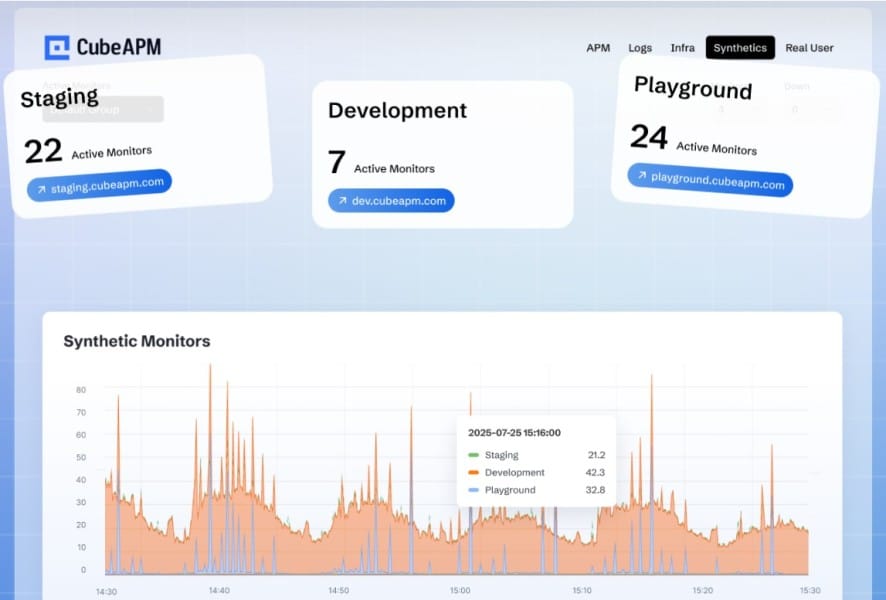
CubeAPM is a self-hosted, OpenTelemetry-native observability platform covering APM, logs, infrastructure, Kubernetes, RUM, synthetic monitoring, Kafka monitoring, and error tracking. It runs inside your cloud or on-prem, so there’s no data egress and no external dependency during incidents; your monitoring stays up even if the internet doesn’t.
Recognized as a High Performer in G2’s Spring 2026 APM Grid Report and ranked #4 among the easiest-to-use APM tools on G2. Trusted by the world’s largest bus aggregator, redBus (part of NASDAQ-listed MakeMyTrip, 8+ countries); Delhivery ($3.5B valuation); Mamaearth ($1.2B valuation); Policybazaar; Practo; Ola; and others.
Key features
- Full-stack unified monitoring: APM, logs, infrastructure, Kubernetes, Kafka, RUM, and error tracking
- OpenTelemetry-native; no proprietary agents. Compatible with Prometheus and existing Datadog and New Relic agent configs for incremental migration
- Vendor-managed self-hosted deployment: data sovereignty by design, zero backend operations overhead
- Data compliance and security; CubeAPM is SOC 2 and ISO 27001 certified
- Unlimited data retention with no egress surprises or extension costs
- AI-based trace sampling retains traces that matter while reducing storage overhead
- Direct engineering support via shared Slack channel, not a ticket queue
Pros
- Simplest pricing model: $0.15/GB with no per-host, per-node, per-module, or per-user dimensions
- Full MELT coverage replaces SolarWinds NPM plus a separate APM tool in one platform
- Predictable, flat pricing that does not compound as infrastructure scales
- Complete data ownership: no telemetry leaves your infrastructure
- No polling engine costs or module add-ons
Cons
- Focused on APM and observability; not a direct replacement for deep enterprise SNMP network topology mapping at very large scale
- Not suited for teams requiring SaaS-only deployment with no internal infrastructure commitment
Pricing
- $0.15/GB ingested. No host charges. No user charges. No per-node charges. No module add-ons. Unlimited retention.
CubeAPM vs SolarWinds
Choose CubeAPM over SolarWinds when your team wants full-stack observability with a simpler and more predictable pricing model as telemetry volume grows. SolarWinds now offers full-stack observability and self-hosted deployment, but its public pricing still spans separate product areas and billing units across observability, database, ITSM, and incident response. CubeAPM takes a different approach with a single ingestion-based pricing model starting at $0.15/GB, which can be easier to plan for teams that want one clearer cost path across logs, metrics, and traces.
2. Zabbix
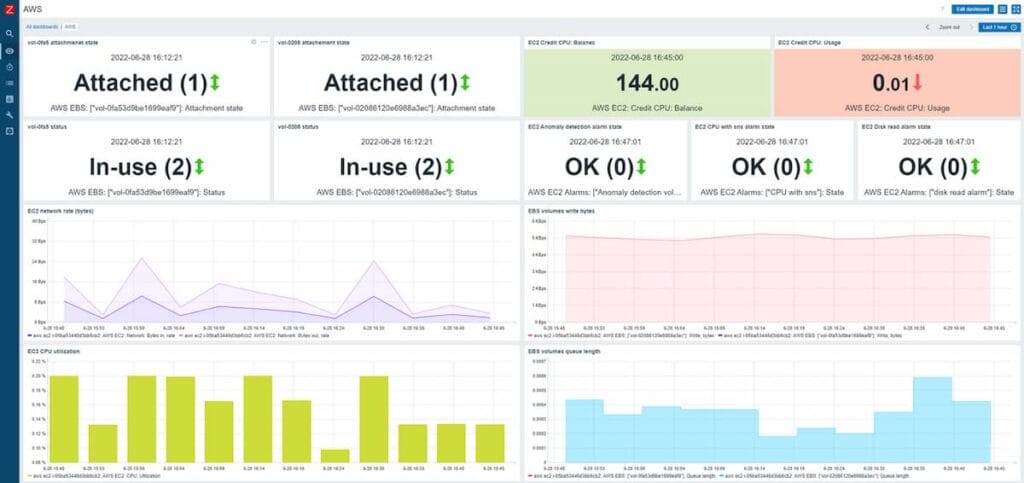
Best for: Large enterprises or public-sector organizations that need feature-rich network and server monitoring without licensing costs and have the technical team to manage deployment.
Known for
Zabbix is a fully open-source monitoring platform supporting SNMP, IPMI, JMX, and agent-based monitoring with no licensing fees. It scales horizontally through proxies without additional cost. Its auto-discovery engine, native graphing, and template-based configuration make it considerably more capable out of the box than Nagios for teams that need enterprise monitoring without a commercial license budget.
Key features
- SNMP, ICMP, IPMI, JMX, and agent-based monitoring across Windows, Linux, Unix, and cloud endpoints
- Auto-discovery with template-based configuration
- Native graphing, dashboards, and alerting without additional plugins
- Proxy-based horizontal scaling: no per-polling-engine charges compared to SolarWinds’ $20,000 per engine
- Active open-source development; enterprise support available from Zabbix LLC
Pros
- No licensing costs; scales without polling engine add-ons
- Scales to millions of metrics from thousands of devices
- Strong security features and broad protocol support
- Grafana integration for modern visualization overlays
Cons
- Steep learning curve; initial setup requires significant time and expertise
- Complex setup and configuration especially for Cloud and Kubernetes monitoring
Pricing
Free and open-source. Enterprise support packages are available from Zabbix LLC.
Zabbix vs SolarWinds
Choose Zabbix over SolarWinds when your priority is lowering software cost and keeping monitoring fully self-hosted. Zabbix is open source and says it has no license fees or per-device charges, while SolarWinds is a commercial platform that now offers full-stack self-hosted observability starting at $7.42 per node per month. That makes Zabbix the better fit for teams with enough in-house ops capacity, while SolarWinds is the easier path for teams that want a more packaged commercial product.
3. Nagios
Best for: Organizations with deep technical expertise that need to monitor legacy, custom, or mixed-vendor infrastructure with maximum plugin flexibility.
Known for
Nagios has over 20 years of development history and more than 5,000 community-contributed plugins, making it adaptable to virtually any monitoring use case. Where SolarWinds only runs on Windows, Nagios supports Linux, Unix, Solaris, AIX, HP-UX, and macOS, a meaningful advantage in heterogeneous environments.
Key features
- 5,000+ plugins covering databases, operating systems, applications, and network equipment
- Multi-platform support: Windows, Linux, Unix, macOS, Solaris, AIX, HP-UX
- Distributed monitoring with NRPE and passive checks
- Nagios XI enterprise edition adds a modern interface and reporting tools
- Extensive third-party integration ecosystem
Pros
- Free Nagios Core edition; no licensing cost for network and server monitoring
- 5,000+ community plugins cover almost any monitoring target
- Multi-platform support far exceeds SolarWinds’ Windows-only constraint
- Proven reliability in large-scale deployments over two decades
Cons
- Steep learning curve
- Manual configuration is time-consuming
Pricing
Nagios Core: Free and open-source.
Nagios Standard: Starts at approximately $2,495 per 100 nodes.
Nagios vs SolarWinds
Choose Nagios over SolarWinds when your priority is a simpler, node-based commercial monitoring model and lower software cost for infrastructure-heavy environments. Nagios XI says its pricing is primarily based on node count, while SolarWinds positions Observability Self-Hosted as a broader full-stack observability platform starting at $7.42 per node per month. That makes Nagios a better fit for teams focused mainly on core infrastructure monitoring and cost control, while SolarWinds is the stronger fit for teams that want a more packaged observability platform with broader hybrid coverage.
4. PRTG Network Monitor

Best for: Small to mid-sized businesses that want quick deployment, intuitive dashboards, and deep Windows integration without the module complexity of SolarWinds.
Known for
PRTG (Paessler) packages bandwidth monitoring, server health, cloud app tracking, and network device monitoring into a single application. Setup requires only one server with no SQL Server prerequisite, unlike SolarWinds, which requires SQL Server infrastructure. Its auto-discovery feature maps network devices automatically, and unlike SolarWinds’ per-polling-engine pricing, PRTG allows unlimited remote probes under a single license.
Key features
- All-in-one monitoring: network, server, cloud apps, bandwidth, and storage under one license
- Auto-discovery with drag-and-drop dashboard setup
- Unlimited remote probes per license; no polling engine add-ons at $20,000 each
- REST API and custom sensor support for extended monitoring targets
- Mobile app for monitoring access on the go
Pros
- Intuitive setup with no SQL Server prerequisite, unlike SolarWinds Orion
- All-in-one package with no separate module purchases
- Sensor-based pricing with unlimited remote probes at no extra cost
- Strong pre-built reporting templates and visualization
Cons
- Costs escalate quickly as sensor count grows for larger networks
- Steep learning curve for beginners
- The UI can feel overwhelming, especially for those new to observability
Pricing
Sensor-based licensing. Free trial available. Pricing scales with the number of sensors monitored.
PRTG vs SolarWinds
Choose PRTG over SolarWinds when your priority is faster setup and simpler infrastructure monitoring for a growing network and server estate. PRTG uses sensor-based pricing, with public plans like PRTG 2500 at $742/month and PRTG 5000 at $1,300/month, while SolarWinds positions Observability Self-Hosted as a broader hybrid observability platform that spans multiple product areas and pricing units. That makes PRTG the better fit for teams that want a more straightforward monitoring rollout, while SolarWinds is the stronger fit for teams that want a broader all-in-one observability and IT operations platform.
5. Datadog
Best for: Cloud-first or hybrid organizations running workloads on AWS, Azure, or GCP that need unified infrastructure monitoring, APM, and log management in one managed platform.
Known for
Datadog is a cloud-native observability platform with 1000+ pre-built integrations combining infrastructure metrics, distributed traces, log management, real user monitoring, and security monitoring. Its AI-powered Watchdog engine surfaces anomalies, error spikes, and latency issues automatically.
Key features
- 1000+ integrations across cloud providers, container orchestration, and DevOps tools
- ML-powered anomaly detection, forecasting, and outlier analysis via Watchdog
- Unified view correlating metrics, traces, and logs in a single interface
- Strong Kubernetes, Docker, and serverless monitoring
- Code-level CPU profiling via Continuous Profiler
- HIPAA and FedRAMP compliance options (not available in SolarWinds)
Pros
- 1000+ integrations; the broadest managed observability ecosystem available
- Strong Kubernetes and cloud-native monitoring that SolarWinds cannot match natively
- Code-level CPU profiling and HIPAA/FedRAMP compliance not available in SolarWinds
- No polling engines, no module fragmentation
Cons
- Pricing model is complex and can become expensive at scale across multiple products
- No self-hosted deployment option
- Steep learning curve
- Significantly more expensive for teams that only need network monitoring
Pricing
- Infrastructure Pro: $15/host/month billed annually
- APM Pro: $35/APM host/month
- Log Management: from $0.10/GB ingested
Datadog vs SolarWinds
Choose Datadog over SolarWinds when your team wants a more mature SaaS observability platform for cloud-native applications and is comfortable paying more for that breadth. Datadog’s public pricing separates Infrastructure Pro at $15 per host per month and APM hosts at $31 per host per month, while SolarWinds positions Observability Self-Hosted as a full-stack hybrid observability platform starting at $7.42 per node per month. That makes Datadog the stronger fit for teams prioritizing SaaS depth and cloud-native tooling, while SolarWinds is the better fit for teams that want a self-hosted option and a lower public entry price.
6. ManageEngine OpManager
Best for: Mid-sized organizations (100 to 1,000 devices) that need comprehensive network fault and performance monitoring with transparent, affordable per-device pricing.
Known for
ManageEngine OpManager covers routers, switches, firewalls, load balancers, wireless controllers, servers, VMs, and storage devices under a single per-device license.
Key features
- Real-time network mapping and automated device discovery with Switch Port Mapper integration
- Escalation-chain alerting (SMS, email) that routes to secondary staff if the first responder does not react
- Per-device licensing covering all components: interfaces, ports, disks, and performance metrics
- Free upgrades included; no separate module licenses or polling engine fees
- Part of the broader ManageEngine ecosystem (ServiceDesk Plus, NetFlow Analyzer, OpUtils)
Pros
- Clear per-device pricing with no module add-ons or polling engine fees
- Free upgrades included in the base license
- Covers the same network and server monitoring scope as SolarWinds NPM and SAM
- Active development with regular feature additions
Cons
- Expensive as usage grows
- The interface can feel overwhelming for new users
- Scaling beyond 1,000 devices may require architecture planning and adding operational overhead
Pricing
- Free trial available. All-inclusive per-device licensing.
- Paid option is custom-based
ManageEngine OpManager vs SolarWinds
Choose ManageEngine OpManager over SolarWinds when your priority is a simpler commercial monitoring product with clearer entry pricing for network and server monitoring. ManageEngine publicly lists OpManager editions starting from $245 and uses device-based licensing, while SolarWinds positions Observability Self-Hosted as a broader full-stack observability platform starting at $7.42 per node per month. That makes OpManager the better fit for teams focused mainly on infrastructure monitoring and cost control, while SolarWinds is the stronger fit for teams that want a wider observability platform across hybrid environments.
7. LogicMonitor
Best for: Large enterprises and managed service providers managing complex hybrid environments across multiple clients or cloud regions.
Known for
LogicMonitor’s SaaS architecture and Edwin AI engine make it well-suited to organizations that have outgrown SolarWinds’ on-premises model. Edwin AI groups, deduplicates, and prioritizes alerts into actionable insights. Its agentless deployment and automatic device discovery reduce implementation time compared to SolarWinds’ typical three to six month deployment window.
Key features
- AI-powered alert grouping and root-cause correlation via Edwin AI
- Multi-tenant architecture purpose-built for MSPs managing multiple client networks
- Covers hybrid, on-premises, and multi-cloud environments from a single SaaS pane
- Resource Explorer for end-to-end hybrid cloud infrastructure visibility
- An early warning system detects anomalies before they escalate to incidents
Pros
- AI-assisted alert grouping reduces alert fatigue at scale
- Multi-tenant model purpose-built for MSPs
- Strong hybrid cloud monitoring that SolarWinds cannot match natively
- Agentless discovery reduces deployment overhead
Cons
- Enterprise pricing; not cost-effective for small organizations
- SaaS-only; no self-hosted deployment for teams with data residency requirements
- Steep learning curve
Pricing
- Essentials: $16/hybrid/unit
- Advanced: $27/hybrid/unit
- Signature: $53/hybrid/unit
LogicMonitor vs SolarWinds
Choose LogicMonitor over SolarWinds when your priority is SaaS simplicity for hybrid infrastructure monitoring and you do not need a fully self-hosted deployment. LogicMonitor positions itself around hybrid observability and infrastructure monitoring across data centers and the cloud, while SolarWinds positions Observability Self-Hosted as a broader full-stack observability platform starting at $7.42 per node per month. That makes LogicMonitor the better fit for teams that want easier SaaS operations, while SolarWinds is the stronger fit for teams that want self-hosted control and a lower public entry price.
8. Checkmk
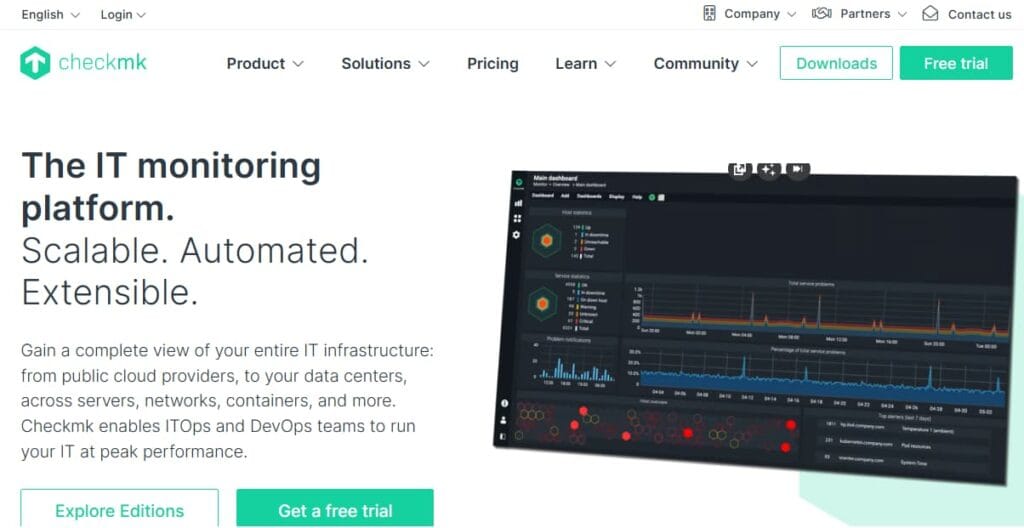
Best for: Organizations that want open-source monitoring flexibility with a more modern interface and faster initial setup.
Known for
Checkmk builds on Nagios’ plugin ecosystem but delivers a significantly improved setup experience, auto-discovery, and dashboard quality. Its Raw edition is free and open-source; its Enterprise edition adds distributed monitoring, SLA reporting, and business intelligence dashboards.
Key features
- Compatible with the Nagios plugin ecosystem (5,000+ plugins)
- Modern web interface; faster to configure than raw Nagios or Zabbix
- Auto-discovery for network devices, services, and cloud workloads
- Free Raw edition with a full Enterprise edition for additional scale and business features
- Active development roadmap and community
Pros
- Nagios plugin compatibility without Nagios’ dated interface
- Faster initial configuration than Zabbix; more auto-discovery out of the box
- Free Raw edition covers most mid-sized monitoring requirements
- Eliminates SolarWinds’ per-node, per-module pricing structure entirely
Cons
- Enterprise edition licensing costs approach commercial alternatives at larger scale
- Requires internal Linux expertise for deployment and management
Pricing
- Checkmk Raw: Free and open-source.
- Cloud: starts at $290/month and increases based on services to monitor
Checkmk vs SolarWinds
Choose Checkmk over SolarWinds when your priority is lower self-hosted monitoring cost with more control over deployment. Checkmk offers a free Community edition and paid self-hosted plans starting at $275/month for about 3,000 services, while SolarWinds positions Observability Self-Hosted as a broader full-stack observability platform starting at $7.42 per node per month. That makes Checkmk the better fit for teams focused mainly on cost-efficient infrastructure monitoring, while SolarWinds is the stronger fit for teams that want a more packaged hybrid observability platform.
9. New Relic
Best for: DevOps and engineering teams that want full-stack observability covering APM, infrastructure monitoring, logs, browser monitoring, and mobile real user monitoring in one managed platform.
Known for
New Relic is known for full-stack observability across applications, infrastructure, logs, traces, and digital experience monitoring, with a strong focus on unified telemetry and AI-powered analysis in one platform.
Key features
- 30+ capabilities including APM, infrastructure monitoring, logs, RUM, and synthetic monitoring
- Transparent consumption-based pricing with 100 GB free monthly ingest
- Unlimited hosts and CPUs at no extra charge
- Session replay and mobile RUM for full user experience visibility
- AI-driven anomaly detection and alerting
Pros
- Broad observability coverage in one managed platform
- 100 GB free ingest per month; no host-based charges
- Transparent consumption pricing without module purchasing
- Mature enterprise platform with strong ecosystem support
Cons
- User-based pricing adds cost as the team grows (Core users: $49/user/month; Full platform: $349/user/year)
- Costs rise beyond the free tier with telemetry volume
- No self-hosted deployment
- Learning curve for teams coming from network-monitoring-focused tools like SolarWinds
Pricing
- Free: 100 GB/month ingest
- Standard ingest: $0.40/GB
- Core users: $49/user/month
- Pro full platform: $349/user/year
New Relic vs SolarWinds
Choose New Relic over SolarWinds when your team wants a mature SaaS observability platform with unified telemetry across applications, infrastructure, logs, traces, and digital experience monitoring and is comfortable with a usage-based commercial model. New Relic bills by data ingest with 100 GB/month free and also uses paid user tiers, while SolarWinds positions Observability Self-Hosted as a full-stack hybrid observability platform starting at $7.42 per node per month. That makes New Relic the stronger fit for teams prioritizing SaaS breadth and AI-assisted observability, while SolarWinds is the better fit for teams that want self-hosted control and a lower public entry price.
10. Dynatrace
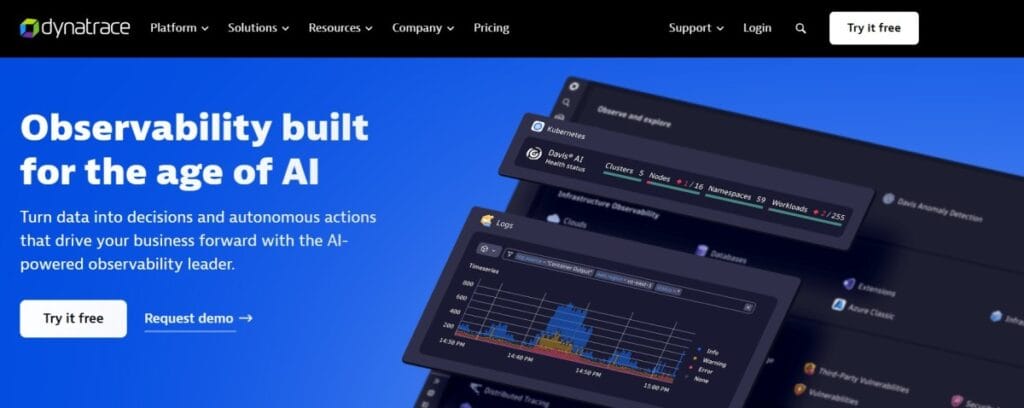
Best for: Enterprise teams that want AI-assisted root cause analysis, topology-aware Kubernetes monitoring, and deep full-stack observability across complex distributed environments.
Known for
Dynatrace is known for enterprise-grade observability with Davis AI for automated root cause analysis and Smartscape for topology mapping. Often evaluated by organizations that want deep automation and broad platform coverage at scale. It is a common enterprise destination for teams that have outgrown SolarWinds’ on-premises model and need AI-driven incident management alongside application and infrastructure visibility.
Key features
- Full-stack application and infrastructure observability
- Davis AI for automated root cause analysis: reduces alert noise and isolates the failing layer
- Kubernetes platform monitoring with Smartscape topology mapping
- Distributed tracing and log analytics
- Digital experience and security add-ons
- Grail-backed long-term data retention (up to 10 years with add-on)
Pros
- Best-in-class Kubernetes topology mapping and automated root cause analysis
- Davis AI significantly reduces MTTR in complex, multi-service incidents
- Broad platform coverage across infrastructure, APM, logs, and digital experience
- Mature enterprise platform with strong compliance options
Cons
- Expensive for smaller teams; pricing model involves per-host and per-GiB charges
- Complex configuration; steep learning curve
- Limited self-hosted option; primarily SaaS
- Grail long-term retention and security add-ons carry additional cost
Pricing
- Infrastructure Monitoring: $29/month per host
- Full-Stack Monitoring: $58/month per 8 GiB host
- Logs ingest and process: $0.20/GiB
- Grail DPS add-on for extended retention: additional cost
Dynatrace vs SolarWinds
Choose Dynatrace over SolarWinds if you want deeper enterprise observability with AI-assisted root cause analysis built into the platform. SolarWinds handles uptime monitoring and SNMP-based network metrics well, but Dynatrace is built around full-stack observability with automated dependency mapping that goes significantly further, making it the stronger fit when automated incident diagnosis across complex environments is the priority.
- Zabbix: Best when the main goal is cutting software spend as much as possible, because Zabbix is open source and says there are no license fees or per-device charges.
- Checkmk: A strong fit when you want lower self-hosted cost without giving up a cleaner upgrade path, since Checkmk offers a free Community edition and paid plans starting from a defined monthly tier.
- Nagios: Works well for teams that still want a commercial product, but with a simpler node-based model that is usually easier to understand than a broader SolarWinds rollout.
- CubeAPM: Best when you want self-hosting without taking on all the operational burden yourself, because CubeAPM is positioned as vendor-managed in your own environment.
- Zabbix: Best when maximum on-prem control matters more than convenience, especially for teams comfortable owning setup, tuning, and maintenance themselves.
- Checkmk: A good middle ground for teams that want self-hosted monitoring with a free edition today and a clearer paid path if they need to scale later.
- CubeAPM: Best when the team wants one platform for logs, metrics, traces, APM, and infrastructure monitoring without splitting costs across multiple product areas.
- Datadog: Strong fit for teams that want mature SaaS observability across infrastructure, APM, logs, and more, even if the pricing model gets heavier as usage grows.
- New Relic: Strong fit for teams that want broad full-stack observability with unified telemetry and a large SaaS platform footprint.
- ManageEngine OpManager: Best when the team mostly wants a more straightforward commercial replacement for SolarWinds focused on infrastructure and device monitoring.
- PRTG: Best when faster rollout and easier day-one setup matter more than building out a broader observability stack.
- Checkmk: A strong option for teams that still care mainly about infrastructure monitoring and want to keep deployment self-hosted and cost-efficient.
- Datadog: Best for teams that want a mature SaaS platform built around cloud-scale infrastructure, APM, logs, and developer workflows.
- New Relic: Best for teams that want broad SaaS observability with strong application, infrastructure, and digital experience coverage in one platform.
- Dynatrace: Best for teams that want enterprise-grade SaaS observability with deeper automation and AI-driven analysis.
- Dynatrace: Best when the environment is large and complex enough that automation, AI-assisted analysis, and enterprise-scale observability matter more than raw entry price.
- Datadog: Strong fit for large distributed environments that need broad integrations, cloud-native coverage, and mature SaaS tooling.
- CubeAPM: A strong option for enterprises that want full observability with more deployment control and a simpler cost path than many large SaaS platforms.
- CubeAPM: Best when the team wants observability data to stay inside its own environment while still using a vendor-managed platform model.
- Zabbix: Best when the team wants fully self-managed, on-prem monitoring with no dependency on SaaS data handling.
- Checkmk: A strong fit for teams that want self-hosted deployment and tighter control over where monitoring data lives.
A note on migration timelines
One factor consistently underestimated when leaving SolarWinds is migration complexity. According to Uptrace’s 2025 analysis, small environment migrations typically take four to six weeks, while enterprise migrations average three to six months. Open-source tools like Zabbix and Nagios require the most setup time but offer the greatest flexibility post-migration. SaaS tools like Auvik, Datadog, and LogicMonitor reduce implementation overhead through auto-discovery and managed infrastructure.
Running SolarWinds and your replacement in parallel during a validation window is strongly recommended regardless of environment size. Alerting coverage and device discovery need to be verified in the replacement before SolarWinds is decommissioned.
Migration timeline benchmarks (Source: Uptrace, 2025):
- Small organizations: 2 to 4 weeks
- Enterprise environments: 3 to 6 months
Conclusion
The SolarWinds alternatives landscape in 2026 is robust and well-matched to the different reasons teams are leaving the platform. For teams with a pure pricing problem, Zabbix and Nagios Core eliminate licensing costs entirely, while ManageEngine OpManager and Checkmk offer structured commercial support at a fraction of SolarWinds’ cost. For teams that need full application observability alongside network monitoring, CubeAPM, New Relic, and Datadog cover APM, distributed tracing, and infrastructure metrics in one platform, removing the need for a second tool alongside SolarWinds. For teams with data residency or compliance requirements, CubeAPM’s vendor-managed self-hosted model and Zabbix’s on-premises architecture offer the clearest path.
The key question to answer before choosing is whether you are replacing SolarWinds’ network monitoring layer, its server monitoring layer, or both and whether your next toolset also needs to cover applications, Kubernetes workloads, and cloud infrastructure that SolarWinds cannot reach. That scope decision narrows the field considerably and points to materially different tools for different teams.
FAQs
1. What is the best free alternative to SolarWinds?
Zabbix is the most widely recommended free open-source alternative for organizations that need enterprise-grade network and server monitoring without licensing costs. Nagios Core and Checkmk Raw are also free. Zabbix has no per-device or per-feature fees, scales to large environments, and has an active development community. The tradeoff is a steeper setup curve compared to commercial alternatives.
2. What happened to SolarWinds in 2020?
In December 2020, security researchers discovered that SolarWinds Orion software updates had been compromised by state-sponsored attackers in the SUNBURST supply-chain attack. Malicious code embedded in legitimate Orion updates gave attackers remote access to thousands of organizations, including U.S. government agencies and major corporations. The breach raised lasting concerns about software supply-chain risk and accelerated many organizations’ search for alternatives.
3. Is PRTG a good SolarWinds alternative?
PRTG is a reasonable alternative for small to mid-sized businesses that need quick deployment and a Windows-friendly interface. The important caveat is that PRTG is now owned by Turn/River Capital, the same private equity firm that acquired SolarWinds and has driven price increases across both products. Teams prioritizing vendor independence from that ownership structure may prefer alternatives outside the Turn/River portfolio.
4. What is the best SolarWinds alternative for APM?
For application performance monitoring specifically, CubeAPM, Datadog, and New Relic are the most commonly evaluated alternatives. Datadog and New Relic are the most feature-complete but carry higher price points at scale. CubeAPM is OpenTelemetry-native with a flat per-GB price and no host-based or module-based charges, making it a strong fit for teams consolidating network monitoring and APM into one tool.
5. How long does it take to migrate from SolarWinds?
Migration timelines vary by environment size. Small environments with fewer than 100 devices typically complete a migration in four to six weeks. Mid-market environments take six to twelve weeks. Large enterprise deployments with 500+ devices and complex module dependencies typically require three to six months. Running both platforms in parallel during a validation window is strongly recommended.
6. Can Zabbix fully replace SolarWinds?
For network and server monitoring use cases (SNMP, ICMP, IPMI), Zabbix can replace SolarWinds comprehensively at no licensing cost. For ITSM ticketing, Zabbix would need to be paired with a separate service desk tool. For deep APM and distributed tracing, a dedicated tool like CubeAPM, Datadog, or New Relic is needed alongside Zabbix. Most SolarWinds deployments span multiple capabilities, and a complete replacement typically involves two or three specialized tools rather than one.