










Sematext is a full-stack observability platform for logs, infrastructure monitoring, service monitoring, distributed tracing, real user monitoring, synthetic monitoring, dashboards, alerts, and integrations. It is built for DevOps, SRE, engineering, platform, and operations teams that need visibility across applications, infrastructure, Kubernetes, containers, websites, APIs, and user experience.
Sematext pricing matters because the platform is modular. Teams do not buy one simple flat observability bundle. They configure separate Apps for Logs, Monitoring, Experience, Synthetics, and related capabilities, and each App can have its own plan, usage volume, and retention settings.
In this Sematext pricing and review, we’ll break down Sematext pricing, what drives cost, how much Sematext can cost in real production scenarios, what users say in public reviews, and how Sematext compares with alternatives such as CubeAPM, Datadog, New Relic, Dynatrace, Grafana Cloud, and Elastic Observability.
What Is Sematext?
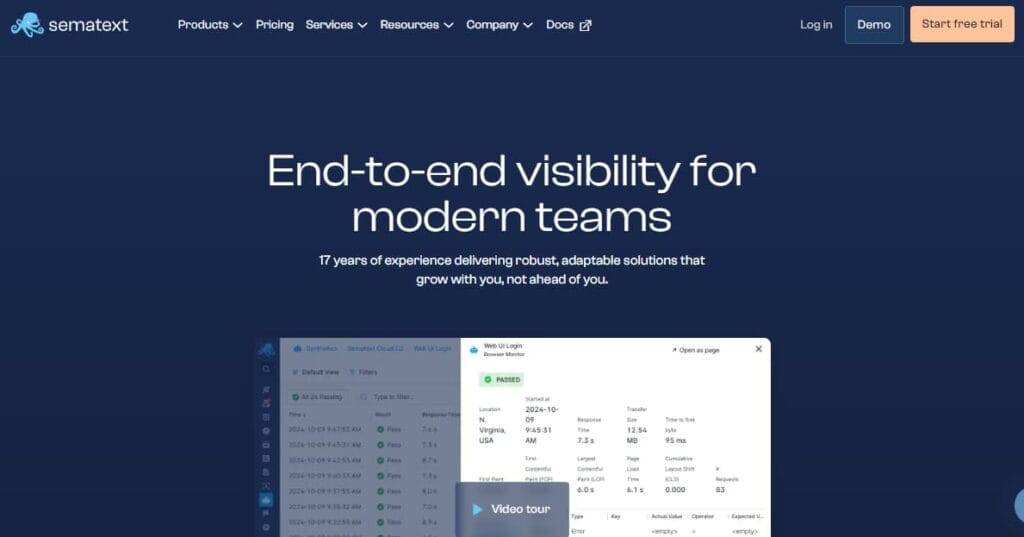
Sematext Cloud is an observability platform that combines log management, infrastructure monitoring, real user monitoring, synthetic monitoring, distributed tracing, service monitoring, dashboards, alerts, and integrations in one platform. G2 describes Sematext Cloud as a unified platform for infrastructure monitoring, APM, log management, real user monitoring, and synthetic monitoring.
The platform is useful for teams that need to monitor application health, infrastructure performance, Kubernetes clusters, containers, logs, API availability, website uptime, browser performance, and user experience.
Sematext is especially useful for teams that want modular observability pricing. Instead of buying one large enterprise plan, teams can create separate Apps for different products and configure each App by plan, volume, and retention. Sematext’s pricing guide says each App is isolated and standalone, and each App can have different attributes that affect cost.
Supported Platforms, Integrations, and Data Sources
Sematext supports modern infrastructure, cloud-native systems, application logs, containers, Kubernetes, real user monitoring, synthetic monitoring, and distributed tracing. Its documentation says Sematext supports more than 100 integrations for collecting metrics and logs from systems and applications.
| Area | Sematext support |
| Logs | Log monitoring, search, analysis, pipelines, alerting |
| Infrastructure | Servers, containers, Kubernetes, processes, inventory, databases |
| Tracing | Distributed tracing, OpenTelemetry support, trace explorer, service map |
| Experience | Real user monitoring, page views, frontend performance, user experience |
| Synthetics | HTTP monitors, browser monitors, uptime checks, API checks, SSL monitoring |
Sematext also supports Kubernetes monitoring and log collection. Its Kubernetes documentation explains that Sematext can collect Kubernetes logs and events and help teams troubleshoot cluster issues.
Key Features of Sematext
Sematext Logs helps teams collect, search, analyze, and alert on logs from applications, servers, containers, Kubernetes, and cloud services. It is useful for troubleshooting errors, finding production issues, correlating logs with metrics, and reducing noisy log data through pipelines.
Sematext’s pricing guide says Logs Apps are priced mainly around daily log volume, retained data, retention, and plan selection. It also states that raw log messages carry a fixed received-data charge of $0.10/GB, while storage prices vary across plans, daily log volumes, and retention periods.
Sematext Infrastructure Monitoring helps teams track servers, containers, Kubernetes clusters, processes, databases, and system-level metrics. It is useful for monitoring CPU, memory, disk, network, container health, host performance, and workload behavior.
Sematext’s pricing guide says Infrastructure Monitoring Apps depend on plan, number of hosts and containers, and data retention duration.
Sematext Service Monitoring focuses on service-level performance metrics. It helps teams monitor services and dependencies in real time. Sematext’s public pricing page lists Service Monitoring from $8.64/month on monthly billing.
Sematext Tracing helps teams follow requests across services and identify bottlenecks in distributed applications. It supports OpenTelemetry SDKs across languages including Java, Python, Node.js, Go, .NET, PHP, Ruby, browser JavaScript, Android, and iOS/Swift according to Sematext’s documentation navigation.
Tracing is useful for microservices, API-heavy applications, and cloud-native systems where teams need to understand latency, errors, slow dependencies, and request flow across services.
Sematext Experience is the real user monitoring product. It helps teams monitor frontend performance, page views, user experience, Web Vitals, browser timing, and real-user behavior. Sematext’s pricing guide says Experience Apps depend on plan, number of page views, and retention.
Sematext Synthetics monitors website uptime, APIs, SSL certificates, and browser-based user journeys. Sematext’s pricing page lists Synthetics from $2 per monitor/month on monthly billing and $1.80 per monitor/month on annual billing.
Sematext supports Kubernetes and container monitoring, making it useful for cloud-native teams. Sematext’s docs say container monitoring uses a base price and per-container price, where the base price includes monitoring of a container host and free monitoring of up to a plan-specific number of containers. Per-container pricing applies only when the container count exceeds the included allowance.
Sematext Logs Pipelines help teams reduce log noise before logs are stored. Teams can drop redundant logs, filter unnecessary fields, mask sensitive data, and reduce storage costs.
This matters because Sematext’s docs separate received log pricing from stored log pricing. Raw logs have a received-data charge, while storage varies by plan, daily volume, and retention. Logs Pipelines can reduce stored volume before storage charges apply.
Sematext includes dashboards, alerts, notifications, and reporting features. Teams can create dashboards for infrastructure, logs, traces, uptime, and user experience. Its Kubernetes page also describes alerting on Kubernetes events such as failed, unknown, pending, or CrashLoopBackOff pods, missing replicas, node load, CPU limits, and etcd leadership changes.
Sematext’s App model is one of its most important pricing features. Teams can create multiple Apps, and every App can have its own plan, volume, and retention settings. Sematext says this allows teams to customize costs individually and control overall spend.
Sematext Pricing in 2026
Sematext pricing is modular. Teams pay based on the Sematext products they use and the configuration of each App.
Sematext’s public pricing page lists the following monthly starting prices:
| Product | Public starting price | Billing basis |
| Logs | From $5/month | Log volume, plan, retention |
| Infra Monitoring | From $2.80/month | Hosts, containers, plan, retention |
| Service Monitoring | From $8.64/month | Agents, plan, retention |
| Tracing | From $19/month | Tracing App usage, plan, retention |
| Experience | From $9/month | Page views, plan, retention |
| Synthetics | From $2 per monitor/month | HTTP and browser monitors |
Sematext also offers annual pricing with a 10% discount. On annual billing, the pricing page shows lower starting prices such as $4.50/month for Logs, $2.52/month for Monitoring, $17.10/month for Tracing, $8.10/month for Experience, and $1.80 per synthetic monitor/month.
Is There a Free Trial in Sematext?
Yes. Sematext offers a 14-day free trial. The pricing page says the trial lasts 14 days and requires no credit card.
Sematext’s pricing guide says the trial enables Pro features, charges $0 during the trial, and lets buyers view post-trial estimates in the Plans & Billing section.
How Sematext Measures Pricing
Sematext pricing is App-scoped. Teams create Apps for different products, and each App can have different pricing settings.
Sematext pricing depends on:
| App type | Main pricing drivers |
| Logs Apps | Plan, daily log volume, retention |
| Infrastructure Monitoring Apps | Plan, hosts, containers, retention |
| Service Monitoring Apps | Plan, agents, retention |
| Experience Apps | Plan, page views, retention |
| Synthetics Apps | Plan, HTTP monitors, browser monitors, retention |
Sematext says App attributes such as plan and retention can be changed up or down at any time, and changes take effect right away.
Important Sematext Pricing Details Buyers Should Know
Sematext’s pricing guide says Logs Apps do not charge based on the number of hosts shipping logs. Logs pricing is based on daily log volume.
Sematext says raw log messages carry a fixed received-data charge of $0.10/GB, regardless of plan, daily volume, or retention. Storage prices vary by plan, daily volume, and retention.
Container monitoring is based on a base price plus per-container pricing when container count exceeds the included allowance for the selected plan.
Sematext’s pricing guide says Audit Trail adds 2% to the monthly bill on annual plans and 3% on monthly plans when enabled.
Sematext’s pricing guide says teams can invite as many team members as they want at no additional cost.
What Does Sematext Really Cost?
Disclaimer: The scenarios below are directional editorial estimates, not official Sematext quotes. Sematext pricing can change based on plan selection, daily log volume, received log volume, stored log volume, retention, hosts, containers, tracing usage, RUM page views, synthetic monitors, Audit Trail, support needs, annual billing, and custom plans. Buyers should confirm final pricing directly in Sematext’s calculator or with Sematext sales before purchase.
Sematext is not priced like a single per-host APM tool. It is also not priced only by GB ingested. The final bill depends on how many Sematext Apps a team enables and how each App is configured.
Sematext’s public pricing page lists starting prices for Logs, Infra Monitoring, Service Monitoring, Tracing, Experience, and Synthetics. Logs start at $5/month, Infra Monitoring starts at $2.80/month, Service Monitoring starts at $8.64/month, Tracing starts at $19/month, Experience starts at $9/month, and Synthetics starts at $2 per monitor/month. Sematext also offers a 10% annual discount.
The most important detail for these scenarios is logs. Sematext’s pricing guide says raw log messages have a fixed received-data charge of $0.10/GB, while stored log pricing varies by plan, daily volume, and retention.
Pricing Assumptions Used in These Scenarios
These scenarios use moderate production assumptions. They do not use the cheapest possible configuration, and they do not assume every feature is maxed out.
| Team profile | Infrastructure | Logs | Traces/APM | RUM | Synthetics |
| Small team | 10 hosts | 720 GB/month | 360 GB/month | 5,000 sessions/month | 50,000 API + 2,000 browser runs/month |
| Growing team | 50 hosts | 3,600 GB/month | 1,800 GB/month | 50,000 sessions/month | 500,000 API + 20,000 browser runs/month |
| Mid-market team | 250 hosts | 18,000 GB/month | 9,000 GB/month | 200,000 sessions/month | 2,000,000 API + 80,000 browser runs/month |
For Synthetics, Sematext publicly states that pay-as-you-go pricing starts at $2 per API/HTTP monitor and $7 per browser monitor. Sematext also says each monitor includes up to 200,000 API runs and 15,000 browser runs per month, with monthly plans available for larger usage.
Scenario 1: Small Team, About 10 Hosts
Situation
A small production team runs around 10 hosts and produces about 1.1 TB/month of total telemetry. This includes about 720 GB/month of logs, 360 GB/month of traces/APM data, and light infrastructure metrics.
The team also runs basic real user monitoring and synthetic monitoring for important APIs and browser flows.
Estimated Sematext Configuration
| Component | Assumption |
| Logs | 720 GB/month, about 24 GB/day |
| Infra Monitoring | 10 hosts |
| Tracing | Light tracing for key services |
| Experience/RUM | 5,000 user sessions/month |
| Synthetics | 1 API monitor and 1 browser monitor |
| Retention | Short to moderate retention |
| Plan posture | Paid production setup, not bare-minimum entry pricing |
Estimated Monthly Cost
| Component | Calculation approach | Estimated monthly cost |
| Logs | $72 raw received log charge + stored log cost and retention | $220 |
| Infra Monitoring | 10 hosts with paid monitoring configuration | $60 |
| Tracing | Light tracing usage above starting price | $80 |
| Experience/RUM | Low RUM usage above entry plan | $30 |
| Synthetics | 1 API monitor + 1 browser monitor, light usage | $30 |
| Estimated total | Moderate small-team Sematext setup | $420/month |
CubeAPM Cost Comparison
| Platform | Pricing basis | Estimated monthly cost |
| Sematext | Modular logs, monitoring, tracing, RUM, synthetics | $420/month |
| CubeAPM | 1.1 TB/month telemetry estimate | $522/month |
| Difference | Sematext lower in this small scenario | $102/month lower |
What This Scenario Shows
For a small team, Sematext can be cheaper than CubeAPM if the team keeps usage moderate, retention reasonable, and synthetic monitoring limited. This is where Sematext’s modular pricing can work well.
The main caution is that the $5/month Logs starting price is not a realistic production estimate for a team sending 720 GB/month of logs. The raw received-log charge alone is about $72/month before stored-log pricing and retention are included.
Scenario 2: Growing Team, About 50 Hosts
Situation
A growing SaaS or platform team runs around 50 hosts and produces about 5.4 TB/month of telemetry. This includes about 3,600 GB/month of logs, 1,800 GB/month of traces/APM data, and light metrics.
The team also monitors user experience and runs synthetic checks for production APIs and browser journeys.
Estimated Sematext Configuration
| Component | Assumption |
| Logs | 3,600 GB/month, about 120 GB/day |
| Infra Monitoring | 50 hosts |
| Tracing | Moderate tracing across key services |
| Experience/RUM | 50,000 user sessions/month |
| Synthetics | 3 API monitors and 2 browser monitors |
| Retention | Moderate production retention |
| Plan posture | Practical growing-team setup with broader coverage |
Estimated Monthly Cost
| Component | Calculation approach | Estimated monthly cost |
| Logs | $360 raw received log charge + stored log cost and retention | $1,350 |
| Infra Monitoring | 50 hosts with paid monitoring configuration | $300 |
| Tracing | Moderate tracing usage | $350 |
| Experience/RUM | 50,000 sessions/page-view equivalent planning | $120 |
| Synthetics | API and browser monitor mix | $180 |
| Estimated total | Moderate growing-team Sematext setup | $2,300/month |
CubeAPM Cost Comparison
| Platform | Pricing basis | Estimated monthly cost |
| Sematext | Modular logs, monitoring, tracing, RUM, synthetics | $2,300/month |
| CubeAPM | 5.4 TB/month telemetry estimate | $919/month |
| Estimated savings with CubeAPM | Difference vs Sematext estimate | $1,381/month |
| Percentage savings | Based on Sematext estimate | ~60% lower |
What This Scenario Shows
For a growing team, Sematext becomes more expensive mainly because log volume increases. At 3,600 GB/month of logs, the raw received-log charge is about $360/month before stored-log pricing, retention, tracing, infrastructure monitoring, RUM, and synthetics are added.
This does not mean Sematext is overpriced. It means buyers need to model logs carefully. Sematext can still be attractive for teams that want strong log management, app-scoped retention, synthetics, RUM, and tracing in one platform.
Scenario 3: Mid-Market Team, About 250 Hosts
Situation
A mid-market team runs around 250 hosts and produces about 27 TB/month of telemetry. This includes about 18,000 GB/month of logs, 9,000 GB/month of traces/APM data, and light infrastructure metrics.
The team likely runs multiple production services, Kubernetes clusters, internal tools, customer-facing APIs, frontend applications, and synthetic checks for critical workflows.
Estimated Sematext Configuration
| Component | Assumption |
| Logs | 18,000 GB/month, about 600 GB/day |
| Infra Monitoring | 250 hosts |
| Tracing | Broad tracing across production services |
| Experience/RUM | 200,000 user sessions/month |
| Synthetics | 10 API monitors and 6 browser monitors |
| Retention | Moderate to longer production retention |
| Plan posture | Larger production setup, but not worst-case enterprise usage |
Estimated Monthly Cost
| Component | Calculation approach | Estimated monthly cost |
| Logs | $1,800 raw received log charge + stored log cost and retention | $7,200 |
| Infra Monitoring | 250 hosts with paid monitoring configuration | $1,400 |
| Tracing | Higher tracing usage across production services | $1,400 |
| Experience/RUM | 200,000 sessions/page-view equivalent planning | $350 |
| Synthetics | Larger API and browser monitor footprint | $650 |
| Estimated total | Moderate mid-market Sematext setup | $11,000/month |
CubeAPM Cost Comparison
| Platform | Pricing basis | Estimated monthly cost |
| Sematext | Modular logs, monitoring, tracing, RUM, synthetics | $11,000/month |
| CubeAPM | 27 TB/month telemetry estimate | $4,594/month |
| Estimated savings with CubeAPM | Difference vs Sematext estimate | $6,406/month |
| Percentage savings | Based on Sematext estimate | ~58% lower |
What This Scenario Shows
At mid-market scale, Sematext cost is mostly driven by logs, retention, and tracing. A team sending 18,000 GB/month of logs would already have about $1,800/month in raw received-log charges before stored-log pricing and retention are added.
This is where Sematext buyers should use Logs Pipelines aggressively, reduce noisy logs, keep retention practical, and separate Apps by environment or team. Sematext can still be a strong fit for teams that value modular control, but CubeAPM may be easier to forecast for teams that want predictable per-GB observability pricing.
Summary: Sematext vs CubeAPM Estimated Monthly Cost
| Team profile | Sematext estimate | CubeAPM estimate | Estimated monthly savings with CubeAPM |
| Small team | $420/month | $522/month | Sematext is ~$102/month lower |
| Growing team | $2,300/month | $919/month | CubeAPM saves ~$1,381/month |
| Mid-market team | $11,000/month | $4,594/month | CubeAPM saves ~$6,406/month |
What This Cost Comparison Shows
Sematext can be very cost-effective for small teams that use a limited number of Apps, short retention, and a modest synthetic monitoring footprint. In that case, its modular pricing can keep the bill lower than a full-stack ingest-based benchmark.
As usage grows, Sematext becomes more sensitive to logs, retention, tracing, hosts, and synthetic monitor configuration. The platform is transparent, but buyers need to model each App separately instead of assuming the public starting prices represent production cost.
CubeAPM becomes more attractive in the growing and mid-market scenarios because the cost is easier to estimate from telemetry volume. Sematext may still be the better fit for teams that want modular Apps, strong log management, flexible retention, and built-in synthetics/RUM controls.
What Drives Sematext Costs?
Log volume is one of the biggest Sematext cost drivers. Sematext Logs pricing depends on daily log volume, received data, stored data, retention, and plan. Teams with high log volume should use pipelines to drop noisy logs, mask fields, reduce storage, and avoid sending unnecessary data.
Retention affects the cost of logs, monitoring, Experience, Synthetics, and other Apps. Longer retention gives teams more historical visibility, but it also increases cost. Sematext says Apps can have different retention settings, which helps teams use shorter retention for lower-value environments and longer retention for production or compliance workloads.
Infrastructure Monitoring cost depends on hosts, containers, plan, and retention. Container monitoring can add cost when the number of containers per host exceeds the included allowance for the selected plan.
Tracing cost depends on the Tracing App configuration, trace volume, retention, and sampling. Teams with high-volume microservices should model trace sampling and OpenTelemetry span volume carefully.
Sematext Experience pricing depends on page views, plan, and retention. Teams with high-traffic websites or SaaS applications should estimate page views before enabling real user monitoring broadly.
Synthetics pricing depends on HTTP monitors, browser monitors, plan, and retention. Browser-based user journeys usually cost more than simple uptime checks, so teams should choose synthetic coverage based on critical workflows.
Sematext Audit Trail adds 2% to the monthly bill on annual plans and 3% on monthly plans when enabled.
Sematext includes live chat and email support across plans. Standard and Pro plans include phone support and a dedicated account manager. Larger teams can contact Sematext for custom plans, volume discounts, and cost optimization.
Sematext User Reviews
Sematext has positive review visibility across G2, Capterra, TrustRadius, and Gartner Peer Insights.
| Review source | Public rating | Review count |
| G2 | 4.7/5 | 38 reviews |
| Capterra | 4.8/5 | 29 reviews |
| TrustRadius | 9/10 | 2 reviews and ratings |
| Gartner Peer Insights | 4.0/5 | 2 ratings |
G2 lists Sematext Cloud at 4.7/5 from 38 reviews. Its review summary says users praise the user-friendly interface, responsive support, ease of setup, and monitoring capabilities, while some users say pricing can be high for extensive usage.
Capterra lists Sematext Cloud at 4.8/5 from 29 reviews and describes it as an all-in-one observability solution with app-scoped pricing based on plan, volume, and retention.
TrustRadius lists Sematext Cloud at 9/10 from 2 reviews and ratings.
Gartner Peer Insights lists Sematext Cloud at 4.0/5 from 2 ratings. Gartner’s page also notes user comments around a simple interface, useful logs, many features, complexity, and a smaller ecosystem.
What Users Like
Users often praise Sematext for being easy to set up. This is useful for teams that want logs, monitoring, and synthetics without spending weeks configuring a complex observability platform.
Sematext is known for log monitoring and log analysis. G2 describes Sematext Logs as a unified log management solution for real-time log analysis, available in cloud or on-premises deployment.
Public review summaries mention responsive customer support. This matters because observability tools often require help with agents, pipelines, alerts, dashboards, and cost tuning.
Users like that Sematext combines logs, monitoring, synthetics, real user monitoring, tracing, dashboards, and alerts in one platform. This can reduce tool sprawl for small and mid-sized teams.
Sematext’s App model, cost calculator, plan settings, and retention controls help teams manage spend. Buyers can tune Apps individually instead of applying one pricing model to every workload.
What Users Criticize
Disclaimer: These points reflect public user-review themes and buyer concerns. They should not be treated as universal Sematext limitations.
G2’s review summary notes that some users find Sematext pricing higher for extensive usage. This is common for observability tools where logs, retention, and monitoring scope grow over time.
Sematext is transparent, but it is also modular. Teams need to understand Apps, daily log volume, retention, hosts, containers, page views, monitors, and Audit Trail. Incorrect assumptions can produce higher-than-expected costs.
Gartner Peer Insights includes a review theme that Sematext can become complex, while also noting that it provides many useful features.
Gartner Peer Insights includes a user dislike around a smaller ecosystem and limited dashboard customization. Larger enterprises should validate integrations, governance, dashboard needs, and support requirements during the trial.
Sematext Alternatives: How It Compares to Competitors
Sematext vs CubeAPM
Sematext is a modular observability platform with logs, monitoring, tracing, RUM, and synthetics. CubeAPM is better positioned for teams that want predictable per-GB observability pricing and do not want to model each telemetry product separately.
| Category | Sematext | CubeAPM |
| Pricing model | Modular by App, volume, hosts, retention, monitors | Per-GB ingestion model |
| Cost predictability | Flexible but requires modeling | Easier to estimate from GB volume |
| Logs | Strong log management and pipelines | Native logs |
| Traces | OpenTelemetry tracing | OpenTelemetry-native tracing |
| Best for | Teams wanting modular observability pricing | Teams wanting predictable full-stack pricing |
Choose Sematext if you want modular pricing, strong log management, and separate control over each observability App. Choose CubeAPM if you want simpler per-GB pricing across telemetry volume.
Sematext vs Datadog
Datadog is a larger SaaS observability and security platform with infrastructure monitoring, APM, logs, RUM, synthetics, cloud monitoring, network monitoring, and security products. Datadog’s pricing list shows modular charges such as Infrastructure Pro at $15 per host/month annually, Infrastructure Enterprise at $23 per host/month annually, container monitoring at $1 per container/month, and custom metrics pricing.
| Category | Sematext | Datadog |
| Pricing model | Modular Apps, volume, hosts, retention, monitors | Modular by host, logs, APM, sessions, tests, metrics |
| Entry pricing | Lower public starting prices | Higher starting points across many products |
| Logs | Strong log management | Strong log management |
| Enterprise ecosystem | Smaller | Larger |
| Best for | Cost-conscious teams wanting modular observability | Enterprises wanting broad SaaS observability and security |
Datadog is stronger for large enterprise ecosystems and deep product breadth. Sematext may be better for teams that want lower entry costs and simpler App-level cost controls.
Sematext vs New Relic
New Relic uses a data-ingest and user-based pricing model. New Relic’s docs say it bills data by GB ingested, provides 100 GB/month free, and counts billable users as a billing factor.
| Category | Sematext | New Relic |
| Pricing model | App-based pricing by product and usage | Data ingest plus user pricing |
| Free data allowance | Trial and low starting prices | 100 GB/month free |
| Logs | App-based log pricing | Ingest-based pricing |
| User pricing | No added cost for team members | Billable user types |
| Best for | Teams wanting product-by-product control | Teams wanting ingest-based SaaS observability |
New Relic may be easier to model by data volume. Sematext may be better when teams want to tune logs, monitoring, RUM, and synthetics separately.
Sematext vs Dynatrace
Dynatrace is an enterprise observability platform with automated discovery, AI-assisted root cause analysis, APM, infrastructure monitoring, log analytics, digital experience monitoring, and Kubernetes monitoring. Dynatrace lists Foundation & Discovery at $7/host/month, Infrastructure Monitoring at $29/host/month, and Full-Stack Monitoring at $58/month per 8 GiB host, with hourly billing underneath those rates.
| Category | Sematext | Dynatrace |
| Pricing model | Modular and App-scoped | Usage-based enterprise pricing |
| Infrastructure pricing | Starts at $2.80/month | Starts at $7/host/month for Foundation |
| Automation | Monitoring, alerting, dashboards | Strong AI-assisted automation |
| Enterprise positioning | Flexible for small and mid-sized teams | Enterprise-heavy |
| Best for | Teams wanting transparent modular pricing | Enterprises needing automated root cause analysis |
Dynatrace is stronger for deep enterprise automation and AI-assisted analysis. Sematext is often easier for teams that want transparent modular observability without enterprise complexity.
Sematext vs Grafana Cloud
Grafana Cloud is strong for teams that want dashboards, Prometheus metrics, Loki logs, Tempo traces, k6 performance testing, and open-source-aligned observability. Grafana Cloud pricing lists a Free plan, a Pro plan from $19/month plus usage, and Enterprise starting at a $25,000/year spend commit.
| Category | Sematext | Grafana Cloud |
| Pricing model | App-based pricing | Usage-based metrics, logs, traces, profiles, k6 |
| Dashboards | Built-in dashboards | Very strong dashboard ecosystem |
| Logs | Sematext Logs | Grafana Loki |
| Open-source alignment | Moderate | Strong |
| Best for | Managed logs, monitoring, RUM, synthetics | Grafana-native teams |
Grafana Cloud is stronger for teams already committed to Grafana, Prometheus, Loki, and Tempo. Sematext is simpler for teams that want managed logs, monitoring, synthetics, RUM, and tracing in one product family.
Sematext vs Elastic Observability
Elastic Observability is built around Elasticsearch and the Elastic Stack. It is strong for teams already using Elastic for search, logs, security, or analytics. Elastic’s pricing page describes flexible Hosted, Serverless, and Self-managed options for Search, Observability, and Security.
| Category | Sematext | Elastic Observability |
| Pricing model | App-scoped SaaS pricing | Hosted, Serverless, or Self-managed resource-based pricing |
| Logs | Managed Sematext Logs | Elasticsearch-based logs |
| Setup complexity | Lower for managed observability workflows | Can be higher depending on deployment |
| Search strength | Good log search | Very strong search foundation |
| Best for | Teams wanting managed observability | Teams already using Elastic Stack |
Elastic is powerful but can be complex. Sematext is attractive when teams want managed log and monitoring workflows without operating or tuning an Elastic-style deployment.
Is Sematext the Right Choice?
Sematext Works Best For
Sematext is a good fit for teams that want logs, monitoring, tracing, RUM, and synthetics without buying a large enterprise platform.
Sematext is especially strong for teams that need log search, log analysis, log alerts, and log pipelines.
Sematext works well when teams want different retention and plan settings for different Apps.
Sematext Synthetics is useful for monitoring websites, APIs, SSL certificates, and browser journeys.
Sematext’s pricing guide says teams can invite as many members as they want at no additional cost.
Sematext May Not Be the Right Fit For
Sematext is modular, which is flexible but requires more planning. Teams wanting one simple per-GB model may prefer CubeAPM or New Relic.
High log volume can become expensive if retention is long and pipelines are not used carefully.
Dynatrace or Datadog may be stronger for enterprises that want more automated root-cause analysis across complex environments.
Sematext’s App model is flexible, but teams need to manage each App’s plan, volume, and retention settings.
Conclusion
Sematext pricing and review in 2026 should be understood through its modular App-based pricing model. Public starting prices are low, but real production cost depends on logs, hosts, containers, retention, traces, RUM page views, synthetic monitors, Audit Trail, and support needs.
Sematext is best for teams that want strong log management, flexible monitoring, real user monitoring, synthetic monitoring, distributed tracing, and transparent cost controls without committing to a large enterprise observability contract.
The safest buying approach is to start with Sematext’s 14-day free trial, model logs and hosts with the cost calculator, keep retention realistic, use Logs Pipelines to reduce noisy data, and compare the final estimate against alternatives such as CubeAPM, Datadog, New Relic, Dynatrace, Grafana Cloud, and Elastic Observability.
Disclaimer: Pricing, packaging, discounts, retention options, plan names, support terms, and product features can change. The cost examples in this article are editorial estimates based on publicly available pricing information as of June 2026. Always confirm final pricing, limits, discounts, and contract terms directly with Sematext before purchase.
FAQs
1. How much does Sematext cost?
Sematext public pricing starts at $5/month for Logs, $2.80/month for Infra Monitoring, $8.64/month for Service Monitoring, $19/month for Tracing, $9/month for Experience, and $2 per monitor/month for Synthetics. Real cost depends on usage, retention, and selected plans.
2. Does Sematext have a free trial?
Yes. Sematext offers a 14-day free trial with no credit card required. Its pricing guide says trial Apps show $0 during the trial and users can view post-trial estimates.
3. Is Sematext pricing transparent?
Yes. Sematext publishes starting prices and provides a cost calculator. However, real cost still depends on daily log volume, hosts, containers, page views, monitors, retention, and plan settings.
4. What drives Sematext cost the most?
For many teams, logs are the biggest cost driver. Sematext charges raw received logs at $0.10/GB and applies stored-log pricing based on plan, daily volume, and retention.
5. Does Sematext charge per user?
Sematext’s pricing guide says teams can invite as many members as they want at no additional cost.
6. Does Sematext charge for logs by host?
No. Sematext says Logs Apps do not charge based on the number of hosts shipping logs. Logs pricing is based on daily log volume.
7. How does Sematext charge for containers?
Container monitoring is based on the base host price and per-container pricing when the included container allowance is exceeded.
8. What is Sematext Experience?
Sematext Experience is Sematext’s real user monitoring product. It helps teams monitor frontend performance, page views, user experience, browser timing, and Web Vitals.