










Datadog is a cloud-based observability and monitoring platform for infrastructure, applications, logs, user experience, security, cloud costs, databases, CI pipelines, and incident workflows. It is widely used by DevOps, SRE, platform, and enterprise engineering teams that need visibility across distributed systems.
Datadog pricing is important because it is not based on one simple plan. Infrastructure, APM, logs, RUM, synthetics, custom metrics, security, database monitoring, and other modules are priced separately. That makes Datadog powerful, but it also means teams need to model usage carefully before committing.
This Datadog pricing and review guide explains what Datadog costs, how its pricing model works, what drives real-world bills, what users like and dislike, and how it compares with alternatives such as CubeAPM, Grafana Cloud, New Relic, Splunk Observability Cloud, and Elastic Observability.
What Is Datadog?
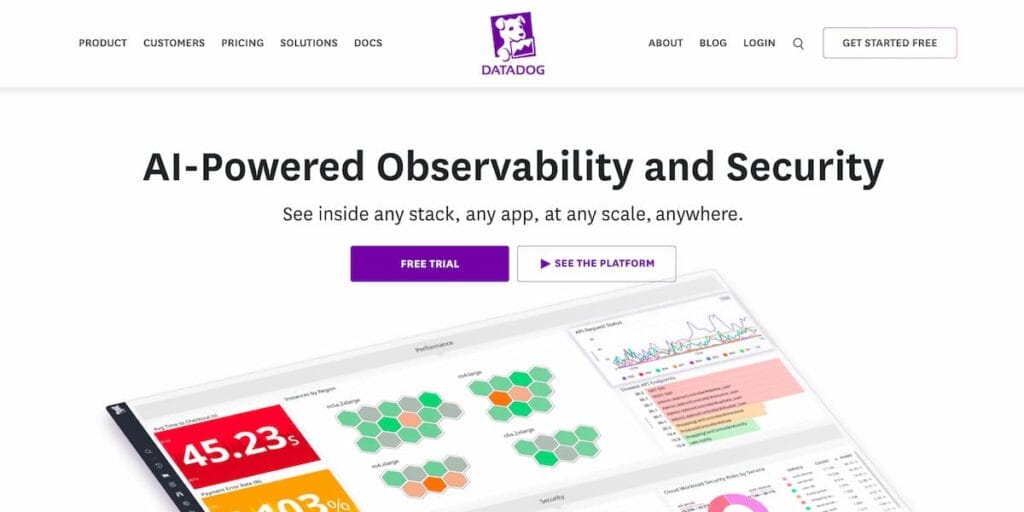
Datadog is a SaaS observability platform that brings metrics, traces, logs, dashboards, alerts, user monitoring, synthetic checks, cloud monitoring, and security signals into one platform.
Datadog was founded in 2010 and went public in 2019. Its IPO announcement confirmed that Datadog shares began trading on Nasdaq under the ticker symbol DDOG on September 19, 2019.
Datadog is built for teams running cloud-native, hybrid, containerized, and distributed environments. Its documentation says Datadog supports more than 1,000 built-in integrations for collecting metrics, traces, logs, and events from different systems.
Supported Languages, Integrations, and Data Sources
Datadog supports modern application stacks, cloud platforms, containers, serverless workloads, databases, logs, traces, and user experience data.
| Area | Datadog support |
| Languages | Java, Python, Go, Ruby, Node.js, .NET, PHP, C++, and more through Datadog libraries and OpenTelemetry |
| Infrastructure | Linux, Windows, Kubernetes, containers, VMs, bare metal, cloud services |
| Cloud platforms | AWS, Microsoft Azure, Google Cloud, Kubernetes, serverless, SaaS integrations |
| Data collection | Datadog Agent, OpenTelemetry Collector, integrations, APIs, cloud integrations |
| Integrations | 1,000+ built-in integrations |
| Workflows | Alerts, dashboards, incident management, Slack, PagerDuty, Jira, ServiceNow, webhooks |
Key Features of Datadog
Datadog Infrastructure Monitoring tracks hosts, containers, Kubernetes nodes, cloud services, and networked infrastructure. The Pro plan starts at $15 per infra host per month when billed annually, while Enterprise starts at $23 per infra host per month.
Infrastructure Monitoring is often the entry point for Datadog because many other observability workflows depend on host, container, and service-level context.
Datadog APM provides distributed tracing, service maps, dependency views, latency analysis, error tracking, and performance troubleshooting. Standard APM starts at $31 per APM host per month when billed annually. APM Pro starts at $35 per host, and APM Enterprise starts at $40 per host.
Datadog’s APM billing documentation says each APM host includes 150 GB of ingested spans and 1 million indexed spans per month. Extra ingested spans are priced at $0.10/GB, and extra indexed spans are priced at $1.70 per million indexed spans for 15-day retention.
Datadog Log Management separates ingestion from indexing. Log ingestion is priced at $0.10/GB. Indexed logs are priced per million indexed events, with the rate changing based on retention period. Datadog lists 15-day indexed logs at $1.70 per million events and 30-day indexed logs at $2.50 per million events when billed annually.
This is one of the most important Datadog pricing details. A team can ingest logs without indexing everything, but searchable logs, alerting, and real-time troubleshooting usually require indexed retention.
Datadog RUM helps teams monitor frontend performance, browser sessions, page loads, JavaScript errors, Core Web Vitals, session behavior, and user journeys.
Datadog’s current pricing list separates RUM into multiple products. RUM Measure is listed at $0.15 per 1,000 sessions annually. RUM Investigate is listed at $3 per 1,000 filtered sessions annually. Product Analytics is listed at $0.80 per 1,000 sessions, and Session Replay is listed separately at $2.50 per 1,000 sessions annually.
Datadog Synthetic Monitoring includes API tests and browser tests. Synthetic API Tests are listed at $5 per 10,000 API test runs annually. Synthetic Browser Tests are listed at $12 per 1,000 browser test runs annually.
Synthetics are useful for testing critical user flows, APIs, checkout paths, login pages, and uptime from outside the production environment.
Datadog custom metrics are priced separately. Datadog lists custom metrics at $5 per 100 custom metrics per month. It also lists ingested custom metrics at $0.10 per 100 ingested custom metrics per month.
Datadog defines a custom metric as a unique combination of metric name and tag values, including the host tag. That means high-cardinality tags can increase the number of billable custom metrics quickly.
Datadog security products are separate from core observability. Cloud Security Management Pro is listed at $10 per CSM host per month annually, and Cloud Security Management Enterprise is listed at $25 per CSM host per month annually. Cloud SIEM is priced differently, at $5 per 1 million analyzed events annually.
This distinction matters because not every Datadog security product is priced per host.
Datadog Pricing in 2026
Datadog has public pricing for many core products, but the final cost depends on which modules you enable and how much you use.
| Product | Starting annual price | Billing unit |
| Infrastructure Pro | $15 | Per infra host/month |
| Infrastructure Enterprise | $23 | Per infra host/month |
| APM | $31 | Per APM host/month |
| APM Pro | $35 | Per APM host/month |
| APM Enterprise | $40 | Per APM host/month |
| Product | Starting annual price | Billing unit |
| Log ingestion | $0.10 | Per GB |
| Log indexing, 15-day retention | $1.70 | Per 1M indexed events |
| RUM Measure | $0.15 | Per 1,000 sessions |
| RUM Investigate | $3 | Per 1,000 filtered sessions |
| Synthetic API Tests | $5 | Per 10,000 API test runs |
How Datadog Measures Hosts
Datadog defines a host as a physical or virtual operating system instance monitored by Datadog. This can include servers, VMs, cloud instances, Kubernetes nodes, app service instances, and similar compute resources.
Datadog’s billing documentation says host-based products on a high-water mark plan are metered hourly. At the end of the month, Datadog calculates the billable host count using the maximum count from the lower 99% of hourly usage, excluding the top 1% of hours.
This is different from a simple monthly average. It reduces the effect of very short spikes, but teams with sustained autoscaling bursts can still see higher bills.
What Does Datadog Really Cost?
⚠️ Disclaimer
The scenarios below are directional editorial estimates, not official Datadog quotes. Datadog publishes public list pricing, but final cost can change based on contract terms, annual commitments, on-demand usage, discounts, retention, log indexing, custom metrics, security products, support, and actual telemetry patterns.
Datadog pricing is mainly modular. Infrastructure and APM are host-based. Logs are priced by ingestion and indexing. RUM is priced by sessions. Synthetic monitoring is priced by test runs. Custom metrics, security, database monitoring, incident management, cloud cost management, and other modules can add separate costs.
The estimates below use conservative production assumptions. They include Infrastructure Pro, standard APM, log ingestion, RUM Investigate, Synthetic API Tests, and Synthetic Browser Tests. They do not include full log indexing, Cloud SIEM, Cloud Security Management, Database Monitoring, custom metric overages, premium support, or negotiated enterprise discounts.
Pricing Assumptions Used in These Scenarios
| Scenario | Datadog pricing anchor | Datadog estimate | CubeAPM estimate |
| Small team | 10 hosts, Infra Pro + APM + light logs/RUM/synthetics | ~$596/month | ~$522/month |
| Growing team | 50 hosts, Infra Pro + APM + logs/RUM/synthetics | ~$3,300/month | ~$919/month |
| Mid-market team | 250 hosts, Infra Pro + APM + higher telemetry usage | ~$15,860/month | ~$4,594/month |
CubeAPM pricing is based on the user’s stated benchmark estimates: small team at about $522/month, growing team at about $919/month, and mid-market team at about $4,594/month. CubeAPM’s public pricing page lists $0.15/GB ingestion pricing.
Workload Assumptions Used for Datadog Estimates
| Team size | Infrastructure context | Telemetry context | Datadog usage assumption | Estimated Datadog cost |
| Small team | 10 hosts | ~1.1 TB/month | Infra Pro + APM + log ingest + light RUM/synthetics | ~$596/month |
| Growing team | 50 hosts | ~5.4 TB/month | Infra Pro + APM + log ingest + RUM/synthetics | ~$3,300/month |
| Mid-market team | 250 hosts | ~27 TB/month | Infra Pro + APM + log ingest + RUM/synthetics | ~$15,860/month |
The telemetry volume is included because it matters for logs, traces, and ingest-based alternatives. For Datadog, host count and enabled modules remain major cost drivers.
Scenario 1: Small Team, ~10 Hosts
Situation
A small production team runs around 10 hosts and produces about 1.1 TB/month of telemetry across logs, traces, and metrics. The team needs infrastructure monitoring, APM, basic frontend visibility, and lightweight synthetic monitoring.
For Datadog, the main cost drivers are the 10 infrastructure hosts, 10 APM hosts, log ingestion, RUM sessions, and synthetic test runs.
Why teams at this stage consider Datadog
Small teams may choose Datadog because it gives them dashboards, alerting, infrastructure monitoring, APM, logs, RUM, and synthetics in one SaaS product. That can be easier than running several open-source tools separately.
Estimated profile
| Configuration | Detail |
| Infrastructure context | 10 hosts |
| Telemetry context | ~1.1 TB/month |
| Logs | 720 GB/month ingested |
| Traces/APM | 360 GB/month |
| RUM sessions | 5,000/month |
| Synthetic activity | 50,000 API runs + 2,000 browser runs/month |
| Pricing basis | Infra Pro + APM + log ingestion + RUM Investigate + synthetics |
Estimated monthly cost
Disclaimer: This estimate uses Datadog public list pricing as a planning anchor. It does not include full log indexing, custom metric overages, security products, database monitoring, support upgrades, or enterprise discounts.
| Component | Assumption | Monthly cost |
| Infrastructure Pro | 10 hosts × $15/host | $150 |
| APM | 10 hosts × $31/host | $310 |
| Log ingestion | 720 GB × $0.10/GB | $72 |
| RUM Investigate | 5,000 sessions × $3/1,000 | $15 |
| Synthetic API + browser tests | 50,000 API runs + 2,000 browser runs | $49 |
| Estimated total | Production app + infra setup | ~$596/month |
CubeAPM cost comparison
| Platform | Pricing basis | Estimated monthly cost |
| Datadog | 10 hosts + APM + log ingest + light RUM/synthetics | ~$596/month |
| CubeAPM | ~1.1 TB/month ingestion estimate | ~$522/month |
| Estimated savings with CubeAPM | Difference vs Datadog | ~$74/month |
| Percentage savings | ~12% lower |
What this scenario shows
For a small team, Datadog can be reasonable if usage stays controlled and the team does not index all logs or enable many add-ons. CubeAPM is slightly cheaper in this example because it does not charge per host. The cost gap becomes larger as host count and enabled modules increase.
Scenario 2: Growing Team, ~50 Hosts
Situation
A growing SaaS team runs around 50 hosts and produces about 5.4 TB/month of telemetry. The team has more services, more traffic, more dashboards, and more production workflows. It needs infrastructure monitoring, APM, RUM, API checks, and browser checks.
For Datadog, the host-based cost becomes more visible at this stage. Infrastructure and APM alone create a $2,300/month baseline before logs, RUM, synthetics, security, database monitoring, or custom metrics.
Why teams at this stage consider Datadog
Growing teams often choose Datadog because they need faster incident response, better service maps, distributed tracing, alerting, frontend visibility, and centralized monitoring across cloud services and Kubernetes.
Estimated profile
| Configuration | Detail |
| Infrastructure context | 50 hosts |
| Telemetry context | ~5.4 TB/month |
| Logs | 3,600 GB/month ingested |
| Traces/APM | 1,800 GB/month |
| RUM sessions | 50,000/month |
| Synthetic activity | 500,000 API runs + 20,000 browser runs/month |
| Pricing basis | Infra Pro + APM + log ingestion + RUM Investigate + synthetics |
Estimated monthly cost
Disclaimer: This estimate uses Datadog public list pricing as a planning model. It does not include full log indexing, custom metrics, security, database monitoring, incident management, or support upgrades.
| Component | Assumption | Monthly cost |
| Infrastructure Pro | 50 hosts × $15/host | $750 |
| APM | 50 hosts × $31/host | $1,550 |
| Log ingestion | 3,600 GB × $0.10/GB | $360 |
| RUM Investigate | 50,000 sessions × $3/1,000 | $150 |
| Synthetic API + browser tests | 500,000 API runs + 20,000 browser runs | $490 |
| Estimated total | Growing app + infra setup | ~$3,300/month |
CubeAPM cost comparison
| Platform | Pricing basis | Estimated monthly cost |
| Datadog | 50 hosts + APM + log ingest + RUM/synthetics | ~$3,300/month |
| CubeAPM | ~5.4 TB/month ingestion estimate | ~$919/month |
| Estimated savings with CubeAPM | Difference vs Datadog | ~$2,381/month |
| Percentage savings | ~72% lower |
What this scenario shows
This is where Datadog’s modular pricing starts to compound. The team is paying for hosts, APM, log ingestion, RUM, and synthetics separately. CubeAPM becomes much cheaper in this scenario because pricing follows ingested telemetry volume instead of host count and separate observability modules.
Scenario 3: Mid-Market Team, ~250 Hosts
Situation
A mid-market team runs around 250 hosts and produces about 27 TB/month of telemetry. The environment may include multiple Kubernetes clusters, backend services, frontend applications, APIs, databases, queues, and customer-facing workloads.
At this stage, the team likely needs full-stack production visibility across infrastructure, APM, logs, RUM, synthetics, dashboards, and alerts.
Why teams at this stage consider Datadog
Datadog is attractive at mid-market and enterprise scale because it gives teams a broad SaaS observability platform with many integrations, strong dashboards, distributed tracing, alerting, and cross-signal correlation.
Estimated profile
| Configuration | Detail |
| Infrastructure context | 250 hosts |
| Telemetry context | ~27 TB/month |
| Logs | 18,000 GB/month ingested |
| Traces/APM | 9,000 GB/month |
| RUM sessions | 200,000/month |
| Synthetic activity | 2,000,000 API runs + 80,000 browser runs/month |
| Pricing basis | Infra Pro + APM + log ingestion + RUM Investigate + synthetics |
Estimated monthly cost
Disclaimer: This estimate uses Datadog public list pricing as a planning model. It excludes full log indexing, custom metric overages, Cloud SIEM, Cloud Security Management, Database Monitoring, premium support, and discounts.
| Component | Assumption | Monthly cost |
| Infrastructure Pro | 250 hosts × $15/host | $3,750 |
| APM | 250 hosts × $31/host | $7,750 |
| Log ingestion | 18,000 GB × $0.10/GB | $1,800 |
| RUM Investigate | 200,000 sessions × $3/1,000 | $600 |
| Synthetic API + browser tests | 2,000,000 API runs + 80,000 browser runs | $1,960 |
| Estimated total | Mid-market app + infra setup | ~$15,860/month |
CubeAPM cost comparison
| Platform | Pricing basis | Estimated monthly cost |
| Datadog | 250 hosts + APM + log ingest + RUM/synthetics | ~$15,860/month |
| CubeAPM | ~27 TB/month ingestion estimate | ~$4,594/month |
| Estimated savings with CubeAPM | Difference vs Datadog | ~$11,266/month |
| Percentage savings | ~71% lower |
What this scenario shows
At mid-market scale, Datadog’s host-based and module-based pricing creates a much larger bill. CubeAPM is lower in this estimate because it does not charge separately for every host, user, or observability signal. The cost gap would grow further if the Datadog setup also added full log indexing, Cloud SIEM, Cloud Security Management, Database Monitoring, or custom metric overages.
Summary: Datadog vs CubeAPM Estimated Monthly Cost
Disclaimer: These are directional planning estimates, not official quotes. Datadog’s final pricing can change with discounts, commitments, overages, retention, log indexing, custom metrics, support, and contract terms. CubeAPM’s value is strongest for teams that want full-stack observability without per-host fees, per-user fees, or separate pricing for every signal.
| Team profile | Datadog estimate | CubeAPM estimate | Monthly savings with CubeAPM | Percentage savings |
| Small team | ~$596/month | ~$522/month | ~$74/month | ~12% |
| Growing team | ~$3,300/month | ~$919/month | ~$2,381/month | ~72% |
| Mid-market team | ~$15,860/month | ~$4,594/month | ~$11,266/month | ~71% |
What Drives Datadog Costs?
Host count is one of the biggest Datadog cost drivers. Infrastructure Pro starts at $15 per host per month, while APM starts at $31 per host per month. A team running both Infrastructure Pro and standard APM is already at $46 per monitored host per month before logs, RUM, synthetics, or add-ons.
Datadog does not simply bill host-based products on a plain monthly average. Its documentation says high-water mark billing uses the maximum count from the lower 99% of hourly usage, excluding the top 1% of hours.
This matters for autoscaling workloads, Kubernetes clusters, temporary environments, and load-testing spikes.
Logs can become expensive because ingestion and indexing are separate. Datadog lists ingestion at $0.10/GB, but indexed logs add another charge based on event count and retention.
Teams should decide which logs need full indexing and which logs can be filtered, archived, or sampled.
Custom metrics cost $5 per 100 custom metrics per month. High-cardinality tags can increase the number of unique metric combinations, which can increase cost quickly.
RUM pricing depends on product type and session volume. RUM Measure is cheaper, while RUM Investigate costs more per 1,000 sessions. High-traffic SaaS, ecommerce, consumer, and mobile applications should model RUM usage before enabling it broadly.
Synthetic API and browser tests are priced separately. Costs rise with test frequency, test locations, number of critical journeys, and whether tests are API-based or browser-based.
Datadog security pricing depends on the product. Cloud Security Management is host-based, while Cloud SIEM is priced per analyzed event. Teams adding security monitoring should model these costs separately from core observability.
Datadog User Reviews
Datadog has strong visibility across major review platforms. Gartner Peer Insights lists Datadog at 4.5/5, with more than 1,300 ratings shown publicly. Capterra lists Datadog at 4.6/5 from 360 reviews. G2 lists Datadog products at 4.4/5 across 722 verified reviews.
| Review source | Rating shown publicly |
| Gartner Peer Insights | 4.5/5 |
| Capterra | 4.6/5 |
| G2 | 4.4/5 |
| TrustRadius | 8.6/10 |
What Users Like
G2 review summaries say users praise Datadog for bringing logs, metrics, and traces into one interface, which helps teams troubleshoot faster across applications and infrastructure.
Datadog’s 1,000+ integrations are a major strength for teams that want fast coverage across cloud providers, databases, queues, Kubernetes, application frameworks, SaaS tools, and incident workflows.
Capterra review snippets highlight Datadog’s monitoring, dashboards, alerting, and observability capabilities as major positives.
Datadog covers infrastructure, APM, logs, RUM, synthetics, security, cloud cost, databases, CI visibility, and incident workflows. That breadth is useful for larger teams that want one vendor for many observability needs.
What Users Criticize
⚠️ Disclaimer
The following points reflect public user-review themes from review platforms. They should be treated as user feedback, not universal limitations of Datadog.
G2 review summaries say many users note that Datadog costs can escalate quickly as usage increases. AWS Marketplace review snippets also mention that expenses can rise faster than expected as hosts and enabled features grow.
Datadog’s pricing model includes hosts, logs, indexed events, custom metrics, sessions, test runs, analyzed events, and other units. This makes the platform harder to forecast than simpler per-GB or per-user models.
Some review snippets mention that Datadog has many features and can be complex for new users. That is common for broad enterprise observability tools, but buyers should still test onboarding workflows during evaluation.
Log indexing and custom metric cardinality can create unexpected charges if teams do not configure filters, retention, indexing rules, and tag controls carefully.
Datadog Alternatives: How It Compares to Competitors
Datadog vs CubeAPM
Datadog is a SaaS observability platform with modular pricing across hosts, logs, sessions, test runs, custom metrics, and security products. CubeAPM is a self-hosted, vendor-managed observability platform priced at $0.15/GB ingestion.
CubeAPM is strongest for teams that want OpenTelemetry-native observability, full-stack visibility, and data control inside their own cloud without per-host or per-user pricing.
| Category | Datadog | CubeAPM |
| Deployment | SaaS | Self-hosted, vendor-managed |
| Pricing model | Modular, per product | $0.15/GB ingestion |
| Host fees | Yes | No per-host fee |
| Log management | Native, priced by ingest + indexing | Native log ingestion |
| Best for | Teams wanting broad SaaS observability | Teams needing predictable self-hosted observability |
Datadog vs Grafana Cloud
Grafana Cloud is a strong alternative for teams already using Grafana, Prometheus, Loki, Tempo, and OpenTelemetry. Grafana’s pricing page lists a free tier, a $19/month Pro platform fee, usage-based pricing, and an Enterprise plan with a $25,000/year minimum commit.
| Category | Datadog | Grafana Cloud |
| Deployment | SaaS | SaaS, Enterprise options |
| Pricing model | Modular per product | Platform fee + usage |
| Open-source base | No | Yes |
| Dashboards | Datadog dashboards | Grafana dashboards |
| Best for | One commercial SaaS platform | Open-source aligned teams |
Grafana Cloud is usually better for teams that want open-source compatibility and flexible telemetry pipelines. Datadog is usually better for teams that want a more packaged commercial platform.
Datadog vs New Relic
New Relic uses a data-ingest and user-based pricing model. Its pricing page says accounts get 100 GB of free data ingest per month, then pay $0.40/GB beyond that for standard data ingest.
| Category | Datadog | New Relic |
| Pricing model | Modular per product | Data ingest + users |
| Free ingest | Product-specific free tiers | 100 GB/month free |
| Infrastructure pricing | Per host | Data-based, plus users |
| Logs | Native log ingestion | Native log ingestion |
| Best for | Broad SaaS observability | Teams preferring ingest-based pricing |
New Relic can be easier to estimate for teams that think mainly in data ingest and users. Datadog is broader in module depth, but its cost model has more separate pricing dimensions.
Datadog vs Splunk Observability Cloud
Splunk Observability Cloud is an enterprise observability platform with host-based bundle pricing. Splunk’s public pricing page lists Infrastructure Monitoring at $15 per host per month, App & Infrastructure at $60 per host per month, and End-to-End at $75 per host per month, billed annually.
| Category | Datadog | Splunk Observability Cloud |
| Infrastructure pricing | Starts at $15/host/month | Starts at $15/host/month |
| APM pricing | Starts at $31/host/month | Standalone APM starts at $55/host/month |
| Logs | Native log ingestion | Often tied to broader Splunk log platform |
| Trace approach | Configurable tracing and sampling | NoSample full-fidelity APM |
| Best for | Broad SaaS observability | Existing Splunk/Cisco customers |
Datadog may be easier for teams that want native logs, APM, RUM, synthetics, and infrastructure monitoring inside one SaaS observability product. Splunk Observability Cloud is stronger for organizations already invested in Splunk logs, security, or Cisco workflows.
Datadog vs Elastic Observability
Elastic Observability is built on the Elastic Stack and is available through hosted, serverless, and self-managed options. Elastic’s serverless observability pricing page describes a usage-based model with ingest, retention, and other serverless pricing components.
| Category | Datadog | Elastic Observability |
| Deployment | SaaS | Hosted, serverless, self-managed options |
| Pricing model | Modular per product | Usage-based Elastic pricing |
| Search strength | Strong log search | Elasticsearch-native search |
| Open ecosystem | Partial | Strong Elastic ecosystem |
| Best for | Unified SaaS monitoring | Search-heavy observability teams |
Elastic is often a better fit for teams already using Elasticsearch or wanting more control over search-heavy observability. Datadog is stronger for teams that want a packaged SaaS observability platform with broad built-in integrations.
Is Datadog the Right Choice?
Datadog Works Best For
Datadog is a strong fit for teams running Kubernetes, cloud services, microservices, serverless workloads, and distributed applications.
Datadog works well when a team wants infrastructure monitoring, APM, logs, RUM, synthetics, dashboards, alerts, and security workflows in one commercial SaaS platform.
Datadog can be worth the cost for larger organizations that have the people and processes to manage usage, configure retention, control custom metrics, and monitor spending.
Datadog’s 1,000+ integrations make it easier to connect many systems without building every integration from scratch.
Datadog is useful when teams need dashboards, service maps, alerts, traces, logs, and infrastructure context during incidents.
Datadog May Not Be the Right Fit For
Datadog can become expensive as hosts, logs, indexed events, sessions, custom metrics, and add-ons grow. User reviews commonly mention cost escalation as a concern.
Datadog’s pricing is transparent in many areas, but it is not simple. Buyers need to model multiple units, not just one plan.
Datadog is SaaS. Teams that need telemetry data to stay inside their own infrastructure may prefer self-hosted options such as CubeAPM or Elastic self-managed deployments.
Datadog log ingestion and indexing can become costly at scale. Teams with high log volume should model ingestion, indexing, retention, and filtering before sending everything to Datadog.
Conclusion
Datadog is a mature and capable observability platform. Its biggest strengths are broad integrations, unified monitoring, strong dashboards, APM, log management, RUM, synthetics, security modules, and cloud-native coverage.
The main trade-off is cost predictability. Datadog publishes many public prices, but the real bill depends on hosts, APM hosts, log ingestion, indexed events, retention, RUM sessions, synthetic test runs, custom metrics, security products, and support terms.
For large teams with dedicated SRE, platform, and FinOps processes, Datadog can be worth the investment. For teams that want self-hosted observability, simpler pricing, and no per-host fees, CubeAPM is a strong alternative to evaluate. For teams already invested in open-source observability, Grafana Cloud or Elastic may also be worth comparing.
Disclaimer: Pricing, packaging, included entitlements, support terms, and product limits can change. The cost examples in this article are editorial estimates based on publicly available pricing as of June 2026. Always confirm final pricing, usage limits, discounts, retention, and contract terms directly with Datadog before purchase.
FAQs
1. How much does Datadog cost?
Datadog Infrastructure Pro starts at $15 per infra host per month when billed annually. Standard APM starts at $31 per APM host per month. Log ingestion is listed at $0.10/GB, and 15-day log indexing is listed at $1.70 per million indexed events.
2. Is Datadog priced per host?
Some Datadog products are priced per host, including Infrastructure Monitoring and APM. Other products use different billing units, such as GB, indexed events, sessions, test runs, analyzed events, or custom metrics.
3. Does Datadog have a free plan?
Yes. Datadog lists a free Infrastructure Monitoring plan for up to 5 hosts with 1-day retention. This is useful for testing or evaluation, but production teams usually need paid modules.
4. Why is Datadog expensive?
Datadog can become expensive because costs stack across several products. A team may pay for infrastructure hosts, APM hosts, log ingestion, log indexing, RUM sessions, synthetic test runs, custom metrics, security products, and other add-ons.
5. What are the best Datadog alternatives?
The strongest Datadog alternatives are CubeAPM, Grafana Cloud, New Relic, Splunk Observability Cloud, and Elastic Observability. CubeAPM is best for self-hosted, OpenTelemetry-native observability with per-GB pricing. Grafana Cloud is best for open-source aligned teams. New Relic is best for teams that prefer ingest-based pricing. Splunk is best for existing Splunk/Cisco customers. Elastic is best for search-heavy observability workflows.