









The main difference between Datadog, SigNoz, and CubeAPM is how they handle pricing, deployment, and data control.
Datadog is a powerful SaaS platform, but it can be costly for smaller teams with its per-host and per-GB billing. SigNoz is open-source and ideal for small, self-hosted setups, but certain advanced capabilities are locked behind paid tiers. CubeAPM, in contrast, offers cost-effective $0.15/GB pricing, smart sampling (95 % compression), and self-hosting deployment.
As observability costs climb, teams are moving toward OpenTelemetry-native solutions that balance cost and control. Let’s explore this Datadog vs SigNoz vs CubeAPM comparison guide across features, pricing, and deployment.
Datadog vs SigNoz vs CubeAPM Comparison
| Feature | CubeAPM | Datadog | Signoz |
| Multi-Agent Support | Yes (OTel, New Relic, Datadog, Elastic) | Yes (proprietary Datadog Agent and third-party agents) | No (Only OTel) |
| MELT Support (Metrics, Events, Logs, Traces) | Full MELT coverage | Full MELT coverage | Full MELT coverage |
| Deployment (Self-Host / Setup) | Self-hosted but vendor-managed | SaaS-only | self-hosted and SaaS-based |
| Pricing | Ingestion-based pricing of $0.15/GB | APM: $31/host/ month; Infra: $15 /host/month; Logs: $0.10/GB | Free; paid: $49/month; Traces: $0.30/GB;Logs: $0.30/GB;Metrics: $0.10/million samples. |
| Sampling Strategy | Smart sampling – fully automated, context-aware | Head and tail-based sampling | Tail-based sampling |
| Data Retention | Infinite Retention (no extra cost) | 15-30 days based on plan | 15 days for logs; 30 days for metrics |
| Support Channel & TAT & Pricing | Slack, WhatsApp; response in minutes | Community-based; email & chat (paid plan) with TAT: <2 hrs To 48 hrs; premium support costs extra | Slack, GitHub, Community; TAT: 1–2 days (free), <4h (enterprise); Enterprise support paid |
| Known for | Unified MELT, self-hosting, OpenTelemetry-native, cost predictability | Large enterprise SaaS ecosystem with 900+ integrations. | Open-source observability built on ClickHouse + OTel |
Datadog vs SigNoz vs CubeAPM: Feature-by-Feature Breakdown
Multi-Agent Support
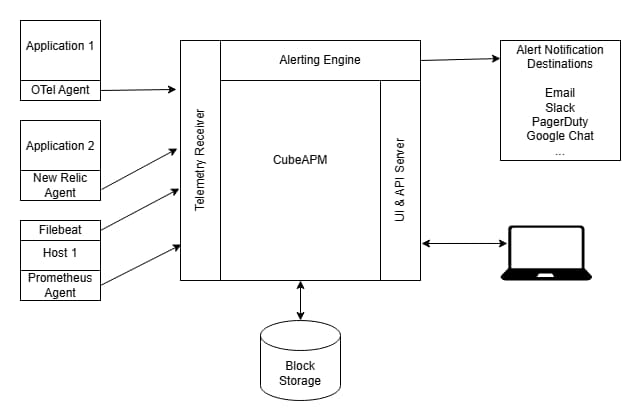
CubeAPM provides true multi-agent compatibility. It natively supports OpenTelemetry, Prometheus, Datadog, and New Relic agents, letting teams ingest data from mixed environments without rebuilding instrumentation. This flexibility ensures smooth migration and easy interoperability across observability stacks.
Datadog primarily relies on its proprietary Datadog Agent, which is responsible for collecting metrics, traces, and logs from hosts, containers, and services. Datadog also accepts OpenTelemetry data through OTLP endpoints.
SigNoz, on the other hand, is fully OpenTelemetry-native. It does not provide its own agent but depends entirely on the OpenTelemetry Collector and SDKs for data collection and ingestion. This makes it vendor-neutral and ideal for teams already using OpenTelemetry, though it lacks native support for proprietary agents such as Datadog or New Relic.
MELT Support (Metrics, Events, Logs, Traces)
This feature defines how effectively each platform unifies telemetry signals to provide full-stack observability.
CubeAPM offers end-to-end MELT visibility across applications, infrastructure, and user experience. It unifies metrics, logs, events, and traces in a single pipeline powered by OpenTelemetry, eliminating the need for separate licenses per signal. With built-in synthetic and real user monitoring, CubeAPM helps teams quickly trace performance issues from backend latency to frontend impact.
Datadog provides complete MELT observability through separate modules — APM, Infrastructure, Log Management, and Event Monitoring. Its modular architecture supports deep analytics but increases total cost as each telemetry type adds to billing. The 900+ integrations strengthen coverage but make managing ingestion and retention costs more complex for large deployments.
SigNoz delivers metrics, logs, and traces support via OpenTelemetry, offering basic correlation between signals. It uses ClickHouse for fast querying and visualizations, but lacks mature event monitoring and RUM. While sufficient for open-source and developer teams, it’s less suited for enterprise environments needing unified alert workflows or full MELT automation.
Deployment (Self-Host/Setup)
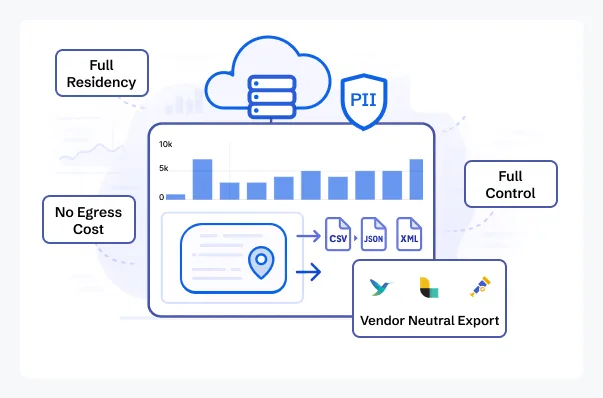
CubeAPM offers self-hosted and vendor-managed deployment options, allowing organizations to run it in their own cloud (BYOC) or use CubeAPM’s managed service. Setup takes under an hour using pre-built Helm charts and native OpenTelemetry collectors. This flexibility ensures compliance with data residency laws and near-zero latency since data never leaves your environment.
Datadog is a cloud-only SaaS platform that cannot be self-hosted. Users install Datadog Agents on hosts or containers, but all telemetry is sent to Datadog’s managed cloud. While this model removes infrastructure overhead, it limits data ownership and can introduce egress costs or compliance challenges for regulated industries.
SigNoz supports both self-hosted and cloud-based setups, giving users control over deployment. The self-hosted version runs on Kubernetes or Docker using the OpenTelemetry Collector, while the managed cloud simplifies onboarding. However, scaling and maintenance in large environments still require manual configuration and active infrastructure management.
Pricing for Small, Medium, & Large Teams
Pricing plays a pivotal role in long-term observability planning, as costs can scale rapidly with data volume and infrastructure size.
To summarize the pricing:
*All pricing comparisons are calculated using standardized Small/Medium/Large team profiles defined in our internal benchmarking sheet, based on fixed log, metrics, trace, and retention assumptions. Actual pricing may vary by usage, region, and plan structure. Please confirm current pricing with each vendor.
Cost for Small Teams (~30):
- CubeAPM: $2,080
- Datadog: $8,185
- SigNoz: $4,600
Cost for Mid-Sized Teams (~125):
- CubeAPM: $7,200,
- Datadog: $27,475
- SigNoz: $16,000
Cost for Large Teams (~250):
- CubeAPM: $15,200
- Datadog: $59,050
- SigNoz: $34,000
CubeAPM Costs: Detailed Calculation
CubeAPM follows an ingestion-based pricing model of $0.15 per GB, which includes logs, metrics, traces, and infrastructure monitoring without hidden add-ons. There are no host-based or event-based charges, and support is bundled at no extra cost. This transparent model ensures predictable billing and allows teams to scale observability without worrying about exponential growth in monitoring costs.
- Small teams (~ 30): $2,080
- Mid-sized teams (~ 125): $7,200
- Large teams (~250): $15,200
Datadog Costs: Detailed Calculation
Datadog uses a complex host- and usage-based pricing structure, where each feature—APM, Infrastructure, Logs, or Synthetic Monitoring—is billed separately. For example, APM starts at around $31 per host/month, Infrastructure Monitoring at $15 per host/month, and Logs cost $0.10 per GB ingested. Additional charges apply for data retention, user licenses, and extended support, often resulting in bills that escalate quickly at enterprise scale.
- Small teams: $8,185
- Mid-size teams: $27,475
- Large teams: $59,050
SigNoz Costs: Detailed Calculation
SigNoz provides a freemium model for its open-source edition and usage-based pricing for its managed cloud service. The cloud plan starts at $49 per month with variable costs for data ingestion—around $0.30 per GB for logs and traces, and $0.10 per million metric samples. While affordable for small workloads, costs rise with higher retention and scaling, and enterprise support is billed separately.
- Small: $4,600
- Medium: $16,000
- Large: $34,000
Sampling Strategy

CubeAPM uses an advanced Smart Sampling engine that is fully automated and context-aware, dynamically prioritizing spans based on latency, error rate, and business impact. It achieves up to 95% data compression while retaining all critical traces, allowing teams to reduce ingestion costs dramatically without losing diagnostic depth. This adaptive method ensures that anomaly and error traces are always preserved for accurate RCA.
Datadog employs head-based and tail-based sampling. Datadog also supports adaptive and probabilistic sampling for RUM, errors, and rare traces.
SigNoz supports tail-based sampling through the OpenTelemetry Collector, allowing decisions to be made after spans complete — so only the most relevant traces (e.g., slow or error spans) are retained. This improves accuracy over head-based methods.
Data Retention
Log/data retention defines how long observability data is stored and whether extended access incurs extra cost — a key factor for compliance, forensics, and cost predictability.

CubeAPM provides unlimited data retention at no additional cost when deployed in your own cloud or VPC. Since storage is under your control, there are no egress or archival fees, and historical logs remain instantly searchable. This makes CubeAPM ideal for teams in regulated sectors like finance or healthcare that need long-term observability data for audits or compliance.
Datadog offers 15-day default log retention for indexed logs, while non-indexed logs can be archived to external storage like AWS S3 or Google Cloud at an extra cost. Metrics are stored for up to 15 months, but traces and logs beyond the default period require paid extensions.
SigNoz provides 15 days of default retention for log and traces and 30 days for metrics on its managed cloud, with configurable options for self-hosted setups. Users running SigNoz on-premise can extend retention by increasing their own storage, but doing so raises infrastructure costs. While this approach gives flexibility to developers, it lacks the “set-and-forget” simplicity that CubeAPM provides for long-term data management.
Support Channel & TAT & Pricing
Support quality and response speed are crucial in incident resolution, especially for production-grade observability platforms where downtime can cost thousands per minute.
CubeAPM includes real-time support at no extra cost, providing direct access to engineers through Slack, WhatsApp, or email. Response times average under 10 minutes during business hours, and even complex issues are typically resolved the same day. Because CubeAPM is vendor-managed even in self-hosted deployments, customers get full technical assistance without premium tiers or ticket queues.
Datadog offers free community-based support. It also offers email and chat-based support in paid plans, with response times ranging from less than 2 to 48 hours. Faster SLAs and dedicated account managers are only available under Premium Support, which is billed separately. This model suits large enterprises with defined escalation policies, but can be overkill or costly for smaller teams.
SigNoz provides community-driven support for its open-source edition through Slack and GitHub discussions, while enterprise customers can access faster response times via paid plans. On the managed cloud, TAT ranges from 1–2 days (free) to under 4 hours for enterprise users. While the community is active, support depth depends on team size and technical maturity.
Known For
CubeAPM is known for its unified MELT observability, self-hosted flexibility, and predictable pricing model. It’s fully OpenTelemetry-native, allowing seamless integration across diverse environments while ensuring data stays within the user’s control. With its $0.15/GB ingestion-based pricing, smart sampling, and Slack-level real-time support, CubeAPM appeals to engineering teams seeking enterprise-grade visibility without vendor lock-ins.
Datadog is known for its large-scale SaaS ecosystem, extensive 900+ integrations, and enterprise-ready dashboards covering every layer of infrastructure and application monitoring. It excels in breadth and automation, supporting everything from serverless monitoring to security analytics.
SigNoz is known for its open-source architecture built on ClickHouse and OpenTelemetry, providing complete transparency and control over observability data. It’s favored by developers and startups that want self-managed, vendor-neutral monitoring without license restrictions.
Which Tool Is Best for You? Why Brands Choose CubeAPM
Choosing the right observability platform depends on your team’s size, data volume, and need for control versus convenience.
Datadog and SigNoz serve different audiences—Datadog fits large enterprises needing managed SaaS with broad integrations, while SigNoz appeals to open-source users wanting a self-managed, low-cost option.
CubeAPM is best for teams that want predictable pricing, full MELT observability, and complete data control. It’s designed for DevOps, SRE, and compliance-driven teams that need enterprise-grade visibility without vendor lock-in or unpredictable bills.
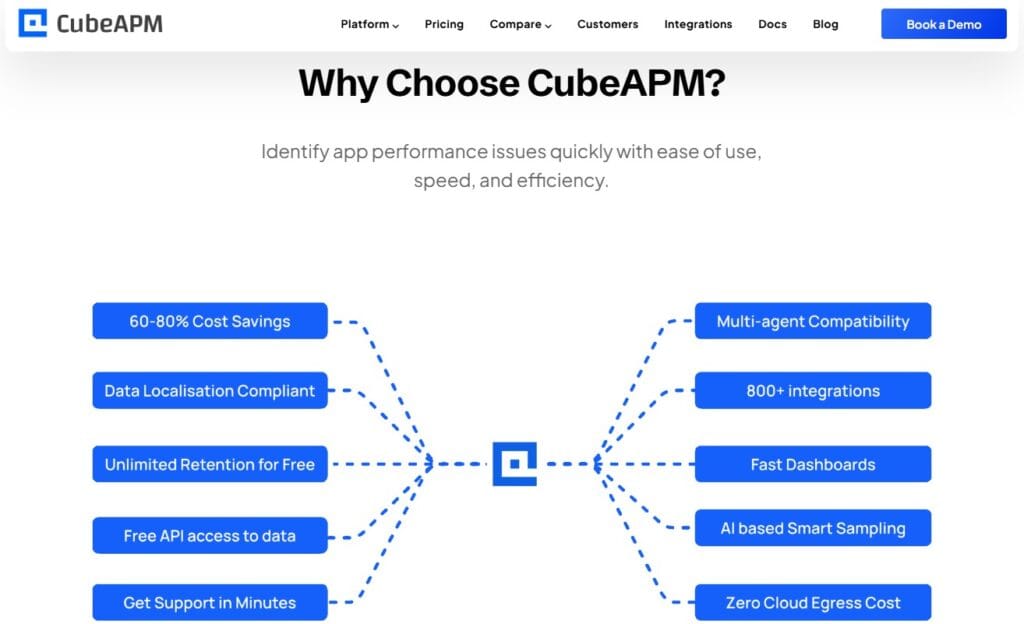
- Predictable pricing: $0.15/GB ingestion model covers logs, metrics, and traces with no hidden add-ons.
- Data control: Self-hosted or BYOC deployment ensures full compliance with data residency laws.
- Smart Sampling: Context-aware sampling compresses 95% of data while preserving critical traces, reducing storage and costs.
- OpenTelemetry-native: Seamlessly integrates with any telemetry source—Datadog, Prometheus, or New Relic—without re-instrumentation.
- Fast support: Direct Slack and WhatsApp access to core engineers for near real-time issue resolution.
- Scalability: Built for teams ingesting terabytes of telemetry data while maintaining performance and visibility.
Datadog vs SigNoz vs CubeAPM: Use Cases
Each tool caters to a different audience and observability maturity level. Based on our research, pricing data, and product documentation, here’s where Datadog, SigNoz, and CubeAPM best fit.
Choose Datadog if:
You prefer a fully managed SaaS platform with comprehensive automation and integrations for hybrid and multi-cloud systems.
- For enterprise-scale observability: Datadog is best for large organizations that rely on 900+ integrations and prefer managed operations.
- For global monitoring teams: Ideal for multi-cloud DevOps pipelines or distributed teams who prioritize ease of setup over cost efficiency.
- For visualization-heavy workflows: Works well when rich dashboards, automated alerting, and ML-driven anomaly detection are top priorities.
Choose SigNoz if:
You want an open-source, self-managed APM that’s simple to deploy and tailor to your infrastructure.
- For startups or developer teams: Great for early-stage companies seeking an affordable, OpenTelemetry-based alternative to SaaS APMs.
- For testing and internal observability: Useful for staging or QA environments where teams experiment with tracing and metrics collection.
- For OpenTelemetry-first architectures: Suitable for developers who want to extend observability pipelines using custom OTel collectors and dashboards.
Choose CubeAPM if:
You need enterprise-grade observability with predictable costs and strict data control in modern distributed environments.
- For self-hosted observability at scale: Ideal for fintech, healthcare, or government teams requiring on-prem or BYOC deployment with full data residency.
- For OpenTelemetry-native microservice monitoring: Perfect for organizations migrating from Datadog or New Relic that already use OTel collectors.
- For reducing incident response times: Real-time Slack and WhatsApp integration make CubeAPM effective for on-call SREs handling production incidents.
- For predictable high-volume ingestion: Works best for teams ingesting 10–50 TB/month of telemetry data who need simple, ingestion-based pricing ($0.15/GB) without surprise bills.
- For compliance and audit-heavy sectors: Designed for businesses subject to SOC 2 or ISO 27001 that require full control of observability data.
Datadog vs SigNoz vs CubeAPM: Conclusion
When comparing Datadog vs SigNoz vs CubeAPM, the right choice depends on your priorities—whether it’s automation, flexibility, or cost transparency.
Datadog is suited for large enterprises needing an all-in-one SaaS platform with 900+ integrations, but its host-based pricing quickly adds up at scale. SigNoz is ideal for smaller teams or developers seeking an open-source, self-managed APM that integrates easily with OpenTelemetry but lacks enterprise-grade support and automation.
CubeAPM clearly stands out as the most balanced, cost-effective, and future-ready choice. It delivers OpenTelemetry-native MELT observability, $0.15/GB ingestion-based pricing, and self-hosted or BYOC deployment—combining the scalability of SaaS with the control of on-prem.
Take the smarter route, book a free CubeAPM demo or explore the CubeAPM Playground.
Disclaimer: The information in this article reflects the latest details available at the time of publication and may change as technologies and products evolve.
FAQs
1. What is the main difference between Datadog, SigNoz, and CubeAPM?
The main difference between Datadog, SigNoz, and CubeAPM lies in pricing, deployment, and data control. Datadog is a cloud-only SaaS platform with per-host and per-GB billing, SigNoz is an open-source self-hosted APM built on OpenTelemetry, and CubeAPM combines both worlds—offering full MELT observability, self-hosting, and predictable $0.15/GB pricing.
2. Which tool is best for OpenTelemetry-based observability?
CubeAPM and SigNoz are both OpenTelemetry-native, but CubeAPM offers deeper MELT integration, real-time dashboards, and enterprise-ready scalability. Datadog supports OpenTelemetry via OTLP, but it’s still optimized for its proprietary agent model.
3. Is CubeAPM more affordable than Datadog?
Yes. Based on our research and demo data, CubeAPM’s $0.15/GB ingestion model results in 60–70% lower monthly costs than Datadog, which charges separately for APM, infrastructure, logs, and data transfer. This makes CubeAPM ideal for teams ingesting high telemetry volumes (10–50 TB/month).
4. Does CubeAPM support self-hosting or BYOC deployment?
Absolutely. CubeAPM can be self-hosted or deployed in your own cloud (BYOC), ensuring full data residency, compliance, and zero egress costs—ideal for regulated sectors like fintech, healthcare, and government.
5. Which tool is best overall in 2025?
In 2025, CubeAPM emerges as the most balanced option among Datadog vs SigNoz vs CubeAPM. It offers the scalability of SaaS tools, the flexibility of open source, and transparent pricing that grows linearly with your data—not your number of hosts.