









Observability costs can grow quickly when teams collect logs, metrics, traces, security events, Kubernetes telemetry, and AI-generated investigation data across cloud-native systems. The challenge is not only collecting telemetry. It is deciding what should be indexed, how long it should stay searchable, and how fast engineers can use it during incidents.
Logz.io is built around that problem. It provides an AI-powered Open 360 observability platform for logs, metrics, traces, cloud SIEM, and AI Agent workflows. Logz.io also says the average customer reduces 32% of overall data volume with its Data Optimization Hub, which is an important pricing-related claim because log volume and retention are major cost drivers.
This Logz.io Pricing & Review guide explains how Logz.io works, how public pricing is structured, what teams like and dislike, what Logz.io may really cost, and how it compares with tools such as CubeAPM, Datadog, Splunk Observability Cloud, New Relic, Elastic, and Grafana Cloud.
What Is Logz.io?
Logz.io is an observability platform for logs, metrics, traces and security telemetry. It is built around familiar open-source technologies and workflows such as OpenSearch-style log analytics, Prometheus-style metrics, Grafana dashboards and Jaeger/OpenTelemetry tracing, while adding managed hosting, alerting, dashboards, integrations, AI-assisted troubleshooting and cost controls. Logz.io’s own site describes the platform as unifying logs, metrics and traces to reduce MTTR and support automated root cause analysis.
In simple terms, Logz.io helps teams answer questions such as:
| Question | Why it matters |
| What changed before an incident? | Helps teams connect deployments, logs and service behavior. |
| Which logs, metrics and traces explain the issue? | Reduces time spent jumping between tools. |
| Which service or Kubernetes workload is affected? | Helps cloud-native teams narrow root cause faster. |
| Which telemetry is noisy or unused? | Helps reduce unnecessary observability spend. |
| Which alerts need investigation first? | Supports incident triage and prioritization. |
Key Features of Logz.io
Logz.io helps teams ingest, parse, search, analyze and alert on logs. This is useful for application troubleshooting, Kubernetes log analysis, production incidents, error pattern detection and compliance-related log review.
Logz.io supports Prometheus-style infrastructure monitoring. Its public pricing page lists Infrastructure Monitoring at $0.40 per 1,000 time-series metrics per day, with 18 months retention and 6 DPM per time series.
Logz.io supports distributed tracing for microservices and latency analysis. The public pricing page currently lists Distributed Tracing at $0.16 per 1 million spans per day with 10 days retention. However, Logz.io’s consumption documentation also includes an “Open 360 traces” line priced per GB per day, so buyers should confirm the exact trace billing unit for their contract or AWS Marketplace path before modeling final cost.
Logz.io positions AI Agent workflows as a major part of its current platform. Its pricing page lists Agentic Observability at $10 per 1M tokens or AI Agent workflow/invocation, with a note that pricing may vary by specific agent and usage.
Logz.io also offers Cloud SIEM for threat detection and security investigation. Its Cloud SIEM page says the product helps consolidate, prioritize and investigate security events and lists compliance references such as PCI Level 1, SOC 2 Type II, HIPAA, GDPR and ISO 27001.
For pricing, Logz.io’s consumption docs list an Open 360 security add-on at $0.35 per GB per day, while a Logz.io Cloud SIEM comparison page shows Cloud SIEM pricing from $1.27 per daily ingested GB of log data, including Log Management.
Data Optimization Hub is one of Logz.io’s strongest cost-control features. Logz.io says it gives teams a single UI to review incoming data, identify unused or noisy telemetry, and filter out data that does not add enough operational value. Logz.io states that the average customer reduces 32% of overall data with this capability.
Logz.io pricing supports hot, warm and cold retention options. This matters because not every log needs to stay in the most expensive searchable tier. The public pricing page lists hot retention extension at $0.03 per additional day, warm retention extension at $0.015 per additional day and cold retention at $0.001 per additional day.
Logz.io is available on AWS Marketplace. The AWS Marketplace listing describes Logz.io Open 360 as a subscription product, sold by Logz.io and deployed on AWS. AWS Marketplace also lists a free trial and private offer/request demo purchase paths.
What Does Logz.io Monitor?
Logz.io is organized around observability and security data rather than one narrow monitoring category.
| Area | What Logz.io Can Monitor |
| Logs | Application logs, Kubernetes logs, infrastructure logs, error logs and operational events. |
| Metrics | Prometheus-style metrics, infrastructure metrics, dashboards and alerting. |
| Traces | Spans, traces, latency patterns and microservice request paths. |
| Kubernetes | Cluster, workload and service-level context for cloud-native teams. |
| Security | Cloud SIEM events, security logs, audit data and investigation workflows. |
| AI workflows | AI Agent investigation, summarization and troubleshooting support. |
| Cost controls | Data volume, noisy telemetry, retention tiers and budget usage. |
Logz.io Pricing Plans
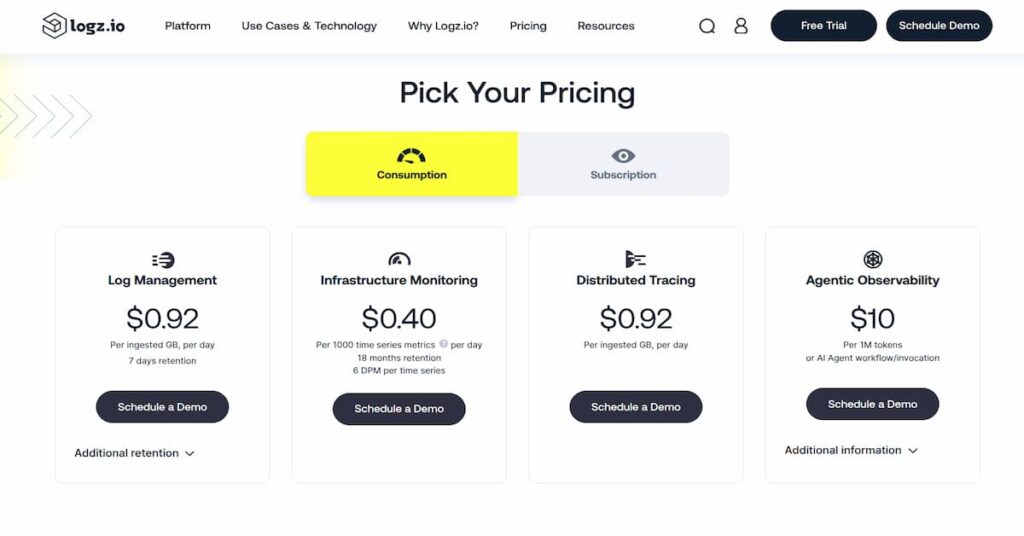
Logz.io offers two pricing paths: Consumption and Subscription. Both are shown on Logz.io’s pricing page, but they work differently. Consumption is usage-based. Subscription is plan-based for teams that want a committed plan.
Logz.io Consumption Pricing
| Product | Listed Price | Billing Unit |
| Log Management | $0.92 | Per ingested GB, per day |
| Infrastructure Monitoring | $0.40 | Per 1,000 time-series metrics, per day |
| Distributed Tracing | $0.92 | Per GB ingested, per day |
| Agentic Observability | $10 | Per 1M tokens or AI Agent workflow/invocation |
Logz.io Subscription Pricing
| Product | Listed Price | Billing Unit |
| Log Management | $0.92 | Per ingested GB, per day |
| Infrastructure Monitoring | $0.40 | Per 1,000 time-series metrics, per day |
| Distributed Tracing | $0.16 | Per 1 million spans, per day |
| Agentic Observability | $10 | Per 1M tokens or AI Agent workflow/invocation |
What Counts as a Billing Unit?
| Billing Unit | Applies To | Why It Matters |
| Ingested GB/day | Log Management | Main driver for log-heavy environments. |
| Time-series metrics/day | Infrastructure Monitoring | High-cardinality labels can increase cost. |
| Spans/day or trace GB/day | Distributed Tracing | Public pricing and docs show different trace units, so confirm with Logz.io. |
| Tokens or invocations | Agentic Observability | AI usage can grow with automated workflows. |
| Security GB/day | Cloud SIEM/security add-on | Security telemetry can add another volume-based line item. |
| Retention days | Logs and storage tiers | Longer hot retention raises effective cost. |
What Does Logz.io Really Cost?
⚠️ Disclaimer
The scenarios below are directional editorial estimates, not official Logz.io quotes. They use Logz.io’s public Consumption pricing where Log Management is listed at $0.92 per ingested GB/day, and Logz.io’s consumption documentation lists Open 360 traces at $0.92 per ingested GB/day. Final cost can change based on subscription terms, retention, region, discounts, metric cardinality, AI Agent usage, Cloud SIEM/security add-ons, and contract terms.
These scenarios use the workload structure you shared, but only the inputs that map cleanly to Logz.io’s public pricing model. Logs and traces/APM are included. Metrics GB, RUM sessions, API test runs, and browser test runs are not included because Logz.io does not price those publicly using the same simple GB/month model.
Pricing Assumptions Used in These Scenarios
| Input | Logz.io pricing used |
| Log Management | $0.92 per ingested GB/day |
| Distributed Tracing / Open 360 traces | $0.92 per ingested GB/day |
| Metrics | Not included because Logz.io prices metrics by UTM/time-series metrics |
| Month length | 30 days |
📝 Note
Logz.io prices logs and traces by average daily ingestion. Since the usage estimates below are monthly GB totals, we convert monthly GB into daily GB first, then multiply by 30 days. The simplified result is the same as monthly GB x $0.92.
| Cost Category | Formula |
| Logz.io logs | Monthly log GB ÷ 30 x $0.92 x 30 |
| Logz.io traces/APM | Monthly trace GB ÷ 30 x $0.92 x 30 |
| Simplified formula | Monthly GB x $0.92 |
Scenario 1: Small Team
Situation
A small team runs around 10 hosts and produces about 1.1 TB/month of telemetry. For Logz.io, the relevant public pricing inputs are 720 GB/month of logs and 360 GB/month of traces/APM data.
Usage Estimate
| Usage Input | Estimate |
| Logs | 720 GB/month |
| Traces/APM | 360 GB/month |
| Total telemetry volume | 1.1 TB/month |
Estimated Monthly Cost
Disclaimer: The cost estimates below are directional editorial estimates based on Logz.io’s public pricing model and assumed telemetry usage. They are not official Logz.io quotes. Final costs can vary based on daily ingestion volume, retention, logs, metrics, traces, security data, support level, committed spend, and any custom enterprise terms.
| Component | Formula | Monthly Cost |
| Log Management | 720 GB/month ÷ 30 x $0.92 x 30 | $662.40 |
| Distributed Tracing/APM | 360 GB/month ÷ 30 x $0.92 x 30 | $331.20 |
| Estimated Logz.io Total | Logs + traces/APM | $993.60 |
CubeAPM Cost Comparison
| Platform | Pricing Basis | Estimated Monthly Cost |
| Logz.io | Logs + traces/APM only | $993.60 |
| CubeAPM | 1.1 TB/month total telemetry estimate | $522 |
| Estimated savings with CubeAPM | $993.60 – $522 | $471.60/month |
| Percentage savings | $471.60 ÷ $993.60 | 47% lower |
What This Scenario Shows
For a small team, Logz.io cost is mainly driven by log and trace ingestion. CubeAPM is lower in this scenario because it uses a simpler ingestion-based model across the total telemetry estimate, while the Logz.io estimate already reaches nearly $1,000/month using only logs and traces/APM.
Scenario 2: Growing Team
Situation
A growing team runs around 50 hosts and produces about 5.4 TB/month of telemetry. For Logz.io, the relevant public pricing inputs are 3,600 GB/month of logs and 1,800 GB/month of traces/APM data.
Usage Estimate
| Usage Input | Estimate |
| Logs | 3,600 GB/month |
| Traces/APM | 1,800 GB/month |
| Total telemetry volume | 5.4 TB/month |
Estimated Monthly Cost
Disclaimer: The cost estimates below are directional editorial estimates based on Logz.io’s public pricing model and assumed telemetry usage. They are not official Logz.io quotes. Final costs can vary based on daily ingestion volume, retention, logs, metrics, traces, security data, support level, committed spend, and any custom enterprise terms.
| Component | Formula | Monthly Cost |
| Log Management | 3,600 GB/month ÷ 30 x $0.92 x 30 | $3,312 |
| Distributed Tracing/APM | 1,800 GB/month ÷ 30 x $0.92 x 30 | $1,656 |
| Estimated Logz.io Total | Logs + traces/APM | $4,968 |
CubeAPM Cost Comparison
| Platform | Pricing Basis | Estimated Monthly Cost |
| Logz.io | Logs + traces/APM only | $4,968 |
| CubeAPM | 5.4 TB/month total telemetry estimate | $919 |
| Estimated savings with CubeAPM | $4,968 – $919 | $4,049/month |
| Percentage savings | $4,049 ÷ $4,968 | 82% lower |
What This Scenario Shows
At growing-team scale, the cost difference becomes much larger. Logz.io reaches about $4,968/month from logs and traces/APM alone. CubeAPM stays lower because it does not price logs and traces as separate product lines in this estimate.
Scenario 3: Mid-Market Team
Situation
A mid-market team runs around 250 hosts and produces about 27 TB/month of telemetry. For Logz.io, the relevant public pricing inputs are 18,000 GB/month of logs and 9,000 GB/month of traces/APM data.
Usage Estimate
| Usage Input | Estimate | Used in Logz.io Estimate? |
| Hosts | 250 | No |
| Logs | 18,000 GB/month | Yes |
| Traces/APM | 9,000 GB/month | Yes |
| Total telemetry volume | 27 TB/month | Used for CubeAPM comparison |
Estimated Monthly Cost
Disclaimer: The cost estimates below are directional editorial estimates based on Logz.io’s public pricing model and assumed telemetry usage. They are not official Logz.io quotes. Final costs can vary based on daily ingestion volume, retention, logs, metrics, traces, security data, support level, committed spend, and any custom enterprise terms.
| Component | Formula | Monthly Cost |
| Log Management | 18,000 GB/month ÷ 30 x $0.92 x 30 | $16,560 |
| Distributed Tracing/APM | 9,000 GB/month ÷ 30 x $0.92 x 30 | $8,280 |
| Estimated Logz.io Total | Logs + traces/APM | $24,840 |
CubeAPM Cost Comparison
| Platform | Pricing Basis | Estimated Monthly Cost |
| Logz.io | Logs + traces/APM only | $24,840 |
| CubeAPM | 27 TB/month total telemetry estimate | $4,594 |
| Estimated savings with CubeAPM | $24,840 – $4,594 | $20,246/month |
| Percentage savings | $20,246 ÷ $24,840 | 82% lower |
What This Scenario Shows
At mid-market scale, Logz.io’s log and trace ingestion costs become the main pricing driver. The estimate reaches $24,840/month before adding metrics, AI Agent usage, Cloud SIEM/security add-ons, support differences, or custom contract terms. CubeAPM is much lower in this scenario because its estimate is based on the total telemetry volume rather than separate log and trace pricing lines.
Summary: Logz.io vs CubeAPM Estimated Monthly Cost
| Team Profile | Logz.io Estimate | CubeAPM Estimate | Monthly Savings with CubeAPM | Percentage Savings |
| Small team | $993.60/month | $522/month | $471.60/month | 47% |
| Growing team | $4,968/month | $919/month | $4,049/month | 82% |
| Mid-market team | $24,840/month | $4,594/month | $20,246/month | 82% |
What Drives Logz.io Costs?
Log ingestion is often the biggest cost driver. Debug logs, duplicate logs, verbose Kubernetes logs, repeated errors and low-value events can all increase spend.
Hot retention is more expensive than warm or cold retention. Teams should separate logs used for active debugging from logs kept mainly for compliance or archive.
Infrastructure Monitoring is priced by time-series metrics. Labels such as pod ID, customer ID, endpoint, region, status code and container ID can multiply unique series.
Trace cost depends on span volume, sampling strategy, service count and instrumentation depth. Because Logz.io’s public pricing page and consumption docs show different trace billing references, buyers should confirm the exact trace unit before committing.
Agentic Observability introduces token or invocation-based pricing. Teams should track automated RCA triggers, prompt size and high-frequency workflows.
Security use cases can increase telemetry through audit logs, firewall logs, IAM logs, endpoint logs and cloud control-plane logs. Logz.io’s consumption docs list a security add-on at $0.35 per GB per day, and its Cloud SIEM page shows pricing from $1.27 per daily ingested GB of log data including Log Management.
Logz.io says pricing on its public page represents AWS US East pricing, and monthly billing is 1.2x the annual rate.
Logz.io User Reviews
Logz.io has generally positive sentiment across major review platforms. On G2 Logz.io has a rating of 4.5/5 after 171 reviews. Review content highlights centralized log search, AI-powered features, dashboards, support and cost optimization. Gartner lists Logz.io with 55 reviews and a 4.5/5 overall average rating, while Software Advice lists 4.6/5 from 30 reviews.
What Users Like
| Theme | Verified Review Pattern |
| Centralized log search | G2 reviewers mention pulling logs into one place and using them for troubleshooting and analysis. |
| Dashboards and visualizations | G2 and Software Advice reviews mention graphs, visualizations, dashboards and search views. |
| Open-source familiarity | Reviewers mention open-source tools and ELK-style workflows as useful. |
| Customer support | G2 and Software Advice reviews mention quick, helpful or strong support. |
| Setup and integrations | Software Advice reviews mention easy setup, log shipping and integrations. |
G2 review examples mention centralized logs, useful graphs, open-source integrations and customer support. Software Advice reviews also mention dashboards, support, easy setup and log analysis value.
What Users Dislike
⚠️ Disclaimer
These are review patterns, not universal product limitations. They should be treated as buyer considerations rather than absolute claims.
| Concern | Verified Review Pattern |
| Alert/report setup complexity | A G2 reviewer said setting up alerts and reports can be difficult because of data complexity. |
| Cost visibility | A G2 reviewer wanted better cost breakdown and allocation by Kubernetes namespace. |
| Retention limits | Software Advice reviews mention short retention with additional retention period adding costs. |
| Implementation complexity | Software Advice reviews mention harder implementation details such as sub-account quota setup and Elasticsearch complexity. |
Logz.io Review Summary
| Review Source | Rating or Signal |
| Gartner Peer Insights | 4.5 average rating across 55 reviews |
| Software Advice | 4.6/5 from 30 reviews |
| G2 | 4.5/5 from 171 reviews |
| AWS Marketplace | Subscription listing shows 4.5 rating with 174 reviews on one listing |
Logz.io Alternatives: How it Compares to Competitors
Logz.io competes with managed open-source observability platforms, broad SaaS observability suites, log analytics tools, SIEM products and full-stack APM platforms.
Logz.io vs CubeAPM
CubeAPM is a full-stack OpenTelemetry-native observability platform covering APM, logs, metrics, traces, infrastructure monitoring, RUM, synthetic monitoring, error tracking, service maps, dashboards and alerts. CubeAPM lists pricing at $0.15 per GB of data ingestion and says it deploys in the customer’s infrastructure while CubeAPM handles upgrades, patches and support.
| Category | Logz.io | CubeAPM |
| Deployment | Managed SaaS and AWS Marketplace context | Customer-controlled/self-hosted deployment positioning |
| Primary use case | Managed open-source observability and AI troubleshooting | Full-stack observability and APM |
| Pricing model | Multiple telemetry units and retention-based pricing | Per-GB ingestion pricing |
| Data control | Logz.io-managed environment | Customer-controlled infrastructure positioning |
| Best for | Teams that like OpenSearch, Prometheus and Jaeger workflows | Teams wanting full-stack APM with simpler ingestion-based pricing |
Logz.io vs Datadog
Datadog is a broad SaaS observability platform covering infrastructure monitoring, APM, logs, RUM, synthetics, security and many other modules. Logz.io is stronger for teams that prefer managed open-source-style workflows around OpenSearch, Prometheus, Grafana and Jaeger.
| Category | Logz.io | Datadog |
| Primary role | Managed open-source-style observability | Broad proprietary SaaS observability |
| Pricing model | Consumption and subscription pricing | Product and usage-based modular pricing |
| Logs | OpenSearch-style log analytics | Datadog-native log management |
| Metrics | Prometheus-style monitoring | Datadog infrastructure monitoring |
| Best for | Teams wanting managed open-source workflows | Teams wanting one broad SaaS platform |
Logz.io vs Splunk Observability Cloud
Logz.io is better for managed open-source-style observability. Splunk Observability Cloud is better for teams that want a broader SaaS observability suite across infrastructure, APM, RUM, synthetics and database monitoring.
| Category | Logz.io | Splunk Observability Cloud |
| Deployment | SaaS | SaaS |
| Logs | Native log management | Log Observer Connect |
| Infrastructure pricing | $0.40 per 1,000 metrics/day | Starts at $15/host/month |
| APM / tracing | Tracing available | APM starts at $55/host/month |
| Best for | OpenSearch, Prometheus, Jaeger-style workflows | Splunk/Cisco ecosystem teams |
Logz.io vs New Relic
New Relic is a full-stack SaaS observability platform with APM, logs, metrics, traces and digital experience monitoring. Logz.io is more attractive for teams that want managed open-source-style observability and telemetry cost controls.
| Category | Logz.io | New Relic |
| Primary strength | Managed logs, metrics, traces and AI workflows | Full-stack SaaS observability |
| Pricing | Consumption and subscription options | Usage plus user-based pricing |
| APM | Supported through tracing and observability workflows | Mature APM workflows |
| Best for | Open-source-style observability teams | Developer-first SaaS observability teams |
Logz.io vs Elastic
Elastic is strongest for teams already committed to Elasticsearch, Kibana and Elastic’s broader search/security/observability ecosystem. Logz.io is better suited for teams that want managed observability without operating the underlying search and telemetry stack themselves.
| Category | Logz.io | Elastic |
| Primary strength | Managed OpenSearch-style observability | Elastic Stack search and observability |
| Deployment | Managed SaaS and marketplace paths | SaaS and self-managed options |
| Logs | Core capability | Core capability |
| Metrics and traces | Supported | Supported |
| Best for | Teams avoiding cluster operations | Teams standardized on Elastic |
Logz.io vs Grafana Cloud
Grafana Cloud is strongest for teams standardized on the Grafana ecosystem, including Loki, Mimir, Tempo and Pyroscope. Logz.io is a stronger fit when teams want OpenSearch-style log analytics combined with managed metrics, tracing, Cloud SIEM and AI Agent workflows.
| Category | Logz.io | Grafana Cloud |
| Primary strength | OpenSearch, Prometheus, Jaeger and AI workflows | Grafana ecosystem |
| Dashboards | Built in | Grafana-native |
| Logs | OpenSearch-style | Loki |
| Metrics | Prometheus-style | Mimir/Prometheus |
| Best for | Managed open-source observability with AI workflows | Grafana-standardized teams |
Is Logz.io the Right Choice?
When Logz.io Is the Right Fit
- Logz.io is a strong fit when your team wants managed OpenSearch-style log analytics without operating the stack internally.
- It also fits teams using Kubernetes, Prometheus, Grafana, Jaeger, OpenTelemetry or mixed cloud-native workflows. The platform is especially relevant when logs, metrics, traces, Cloud SIEM and AI-assisted investigation need to sit closer together.
- Logz.io also makes sense when cost optimization is a priority. Data Optimization Hub, retention tiers and usage controls can help teams reduce noisy telemetry before it becomes a larger cost problem.
When Logz.io May Not Be the Right Fit
- Logz.io may not be ideal if your team wants one very simple flat monthly price. The pricing model spans logs, metrics, traces, AI Agent usage, retention tiers, security add-ons, billing cycles and region differences.
- It may also be less attractive for very small teams with tight budgets and limited telemetry volume. Public pricing starts clearly, but real cost depends heavily on daily GB, retention and usage mix.
Conclusion
Logz.io is a strong option for teams that want managed open-source-style observability across logs, metrics, traces and security data. It is especially relevant for DevOps, SRE and cloud-native teams that like OpenSearch, Prometheus, Grafana, Jaeger and OpenTelemetry workflows but do not want to manage those systems at scale themselves.
The pricing story is flexible, but buyers need to model it carefully. Public pricing includes $0.92 per ingested GB per day for Log Management, $0.40 per 1,000 time-series metrics per day for Infrastructure Monitoring, $0.16 per 1M spans per day for Distributed Tracing on the pricing page, and $10 per 1M tokens or AI Agent workflow/invocation for Agentic Observability. Retention, log volume, metric cardinality, trace billing unit, AI usage, Cloud SIEM, region and billing cycle can all change the final number.
For teams focused on managed open-source observability and telemetry cost optimization, Logz.io is worth evaluating. For teams that want broader full-stack APM, predictable ingestion-based pricing and stronger customer-controlled deployment options, CubeAPM, Datadog, New Relic, Grafana Cloud, Elastic or other alternatives may also be worth comparing.
Disclaimer: This is an independent editorial review based on publicly available Logz.io pricing, documentation, AWS Marketplace information and public review-platform data available at the time of writing. Pricing, packaging and feature availability may change. Buyers should verify current terms directly with Logz.io before making purchasing decisions.
FAQs
1. What is Logz.io?
Logz.io is an AI-powered observability platform for logs, metrics, traces, security data and AI-assisted troubleshooting. It is built around managed open-source-style workflows such as OpenSearch-style logs, Prometheus-style metrics, Grafana-style dashboards and tracing workflows.
2. How much does Logz.io cost?
Public consumption pricing lists Log Management at $0.92 per ingested GB per day, Infrastructure Monitoring at $0.40 per 1,000 time-series metrics per day, Distributed Tracing at $0.16 per 1M spans per day on the pricing page, and Agentic Observability at $10 per 1M tokens or workflow/invocation. Final cost depends on usage, retention, billing cycle, region and contract terms.
3. Does Logz.io offer a free trial?
Yes. Logz.io promotes a free trial from its pricing page and AWS Marketplace listing.
4. How is Logz.io Log Management priced?
Log Management is priced by ingested GB per day and retention. The detailed public pricing view lists $0.92 per ingested GB per day with 7 days retention, plus hot, warm and cold retention extension options.
5. How is Logz.io Infrastructure Monitoring priced?
Infrastructure Monitoring is priced by unique time-series metrics. Logz.io’s pricing page lists $0.40 per 1,000 time-series metrics per day, with 18 months retention and 6 DPM per time series.
6. How is Logz.io Distributed Tracing priced?
Logz.io’s pricing page lists Distributed Tracing at $0.16 per 1M spans per day with 10 days retention. However, its consumption docs also show an Open 360 traces line priced per GB per day, so buyers should confirm the exact trace billing unit before purchase.
7. What are the best Logz.io alternatives?
Common alternatives include Datadog, Splunk, New Relic, Elastic, Grafana Cloud, Coralogix, Sumo Logic, Better Stack and CubeAPM. The best option depends on whether the team wants managed open-source-style observability, a full SaaS suite, security analytics, self-hosting or simpler ingestion-based pricing.
8. How does Logz.io compare with CubeAPM?
Logz.io is best for managed open-source-style observability, especially logs, metrics, traces, Cloud SIEM and AI-assisted investigation. CubeAPM is better positioned for teams that want full-stack OpenTelemetry-native observability, customer-controlled deployment and simple per-GB ingestion pricing. CubeAPM publicly lists $0.15/GB ingestion pricing.