






The main difference between Datadog, Honeycomb, and CubeAPM is how they balance visibility, scalability, and cost.
As organizations adopt OpenTelemetry and scale beyond a few terabytes of telemetry per month, many find traditional APM tools like Datadog or Honeycomb quickly become expensive or inflexible.
Datadog offers an extensive SaaS observability suite with dozens of integrations, but comes with complex, host-based pricing. Honeycomb specializes in high-cardinality event tracing for debugging distributed systems. CubeAPM, on the other hand, delivers OpenTelemetry-native, full-stack observability (MELT) at a predictable price, making it ideal for teams that need end-to-end tracing, self-hosting, and transparent pricing.
Let’s explore Datadog vs Honeycomb vs CubeAPM comparison based on pricing, deployment flexibility, sampling strategies, and use cases.
Datadog vs Honeycomb vs CubeAPM Comparison
| Features | CubeAPM | Datadog | Honeycomb |
|---|---|---|---|
| Multi-Agent Support | Yes (OTel, New Relic, Datadog, Elastic) | Yes (OTel and proprietary Datadog Agent with third-party agents). | Limited (OTel; native Honeytail |
| MELT Support | Full MELT coverage | Full MELT coverage | Full MELT coverage ( Trace-focussed) |
| Deployment (Self-host / Setup) | Self-hosted but vendor-managed | SaaS-only | SaaS-only |
| Pricing | Ingestion-based pricing of $0.15/GB | APM: $31/host/ month; Infra: $15 /host/month; Logs: $0.10/GB | Event-based pricing; $1.30/GB (~$0.35–$0.40/GB effective at scale for enterprises) |
| Sampling Strategy | Smart sampling – fully automated, context-aware | Head and tail-based sampling | Head+tail-based sampling |
| Data Retention | Infinite Retention (no extra cost) | 15-30 days | 60 days by default; longer retention at extra cost |
| Support Channel, TAT, & Pricing | Slack, WhatsApp; response in minutes | Community-based; email & chat (paid plan) with TAT: <2 hrs. To 48 hrs; premium support costs extra | Email and community-based support; limited real-time assistance; TAT: days to hours |
| Known for | Unified MELT + self-hosting+ OpenTelemetry-native + cost predictability | Large enterprise SaaS ecosystem with 900+ integrations. | Event-driven tracing and debugging for microservices-based systems |
Datadog vs Honeycomb vs CubeAPM: Feature-by-Feature Breakdown
Below, we walk through each of the key observability-platform features so you can clearly see how CubeAPM, Datadog, and Honeycomb differ in real-world usage.
Multi-Agent Support
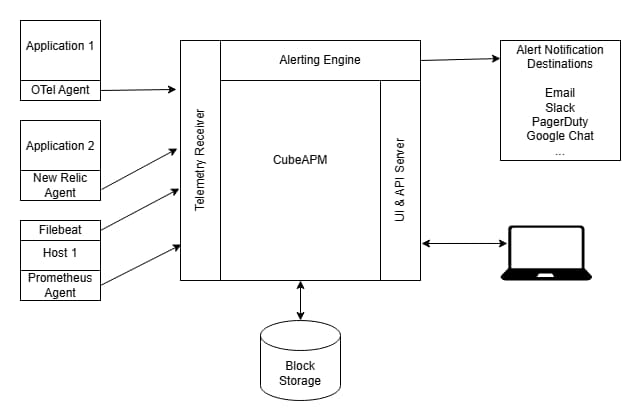
CubeAPM: CubeAPM supports a broad array of agents and instrumentation platforms. For example, it explicitly supports OpenTelemetry (OTel), Prometheus, and even legacy agents from New Relic and Datadog, meaning you can reuse existing instrumentation without being locked into a vendor-specific agent.
Datadog: Datadog primarily works through its own proprietary Datadog Agent, which must be installed on the host to collect metrics, logs, and traces. While it offers many integrations, extending to non-Datadog agents or fully replacing the agent architecture is more constrained.
Honeycomb: Honeycomb supports instrumentation via the OpenTelemetry ecosystem (OTLP exporters), meaning you can send data from any OTel-compatible collector/agent. However, its own native multi-agent support is less broad compared to a full agent catalog model — it leans on the open-standards approach rather than offering a large proprietary agent fleet.
MELT Coverage
This feature evaluates how each platform handles Metrics, Events, Logs, and Traces (MELT) — the core building blocks of modern observability.
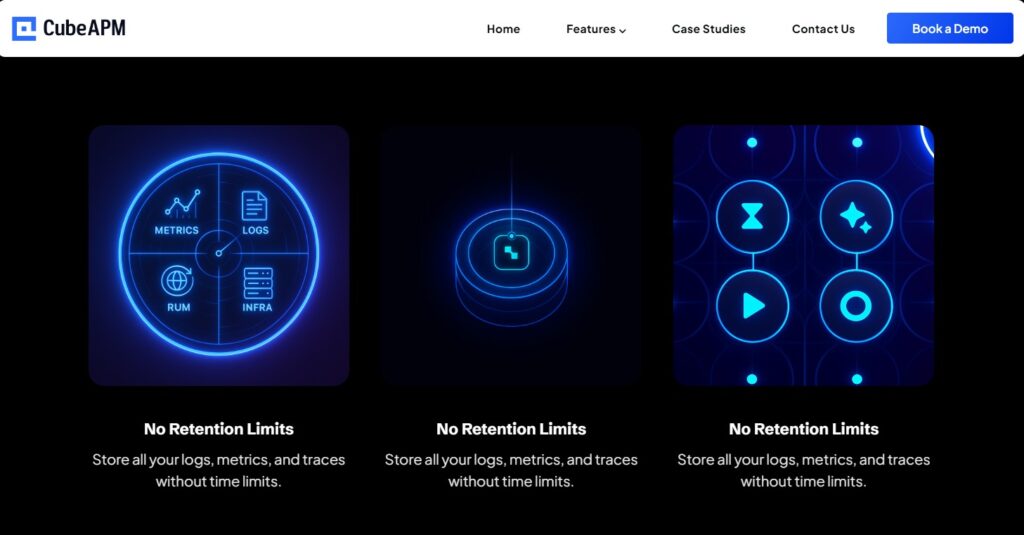
CubeAPM: CubeAPM offers complete MELT coverage with unified dashboards for metrics, logs, events, and traces. It provides a single-pane-of-glass experience that lets users correlate anomalies across data types without switching modules. The platform’s OpenTelemetry-native design ensures seamless ingestion from any standard collector, making it suitable for full-stack visibility across applications, infrastructure, and databases.
Datadog: Datadog also supports full MELT observability but separates each capability into individual products — Infrastructure Monitoring, APM, Logs, RUM, and Events. While this modular setup gives flexibility, it increases cost and complexity as teams need to manage and pay for each component separately. Data correlation between modules requires custom dashboards or linking via Datadog’s Watchdog AI.
Honeycomb: Honeycomb focuses primarily on traces and events for debugging distributed systems. It can ingest metrics via OpenTelemetry and logs through third-party tools, but its architecture is centered on high-cardinality event data and trace analytics. This makes Honeycomb strong in analyzing microservice-level performance but less comprehensive for end-to-end infrastructure metrics and log management.
Deployment (Self-host/Setup)

CubeAPM: CubeAPM supports both self-hosted and vendor-managed (BYOC) deployment options. Teams can run CubeAPM entirely within their own infrastructure or preferred cloud provider while maintaining full control of data residency and compliance. The setup process is streamlined, often taking less than an hour, with automated agent configuration and one-click OpenTelemetry collector integration.
Datadog: Datadog is a fully cloud-hosted SaaS platform. It does not support on-premises or self-hosted deployments, meaning all telemetry data is processed and stored within Datadog’s managed infrastructure. While this ensures quick setup and scalability, it limits organizations with strict data residency or compliance requirements.
Honeycomb: Honeycomb is also SaaS-only and does not provide self-hosted deployment options. Users rely on Honeycomb Cloud for all ingestion, processing, and visualization. While setup is lightweight via OpenTelemetry exporters or Beeline SDKs, data storage and control remain entirely managed by Honeycomb.
Pricing for Small, Medium, & Large Teams
This section highlights how each tool’s pricing model works, helping you compare cost predictability and usage suitability.
To summarize:
*All pricing comparisons are calculated using standardized Small/Medium/Large team profiles defined in our internal benchmarking sheet, based on fixed log, metrics, trace, and retention assumptions. Actual pricing may vary by usage, region, and plan structure. Please confirm current pricing with each vendor.
Cost for Small Teams (~30):
- CubeAPM: $2,080
- Datadog: $8,185
- Honeycomb: $3,000
Cost for Mid-Sized Teams (~125):
- CubeAPM: $7,200,
- Datadog: $27,475
- Honeycomb: $8,100
Cost for Large Teams (~250):
- CubeAPM: $15,200
- Datadog: $59.050
- Honeycomb: $17,200
CubeAPM Costs: Detailed Calculation
CubeAPM: CubeAPM uses a simplified ingestion-based pricing model of $0.15 per GB ingested, and supports self-hosting or BYOC deployment, which allows customers to control infrastructure and data-residency costs.
- Small teams (~ 30): $2,080
- Mid-sized teams (~ 125): $7,200
- Large teams (~250): $15,200
Datadog Costs: Detailed Calculation
Datadog: Datadog uses a host-based pricing model for core services. APM starts around $31 per host per month, infrastructure at ~$15 per host per month, and logs at $0.10 per GB. But costs can escalate rapidly as telemetry volume or host count grows.
- Small teams: $8,185
- Mid-size teams: $27,475
- Large teams: $59,050
Honeycomb Costs: Detailed Calculation
Honeycomb: Honeycomb uses an event-volume pricing model (events per month) rather than purely GB-based; official pricing starts at roughly $130 per month for the Pro tier (covering up to ~100 M events) and provides a baseline rate “starting at ~$0.10 per GB ingest” in their published material. The effective cost per GB may vary (~$0.35-$0.40 per GB at enterprise scale).
- Small teams: $3,000
- Mid-size teams: $8,100
- Large teams: $17,200
Sampling Strategy

CubeAPM: CubeAPM uses smart sampling, an adaptive, context-aware approach that dynamically captures the most valuable traces and metrics based on latency, error rate, and traffic patterns. This allows teams to retain meaningful data while reducing storage needs by over 95%. Sampling is fully automated and tunable per service, making it ideal for high-volume production workloads without losing diagnostic precision.
Datadog: Datadog primarily uses head-based probabilistic sampling, where traces are accepted or dropped at the beginning of a request. That said, Datadog also suppprts tail-based sampling and offers supports probabilistic and adaptive sampling for errors, rare traces, and RUM.
Honeycomb: Honeycomb combines head and tail-based sampling, allowing users to keep significant traces (like errors or latency outliers) after seeing how the request completes. This hybrid model provides deeper insights into outlier events, making it highly effective for debugging and understanding anomalies in production environments.
Log/Data Retention
This feature focuses on how long each platform retains telemetry data and how retention impacts cost, compliance, and historical analysis.

CubeAPM: CubeAPM offers infinite log retention at no additional cost. Because the platform uses ingestion-based pricing and self-hosted storage, users can retain logs, metrics, and traces indefinitely without worrying about tier-based limits or hidden archival charges. This makes it ideal for compliance-heavy industries like fintech or healthcare, where audit trails and long-term observability are critical.
Datadog: Datadog provides a default 15-day log retention window. Users can extend this duration by purchasing additional retention tiers or by archiving logs to external storage such as Amazon S3. However, each additional retention tier incurs separate costs, making long-term storage significantly more expensive for large data volumes.
Honeycomb: Honeycomb’s default retention period is 60 days for most plans. Higher tiers allow extended retention up to 90 days or more, but this comes with additional cost. Logs and traces beyond that window must be exported externally if long-term preservation is needed. This shorter default retention aligns with Honeycomb’s focus on recent, high-cardinality event data rather than historical forensics.
Support Channel, TAT & Pricing
This feature evaluates how each platform delivers customer support, expected response times, and whether priority assistance requires additional payment — a critical aspect for enterprise DevOps and SRE teams.
CubeAPM: CubeAPM offers direct access to core developers via Slack and WhatsApp, providing real-time technical assistance for setup, troubleshooting, and optimization. Response times are typically within minutes, and there’s no extra charge for priority or after-hours support. This model ensures faster resolution cycles and personalized guidance — ideal for teams operating mission-critical systems or scaling observability infrastructure.
Datadog: Datadog provides tiered, community-based support with escalating SLAs depending on the customer’s plan. For standard or pro-tier users, support is available through email and in-app chat, with response times ranging from under 2 hours for critical incidents to up to 48 hours for non-critical issues. Enterprise customers can upgrade to Premier Support for 24×7 coverage, dedicated success managers, and sub-30-minute responses for P1 tickets, at an additional cost.
Honeycomb: Honeycomb delivers structured, email and ticket-based support, backed by comprehensive documentation and an active community forum. Standard support operates during business hours. For Pro users, initial response time is typically within one business day, while Enterprise tier customers receive priority responses within two business hours and enhanced collaboration channels. Real-time or chat-based support is reserved for higher-tier plans, and smaller teams primarily rely on asynchronous assistance.
Known For
This feature summarizes each platform’s core strengths and market positioning, highlighting where each tool performs best.
CubeAPM: CubeAPM is known for its self-hosted, OpenTelemetry-native observability with unified MELT coverage — metrics, events, logs, and traces — under a predictable $0.15/GB pricing model. Its smart sampling (95%+ compression) and infinite retention make it ideal for teams handling large telemetry volumes while maintaining full data control. It’s especially favored by enterprises needing data residency, compliance, and direct developer support.
Datadog: Datadog is a cloud-based SaaS observability suite popular for its wide integrations, AI-driven monitoring, and cloud scalability. It’s well-suited for enterprises that want an all-in-one managed service, though its host-based and per-GB pricing can lead to rising costs as usage grows.
Honeycomb: Honeycomb is recognized for event-driven tracing and high-cardinality debugging across complex microservices. Its tail-based sampling offers deep visibility into outliers and anomalies. While it’s strong in distributed tracing, it provides limited infrastructure and log analytics compared to full-stack platforms.
Which tool is best for you? Why brands choose CubeAPM
Deciding between Datadog, Honeycomb, and CubeAPM comes down to your priorities: manageability, deep tracing, or cost-predictability with full control.
Datadog is best for organizations seeking a mature, enterprise-grade SaaS observability suite with extensive integrations and managed infrastructure. Honeycomb is ideal when your focus is on event-driven tracing, high-cardinality analysis, and drilling deep into microservices irregularities.
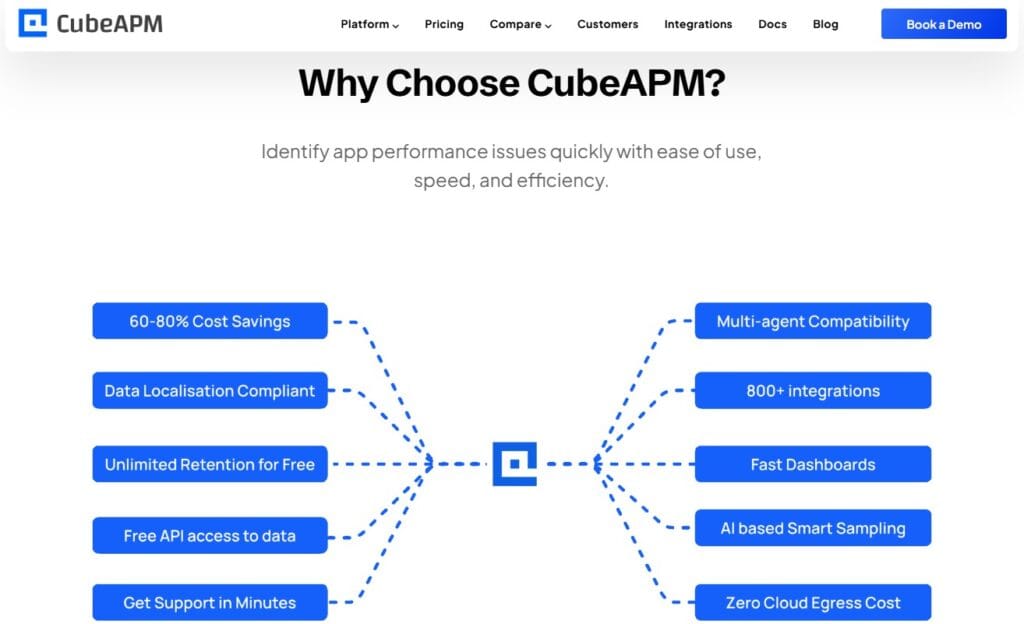
- Self-hosting & data control: Allows you to deploy within your own cloud or on-premise, keeping telemetry data under your control.
- Predictable pricing: Uses an ingestion-based model ($0.15 per GB) so you won’t face escalating host-based or event-based billing surprises.
- Unified MELT stack: Supports metrics, events, logs, and traces in one platform — enabling faster mean-time-to-resolution and easier correlation across data types.
- Smart sampling & unlimited retention: Offers automated context-aware sampling that retains high-value traces while compressing the rest, and supports infinite log retention without tier-based premiums.
With these advantages, CubeAPM becomes the clear winner when you need observability at scale, cost control, and freedom from vendor-lock-in.
Datadog vs Honeycomb vs CubeAPM: Use Cases
Here’s how Datadog, Honeycomb, and CubeAPM fit into different real-world observability needs. Each platform serves distinct priorities depending on scale, compliance, and data strategy.
Choose Datadog if:
Datadog is designed for teams that want an all-in-one, managed SaaS observability suite with powerful integrations and built-in dashboards.
- Cloud-native enterprises: Ideal for organizations operating across AWS, Azure, or GCP and looking for ready-made integrations with cloud services.
- Large DevOps teams: Suitable for enterprises managing thousands of hosts that require centralized visibility, automated alerts, and correlation across metrics, logs, and traces.
- Faster time to deploy: Setup requires minimal configuration—data starts flowing quickly via the Datadog agent.
- AI-driven insights: Its Watchdog AI helps surface anomalies automatically, though at higher tiers.
- Budget flexibility: Works best for teams comfortable with host-based and per-GB pricing, as costs can scale quickly based on data volume.
Choose Honeycomb if:
Honeycomb is best for teams focused on debugging distributed systems and analyzing high-cardinality event data in real time.
- Event-rich microservices: Excellent for analyzing millions of spans to detect latency spikes, request anomalies, or unpredictable service interactions.
- Engineering-led observability: Built for developers who prefer exploring data via traces instead of dashboards, using Honeycomb Query Builder and BubbleUp visualizations.
- Tail-based sampling: Retains only meaningful traces—errors, outliers, or high-latency requests—reducing noise without losing diagnostic context.
- Lightweight instrumentation: Integrates easily with OpenTelemetry SDKs or Honeycomb Beelines, making it simple to add observability to new codebases.
- Short-lived workloads: Works best for modern cloud-native applications with ephemeral infrastructure and 60–90-day data retention cycles.
Choose CubeAPM if:
CubeAPM is built for organizations that want complete visibility, predictable pricing, and full control over their data through self-hosting or BYOC deployment.
- Full-stack observability: Covers metrics, events, logs, and traces (MELT) under one unified view, simplifying root cause analysis and performance optimization.
- Predictable pricing model: Based on our sales data, CubeAPM’s $0.15/GB ingestion pricing saves up to 70% compared to host-based or event-based billing used by competitors.
- Data sovereignty and compliance: Ideal for teams in regulated sectors (like fintech, BFSI, and healthcare) requiring compliance through on-prem or cloud-hosted control.
- Smart sampling for large-scale systems: Automatically prioritizes high-value traces and compresses the rest by 95%, ensuring efficient storage without losing visibility.
- Reduced MTTR: Unified dashboards and contextual trace correlation help teams resolve issues faster across distributed services.
- For startups and large enterprises alike: Startups value its low entry cost and simplicity, while large enterprises benefit from its scalability, automation, and multi-agent compatibility (OpenTelemetry, Datadog, and New Relic agents).
Conclusion
In the Datadog vs Honeycomb vs CubeAPM comparison, it’s clear that Datadog’s steep, host-based pricing and Honeycomb’s trace-only focus limit both scalability and visibility across modern cloud environments.
CubeAPM eliminates these gaps with an OpenTelemetry-native, full-stack observability platform that unifies metrics, events, logs, and traces (MELT) under a predictable $0.15/GB ingestion model. Unlike SaaS-only rivals, CubeAPM offers self-hosted or BYOC flexibility, infinite data retention, and smart sampling with 95%+ compression, ensuring efficiency without compromise.
Start your free 30-day trial today and see why leading teams are switching to CubeAPM.
Disclaimer: The information in this article reflects the latest details available at the time of publication and may change as technologies and products evolve.
FAQs
1. Is CubeAPM cheaper than Datadog and Honeycomb?
Yes. Based on our demo and sales data, CubeAPM’s $0.15/GB ingestion-based pricing is up to 70% more cost-efficient than Datadog’s host-based or Honeycomb’s event-based pricing models. Teams ingesting several terabytes per month benefit from predictable billing and no surprise overages.
2. Can CubeAPM be self-hosted or deployed in my own cloud?
Absolutely. CubeAPM supports self-hosted and BYOC (Bring Your Own Cloud) deployment models, giving you complete control over data residency, compliance, and infrastructure — something neither Datadog nor Honeycomb currently offers.
3. Does Honeycomb offer full-stack observability?
Not entirely. Honeycomb focuses primarily on traces and events, which makes it strong for debugging microservices but limited for metrics, logs, and infrastructure monitoring. CubeAPM, by contrast, provides complete MELT (Metrics, Events, Logs, Traces) coverage for unified observability.
4. How does CubeAPM reduce storage and operational costs?
CubeAPM uses smart sampling — a context-aware algorithm that retains high-value traces while compressing redundant data by 95%. Combined with flat ingestion pricing and infinite retention, it ensures scalable observability at a fraction of the cost of SaaS competitors.
5. Who should choose CubeAPM?
CubeAPM is perfect for startups and enterprises seeking a transparent, cost-stable, and compliance-ready observability platform. It’s ideal for DevOps and SRE teams managing complex microservices who need deep visibility, predictable pricing, and total data ownership.