








AIOps applies machine learning and data analytics to operational telemetry, metrics, logs, traces, and events, to automate work that would otherwise take an engineer manually correlating alerts and tracing a root cause by hand. Nearly every observability platform now markets some version of this, and the label has stopped signaling much about actual capability.
That creates a real problem for evaluation. Teams comparing vendors have no reliable way to tell a capability running in production at scale from one still closer to a roadmap slide, and that gap decides whether an AIOps investment cuts incident load or adds another dashboard nobody fully trusts.
Gartner projects that by 2028, 40 percent of I&O organizations running agentic IT operations at scale in production will face a business-critical disruption caused by those very systems, up from under 1 percent in 2026, according to Gartner’s projection. Precision matters more than enthusiasm here.
This article covers what’s actually production-proven in AIOps today, what’s still aspirational, and what has to be true in the underlying telemetry for either to work.
What AIOps Actually Means?
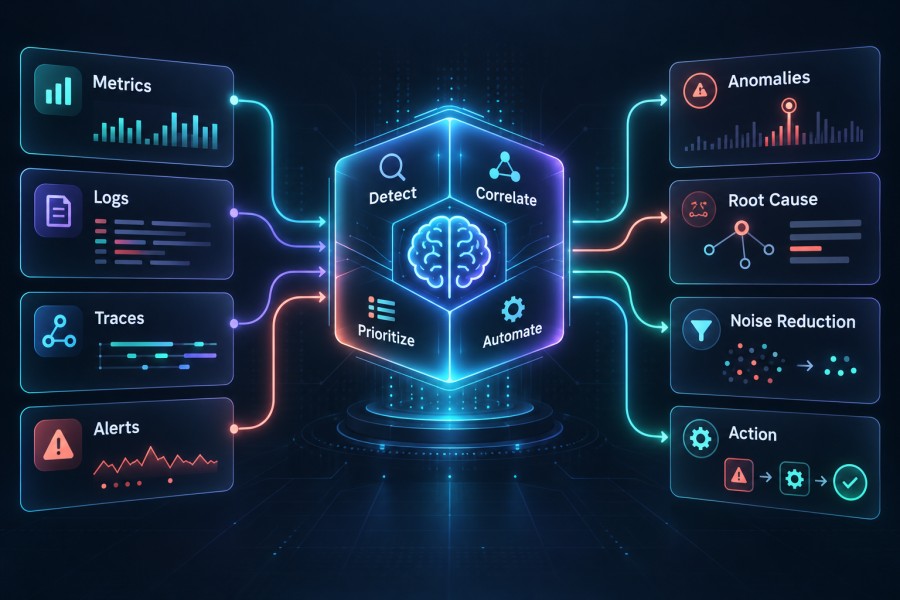
AIOps is the application of machine learning and data analytics to IT operations data, metrics, logs, traces, and events (MELT) to automate and enhance work that otherwise demands manual engineering effort. In practical terms, that spans a specific set of tasks:
- Correlating signals across otherwise disconnected monitoring tools
- Detecting anomalies in metric or log behavior
- Narrowing down likely root causes using topology and telemetry context
- Triggering remediation directly, in more limited and governed cases
Where the term actually comes from
The label dates to 2017, when Gartner first coined it. But the practice it describes, applying statistical and machine learning methods to operational telemetry, existed before the term and isn’t owned by Gartner, by any other analyst firm, or by any single vendor. The underlying techniques are useful on their own merits, independent of whichever marketing term a platform happens to attach to them this year.
Why the label alone tells you very little
What “AIOps” doesn’t communicate is which of those techniques a specific product actually ships, or at what level of maturity. Two platforms can both claim to be AI-powered while one runs a production-hardened correlation engine and the other bolts a thin anomaly detector onto an existing dashboard. The term draws no line between them, which is exactly why it has become such an unreliable signal for anyone trying to evaluate real capability rather than a marketing claim.
The Term Just Got a Major Reality Check
For years, “AIOps” meant whatever a given vendor wanted it to mean. In March 2025, the industry’s own leading analyst firm effectively said as much, and walked the term back.
Gartner retired the category, not just the definition
Gartner formally retired “AIOps Platforms” as a market category in its March 2025 Market Guide, replacing it with a new one, Event Intelligence Solutions. This wasn’t a rebrand for its own sake. Gartner cited widespread vendor overuse of the term “AIOps,” applied so inconsistently across products that buyers had no reliable way to compare offerings, and the resulting confusion and disillusionment among infrastructure and operations leaders whose expectations the category had repeatedly failed to meet.
That is a notable admission from an analyst firm that coined the term in the first place. It amounts to Gartner acknowledging that eight years of vendor marketing had eroded the label past the point of being useful for evaluation, and that a narrower, more precisely scoped category was needed to replace it.
The industry hasn’t fully agreed on what comes next
Here’s where it gets messier for anyone trying to use analyst terminology as a shortcut. Forrester, the other major analyst firm covering this space, continues using “AIOps” as its primary label, having published an updated Wave report under that exact name in the same general period. Two firms whose research shapes enterprise buying decisions are currently using different terms for overlapping technology, which means the terminology itself is contested, not settled.
What this actually means for evaluating a vendor
None of this changes what the underlying technology can or can’t do. What it changes is how much weight a buyer should put on the label a vendor chooses to use.
- A vendor calling its product “AIOps” isn’t automatically behind the curve, since Forrester’s own current research still uses that term
- A vendor calling its product an “Event Intelligence Solution” isn’t automatically more credible just for adopting Gartner’s newer phrasing
- What actually matters is which specific capability tier a given claim falls into: correlation, detection, root cause analysis, or remediation- a distinction the next section breaks down directly, since the label itself won’t do that work for you
What AIOps Actually Does, and How Mature Each Capability Really Is
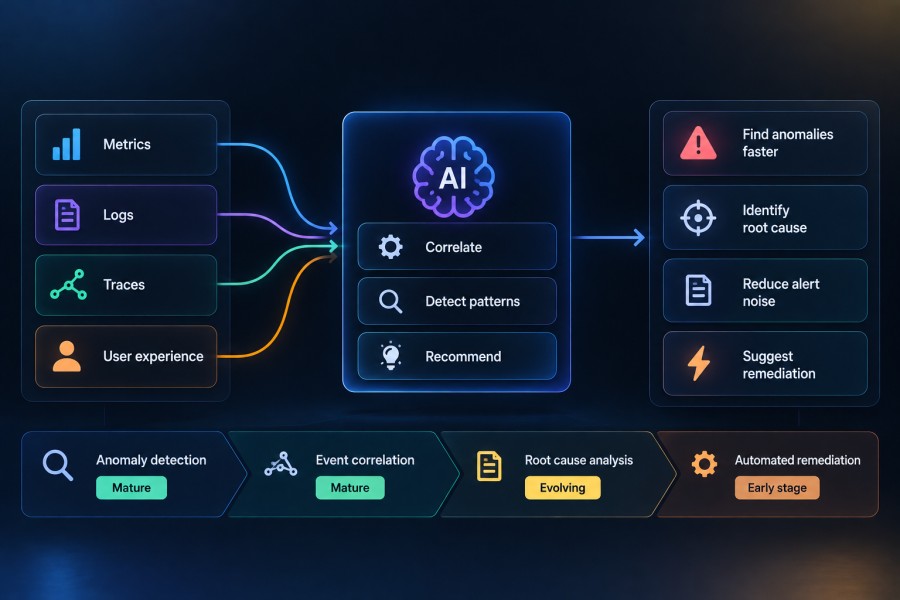
Underneath every AIOps or Event Intelligence pitch sits the same four capabilities, in some combination. What varies enormously, and what actually determines whether a deployment succeeds, is how mature each one is in practice.
Alert correlation and deduplication
This is the capability that started the entire category, and it remains the strongest.
- Groups related alerts firing from disparate monitoring tools into a single actionable incident, instead of leaving an on-call engineer to manually recognize that five alerts describe the same underlying problem
- Requires consistent attributes and shared identifiers across the tools feeding it: service names, trace IDs, timestamps aligned closely enough to correlate reliably
- Maturity today: production-proven. This is the most widely validated capability in the category, deployed successfully across enterprise environments for long enough that its limitations are well understood rather than still being discovered
Anomaly detection
Anomaly detection identifies that a metric is behaving unusually. It does not, on its own, explain why.
- Statistical or machine learning models flag deviations from an established baseline, a latency spike, an error rate climbing outside its normal range, a resource metric trending somewhere it shouldn’t
- Effectiveness depends heavily on how well that baseline reflects the actual environment; a model trained on generic patterns produces far noisier results than one tuned to a specific service’s real traffic behavior
- Maturity today: mature, but reliably noisy without tuning. Widely deployed and technically sound, though a poorly tuned deployment generates enough false positives to erode trust in the tool within weeks
Root cause analysis
This is where the promise of AIOps starts to run into the limits of what any AI layer can actually do with the data it’s given.
- Uses topology mapping and correlated telemetry to narrow a likely cause down from a broad set of possibilities to a specific service, function, or dependency
- Genuinely reduces investigation time when the underlying telemetry is well correlated, since the model has clean signal to reason over instead of having to guess at relationships between systems
- Maturity today: useful, but bounded, and bounded specifically by data quality, not by the sophistication of the AI model itself. A more advanced model fed fragmented, uncorrelated telemetry will not outperform a simpler model fed clean, correlated data. This distinction matters enough that it gets its own section later in this article
Predictive and remediation capabilities
This is the tier where most of the current marketing energy concentrates, and where the gap between claim and reality is widest.
- Ranges from prioritized recommendations, surfacing a likely fix for a human to approve and execute, to fully autonomous remediation, where the system takes action without a human in the loop at all
- Prioritized recommendations are reasonably mature in narrow, well-understood scenarios, restarting a known-flaky service, scaling a resource that’s predictably under load
- Fully autonomous remediation across broad, varied production environments remains largely aspirational. Most deployments claiming this today are running it in tightly scoped, heavily governed pilot cases, not broadly across an unpredictable production estate
- Maturity today: still largely aspirational outside those narrow cases, which is exactly where Gartner’s disruption risk projection from the introduction concentrates
The pattern across all four
| Capability | Production readiness | What still limits it |
| Alert correlation and deduplication | Production-proven | Requires consistent attributes across tools to correlate accurately |
| Anomaly detection | Mature, needs tuning | False positives without environment-specific baselines |
| Root cause analysis | Useful, bounded | Accuracy depends on telemetry correlation quality, not AI sophistication |
| Autonomous remediation | Largely aspirational | Governance and disruption risk, per Gartner’s own 2028 projection |
Read down that table and a pattern emerges that has nothing to do with how advanced any given vendor’s model is. Maturity tracks almost exactly with how much the capability depends on clean, correlated telemetry versus how much it depends on the AI layer acting with real autonomy. The capabilities closest to the data are the most reliable. The ones furthest from it, asking the system to act rather than just interpret, are the ones still catching up.
A Practical Example: Correlation in Action
The table above makes an abstract claim: capability tracks telemetry quality, not AI sophistication. Here’s what that actually looks like inside a real incident.
The scenario
Picture a mid-sized e-commerce platform on a normal weekday afternoon. Checkout latency starts climbing. Within minutes, three separate alerts fire, each from a different monitoring tool covering a different layer of the stack.
- A database monitoring tool flags elevated CPU on the primary order database
- An APM tool flags a rising rate of 500 errors on the checkout service
- A third-party integration monitor flags a timeout against the payment gateway
What happens without correlation
Three alerts, three different on-call engineers, three separate investigations starting from scratch. Each engineer sees their own slice of the problem and has no immediate way to know the other two alerts even exist, let alone that they describe the same incident. The database engineer starts checking for a runaway query. The application engineer starts looking at recent deploys to the checkout service. Twenty minutes pass before anyone realizes, usually through a Slack thread rather than any tool surfacing it directly, that all three teams are chasing the same incident from different angles.
What changes with shared trace context
Now run the same incident through a stack where every signal- the database query, the checkout service span, and the payment gateway call- shares a common trace ID from the moment it was collected. An alert correlation engine sees all three alerts reference the same trace within the same time window and groups them into a single incident automatically. The trace itself shows the sequence directly: the payment gateway timeout came first, the checkout service’s 500 errors followed as requests piled up waiting on that timeout, and the database CPU spike was a downstream effect of retry logic hammering the order table, not the original cause at all.
What actually made the difference
Nothing about this required a more advanced AI model. The correlation engine doing the grouping is a mature, relatively simple capability, the kind rated production-proven in the table earlier. What made it work was that the telemetry feeding it already shared consistent trace context across three separate systems- database, application, and third-party integration- at the moment each signal was collected.
Without that shared context, no correlation engine, however sophisticated, has anything reliable to correlate against. That single fact is the thread the rest of this article pulls on directly.
Where AIOps Breaks Down
The correlation example above shows what AIOps looks like when it works. Most of the disappointment teams report doesn’t come from a weak AI model. It comes from a handful of specific, recurring conditions that have nothing to do with how advanced the model is.
Fragmented, uncorrelated telemetry
This is the failure mode the case study just walked through in reverse. Without shared context across signals, an AI layer has nothing reliable to correlate against, covered in full detail above rather than repeated here.
Over-trusting automation without human-in-the-loop guardrails
The gap between a recommendation and an action is where the real risk sits, and it’s also where a lot of deployments quietly erase that gap faster than the underlying capability actually supports.
- A system that recommends a fix is fundamentally different from one that executes it unsupervised, even when both get marketed under the same “autonomous remediation” label.
- Removing a human checkpoint before that gap has been thoroughly tested in a specific environment is exactly the pattern behind Gartner’s disruption projection from the introduction: business-critical incidents caused by the automation itself, not prevented by it.
- Teams that skip a staged rollout, starting with recommendations only, then narrow, reversible automated actions, then broader scope, are the ones most likely to end up as part of that statistic rather than ahead of it.
Alert fatigue that changes shape instead of disappearing
The promise of AIOps is fewer, more meaningful alerts. What actually happens when correlation logic isn’t tuned to the specific environment is a different, less obvious version of the same problem.
- Poorly tuned correlation still produces a high volume of alerts, just grouped into a high volume of low-confidence AI-generated incidents instead of raw individual ones
- Engineers still have to manually verify whether each grouped incident is accurate before trusting it, which reintroduces much of the manual triage work the tool was meant to remove
- This version of alert fatigue is harder to notice than the original, since the dashboard looks cleaner even when the underlying trust problem hasn’t actually gone away
Why the Telemetry Foundation Matters More Than the AI Layer
Every failure mode in the previous section traces back to the same root cause. It’s worth stating plainly, since it’s the argument this entire article has been building toward.
AIOps tooling, regardless of vendor, regardless of how the category gets labeled this year, is only as good as the correlation quality of the metrics, logs, and traces feeding it. Correlated context is what turns a raw anomaly into an actionable root cause. Without it, the AI layer is reasoning over disconnected fragments and guessing at relationships a well-instrumented system would have made explicit from the start.
The real cost of a fragmented stack
A stack running multiple monitoring tools, each with its own attribute naming, its own timestamp precision, and no shared trace context between them, forces the AI layer to reconstruct correlation after the fact. That reconstruction is exactly where accuracy degrades, and it’s the same gap that turned a straightforward checkout incident into three separate investigations in the case study earlier. No model sophistication fixes a correlation problem that originates upstream, in how the data was collected in the first place.
Where CubeAPM stands in this picture
CubeAPM does not offer AIOps or autonomous remediation features today. That’s worth saying plainly rather than implying otherwise.
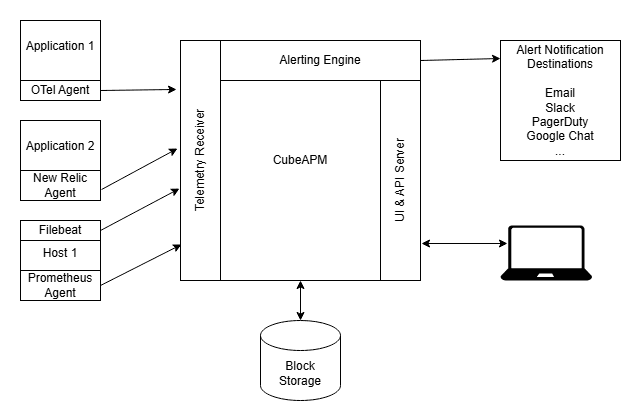
What it does provide is OTel-native ingestion of traces, metrics, and logs that share consistent context from the moment of collection, not stitched together afterward through a translation layer. That consistent context is the foundational layer any AIOps or Event Intelligence tool depends on to work well, whether that tool ships from CubeAPM’s own future roadmap or from an entirely separate platform layered on top.
This is an infrastructure point, not a feature pitch. A team evaluating AIOps tooling should be asking at least as many questions about the telemetry foundation underneath it as about the AI layer sitting on top, since the table earlier in this article makes clear which one actually determines the outcome.
What to Actually Evaluate When a Vendor Says “AI-Powered”
Everything covered so far points to the same practical conclusion. When a vendor pitches an AI-powered observability platform, three questions cut through most of the marketing faster than anything else.
Naming the capability, not the umbrella term
“AI-powered” spans everything from a mature correlation engine to a remediation feature still running in limited pilots. Ask specifically which of the four capabilities covered earlier in this article the claim falls under:
- Alert correlation
- Anomaly detection
- Root cause analysis
- Remediation
Push for a direct answer rather than accepting the umbrella term. A vendor confident in their correlation engine will usually say so specifically, since it’s their strongest, most defensible claim. Vague answers that stay at the “AI-powered” level without naming a specific capability are usually a sign the underlying feature is newer, or less proven, than the pitch suggests.
The data question that matters more than the model
Ask what the AI layer is actually reasoning on before asking how smart the model is. This connects directly back to the telemetry foundation argument earlier in this article, since a correlation or root cause claim is only as strong as the data feeding it. Two answers are possible here, and they’re not equivalent.
Telemetry can be correlated at the source, sharing consistent trace context and attributes from the moment of collection, or it can be stitched together after ingestion through a translation or mapping layer. The second approach can still work, but it introduces a dependency and a failure point the first one doesn’t have, and it’s worth knowing which one you’re actually buying into before signing anything.
What backstops a wrong call before it ships to production
Every model makes mistakes eventually. What actually protects a production environment is whatever stands between a wrong recommendation and a wrong action, and a dashboard showing what the AI did after the fact doesn’t count as that protection.
Two questions get past that easily:
- Does a human-in-the-loop step exist before any automated action executes
- How have the vendor’s own customers staged their rollout of automated actions over time
A vendor with real production deployments will have a concrete, specific answer to the second question. One without real deployments will tend to talk in hypotheticals instead.
Conclusion
AIOps in 2026 is genuinely useful for the parts that have earned it. Alert correlation works. Anomaly detection works, once tuned. Root cause analysis works, bounded by how correlated the underlying telemetry actually is. Autonomous remediation, for now, mostly doesn’t, not at the scale the marketing suggests.
The category’s own analyst firm walking back its name in 2025 wasn’t a footnote. It was an admission that vendor overreach had made the term nearly useless for evaluation, and that’s the clearest sign yet that the hype cycle here is correcting itself.
None of this makes AI in observability a bad bet. It makes precision the differentiator, not enthusiasm. Ask what capability a claim describes, what data it reasons on, and what stands between a wrong call and a production incident. And before any of that matters, make sure the telemetry underneath is actually correlated. CubeAPM ingests traces, metrics, and logs natively over OTLP, which is where that foundation starts.
FAQ
What is the difference between AIOps and Event Intelligence Solutions?
Event Intelligence Solutions is Gartner’s narrower 2025 replacement for what it previously called AIOps Platforms, scoped specifically to cross-domain event correlation rather than the broader, looser use the original term had accumulated. The rename didn’t retire the underlying technology; it retired a label Gartner itself said had become too diluted to evaluate vendors against. Forrester continues publishing under the AIOps name, so both terms are currently in active use for overlapping technology, and neither one is the “correct” or “outdated” choice on its own.
Does AIOps actually reduce MTTR in production?
Yes, primarily through alert correlation and anomaly detection, which are the most mature capabilities in the category. Reductions vary by deployment and how well the underlying telemetry is correlated, but this is the part of AIOps with the strongest production track record.
Is fully autonomous incident remediation realistic in 2026?
Only in narrow, well-governed cases, like restarting a known-flaky service or scaling a predictably loaded resource. Broad, unsupervised remediation across a full production environment remains largely aspirational, and Gartner projects rising disruption risk specifically at that level of autonomy through 2028.
What data does AIOps need to work well?
Correlated, consistent telemetry above all else: metrics, logs, and traces sharing context like trace IDs and service attributes from the moment of collection. A more advanced AI model cannot compensate for fragmented, uncorrelated data feeding it.
Is AIOps the same as AI observability?
Not exactly. AI observability generally refers to monitoring AI and ML systems themselves. AIOps refers to using AI to improve IT operations and observability workflows. The terms get used loosely and sometimes interchangeably in marketing, but they describe different things.
Disclaimer: This article reflects analyst terminology, market category definitions, and statistics as of the publish date. Vendor capabilities in this space are changing quickly; verify current documentation and analyst reports directly before making evaluation decisions.