









IBM Instana is an enterprise observability platform built for application performance monitoring, distributed tracing, infrastructure monitoring, Kubernetes visibility, end-user monitoring, and root cause analysis. IBM describes Instana as an automated, AI-powered observability platform that discovers and instruments applications and infrastructure to provide real-time full-stack visibility.
The pricing model is one of the biggest reasons buyers research IBM Instana carefully. Instana does not mainly price like pure ingestion-based tools. Its core licensing unit is the Managed Virtual Server, or MVS. IBM defines an MVS as a licensing unit that can include physical machines, virtual servers, or worker nodes and says customers need an MVS license for each managed virtual server.
This IBM Instana pricing and review explains how IBM Instana pricing works in 2026, what the real cost drivers are, where the draft pricing needed correction, what users praise and criticize, and how Instana compares with CubeAPM, Datadog, Dynatrace, New Relic, Splunk AppDynamics, and Splunk Observability Cloud.
What Is IBM Instana?
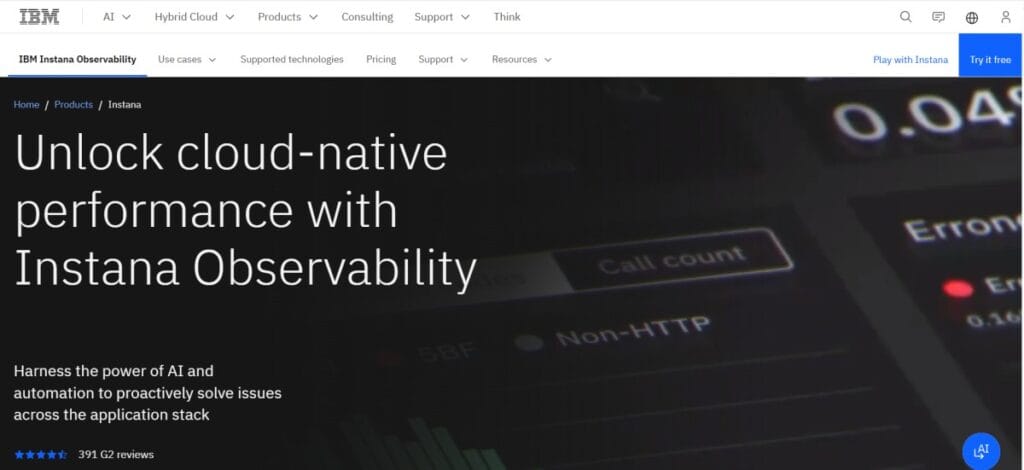
IBM Instana is an observability platform for analyzing and troubleshooting microservices, containerized applications, and complex distributed systems. IBM’s documentation says Instana provides automated APM, end-user experience monitoring, root cause analysis, and anomaly detection.
Instana is used by engineering, DevOps, SRE, and platform teams that need visibility across applications, services, infrastructure, containers, Kubernetes clusters, databases, and user-facing digital experiences.
The platform is especially strong in dynamic environments because it automatically discovers applications, services, endpoints, and infrastructure relationships. IBM’s service documentation says Instana traces and analyzes every request, automatically discovers services and endpoints, and correlates relationships through its Dynamic Graph.
Key IBM Instana Features
Automatic discovery is one of Instana’s main strengths. IBM says Instana automatically discovers and instruments applications and infrastructure, which helps teams reduce manual setup and get faster visibility into complex environments.
This is useful for Kubernetes, microservices, hybrid cloud, and fast-changing production systems where static dashboards quickly become outdated.
Instana supports end-to-end tracing across services, endpoints, and infrastructure. IBM’s documentation says Instana traces and analyzes every request and automatically correlates service relationships.
For teams running microservices, this helps identify slow services, broken dependencies, database bottlenecks, and API failures faster than metric-only monitoring.
Instana supports Kubernetes monitoring through the Instana host agent. IBM’s Kubernetes documentation says the agent must be installed in the Kubernetes cluster and tracks host coverage across cluster nodes.
This makes Instana a strong fit for teams that need visibility into clusters, nodes, pods, services, workloads, and containerized applications.
IBM Instana supports website monitoring by analyzing real browser request times and route loading times. IBM says this gives teams insight into the user browsing experience and application call paths.
This matters because backend health does not always equal good user experience. RUM helps teams connect frontend performance with backend services.
IBM’s documentation says synthetic monitoring in Instana simulates user interactions from different geographic locations to test application availability and performance before real users are affected.
However, managed synthetic points of presence are treated as an add-on on the pricing page, starting at $0.0003 per execution.
Instana supports OpenTelemetry data ingestion. IBM’s tracing documentation says Instana supports ingesting OpenTelemetry data through the Instana host agent, and IBM’s pricing page lists OTel data collection as part of the Standard tier feature set.
This is important for teams that want vendor-neutral instrumentation or are already standardizing around OpenTelemetry.
Instana supports logs in context, but this is not the same as unlimited free log ingestion. IBM’s pricing page lists “Logs in context” as an add-on and shows log ingestion starting at $0.35 per GB with 30, 60, or 90-day retention options.
This is one of the most important pricing corrections to make in the draft.
IBM Instana Pricing 2026
IBM Instana pricing is based mainly on MVS licensing.
IBM’s pricing page says the price is calculated as:
Number of MVS × discounted price per MVS
IBM also states that prices are indicative, can vary by country, exclude taxes and duties, and depend on availability in the customer’s locale.
Instana pricing tiers
IBM’s current pricing page lists two main offering levels:
| Tier | Public description |
| Essentials | Infrastructure discovery, mapping, and monitoring |
| Standard | Full-stack observability with application-centric features such as tracing, log management, real-time change detection, synthetic monitoring, website observability, mobile observability, AI/LLM observability, OTel collection, and more |
IBM’s FAQ says Essentials focuses on infrastructure discovery, mapping, and monitoring, while Standard includes more advanced application-centric capabilities such as code-level visibility, tracing, log management, and real-time change detection.
Minimum order quantity
IBM’s pricing FAQ says a Standard Instana license has a minimum order quantity of 10 hosts and includes unlimited users and support for 300+ technologies.
That means very small teams should be careful. Even if they only need to monitor a few production systems, the public FAQ points to a 10-host minimum for Standard licensing.
Fair-use ingestion policy
IBM’s pricing page lists a fair-use policy for SaaS MVS entitlements:
| Plan | Included fair-use ingestion |
| Standard SaaS MVS | 325 GB per MVS per month |
| Essentials SaaS MVS | 50 GB per MVS per month |
IBM says ingestion is averaged across entitlements. For example, 10 Standard SaaS MVS provide 3,250 GB of default monthly fair-use ingestion across those licenses. IBM also says data ingest is not capped, but usage above entitlement appears as On-Demand Data Ingest or can require an add-on.
Add-ons
| Add-on | Public starting price |
| Managed synthetic PoP executions | $0.0003 per execution |
| Logs in context | $0.35 per GB |
Deployment options
IBM documents three main deployment options:
| Deployment option | Description |
| SaaS | Fully managed by IBM in the cloud |
| Self-hosted Standard Edition | Simplified self-hosted deployment on single-node or multi-node clusters |
| Self-hosted Custom Edition | Advanced self-hosted deployment on Kubernetes clusters |
This means Instana is not SaaS-only. It can also support self-hosted deployment models for teams with compliance, data residency, or internal control requirements.
What Does IBM Instana Really Cost?
⚠️ Disclaimer
The scenarios below are directional editorial estimates based on IBM Instana’s public pricing information, AWS Marketplace pricing references, and usage assumptions. They are not official IBM quotes. Actual pricing can change based on country, contract terms, discounts, deployment model, MVS count, data ingest above fair-use allowance, log packaging, synthetic monitoring usage, support level, and enterprise agreements.
IBM Instana pricing is mainly based on Managed Virtual Servers, or MVS. For these estimates, we treat each monitored host, VM, or Kubernetes worker node as one MVS proxy because IBM describes Instana licensing around hosts/MVS units. Buyers should still confirm exact MVS counting with IBM, especially for Kubernetes, virtualization, and hybrid-cloud environments.
IBM’s Standard SaaS fair-use policy provides 325 GB of data ingest per Standard MVS per month. In the scenarios below, the estimated telemetry volume stays below the fair-use allowance, so we do not add separate ingest overage. IBM also lists managed synthetic PoP usage separately, so synthetic executions are modeled as an extra line item.
Pricing Assumptions
These scenarios use IBM Instana Standard because the workloads include APM traces, infrastructure monitoring, logs, real-user monitoring, synthetic checks, and full-stack observability needs.
For the main model, we use the commonly referenced IBM Instana Standard estimate of $75 per MVS/month. AWS Marketplace also lists Standard MVS contract pricing at $954/year, or about $79.50 per MVS/month, so the real quote may vary slightly depending on the marketplace, region, and contract.
| Pricing item | Assumption used |
| Standard MVS license | ~$75 per MVS/month |
| Standard SaaS fair-use ingest | 325 GB per MVS/month |
| Managed synthetic execution | ~$0.0003 per execution |
| Data ingest overage | $0 because usage remains below fair-use allowance |
| RUM / EUM | Treated as part of Standard APM licensing |
| Logs | Treated as part of the telemetry profile unless IBM quotes Logs in Context separately |
Important note: IBM may price Logs in Context separately depending on packaging, retention, and contract terms. To keep the mid-market estimate closer to the base Instana model, the main estimate below does not add a separate $0.35/GB log charge. If IBM quotes logs separately, the total cost can increase.
Workload Assumptions
| Team size | MVS assumption | Logs | Traces | Metrics | Total telemetry | RUM sessions | Synthetic executions |
| Small team | 10 MVS | 720 GB | 360 GB | 1 GB | ~1.1 TB/month | 5,000 | 52,000 |
| Growing team | 50 MVS | 3.6 TB | 1.8 TB | 5 GB | ~5.4 TB/month | 50,000 | 520,000 |
| Mid-market team | 250 MVS | 18 TB | 9 TB | 25 GB | ~27 TB/month | 200,000 | 2,080,000 |
For synthetic monitoring, the estimate combines API test runs and browser test runs.
Scenario 1: Small Team, 10 MVS + ~1.1 TB Telemetry/Month
Situation
A small engineering team runs a few production services, APIs, databases, background jobs, and Kubernetes workloads. The team needs APM traces, infrastructure monitoring, log search, real-user visibility, alerting, and synthetic checks, but it does not yet have a dedicated observability team.
Why teams at this stage consider IBM Instana
Teams at this stage may consider IBM Instana because MVS pricing is easier to forecast than a pricing model built from many separate meters. The main bill follows monitored infrastructure rather than every user, dashboard, service, or request.
Estimated Cost
Disclaimer: This is a directional editorial estimate. Actual cost may vary based on the exact pricing selector result, contract terms, billing cycle, and add-ons.
| Component | Calculation | Monthly cost |
| Standard MVS licensing | 10 × $75 | ~$750 |
| Managed synthetic executions | 52,000 × $0.0003 | ~$16 |
| Data ingest overage | ~1.1 TB used vs ~3.25 TB fair-use allowance | $0 |
| RUM / EUM | Included in Standard APM model | $0 |
| Total estimated IBM Instana cost | $750 + $16 | ~$766/month |
At a small-team scale, the MVS license is the main cost driver. The estimated telemetry volume is around 1.1 TB/month, while 10 Standard MVS provide about 3.25 TB/month of fair-use ingest allowance. This means the workload appears to remain within the fair-use allowance before contract-specific log packaging is considered.
IBM Instana vs CubeAPM Cost
| Platform | Estimated monthly cost |
| IBM Instana | ~$766/month |
| CubeAPM | ~$522/month |
| Estimated monthly savings with CubeAPM | ~$244/month |
| Estimated annual savings with CubeAPM | ~$2,928/year |
CubeAPM is more affordable in this small-team example because it bills by GB ingested instead of MVS count. For a team ingesting around 1.1 TB/month, CubeAPM gives a simpler cost path while still supporting OpenTelemetry-native observability, traces, logs, metrics, and self-hosted deployment with vendor management.
Scenario 2: Growing Team, 50 MVS + ~5.4 TB Telemetry/Month
Situation
A growing SaaS team runs more production services, APIs, Kubernetes workloads, databases, background jobs, queues, and customer-facing workflows. The team needs full-stack observability across traces, metrics, logs, RUM, alerting, and synthetic checks.
Why teams at this stage consider IBM Instana
At this stage, IBM Instana’s MVS model can still be easier to understand than platforms that combine host billing, user seats, indexed logs, trace volume, dashboards, and add-on products. However, the MVS count now becomes a meaningful monthly budget line.
Estimated Cost
Disclaimer: This is a directional editorial estimate. Actual cost may vary based on the exact pricing selector result, contract terms, billing cycle, and add-ons.
| Component | Calculation | Monthly cost |
| Standard MVS licensing | 50 × $75 | ~$3,750 |
| Managed synthetic executions | 520,000 × $0.0003 | ~$156 |
| Data ingest overage | ~5.4 TB used vs ~16.25 TB fair-use allowance | $0 |
| RUM / EUM | Included in Standard APM model | $0 |
| Total estimated IBM Instana cost | $3,750 + $156 | ~$3,906/month |
At growing-team scale, the Instana bill is shaped mostly by the 50 MVS license. The estimated telemetry volume is around 5.4 TB/month, while the Standard fair-use allowance is about 16.25 TB/month. So in this model, there is no extra data ingest overage.
Synthetic monitoring adds a smaller but visible cost. With 500,000 API runs and 20,000 browser runs, the team has about 520,000 synthetic executions per month, adding around $156/month.
IBM Instana vs CubeAPM Cost
| Platform | Estimated monthly cost |
| IBM Instana | ~$3,906/month |
| CubeAPM | ~$919/month |
| Estimated monthly savings with CubeAPM | ~$2,987/month |
| Estimated annual savings with CubeAPM | ~$35,844/year |
CubeAPM becomes much more cost-effective at this stage. The growing team is ingesting around 5.4 TB/month, but CubeAPM’s GB-based pricing keeps the bill under $1,000/month in this estimate. For teams that want predictable pricing, OpenTelemetry-native architecture, and self-hosted data control without managing the platform themselves, CubeAPM is a strong alternative.
Scenario 3: Mid-Market Team, 250 MVS + ~27 TB Telemetry/Month
Situation
A mid-market engineering team runs a larger distributed application across many services, APIs, Kubernetes clusters, databases, queues, scheduled jobs, and customer-facing workflows. The team needs APM, distributed tracing, infrastructure visibility, RUM, synthetic monitoring, alerts, and enough telemetry depth to investigate incidents across teams.
Why teams at this stage consider IBM Instana
Teams at this scale may consider IBM Instana because automatic discovery, service mapping, and root cause analysis can reduce troubleshooting time in complex environments. But the MVS model must be planned carefully because each monitored host, VM, or worker node increases the base license cost.
Estimated Cost
Disclaimer: This is a directional editorial estimate. Actual cost may vary based on the exact pricing selector result, contract terms, billing cycle, and add-ons.
| Component | Calculation | Monthly cost |
| Standard MVS licensing | 250 × $75 | ~$18,750 |
| Managed synthetic executions | 2,080,000 × $0.0003 | ~$624 |
| Data ingest overage | ~27 TB used vs ~81.25 TB fair-use allowance | $0 |
| RUM / EUM | Included in Standard APM model | $0 |
| Total estimated IBM Instana cost | $18,750 + $624 | ~$19,374/month |
At mid-market scale, IBM Instana’s cost is driven mostly by MVS count. The estimated telemetry volume is around 27 TB/month, while 250 Standard MVS provide about 81.25 TB/month of fair-use ingest allowance. That means the workload appears to remain under the fair-use threshold in this model.
This estimate keeps the mid-market cost under $20,000/month by modeling the core Standard MVS license, synthetic executions, and fair-use ingest. If IBM quotes Logs in Context separately, or if the buyer needs higher retention, custom support, or different deployment terms, the final quote can be higher.
IBM Instana vs CubeAPM Cost
| Platform | Estimated monthly cost |
| IBM Instana | ~$19,374/month |
| CubeAPM | ~$4,594/month |
| Estimated monthly savings with CubeAPM | ~$14,780/month |
| Estimated annual savings with CubeAPM | ~$177,360/year |
At mid-market scale, CubeAPM creates major savings because it does not charge by host or MVS. The team can ingest around 27 TB/month and still keep the estimated CubeAPM bill around $4,594/month. For companies that want strong observability without six-figure annual platform spend, CubeAPM gives a much more affordable path.
What These Scenarios Show
IBM Instana can be predictable because the base license follows MVS count. That makes it easier to forecast for teams that know how many hosts, VMs, or Kubernetes worker nodes they need to monitor.
However, predictable does not always mean cheap. As the environment grows from 10 MVS to 250 MVS, the estimated monthly Instana cost rises from about $766 to about $19,374, even before any separate log packaging, retention, support, or enterprise contract changes.
CubeAPM is more affordable in all three scenarios because it prices by telemetry volume instead of monitored hosts. This matters for modern teams running Kubernetes and microservices, where host counts can grow quickly.
| Scenario | IBM Instana estimate | CubeAPM estimate | Estimated monthly savings with CubeAPM |
| Small team | ~$766/month | ~$522/month | ~$244/month |
| Growing team | ~$3,906/month | ~$919/month | ~$2,987/month |
| Mid-market team | ~$19,374/month | ~$4,594/month | ~$14,780/month |
CubeAPM is especially useful for teams that want OpenTelemetry-native observability, managed self-hosting, and full control over their data. It gives teams logs, metrics, traces, and infrastructure visibility without per-host pricing, per-user pricing, or heavy enterprise licensing. For cost-conscious engineering teams, that makes CubeAPM a strong IBM Instana alternative.
What Actually Drives IBM Instana Costs?
The largest cost driver is the number of Managed Virtual Servers. IBM says customers must obtain an MVS license for each virtual server managed.
As environments grow, MVS counts usually grow too.
SaaS, self-hosted Standard, and self-hosted Custom have different cost profiles. SaaS is managed by IBM, while self-hosted options give more control but add infrastructure and administrative responsibility.
Logs in context are not free unlimited logs. IBM lists log ingestion starting at $0.35/GB, with retention options of 30, 60, or 90 days.
This can matter a lot for teams with high log volume.
IBM lists managed PoP synthetic executions starting at $0.0003 per execution. High-frequency API tests, browser tests, and global synthetic checks can increase monthly cost.
Standard SaaS includes 325 GB per MVS/month and Essentials includes 50 GB per MVS/month under IBM’s fair-use policy. Usage beyond entitlement can appear as on-demand ingest or require add-on capacity.
Kubernetes environments often expand quickly through new nodes, clusters, workloads, namespaces, and services. Since Instana monitoring depends on host or worker-node coverage, Kubernetes growth can affect licensing requirements.
IBM Instana User Reviews
User review patterns are generally positive, but they also show areas buyers should evaluate during a proof of concept.
IBM Instana has a rating of 8.1/10 on TrustRadius, and the community insights are synthesized from 20 verified reviews, last published June 4, 2026. Reviewers often highlight faster issue resolution, end-to-end visibility, root cause analysis, automated discovery, dependency mapping, and data correlation.
On G2, IBM Instana has a rating of 4.4/5, and review content also highlights smart alerts, real-time insights, context-aware alerts, faster deployment, and automated discovery as positives.
What users praise
Users often praise IBM Instana for helping teams find and resolve issues faster. Review feedback commonly mentions faster identification of underlying problems, better incident context, and less time spent jumping between tools during outages.
Many users value Instana’s ability to show how services, infrastructure, and dependencies connect across complex environments. This is especially useful for microservices, Kubernetes, and distributed systems where teams need a clear view of service relationships.
Root cause analysis is another commonly praised area. Users like that Instana helps narrow down where a problem started, instead of forcing engineers to manually inspect many dashboards, traces, and infrastructure metrics.
Users also highlight automated discovery as a major strength. Instana can automatically detect services, infrastructure, and dependencies, which reduces manual setup and helps teams get value faster after deployment.
G2 review content also points to smart alerts and real-time insights as positive themes. Users appreciate alerts that include useful context instead of only showing that something is broken.
What users criticize
⚠️ Disclaimer
These are review patterns, not universal platform limitations. They should be tested against your own environment during a proof of concept.
Some users say the UI can feel complex, especially because Instana has many features and views. In larger deployments, teams may need time to understand where to find the right information during incidents.
G2 reviewers have reported Instana can also have a learning curve for new users. Teams that are new to distributed tracing, service mapping, Kubernetes observability, or advanced APM workflows may need training before they use the platform well.
Some reviewers mention log management as an area that could improve. This does not mean Instana lacks logging features, but buyers should test log search, retention, context, and pricing carefully during a proof of concept.
A few users also mention documentation and configuration gaps, especially for advanced setups or less common use cases. Teams with complex environments should validate integrations and deployment steps before committing.
IBM Instana Alternatives: How it Compares to Competitors
IBM Instana vs CubeAPM
IBM Instana is stronger for teams that want enterprise automation, automatic discovery, service mapping, and IBM ecosystem alignment. CubeAPM is stronger for teams that want OpenTelemetry-native observability, managed self-hosting, customer-controlled data, and simple $0.15/GB pricing without host or user-based charges.
| Category | IBM Instana | CubeAPM |
| Pricing model | MVS-based, with add-ons | $0.15/GB ingestion |
| Deployment | SaaS and self-hosted | Managed self-hosted |
| OpenTelemetry | Supported | OpenTelemetry-native |
| Data control | Depends on deployment | Data stays in customer cloud |
| Best fit | Enterprise automation and dynamic infrastructure | Cost-conscious teams needing full MELT observability with control |
CubeAPM is a better fit when the buyer wants predictable telemetry pricing, unlimited users, long retention options, and no SaaS data residency concerns. Instana is a better fit when automatic discovery and enterprise-grade dependency mapping are the main buying criteria.
IBM Instana vs Datadog
Datadog has a broader product ecosystem across infrastructure monitoring, APM, logs, security, RUM, synthetics, cloud cost, and many integrations. Instana is more focused on automated APM, dependency mapping, Kubernetes visibility, and MVS-based pricing.
| Category | IBM Instana | Datadog |
| Pricing model | MVS-based | Multi-product usage pricing |
| Discovery | Strong | Strong |
| Tracing | Strong | Strong |
| Ecosystem breadth | Enterprise observability | Very broad cloud, security, and DevOps ecosystem |
| Cost predictability | Easier to model by infrastructure | Can become complex across products |
Instana may be easier to budget when infrastructure size is stable. Datadog may be better for teams that want one large SaaS platform across observability, security, cloud, and DevOps workflows.
IBM Instana vs Dynatrace
Dynatrace and Instana are close competitors because both emphasize automation, AI-assisted analysis, dependency mapping, and enterprise observability.
| Category | IBM Instana | Dynatrace |
| Automation | Strong | Very strong |
| AI/root cause | Strong | Very strong |
| Kubernetes | Strong | Strong |
| Deployment | SaaS and self-hosted options | SaaS and managed options |
| Best fit | Teams wanting fast Instana discovery and IBM alignment | Large enterprises needing deep automation and analytics |
Dynatrace is often stronger for very large enterprises that want advanced AI and automation across complex environments. Instana is attractive for teams that want strong automated discovery, tracing, and Kubernetes visibility with MVS-based licensing.
IBM Instana vs New Relic
New Relic uses a telemetry ingestion and user-based model, while Instana uses MVS licensing. This is the biggest buying difference.
| Category | IBM Instana | New Relic |
| Pricing model | MVS-based | Data ingestion plus user licensing |
| OpenTelemetry | Supported | Strong support |
| Deployment | SaaS and self-hosted options | SaaS |
| Discovery | Strong | Strong |
| Cost behavior | Tied mainly to monitored infrastructure | Tied to data volume and user mix |
Instana may be better for teams that want infrastructure-based pricing. New Relic may be better for teams that prefer telemetry-based pricing and a broad SaaS observability platform.
IBM Instana vs Splunk AppDynamics
Splunk AppDynamics is an established enterprise APM platform with strong business transaction monitoring. Instana is more cloud-native and automation-first.
| Category | IBM Instana | Splunk AppDynamics |
| Cloud-native fit | Strong | Moderate to strong |
| Kubernetes visibility | Strong | Moderate to strong |
| Business transaction monitoring | Strong | Strong |
| Automated discovery | Strong | Moderate |
| Best fit | Modern microservices and Kubernetes environments | Enterprise APM and business transaction monitoring |
Instana is often better for teams modernizing around Kubernetes and microservices. Splunk AppDynamics remains relevant for enterprises that need mature application transaction monitoring.
IBM Instana vs Splunk Observability Cloud
Splunk Observability Cloud is strong for metrics, traces, logs, analytics, and OpenTelemetry-based observability. Instana is strong for automated discovery, service mapping, and MVS-based pricing.
| Category | IBM Instana | Splunk Observability Cloud |
| Pricing model | MVS-based | Infrastructure and usage-based pricing |
| OpenTelemetry | Supported | Strong OpenTelemetry focus |
| Deployment | SaaS and self-hosted options | Primarily SaaS |
| Log ecosystem | IBM observability/log context | Strong Splunk log ecosystem |
| Best fit | Teams wanting automated dependency mapping and MVS predictability | Enterprises already invested in Splunk analytics and logs |
Splunk Observability Cloud may be stronger for organizations already using Splunk for logs and security analytics. Instana may be better for teams that value automated discovery and simpler infrastructure-based forecasting.
Is IBM Instana the Right Choice?
IBM Instana works best for
Instana fits large organizations that need automated discovery, tracing, dependency mapping, and incident context across many services.
Instana’s Kubernetes monitoring and automatic environment mapping make it useful for teams running dynamic containerized workloads.
Instana is strong when teams need to understand how requests move across APIs, databases, queues, services, and external dependencies.
IBM documents SaaS, self-hosted Standard, and self-hosted Custom deployment options.
IBM Instana may not be ideal for
Logs in context start at $0.35/GB, so high-volume logging teams should model this separately.
Instana supports OpenTelemetry, but it is not priced like a simple OTEL-native GB-based platform. CubeAPM may be easier to model for teams that want pricing tied directly to telemetry volume.
Instana can deliver strong value, but MVS count, add-ons, ingestion above fair-use entitlement, synthetic executions, support, and deployment model can all affect total cost.
Conclusion
IBM Instana is a strong observability platform for teams running complex applications, microservices, Kubernetes, hybrid cloud, and enterprise infrastructure. Its biggest strengths are automatic discovery, dependency mapping, distributed tracing, Kubernetes visibility, real-time observability, and root cause analysis.
The biggest pricing correction is that Instana should not be explained only with old flat numbers like $75 per MVS/month or $93.80 per MVS/month. The more accurate 2026 framing is MVS-based licensing, minimum order considerations, fair-use ingestion, deployment-specific pricing, and add-ons for logs and managed synthetic PoP executions. IBM’s own pricing page confirms the MVS formula, Standard and Essentials differences, 10-host minimum for Standard, fair-use ingestion, $0.35/GB logs, and $0.0003 synthetic managed PoP executions.
IBM Instana is a good fit for enterprises that value automation and can justify MVS-based licensing through faster troubleshooting and reduced incident impact. CubeAPM is a better fit for teams that want OpenTelemetry-native observability, managed self-hosting, customer-controlled data, and simple $0.15/GB pricing without per-host or per-user charges.
Disclaimer: Pricing, packaging, fair-use policies, add-ons, and deployment options can change. Always verify current IBM Instana pricing directly with IBM or an authorized marketplace before making a purchasing decision.
FAQs
1. What is IBM Instana pricing based on?
IBM Instana pricing is mainly based on Managed Virtual Servers, or MVS. IBM says the price is calculated as the number of MVS multiplied by the customer’s discounted price per MVS.
2. What is an MVS in IBM Instana?
An MVS is a Managed Virtual Server. IBM says it can include physical machines, virtual servers, or worker nodes, and customers need an MVS license for each virtual server managed.
3. Does IBM Instana charge separately for logs?
Yes, logs in context are listed as an add-on. IBM’s pricing page shows logs starting at $0.35 per GB.
4. Does IBM Instana include synthetic monitoring?
Synthetic monitoring is included as a Standard tier capability, but IBM lists managed synthetic PoP executions as an add-on starting at $0.0003 per execution.
5. Does IBM Instana support OpenTelemetry?
Yes. IBM’s documentation says Instana supports ingesting OpenTelemetry data through the Instana host agent, and the pricing page lists OTel data collection in the Standard tier.