










Datadog’s per-host pricing compounds in ways that catch most startups off guard. Infrastructure monitoring starts at $15 per host per month, billed annually. APM adds another $31 per host per month on top. Log management is billed separately at $0.10 per GB ingested. Containers cost an additional $5 per 10 containers per month. For a startup running 20 hosts with APM enabled and 50GB of daily log volume, Datadog’s monthly bill regularly exceeds $5,000 before any enterprise discounts. And that is before custom metric overages, synthetics, RUM, or database monitoring.
Several mature alternatives cover the core observability needs of a startup (traces, metrics, logs, error tracking, alerting) at a fraction of that cost. The right choice depends on whether your primary pain point is the per-host pricing model, the data residency requirement, the cost of APM, or the lack of a genuine free tier.
Key Takeaways
- Datadog pricing in 2026: Infrastructure Pro at $15/host/month (annual) or $18/host/month (on-demand). APM at $31/host/month (annual). Log ingestion at $0.10/GB. These costs stack independently per host, per module, and per product
- Datadog bills at the 99th percentile of hourly host count for the full month. A five-day autoscaling event that doubles your host count sets your entire month’s bill at the higher level
- In Kubernetes, Datadog bills per node. A misconfigured agent running as a sidecar instead of a DaemonSet counts every pod as a separate host, multiplying infrastructure costs instantly
- CubeAPM covers APM, infrastructure monitoring, log management, RUM, synthetic monitoring, error tracking, and Kubernetes monitoring in one self-hosted platform at $0.15/GB with no per-host or per-user fees
- New Relic’s free tier includes 100GB/month data ingest, one full platform user, unlimited basic users, and access to all 50+ capabilities. Paid ingestion is $0.40/GB beyond the free tier
- Grafana Cloud’s free tier covers metrics, logs, traces, and alerting with 14-day retention and no per-host fees on the paid tier
- Sentry covers error tracking, performance monitoring, and session replay. Developer plan is free forever. Team plan starts at $26/month for unlimited users
Why Datadog Gets Expensive for Startups
- Every module is billed separately. Infrastructure monitoring, APM, log management, synthetic monitoring, RUM, database monitoring, and security are each separate products with separate meters. Enabling APM does not include logs. Enabling logs does not include APM. A team enabling five Datadog products on 20 hosts is paying five separate bills that multiply together.
- APM doubles the per-host cost. APM at $31/host/month adds more to the bill than the base infrastructure monitoring at $15/host/month. Running both costs $46/host/month at a minimum. For a 20-host startup, that is $920/month before logs, containers, or custom metrics.
- Log ingestion and indexing are billed separately. Datadog charges $0.10/GB for log ingestion and $1.70 per million events for indexed log search at 15-day retention. A startup ingesting 50GB/day of logs pays $150/month in ingestion plus additional indexing costs on top. Enabling verbose logging during an incident can cause an unexpected bill spike.
- Custom metric overages accumulate silently. Each host on the Pro plan includes 100 custom metrics. Beyond that, custom metric overages are billed based on usage. High-cardinality instrumentation (tagging metrics with user IDs, request IDs, or dynamic values) creates exponential custom metric counts that are invisible until the invoice arrives.
- Container monitoring adds a separate charge. Beyond the included 5 or 10 containers per host license, additional containers are billed at $0.002 per container per hour, or $1 per container per month on a prepaid basis. A 20-host cluster running 200 containers incurs container costs on top of host and APM costs.
- 99th percentile billing means autoscaling events cost a full month. Datadog meters hosts hourly and bills at the peak of the lower 99% of hours. An autoscaling event during a five-day traffic spike that doubles your host count sets your bill at that higher level for the entire month, not just for those five days.
- Kubernetes billing by node can spike with misconfiguration. In Kubernetes, Datadog bills per node. A DaemonSet deployment is correct and cost-efficient. A sidecar deployment makes every pod count as a separate host, multiplying costs by the average number of pods per node with no warning.
Top Datadog Alternatives
1. CubeAPM
CubeAPM is a full-stack observability platform that runs inside your own infrastructure. It covers APM, log management, infrastructure monitoring (hosts, databases, containers, cloud services), Real User Monitoring, synthetic monitoring, error tracking, and Kubernetes monitoring in a single platform, all through a single OTLP-native ingestion pipeline.
Unlike Datadog, CubeAPM has no per-host fees, no per-module charges, no per-user fees, and no custom metric taxes. The bill is determined entirely by data volume, making it predictable as your infrastructure scales.
Pricing: $0.15/GB ingestion. No per-host fees. No per-user fees. No module add-ons.
At 50GB/day of telemetry, that is $225/month regardless of how many hosts, users, containers, or services you are running. As your host count doubles, the bill does not double with it unless your telemetry volume doubles proportionally.
CubeAPM uses AI-based smart sampling that preserves slow, error-prone, and unusual traces while cutting ingestion volume significantly, keeping costs low even as request volume grows. All data stays inside your own cloud environment and never leaves your infrastructure.
Best for: Startups wanting a full Datadog replacement with predictable pricing, data residency control, and no per-host billing surprises as they scale. Teams handling sensitive data who cannot send telemetry to a third-party SaaS. Teams that have hit unexpected Datadog bills and need immediate cost reduction.
Limitations: Requires self-hosted deployment. Not suitable for teams that need a fully managed SaaS with no infrastructure responsibilities.
2. New Relic
New Relic is the closest functional SaaS alternative to Datadog. It covers APM, distributed tracing, infrastructure monitoring, log management, browser monitoring, synthetic monitoring, mobile monitoring, and alerting in one platform with no per-host charges. Pricing is data-volume-based, which makes it far more predictable than Datadog at startup scale.
Pricing:
| Tier | Data included | Users included | Cost |
| Free (perpetual) | 100GB/month from any source | 1 full platform user, unlimited basic users | $0 |
| Standard | 100GB/month free, then $0.40/GB | Up to 5 full platform users | Contact for pricing |
| Pro | 100GB/month free, then $0.40/GB | Unlimited full platform users | Contact for pricing |
The free tier includes full access to all 50+ New Relic capabilities including APM with distributed tracing, infrastructure monitoring, log management, synthetic monitoring, browser monitoring, serverless monitoring, and more. Basic users (unlimited, free on all tiers) can query data and build dashboards. One full platform user gets access to everything at no cost.
Best for: Startups that want a full-featured Datadog SaaS alternative at no initial cost. Teams that can stay within 100GB/month of ingest with a small engineering team get the complete platform for free.
Limitations: Data retention on the free tier is 8 days for most data types. Full platform user pricing on paid tiers can increase costs as teams grow beyond 5 engineers. Data leaves your infrastructure and flows to New Relic’s cloud.
3. Grafana Cloud
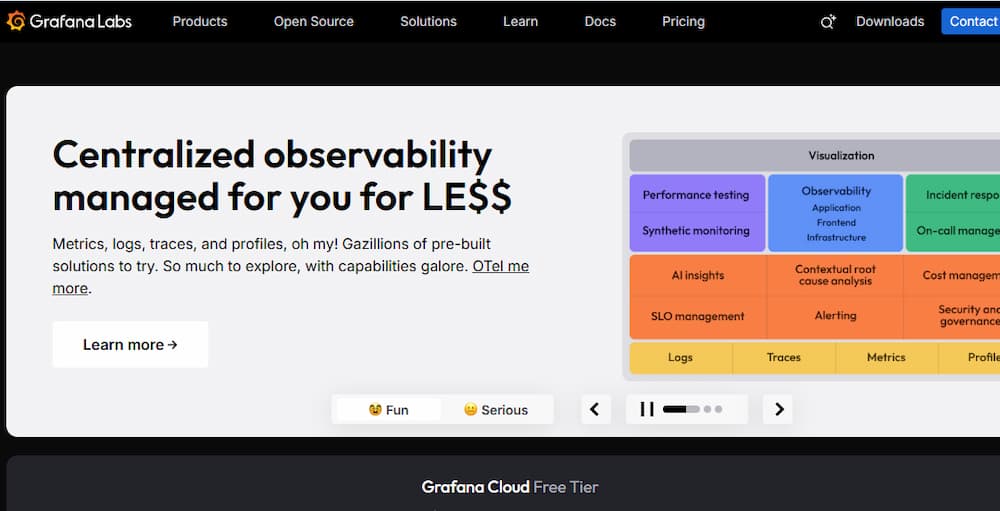
Grafana Cloud is the managed version of the LGTM stack (Loki for logs, Grafana for visualization, Tempo for traces, Mimir for metrics). It provides full-stack observability without the operational overhead of running it yourself. The paid tier is usage-based with no per-host fees.
Pricing:
| Tier | What is included | Cost |
| Free | 2,232 host hours/month, 14-day retention, full platform access including Grafana Assistant AI | $0 |
| Pro (paid) | 13-month metric retention, 30-day log/trace/profile retention, usage-based billing | Pay as you go |
The free tier includes everything Grafana Cloud offers including the AI assistant. The paid tier charges on active series (metrics), GB ingested (logs), and host hours. There are no per-host license fees.
Best for: Teams already using Prometheus and Grafana who want a managed upgrade with no tooling change. Teams that want usage-based pricing with no per-host fees and are comfortable with the Grafana UI.
Limitations: The free tier has 14-day retention, which is not enough for trend analysis over weeks or months. The Grafana UI has a steeper learning curve than Datadog or New Relic for engineers who are new to it.
Sentry
Sentry focuses on error tracking, performance monitoring, session replay, and release health. It does not replace infrastructure monitoring and does not provide host CPU, memory, or disk metrics. For startups where the primary observability need is catching and fixing application errors fast, Sentry is the strongest focused tool at the lowest price.
Pricing (verified directly from sentry.io/pricing, May 2026):
| Plan | Errors/month | Users | Logs included | Cost |
| Developer | 5,000 | 1 | 5GB | Free forever |
| Team | 50,000 | Unlimited | 5GB | $26/month |
| Business | 100,000 | Unlimited | 5GB | $80/month |
Log ingestion beyond 5GB costs $0.50/GB. Additional errors beyond the plan limit are available on a pay-as-you-go basis.
Sentry’s event-based pricing means costs are determined by error and transaction volume, not by host count. A 50-host application that produces few errors costs the same as a 2-host application with the same error volume.
Best for: Startups that want best-in-class error tracking, stack traces with AI-assisted root cause analysis (Seer), release tracking, and session replay. Particularly strong for frontend and full-stack JavaScript teams.
Limitations: Sentry is not an infrastructure monitoring tool. Most production teams use Sentry alongside a separate metrics tool rather than instead of one.
Self-Hosted LGTM Stack
Running Loki (logs), Grafana (dashboards), Tempo (traces), and Mimir or Prometheus (metrics) on your own infrastructure has no per-host or per-metric licensing cost. The OTel Collector routes telemetry from your applications to these backends.
Cost: Infrastructure cost only (cloud VMs or Kubernetes nodes running the stack). No software licensing fees.
Best for: Infrastructure-mature teams with a dedicated SRE or platform engineer who can own the stack. Teams that have outgrown free tiers and want to avoid per-host pricing at significant scale.
Limitations: Deploying, configuring, scaling, and maintaining a production-grade LGTM stack requires meaningful ongoing engineering effort. Loki needs object storage for log data. Tempo needs object storage for traces. Mimir requires more configuration than single-node Prometheus for high availability. A startup with a three-person engineering team does not have the capacity to run this reliably.
Comparison at a Glance
| Tool | Pricing model | Free tier | APM | Infra metrics | Logs | Error tracking | Self-hosted |
| CubeAPM | $0.15/GB, no per-host or per-user fees | None | Yes | Yes | Yes | Yes | Yes |
| Datadog | Per host + per module | 5 hosts, 1-day retention | $31/host/month | $15/host/month | $0.10/GB ingested | Limited | No |
| New Relic | $0.40/GB beyond 100GB free | 100GB/month, 1 full user | Included | Included | Included | Included | No |
| Grafana Cloud | Usage-based (series, GB, host hours) | 14-day retention, 2,232 host hours/month | Via Tempo | Via Mimir | Via Loki | Limited | Partial |
| Sentry | Per event volume | 5K errors, 1 user, 5GB logs | Via tracing | No | 5GB/month free | Yes (best in class) | Yes (open source) |
| LGTM self-hosted | Infrastructure cost only | No limit | Via Tempo | Via Prometheus | Via Loki | Limited | Yes |
Decision Framework for Startups
| Your situation | Recommended tool |
| Need a full Datadog replacement, want predictable pricing, data stays in your cloud | CubeAPM |
| Want full-stack SaaS observability with a genuine zero-cost starting point | New Relic free tier |
| Already using Prometheus and Grafana, want a managed upgrade | Grafana Cloud |
| Primary need is error tracking and session replay, not infra metrics | Sentry Team plan ($26/month) |
| 20+ hosts, full APM and logs needed, want usage-based not per-host | New Relic Standard or Grafana Cloud Pro |
| Platform team with capacity to operate own stack, maximum cost control | Self-hosted LGTM |
| Need enterprise SLAs, compliance features, no self-hosting | Datadog (cost is justified at scale) |
Summary
Datadog’s per-host, per-module pricing model makes it expensive for startups before they reach the scale where its enterprise features become necessary. The seven specific pain points that drive up Datadog costs (stacked module billing, 99th percentile host metering, APM doubling per-host cost, separate log indexing fees, custom metric overages, container add-on charges, and Kubernetes sidecar misconfiguration risk) can all be avoided with the right alternative.
CubeAPM eliminates all of these by billing purely on data volume at $0.15/GB with no per-host, per-user, or per-module fees. New Relic offers the most generous free SaaS tier in the market at 100GB/month with full platform access. Grafana Cloud provides a managed LGTM stack with usage-based pricing and no per-host charges. Sentry is the right choice for error-first observability at $26/month for unlimited users.
| Tool | Starting cost | Pricing model | Data stays in your cloud |
| CubeAPM | $0.15/GB ingestion | Per GB, no per-host or per-user fees | Yes (self-hosted) |
| New Relic | $0 (100GB/month free, then $0.40/GB) | Per GB ingested + per full platform user | No |
| Grafana Cloud | $0 (free tier, 14-day retention) | Usage-based (series, GB, host hours) | Partial |
| Sentry | $0 (Developer), $26/month (Team) | Per event volume | Optional (open source) |
| LGTM self-hosted | Infrastructure cost only | No licensing | Yes |
| Datadog | $15/host/month (annual) + modules | Per host, per module, per product | No |
Disclaimer: All pricing verified directly from official product pages: datadoghq.com/pricing (Infrastructure Pro $15/host/month annual, APM $31/host/month annual, logs $0.10/GB ingested, containers $0.002/container/hour, verified from datadoghq.com/pricing and docs.datadoghq.com/account_management/billing May 2026), newrelic.com/pricing (100GB/month free, $0.40/GB beyond free tier, one full platform user free, verified directly from newrelic.com/pricing May 2026), grafana.com/pricing (free tier 2,232 host hours/month and 14-day retention, verified May 2026), sentry.io/pricing (Developer free/5K errors, Team $26/month/50K errors, 5GB logs free all plans, verified May 2026), cubeapm.com/pricing ($0.15/GB, no per-host or per-user fees, verified May 2026). Pricing is subject to change; verify current rates before purchasing.
Also read:
How to Monitor Azure Data Factory Pipeline Failures
How to Monitor Azure Functions Execution and Errors
How to Monitor Azure Virtual Machines: CPU, Memory, and Disk