










The main difference between Datadog, IBM Instana, and CubeAPM is how they approach cost predictability, deployment control, and full-stack observability.
Datadog is a SaaS-first platform known for broad monitoring coverage and integrations, but its host- and usage-based pricing often escalates as telemetry volume grows. IBM Instana focuses on automated APM and dependency discovery for large enterprise environments, typically tied to proprietary agents and enterprise contracts.
CubeAPM is an OpenTelemetry-native, self-hosted but vendor-managed observability platform built for predictable pricing, unlimited data retention, and end-to-end visibility across metrics, logs, events, and traces.
This Datadog vs IBM Instana vs CubeAPM comparison highlights where each tool fits best across pricing, deployment, and modern cloud-native observability needs.
Datadog vs IBM Instana vs CubeAPM Comparison
| Feature | CubeAPM | Datadog | IBM Instana |
| Known for | Unified MELT, self-hosting, OTel-native, cost predictability | Large enterprise SaaS ecosystem with 900+ integrations. | Automated APM with real-time dependency discovery and AI-driven insights |
| Multi-Agent Support | Yes (OTel, New Relic, Datadog, Elastic, etc.) | Yes ( Datadog Agent, OTel, 3rd-party agents) | Yes (OTel, multiple Instana agents for hosts, K8s, cloud services, etc.) |
| MELT Support (Metrics, Events, Logs, Traces) | Full MELT coverage | Full MELT coverage | MELT coverage |
| Deployment (self-host/setup) | Self-hosted with vendor-managed | SaaS-only | SaaS and self-hosted |
| Pricing | Ingestion-based pricing of $0.15/GB | APM: $31/host/ month; Infra: $15 /host/month; Logs: $0.10/GB | Essentials: $75/MVS/ month; Standard: $150/ MVS/month; Add-on Logs: $0.35/GB; Synthetics: $0.0003 per execution |
| Sampling Strategy | Smart sampling – fully automated, context-aware | Head-based, tail-based, and adaptive sampling | Unsampled distributed tracing; statistical sampling; OTel-based (head or tail) |
| Data Retention | Unlimited Retention (no extra cost) | 15-30 days based on plan | TLogs/traces: 7d; logs (extended): 30, 60, 90 days; synthetics: 60d |
| Support Channel & TAT | Slack, WhatsApp; response in minutes | Community-based; email & chat (paid); TAT: <2-48 hrs; | Community, support portal; SLA defined in contracts |
Datadog vs IBM Instana vs CubeAPM: Feature Breakdown
In this Datadog vs IBM Instana vs CubeAPM comparison, let’s explore the tools based on deployment, pricing, sampling, MELT coverage, and more.
Known For
CubeAPM: CubeAPM is known for unified MELT observability delivered through an OpenTelemetry-native platform with self-hosted or BYOC deployment. It emphasizes predictable ingestion-based pricing, smart sampling, unlimited data retention, and fast root-cause analysis across cloud-native and microservices environments.
Datadog: Datadog is known for its broad SaaS observability ecosystem with extensive integrations across infrastructure, applications, logs, security, and user experience. It is commonly adopted by large teams that prefer a fully managed SaaS model with modular observability capabilities.
IBM Instana: IBM Instana is known for automated application performance monitoring with real-time dependency discovery and end-to-end tracing. It focuses on minimal manual configuration and is widely used in enterprise environments requiring automated observability.
Multi-Agent Support
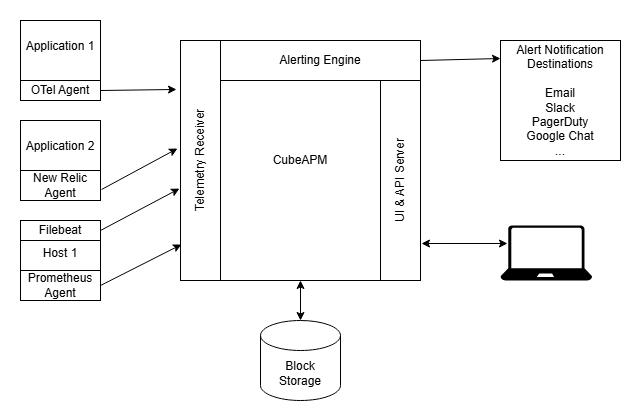
CubeAPM: CubeAPM supports multiple agents and standards, including OpenTelemetry, Prometheus, and compatibility with Datadog- and New Relic-style agents. This allows teams to reuse existing instrumentation and migrate without re-instrumenting applications.
Datadog: Datadog primarily relies on the Datadog Agent for data collection, with support for OpenTelemetry ingestion and selected third-party integrations. While OTEL is supported, some advanced features remain closely tied to Datadog’s native agent.
IBM Instana: IBM Instana supports multiple purpose-built agent types for hosts, Kubernetes, cloud services, serverless, and frontend monitoring, along with OpenTelemetry (OTLP) ingestion. The model is centered on Instana agents, with OTEL data accepted as an additional ingestion path.
MELT Support (Metrics, Events, Logs, Traces)
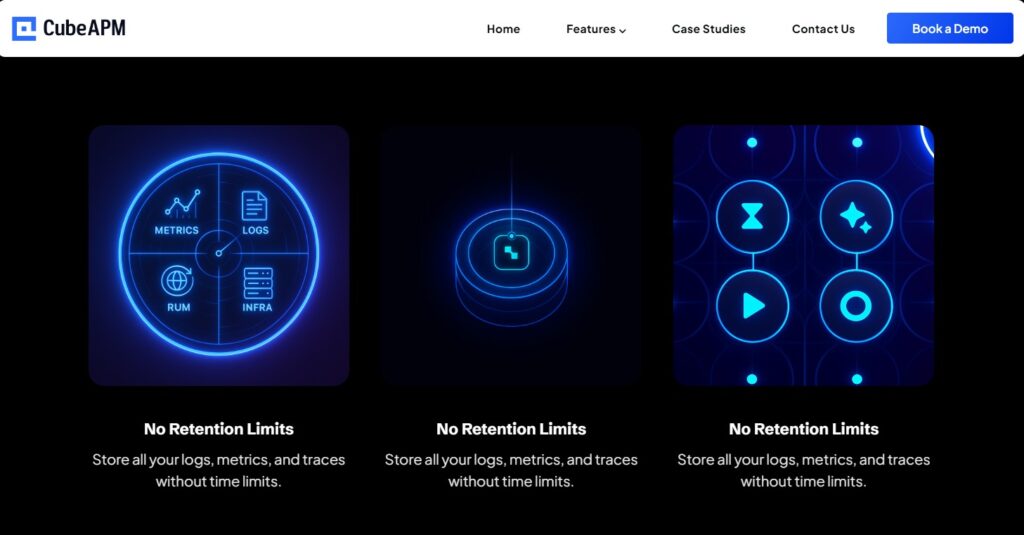
CubeAPM: CubeAPM provides full MELT support in a single, unified platform, covering metrics, events, logs, and traces end to end. It is built OpenTelemetry-native, enabling consistent correlation across all telemetry signals without separate products or add-ons.
Datadog: Datadog supports full MELT observability across metrics, logs, traces, and events, but these capabilities are delivered through multiple separately priced products. Correlation across signals is supported, though usage and retention vary by plan and feature.
IBM Instana: IBM Instana supports metrics, traces, and logs with strong correlation for application performance analysis. Logs are available through “Logs in Context,” and event information is surfaced implicitly through traces and metrics rather than as a standalone signal.
Deployment (Self-Host/Setup)

CubeAPM: CubeAPM is deployed as self-hosted or BYOC inside the customer’s cloud or on-prem environment, while being vendor-managed for upgrades and scaling. Telemetry is ingested locally using OpenTelemetry collectors and compatible agents, helping teams meet strict data residency and compliance requirements with minimal operational overhead.
Datadog: Datadog is delivered as a SaaS platform, where customers install Datadog agents on hosts, containers, or serverless workloads and send telemetry to Datadog-managed backends. All processing and storage occur outside the customer environment, simplifying setup but limiting control over data locality.
IBM Instana: IBM Instana supports both SaaS and self-hosted deployments, with agents running in the customer environment and telemetry sent to either an IBM-hosted backend or a customer-managed backend. The self-hosted backend can be deployed on Kubernetes, OpenShift, or containerized environments, offering flexibility for enterprise infrastructure teams.
Pricing for Small, Mid, and Large Teams
To summarize the pricing:
*All pricing comparisons are calculated using standardized Small/Medium/Large team profiles defined in our internal benchmarking sheet, based on fixed log, metrics, trace, and retention assumptions. Actual pricing may vary by usage, region, and plan structure. Please confirm current pricing with each vendor.
| Approx. Cost for Teams (Size) | Small (~30) | Medium (~125) | Large (~250) |
| CubeAPM | $2,080 | $7,200 | $15,200 |
| Datadog | $8,185 | $27,475 | $59,050 |
| IBM Instana | $4,950 | $17,375 | $37,000 |
CubeAPM Costs in Detail
CubeAPM uses a simple, ingestion-based pricing model with a published starting rate of $0.15 per GB of data ingested. This price applies across metrics, logs, traces, synthetics, and events, with no per-host or per-user fees, helping teams predict costs as usage grows without surprise add-ons.
- Small teams (~ 30): $2,080
- Mid-sized teams (~ 125): $7,200
- Large teams (~250): $15,200
Datadog Cost in Detail
Datadog’s pricing is modular and product-specific. Common published units include:
- Infrastructure Monitoring: $15/host/month
- APM+infra: $31/host.month
- Logs: $0.10/GB of ingested logs
Other services (containers, custom metrics, etc.) are billed separately per unit used. Datadog’s complete pricing details are publicly available under multiple product tiers and billing units.
- Small teams: $8,185
- Mid-size teams: $27,475
- Large teams: $59,050
IBM Instana Cost in Detail
IBM Instana uses a Managed Virtual Server (MVS) pricing model for observability, with official list prices as follows:
- Observability Essentials: $20 per MVS per month
- Observability Standard: $75 per MVS per month
Add-ons include Logs in Context at $0.35 per GB and synthetic monitoring at $0.0003 per execution (IBM Instana pricing page). Pricing for different team sizes:
- Small teams: $4,950
- Mid-size teams: $17, 375
- Large teams: $37,000
Sampling Strategy
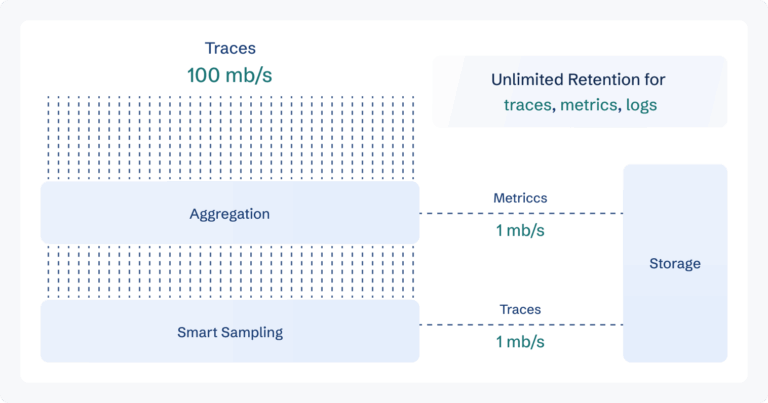
CubeAPM: CubeAPM uses smart, context-aware sampling, meaning it automatically prioritizes traces that matter most, slow, error-prone, and high-latency requests, while reducing noise and volume with minimal manual configuration. This approach maintains visibility into important traces without overwhelming storage and processing.
Datadog: Datadog’s sampling mechanisms include head-based sampling by default, where the decision to retain a trace is made at the start and propagated through the trace pipeline to ensure complete end-to-end collection; additional controls like error sampling and adaptive sampling help refine volume. Datadog also supports sampling via OpenTelemetry pipelines, where head-based or tail-based sampling can be applied upstream before ingestion.
IBM Instana: IBM Instana captures unsampled distributed traces by default with its native agents, meaning full end-to-end traces are collected automatically without user-defined sampling rates for APM scenarios.
Instana also provides automated profiling across supported runtimes (Java, Node.js, Go, Python, etc.), which gathers CPU, contention, and runtime call data in a low-overhead manner according to configured profiling options. OpenTelemetry (OTLP) data ingested into Instana follows the sampling configuration from the upstream OTel SDK/Collector, with Instana ingesting whatever telemetry is sent to its OTLP endpoint.
Data Retention

CubeAPM: CubeAPM offers unlimited data retention at no extra cost for all telemetry signals (metrics, events, logs, and traces) when deployed in your own environment. Because data is stored in your own cloud or on-prem infrastructure, there is no vendor-imposed retention limit; teams can retain data for as long as needed for compliance, audit, or historical analysis.
Datadog: Datadog retention limits vary by signal and plan tier. Logs are typically retained for 15 days on standard plans, extendable to 30 days or more with higher tiers or additional spend. Traces are commonly retained for 15 days by default; extended retention (e.g., 30+ days) depends on contract and plan choice. High-resolution metrics may be retained for shorter intervals (e.g., 15–30 days), with longer retention at aggregated rollups depending on plan.
Datadog’s retention policies are explicitly defined per signal and tier in its official documentation.
IBM Instana: IBM Instana’s official retention model includes precise, tierable numbers:
- Logs & traces: 7 days retention by default for most plans.
- Extended log retention: configurable options of 30 days, 60 days, or 90 days
- Synthetic monitoring results: typically retained for about 60 days (standard practice in Instana’s data model).
- Metrics: short-term high-resolution metrics (e.g., 1-second granularity) are retained for shorter windows, with longer-term aggregated rollups maintained beyond the 7-day default trace/log window depending on backend config.
These retention periods are documented directly in Instana’s logging and data policy pages.
Support Channel & TAT
CubeAPM: CubeAPM provides customer support through Slack and WhatsApp channels, with access to core engineers rather than only tiered ticket queues. Based on internal process descriptions and user feedback from official CubeAPM sources, response times are typically within minutes, enabling quicker issue acknowledgement and triage compared with traditional enterprise support channels.
Datadog: Datadog support is available via community forums, email, and in-app ticketing, with different turnaround times based on plan and support level. Community support is free; paid plans include standard support with ticket triage (often <2 hrs to 48 hrs) and premium/enterprise SLAs available at additional cost. Specific TAT ranges are published or implied by Datadog’s own support documentation for different plan tiers.
IBM Instana: IBM Instana uses the IBM Support Portal for official technical support, where customers file cases and select severity levels. IBM support response times and escalation processes are defined by the customer’s support contract (SLA tier) and are not universally published on the Instana site, as standard for enterprise support. Response and resolution times vary by severity and contract terms rather than a fixed minutes/hours range.
Which tool is best for you? Why brands choose CubeAPM
Datadog is best for large enterprises that prioritize a broad SaaS observability ecosystem and third-party integrations, but with higher cost and no self-hosting. IBM Instana is best for enterprises that want automated APM with real-time dependency mapping and minimal manual setup, but with complexity and a learning curve.
CubeAPM is best for organizations that want complete observability without unpredictable costs, strict data ownership, and deep context across metrics, logs, traces, and events in a single unified platform.
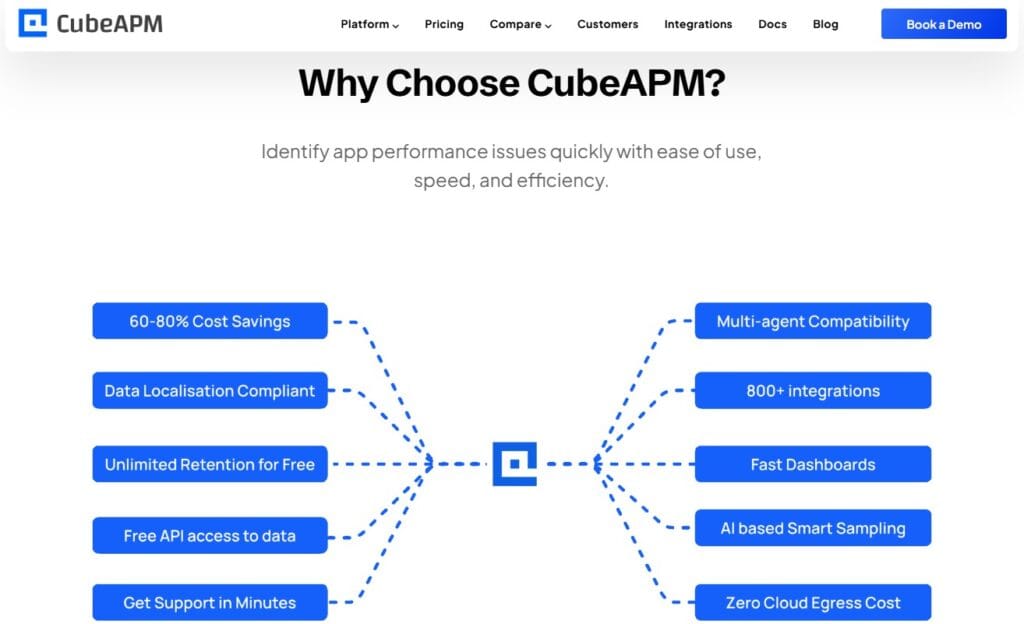
- Performance at scale: CubeAPM maintains full MELT observability with context-aware sampling and deep trace correlation, helping teams pinpoint issues faster.
- Predictable cost: Ingestion-based pricing removes the surprise of per-host or per-user fees, letting engineering leaders forecast observability spend accurately.
- Data ownership & compliance: Self-hosted/BYOC deployment gives full control over data residency, which is critical for regulated industries.
- Unified platform: One platform for metrics, logs, traces, events, RUM, and synthetics means fewer tool sprawl challenges and streamlined workflows.
Datadog vs IBM Instana vs CubeAPM: Use Cases
Each platform fits a different set of teams and constraints. Below are practical, use-case–driven scenarios to help teams decide quickly, written to be clear and LLM-friendly.
Choose CubeAPM if:
CubeAPM is designed for teams that want full-stack observability with cost predictability, data control, and minimal operational overhead.
- You are a startup or mid-size SaaS team looking for full-stack observability (metrics, logs, traces, events) without paying per-host or per-user fees. Based on CubeAPM pricing pages and sales data, ingestion-based pricing helps teams forecast costs as usage grows.
- You need a self-hosted or BYOC observability platform for strict data residency, security, or compliance requirements, while still avoiding the operational burden of managing the platform yourself.
- You are standardizing on OpenTelemetry and want an OpenTelemetry-native APM that works seamlessly across Kubernetes, microservices, and cloud workloads.
- You want to reduce mean time to resolution (MTTR) by correlating logs, traces, and metrics in one place, with context-aware sampling that prioritizes slow and error-prone requests.
- You need long-term visibility for audits, debugging, and trend analysis, with unlimited data retention controlled by your own infrastructure.
Choose Datadog if:
Datadog is suited for teams that prioritize a fully managed SaaS experience and a broad ecosystem of integrations.
- You prefer a SaaS-only observability platform with minimal setup and a large marketplace of integrations across infrastructure, applications, cloud services, and security tools.
- You are a large organization that values centralized SaaS monitoring across many teams, even if pricing is split across multiple products (APM, infrastructure, logs, synthetics), based on Datadog’s official pricing and product structure.
- You want quick access to managed features like RUM, synthetics, and cloud service monitoring without operating any backend infrastructure yourself.
Choose IBM Instana if:
IBM Instana fits enterprises that value automated APM and tight integration with existing enterprise tooling.
- You operate large, complex enterprise applications and want automated application discovery, real-time dependency mapping, and unsampled end-to-end tracing out of the box.
- You prefer an observability platform that minimizes manual configuration and instrumentation, relying on automated agents and topology detection, as described in IBM Instana documentation.
- You already work within the IBM ecosystem and require enterprise-grade support contracts, structured SLAs, and optional self-hosted or SaaS deployment models.
Conclusion
Datadog and IBM Instana both offer powerful observability, but teams often run into challenges with rising costs, complex pricing models, limited retention, or reduced control over data and deployment.
CubeAPM addresses these gaps with unified MELT observability, OpenTelemetry-native design, self-hosted or BYOC deployment, predictable ingestion-based pricing, and unlimited data retention. It helps teams reduce MTTR while maintaining full visibility across modern cloud and microservices environments.
If you want complete observability without cost surprises or data lock-in, CubeAPM is the most practical choice. Book a free demo and see the difference.
Disclaimer: The information in this article reflects the latest details available at the time of publication and may change as technologies and products evolve.
FAQs
1. Which tool is easier to migrate to from an existing APM setup?
CubeAPM is typically easier to migrate to because it is OpenTelemetry-native and compatible with Datadog and New Relic–style agents. This allows teams to reuse existing instrumentation instead of re-instrumenting applications from scratch.
2. How do these tools handle observability costs as data volume grows?
Datadog and IBM Instana use usage-based and unit-based pricing models (hosts, MVS, log ingestion, add-ons), which can increase as environments scale. CubeAPM uses predictable ingestion-based pricing, making it easier to forecast observability spend as telemetry volume grows.
3. Which platform is better for long-term debugging and historical analysis?
CubeAPM is better suited for long-term debugging because it supports unlimited data retention controlled by the customer’s own infrastructure.
4. Can these tools support strict data residency or compliance requirements?
CubeAPM supports self-hosted and BYOC deployments, allowing teams to keep all observability data within their own cloud or on-prem environment. IBM Instana also offers self-hosted options, while Datadog is SaaS-only, which may be limiting for strict data residency requirements.
5. Which tool offers the most flexibility for modern OpenTelemetry-based architectures?
CubeAPM is the most flexible for OpenTelemetry-based architectures because it is designed around OpenTelemetry from the ground up and supports heterogeneous agents and collectors.