


The main difference between Datadog, Better Stack, and CubeAPM is how they balance observability depth, pricing transparency, and flexibility.
Datadog offers an all-in-one enterprise suite, but it becomes costly at scale due to per-module pricing for APM, logs, metrics, and synthetics. Better Stack focuses on uptime and log monitoring simplicity, but lacks deep tracing, OpenTelemetry support, and self-hosting options. CubeAPM delivers full-stack MELT observability with Smart Sampling, unlimited retention, and Slack/WhatsApp developer support.
This comparison breaks down Datadog vs Better Stack vs CubeAPM comparison pricing, deployment, sampling, retention, and support to help you pick the best observability stack for 2025.
Note: We’ve compiled this information from official documentation, pricing pages, and community feedback to provide a transparent, practical view of how these tools differ in day-to-day operations.
Datadog vs Better Stack vs CubeAPM Comparison
| Feature | CubeAPM | Datadog | Better Stack |
| Multi-Agent Support | Yes | Yes | Limited |
| MELT (Metrics, Events, Logs, Traces) Coverage | Full | Full | Logs + Uptime + limited Metrics |
| Deployment | Self-hosted with vendor-managed | SaaS-only | SaaS-only |
| Pricing | $0.15/GB (Ingestion-based) | APM: $31/host/ month; Infra: $15 /host/month; Logs: $0.10/GB | Free; APM: $29/month/host; Logs & Traces: $0.35/GB; Metrics: 2B free + $17.5 |
| Sampling Strategy | Smart sampling | Head and tail based | None |
| Log Retention | Unlimited | 15-30 days | 15–30 days |
| Support Channel & TAT | Slack, WhatsApp; response in minutes | Community-based; email & chat; TAT: 2-48 hrs | Email, Chat, Slack; TAT: 4h to 1–2 days |
| Known for | Unified MELT, self-hosting, OTel-native, predictable cost | Large enterprise SaaS ecosystem, 900+ integrations. | Developer-friendly dashboards, uptime & incident management |
Datadog vs Better Stack vs CubeAPM: Feature-by-Feature Breakdown
Multi-Agent Support
In any observability stack, multi-agent support defines how easily teams can collect and correlate telemetry data from different environments, especially when migrating from other APMs or integrating hybrid infrastructures.
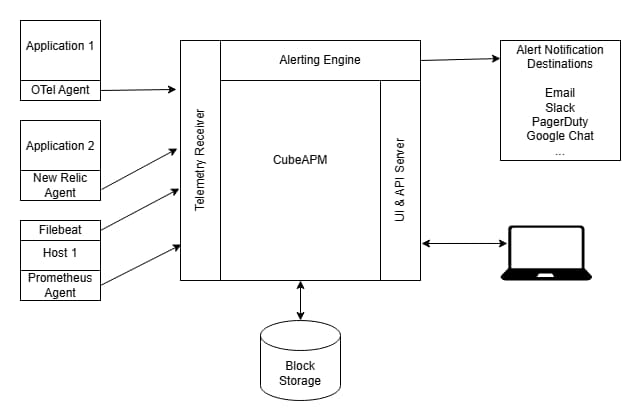
CubeAPM: CubeAPM provides true multi-agent flexibility, supporting multiple data exporters and existing instrumentation frameworks out of the box. It’s compatible with OpenTelemetry, Prometheus, Datadog, New Relic, and Elastic agents, allowing organizations to reuse their existing setups without vendor lock-in.
This interoperability makes CubeAPM ideal for teams:
- Operating in mixed environments
- Transitioning from proprietary agents to open-standards-based monitoring
- Looking to simplify adoption, reduce migration effort, and ensure full data continuity
Datadog: Datadog depends primarily on its proprietary Datadog Agent for collecting logs, metrics, and traces across environments. While it supports major operating systems and cloud platforms, Datadog could be less flexible for teams using multiple agent ecosystems or open frameworks, because it’s:
- Third-party agent compatibility is limited
- OpenTelemetry ingestion is available but not fully interchangeable with Datadog’s native instrumentation.
- Often requires custom pipelines or additional setup.
Better Stack: Better Stack’s observability pipeline is built around its Logtail Agent and API-based integrations. It works well for collecting logs and uptime data, but it is mainly suitable for simpler architectures rather than large, distributed environments because:
- It lacks native support for tracing or advanced multi-agent ingestion
- External integrations typically require manual connectors
MELT Support
Modern observability hinges on how well a platform unifies MELT data — Metrics, Events, Logs, and Traces — to provide true end-to-end visibility across systems. Here’s how each tool compares in delivering complete stack observability.
CubeAPM: CubeAPM offers complete MELT observability within a single platform, covering every layer of system and application performance. It collects:
- Metrics from infrastructure, containers, and services via Prometheus and OpenTelemetry
- Events from Kubernetes, databases, and application-level signals
- Logs through unified log pipelines with real-time querying
- Traces for distributed, service-level transactions with Smart Sampling for cost efficiency
This unified MELT design helps engineering teams quickly connect cause and effect across metrics spikes, error logs, and trace anomalies — all in one interface. Because CubeAPM supports OpenTelemetry by default, teams can instrument once and observe everything without re-configuring multiple agents or paying for separate modules.
Datadog: Datadog also supports full-stack observability across metrics, logs, events, and traces, but does so through modular pricing and separate features (APM, Logs, Infrastructure, RUM, and Synthetics). Each layer requires individual activation and billing, making costs scale quickly for teams that need all components.
Despite its depth and polished dashboards, Datadog’s MELT coverage is fragmented — users often navigate between separate dashboards for logs, metrics, and traces, which can complicate correlation and analysis for large-scale environments.
Better Stack: Better Stack’s MELT coverage is partial. It focuses primarily on logs, uptime, and metrics visualization, but lacks distributed tracing and deep event correlation. Its dashboards excel at incident visibility and log management, but do not provide full application tracing or contextual error diagnostics.
This makes it effective for monitoring site uptime, error logs, and basic infrastructure health, but not ideal for full-stack APM or microservice-level observability.
Deployment
Deployment flexibility is becoming a key decision factor for engineering and compliance-driven teams as it impacts data residency, latency, and operational control.
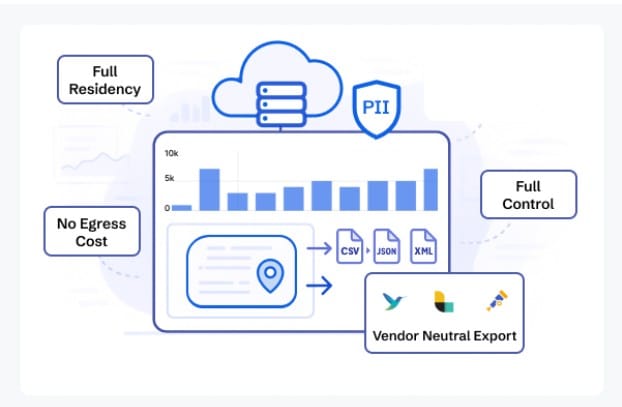
CubeAPM: CubeAPM supports self-hosting and vendor-managed deployments, allowing organizations to Bring Your Own Cloud (BYOC) or deploy in their preferred region for compliance and data localization. Teams can host CubeAPM on AWS, GCP, Azure, or private infrastructure while still receiving fully managed updates and support from the CubeAPM engineering team.
Datadog: Datadog is a fully SaaS-based platform hosted on its own cloud infrastructure. While it offers multiple regional data centers (US, EU, APAC), it does not support on-premise or BYOC deployments. This can be a constraint for enterprises in regulated industries or geographies with strict data residency laws, such as finance, healthcare, or government sectors.
Better Stack: Better Stack operates as a pure SaaS solution with hosting in the US and EU regions. It does not provide self-hosting or private cloud deployment options. Setup is lightweight, which makes it ideal for startups and smaller engineering teams. However, its lack of BYOC or private deployment restricts adoption for organizations with on-prem or hybrid data governance requirements.
Pricing for Small, Mid, and Large Teams
Pricing plays a decisive role when choosing an observability platform. Beyond core capabilities, how a tool scales with data volume directly affects predictability and total cost of ownership. Here’s how the three platforms compare.
Pricing Summary
*All pricing comparisons are calculated using standardized Small/Medium/Large team profiles defined in our internal benchmarking sheet, based on fixed log, metrics, trace, and retention assumptions. Actual pricing may vary by usage, region, and plan structure. Please confirm current pricing with each vendor.
Cost for Small Teams (~30):
- CubeAPM: $2,080
- Datadog: $8,185
- Better Stack: $5,723
Cost for Mid-Sized Teams (~125):
- CubeAPM: $7,200,
- Datadog: $27,475
- Better Stack: $20,550
Cost for Large Teams (~250):
- CubeAPM: $15,200
- Datadog: $59,050
- Better Stack: $43,350
CubeAPM Costs for Small, Mid, & Large Teams: Detailed Calculation
CubeAPM uses an ingestion-based pricing model — $0.15 per GB of data ingested, with no additional host, user, or feature-based fees. All features — APM, logs, infrastructure, synthetics, RUM, and error tracking — are included under the same rate. This simplicity ensures cost predictability and removes the complexity of multi-module billing.
- Small teams (~ 30): $2,080
- Mid-sized teams (~ 125): $7,200
- Large teams (~250): $15,200
Datadog Costs for Small, Mid, & Large Teams in Detail
Datadog’s pricing is modular, with separate billing for each feature and host type:
- APM: ~$31 per host per month
- Infrastructure: ~$15 per host per month
- Logs: $0.10 per GB ingested
- Data transfer: $0.10 per GB (approx.)
Here’s what it may cost teams:
- Small teams: $8,185
- Mid-size teams: $27,475
- Large teams: $59,050
Better Stack Costs for Small, Mid, & Large Teams in Detail
Better Stack offers a freemium model with modular pricing for uptime, logs, and incident management.
- Free plan: Basic uptime and log monitoring
- Paid plan: Starts at $29 per host/month
- Logs & traces: $0.35 per GB
- Metrics: 2 billion data points free, then $17.50 per additional billion retained
Here’s how Better Stack’s pricing looks like for different sizes of teams:
- Small teams: $5,723
- Mid-size teams: $20,550
- Large teams: $43,350
Sampling Strategy
Sampling defines how efficiently an observability tool captures and stores telemetry data — balancing visibility with cost. The right strategy can significantly reduce ingestion volume while preserving key diagnostic insights.

CubeAPM: CubeAPM uses Smart Sampling, a context-aware, automated strategy that evaluates trace and log relevance before deciding what to retain. Instead of randomly sampling data, CubeAPM prioritizes traces associated with high latency, errors, or unusual patterns, ensuring critical events are always captured.
Datadog: Datadog primarily uses head-based sampling, where a small percentage of traces are captured at the start of a request. While this method reduces data ingestion volume, it can miss important transactions that show anomalies later in execution, especially in distributed systems. For RUM, certain traces and errors, it also offers probabilistic and adaptive sampling.
Better Stack: Better Stack does not use sampling — it ingests all log and event data by default. While this ensures no visibility gaps, it can quickly inflate storage usage and costs at scale. The lack of selective sampling or compression mechanisms makes it suitable for smaller deployments but less efficient for high-volume telemetry pipelines where cost and performance optimization are priorities.
Log Retention
Log retention determines how long observability data remains accessible for troubleshooting, compliance, and performance analysis. The retention policy and associated costs can dramatically influence long-term observability ROI.

CubeAPM: CubeAPM provides infinite data retention at no additional cost, giving teams full control over historical logs, traces, and metrics. This ensures that developers can analyze long-term performance trends, investigate regressions, and meet compliance requirements without worrying about data expiry.
Datadog: Datadog’s standard log retention defaults to 15 days, with extended storage available only through paid retention tiers or external archiving services (like AWS S3). Extended retention may also slow query performance due to multi-layered log indexing.
Better Stack: Better Stack offers 15–30 days of log retention, depending on the plan selected. To retain logs beyond this period, teams must rely on external storage or exports, increasing operational overhead.
Support Channel & TAT & Pricing
Support responsiveness and communication channels directly influence mean time to resolution (MTTR). Here’s how each platform handles user assistance and service quality.
CubeAPM: CubeAPM provides real-time support via Slack and WhatsApp, connecting users directly with core developers for instant issue resolution. Average turnaround time (TAT) is within minutes, even for technical escalations. All support tiers are included in the base pricing—no hidden “premium” support charges.
Datadog: Datadog offers email, chat, and community-based support, but response times vary based on plan. The standard plan typically sees replies within 24–48 hours, while premium support with faster SLAs incurs additional costs. Although documentation and community forums are extensive, real-time developer engagement is limited, often leading to delayed resolutions in critical scenarios.
Better Stack: Better Stack provides multi-channel support via email, chat, and Slack, with turnaround times of under 4 hours for paid tiers and up to 1–2 days for free plans. While it maintains active community resources and an intuitive dashboard, the lack of 24/7 live assistance on lower tiers can slow response during high-severity incidents.
Known For
Each platform has its distinct identity in the observability landscape, shaped by its core strengths, design philosophy, and target user base.
CubeAPM: Known for being an OpenTelemetry-native, full-stack observability platform built around predictable pricing, self-hosting flexibility, and Smart Sampling. It delivers unified MELT (Metrics, Events, Logs, Traces) coverage under a single pricing model and excels in compliance-heavy or cost-conscious environments. CubeAPM is often chosen by teams seeking end-to-end visibility, unlimited retention, and real-time developer support without the complexity.
Datadog: Recognized as an enterprise-grade SaaS observability leader with more than 900 integrations, advanced visualization capabilities, and mature alerting features. It offers deep analytics and scalability for large, cloud-native enterprises, but is often criticized for complex pricing and modular billing that make cost prediction difficult.
Better Stack: Best known for its developer-friendly dashboards, uptime monitoring, and incident management tools. Its focus on simplicity and clean UI makes it a favorite among startups and DevOps teams seeking quick setup and clear visibility into application availability. However, its limited tracing depth and a lack of full MELT support position it better for lightweight monitoring instead of deep APM.
Which tool is best for you? Why brands choose CubeAPM
Datadog is best for large enterprises with deep budgets and extensive integration requirements—but the cost can scale unpredictably as telemetry volume grows. Better Stack is best for smaller teams needing rapid setup, uptime monitoring, and simple logging—not full-scale APM or distributed tracing.
But CubeAPM is best when you want OpenTelemetry-native full-stack observability, ingestion pricing, and self-hosting or BYOC flexibility—ideal for engineering teams that need predictable cost, compliance readiness, and real developer workflow support.
Benefits of CubeAPM:
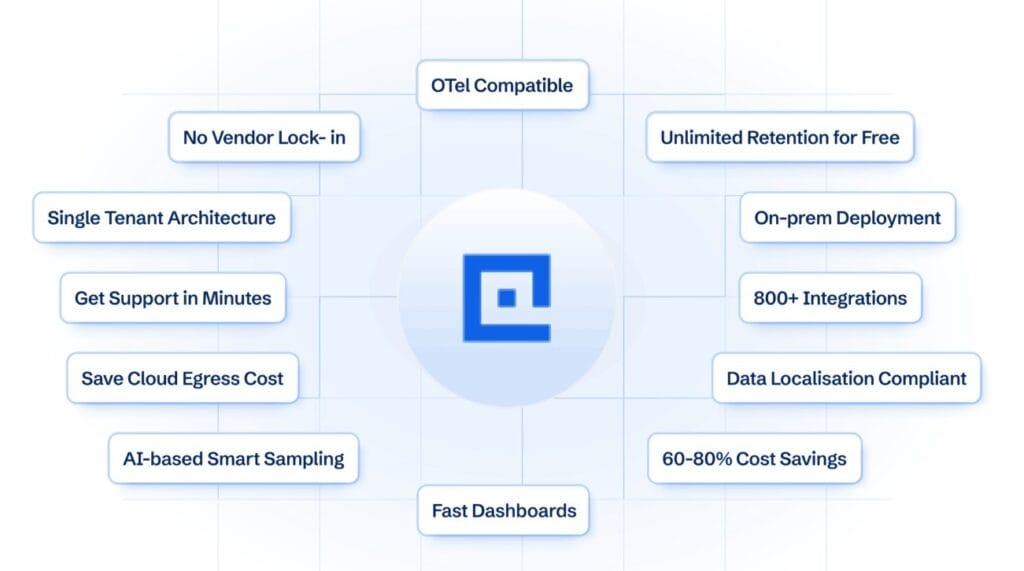
- Predictable pricing: $0.15/GB ingestion with no host/user fees means cost forecasting is simple and transparent.
- Data sovereignty: Self-hosted or BYOC options allow full control over data location, retention, and compliance.
- Unified observability: Metrics, events, logs, and traces (MELT) all live in one platform—avoiding data silos and simplifying investigations.
- Developer-first support: Real-time access to core developers via Slack/WhatsApp ensures faster MTTR and a true engineering-centric experience.
Datadog vs BetterStack vs CubeAPM: Use Cases
Every observability tool serves a different kind of engineering team depending on scale, budget, and compliance requirements. Below are the practical scenarios where each tool fits best.
Choose CubeAPM if:
CubeAPM is the best choice for teams that want predictable pricing, OpenTelemetry-native observability, and full data control, without compromising on speed or scale.
- Full-stack observability: Ideal for engineering teams needing unified visibility across metrics, events, logs, and traces (MELT) in one dashboard.
- Cost predictability: Based on our sales data, CubeAPM saves teams 60–70% compared to Datadog, offering a predictable $0.15/GB ingestion pricing.
- Strict compliance & self-hosting: Perfect for industries with data residency laws, enabling BYOC or private cloud deployments for total data sovereignty.
- High-volume telemetry: Efficient for microservice-based systems needing Smart Sampling to retain valuable traces and reduce ingestion overhead.
- Fast issue resolution: Teams benefit from Slack/WhatsApp developer support with minute-level response times — reducing MTTR dramatically.
- Scalable enterprise adoption: Supports multi-agent environments (OTel, Prometheus, Datadog, New Relic) for smooth migration from legacy observability tools.
Choose Datadog if:
Datadog suits large, cloud-native enterprises that prioritize depth of integrations and analytics over pricing predictability.
- Complex multi-cloud environments: Ideal for teams running across AWS, GCP, and Azure with 900+ supported integrations and automation workflows.
- High observability budgets: Works best for organizations comfortable with per-host and per-module billing, even as costs exceed $4,000–$10,000/month for mid-sized deployments.
- Advanced analytics needs: Great for engineering teams that rely on machine-learning-driven anomaly detection and automated dashboards across large data volumes.
- Centralized SaaS operations: Suitable for businesses that prefer vendor-managed SaaS platforms without on-premise control requirements.
Choose Better Stack if:
Better Stack is designed for startups and DevOps teams that want simple uptime visibility and quick setup without deep APM requirements.
- Lightweight monitoring: Perfect for teams needing a modern, easy-to-use dashboard for website and API uptime monitoring.
- Developer collaboration: Integrates well with incident management workflows, Slack alerts, and linear dashboards for faster visibility.
- Log-centric observability: Works for smaller workloads where 15–30-day retention is sufficient, and distributed tracing is not critical.
- Cost-sensitive setups: Best suited for teams starting with the free tier or $29/host plans before scaling logs at $0.35/GB (based on Better Stack pricing page).
Conclusion
In the Datadog vs Better Stack vs CubeAPM comparison, Datadog offers deep enterprise capabilities, but becomes expensive and complex as data scales. Better Stack delivers simplicity and elegant dashboards but lacks distributed tracing, long-term retention, and self-hosting flexibility.
CubeAPM bridges these gaps with a unified, OpenTelemetry-native observability platform that covers metrics, events, logs, and traces (MELT) in one interface. With $0.15/GB ingestion pricing, Smart Sampling, and unlimited retention, it ensures predictable costs and compliance readiness.
For teams prioritizing scalability, transparency, and developer efficiency, CubeAPM is the clear winner in the Datadog vs Better Stack vs CubeAPM debate. Start your free trial or book a demo with CubeAPM.
Disclaimer: The information in this article reflects the latest details available at the time of publication and may change as technologies and products evolve.
FAQs
FAQs
1. Which tool provides the best balance between cost and scalability?
CubeAPM offers the best balance with its $0.15/GB ingestion pricing, which stays predictable even as data volumes grow. Datadog’s per-host pricing can spike unpredictably at scale, while Better Stack’s pricing remains suitable for smaller teams but lacks scalability for enterprise workloads.
2. Do any of these tools support on-prem or private cloud deployment?
Only CubeAPM supports self-hosting and Bring Your Own Cloud (BYOC) options. Datadog and Better Stack are SaaS-only and do not offer private deployment, which limits their use in regulated or compliance-driven industries.
3. Which tool integrates best with OpenTelemetry?
CubeAPM is fully OpenTelemetry-native, offering first-class support for metrics, logs, and traces. Datadog provides partial OpenTelemetry support, but still depends heavily on its proprietary agent for full functionality. Better Stack does not natively support OpenTelemetry or distributed tracing, as it focuses primarily on logs and uptime monitoring.
4. Which platform offers the fastest customer support?
CubeAPM provides real-time support via Slack and WhatsApp, connecting users directly with its core developers. Datadog’s standard support relies on tickets and email (24–48 hours), and Better Stack offers chat/email support with a slower turnaround on free plans.
5. Which observability platform is best for startups or mid-size engineering teams?
Based on our research and demo data, CubeAPM is ideal for startups and mid-size teams that need cost predictability, unlimited retention, and OpenTelemetry-based observability. Better Stack suits teams focused on uptime and logging, while Datadog is often overkill in both cost and complexity for smaller teams.