









Netdata is one of the most popular open-source infrastructure monitoring platforms in 2026. It started as a lightweight Linux system monitor but has grown into a real-time observability platform for infrastructure, containers, applications, metrics, logs, anomaly detection, and AI-assisted troubleshooting.
Netdata Cloud uses active-node pricing, not per-user or per-GB pricing. Its Business plan is listed at $4.50 per node per month when billed annually, with unlimited metrics, logs, dashboards, and retention.
This review gives an independent look at Netdata in 2026, including pricing, product capabilities, cost examples, user sentiment, and alternatives worth checking before choosing it.
What Is Netdata?
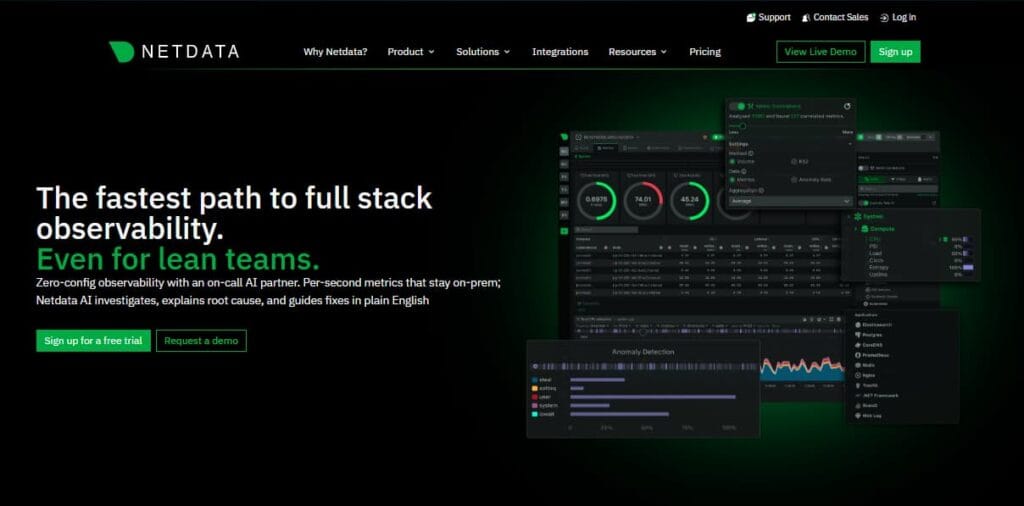
Platform Overview
Netdata is an open-source, real-time infrastructure monitoring platform created by Costa Tsaousis. The idea behind Netdata started in 2013, but the project became publicly known as an open-source monitoring tool in 2016.
It has grown from a lightweight system monitor into a distributed observability platform for physical servers, virtual machines, containers, Kubernetes clusters, cloud deployments, and edge environments.
Its main architectural difference is its edge-first model. The Netdata Agent runs on each system, collects metrics locally, stores data locally, runs machine learning, evaluates alerts, and serves local dashboards.
Netdata Cloud acts as a control plane for centralized views, collaboration, RBAC, SSO, and managed AI features. Netdata says Cloud does not store metrics; metrics stay on the user’s infrastructure.
Netdata’s resource footprint depends on deployment mode. Its docs list about 5% of one CPU core and 200 MB RAM for a standalone node handling 5,000 metrics per second. A child node is listed at about 3% of one CPU core and 150 MB RAM.
Today, Netdata covers:
- Real-time infrastructure metrics with 1-second granularity
- Container and Kubernetes monitoring
- Log monitoring and edge log querying
- Unsupervised ML anomaly detection on metrics
- Automated dashboards and alerts
- AI-assisted troubleshooting, root cause analysis, and reporting
- Centralized streaming through Netdata Parents
- SaaS, on-premises, and air-gapped deployment options
Key Features of Netdata
Netdata collects metrics every second, which helps teams catch short CPU, memory, disk, network, and container spikes that slower polling intervals may miss. Its docs also describe the agent as lightweight, with common node roles using around 5% of one CPU core and 150–200 MiB RAM.
Netdata provides automated dashboards and preconfigured alerts out of the box, helping teams get useful visibility without building every dashboard manually or writing PromQL/LogQL first. Paid plans add features such as custom dashboards, RBAC, SSO, SCIM, unlimited metrics and logs, unlimited retention, and Netdata AI.
What Are Netdata’s Pricing Options?
Netdata uses a per-node pricing model. A billable node is each Netdata Agent you run, plus optional virtual nodes used for remote monitoring. Containers running on a monitored host are included at no extra cost.
Published plan rates
| Plan | Price | Node limit / basis | Commercial use |
| Community | Free | Max 5 active connected nodes | Limited / free tier |
| Business | $4.50/node/month, billed annually | Priced per active node | Yes |
| Enterprise On-Premise | Contact sales | Starts at 200 node licenses | Yes |
Billing mechanics: The real price driver
Netdata bills based on active nodes, not users, dashboards, metrics, logs, or containers. Offline or stale nodes are not billed, even if their data remains available to query through a Netdata Parent.
Netdata also uses P90 metering. This means the top 10% of short-lived node-count spikes are excluded from monthly billing, which helps reduce the impact of autoscaling bursts.
Annual billing gives a 25% discount compared with monthly billing. Netdata also says Business users can start with a 14-day trial for as many nodes as needed.
What is included in Netdata Business?
| Feature | What Netdata lists |
| Metrics and logs | Unlimited Metrics & Logs |
| Custom dashboards | Unlimited Custom Dashboards |
| Data retention | Unlimited Data Retention |
| Netdata AI | Investigate, troubleshoot, and generate reports automatically |
| RBAC | Role-based access with fine-grained permissions |
| SSO | Single Sign-On |
| SCIM | System for Cross-domain Identity Management |
| Centralized configuration | Centralized Configuration Management |
| Notifications | MS Teams, Slack, PagerDuty, and more |
| Audit logs | Trace system activity for security and compliance monitoring |
What Does Netdata Really Cost?
These are directional editorial estimates based on Netdata’s public pricing. They are not official Netdata quotes. Actual costs depend on active node count, billing cycle, P90 metering, committed-node terms, enterprise agreements, and any future pricing changes. Netdata states that offline or stale nodes are not billed, and monthly billing excludes the top 10% of node-count spikes using P90 over time.
Netdata’s per-node rate is clear, but the real total cost depends on how many active nodes your infrastructure runs at the same time, whether you choose monthly or annual billing, and whether you pre-commit nodes on a yearly plan. Netdata defines a billable node as each Netdata Agent you run, plus optional virtual nodes for remote monitoring. Containers on a monitored host are included at no extra cost.
For this review, we model Netdata by active nodes, not GB/month. A Netdata node can represent a production server, cloud instance, VM, Kubernetes worker node, database server, test system, IoT device, dynamic container or VM, or another monitored infrastructure target, depending on deployment. Netdata also separates nodes into permanent and ephemeral types, which matters in autoscaling and dynamic environments.
The three scenarios below walk through realistic node-based configurations at different team scales.
| Team size | Active nodes | Billing model |
| Small Team | 150 nodes | Annual, Business plan |
| Growing Team | 500 nodes | Annual, Business plan |
| Mid-Market Team | 1,000 nodes | Annual, Business plan |
Assumptions Used in the Cost Scenarios
- All node counts and cost estimates are directional.
- Netdata’s publicly available Business pricing is used as the base rate.
- Annual billing is used across all scenarios because teams running 150+ nodes are more likely to choose annual billing for the lower rate.
- Netdata Business is modeled at $4.50 per node/month, billed annually.
- Containers running on a monitored host are not counted as separate billable nodes.
- The scenarios do not include negotiated enterprise discounts, professional services, Homelab pricing, or Enterprise On-Premise pricing.
- Enterprise On-Premise pricing is not modeled because Netdata lists it as “Contact Us” and says it starts at 200 node licenses.
Scenario 1: Small Team, 150 Nodes, Annual Billing
Situation
A small but cloud-native engineering team runs about 150 active Netdata nodes across EC2 instances, Kubernetes worker nodes, databases, staging systems, test environments, and supporting infrastructure. This is more realistic than a 10-node estimate when the team has multiple services, non-production environments, autoscaling capacity, and shared infrastructure.
Why teams at this stage consider Netdata
Teams evaluate Netdata at this stage because of the following reasons
- They have moved far beyond the Community plan’s 5 active connected node limit.
- They need one place to monitor production, staging, databases, cloud instances, and Kubernetes infrastructure.
- They want real-time infrastructure visibility without paying separately for users, logs, metrics, dashboards, or containers.
- They also want automated dashboards, built-in alerts, anomaly detection, and AI-assisted troubleshooting without building the whole monitoring setup manually.
Estimated profile
| Configuration | Detail |
| Active nodes | 150 |
| Plan | Business |
| Billing frequency | Annual |
| Pricing basis | Public Netdata rate: $4.50/node/month |
| Cost variable | Final cost changes based on active node count, P90 metering, committed nodes, and negotiated terms |
Estimated monthly cost
Disclaimer: These are directional editorial estimates based on Netdata’s public Business pricing. They are not official Netdata quotes. Netdata bills by active nodes, not telemetry volume. Actual costs can change based on active node count, billing cycle, P90 metering, committed-node terms, enterprise agreements, and any future pricing updates.
| Component | Calculation | Monthly cost |
| 150 active nodes, annual billing | $4.50/node/month × 150 nodes | ~$675/month |
| Containers on monitored hosts | Included at no extra cost | $0 |
| Total estimated cost | ~$675/month |
What this scenario shows
At 150 nodes, Netdata costs about $675/month on the public Business annual rate. The cost remains easy to forecast because it is tied to active node count, not telemetry volume, dashboard count, user seats, or containers on monitored hosts.
This makes Netdata attractive for small cloud-native teams that have more infrastructure than headcount. The main caveat is scope: Netdata is strong for real-time infrastructure monitoring, logs, metrics, dashboards, alerts, anomaly detection, and AI troubleshooting, but teams that need full OpenTelemetry-native APM and distributed tracing may still need another observability tool.
Scenario 2: Growing Team, 500 Nodes, Annual Billing
Situation
A growing SaaS company runs around 500 active Netdata nodes across production services, Kubernetes clusters, databases, worker fleets, staging environments, cloud instances, and shared platform infrastructure. Several engineers share on-call duties, and the team needs centralized monitoring across many moving parts.
Why teams at this stage consider Netdata
At this scale, per-node pricing is easier to plan than per-GB or multi-meter pricing. Netdata Business includes unlimited metrics and logs, unlimited custom dashboards, unlimited data retention, RBAC, SSO, SCIM, centralized configuration management, enterprise notification integrations, audit logs, and Netdata AI.
The model is especially useful when infrastructure grows faster than the team. A 500-node environment can come from multiple clusters, staging and production systems, autoscaling instances, database servers, and test infrastructure, even if the engineering team is still relatively lean.
Estimated profile
| Configuration | Detail |
| Active nodes | 500 |
| Plan | Business |
| Billing frequency | Annual |
| Pricing basis | Public Netdata rate: $4.50/node/month |
| Cost variable | Final cost changes based on active node count, P90 metering, committed nodes, and negotiated terms |
Estimated monthly cost
Disclaimer: These are directional editorial estimates based on Netdata’s public Business pricing. They are not official Netdata quotes. Netdata bills by active nodes, not telemetry volume. Actual costs can change based on active node count, billing cycle, P90 metering, committed-node terms, enterprise agreements, and any future pricing updates.
| Component | Calculation | Monthly cost |
| 500 active nodes, annual billing | $4.50/node/month × 500 nodes | ~$2,250/month |
| Containers on monitored hosts | Included at no extra cost | $0 |
| Total estimated cost | ~$2,250/month |
What this scenario shows
At 500 nodes, Netdata costs about $2,250/month on annual Business pricing. The cost can still be lower than many full-stack observability platforms because Netdata does not price separately by telemetry volume, containers, dashboards, or users.
The main cost variable is node churn. If the team uses autoscaling, ephemeral VMs, test environments, or short-lived infrastructure, the active-node count can move during the month. Netdata’s P90 billing helps reduce the impact of short-lived spikes, but sustained growth in active nodes will still increase the bill.
Scenario 3: Mid-Market Team, 1,000 Nodes, Annual Billing
Situation
A mid-market company runs about 1,000 active Netdata nodes across cloud instances, Kubernetes worker nodes, VMs, databases, production systems, staging environments, and possibly edge or regional infrastructure. Multiple teams depend on the monitoring setup for operations, troubleshooting, and incident response.
Why teams at this stage consider Netdata
At 1,000 nodes, observability cost becomes a serious budget item. Netdata’s per-node model gives finance and engineering teams a simpler way to estimate spend than platforms that combine host fees, ingest fees, user seats, retention charges, and add-on products.
Netdata’s architecture also matters at this size. Its docs describe permanent nodes for production servers, core infrastructure, critical monitoring systems, and stable database servers, while ephemeral nodes cover autoscaling cloud instances, dynamic containers and VMs, IoT devices, and test environments.
Estimated profile
| Configuration | Detail |
| Active nodes | 1,000 |
| Plan | Business |
| Billing frequency | Annual |
| Pricing basis | Public Netdata rate: $4.50/node/month |
| Cost variable | Final cost changes based on active node count, P90 metering, committed nodes, enterprise negotiations, and whether Enterprise On-Premise is required |
Estimated monthly cost
Disclaimer: These are directional editorial estimates based on Netdata’s public Business pricing. They are not official Netdata quotes. Netdata bills by active nodes, not telemetry volume. Actual costs can change based on active node count, billing cycle, P90 metering, committed-node terms, enterprise agreements, and any future pricing updates.
| Component | Calculation | Monthly cost |
| 1,000 active nodes, annual billing | $4.50/node/month × 1,000 nodes | ~$4,500/month |
| Containers on monitored hosts | Included at no extra cost | $0 |
| Total estimated cost | ~$4,500/month |
What this scenario shows
At 1,000 nodes, Netdata costs about $4,500/month on the public Business annual rate. This is still predictable because the main public pricing variable is active node count.
The main consideration is whether Business is enough or whether the organization needs Enterprise On-Premise. Netdata lists Enterprise On-Premise as a contact-sales plan that starts at 200 node licenses and is designed for organizations that need full on-premises hosting, air-gapped facilities, complete data isolation, and custom enterprise requirements.
What Actually Drives Netdata Costs
Understanding Netdata pricing means looking beyond the headline per-node rate. The final bill depends on three main cost drivers: active node count, billing frequency, and how dynamic the infrastructure is. Netdata bills by active nodes, not by telemetry volume, users, logs, dashboards, or containers on monitored hosts.
Active node count is the biggest cost lever in Netdata. A billable node is each Netdata Agent you run, plus any optional virtual node used for remote monitoring network devices or third-party managed applications. Containers on a monitored host are included at no extra cost.
This means costs rise when teams add more active servers, VMs, cloud instances, Kubernetes worker nodes, database servers, test systems, or other monitored infrastructure targets. Reducing stale, duplicate, or unnecessary monitored nodes can directly reduce the bill.
Netdata Business is listed at $4.50 per node/month when billed annually, with a 25% annual discount. The implied monthly rate is $6.00 per node/month before the annual discount.
For teams with stable infrastructure, yearly plans can also include committed nodes. Netdata’s billing docs say yearly plans offer a discounted rate for a predefined number of committed nodes, while usage above that commitment is billed at the standard rate.
Teams using Kubernetes, cloud autoscaling, test environments, or ephemeral infrastructure need to watch active-node patterns closely. Netdata’s P90 billing is designed to reduce the impact of short-lived node spikes, so brief scale-out events are less likely to inflate the bill.
However, P90 does not remove sustained growth. If autoscaling keeps a higher number of nodes active for long periods, that higher active-node base will still be reflected in the final cost.
Additional Costs Buyers Should Plan For
Netdata Business includes SSO and SCIM, with support for identity workflows such as Okta, OIDC, and SCIM 2.0. Buyers should still plan setup time for identity-provider configuration, access policies, testing, and user provisioning rules.
Netdata is strongest for real-time infrastructure monitoring, metrics, logs, dashboards, alerts, anomaly detection, and AI-assisted troubleshooting. Teams that need deep distributed tracing, OpenTelemetry-native APM workflows, or end-to-end request tracing across microservices should verify whether Netdata fully covers those requirements or whether a separate APM tool is needed.
Netdata User Reviews in 2026
Netdata has strong scores across major software review platforms, but the review volume is still modest compared with larger observability vendors. GetApp UK lists Netdata at 5.0/5 from 25 reviews, and Capterra shows the same 5.0/5 from 25 reviews. G2 lists Netdata at 4.6/5 from about 54 reviews, while SourceForge has only a small number of visible reviews.
What users praise
Users often praise Netdata for being easy to set up and fast to use. G2’s review summary says users consistently mention ease of use, quick setup, real-time monitoring, intuitive dashboards, and comprehensive metrics.
Reviewers highlight Netdata’s real-time monitoring as a major benefit. This matches Netdata’s own positioning around per-second metrics, low-latency dashboards, and immediate infrastructure visibility.
What users criticize
The following points reflect review themes from GetApp, Capterra, G2, SourceForge, and mobile app listings. They should be treated as user feedback, not universal platform limitations.
Automated dashboards are praised, but custom dashboards can feel harder. One Capterra reviewer said “The UI is clutterd and somewhat complex.” to create and suggested templates would help.
Netdata should not be positioned as a complete distributed tracing/APM replacement today. Netdata’s own application performance page says distributed tracing is planned for Q2 2026 and recommends using OpenTelemetry with a dedicated APM tool for distributed tracing today.
G2’s AI review summary says some users mention limitations in scalability and integration with certain systems. This does not mean Netdata fails at scale, but buyers with complex environments should test the integrations they need before rollout.
SourceForge feedback suggests caution for Windows users, noting that Linux monitoring is stronger and Windows support has historically required more work. Treat this as limited user feedback because SourceForge has a very small review count.
Summary Rating Breakdown
| Platform | Rating |
| GetApp UK | 5.0/5 from 25 reviews |
| Capterra | 5.0/5 from 25 reviews |
| G2 | 4.6/5 from about 54 reviews |
| SourceForge | Small visible review count; useful only as light supporting feedback |
Netdata Alternatives: How It Compares to Competitors
Netdata vs. CubeAPM
Netdata is stronger for real-time infrastructure monitoring, per-second metrics, automated dashboards, and anomaly detection. CubeAPM is stronger for APM, distributed tracing, OpenTelemetry-native observability, and full MELT visibility inside the customer’s own infrastructure.
| Category | Netdata | CubeAPM |
| Pricing model | Per active node | $0.15/GB ingested |
| Deployment | SaaS control plane + self-hosted agent | Fully self-hosted, vendor-managed |
| Core strength | Real-time infrastructure monitoring | APM, tracing, and full-stack observability |
| Distributed tracing | Planned / not core today | Core strength |
| Best fit | Infrastructure-first teams | Teams needing APM + strict data control |
Netdata vs. Prometheus + Grafana
Prometheus and Grafana give teams more flexibility, especially when they already know PromQL. Netdata is easier for teams that want automatic setup, dashboards, alerts, and ML anomaly detection without managing a full monitoring stack.
| Category | Netdata | Prometheus + Grafana |
| Setup effort | Low / auto-configures | Moderate to high |
| Dashboard setup | Mostly automated | Mostly manual |
| Query language | Not needed for basic use | PromQL required |
| Anomaly detection | Built-in ML | Usually configured separately |
| Best fit | Fast infrastructure visibility | Teams with Prometheus expertise |
Netdata vs. Datadog
Datadog is broader for enterprise observability, especially APM, logs, RUM, synthetics, and security monitoring. Netdata is simpler and more predictable for infrastructure-first teams because it prices by active node.
| Category | Netdata | Datadog |
| Pricing model | Per active node | Per host + usage-based modules |
| Infrastructure monitoring | Core strength | Strong |
| APM / tracing | Planned / not core today | Strong |
| Log management | Included in Business | Separate log pricing |
| Best fit | Predictable infra monitoring | Broad enterprise observability |
Netdata vs. New Relic
New Relic is stronger for application teams that need APM, distributed tracing, browser monitoring, and full-stack observability. Netdata is better when the main need is infrastructure monitoring with predictable node-based pricing.
| Category | Netdata | New Relic |
| Pricing model | Per active node | Data ingest + user seats |
| Free tier | Up to 5 active connected nodes | 100 GB/month free ingest |
| Infrastructure monitoring | Core strength | Strong |
| APM / tracing | Planned / not core today | Core strength |
| Best fit | Infra-first monitoring | App + infra observability |
Netdata vs. AWS CloudWatch
AWS CloudWatch is the default option for AWS-native monitoring because it is built into AWS. Netdata is better when teams need one monitoring layer across AWS, non-AWS servers, Kubernetes, VMs, and hybrid environments.
| Category | Netdata | AWS CloudWatch |
| Pricing model | Per active node | Separate AWS charges |
| Best environment | Hybrid / multi-cloud | AWS-native |
| Setup effort | Low after Agent install | Varies by service |
| Logs and dashboards | Included in Business | Charged separately |
| Best fit | Multi-environment infra monitoring | AWS-only monitoring |
Is Netdata the Right Choice?
When Netdata works best
Netdata is a strong fit for teams that want infrastructure monitoring running quickly after installation. Its main strengths are auto-discovery, per-second metrics, automated dashboards, built-in alerts, ML anomaly detection, and AI-assisted troubleshooting.
Netdata is also useful for teams that do not want metrics copied into a central SaaS backend. Netdata says its Cloud model provides centralized visibility without centrally storing or replicating metrics data. For stricter environments, Netdata also offers Cloud On-Premises for customer-hosted deployments.
Netdata can appeal to teams that find Prometheus, Grafana, Alertmanager, and log tooling too maintenance-heavy. Its automated dashboards, alerts, integrations, and anomaly detection reduce the need to build and maintain everything manually.
Netdata’s per-node pricing is easier to forecast than pricing based on ingest volume, users, queries, dashboards, or log volume. Netdata lists Business at $4.50 per node/month when billed annually and says it has no per-GB ingestion charges or per-user fees.
Netdata is also accessible for smaller personal setups. Its Community plan is free for up to 5 active connected nodes, while Homelab pricing is positioned separately for non-commercial personal use.
When Netdata may not be the right fit
Netdata should not be positioned as a full APM or distributed tracing replacement today. Netdata’s own application performance page says distributed tracing is planned for Q2 2026 and recommends using OpenTelemetry with a dedicated APM tool for tracing today.
Netdata’s P90 billing helps reduce the impact of short-lived autoscaling spikes, but sustained growth in active nodes still increases cost. This matters for teams with large cloud fleets, many VMs, Kubernetes worker nodes, test environments, or ephemeral infrastructure.
Netdata now offers a Windows Agent, but teams should still validate feature coverage for their exact Windows Server workloads before committing. Netdata’s Windows docs note that the Windows Agent is available for paid subscriptions, with limitations for free users.
Netdata is strongest at real-time infrastructure monitoring, metrics, logs, alerts, dashboards, anomaly detection, and AI troubleshooting. Teams that need code-level profiling, distributed traces, service maps, and deep application diagnostics may need a dedicated APM platform alongside Netdata.
Conclusion
Netdata is best understood as an infrastructure-first observability platform for teams that want real-time, per-second visibility with minimal setup. Its main strengths are zero-configuration deployment, predictable per-node pricing, unlimited metrics and logs, metadata-only Cloud, and built-in ML anomaly detection.
Its pricing is one of its clearest advantages. At $4.50 per node/month on annual billing, with containers included at no extra cost, Netdata can be cost-effective for infrastructure-heavy teams that mainly need metrics, logs, dashboards, alerts, and AI-assisted troubleshooting.
The main gap is distributed tracing and deep APM. Netdata says distributed tracing is planned and recommends using OpenTelemetry with a dedicated APM tool today for tracing needs. Teams that need code-level visibility, service maps, and end-to-end request traces should compare Netdata with an APM-focused option like CubeAPM.
Disclaimer: This is an independent editorial review based on publicly available Netdata documentation, pricing pages, and product materials, supplemented by verified user reviews from GetApp, SourceForge, and Reddit at the time of writing (May 2026). Pricing, feature availability, and plan terms may change; readers should verify current details directly with Netdata before making purchasing or implementation decisions.
FAQs
1. What is Netdata’s pricing in 2026?
Netdata offers four plans. The Community plan is free for up to 5 nodes. The Business plan is $4.50/node/month billed annually ($6.00/node/month on monthly billing). The Enterprise On-Premise plan requires contacting Netdata sales and starts at 200 node licenses.
2. Does Netdata store my metrics in the cloud?
No. All metrics are stored on your own infrastructure at the agent level, regardless of which plan you use. Netdata Cloud provides a centralized UI that queries local agents in real time. No metrics are uploaded to Netdata’s servers.
3. What is P90 billing in Netdata?
P90 metering means the top 10% of transient node count spikes are excluded from the monthly billing calculation. This protects teams using autoscaling from having brief scale-out events inflate their monthly bill. Only sustained node counts are reflected in the charge.
4. What is the difference between Netdata Business and the Homelab plan?
The Homelab plan ($90/year) is for personal, non-commercial use with unlimited nodes under a fair usage policy. It does not include RBAC, SSO, SCIM, Netdata AI, audit logs, or enterprise notification integrations. The Business plan ($4.50/node/month, annual) is for commercial use and includes all of those features.
5. Can I self-host Netdata entirely without using Netdata Cloud?
Yes. The Netdata Agent is fully open source and can be deployed and used entirely on-premise with a built-in web dashboard, without any connection to Netdata Cloud.