










The main difference between Sentry, Uptrace, and CubeAPM lies in how each platform models observability data and turns telemetry into actionable insight. Uptrace is built around OpenTelemetry and optimized for distributed systems analysis. Sentry delivers robust correlation between errors, performance data, releases, and user impact. CubeAPM is designed as an OpenTelemetry native unified observability platform with predictable pricing and unlimited retention.
Teams usually start noticing meaningful differences once telemetry volume grows beyond early-stage usage. As traffic stabilizes, services multiply, and high-cardinality data becomes common, observability costs tend to shift from a fixed tooling expense to a variable operational cost that requires deliberate governance, forecasting, and control.
In this guide, we compare Sentry vs Uptrace vs CubeAPM to help teams understand how these platforms differ in architecture, scaling behavior, and cost dynamics, and how those differences impact long-term observability decisions.
Sentry vs Uptrace vs CubeAPM Comparison
The comparisons below reflect behavior observed from public documentation and common production usage patterns. Pricing, sampling, and retention characteristics can change depending on workload size, data shape, and operational configuration.
| Features | CubeAPM | Sentry | Uptrace |
| Known for | Unified, OpenTelemetry-native observability with predictable cost | Strong error tracking and developer workflows | OpenTelemetry-first unified observability platform |
| Multi-Agent Support | Yes (OTel, New Relic, Datadog, Elastic) | Limited (OTel, Prometheus) | Limited (OTel, Prometheus) |
| MELT Support | Full MELT | Full MELT | Full MELT |
| Setup | Self-hosted but vendor-managed | SaaS & Self-hosted | SaaS & Self-hosted |
| Pricing | Ingestion-based pricing of $0.15/GB | Team: $26/month Business: $80/month | Free: 1TB storage Traces: $0.10/GB Metrics: $0.10/million samples |
| Sampling Strategy | Smart sampling (95% compression) | Head + Dynamic | Head + Tail-based |
| Log Retention | Infinite Retention | Developer: 90 days | Free: 14 days Paid: Custom |
| Support TAT | < 10 minutes | No details | No details |
Sentry vs Uptrace vs CubeAPM: Feature-by-feature breakdown
Known for
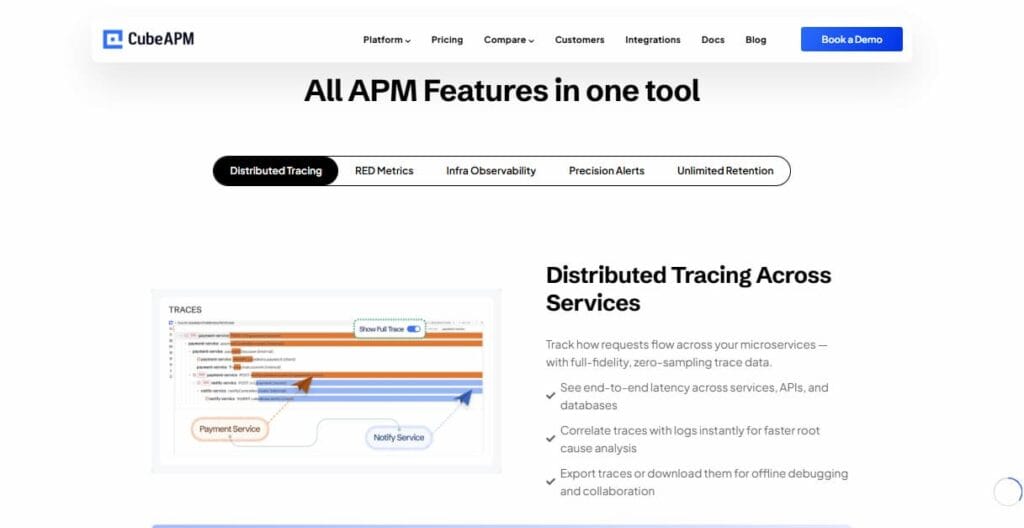
CubeAPM: Known for delivering a unified, OpenTelemetry-native observability backend that prioritizes predictable cost, long-term data retention, and self-hosted deployment inside customer-controlled infrastructure. CubeAPM is typically adopted by teams that need observability to scale without sacrificing data ownership, governance, or cost visibility.
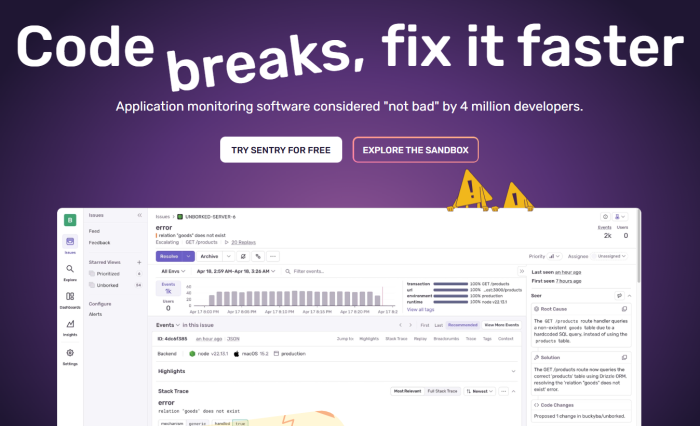
Sentry: Known for combining full-stack observability with event- and issue-driven workflows. Sentry excels at correlating errors, performance signals, releases, and user impact, making it a strong choice for developer-centric debugging and fast incident investigation.
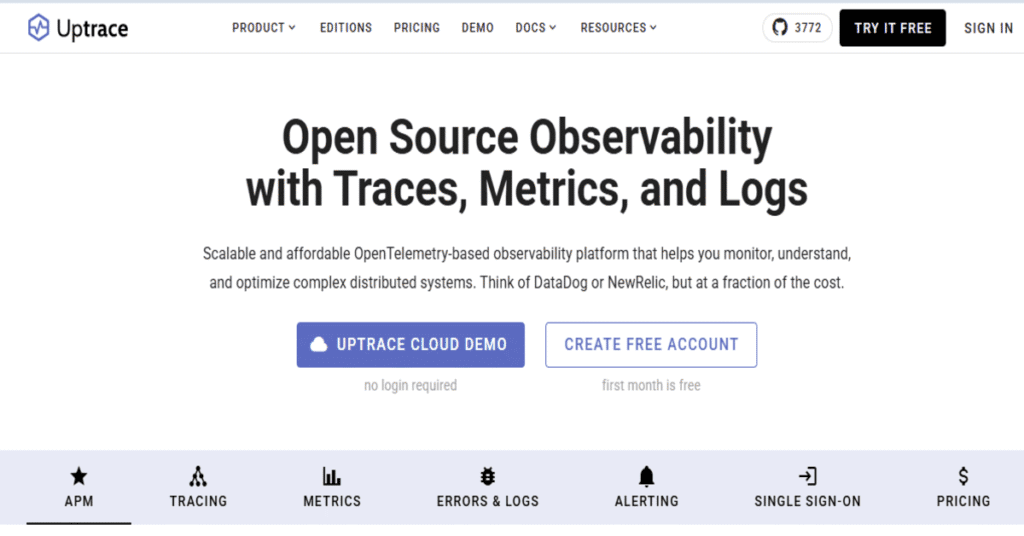
Uptrace: Known for being an OpenTelemetry-native observability platform that treats traces, metrics, and logs as queryable telemetry. Uptrace emphasizes flexibility in deployment, efficient querying, and a relatively lightweight operational footprint for distributed systems.
Multi-agent support
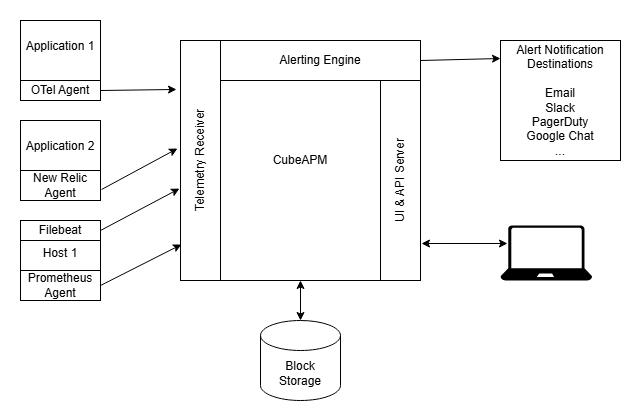
CubeAPM: Supports true multi-agent ingestion across heterogeneous environments. In addition to OpenTelemetry, CubeAPM can ingest telemetry from existing vendor agents such as Datadog, New Relic, and Elastic. This allows teams to consolidate observability without forcing immediate re-instrumentation or running parallel monitoring stacks. Multi-agent support is designed for real-world production systems where different teams and services often rely on different agents.
Sentry: Supports multiple instrumentation paths, including OpenTelemetry for distributed traces alongside its native SDKs. This means Sentry can collect telemetry via OpenTelemetry agents while also using its own SDKs and integrations. It supports multi-agent instrumentation where OpenTelemetry is part of the stack.
Uptrace: Relies primarily on OpenTelemetry for ingestion and instrumentation. Multi-agent environments are supported to the extent that services are instrumented using OpenTelemetry SDKs and collectors.
MELT Support (Metrics, Events, Logs, Traces)
CubeAPM: Provides native support for metrics, events, logs, and traces as first-class signals within a single backend. All four signal types are designed to be correlated without moving between separate tools or storage systems, which helps teams investigate issues across infrastructure, services, and user activity as telemetry volume grows.
Sentry: Supports all MELT signals, with strong emphasis on events and traces tied to application behavior. Logs and metrics are available, but the experience is centered around event-driven workflows, where errors, performance data, and contextual signals are analyzed through issues, releases, and user impact rather than raw telemetry exploration.
Uptrace: Supports metrics, logs, and traces natively through OpenTelemetry, with events typically modeled as part of trace or log data. MELT coverage is closely aligned with OpenTelemetry standards, making it flexible for telemetry ingestion, though correlation across signals depends on how pipelines and queries are configured.
Deployment model

CubeAPM: Designed to run inside customer-controlled infrastructure. CubeAPM is self-hosted or deployed in the customer’s VPC, but vendor-managed operations, meaning day-to-day operations, upgrades, and maintenance, are handled by the vendor. This model gives teams full data residency and infrastructure control without adding operational overhead typically associated with self-hosting observability systems.
Sentry: Available as both SaaS and self-hosted. The SaaS offering minimizes operational effort by shifting infrastructure and maintenance to Sentry. In self-hosted deployments, however, teams are responsible for installation, upgrades, scaling, and ongoing operations, with limited dedicated support. This model is typically chosen when data control is required, and teams are willing to absorb operational overhead.
Uptrace: Offered as both a managed cloud service and a self-hosted deployment. The managed option reduces operational responsibility, while self-hosted installations place infrastructure and maintenance duties on the customer. Operational overhead depends on the chosen deployment model and the complexity of the underlying environment.
Pricing: Approximate Cost for Small, Mid-Sized & Large Teams
*All pricing comparisons are calculated using standardized Small/Medium/Large team profiles defined in our internal benchmarking sheet, based on fixed log, metrics, trace, and retention assumptions. Actual pricing may vary by usage, region, and plan structure. Please confirm current pricing with each vendor.
*An APM host is a host that is actively generating trace data, and an Infra host is any physical or virtual OS instance that you monitor with any observability tool.
Below is a cost comparison for small, mid-sized, and large teams.
| Approx. Cost for Teams | Small (~30 APM Hosts) | Mid-sized (~125 APM Hosts) | Large (~250 APM Hosts) |
| CubeAPM | $2,080 | $7,200 | $15,200 |
| Sentry | $3,560 | $12,100 | $32,400 |
| Uptrace | $1,695 | $5,600 | $12,500 |
What this comparison reveals at scale
As observability environments grow, differences between platforms become structural rather than based on features alone. Choices around pricing mechanics, data retention, sampling controls, and deployment models begin to influence incident response, cost predictability, and compliance posture. Teams that evaluate observability as a long-term operational system tend to make more durable decisions than those comparing tools only on feature checklists.
CubeAPM: Cost for Small, Medium, and Large Teams
CubeAPM uses a data-ingestion–based pricing approach that ties observability spend directly to the amount of telemetry processed, rather than the number of users, services, or enabled features. This model is designed to keep costs aligned with actual system activity as environments grow in size and complexity.
Pricing:
- Predictable pricing of $0.15/GB
Based on comparable production workloads, typical monthly costs fall into the following ranges:
- Small teams (~30 APM hosts): $2,080
- Mid-sized teams (~125 APM hosts): $7,200
- Large teams (~250 APM hosts): $15,200
Sentry: Cost for Small, Medium, and Large Teams
Sentry pricing is based on a combination of per-seat plans and usage-based components.
Pricing:
- Team plan: $26 per user per month
- Business plan: $80 per user per month
- Logs: $0.50 per GB ingested
Using comparable production workloads, estimated monthly costs typically look like this:
- Small teams (~30 APM hosts): $3,560
- Mid-sized teams (~125 APM hosts): $12,100
- Large teams (~250 APM hosts): $32,400
At larger scales, Sentry’s cost growth is primarily driven by increased event volume, higher log ingestion, and broader feature adoption across teams, which can make spending less predictable as traffic and usage fluctuate.
Uptrace: Cost for Small, Medium, and Large Teams
Uptrace pricing is primarily based on telemetry ingestion and storage, with plans that scale according to the volume of traces, metrics, and logs collected via OpenTelemetry.
Using comparable production workloads, estimated monthly costs typically look like this:
- Small teams (~30 APM hosts): $1,695
- Mid-sized teams (~125 APM hosts): $5,600
- Large teams (~250 APM hosts): $12,500
As environments grow, cost efficiency depends heavily on how telemetry volume is managed, including log verbosity, trace sampling decisions, and retention settings. Teams with high-cardinality data or sustained traffic often see costs rise proportionally with ingestion.
Sampling Strategy
CubeAPM: Uses smart sampling to control telemetry volume while preserving meaningful production signals. Sampling decisions are applied intentionally across traces, logs, and metrics, with the goal of retaining high-value data rather than relying on uniform drop rates. This approach is designed to keep observability reliable as traffic grows, without forcing teams to choose between cost control and visibility.
Sentry: Primarily uses head-based sampling for transactions and events, combined with dynamic sampling rules that allow teams to prioritize or de-prioritize specific traffic patterns. Dynamic sampling enables more granular control than static rates, but sampling decisions are still made early in the data lifecycle and are often influenced by plan limits and usage thresholds.
Uptrace: Supports both head-based and tail-based sampling through OpenTelemetry SDKs and collectors. This gives teams flexibility to sample early for cost efficiency or later based on trace outcomes and attributes. The effectiveness of sampling in Uptrace depends largely on how well OpenTelemetry pipelines are configured and maintained by the engineering team.
In practice, teams rarely revisit observability platforms because of missing surface-level features. Re-evaluation usually happens when telemetry growth exposes deeper constraints, such as unpredictable cost behavior, reduced historical visibility during incident analysis, or difficulty answering audit and compliance questions long after data was generated. These pressures tend to emerge only once observability becomes core operational infrastructure rather than a supplementary debugging tool.
Data Retention

CubeAPM: Offers unlimited data retention, with retention duration controlled by the customer rather than enforced by plan-level limits. Teams can retain logs, metrics, traces, and contextual data for as long as required, making historical analysis, long-running incident reviews, and compliance audits possible without artificial cutoffs tied to pricing tiers.
Sentry: Sentry offers limited data retention. On the Developer plan, most data types, such as errors, logs, transactions, and replays, default to 30 days. On the Team and Business plans, retention for several data types increases to 90 days. Retention behavior varies across errors, logs, spans, replays, profiles, and attachments. As a result, teams often operate with multiple retention timelines depending on the telemetry they rely on.
Uptrace: Uptrace retention depends on the edition and deployment model. The Community edition provides a fixed retention period of 14 days. Premium, Managed, and Cloud editions allow configurable retention periods, with actual duration determined by plan limits or available storage. In self-hosted deployments, retention is ultimately governed by infrastructure capacity and lifecycle policies configured by the team.
Support Channel and Response Time (TAT)
CubeAPM: Provides support through email, Slack, and WhatsApp. Support is designed to be real-time and operationally responsive, with typical response times under 10 minutes. This model is intended for teams running observability as core infrastructure, where delays in support directly affect incident response and system reliability.
Sentry: Offers support primarily through email, Slack (for eligible plans), and GitHub community channels. There is no publicly documented response time guarantee.
Uptrace: Provides support through Slack, email, and community-driven channels, with additional support options available for Managed and Cloud editions. Public documentation does not specify guaranteed response times, and response speed generally depends on the selected edition and support tier.
How Teams Evaluate These Platforms at Scale
As observability becomes embedded into day-to-day operations, teams tend to move beyond surface-level feature comparisons and focus on how a platform behaves under sustained load and organizational complexity. Evaluation shifts toward questions such as how costs evolve with traffic growth, how much historical data remains accessible during investigations, and how much operational effort is required to keep the system reliable.
At scale, teams also look closely at data lifecycle controls. Retention policies, sampling strategies, and ingestion limits directly affect whether engineers can reconstruct incidents weeks or months later, correlate signals across services, or satisfy audit and compliance requirements. Platforms that make these controls explicit are generally easier to reason about as systems mature.
Finally, ownership and support models start to matter more. When observability is treated as core infrastructure rather than a developer add-on, teams evaluate who is responsible for operating the platform, how quickly support responds during incidents, and whether the system aligns with long-term architectural and governance goals. These factors often outweigh individual feature differences once environments reach a meaningful scale.
Sentry vs Uptrace vs CubeAPM: Use Cases
Choose CubeAPM if:
- You want observability costs to remain predictable as telemetry volume increases.
- Long-term or unlimited retention is required for audits, compliance, or historical analysis.
- Your environment already has multiple agents, and you want to consolidate without re-instrumentation.
- Observability must run inside your own infrastructure for data residency or governance reasons.
- Fast, real-time support is critical during production incidents.
Choose Sentry if:
- Developer-centric debugging and error visibility are the primary goals.
- Release impact, performance regressions, and user-facing issues need tight correlation.
- You prefer a SaaS-first model with minimal setup, and also a self-hosted version.
- Retention requirements fit within plan-based and data-type–specific limits.
Choose Uptrace if:
- You want an OpenTelemetry-first platform for traces, metrics, and logs.
- Cost efficiency at small to mid-scale is a priority.
- Flexible deployment options (cloud or self-hosted) are important.
- Telemetry volume and retention can be actively controlled by engineering teams.
Conclusion
Sentry, Uptrace, and CubeAPM all support modern observability needs, but they serve different priorities as systems grow. Differences in how data is ingested, sampled, retained, and priced become more visible once observability moves beyond early-stage usage.
Sentry works well for teams centered on developer workflows and fast application-level debugging. Uptrace fits teams that want an OpenTelemetry-first platform with flexible deployment and are comfortable managing telemetry pipelines. CubeAPM is better aligned with organizations that treat observability as core infrastructure and need predictable cost, long-term data retention, and operational control at scale.
Choosing between these platforms is less about feature parity and more about how each one behaves under sustained production load and long-term operational demands.
Choosing the right Platform as Observability Scales
As observability matures, platform selection shifts from quick setup to long-term behavior under sustained load. Teams begin to evaluate how tools respond to increasing traffic, expanding services, and higher telemetry volume.
At scale, pricing mechanics, retention policies, and control over ingestion and sampling matter more than individual features. These factors shape cost predictability, incident investigation, and compliance readiness.
The right platform is typically the one that continues to support growth without forcing trade-offs between visibility, cost control, and operational ownership.
Disclaimer: The information in this article reflects the latest details available at the time of publication and may change as technologies and products evolve.
FAQs
1. Is CubeAPM a full replacement for Sentry or Uptrace?
CubeAPM can replace both Sentry and Uptrace for teams that want a single, OpenTelemetry-native observability platform covering logs, metrics, traces, and events. Some teams still choose to keep Sentry alongside CubeAPM when developer-focused error workflows are deeply embedded.
2. Does Sentry support OpenTelemetry?
Yes. Sentry supports OpenTelemetry for distributed tracing and can ingest OTel data, alongside its native SDKs. However, its data model and workflows remain centered around events and issues rather than raw telemetry pipelines.
3. Can Uptrace be used in production at scale?
Yes, Uptrace is used in production environments, especially where OpenTelemetry is already standardized. At scale, teams need to actively manage sampling, retention, and storage to keep costs and performance predictable.
4. How do observability costs typically change as systems scale?
Costs usually increase with telemetry volume, service count, and data cardinality. Platforms differ in how transparently these costs grow and how much control teams have over ingestion, sampling, and retention as usage expands.
5. Which platform is best for long-term data retention and audits?
CubeAPM is generally preferred when long-term or unlimited retention is required, since retention is customer-controlled rather than plan-limited. This is especially relevant for compliance, audits, and extended incident analysis.