








If you’re looking at Sentry alternatives because quota overages are causing surprise bills, the self-hosted setup feels heavy, or your team needs more than error tracking, this guide is for you.
We compare 7 platforms against Sentry across pricing predictability, deployment model, observability depth, and OpenTelemetry support, so you can choose with more confidence.
Sentry is a well-known error monitoring tool with strong SDK support and mature issue grouping. But as teams grow, the same concerns keep coming up: unpredictable quota-based pricing, a self-hosted stack that is hard to manage, and a product scope that still leans more toward error tracking than full observability.
Top 7 Sentry alternatives
- CubeAPM
- SigNoz
- Datadog
- New Relic
- Uptrace
- Dynatrace
- Grafana Cloud
Quick comparison table: Best Sentry alternatives at a glance
The information in this table is based on publicly available vendor documentation at the time of writing. Feature availability, pricing models, and retention policies may vary by deployment configuration, subscription tier, or enterprise agreement. Consult official documentation before making platform decisions.
*All pricing comparisons are calculated using standardized Small/Medium/Large team profiles defined in our internal benchmarking sheet, based on fixed log, metrics, trace, and retention assumptions. Actual pricing may vary by usage, region, and plan structure. Please confirm current pricing with each vendor.
| Tool | Pricing (Small / Mid / Large) | Native OTEL | Self-hosted? | Backend managed by | Error tracking depth |
| CubeAPM | $2,080 / $7,200 / $15,200 | Yes | Yes | Vendor (CubeAPM) | Full — tied to traces & logs |
| Sentry | $3,560 / $12,100 / $32,400 | Yes | Yes | You (5-component) | Deep — error-first workflow |
| Uptrace | $1,695 / $5,600 / $12,500 | Yes | Yes | Self-hosted: You SaaS: Uptrace | Via trace correlation |
| Grafana | $3,870 / $11,875 / $26,750 | Yes | Yes | Self-hosted: You SaaS: Grafana | Via Loki + Tempo |
| SigNoz | $4,600 / $16,000 / $34,000 | Yes | Yes | Self-hosted: You: (ClickHouseSaaS: SigNoz | Unified with logs & traces |
| Dynatrace | $7,740 / $21,850 / $46,000 | *No | Yes | Dynatrace | AI-assisted, enterprise-scale |
| New Relic | $7,896 / $25,990 / $57,970 | *No | No | New Relic | Full-stack with RUM |
| Datadog | $8,185 / $27,475 / $59,050 | *No | No | Datadog | Full-stack with RUM & profiling |
Sentry’s biggest drawback: Event-quota pricing that punishes growth
For SigNoz, the equivalent pain is ClickHouse management overhead. For Sentry, the structural equivalent is its event-quota pricing model, and it affects teams much earlier than they expect.
Sentry bills across five separate quota buckets: errors, spans (performance traces), replays, log items, and attachments. Each has its own monthly quota and its own overage rate. When a bug ships, a traffic spike hits, or a noisy error starts looping, any of these buckets can be exhausted within hours.
- If pay-as-you-go is enabled, your bill grows automatically with no ceiling unless you set one manually.
- If pay-as-you-go is disabled, new events are dropped silently once the quota is hit, meaning errors go untracked for the rest of the month.
- Either way, you are now in the business of configuring quota limits, spike protection, and SDK-level sampling just to control your own observability costs.
This is not a small overhead. Teams frequently report spending engineering time tuning before Sending filters, adjusting sample rates per environment, and managing per-project quotas work that has nothing to do with debugging applications.
What Sentry’s quota model costs at scale
*Illustrative estimates based on public Sentry pricing and quota information as of early 2026. Actual costs may vary by usage and contract terms.
| Sentry plan | Errors/month | Spans/month | Replays/month | Overage (errors) | Overage (spans) |
| Team ($26/mo) | 50K | 5M | 50 | $0.0003625/error | $0.0000016/span |
| Business ($80/mo) | 50K | 5M | 50 | $0.0011125/error | $0.0000016/span |
| 500K errors in one day (traffic spike) | → exhausts monthly quota in hours | — | — | Unexpected overage added immediately |
Compare this to CubeAPM’s $0.15/GB ingestion model or Uptrace’s $0.10/GB model, both of which bill on data volume regardless of whether that data represents 1 error or 1 million errors per GB. The difference is not just cost: it is that ingestion-based pricing scales smoothly with traffic, while event-based quota pricing creates cliffs.
Teams looking to avoid Sentry’s SaaS costs often consider self-hosting, but Sentry’s self-hosted stack is one of the most operationally complex in this space. A production-grade Sentry self-hosted deployment requires running and managing:
- PostgreSQL: primary relational database
- Redis: caching and task queue
- Kafka: event streaming and ingestion pipeline
- ClickHouse: time-series storage for performance data
- Relay: Sentry’s inbound event proxy and rate limiter
That is five separate systems, each with their own upgrade path, backup requirements, scaling considerations, and failure modes. The self-hosted project’s own documentation notes a minimum of 16 GB RAM (recommended 32 GB) and orchestrates 40+ containers via an install script you cannot reasonably write by hand.
In early January 2024, Sentry announced a terms update and published a blog post saying it wanted language that would allow it to use usage data and service data for analytics and product development, including training or improving AI features and generating outputs. The blog included this exact wording: “Sentry may use Usage Data and Service Data for analytics and product development (including to train or improve AI Features and generate Outputs).”
That change triggered visible backlash in the developer community, including a Hacker News thread focused on Sentry’s new TOS and AI training language, plus follow-up discussion questioning the lack of an opt-out.
Sentry later revised the legal position. In its legal changelog for the February 12, 2024, Terms of Service update, effective April 12, 2024, Sentry says it “requires[s] customer authorization to use Service Data (other than non-identifying data) for any purpose other than providing Sentry’s service to the customer.” The current Terms of Service also say Sentry may use Non-Identifying Data for additional uses but may use other elements of Service Data for those uses only if the customer authorizes it through service configuration.
Sentry has expanded its feature set; it now supports performance monitoring, distributed tracing, logs, and session replay. But its core product design, workflow, and pricing model remain centered on the developer error-monitoring experience. For teams whose primary need has shifted toward full MELT observability correlating errors with infrastructure metrics, trace context, and Kubernetes health Sentry increasingly functions as a point tool alongside other platforms rather than replacing them.
How we evaluated Sentry alternatives
We assessed each platform against seven criteria and modelled costs across two standardized usage scenarios using publicly available pricing as of early 2026.
- Error tracking depth: Issue grouping, stack traces, breadcrumbs, crash reporting, and debugging workflow quality.
- Broader observability coverage: Whether the platform also supports logs, traces, metrics, and infrastructure visibility.
- OpenTelemetry and modern telemetry fit: Native OTel support vs. proprietary instrumentation requirements.
- Deployment model: SaaS, self-hosted, or vendor-managed self-hosted, and the operational overhead each carries.
- Pricing predictability: Whether costs stay manageable during traffic spikes, not just at average volumes.
- Frontend and user context: Session replay, user impact, and browser or mobile debugging depth.
- Self-hosted operational overhead: How much backend management your team absorbs is particularly relevant given Sentry’s 5-component self-hosted stack.
Best self-hosted Sentry alternatives
Teams choosing to self-host Sentry often do so to avoid SaaS costs and data egress. But the five-service stack (PostgreSQL, Redis, Kafka, ClickHouse, and Relay) means you trade one cost for another in infrastructure and engineering time.
*Directional estimates based on publicly available product information, documentation, and pricing pages as of early 2026. Actual deployment effort and management responsibility may vary based on your architecture, team skills, hosting model, and support plan.
| Tool | Deployment model | Who manages the backend? | Data in your cloud? | Ops effort (1–5) | Best for |
| CubeAPM | Self-hosted, vendor-managed | CubeAPM team | Yes | 1 — very low | Data residency without backend ops |
| Sentry | Self-hosted, self-managed | You (5 services) | Yes | 5 — very high | Teams with full DevOps capacity |
| Uptrace | Self-hosted or SaaS | You or Uptrace | Yes | 2 — low | Lightweight OTel-native replacement |
| Grafana OSS | Self-hosted or SaaS | You or Grafana | Yes | 3 — moderate | Teams on Prometheus/Grafana stack |
| SigNoz | Self-hosted or SaaS | You (ClickHouse) | Yes | 4 — high | OTel-first teams with DevOps capacity |
Ops effort scale: 1 = almost no backend work required; 5 = significant ongoing engineering investment.
Runs entirely inside your own AWS, GCP, or Azure environment. The CubeAPM team manages the platform you get data sovereignty and zero backend operations.
Lightweight OpenTelemetry-native platform that can be self-hosted with significantly less complexity than Sentry. Accepts Sentry SDK events natively; just change your DSN.
PostgreSQL + Redis + Kafka + ClickHouse + Relay. Full error-tracking feature parity with SaaS. Best for teams with dedicated DevOps who specifically need Sentry’s issue workflow.
The hidden cost: Engineering time spent managing Sentry quotas
For teams running Sentry at scale, the real cost is not just the subscription; it is the engineering time absorbed by quota management and self-hosted operations.
*Assumptions: $80/hour blended engineering rate. Hours estimated from community reports and Sentry operational documentation.
*These estimates are directional. They are intended to make the operational tradeoff visible, not to serve as precise forecasts.
| Task | Hours/month (growing) | Hours/month (mid-market) | Annual cost (growing) | Annual cost (mid-market) |
| Quota tuning (rate limits, spike protection, SDK sampling) | 3–5 hrs | 5–8 hrs | $2,880–$4,800 | $4,800–$7,680 |
| Self-hosted: PostgreSQL + Redis + Kafka management | 4–6 hrs | 8–12 hrs | $3,840–$5,760 | $7,680–$11,520 |
| Self-hosted: ClickHouse + Relay tuning | 2–3 hrs | 4–6 hrs | $1,920–$2,880 | $3,840–$5,760 |
| Self-hosted: upgrades & version compatibility | 2–3 hrs | 3–5 hrs | $1,920–$2,880 | $2,880–$4,800 |
| Alert noise reduction & issue triage config | 2–3 hrs | 3–5 hrs | $1,920–$2,880 | $2,880–$4,800 |
| Total estimated (SaaS only) | 5–8 hrs | 8–13 hrs | $4,800–$7,680 | $7,680–$12,480 |
| Total estimated (self-hosted) | 13–20 hrs | 23–36 hrs | $12,480–$19,200 | $22,080–$34,560 |
Pricing model comparison: Event-based quotas vs. ingestion-based
Sentry’s per-event, per-category quota model is fundamentally different from the GB-ingestion model used by most observability platforms. Understanding this difference is the single most important thing when comparing alternatives; it determines not just cost but cost predictability.
*Disclaimer: All rates are directional estimates based on publicly available pricing pages as of early 2026. Verify with each vendor before making decisions.
| Tool | Pricing model | Error pricing | Trace/span pricing | Log pricing | Cost during traffic spike |
| Sentry | Per-event quotas | $0.000290/error (Team) | $0.0000016/span (Team) | Separate quota | Can exhaust included quota quickly, then move into overage pricing |
| CubeAPM | GB ingested (flat) | Included in $0.15/GB | Included in $0.15/GB | $0.15/GB | Scales proportionally |
| Uptrace | GB ingested | Not separately priced; part of ingest-based model | $0.10/GB traces | $0.10/GB logs | Scales proportionally |
| Grafana | Process+write+retain | Via Loki correlation | $0.50/GB all-in | $0.50/GB all-in | Scales proportionally |
| SigNoz | GB ingested | Included in $0.30/GB ingested | $0.30/GB traces | $0.30/GB logs | Scales proportionally |
| New Relic | GB ingested + users | Included in ingest | Included in ingest | Included in GB | Scales proportionally |
| Datadog | Per-host + per-span | Error tracking is available as a separate product | APM host + ingest/indexed span pricing | $0.10/GB | Host-fixed; spans variable |
| Dynatrace | Per-host + DPS | Included (per host) | Included (per host) | $0.20/GB | Host-fixed; logs variable |
Real-world scenarios: Which Sentry alternative fits best?
How to find your scenario
| Primary reason for evaluating alternatives | Deployment preference | Likely best fit |
| Unpredictable billing / quota overages | Any | CubeAPM or Uptrace flat GB-ingestion pricing |
| Self-hosted ops overhead is too high | Self-hosted | CubeAPM (vendor-managed) or Uptrace (simpler stack) |
| Need more than error tracking | Managed SaaS | CubeAPM, Datadog, or New Relic |
| OpenTelemetry-first, no proprietary agents | Any | CubeAPM, SigNoz, or Uptrace |
| Data compliance / no data egress | Self-hosted | CubeAPM (vendor-managed in your cloud) |
| Enterprise automation + AI root cause | Managed SaaS | Dynatrace or Datadog |
Scenario 1: Growing team hitting Sentry quota limits
The situation: Your team is 4 engineers on ~60 hosts. You started on Sentry’s Team plan because the developer workflow was familiar. Now a noisy error exhausted your monthly quota in two days; you missed errors for the rest of the month without realizing it, and you spent half a sprint tuning rate limits and SDK sampling to avoid it happening again.
Reference profile
- Data ingested: ~13 TB/month (6 TB logs, 4 TB traces, 3 TB metrics)
- Infrastructure: 60 hosts
- Users: 4 (20% engineers)
- Retention: 30 days
- Scope: Core observability only
Approximate monthly costs for a growing team
*All pricing comparisons are calculated using standardized Small/Medium/Large team profiles defined in our internal benchmarking sheet, based on fixed log, metrics, trace, and retention assumptions. Actual pricing may vary by usage, region, and plan structure. Please confirm current pricing with each vendor.
| Tool | Est. monthly cost | vs Sentry ($3,560) | Pricing model | Quota spike risk |
| Uptrace | $1,695 | -52% | GB ingested | None scales smoothly |
| CubeAPM | $2,080 | -42% | GB ingested | None, scales smoothly |
| Grafana Cloud | $3,870 | +9% | Process+write+retain | None, scales smoothly |
| Sentry | $3,560 | — | Per-event quotas | A high quota can exhaust in hours |
| SigNoz | $4,600 | +29% | GB ingested | None, scales smoothly |
| Dynatrace | $7,740 | +117% | Per-host | Low host-based |
| New Relic | $7,896 | +122% | GB + users | None, scales smoothly |
| Datadog | $8,185 | +130% | Per-host + spans | Moderate span cardinality |
- Uptrace: Cheapest option with OTel-native ingestion and no per-event quota risk. Accepts Sentry SDK events natively. Change your DSN and you are done.
- CubeAPM: Most cost-effective self-hosted option with vendor-managed operations. Predictable GB pricing, unlimited retention, no quota management required.
- Grafana Cloud: Good option for teams already on the Grafana/Prometheus ecosystem. No event-quota surprises.
Scenario 2: Mid-market team needing full observability
The situation: Your organization is running 200 hosts, ingesting ~45 TB/month. Your 10-person platform team has outgrown error tracking as a standalone workflow. You need errors correlated with infrastructure metrics, distributed traces, and Kubernetes health in one platform, not Sentry plus three other tools.
Reference profile
- Data ingested: ~45 TB/month (20 TB logs, 15 TB traces, 10 TB metrics)
- Infrastructure: 200 hosts
- Users: 10 platform users
- Retention: 30 days
- Scope: Core observability only
Approximate monthly costs for a mid-market team
*All pricing comparisons are calculated using standardized Small/Medium/Large team profiles defined in our internal benchmarking sheet, based on fixed log, metrics, trace, and retention assumptions. Actual pricing may vary by usage, region, and plan structure. Please confirm current pricing with each vendor.
| Tool | Est. monthly cost | vs Sentry ($12,100) | Full MELT? | Self-hosted option? |
| Uptrace | $5,600 | -54% | Yes (traces/logs/metrics) | Yes |
| CubeAPM | $7,200 | -41% | Yes (full stack) | Yes (vendor-managed) |
| Grafana Cloud | $11,875 | -2% | Yes (LGTM stack) | Yes |
| Sentry | $12,100 | — | Partial (error-first) | Yes (5 services) |
| SigNoz | $16,000 | +32% | Yes (OTel-native) | Yes (ClickHouse) |
| Dynatrace | $21,850 | +81% | Yes (enterprise) | Limited |
| New Relic | $25,990 | +115% | Yes (full platform) | No |
| Datadog | $27,475 | +127% | Yes (broadest coverage) | No |
- CubeAPM: Strong fit for mid-market teams that want to consolidate from Sentry + APM + log tools into one platform. Delhivery documented 75% savings after replacing three separate monitoring tools. Mamaearth documented nearly 70% savings with migration in under an hour and zero downtime. redBus reported 4x faster dashboards and 50% faster MTTR.
- Grafana Cloud: At similar cost to Sentry, full MELT observability across Loki, Tempo, and Mimir. Strong fit for teams already on Prometheus.
- New Relic: Good for mid-market teams wanting broad managed platform access. No host-based charges: 100 GB free ingest per month, then $0.40/GB.
- Dynatrace: Worth the premium for teams that need AI-assisted root cause analysis across large distributed systems.
Top Sentry alternatives to consider
1. CubeAPM
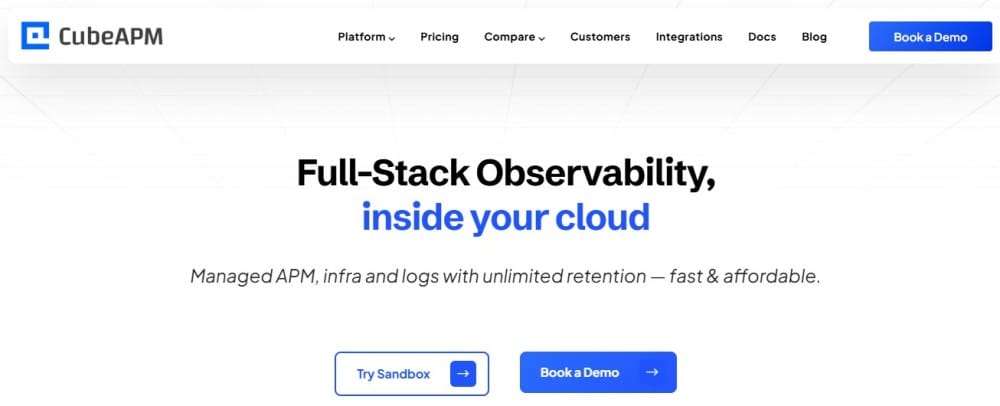
Best for: Teams that want to move from standalone error tracking to full MELT observability with self-hosted deployment, predictable pricing, and no backend management overhead.
Known for
CubeAPM is a self-hosted, vendor-managed, OpenTelemetry-native observability platform covering APM, logs, infrastructure, Kubernetes, RUM, synthetic monitoring, Kafka monitoring, and error tracking. It runs inside your cloud: no data egress and no external dependency during incidents.
Recognized as a High Performer in G2’s Spring 2026 APM Grid Report and ranked #4 among the easiest-to-use APM tools on G2. Trusted by redBus (part of NASDAQ-listed MakeMyTrip, 8+ countries), Delhivery ($3.5B valuation), Mamaearth ($1.2B valuation), Policybazaar, Practo, and others.
Key features
- Full-stack unified observability: APM, logs, infrastructure, Kubernetes, Kafka, RUM, synthetic monitoring, error tracking
- OpenTelemetry-native, no proprietary agents; compatible with Prometheus, Datadog, and New Relic agents for incremental migration
- Self-hosted and BYOC deployment data sovereignty by design
- Data compliance: SOC 2 and ISO 27001 certified
- Unlimited data retention with no egress surprises
- AI-based trace sampling retains traces that matter while reducing storage overhead
- Direct engineering support via shared channel, not a ticket queue
Pros
- Simplest pricing model: single billing dimension ($0.15/GB) no event quotas, no host charges, no user charges
- Consistently 70–75% lower cost than enterprise APM at scale
- Multi-agent compatibility works alongside Datadog, New Relic, Elastic, and Prometheus agents
- Complete data ownership: no telemetry leaves your infrastructure
- Unlimited retention, predictable pricing, no egress charges
Cons
- Not suited for teams requiring off-premises SaaS
- Strictly an observability platform, no cloud security management
Pricing
$0.15/GB ingested. No host charges. No user charges. No event quotas. Unlimited retention.
CubeAPM vs Sentry
Choose CubeAPM over Sentry if you want predictable pricing, self-hosted deployment without operational burden, and broader observability beyond error tracking. Sentry’s per-event quota model can exhaust monthly allowances during traffic spikes. CubeAPM’s flat $0.15/GB ingestion rate scales proportionally with actual data volume, so a traffic spike never creates a billing cliff. CubeAPM is vendor-managed, so teams do not handle the scaling, tuning, and maintenance work that comes with Sentry’s five-service self-hosted stack. It also includes unlimited data retention, while Sentry’s retention is plan-gated and extending it adds cost.
2. SigNoz
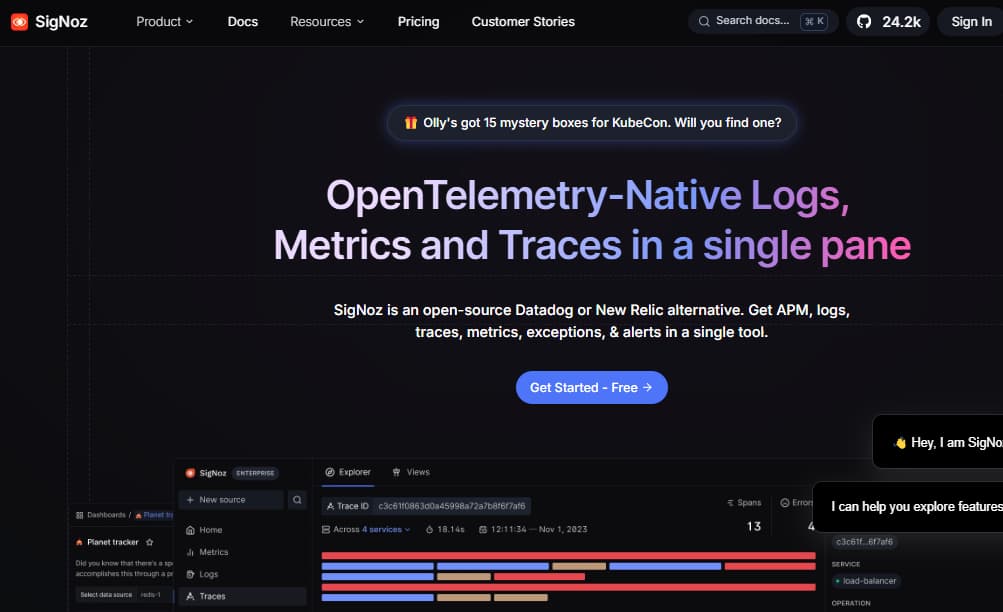
Best for: Teams that want OpenTelemetry-first observability with unified logs, metrics, traces, and errors and are comfortable managing the ClickHouse backend self-hosted.
Known for
SigNoz is an OpenTelemetry-native observability platform that combines traces, metrics, logs, and errors in one system. Usually considered by teams that want broader observability with more control over deployment and telemetry ownership.
Key features
- OpenTelemetry-native ingestion
- Unified logs, metrics, traces, and errors
- Distributed tracing with service dependency views
- Self-hosted and cloud deployment
- PromQL and flexible query workflows
Pros
- OpenTelemetry-first
- Unified observability
- Self-hosted option available
- Flexible querying
Cons
- Self-hosting requires managing the ClickHouse backend, a significant ongoing operational overhead
- Short default retention windows: 15 days for logs and traces; extending them costs more
- Steep learning curve
- Costs can scale with data volumes
Pricing
- Logs: $0.30/GB ingested
- Traces: $0.30/GB ingested
- Metrics: $0.10 per million samples
- Cloud: starts at $49/month
SigNoz vs Sentry
Choose SigNoz if you want broader observability beyond error tracking. While Sentry is mainly centered on application errors, issue workflows, and debugging, SigNoz combines logs, metrics, traces, and errors in one OpenTelemetry-native platform. Note that SigNoz’s self-hosted model carries its own ClickHouse backend overhead, different from Sentry’s five-service stack but still significant for teams without dedicated DevOps capacity.
3. Datadog
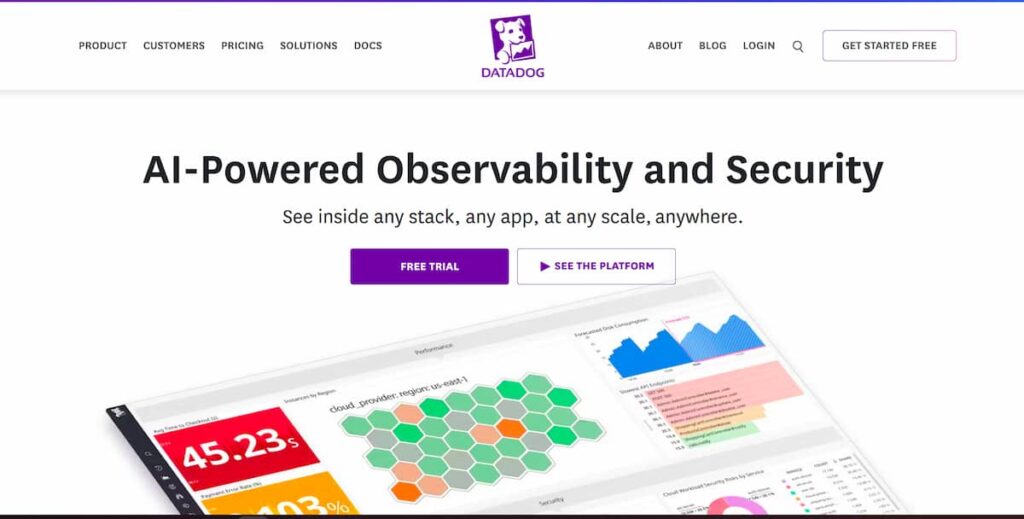
Best for: Teams that want a mature managed SaaS platform with broad integrations, deep RUM, and one vendor across infrastructure, applications, logs, and user-facing monitoring.
Known for
Datadog is known for broad, cloud-native observability, combining infrastructure monitoring, APM, logs, RUM, security, and incident tooling in one platform.
Key features
- Unified infrastructure, logs, traces, and RUM
- 900+ integrations
- Distributed tracing and code-level profiling
- Cloud-native and Kubernetes monitoring
- Error tracking within a broader platform suite
Pros
- Broad platform coverage
- Strong integrations: 900+
- Mature SaaS platform
- Good cross-signal correlation
Cons
- Can get expensive as usage grows
- Multi-axis pricing can get complex at high cardinality
- Steeper learning curve
- No self-hosted option
Pricing
- Infrastructure Pro: $15/host/month billed annually
- APM Pro: $35/APM host/month
Use the Datadog pricing calculator at cubeapm.com/pricing-calculator/datadog/ to estimate costs based on your data volume, users, and observability needs.
Datadog vs Sentry
Choose Datadog if you want a broader managed observability platform built around one workflow for infrastructure, logs, traces, RUM, and error tracking. Sentry also supports logs, tracing, and session replay, but it still presents itself as a developer-first error monitoring platform. Datadog positions error tracking as one part of a wider observability stack. That makes Datadog a stronger fit for teams that want application errors tied more closely to cloud infrastructure, service health, and user experience in one managed platform.
4. New Relic
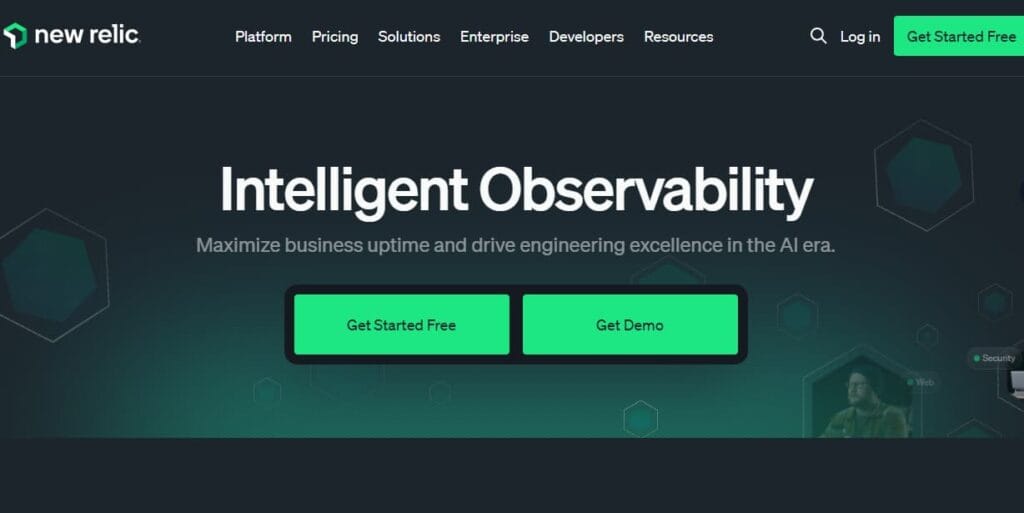
Best for: Teams that want broad platform coverage with strong real-time APM, usage-based pricing without per-host charges, and a managed platform supporting both engineering and operations workflows.
Known for
New Relic is known for full-stack observability, combining APM, infrastructure monitoring, logs, distributed tracing, browser monitoring, and incident workflows in one platform.
Key features
- Unified logs, metrics, traces, and errors
- Distributed tracing and APM
- Browser and mobile monitoring
- Kubernetes and infrastructure monitoring
- OpenTelemetry support
Pros
- Broad platform coverage
- Strong APM depth
- 100 GB free ingest per month
- Good cross-signal visibility
Cons
- Expensive as usage grows beyond free tier
- User-based pricing adds cost at scale
- Complex packaging
Pricing
- 100 GB/month ingest: free
- Data ingest beyond free tier: $0.40/GB
- Core user: $49/user/month
- Full Platform Pro: $349/user/year
Use the New Relic pricing calculator at cubeapm.com/pricing-calculator/new-relic/ to estimate costs based on your data volume, users, and observability needs.
New Relic vs Sentry
Choose New Relic if you want error tracking inside a broader full-stack observability platform. Sentry also supports tracing, logs, session replay, and performance monitoring, but it still presents error monitoring as a core developer workflow, while New Relic positions itself around correlating telemetry across the entire stack. That makes New Relic a better fit for teams that want application errors tied more closely to infrastructure, browser monitoring, and wider operational visibility in one platform.
5. Grafana Cloud
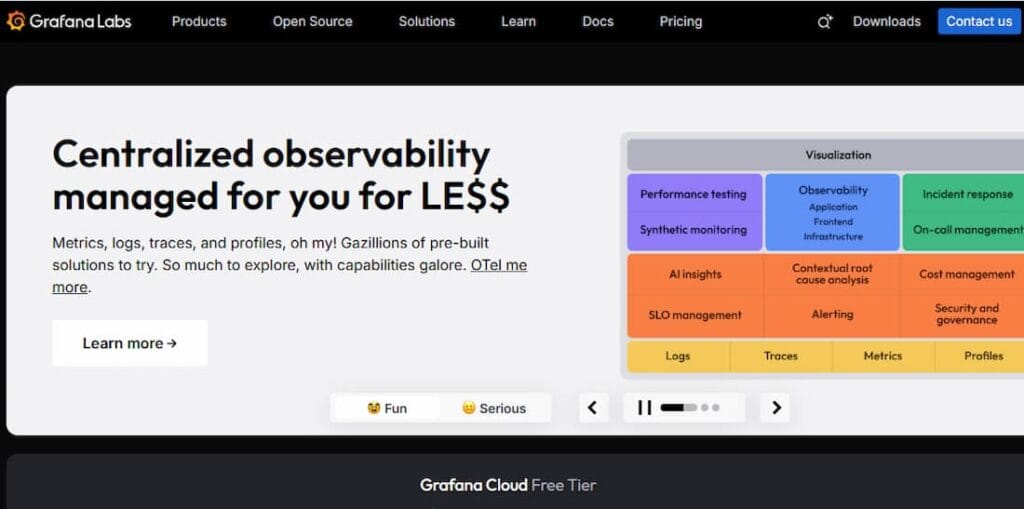
Best for: Teams that want flexible, composable observability built around the LGTM stack and are already comfortable with Grafana, Prometheus, Loki, and Tempo tooling.
Known for
Grafana is known for flexible observability built around the LGTM stack: Loki for logs, Grafana for visualization, Tempo for traces, and Mimir or Prometheus-compatible workflows for metrics.
Key features
- LGTM-based observability stack
- Strong log, metrics, and traces correlation
- OpenTelemetry and Prometheus-friendly workflows
- Self-hosted and cloud deployment options
- Kubernetes and cloud-native monitoring
Pros
- Flexible composable stack
- Strong visualisation
- Open ecosystem
- Good cloud-native fit
Cons
- More setup and architectural decisions required
- Pricing across process + write + retain dimensions can be complex to forecast
Pricing
- Free tier: $0
- Pro platform fee: $19/month
- Logs: $0.05 process + $0.40 write + $0.10 retain per GB
- Traces: $0.05 process + $0.40 write + $0.10 retain per GB
- Enterprise: custom, minimum commit $25,000/year
Grafana vs Sentry
Choose Grafana if you want a more composable observability stack built around logs, metrics, and traces rather than a developer-first error monitoring workflow. Sentry also supports tracing, logs, and session replay, but Grafana positions itself around the LGTM stack and broader telemetry correlation, while Sentry still centres the experience around debugging application issues. That makes Grafana a better fit for teams that want more flexibility in how they collect, route, and analyse observability data and want to avoid event-quota surprises.
6. Uptrace
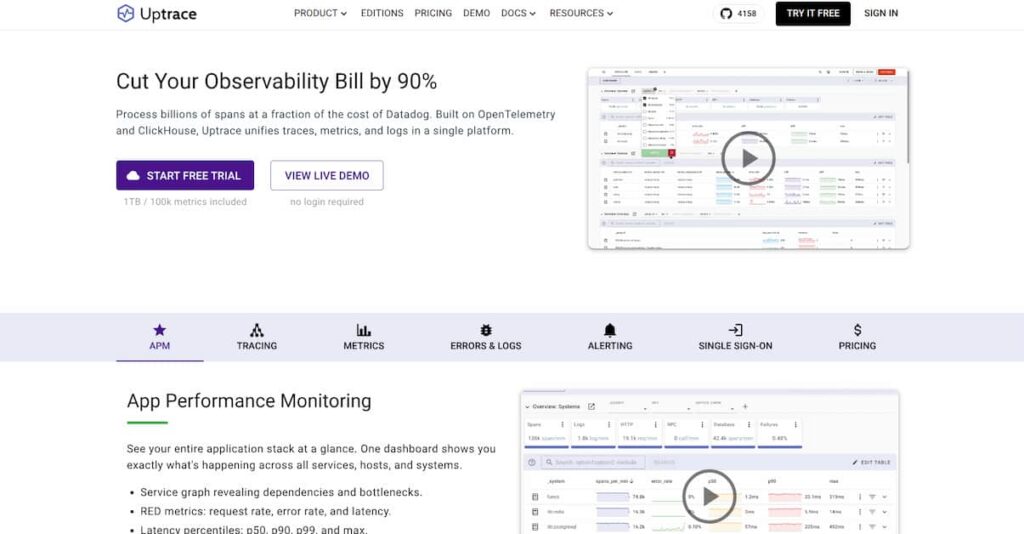
Best for: Teams that want a lightweight OpenTelemetry-native platform with predictable GB pricing, no per-seat fees, and the simplest possible migration from Sentry.
Known for
Uptrace is known for OpenTelemetry-native observability focused on traces, metrics, and logs with predictable pricing and self-hosting flexibility. Often considered by teams that want broad observability without per-seat fees or a heavy platform footprint.
Key features
- OpenTelemetry-native ingestion
- Unified traces, metrics, and logs
- Exception tracking with trace correlation
- Self-hosted, cloud, and on-prem options
- Sentry SDK compatibility changes DSN, not instrumentation
Pros
- Predictable GB-ingestion pricing, no event quota surprises
- No per-seat fees
- Self-host free
- Strong OpenTelemetry fit
- Sentry SDK-compatible migration in under an hour
Cons
- More self-managed responsibility for self-hosted deployment
- Smaller ecosystem than Sentry or Datadog
Pricing
- Free trial: 1 TB storage, 100K time series
- Logs and traces: from $0.10/GB
- Metrics: from $0.025 per 200M datapoints
Uptrace vs Sentry
Choose Uptrace if you want a lighter OpenTelemetry-native platform with more predictable usage-based pricing. Sentry also supports logs, tracing, and session replay, but it still presents itself around developer-facing error monitoring with a per-event quota model while Uptrace positions itself as an observability platform that unifies traces, metrics, and logs with no per-seat fees, no monthly quota cliffs, and Sentry SDK compatibility. The migration path is the simplest of any tool in this guide: just update your DSN and keep your existing instrumentation.
7. Dynatrace
Best for: Large teams and enterprises that want deep application and infrastructure observability with AI-assisted root cause analysis and automated incident triage.
Known for
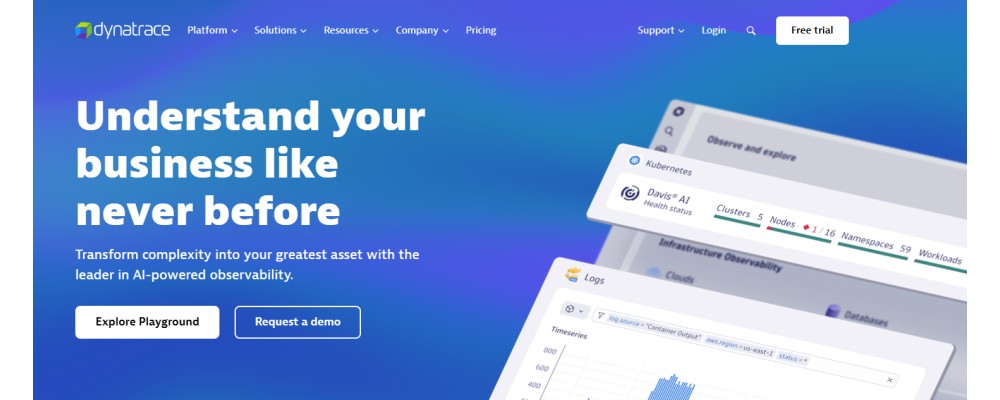
Dynatrace is known for enterprise-grade observability with strong APM, infrastructure monitoring, distributed tracing, and AI-assisted root cause analysis via Davis AI. Often considered by teams that want deep automation and broad platform coverage across modern cloud and large-scale environments.
Key features
- Full-stack monitoring
- AI-assisted root cause analysis (Davis AI)
- Distributed tracing and code-level profiling
- Kubernetes and infrastructure monitoring
- OpenTelemetry metrics and traces support
Pros
- Strong automation Davis AI reduces alert noise
- Deep APM visibility
- Mature enterprise platform
- Good cloud-scale fit
Cons
- Expensive
- Complex pricing across modules
- Steeper learning curve
Pricing
- Foundation & Discovery: $7/month per host
- Infrastructure Monitoring: $29/month per host
- Full-Stack Monitoring: $58/month per 8 GiB host
- Logs ingest and process: $0.20/GiB
- Traces ingest and process: $0.20/GiB
Dynatrace vs Sentry
Choose Dynatrace if you want error tracking inside a broader enterprise observability platform. Sentry also supports logs, tracing, session replay, and performance monitoring, but it still centers the experience on developer-focused error monitoring, while Dynatrace is built around full-stack observability, automated topology mapping, and platform-wide AI analysis. That makes Dynatrace a better fit for teams that want errors tied more closely to infrastructure and operations.
Which Sentry alternative is best for your use case?
- CubeAPM: Flat $0.15/GB, no event quotas, no per-span charges, scales smoothly with traffic.
- Uptrace: $0.10/GB is the cheapest GB-ingestion option; no quota management is required.
- New Relic: 100 GB free/month, then $0.40/GB, no event-quota model.
- CubeAPM: Vendor-managed in your cloud data residency, zero backend ops, and SOC 2 / ISO 27001 certified.
- Uptrace: Simple self-hosted deployment, Sentry SDK compatible, and far less complex than Sentry self-hosted.
- Grafana OSS: Fully open-source LGTM stack for teams with DevOps capacity to self-manage.
- CubeAPM: Full MELT observability, APM, logs, traces, infrastructure, Kubernetes, RUM, synthetics in one platform.
- Datadog: Broadest managed coverage of infrastructure, logs, traces, RUM, security in one platform.
- New Relic: Strong full-stack option with browser monitoring and 100 GB free ingest.
- CubeAPM: OTel-native, no proprietary agents, multi-agent compatible for incremental migration.
- SigNoz: OTel-native platform with broader signal coverage than Sentry.
- Uptrace: Lightweight OTel-first observability, the simplest migration from Sentry.
- Dynatrace: AI-assisted root cause analysis, topology mapping, enterprise automation.
- Datadog: The broadest managed platform with 900+ integrations.
- CubeAPM: Kubernetes and microservices observability with deployment control at enterprise scale.
- CubeAPM: Vendor-managed self-hosted data never leaves your cloud. SOC 2, ISO 27001 certified.
- Uptrace (self-hosted): Fully self-managed option with simpler infrastructure than Sentry self-hosted.
Migrating from Sentry
Uptrace is Sentry-SDK compatible. You change your DSN endpoint and nothing else — no re-instrumentation, no new SDKs, no code changes. Teams have reported completing this migration in under an hour.
If your team is already using OpenTelemetry instrumentation alongside Sentry, migrating to an OTel-native platform means updating your OTEL exporter endpoint. Application-level instrumentation stays the same. The main migration effort is recreating dashboards, alert rules, and issue workflows in the new platform.
These platforms have their own instrumentation agents. Migration involves installing new agents, configuring integrations, and rebuilding dashboards. CubeAPM specifically supports multi-agent operation during migration — you can run CubeAPM alongside your existing Datadog or New Relic agents and migrate service-by-service without a hard cutover.
Conclusion
There is no single best Sentry alternative for every team. But there is a clear pattern in why teams leave: event-quota pricing that creates billing unpredictability during traffic spikes, a self-hosted stack that requires operating five separate services, or a product scope that stays centered on developer error monitoring when the team has outgrown it.
For teams that primarily want to escape quota surprises and move to predictable pricing, CubeAPM and Uptrace are the strongest options; both use GB-ingestion models that scale smoothly with traffic. For teams that want broader observability and a managed platform, CubeAPM, Datadog, and New Relic lead. For teams that want the self-hosted data control of Sentry but without its five-service operational burden, CubeAPM’s vendor-managed deployment model is the most direct replacement.
In the end, the best way to evaluate Sentry alternatives is to be honest about which of Sentry’s specific limitations is driving the evaluation quota pricing, self-hosted complexity, or observability scope. Match the replacement to the actual pain, not just the feature list.
Disclaimer: The information in this article reflects the latest details available at the time of publication and may change as technologies and products evolve.
FAQs
1. What is the best Sentry alternative?
The best Sentry alternative depends on what you’re escaping. For quota pricing surprises: CubeAPM or Uptrace. For broader observability: CubeAPM, Datadog, or New Relic. For self-hosted data control: CubeAPM (vendor-managed) or Uptrace. For OpenTelemetry-first teams: CubeAPM, SigNoz, or Uptrace.
2. What is the best self-hosted alternative to Sentry?
CubeAPM is the best self-hosted alternative for most teams it runs inside your own cloud and is fully managed by the CubeAPM team, so you get data residency without operating PostgreSQL, Redis, Kafka, ClickHouse, and Relay yourself. For teams that want fully open-source and self-managed, Uptrace is the simplest option.
3. Is there a cheaper alternative to Sentry?
Yes. At the growing-team profile (~13 TB/month, 60 hosts), Uptrace costs ~$1,695/month and CubeAPM ~$2,080/month versus Sentry’s ~$3,560. More importantly, both use GB-ingestion pricing rather than event quotas, so they don’t create billing spikes when a noisy error exhausts your monthly allowance.
4. What are Sentry’s biggest drawbacks?
Sentry’s three main drawbacks are: (1) Event-quota pricing billing per error, per span, per replay, and per log separately, with quotas that can exhaust in hours during traffic spikes. (2) Self-hosted complexity the self-hosted stack requires running PostgreSQL, Redis, Kafka, ClickHouse, and Relay together, with a minimum of 16 GB RAM and 40+ containers. (3) Observability scope Sentry’s product experience remains centred on developer error monitoring rather than full MELT observability.
5. Can I migrate from Sentry without changing my instrumentation?
With Uptrace, yes it is Sentry SDK compatible, so you change your DSN endpoint and nothing else. With OTel-native platforms like CubeAPM, SigNoz, and Grafana Cloud, teams already using OpenTelemetry instrumentation alongside Sentry can migrate by updating the OTEL exporter endpoint without touching application code. Full re-instrumentation is only required for platforms with proprietary agents like Datadog or Dynatrace.
6. What is the difference between Sentry and full observability platforms?
Sentry is centred on error tracking, exception visibility, and developer debugging workflows. Full observability platforms go further by combining errors with logs, traces, metrics, infrastructure health, and sometimes frontend monitoring. The key difference is correlation: in Sentry, an error is an event with a stack trace. In a full observability platform, an error is correlated with the distributed trace it lived in, the infrastructure metrics at that moment, and the Kubernetes pod it originated from.
7. Which Sentry alternative is best for Kubernetes and microservices?
CubeAPM, Datadog, Grafana Cloud, and Dynatrace are strong choices. CubeAPM and Grafana Cloud are the most cost-effective with self-hosted options available. Datadog and Dynatrace lead on automation, correlation depth, and managed breadth at higher price points.