










Catchpoint is an Internet Performance Monitoring platform built for teams that need visibility into websites, APIs, DNS, CDN, BGP, SaaS, cloud services, endpoint experience, and external digital performance. The platform is especially useful when performance issues may come from the wider Internet Stack, not only from internal application code or infrastructure.
Catchpoint pricing is important to verify carefully because the platform now publishes a Customer Experience Quick Start Package starting at $10,000/year, but its broader Enterprise plan is still custom priced. It also uses a token-based points model rather than a simple per-host or per-GB public rate card.
In this guide, we’ll break down Catchpoint pricing, WebPageTest pricing, what affects real-world cost, key features, user reviews, and alternatives such as CubeAPM, ThousandEyes, Datadog, Dynatrace, and New Relic.
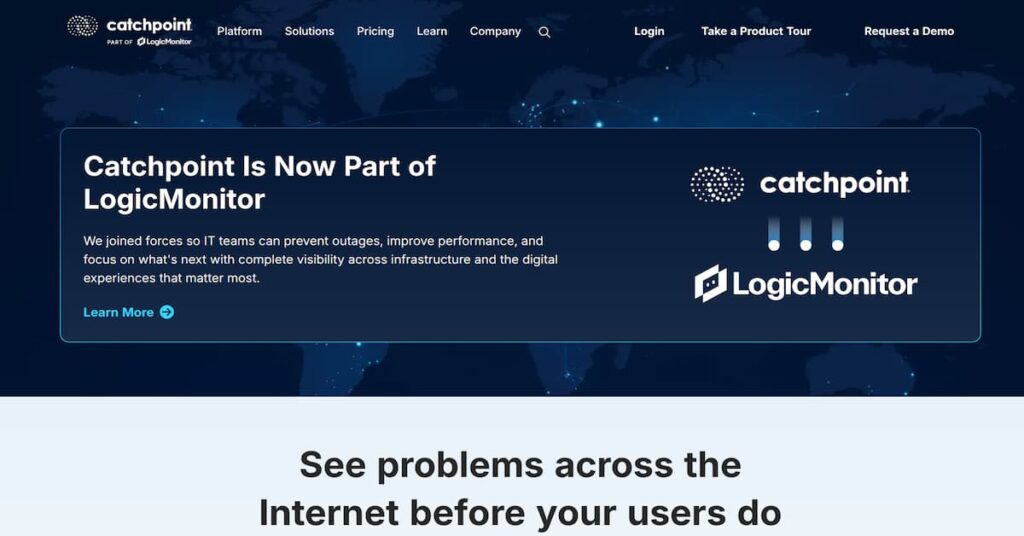
📌 Important Note: Catchpoint Is Now Part of LogicMonitor
LogicMonitor completed its acquisition of Catchpoint on December 2, 2025. Because of this, some Catchpoint pricing and product pages now appear under LogicMonitor, including WebPageTest pricing. In this article, we refer to Catchpoint as the product/platform, but pricing, packaging, and procurement may now be handled through LogicMonitor.
🔑 Key Takeaways
- Catchpoint is now part of LogicMonitor. LogicMonitor completed its acquisition of Catchpoint on December 2, 2025, combining hybrid observability with Internet Performance and Digital Experience Monitoring.
- Catchpoint does publish some pricing. The official pricing page lists a Customer Experience Quick Start Package starting at $10,000/year, while Enterprise pricing remains custom.
- Catchpoint uses a token-based points model. Catchpoint says points can be used across platform capabilities, with no overage penalties.
- WebPageTest pricing is public. The free Starter plan includes 150 monthly test runs, while WebPageTest Pro pricing is listed by TrustRadius at $18.75/month or $180/year.
- Catchpoint is strongest for Internet Performance Monitoring, synthetic monitoring, RUM, BGP monitoring, endpoint monitoring, WebPageTest, Internet Sonar, Internet Stack Map, and external digital experience diagnostics.
What Is Catchpoint?
Catchpoint is an Internet Performance Monitoring platform that helps teams monitor digital services from the outside in. Instead of only showing whether servers or services are healthy internally, Catchpoint helps teams understand how users, employees, networks, APIs, DNS, CDN providers, SaaS dependencies, cloud providers, and routing paths affect digital experience.
Catchpoint’s platform includes synthetic monitoring, real user monitoring, network traces, OpenTelemetry data, uptime monitoring, Internet Sonar, BGP monitoring, endpoint monitoring, WebPageTest, and Internet Stack visibility. Its platform page says Catchpoint ingests telemetry from every layer of the global Internet Stack and uses that data to detect anomalies, identify root causes, and predict potential failures.
This makes Catchpoint a strong fit for enterprises where digital performance depends on many external layers: CDN providers, DNS providers, ISPs, SaaS tools, cloud regions, APIs, edge services, and employee networks.
Supported Monitoring Areas, Integrations, and Data Sources
Catchpoint is not mainly a language-specific APM product. Its strongest coverage is across Internet Performance Monitoring, synthetic tests, user experience, network visibility, and third-party dependency monitoring.
| Area | Catchpoint Support |
| Internet Stack | SaaS, DNS, CDN, BGP, SASE, WAN, APIs, cloud, and edge dependencies |
| Synthetic monitoring | Website, API, transaction, DNS, and network-style synthetic testing |
| User experience | RUM, endpoint monitoring, session replay, and workforce experience use cases |
| Network visibility | BGP monitoring, network reachability, routing paths, and third-party services |
| Web performance | WebPageTest, Lighthouse, filmstrip/video, test history, and Core Web Vitals-style diagnostics |
Catchpoint also highlights 3,000+ intelligent agents worldwide and enterprise agents that can run inside customer networks. This is important for teams that need to test performance from real user geographies, enterprise offices, cloud regions, and private network locations.
Key Features of Catchpoint
Catchpoint’s core positioning is Internet Performance Monitoring. It helps teams validate performance across the Internet Stack, observe real user and workforce experience, analyze incidents, and protect digital services from external dependency issues.
This is where Catchpoint differs from basic infrastructure monitoring. It is designed to answer questions like: Is the problem in our app, DNS, CDN, ISP, SaaS provider, cloud region, BGP route, or user network?
Catchpoint supports synthetic monitoring for websites, APIs, and user journeys. Synthetic tests help teams detect availability and performance problems before real users report them.
This is useful for ecommerce, SaaS, media, financial services, and any business where uptime and page performance directly affect revenue or user experience.
Catchpoint includes Real User Monitoring to show what actual users experience in browsers and devices. This gives teams a real-world view that complements synthetic tests.
RUM is useful when teams need to compare synthetic test results against actual page loads, user geographies, device types, browsers, and real customer sessions.
Catchpoint supports BGP monitoring and network reachability use cases. Its IPM capabilities can help teams monitor network reach, BGP routes, network paths, and third-party services such as DNS.
This is important because many production incidents are not caused by application code. DNS misconfiguration, CDN degradation, ISP problems, routing changes, and third-party outages can all affect users even when internal services appear healthy.
Catchpoint provides endpoint monitoring for workforce and device-level experience. This helps IT teams diagnose problems affecting employees across home networks, offices, VPNs, SASE tools, SaaS applications, and enterprise networks.
This makes Catchpoint relevant beyond customer-facing website monitoring. It can also support employee digital experience and enterprise IT troubleshooting.
WebPageTest is part of Catchpoint’s web performance offering. The Starter plan supports free occasional testing, while Pro adds more usage and team capabilities.
Catchpoint’s pricing page lists Starter features such as filmstrip and video, Google Lighthouse, 60-day test retention, opportunities, custom scripts up to 3 steps, monitoring from 30 locations, and 3 runs per test.
Catchpoint’s Internet Sonar is designed to help teams answer whether an issue is internal or caused by something else on the Internet. Catchpoint also promotes Internet Stack Map as an AI-powered workflow display to help ITOps and SRE teams identify what is wrong with an application or dependency faster.
These features are most useful for teams that need fast incident triage across DNS, CDN, SaaS, cloud, edge, and routing dependencies.
Catchpoint also has tracing capabilities. Its tracing demo page says Catchpoint Tracing provides end-to-end visibility for distributed applications across physical devices, virtual machines, containers, and serverless environments.
That said, Catchpoint should still be understood primarily as an Internet Performance Monitoring and Digital Experience Monitoring platform, not as a traditional APM-first tool.
Catchpoint Feature Availability
| Feature | Catchpoint Availability |
| Synthetic monitoring | Yes, core capability |
| Real User Monitoring | Yes |
| BGP and network monitoring | Yes |
| Endpoint monitoring | Yes |
| WebPageTest | Yes |
| Internet Sonar / Stack Map | Yes |
| Tracing | Yes |
| Public pricing | Partly public; Enterprise is custom |
| Unlimited users | Catchpoint says no per-user charges in its pricing model |
| Data retention | Standard retention is listed as 3 years, extendable to 7 years |
Catchpoint’s pricing FAQ says there is no extra user or seat cost, and that standard retention is 3 years, extendable to 7 years.
Catchpoint Pricing in 2026
Catchpoint pricing has two important parts: Catchpoint IPM pricing and WebPageTest pricing.
Catchpoint IPM Pricing
| Plan | Starting Price | Main Use Case |
| Customer Experience Quick Start Package | Starts at $10,000/year | One critical end-to-end customer experience journey |
| Enterprise | Custom pricing | Broad Internet Performance Monitoring across teams, agents, services, and dependencies |
The Customer Experience Quick Start Package includes initial setup, onboarding, support for a single end-to-end CX journey, visual global outage display, service dependency map, dashboards, alerts, reports, AI-powered performance insights, monitoring for critical Internet Stack components, and CX performance diagnostics.
The Enterprise plan is still quote-based. Buyers need to speak with Catchpoint or LogicMonitor sales to confirm points, capabilities, agents, testing scope, support, and contract terms.
How Catchpoint Licensing Works
Catchpoint says its pricing uses a token-based points model. Points can be used to enable capabilities across the platform as needed, and Catchpoint says customers can make changes without overage penalties.
Gartner Peer Insights describes Catchpoint pricing as subscription-based and structured around monitoring nodes, test frequency, selected feature sets, monitoring locations, retention periods, and access to advanced analytics.
| Pricing Factor | Why It Matters |
| Monitoring nodes / agents | More global or enterprise test locations usually increase scope |
| Test frequency | More frequent tests consume more usage |
| Feature set | RUM, BGP, endpoint, WebPageTest, tracing, and Internet Sonar can affect scope |
| Retention | Longer retention may affect contract structure |
| Enterprise requirements | Support, onboarding, private agents, and security needs can change final pricing |
WebPageTest Pricing
WebPageTest pricing is now published under LogicMonitor’s Web Performance Optimization pricing page after LogicMonitor’s acquisition of Catchpoint. The page lists a Free Starter plan at $0 with 150 monthly test runs and a Professional plan starting at $180/year. The Professional plan includes scheduled tests, alerts, API access, integrations, private tests, bulk testing, experiments, 13-month test retention, and dedicated support.
| WebPageTest Plan | Published Price | Included Usage |
| Free Starter | $0 | 150 monthly test runs |
| Professional | Starts at $180/year | Starts at 1,000 runs/month |
| Higher Pro usage tiers | Pricing changes by selected run volume | 5,000, 10,000, or 20,000 runs/month options shown |
Also, we should remove the TrustRadius pricing reference unless we are using it only as a secondary source. The stronger source is now the LogicMonitor WebPageTest pricing page, because LogicMonitor owns Catchpoint and has a dedicated WebPageTest pricing page.
Is There a Free Tier in Catchpoint?
Catchpoint’s broader IPM platform does not show a broad free tier on the pricing page. The public IPM pricing starts with the Customer Experience Quick Start Package at $10,000/year, while Enterprise pricing is custom.
WebPageTest does have a free Starter plan. It is best for occasional web performance testing, Lighthouse checks, filmstrip/video review, and small-scale page performance analysis.
How Catchpoint Measures Usage
Catchpoint does not publish a simple public rate card like “$X per monitor” or “$Y per GB.” Instead, its pricing model uses points that can be applied across platform capabilities.
Based on Catchpoint’s own pricing page and Gartner Peer Insights’ pricing description, usage is shaped by monitoring nodes, test frequency, selected modules, monitoring locations, retention, and access to advanced analytics.
This means a buyer should not estimate Catchpoint the same way they would estimate a per-host APM tool or a per-GB observability platform. The pricing conversation should start with the customer journeys, dependencies, agents, and test frequency that actually need monitoring.
What Does Catchpoint Really Cost?
⚠️ Disclaimer
The scenarios below are directional editorial estimates, not official Catchpoint quotes. Catchpoint publishes a $10,000/year Customer Experience Quick Start Package, but Enterprise pricing remains custom. Final cost can change based on points, test frequency, agents, monitoring locations, modules, retention, support, onboarding, contract term, and enterprise requirements.
Catchpoint is not priced like a pure APM, logging, or infrastructure monitoring tool. A team producing 5 TB/month of telemetry does not automatically pay based on 5 TB of ingest. The stronger pricing factors are usually customer journeys, monitoring locations, test frequency, agents, and product capabilities.
Pricing Assumptions Used in These Scenarios
| Scenario | Catchpoint Pricing Anchor | Catchpoint Estimate | CubeAPM Context |
| Starter IPM | Official Quick Start Package | Starts at ~$833/month | CubeAPM not a direct IPM replacement |
| Growing Team | Multiple journeys and broader monitoring | Quote-based | CubeAPM can cover internal observability separately |
| Enterprise | Global IPM, agents, BGP, endpoint, RUM, WebPageTest | Custom quote | CubeAPM can reduce internal APM/log/trace cost |
CubeAPM is not a one-to-one replacement for Catchpoint’s Internet Performance Monitoring. Catchpoint is stronger for external Internet Stack visibility, while CubeAPM is stronger for internal observability across logs, metrics, traces, APM, infrastructure monitoring, RUM, synthetics, dashboards, and telemetry cost control. CubeAPM lists pricing at $0.15/GB ingested.
Scenario 1: Starter IPM Team
Situation
A team wants to monitor one critical customer journey, such as checkout, login, onboarding, payment flow, or a key SaaS workflow. The team needs dashboards, alerts, reports, service dependency mapping, and visibility into DNS, SSL, CDN, and API dependencies.
Why teams at this stage consider Catchpoint
Teams consider Catchpoint here because simple uptime checks are often not enough. They need to know whether the user journey is failing because of the app, DNS, CDN, API service, SSL issue, or a wider internet dependency.
Estimated profile
| Configuration | Detail |
| Monitoring scope | One critical end-to-end CX journey |
| Core need | External customer experience monitoring |
| Included areas | Dashboards, alerts, reports, dependency map, DNS, SSL, CDN, API monitoring |
| Pricing basis | Customer Experience Quick Start Package |
| Estimated monthly cost | Starts at ~$833/month |
Estimated monthly cost
| Component | Assumption | Monthly Cost |
| Customer Experience Quick Start Package | $10,000/year ÷ 12 | ~$833 |
| WebPageTest Free Starter | Optional light web performance testing | $0 |
| Enterprise add-ons | Not assumed | $0 |
| Estimated total | Starter CX monitoring | Starts at ~$833/month |
What this scenario shows
The official Catchpoint entry point is now clearer than before. The right editorial estimate is not “unknown” or “starts around $40,000/year.” The verified public anchor is $10,000/year for the Customer Experience Quick Start Package.
Scenario 2: Growing Digital Team
Situation
A growing SaaS, ecommerce, fintech, or media team needs to monitor multiple customer journeys, APIs, DNS, CDN, frontend performance, third-party services, and user experience across several regions.
Why teams at this stage consider Catchpoint
At this stage, teams often need more than one synthetic journey. They may need RUM, endpoint monitoring, BGP visibility, WebPageTest, alert routing, dependency maps, and more global test coverage.
Estimated profile
| Configuration | Detail |
| Monitoring scope | Multiple customer journeys and APIs |
| Core need | Digital experience and external dependency monitoring |
| Likely capabilities | Synthetic, RUM, API monitoring, DNS/CDN checks, WebPageTest |
| Pricing basis | Points-based Catchpoint IPM usage |
| Estimated monthly cost | Quote-based |
Estimated monthly cost
| Component | Assumption | Monthly Cost |
| Catchpoint IPM | More than one journey and broader monitoring | Quote-based |
| WebPageTest Pro | Optional paid web performance testing | From $18.75/month or $180/year, based on third-party listing |
| Enterprise agents / advanced modules | Depends on scope | Quote-based |
| Estimated total | Growing team setup | Quote-based |
What this scenario shows
For growing teams, the official pricing page does not provide enough public unit pricing to calculate a reliable monthly estimate. The correct approach is to model the monitoring scope and request a quote, rather than inventing a fixed annual range.
Scenario 3: Enterprise IPM Team
Situation
A large enterprise needs global digital experience monitoring across websites, APIs, DNS, CDN, BGP routes, employee endpoints, SaaS tools, cloud services, and business-critical customer journeys.
Why teams at this stage consider Catchpoint
Enterprises consider Catchpoint because performance problems can come from many places outside their own infrastructure. For large teams, the value is in quickly finding whether an issue is internal or caused by an external internet dependency.
Estimated profile
| Configuration | Detail |
| Monitoring scope | Global IPM across customers, employees, and third-party dependencies |
| Core need | Internet Stack visibility and enterprise incident triage |
| Likely capabilities | Synthetic, RUM, BGP, endpoint, WebPageTest, Internet Sonar, Stack Map |
| Pricing basis | Custom Enterprise pricing |
| Estimated monthly cost | Custom quote |
Estimated monthly cost
| Component | Assumption | Monthly Cost |
| Enterprise IPM | Global external monitoring | Custom quote |
| Enterprise agents | Private/internal test locations | Custom quote |
| Advanced analytics | Depends on plan and scope | Custom quote |
| Support / services | Depends on contract | Custom quote |
| Estimated total | Enterprise deployment | Custom quote |
What this scenario shows
Catchpoint’s enterprise pricing should be treated as a sales-led procurement process. It may be highly valuable for large digital businesses, but buyers should confirm test volumes, agent requirements, point usage, retention, support, and renewal terms before signing.
What Drives Catchpoint Costs?
The more journeys, APIs, services, dependencies, agents, and external systems you monitor, the more points you are likely to consume. Catchpoint’s pricing page says the points model is designed to let teams enable capabilities across the platform as needed.
Test frequency is a major cost driver for synthetic monitoring. Running a check every minute across many locations consumes more monitoring capacity than running the same check every five or ten minutes.
Catchpoint’s value comes partly from testing “where it matters.” The platform highlights 3,000+ intelligent agents worldwide and enterprise agents inside customer networks. More locations and agent types can increase monitoring scope.
Synthetic monitoring, RUM, BGP monitoring, endpoint monitoring, WebPageTest, Internet Sonar, Stack Map, and tracing all serve different use cases. A buyer using only one CX journey will not have the same cost profile as a global enterprise using multiple modules.
Catchpoint says standard data retention is 3 years and can be extended to 7 years. Buyers should confirm how retention, analytics, dashboards, and reporting affect their contract.
The Quick Start Package includes initial setup, onboarding, and support for a single end-to-end CX journey. Larger enterprise deployments may involve more onboarding, professional services, custom dashboards, private agents, and support requirements.
Catchpoint User Reviews
Catchpoint has visible ratings on G2, Gartner Peer Insights, Capterra, and PeerSpot. The strongest review sources are G2 and Gartner Peer Insights because they show both a rating and a meaningful review count. Capterra shows a rating, but it is based on only one review, so it should be treated as a limited signal.
| Review Source | Rating Shown Publicly | Total Reviews / Ratings | Notes |
| G2 | 4.5/5 | 112 reviews | Strongest public software-review sample |
| Gartner Peer Insights | 4.5/5 | 153 reviews | All-time vendor average across Catchpoint products |
| Capterra | 5.0/5 | 1 review | Very limited sample size |
What Users Like
A Gartner Peer Insights review snippet says Catchpoint is one of the best monitoring tools the reviewer uses because of alerting and real-time monitoring capabilities.
Gartner Peer Insights describes Catchpoint as offering Internet Synthetics, RUM, BGP, tracing, performance optimization, advanced analytics, high-fidelity data, and flexible visualizations.
Catchpoint’s own Gartner-related press release quotes a review calling it a powerful tool with comprehensive monitoring features and notes that it helps monitor global application performance per node.
Catchpoint’s product positioning around SaaS, DNS, CDN, BGP, SASE, WAN, APIs, and cloud dependencies matches what many enterprises need when incidents are caused by the wider internet rather than internal application code.
What Users Criticize
⚠️ Disclaimer
The following points reflect public user-review themes from review platforms. They should be treated as user feedback, not universal limitations of Catchpoint.
G2’s pros-and-cons summary says users find Catchpoint’s pricing expensive and not flexible enough for smaller teams, with pricing leaning toward larger enterprises.
G2’s pros-and-cons summary also says users find configuration challenging initially and that it can take time to learn and optimize the platform’s features.
A G2 review snippet says Catchpoint has many features, so it takes time to fully learn and configure.
Catchpoint Pros and Cons
| Pros | Cons |
| Strong Internet Performance Monitoring | Pricing can be high for smaller teams |
| Broad synthetic, RUM, BGP, and endpoint coverage | Enterprise plan is still custom quoted |
| WebPageTest adds strong web performance diagnostics | Configuration can take time |
| Good fit for external dependency triage | May be overbuilt for simple uptime monitoring |
| No per-user pricing in the points model | Cost depends heavily on monitoring scope |
Catchpoint Alternatives: How It Compares to Competitors
Catchpoint vs CubeAPM
Catchpoint is stronger for external Internet Performance Monitoring, synthetic checks, BGP visibility, DNS/CDN monitoring, endpoint experience, and Internet Stack diagnostics. CubeAPM is stronger for internal observability, APM, logs, traces, infrastructure monitoring, RUM, synthetics, dashboards, SLOs, and predictable ingestion-based pricing. CubeAPM’s official pricing page lists $0.15/GB ingested.
| Category | Catchpoint | CubeAPM |
| Core focus | Internet Performance Monitoring | Full-stack observability and APM |
| Pricing model | Points-based; starts at $10,000/year for Quick Start | $0.15/GB ingested |
| Deployment | SaaS / enterprise monitoring platform | Self-hosted, vendor-managed |
| Strongest fit | External digital experience and Internet Stack visibility | Internal MELT observability and cost control |
| Best for | Enterprises monitoring external dependencies | Teams needing predictable observability pricing |
CubeAPM is not a direct replacement for Catchpoint’s IPM use case. It is better evaluated as an alternative for internal observability cost control or as a complementary platform alongside an external synthetic/IPM tool.
Catchpoint vs ThousandEyes
ThousandEyes, owned by Cisco, is a strong alternative for network path visibility, enterprise network monitoring, endpoint experience, and internet intelligence. Cisco’s ThousandEyes offer description says customers can purchase ThousandEyes Units and Endpoint Agent licenses, with units consumed based on test configuration and flow collection.
| Category | Catchpoint | ThousandEyes |
| Core focus | Internet and digital experience monitoring | Network intelligence and path visibility |
| Pricing model | Points-based / custom Enterprise | Unit-based and endpoint licensing |
| Strongest area | Synthetic, RUM, BGP, WebPageTest, IPM | Network path and enterprise network visibility |
| Best buyer | SRE, ITOps, digital experience teams | Network engineering and enterprise IT teams |
| Best fit | User-facing experience and external dependencies | Cisco-heavy and network-first environments |
Catchpoint is usually stronger when customer digital experience is the main measurement goal. ThousandEyes is often stronger when the main concern is network path visibility and enterprise network troubleshooting.
Catchpoint vs Datadog
Datadog is a broader SaaS observability platform covering infrastructure, APM, logs, RUM, synthetics, security, and many integrations. Datadog’s APM billing docs list APM at $31 per underlying APM host per month, including 1 million indexed spans and 150 GB of ingested spans per APM host.
| Category | Catchpoint | Datadog |
| Core focus | Internet Performance Monitoring | Full-stack SaaS observability |
| Pricing model | Points-based / Enterprise quote | Per-host, per-feature, usage-based |
| Synthetic monitoring | Core strength | Available as part of broader platform |
| APM/logs | Available, but not primary positioning | Strong core coverage |
| Best for | External performance and dependency visibility | Cloud-native full-stack observability |
Datadog is usually a better fit when teams need one broad SaaS platform for infrastructure, APM, logs, RUM, synthetics, and security. Catchpoint is better when external digital experience and internet dependency monitoring are the priority.
Catchpoint vs Dynatrace
Dynatrace is an enterprise observability platform with strong application, infrastructure, automation, and AI-assisted root cause analysis capabilities. Dynatrace’s pricing page lists Foundation & Discovery at $7/month per host, Infrastructure Monitoring at $29/month per host, and Full-Stack Monitoring at $58/month per 8 GiB host, while the rate card lists Full-Stack Monitoring at $0.01 per memory-GiB-hour and Infrastructure Monitoring at $0.04 per host-hour.
| Category | Catchpoint | Dynatrace |
| Core focus | Internet and digital experience monitoring | Enterprise observability |
| Pricing model | Points-based / Enterprise quote | Usage-based rate card |
| Strongest area | External internet visibility | AI-driven full-stack monitoring |
| Best for | DNS, CDN, BGP, API, SaaS, user experience | Application and infrastructure automation |
| Buyer fit | ITOps, SRE, digital experience teams | Large enterprise platform teams |
Dynatrace is stronger when teams want automated application and infrastructure observability. Catchpoint is stronger when the hardest problems come from the external internet and third-party dependency layer.
Catchpoint vs New Relic
New Relic uses a data ingest and user-based pricing model. Its pricing page says every account gets 100 GB of free data ingest per month, with $0.40/GB beyond the free allowance.
| Category | Catchpoint | New Relic |
| Core focus | Internet Performance Monitoring | Full-stack observability |
| Pricing model | Points-based / Enterprise quote | Data ingest + users |
| Free tier | WebPageTest Starter available | 100 GB/month free ingest |
| Strongest area | External digital experience | APM, logs, metrics, traces |
| Best for | Enterprise IPM and Internet Stack visibility | Teams wanting transparent ingest-based pricing |
New Relic is easier to model for teams that think in telemetry volume and users. Catchpoint is better when the monitoring goal is external internet health, customer journeys, BGP, DNS, CDN, and user experience outside the application stack.
Is Catchpoint the Right Choice?
Catchpoint Works Best For
Catchpoint is a strong fit for businesses where checkout, login, trading, booking, streaming, onboarding, or SaaS workflows must stay fast and available across many geographies.
Catchpoint is useful when issues can come from DNS, CDN, SaaS, cloud, ISP, BGP, WAN, edge, or third-party API providers.
Catchpoint helps teams see whether an incident is caused by internal systems or external internet conditions. That is valuable during incident triage and executive communication.
Catchpoint’s global agent network and enterprise agents make it relevant for teams that need to test performance from many locations and network perspectives.
WebPageTest gives frontend and performance teams a focused way to test page speed, Lighthouse results, filmstrip/video, and optimization opportunities.
Catchpoint May Not Be the Right Fit For
Disclaimer: These points are based on Catchpoint’s public positioning, pricing model, and user-review themes. They are not universal limitations of Catchpoint.
Catchpoint may be more advanced than necessary if the team only needs simple HTTP uptime checks or basic availability alerts. Its strength is deeper Internet Performance Monitoring across synthetic tests, RUM, BGP, DNS, CDN, SaaS, ISP, and other Internet Stack dependencies.
Catchpoint publishes starter pricing, but broader Enterprise pricing still requires sales-led scoping. Teams that want a simple public rate card may need extra clarification before procurement.
Catchpoint has tracing and observability features, but its main positioning is Internet Performance Monitoring. Teams mainly looking for internal APM, log management, metrics, and trace correlation should compare it with full-stack observability tools.
G2 review themes mention pricing and flexibility concerns for smaller teams. Since Catchpoint’s public starter package begins at $10,000/year, smaller teams should confirm whether they need enterprise-grade IPM or a lighter monitoring setup.
Catchpoint’s depth is a strength, but it can take time to configure. G2 review themes mention learning curve and complex configuration, so teams should budget time for test design, dashboards, alerts, and workflow setup.
Conclusion
Catchpoint is a strong Internet Performance Monitoring platform for organizations that need to understand digital experience across the wider Internet Stack. Its biggest strengths are synthetic monitoring, RUM, BGP monitoring, endpoint monitoring, WebPageTest, Internet Sonar, Internet Stack visibility, and external dependency diagnostics.
The most important pricing correction is that Catchpoint is no longer completely opaque at the entry level. Its official pricing page lists a Customer Experience Quick Start Package starting at $10,000/year, while Enterprise pricing remains custom. WebPageTest also has a free Starter plan, and third-party pricing listings show WebPageTest Pro at $18.75/month or $180/year.
Catchpoint is best for enterprises where external performance, customer journeys, workforce experience, and internet dependency visibility are business-critical. For teams mainly focused on internal APM, logs, traces, infrastructure monitoring, and predictable telemetry cost, alternatives like CubeAPM, Datadog, Dynatrace, and New Relic may be better fits depending on deployment and pricing needs.
Disclaimer
Pricing, packaging, feature entitlements, support terms, retention, usage limits, and contract terms can change. The cost examples in this article are editorial estimates based on publicly available pricing and review data as of June 2026. Always confirm final pricing, included capabilities, point usage, support, discounts, and contract terms directly with Catchpoint or LogicMonitor before purchase.
FAQs
1. How much does Catchpoint cost?
Catchpoint publishes a Customer Experience Quick Start Package starting at $10,000/year. Its Enterprise plan is custom priced.
2. Does Catchpoint publish full pricing?
No. Catchpoint publishes starter pricing for the Customer Experience Quick Start Package, but Enterprise pricing still requires a sales quote.
3. How does Catchpoint pricing work?
Catchpoint uses a token-based points model. Points can be used across platform capabilities, and Catchpoint says the model allows teams to monitor what they need and make changes without overage penalties.
4. What drives Catchpoint cost?
The biggest cost drivers are monitoring scope, number of monitoring nodes or agents, test frequency, selected features, monitoring locations, retention, analytics, onboarding, and support requirements. Gartner Peer Insights describes Catchpoint pricing as structured around monitoring nodes, test frequency, selected feature sets, locations, retention, and advanced analytics.
5. Does Catchpoint charge per user?
Catchpoint’s pricing page says portal users are unlimited and that there is no additional user or seat cost.
6. What is Catchpoint’s data retention?
Catchpoint says standard data retention is 3 years and can be extended to 7 years.
7. What is WebPageTest pricing?
Catchpoint’s pricing page lists a free WebPageTest Starter plan with 150 monthly test runs. TrustRadius lists WebPageTest Pro Monthly at $18.75/month and WebPageTest Pro Annual at $180/year.
8. Is WebPageTest part of Catchpoint?
Yes. WebPageTest is part of Catchpoint’s web performance offering, and Catchpoint lists it under Web Performance Optimization pricing.
9. Is Catchpoint now part of LogicMonitor?
Yes. LogicMonitor completed its acquisition of Catchpoint on December 2, 2025.
10. Is Catchpoint good for small teams?
Catchpoint can work for smaller teams with one critical customer journey, especially through the $10,000/year Quick Start Package. However, teams with only basic uptime monitoring needs may find simpler tools more cost-effective.
11. What are the best Catchpoint alternatives?
The strongest alternatives depend on the use case. CubeAPM is strong for self-hosted, vendor-managed observability and APM with $0.15/GB ingestion pricing. ThousandEyes is strong for network path visibility. Datadog is strong for broad SaaS observability. Dynatrace is strong for AI-driven enterprise observability. New Relic is strong for ingest-based full-stack observability with 100 GB/month free ingest.