






Aerospike and CockroachDB solve different problems. Aerospike prioritizes sub-millisecond latency for key value workloads using a hybrid memory architecture that keeps indexes in RAM and data on SSD. CockroachDB prioritizes distributed SQL consistency using a Raft-based replication model that guarantees serializable transactions across globally distributed clusters.
The choice between them comes down to the access pattern. If your application reads and writes individual records by key at high velocity of session stores, real-time bidding, and fraud detection, Aerospike’s architecture delivers faster response times. If your application runs complex queries across relational data with strong consistency requirements, financial transactions, and multi-region inventory systems, CockroachDB’s distributed SQL layer prevents the data anomalies that eventually consistent systems allow.
According to the CNCF Annual Survey 2024, 43% of organizations now run stateful workloads in production Kubernetes environments, creating demand for databases that can scale horizontally while maintaining data guarantees. This guide compares Aerospike and CockroachDB on architecture, consistency model, monitoring, pricing, and operational complexity.
| Aerospike | CockroachDB | |
|---|---|---|
| Architecture | Shared-nothing, hybrid memory (RAM + SSD) | Distributed SQL, Raft consensus |
| Data model | Key value with secondary indexes | Relational SQL (PostgreSQL compatible) |
| Consistency | Tunable (eventual to strong per namespace) | Serializable by default |
| Replication | Intra-cluster replication factor, cross datacenter XDR | Multi-region Raft replication |
| Latency profile | Sub-millisecond for key value reads | Single-digit millisecond for distributed SQL |
| Deployment | Self hosted or managed cloud | Self hosted, CockroachDB Cloud, or dedicated |
| Pricing model | Enterprise license per core + support | Free tier, Serverless (request + storage), Dedicated (compute + storage) |
| Best for | High throughput key value, real time decisioning | Distributed transactions, relational workloads, geo-distributed apps |
Aerospike Overview

Aerospike is a distributed NoSQL database built for applications that require consistently fast read and write performance at scale. Its Hybrid Memory Architecture stores primary indexes in RAM and data on SSD, eliminating disk seeks for index lookups while keeping storage costs lower than pure in-memory systems.
Aerospike uses a shared-nothing architecture where each node owns a partition of the data. The cluster automatically rebalances when nodes are added or removed. Replication happens synchronously within a datacenter using a configurable replication factor (typically 2 or 3). Cross datacenter replication uses XDR (Cross Datacenter Replication), an asynchronous replication mechanism that allows writes in one region to propagate to remote clusters.
Consistency model: Aerospike allows per-namespace tunable consistency. Strong consistency mode forces all reads and writes to go through the master replica, guaranteeing linearizability at the cost of higher latency. Availability mode allows reads from any replica, accepting eventual consistency in exchange for lower latency and higher availability during network partitions.
Pricing: Aerospike offers a free Community Edition with limitations on cluster size and features. Enterprise Edition requires a license based on the number of CPU cores deployed. Pricing is custom and negotiated per contract. Aerospike Cloud Managed Service pricing starts at approximately $0.10 per GB per month for storage plus compute charges; verify current rates at aerospike.com/products/pricing.
Best for: Real-time ad tech, fraud detection, session stores, profile caches, recommendation engines where individual record access speed matters more than relational joins.
CockroachDB Overview

CockroachDB is a distributed SQL database that provides ACID transactions and serializable isolation across a globally distributed cluster. It is PostgreSQL wire-compatible, meaning applications written for Postgres can often connect to CockroachDB with minimal changes.
CockroachDB uses Raft consensus at the range level. Data is divided into ranges (64 MB by default), and each range is replicated across multiple nodes. Writes to a range require acknowledgment from a majority of replicas before committing, ensuring that data remains consistent even if nodes fail. The system automatically rebalances ranges as load changes or nodes are added.
The architecture separates the SQL layer from the key value storage layer. The SQL layer parses queries, generates execution plans, and distributes work across the cluster. The storage layer handles replication, consensus, and persistence using RocksDB.
Consistency model: CockroachDB defaults to serializable isolation, the strongest isolation level in SQL. This prevents anomalies like phantom reads and write skew at the cost of higher latency compared to read committed or snapshot isolation. A recent addition is the READ COMMITTED isolation level, which trades some consistency guarantees for better compatibility with legacy applications that expect Postgres behavior.
Pricing: CockroachDB offers a free tier with resource limits. Serverless pricing is based on Request Units (RUs) and storage, approximately $1 per million RUs plus $0.50 per GB stored per month. Dedicated clusters charge hourly for compute nodes plus storage costs. Enterprise licensing for self-hosted deployments is negotiated per contract. See cockroachlabs.com/pricing for current rates.
Best for: Multi-region e-commerce, financial systems, SaaS platforms with strict consistency requirements, and applications migrating from PostgreSQL that need horizontal scalability.
Architecture Comparison
Storage and Indexing
Aerospike’s Hybrid Memory Architecture keeps all primary key indexes in RAM. When a read request arrives, the database looks up the record’s SSD location in the in-memory index and fetches the data in a single SSD read. This eliminates the random disk I/O that slows down traditional databases. Secondary indexes are also stored in RAM, allowing fast lookups on non-primary key fields.
CockroachDB stores data in RocksDB, a log-structured merge tree (LSM) storage engine. Data is written to an in-memory buffer (memtable), flushed to disk as immutable SSTables, and periodically compacted to reduce read amplification. Indexes in CockroachDB are stored as separate key value ranges, meaning index lookups require reading from the underlying LSM tree.
The architectural difference shows up in latency profiles. Aerospike’s in-memory indexes deliver p99 read latencies under 1 millisecond for key value lookups. CockroachDB’s distributed SQL and consensus overhead typically produce p99 latencies in the low single-digit milliseconds for queries that touch multiple ranges.
Replication and Consistency
Aerospike replicates data synchronously within a cluster using a replication factor configured per namespace. When a write arrives, it is sent to all replicas in parallel. In strong consistency mode, the write is acknowledged only after all replicas confirm. In availability mode, the write is acknowledged after the master replica confirms, and replica updates happen asynchronously.
Cross datacenter replication in Aerospike uses XDR, which is always asynchronous. A change in one datacenter is logged and shipped to remote clusters. This creates an eventually consistent model across datacenters, which works well for use cases like session replication or analytics feeds but introduces complexity for applications that require cross-region consistency.
CockroachDB replicates every range using Raft consensus. A write to a range is proposed by the leaseholder (the node currently responsible for coordinating writes to that range), sent to all replicas, and committed once a majority of replicas acknowledge. Raft guarantees that even if nodes fail or network partitions occur, the cluster remains consistent. Multi-region deployments can pin data to specific regions using zone configurations, controlling where replicas are placed to meet latency or compliance requirements.
A Reddit thread on r/Database comparing CockroachDB and Scylla highlights the consistency vs latency trade-off. One user noted: “We expect Scylla will be faster, providing lower latencies and greater throughputs, while CockroachDB should have stronger consistency and be easier to reason about for complex transactions.”
Query Model
Aerospike exposes a key value API with support for secondary indexes, UDFs (User Defined Functions), and aggregations. Queries are expressed using the Aerospike Query Language (AQL) or client SDKs. Complex multi-table joins are not supported natively, applications must handle denormalization or run multiple queries.
CockroachDB is a full SQL database. It supports joins, subqueries, window functions, and stored procedures. The query planner can distribute work across the cluster, executing parts of a query on different nodes and aggregating results. For applications with relational data models, this eliminates the need to rewrite queries or restructure schemas.
Monitoring Aerospike
Aerospike exposes metrics via the asinfo protocol and the Aerospike Prometheus Exporter. Key metrics to monitor include:
Namespace metrics: client_read_success, client_write_success, client_read_error, client_write_error, expired_objects, evicted_objects
Node health: cluster_size, node_state, migrations_in_progress, free_pct_memory, free_pct_disk
Latency histograms: Aerospike provides per-operation latency histograms with configurable buckets (1ms, 8ms, 64ms). These show the distribution of read and write latencies across the cluster.
XDR lag: For cross datacenter replication, monitor xdr_timelag (seconds behind the source cluster) and xdr_ship_bytes (replication throughput).
A common issue in production: memory exhaustion, causing evictions. Aerospike evicts the least recently used (LRU) data when a namespace reaches its memory limit. If evicted_objects spikes occur, it usually means the working set exceeds available RAM, forcing the database to discard cached data prematurely. The fix is either adding RAM or tuning the eviction policy.
Most teams monitoring Aerospike use Prometheus to scrape metrics and Grafana to visualize them. Community dashboards are available but often require customization for namespace-specific metrics.
Monitoring CockroachDB
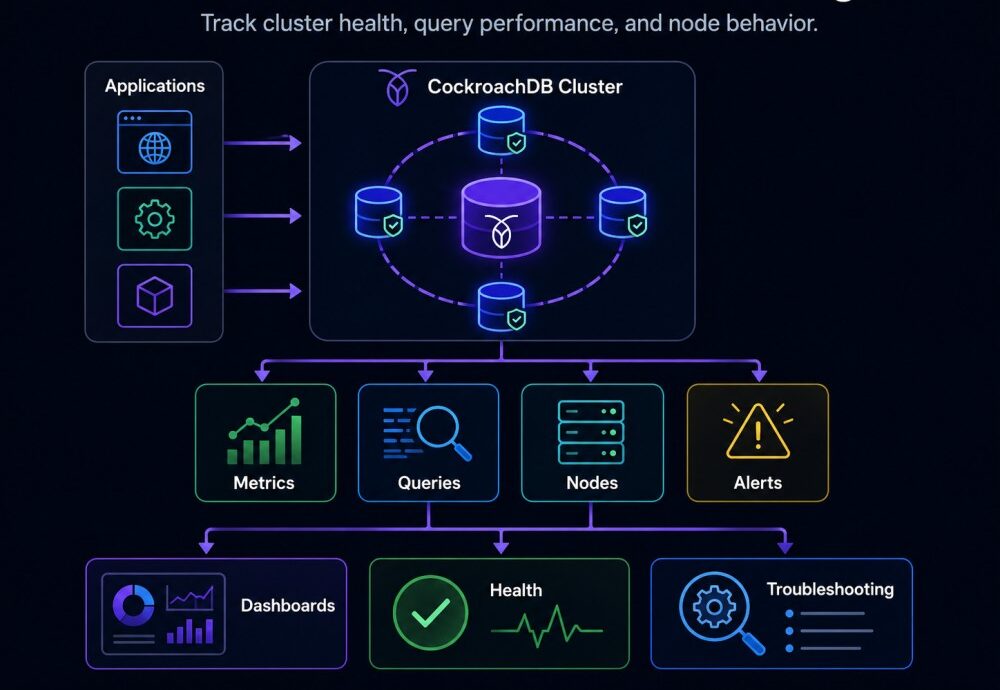
CockroachDB includes a built-in Admin UI accessible at http://<node>:8080. It provides dashboards for cluster health, SQL query performance, replication lag, and resource usage. The UI surfaces common problems like underreplicated ranges (ranges without enough healthy replicas), slow queries, and nodes approaching storage capacity.
CockroachDB also exposes Prometheus-compatible metrics at http://<node>:8080/_status/vars. Key metrics include:
SQL performance: sql_query_count, sql_exec_latency, sql_query_errors, sql_txn_abort_count
Replication health: ranges_underreplicated, ranges_unavailable, ranges_overreplicated, liveness_heartbeatlatency
Storage: capacity_used, capacity_available, compaction_pending_bytes, rocksdb_read_amplification
Network and consensus: raft_process_logcommit_latency, raft_rcvd_messages, rpc_heartbeat_latency
Monitoring replication lag is critical in multi-region deployments. CockroachDB’s changefeed feature can lag behind the main cluster if network bandwidth is constrained or the sink (Kafka, cloud storage) cannot keep up. The changefeed.max_behind_nanos metric shows how far behind the changefeed is from the latest committed transaction.
A production issue documented in a GitHub issue showed that compaction storms during bulk imports caused read latencies to spike above SLA thresholds. The team reduced the bulk import rate and tuned RocksDB’s max_background_compactions setting to smooth out compaction load.
For teams running CockroachDB at scale, alerting on ranges_unavailable (ranges with no quorum) is non-negotiable. Even a single unavailable range can block writes to part of your dataset.
Monitoring Aerospike and CockroachDB with CubeAPM
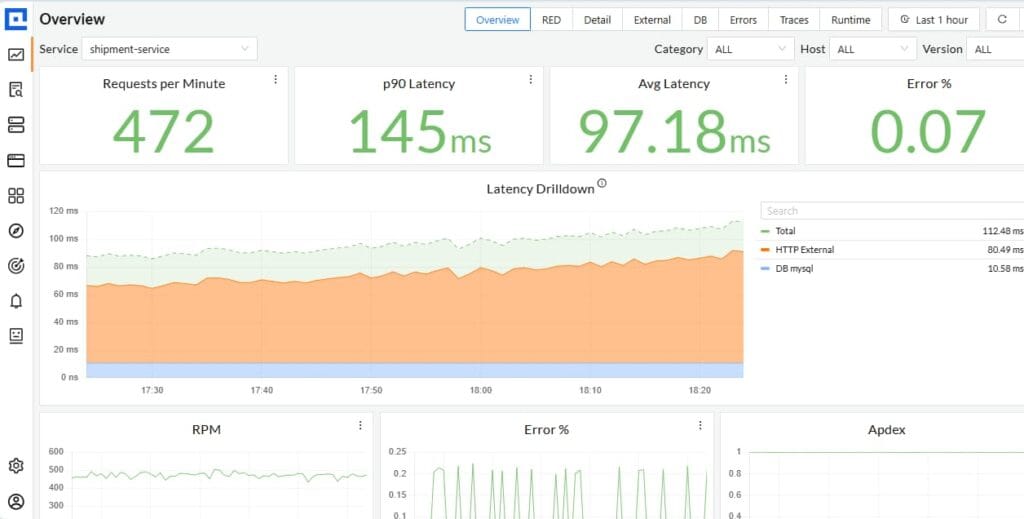
CubeAPM provides unified monitoring for both Aerospike and CockroachDB alongside application traces, logs, and infrastructure metrics. It ingests telemetry via OpenTelemetry collectors or Prometheus exporters, allowing teams to correlate database performance with application behavior in a single view.
For Aerospike, CubeAPM pulls metrics from the Prometheus exporter and surfaces namespace level health, latency histograms, and eviction trends in customizable dashboards. You can create alerts on evicted_objects or client_write_error rate and correlate spikes with trace data to see which services are triggering the load.
For CockroachDB, CubeAPM scrapes the _status/vars endpoint and provides dashboards for SQL query latency, replication lag, and storage capacity. It tracks slow queries over time and links them to the application endpoints that generated them, cutting root cause time.
CubeAPM runs on your own infrastructure or in a managed deployment inside your VPC. Telemetry data never leaves your environment, meeting data residency and compliance requirements without the cost and complexity of building a custom Prometheus + Grafana stack. Pricing is $0.15 per GB ingested with unlimited retention. More details at cubeapm.com/pricing.
Cost Comparison: Aerospike vs CockroachDB
Scenario 1: Small team (5 nodes, 500 GB data, 10K ops/sec)
Aerospike: Enterprise Edition requires licensing negotiation. Rough estimate: $20K to $40K per year for a 5-node cluster based on industry reports. Managed Aerospike Cloud pricing starts around $1,000 to $1,500 per month for this profile.
CockroachDB: CockroachDB Dedicated with 5 nodes (4 vCPUs, 16 GB RAM each) runs approximately $1,800 per month. Serverless pricing depends on read/write patterns but typically $500 to $1,000 per month for this workload.
This estimate models a small production deployment. Your actual costs will vary based on region, support tier, and negotiated enterprise discounts.
Scenario 2: Growing team (20 nodes, 5 TB data, 100K ops/sec)
Aerospike: Enterprise licensing scales with cores. A 20-node cluster (8 cores per node) could cost $100K to $200K per year. Managed cloud pricing for this scale runs $8K to $12K per month.
CockroachDB: Dedicated cluster with 20 nodes (8 vCPUs, 32 GB RAM each) costs approximately $10,800 per month. Serverless is not cost effective at this scale due to RU consumption.
Pricing based on publicly available information as of early 2026. Enterprise discounts, custom contracts, and negotiated rates are not reflected here.
Scenario 3: Enterprise (100 nodes, 50 TB data, 1M ops/sec)
Aerospike: Enterprise licensing for a 100-node cluster typically requires custom pricing. Expect $500K+ per year. Managed cloud at this scale runs $50K+ per month.
CockroachDB: Dedicated cluster with 100 nodes (16 vCPUs, 64 GB RAM each) costs approximately $86,400 per month. Self hosted deployments shift cost to infrastructure but require operational expertise.
This estimate models a large production deployment with high availability. Actual costs vary based on replication factor, backup strategy, and disaster recovery requirements.
When to Choose Aerospike
Choose Aerospike if your application workload matches these patterns:
Key value access dominates: Reads and writes target individual records by primary key. Queries that scan large ranges or join multiple tables are rare.
Latency is critical: You need sub-millisecond p99 latency and cannot accept the overhead of distributed SQL query planning.
Write heavy workloads: Your application writes more than it reads, and you need consistent write throughput even under high concurrency.
Tunable consistency is acceptable: Your use case can tolerate eventual consistency (session stores, caches) or you are willing to pay the latency cost of strong consistency mode when needed.
Large datasets with hot/cold access patterns: The hybrid memory architecture keeps hot data in RAM while storing the full dataset on SSD, making it cost effective for terabyte-scale workloads where only a fraction of data is accessed frequently.
Cross datacenter replication is asynchronous: You do not require synchronous multi-region writes. XDR handles eventual consistency across datacenters, which works for analytics, backups, or disaster recovery but not for globally consistent transactions.
Real-world use case: A real-time bidding platform processes 500K bid requests per second. Each request reads user profile data, evaluates targeting rules, and writes bid logs. Aerospike’s sub-millisecond reads ensure bid decisions complete within the 100ms time window before the ad exchange moves to the next bidder.
When to Choose CockroachDB
Choose CockroachDB if your application matches these requirements:
SQL and relational data: Your schema uses foreign keys, joins, and complex queries that would require denormalization or application-side logic in a key value store.
Strong consistency is mandatory: You cannot tolerate eventual consistency anomalies. Financial transactions, inventory systems, and compliance-heavy applications require serializable isolation.
Multi-region deployments: You need to replicate data across regions with configurable consistency guarantees. CockroachDB’s Raft replication and zone configs allow you to control where data lives and how it replicates.
PostgreSQL compatibility: You are migrating from Postgres or using an ORM (Django, Rails, TypeORM) that expects PostgreSQL semantics. CockroachDB’s wire compatibility reduces migration effort.
Horizontal scalability without re-architecting: Your monolithic Postgres database is hitting limits and you want to scale out without rewriting queries or breaking the application.
Complex transactions across tables: Your application runs multi-statement transactions that update multiple rows across different tables. CockroachDB guarantees these complete atomically even when data is distributed across nodes.
Real-world use case: A SaaS billing platform runs on CockroachDB across three AWS regions. Customer invoices, subscription data, and payment records are replicated with zone constraints to keep EU customer data in EU regions. Transactions that debit accounts, create invoices, and update subscription state run atomically, preventing partial updates during node failures.
Verdict
Aerospike and CockroachDB solve fundamentally different problems. Aerospike is a key value store optimized for speed. CockroachDB is a distributed SQL database optimized for consistency.
If your application is latency-sensitive, data fits a key value model, and you can manage eventual consistency, Aerospike delivers faster response times and lower operational complexity at the database layer.
If your application uses relational data, requires strong consistency, or needs multi-region transactions, CockroachDB removes the complexity of building those guarantees yourself and provides a familiar SQL interface.
For teams evaluating both, run a proof of concept with production traffic patterns. Measure p99 latency, write amplification, replication lag, and cost under realistic load. The database that meets your latency and consistency SLAs at acceptable cost is the right choice.
Disclaimer: The information in this article reflects the latest details available at the time of publication and may change as technologies and products evolve. Features, pricing, and plan limits can change over time. Always verify the latest information directly with the vendor before making purchasing or deployment decisions.
Frequently Asked Questions
Is Aerospike open source?
Aerospike offers a Community Edition with an AGPL license that is free to use with limitations on cluster size and features. The Enterprise Edition is proprietary and requires a commercial license.
Can CockroachDB replace PostgreSQL?
CockroachDB is PostgreSQL wire-compatible and supports most Postgres SQL features. Some Postgres extensions and stored procedures may require changes. Applications using ORMs like Django or Rails typically migrate with minimal code changes.
What is the main architectural difference between Aerospike and CockroachDB?
Aerospike uses a hybrid memory architecture with RAM indexes and SSD storage optimized for key value access. CockroachDB uses a distributed SQL layer on top of Raft-replicated ranges optimized for relational queries with strong consistency.
How does Aerospike handle cross datacenter replication?
Aerospike uses XDR (Cross Datacenter Replication), which is asynchronous. Changes in one datacenter are logged and shipped to remote clusters, creating an eventually consistent model across regions.
What consistency level does CockroachDB use by default?
CockroachDB defaults to serializable isolation, the strongest SQL isolation level. It also supports read committed isolation for applications that require Postgres-compatible behavior.
Can I monitor Aerospike and CockroachDB in the same platform?
Yes. Platforms like CubeAPM ingest metrics from both databases via OpenTelemetry or Prometheus exporters, allowing you to monitor database performance alongside application traces and infrastructure metrics in a unified view.