









ClickStack is a strong open-source observability stack, but it is not the right fit for every team. Self-hosting ClickHouse at production scale requires real operational expertise. The managed version is in beta with variable compute costs. And some teams need structured APM workflows, not just a SQL-queryable telemetry store.
If you are evaluating ClickStack and want to compare it against the alternatives before committing, this article covers the six most relevant options: what each one does, where it fits, verified pricing, and its limitations relative to ClickStack.
Key Takeaways
- ClickStack’s main gaps are operational complexity for self-hosted production deployments, variable compute costs on the managed path, and the absence of structured APM views out of the box.
- CubeAPM is the most direct alternative for teams that want self-hosted, OpenTelemetry-native APM with flat, predictable pricing and no ClickHouse operational overhead.
- SigNoz is the closest open-source structural match to ClickStack: ClickHouse backend, OTel-native, unified logs, metrics, and traces, with a more mature APM layer and no session replay.
- Grafana LGTM is the most widely deployed open-source observability stack, but it requires running four separate components and its self-hosted components are licensed under AGPLv3, not Apache 2.0.
- OpenObserve is a compelling option if you want session replay alongside standard signals and prefer object storage over ClickHouse, at $0.50/GB ingested on cloud with no per-seat fees.
- Elastic Observability is the strongest option for teams with existing Elasticsearch infrastructure who need deep full-text log search alongside APM.
- VictoriaMetrics Stack is the right choice when metrics are the dominant signal and you need Prometheus-compatible long-term storage at scale without a full ClickHouse deployment.
Why look for a ClickStack alternative?
ClickStack requires you to own ClickHouse. For teams without existing ClickHouse experience, the path from Docker quickstart to a highly available production deployment covering failover, backups, cluster upgrades, and schema tuning is a significant operational commitment. The monthly ClickHouse release cadence adds ongoing maintenance pressure.
On the managed side, Managed ClickStack is still in beta. Storage is under $0.03/GB/month, but query compute costs depend on workload and are not a published fixed number. For teams that need a predictable monthly observability bill, this makes budgeting harder.
ClickStack also does not replace a purpose-built APM tool. The HyperDX UI provides traces, logs, and metric charts, but it does not have the service maps, error rate dashboards, latency percentile views, and deployment-aware performance tracking that APM platforms surface out of the box.
1. CubeAPM
CubeAPM is a self-hosted, OpenTelemetry-native APM and observability platform with simple ingestion-based pricing. It is the most direct alternative for teams that want ClickStack-style self-hosted economics without the ClickHouse operational burden.
Key features:
- Unified logs, metrics, traces, and events in a single backend
- Native OpenTelemetry ingestion over OTLP; also accepts Prometheus, Datadog, New Relic, and Elastic agents
- Service maps, latency distributions, error tracking, and deployment-correlated performance views out of the box
- Correlates all signals automatically by trace ID without manual SQL joins
- Runs inside your VPC with no telemetry leaving your infrastructure
Pricing: $0.15 per GB ingested. No per-host, per-user, per-series, or per-seat fees. Self-hosted; compute costs are your own infrastructure.
Why it fits as a ClickStack alternative: CubeAPM gives you OpenTelemetry-native observability with no ClickHouse cluster to manage. The flat $0.15/GB rate is fully predictable in a way that ClickStack’s managed compute billing is not. CubeAPM also provides structured APM workflows out of the box, filling the gap ClickStack leaves for teams who need service-level performance monitoring rather than a SQL telemetry explorer.
Limitations: No session replay. No direct SQL access to the underlying data. Not open-source.
Best for: Teams that want self-hosted, cost-predictable APM with OpenTelemetry and do not need ClickHouse’s SQL layer or session replay.
2. SigNoz
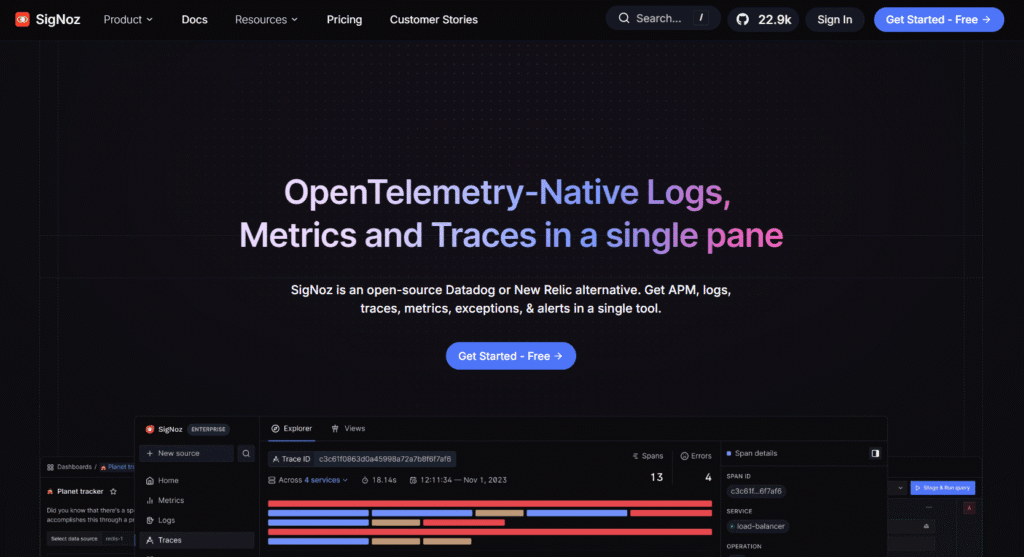
SigNoz is an open-source observability platform built on ClickHouse, similar in architecture to ClickStack but with a more mature APM layer and a longer production track record.
Key features:
- Unified logs, metrics, and traces on a ClickHouse backend
- OpenTelemetry-native from the start with no proprietary agent required
- Service maps, RED metrics, APM dashboards, and exception tracking out of the box
- Flamegraph trace explorer with correlated log navigation
- Self-hosted Community Edition (free) and managed SigNoz Cloud
Pricing:
- Community Edition: Free, self-hosted, MIT Expat license
- SigNoz Cloud (Teams): $49/month base (promotional; list is $199/month), which includes $49 of usage. Additional usage billed at $0.30/GB for logs and traces, $0.10 per million metric samples
- Enterprise: starts at $4,000/month; dedicated environment, BYOC, or self-host with support contract
Why it fits as a ClickStack alternative: SigNoz covers the APM layer that ClickStack does not. If you want a ClickHouse-backed observability platform with structured service performance views and you do not need session replay or direct SQL table access, SigNoz is architecturally close to ClickStack with more polished APM workflows and a free self-hosted option.
Limitations: No session replay. Self-hosted still requires managing ClickHouse, so the operational burden is similar to ClickStack. Enterprise SSO and SAML are cloud-only features on standard plans.
Best for: Teams that want an open-source, ClickHouse-backed APM platform with OTel-first design and do not need ClickStack’s direct SQL exploration or session replay.
3. Grafana LGTM Stack
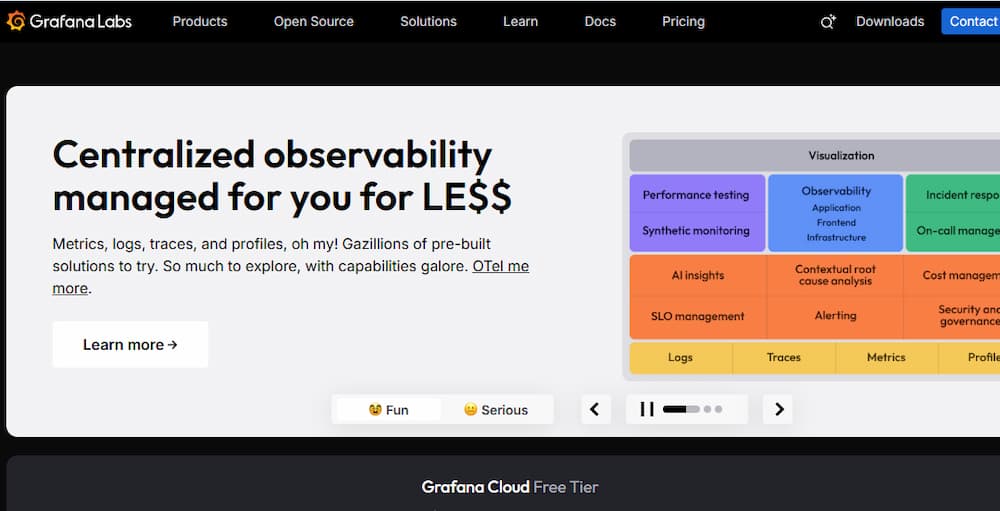
The Grafana stack (Loki for logs, Grafana for visualization, Tempo for traces, Mimir for metrics) is the most widely deployed open-source observability combination in the industry. It is the most common reference point when teams compare ClickStack against a multi-component alternative.
Key features:
- Prometheus-compatible metrics via Mimir with PromQL support
- Log aggregation via Loki with LogQL
- Distributed tracing via Tempo
- Largest plugin and dashboard marketplace of any open-source observability toolchain
- Grafana Cloud as a managed option; full OSS stack for self-hosted control
Pricing:
- Self-hosted: Free (infrastructure costs apply); core self-hosted components are AGPLv3 licensed
- Grafana Cloud Free: $0; includes 10,000 active metric series, 50 GB logs, 50 GB traces, 14-day retention, 3 users
- Grafana Cloud Pro: $19/month platform fee, then $6.50/1,000 active metric series, $0.50/GB for logs and traces (30-day retention included)
- Enterprise/Advanced: starts at $25,000/year spend commit
Why it fits as a ClickStack alternative: If your team is already running Prometheus and Grafana, the LGTM stack is the natural extension rather than a greenfield ClickStack deployment. The plugin ecosystem is unmatched. Grafana Cloud is a mature managed option with a free tier generous enough for small teams to evaluate fully.
Limitations: Four separate components to deploy, scale, and maintain. No single unified query language across signals: LogQL for logs, PromQL for metrics, TraceQL for Tempo. No session replay. Self-hosted components (Loki, Mimir, Tempo) are AGPLv3, not Apache 2.0, which has commercial redistribution implications. Cross-signal correlation requires manual configuration and is structurally weaker than ClickStack’s native SQL joins.
Best for: Teams already standardized on Prometheus and Grafana who want to extend to full MELT coverage without rebuilding their observability foundation.
4. OpenObserve
OpenObserve is a Rust-based observability platform that unifies logs, metrics, traces, and session replay with a strong focus on storage efficiency and simple deployment.
Key features:
- Logs, metrics, traces, RUM, session replay, and error tracking in one platform
- Written in Rust using the DataFusion query engine; queries Parquet files on object storage directly
- Bring-your-own-bucket storage (S3, GCS, Azure Blob, local disk)
- SQL and PromQL query support
- AI SRE Agent for automated root cause analysis and incident correlation (in preview)
- Unlimited users on all plans with no per-seat charges
Pricing:
- Self-hosted Open Source: Free; Self-Hosted Enterprise free up to 50 GB/day ingest, includes SSO and RBAC
- Cloud Professional: $0.50/GB ingested plus $0.01/GB queried; 30-day default retention for logs and traces, 15-month retention for metrics
- Additional retention for non-metrics data: $0.02/GB per additional 30-day period
- 14-day free trial on cloud, no credit card required
Why it fits as a ClickStack alternative: OpenObserve includes session replay like ClickStack but runs on Parquet and object storage rather than ClickHouse, giving teams more flexibility in their storage backend. The cloud pricing is straightforward: $0.50/GB ingested with no hidden compute variable. The Rust-based architecture has a lower resource footprint than a full ClickHouse cluster.
Limitations: OpenObserve is a younger project with a smaller community than ClickHouse-backed stacks. The APM layer is less mature than SigNoz or CubeAPM. SQL support is present but not as deep as ClickStack’s direct ClickHouse access.
Best for: Teams that want session replay alongside standard observability signals, prefer object storage over ClickHouse, and want simple per-GB cloud billing with no surprises.
5. Elastic Observability
Elastic Observability is the APM, log management, and infrastructure monitoring layer built on Elasticsearch, available as Elastic Cloud (hosted and serverless) or self-managed.
Key features:
- Industry-leading full-text log search via Elasticsearch
- APM with distributed tracing, service maps, and error tracking
- Infrastructure monitoring, host metrics, and Kubernetes visibility
- OpenTelemetry ingestion via OTLP endpoint and the Elastic OTel distribution
- AIOps features including anomaly detection and automated root cause suggestions
- LLM observability support added in 2025
Pricing:
- Self-managed: The Elastic Stack core is source-available; free to download and run, but the Elastic License 2.0 (ELv2) is not an OSI-approved open-source license
- Elastic Cloud Serverless (Observability): Usage-based per-GB pricing; Logs Essentials starts at $0.105/GB ingested plus $0.018/GB/month retained; Observability Complete starts at $0.150/GB ingested plus $0.020/GB/month retained. Volume tiers reduce per-GB rates at scale. No fixed monthly minimum on serverless.
- Elastic Cloud Hosted: Provisioned resource pricing (RAM-hour based); a small production cluster starts at approximately $95/month, scaling to $1,500–$8,000/month for typical mid-sized production deployments
Why it fits as a ClickStack alternative: Elastic’s log search is deeper than ClickStack’s for unstructured, high-volume log exploration. If your team’s primary observability use case is log analytics with APM as a secondary need, Elastic provides a more mature full-text log querying experience than HyperDX.
Limitations: Elasticsearch’s performance on aggregation-heavy observability analytics lags behind ClickHouse’s columnar engine at high ingest rates. Elastic License 2.0 is not fully open source by the OSI definition, which matters for teams with open-source compliance requirements. No session replay. Hosted deployments at production scale are resource-intensive and costs can grow quickly.
Best for: Teams with existing Elasticsearch infrastructure or where log search depth and full-text indexing are the primary observability workflow, and APM is a secondary need.
6. VictoriaMetrics Stack
VictoriaMetrics is a high-performance, Prometheus-compatible time-series database. The broader VictoriaMetrics Stack now includes VictoriaLogs for logs, VictoriaTraces for distributed tracing (open source, currently in preview), and VMAgent for collection.
Key features:
- Drop-in Prometheus replacement with PromQL and MetricsQL support
- Significantly lower resource usage than Prometheus at high cardinality and long retention
- VictoriaLogs for log ingestion and query (LogsQL)
- VictoriaTraces for distributed tracing via OTLP (open source, in preview as of 2025)
- OpenTelemetry ingestion supported natively across metrics, logs, and traces
- Horizontal scaling in cluster mode
Pricing:
- Open Source (VictoriaMetrics, VictoriaLogs, VictoriaTraces): Free; Apache 2.0 license for core components; infrastructure costs apply for self-hosting
- Enterprise: Custom pricing; contact sales; includes SSO, anomaly detection, multi-tenancy, advanced retention controls, and production SLAs
Why it fits as a ClickStack alternative: If your team’s observability needs are metrics-dominant and you need Prometheus-compatible long-term storage at scale without running a full ClickHouse cluster, VictoriaMetrics is cheaper to operate and simpler to maintain than ClickStack for that workload. The addition of VictoriaTraces gives it native tracing support, though this component is still in preview.
Limitations: VictoriaTraces is in preview and not yet production-ready for teams that need mature distributed tracing. No session replay. No purpose-built APM UI; it relies on Grafana for visualization. Cross-signal correlation between metrics, logs, and traces is still maturing.
Best for: Teams running at high Prometheus metric cardinality who need better long-term retention and cost efficiency, primarily for metrics-dominant workloads.
Comparison table
| Tool | Backend | Session replay | OTel native | Self-hosted | Managed pricing | APM views | License |
| CubeAPM | ClickHouse | No | Yes | Yes | $0.15/GB | Yes | Proprietary |
| SigNoz | ClickHouse | No | Yes | Yes | $49/mo + $0.30/GB | Yes | MIT Expat |
| Grafana LGTM | Loki / Mimir / Tempo | No | Partial | Yes | $19/mo + $0.50/GB (logs/traces) | Partial | AGPLv3 |
| OpenObserve | Parquet / object store | Yes | Yes | Yes | $0.50/GB ingested | Partial | Apache 2.0 |
| Elastic Observability | Elasticsearch | No | Yes | Yes | $0.105–0.150/GB (serverless) | Yes | Elastic License 2.0 |
| VictoriaMetrics Stack | Custom TSDB | No | Yes | Yes | Custom (Enterprise) | No | Apache 2.0 |
| ClickStack | ClickHouse | Yes | Yes | Yes | Under $0.03/GB storage + compute | Partial | Apache 2.0 / MIT |
Which ClickStack alternative should you choose?
- Choose CubeAPM if you want self-hosted, OTel-native observability with structured APM workflows and a flat, predictable per-GB bill, without managing a ClickHouse cluster. It is the clearest operational simplification over ClickStack for teams that need APM-first visibility.
- Choose SigNoz if you want the same ClickHouse-backed architecture as ClickStack but with more mature APM views and a free community edition, and you do not need session replay.
- Choose Grafana LGTM if your team is already running Prometheus and Grafana and you want to extend to full MELT coverage within a familiar ecosystem, accepting the multi-component operational model.
- Choose OpenObserve if you want session replay alongside standard observability signals, prefer Parquet over ClickHouse as your storage layer, and want a simple per-GB managed bill with no compute variable.
- Choose Elastic Observability if your team already has Elasticsearch infrastructure and log search depth is your primary observability requirement.
- Choose VictoriaMetrics Stack if metrics are your dominant signal, you need Prometheus-compatible long-term storage at scale, and you can tolerate VictoriaTraces being in preview for tracing workflows.
CubeAPM alongside ClickStack
For teams that already run ClickStack or are evaluating it, CubeAPM addresses the gap that ClickStack does not fill on its own. ClickStack gives you a powerful telemetry store with session replay and direct SQL access to raw data.
CubeAPM adds the structured APM layer: service health views, latency distributions, error rate tracking, and deployment-correlated performance data, all driven by the same OpenTelemetry instrumentation your team already has in place. Both CubeAPM and ClickStack accept standard OTLP input, so there is no re-instrumentation required to run them alongside each other. You get deep telemetry exploration through ClickStack and service-level performance monitoring through CubeAPM, at $0.15/GB with no per-host or per-user fees.
Summary
Every team evaluating ClickStack is solving one of a few underlying problems: high telemetry volume with unpredictable SaaS costs, the need to keep data inside their own infrastructure, or the complexity of running multiple separate observability tools. ClickStack answers all three well when your team has the expertise to run ClickHouse in production.
When it does not, or when you need structured APM workflows on top of raw telemetry access, the alternatives above cover the gaps cleanly. CubeAPM is the most natural complement or replacement for teams who need self-hosted, OpenTelemetry-native observability priced to stay predictable as data volumes grow. Get started with CubeAPM to see how it fits your stack.
Disclaimer: Pricing and feature details are verified from official vendor pricing pages and documentation as of June 2026. SigNoz’s $49/month Teams rate is a current promotional price; verify the current rate at signoz.io/pricing before purchasing. Always confirm current pricing directly with each vendor before making purchasing decisions. CubeAPM is referenced as a preferred tool; evaluate all platforms against your own requirements.
Also read:
What Is ClickStack? Features, Pricing & Review