









New Relic supports OpenTelemetry, but there is a meaningful difference between supporting it and being built around it. New Relic’s own documentation states that its proprietary agents work better out of the box than OTel SDKs, and that using OpenTelemetry sometimes requires additional research and effort to achieve the same results. Some native OTel instrumentations also produce different span and metric names compared to New Relic’s built-in instrumentation due to differences in OTel semantic conventions. In practice, teams on OTel get a second-tier experience compared to teams using New Relic’s proprietary agents.
The deeper problem is NRQL. Every dashboard, alert condition, and SLO workflow you build in New Relic is written in New Relic’s proprietary query language, which has no equivalent outside the platform. Switching to OpenTelemetry instrumentation solves the agent lock-in problem but leaves the entire query and alerting layer locked to New Relic.
This New Relic alternatives with OpenTelemetry support guide evaluates how deeply OpenTelemetry is embedded in a platform, not just whether OTLP data can be ingested.
Key Takeaways
- New Relic supports OTel ingestion, but its own documentation recommends its proprietary agents for a better out-of-the-box experience. All dashboards and alerts are written in NRQL, which cannot be migrated to any other platform.
- OTel-native platforms (CubeAPM, SigNoz, Grafana Cloud, Honeycomb) treat OTLP as the primary data path, not a secondary ingestion option alongside proprietary agents.
- CubeAPM is OpenTelemetry-native, self-hosted, and priced at $0.15/GB with no per-user or per-host fees.
- SigNoz is fully OTel-native, open-source, free to self-host, and available on Cloud from $49/month.
- Grafana Cloud is the best OTel-compatible option for teams already using Prometheus and PromQL.
- Honeycomb is OTel-native and purpose-built for high-cardinality distributed tracing. Pro starts at $130/100M events/month.
- Once services emit OTLP data, switching between OTel-native backends requires only changing the OTEL_EXPORTER_OTLP_ENDPOINT, not re-instrumenting your services.
Why New Relic Is Not Truly OTel-Native
OTel data gets a reduced experience in New Relic: New Relic’s official documentation acknowledges that its native agents tend to work better out of the box, and that OpenTelemetry sometimes requires additional research and effort. Some OTel instrumentations produce different spans and metric names compared to New Relic’s built-in instrumentation due to differences in OTel semantic conventions. Teams on OTel SDKs are effectively using a secondary instrumentation path on New Relic.
NRQL lock-in survives the OTel migration: OpenTelemetry solves the instrumentation layer. It does not solve the query layer. Every dashboard, alert, and workflow built in New Relic uses NRQL, which exists nowhere else. When teams eventually want to switch backends, they face a full rebuild of their observability configuration regardless of how they instrumented their services.
Per-user pricing persists regardless of instrumentation approach: Switching from New Relic’s proprietary agents to OTel SDKs does not reduce the seat cost. Full platform users still cost up to $349/user/month on Pro annual. A team of eight engineers who all need dashboard and alert access pays $2,792/month in user fees, whether they instrument with New Relic agents or OTel SDKs.
Best New Relic Alternatives with OpenTelemetry Support
1. CubeAPM
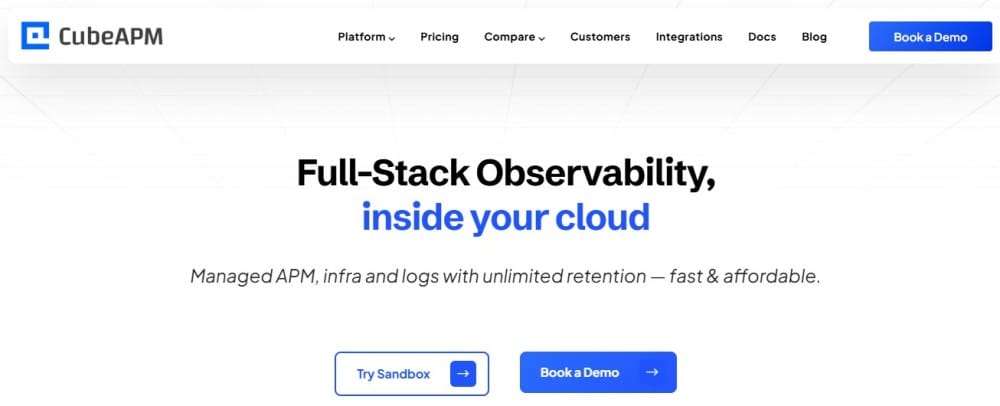
CubeAPM is an OpenTelemetry-native full-stack observability platform that runs inside your own infrastructure. OTLP is the primary and only ingestion path. There are no proprietary agents and no alternative data format. Every service sends telemetry via the OpenTelemetry Collector or OTel SDK, and all of it lands in CubeAPM without translation.
Key features
- OpenTelemetry-native: OTLP is the only ingestion path, no proprietary agents
- Also accepts data from existing Datadog, New Relic, Elastic, and Prometheus agents, enabling incremental migration without a hard cutover
- Full signals: APM, distributed tracing, logs, infrastructure, RUM, synthetics, error tracking, Kubernetes monitoring
- Auto-instrumentation for all major languages and frameworks via standard OTel SDKs
- Self-hosted inside your own cloud or on-prem infrastructure
- $0.15/GB, no per-user fees, no per-host fees, no annual commitment
Why it fits OTel-first teams specifically: Because CubeAPM accepts data from existing Datadog, New Relic, and Prometheus agents alongside OTLP, teams can migrate incrementally: new services send OTel data to CubeAPM while existing services continue using their current agents, migrating over time. There is no NRQL equivalent. Nothing you build is locked to CubeAPM.
Best for: Teams standardizing on OpenTelemetry who want a complete New Relic replacement with no proprietary agents, no query language lock-in, no per-user billing, and full data residency control.
Limitations: Self-hosted deployment required. Requires at least one engineer comfortable with Helm or Docker Compose.
2. SigNoz
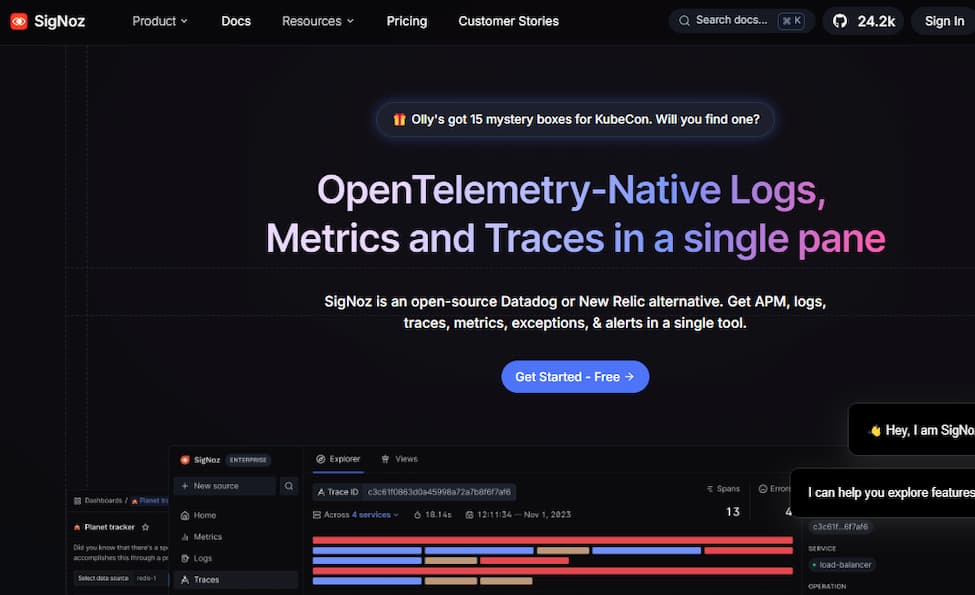
SigNoz is a fully OpenTelemetry-native, open-source observability platform built from day one around OTLP ingestion and the OpenTelemetry data model. There are no proprietary agents. Every language and framework is instrumented via standard OTel SDKs, and the data model in SigNoz maps directly to OTel semantic conventions without translation.
Key features
- Fully OpenTelemetry-native: built around OTLP ingestion and the OTel data model from day one
- No proprietary agents; all instrumentation via standard OTel SDKs
- Signals: APM, distributed tracing, logs, infrastructure metrics, exception tracking
- Exception tracking is linked directly to the triggering trace
- Community edition free to self-host under Apache 2.0; Cloud Teams plan from $49/month
- $0.30/GB for logs and traces, $0.10/million metric samples on Cloud; no per-user or per-host fees
- SOC2 Type II and HIPAA compliant on Cloud; data centers in US, EU, and India
Why it fits OTel-first teams: SigNoz gives teams an open-source path with full source code access and zero licensing cost. The instrumentation is identical whether running self-hosted or on Cloud, so there is no lock-in to SigNoz’s Cloud infrastructure. Teams coming from New Relic with OTel SDKs already in place can often migrate by updating the OTLP exporter endpoint alone.
Best for: Teams that want a fully OTel-native platform with an open-source self-hosted option at zero licensing cost, or an affordable Cloud plan at $49/month with no seat fees.
Limitations: The community edition has some dashboard panel count limitations. UI is less polished than New Relic for teams new to observability tooling.
3. Grafana Cloud
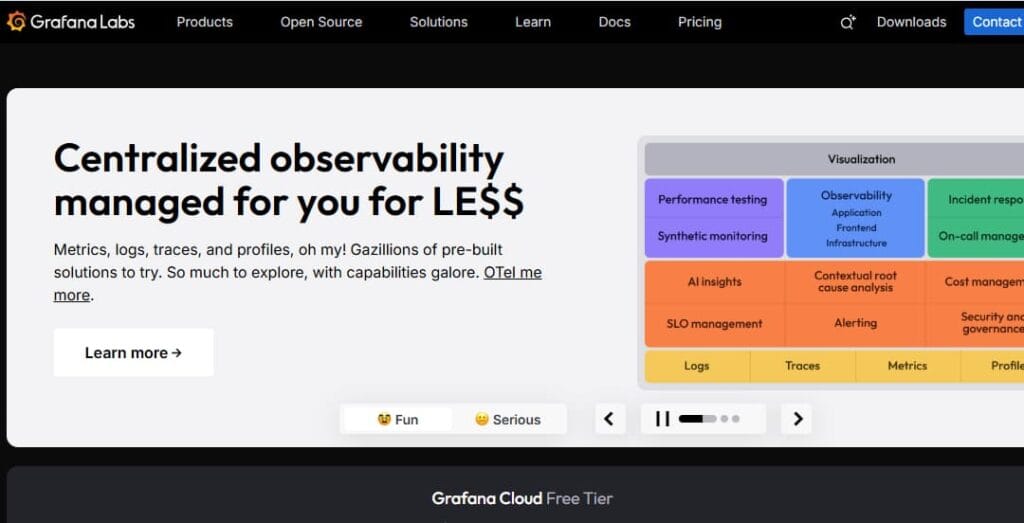
Grafana Cloud is the managed version of the LGTM stack: Loki for logs, Grafana for visualization, Tempo for distributed tracing, and Mimir for metrics. All four components accept OpenTelemetry data natively. For teams already using Prometheus and PromQL, it is the most natural OTel-compatible migration path because existing metric pipelines and alert rules carry over without changes.
Key features
- OTel-native across all signals: Tempo (traces), Loki (logs), and Mimir (metrics) all accept OTLP natively
- Prometheus and PromQL compatible: existing metric configurations and alert rules migrate without changes
- Grafana’s exemplars feature links a metric anomaly directly to the responsible trace span
- Full signals: metrics, distributed tracing, logs, profiles, synthetic monitoring
- Free tier: 10,000 metric series, 50 GB traces, 50 GB logs (3-day log retention, 14-day metric retention)
- Pro tier from $19/month base; usage-based, no per-host or per-user license fees; self-hosted OSS available
Why it fits OTel-first teams: The LGTM stack is built on open standards throughout. PromQL is a widely known query language with no lock-in. Dashboards built in Grafana can run against any Prometheus-compatible backend. Teams that want to move away from Grafana Cloud later can point their OTel Collector at a self-hosted LGTM stack without rebuilding instrumentation or dashboards.
Best for: Teams already using Prometheus and Grafana locally who want a managed OTel-compatible backend. Teams that want open-standards querying with no proprietary query language lock-in.
Limitations: Active series billing can grow unexpectedly with high-cardinality metric labels from OTel instrumentation. Free tier log retention is only 3 days. Self-hosted LGTM stack requires meaningful engineering effort to operate at scale.
4. Honeycomb
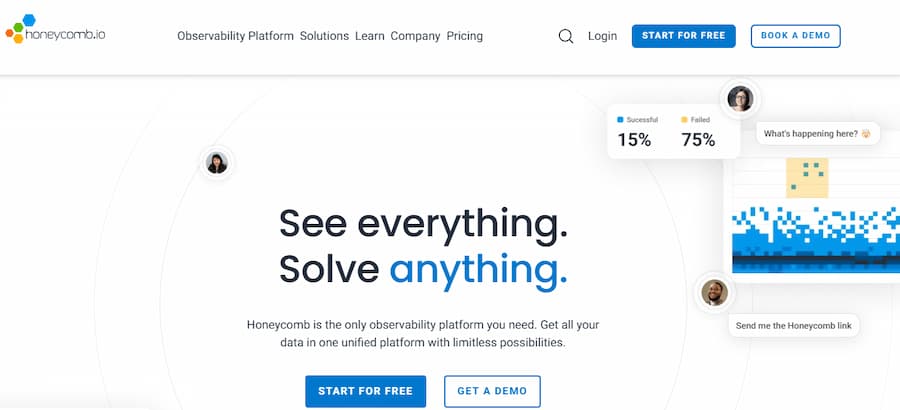
Honeycomb is purpose-built for high-cardinality observability and distributed tracing. It is fully OpenTelemetry-native and was one of the earliest commercial platforms to adopt OTLP as its primary ingestion format. Honeycomb Metrics became generally available in March 2026, adding native time-series metric storage alongside its event-based trace model.
Key features
- Fully OpenTelemetry-native: OTLP is the primary ingestion path
- Event-based storage: every span stored with a full attribute set, no pre-aggregation
- Unlimited cardinality: query any attribute dimension without limits
- BubbleUp automatically surfaces outlier groups within large trace datasets
- SLO-based burn rate tracking with trace-level drill-down
- Honeycomb Metrics GA (March 2026): native time-series metric storage, OTel metrics supported without re-instrumentation
- Free tier: 20M events/month and 100M time-series data points; Pro from $130/100M events (up to 1.5B events/month); no per-host or per-user fees
Why it fits OTel-first teams: Honeycomb’s data model was designed specifically to make OTel span attributes first-class query dimensions. The richer your OTel instrumentation, the more powerful your Honeycomb queries become. BubbleUp can isolate an anomalous attribute value across millions of spans in seconds, something that is impossible with pre-aggregating APM platforms.
Best for: Developer and SRE teams who want to extract maximum debugging value from high-cardinality OTel instrumentation without pre-aggregation or cardinality limits.
Limitations: SaaS-only. Infrastructure monitoring depth is more limited than full-stack platforms, though Honeycomb Metrics now covers the basics. Most teams pair it with a separate infrastructure monitoring tool.
5. Elastic APM
Elastic APM supports OpenTelemetry ingestion alongside its own agents and is part of the broader Elastic Observability stack. The Elastic OTLP endpoint accepts trace, metric, and log data directly and indexes it in Elasticsearch. For teams already running ELK for log aggregation, OTel trace data lands in the same store as existing logs with trace-to-log correlation built in.
Key features
- Native OTLP endpoint accepts traces, metrics, and logs directly alongside Elastic APM agents
- Trace, metric, and log data indexed in Elasticsearch with trace-to-log correlation built in
- Kibana provides querying and visualization across all OTel signals
- Supports both Elastic APM agents and OTel SDKs, enabling incremental migration
- Self-hosted free (OSS under AGPL and Elastic License 2.0); Elastic Cloud from ~$16/month
- Available on AWS, GCP, and Azure via Elastic Cloud
Why it fits OTel-first teams: Teams already running the ELK stack can route OTel data into Elasticsearch without adding a new platform. OTel traces correlate with existing application logs in the same cluster, making root cause investigation faster for teams with high log volumes.
Best for: Teams with existing ELK investments who want to extend into OTel-based APM and distributed tracing without tool proliferation.
Limitations: Managing Elasticsearch at scale for high-throughput OTel data requires meaningful infrastructure expertise. Elastic Cloud costs can be significant at high ingest volumes.
Comparison at a Glance
| Tool | OTel Nativeness | Self-hosted | Query Language | Starting Price |
| CubeAPM | Native (OTLP only) | Yes (required) | Open standards | $0.15/GB |
| SigNoz | Native (OTel data model) | Yes | Open standards | Free / $49/mo Cloud |
| Grafana Cloud | Native (LGTM stack) | Yes (OSS) | PromQL / LogQL | Free / $19/mo Pro |
| Honeycomb | Native (OTLP primary) | No | BubbleUp / custom | Free / $130 per 100M events |
| Elastic APM | Supported (OTLP endpoint) | Yes | KQL / EQL | Free OSS / ~$16/mo Cloud |
Monitor Your Applications with CubeAPM
CubeAPM is built for teams who have chosen OpenTelemetry as their instrumentation standard and want a backend that treats OTLP as a first-class citizen, not a secondary ingestion path. There are no proprietary agents to install, no vendor-specific SDK wrappers, and no query language to learn that does not exist outside CubeAPM.
Point your OTel Collector or SDK exporter at your CubeAPM instance with a single endpoint change. All signals land in one place: traces, metrics, logs, infrastructure, and Kubernetes. Teams migrating from New Relic can send OTel data to CubeAPM for new services while existing New Relic agents continue running on older services, then migrate incrementally with no hard cutover required. At $0.15/GB with no seat fees and no per-host charges, cost scales only with the telemetry volume you choose to send.
Summary
New Relic supports OTel ingestion but its own documentation recommends its proprietary agents for better out-of-the-box results, and all dashboards and alerts remain locked in NRQL. The five alternatives above treat OpenTelemetry as a core design principle, not an add-on. CubeAPM and SigNoz are the most deeply OTel-native options. Grafana Cloud is the best fit for Prometheus teams. Honeycomb extracts the most value from high-cardinality OTel attributes. Elastic APM is the natural choice for ELK stack teams.
| Tool | Best For | OTel Nativeness | Starting Price |
| CubeAPM | Full-stack, self-hosted, no per-user fees | Native (OTLP only) | $0.15/GB |
| SigNoz | Open-source OTel, zero licensing cost | Native (OTel data model) | Free / $49/mo |
| Grafana Cloud | Prometheus teams, PromQL querying | Native (LGTM stack) | Free / $19/mo Pro |
| Honeycomb | High-cardinality tracing, max OTel attribute value | Native (OTLP primary) | Free / $130 per 100M events |
| Elastic APM | ELK teams, OTel trace-to-log correlation | Supported (OTLP endpoint) | Free OSS / ~$16/mo Cloud |
Disclaimer: All pricing verified as of June 2026 from official vendor pages. New Relic Pro: $349/user/month annual, overages $0.40/GB or $0.60/GB (Data Plus). SigNoz: Community free, Cloud Teams $49/month, $0.30/GB logs and traces. Grafana Cloud: free tier 10K metric series, 50 GB traces/logs; Pro from $19/month base. Honeycomb: free 20M events/month, Pro from $130/100M events. Elastic Cloud: from ~$16/month. CubeAPM: $0.15/GB. Pricing subject to change; verify before purchasing.
Also read:
What are the Best New Relic Alternatives for Java Applications?