










New Relic is a capable full-stack observability platform, but microservices teams encounter specific friction points that make it a poor long-term fit as architectures scale. Per-user pricing becomes the primary cost driver as teams grow. Each additional full platform user costs $349/month on Pro annual plans. A 10-engineer team with full platform access pays over $3,490/month in user licenses before ingesting a single byte of telemetry data.
High-cardinality distributed tracing across dozens of services drives data ingest well beyond the free 100 GB/month tier quickly, where overages are billed at $0.40/GB. And New Relic’s 8-day default retention on the free tier is too short for meaningful cross-service incident investigation.
The New Relic alternatives in this guide are chosen specifically for microservices observability. The key evaluation criteria are: quality of distributed tracing, handling of high-cardinality service data, OpenTelemetry support, pricing behavior as service count grows, and ability to correlate traces with logs and infrastructure metrics in one place.
Key Takeaways
- New Relic’s per-user pricing (up to $349/user/month on Pro annual) makes it expensive for microservices teams where many engineers need full platform access for debugging distributed systems.
- High data ingest from distributed tracing across many services quickly exceeds the 100 GB/month free tier, with overages at $0.40/GB or $0.60/GB (Data Plus).
- CubeAPM runs inside your infrastructure with no per-service, per-host, or per-user fees at $0.15/GB, making costs predictable as microservices scale.
- Honeycomb is purpose-built for high-cardinality microservices debugging and distributed tracing, with a developer-centric query model.
- Grafana Cloud (Tempo for tracing, Loki for logs, Mimir for metrics) is the best open-standards alternative for teams already using Prometheus.
- SigNoz is fully OpenTelemetry-native and available free to self-host, or from $49/month on Cloud with no per-service pricing.
- All tools compared support OpenTelemetry instrumentation, so switching from New Relic does not require re-instrumenting your services.
Why New Relic Is Specifically Difficult for Microservices Teams
Here are the reasons why New Relic’s pricing can become complex for teams:
- Per-user pricing scales with team size, not service count: Microservices debugging is a collaborative activity. When an incident spans services owned by multiple teams, every engineer investigating needs full platform access to see the distributed trace end-to-end. On the Pro plan, that is $349/user/month (annual) or $418.80/month (monthly). A 10-engineer team with full access pays over $3,490/month in user fees before any data costs.
- High-cardinality trace data blows past the free ingest tier: Distributed tracing across microservices generates spans with high-cardinality attributes: service name, instance ID, request ID, user ID, feature flag values. Collecting full-fidelity trace data for 20 to 50 services at moderate throughput can generate 300 GB to 1 TB of telemetry per month. Every GB beyond the free 100 GB is billed at $0.40 (Original Data) or $0.60 (Data Plus).
- 8-day default retention is insufficient for incident investigation: Distributed system problems often recur slowly or manifest as degraded patterns rather than acute incidents. An SRE investigating a latency regression that appeared gradually over two weeks cannot use New Relic’s free 8-day retention window to correlate the change with a deployment or infrastructure event. Extended retention requires Data Plus at $0.60/GB.
Top New Relic Alternatives for Microservices
1. CubeAPM
CubeAPM is a full-stack observability platform that runs inside your own infrastructure. For microservices teams, it removes the three New Relic pain points simultaneously: per-user billing, per-ingest pricing that compounds with service count, and telemetry data leaving your infrastructure.
Why it fits microservices teams specifically: Adding a new microservice or a new engineer costs nothing at the platform level. The per-GB rate is flat at $0.15/GB regardless of how many services you instrument, how many engineers access the platform, or which capabilities you use. A team going from 10 to 50 services pays proportionally with telemetry volume growth, not with a per-service or per-host step change.
Distributed tracing: Full distributed tracing with span-level correlation across services. OpenTelemetry-native. Point OTEL_EXPORTER_OTLP_ENDPOINT at your CubeAPM instance, and all instrumented services send traces automatically with no per-service configuration.
Pricing: $0.15/GB ingestion. No per-host fees. No per-user fees. No per-module charges. No annual commitment required.
Signals covered: APM, distributed tracing, log management, infrastructure monitoring, Real User Monitoring, synthetic monitoring, error tracking, and Kubernetes monitoring.
Best for: Microservices teams that want a complete New Relic replacement without per-user billing surprises as team size grows. Teams handling sensitive telemetry data who cannot send traces to a third-party SaaS. Teams running Kubernetes who want all signals correlated in one place.
Limitations: Self-hosted deployment required. Requires at least one engineer comfortable with Helm or Docker Compose.
2. Datadog
Datadog is the most direct full-stack competitor to New Relic for enterprise microservices teams. It covers APM, distributed tracing, infrastructure metrics, logs, RUM, synthetics, and security monitoring in a single SaaS platform with 900+ integrations.
Why it fits microservices teams: Datadog’s auto-discovery and Kubernetes-native tagging make onboarding microservices fast without manual per-service configuration. The service map automatically visualizes upstream and downstream service dependencies and shows error rates and latency at each connection. APM correlates traces with logs and infrastructure metrics in a single view.
Distributed tracing: Full distributed tracing with span-level breakdown, flame graphs, and trace search. Auto-instrumentation available for most major languages. Supports W3C Trace Context and OpenTelemetry.
Pricing: Infrastructure Pro at $15/host/month (annual). APM at $31/host/month (annual). Log management costs stack on top. A team running 20 services on 20 hosts with APM and logs enabled pays a minimum of ($15 + $31) x 20 = $920/month before log volume and custom metrics costs.
Best for: Large enterprise microservices teams that need deep integrations with cloud-native services and have the infrastructure scale to justify the cost.
Limitations: Per-host pricing stacks with per-module pricing. Teams running many small services on shared infrastructure can face a high cost-to-value ratio compared to consumption-based alternatives.
3. Dynatrace
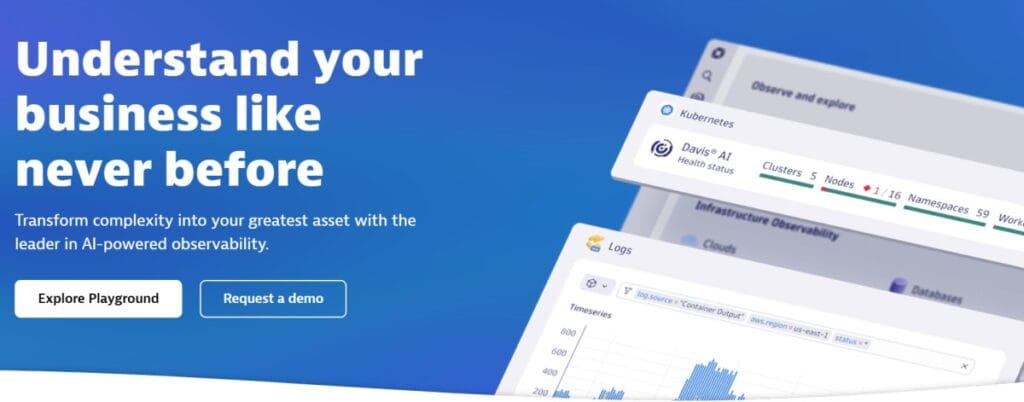
Dynatrace differentiates with its Davis AI engine, which automatically maps service dependencies and performs causal root-cause analysis rather than just anomaly detection. For microservices teams managing complex, auto-scaling deployments, this reduces manual investigation time significantly during incidents.
Why it fits microservices teams: Dynatrace OneAgent auto-discovers services and instruments them automatically without manual configuration per service. The Davis AI engine traces the causal chain of an incident across services automatically, which is particularly valuable in microservices architectures where a single user-facing issue can originate four or five service calls deep.
Distributed tracing: PurePath distributed tracing provides full end-to-end transaction trace capture across all services. Auto-instrumented. Davis AI annotates traces with root-cause analysis automatically.
Pricing: Usage-based, starting at approximately $0.08/host-hour for Full-Stack Monitoring. Annual commitment required.
Best for: Large enterprises running complex, fast-moving microservice estates that need AI-automated incident triage with minimal manual configuration.
Limitations: Expensive for smaller teams. Annual commitment required for standard pricing. Less suited to teams that want to manage their own instrumentation via OpenTelemetry.
4. Honeycomb
Honeycomb is purpose-built for high-cardinality observability and distributed tracing in microservices. It is designed around the premise that traditional APM tools aggregate away the context you need to debug modern distributed systems.
Why it fits microservices teams: Honeycomb stores every event as a structured row with arbitrary columns, so you can query on any dimension without cardinality limits. In a microservices environment, this means you can filter traces by user ID, feature flag, deployment version, or any custom attribute you attach during instrumentation, and explore them instantly without pre-aggregation.
Distributed tracing: Full distributed tracing with flame graphs, service maps, and SLO-based burn rate tracking. OpenTelemetry-native. BubbleUp automatically surfaces outlier groups within large datasets, isolating anomalies by attribute value in seconds.
Pricing: Free tier includes 20 million events/month. Team plan starts at approximately $100/month for higher volumes. Pricing scales with events ingested, not with host count or user count.
Best for: Developer and SRE teams debugging high-cardinality distributed systems where root cause investigation needs exploratory, ad-hoc query capability.
Limitations: SaaS-only. Does not cover infrastructure monitoring or logs with the same depth as full-stack platforms. Most microservices teams pair it with a separate log and metrics tool.
5. Grafana Cloud
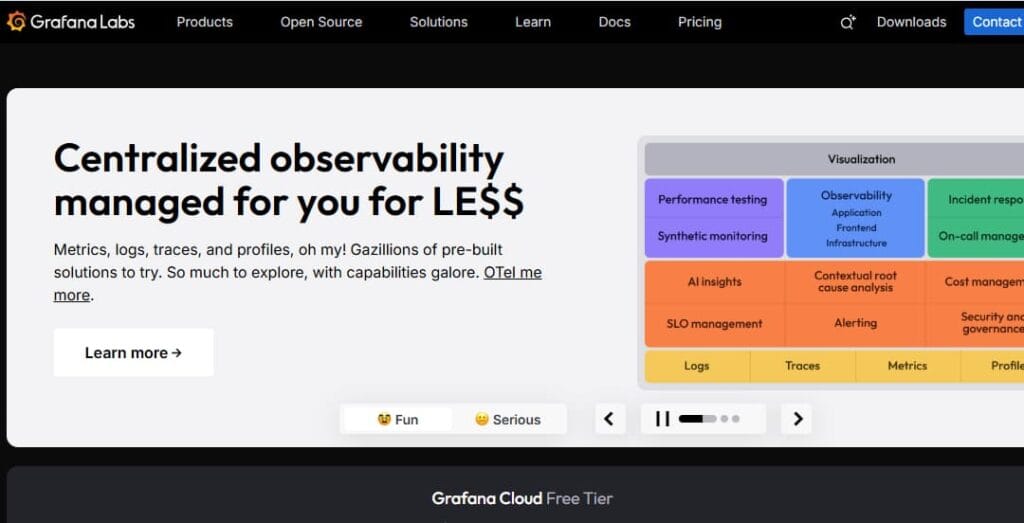
Grafana Cloud is the managed version of the LGTM stack: Loki for logs, Grafana for visualization, Tempo for traces, and Mimir for metrics. For microservices teams already using Prometheus, it provides a managed backend that accepts existing configurations and PromQL-based alert rules with no migration overhead.
Why it fits microservices teams: The composable architecture means you can adopt signals incrementally. Teams running Prometheus for metrics can add Tempo for distributed tracing and Loki for log aggregation without switching platforms. OpenTelemetry is fully supported across all signals. Grafana’s exemplars feature links a Prometheus metric spike directly to the specific trace spans responsible.
Distributed tracing: Tempo provides distributed tracing with native integration into Grafana dashboards. Exemplars connect a time-series metric to a representative trace automatically. Supports OpenTelemetry, Jaeger, and Zipkin formats.
Pricing: Free tier includes 50 GB traces/month, 50 GB logs/month, 10,000 metric series, and 500 synthetic checks. Paid tier is usage-based with no per-host license fees.
Best for: Teams already using Prometheus and Grafana locally who want a managed backend. Teams that want PromQL-based alerting and dashboards across microservices without running storage infrastructure themselves.
Limitations: Active series billing can grow unexpectedly with high-cardinality metric instrumentation. Free tier retention is 14 days for logs and traces, which is too short for longer-term trend analysis.
Comparison at a Glance
| Tool | Best For Microservices | Distributed Tracing | OTel Native | Self-hosted | Starting Price |
| CubeAPM | Full-stack on-prem, no per-service fees | Yes | Yes | Yes (required) | $0.15/GB |
| Datadog | Large enterprise, 900+ integrations | Yes | Partial | No | $31/host/mo (APM) |
| Dynatrace | AI-automated root cause, auto-discovery | Yes | Partial | No | ~$0.08/host-hr |
| Honeycomb | High-cardinality debugging, distributed traces | Yes | Yes | No | Free / ~$100+/mo |
| Grafana Cloud | PromQL teams, composable LGTM stack | Yes (Tempo) | Yes | Yes (OSS) | Free / usage-based |
Monitor Your Microservices with CubeAPM
CubeAPM is built for teams who want complete microservices observability without the pricing model getting in the way. Unlike New Relic, there are no per-user fees that punish you for giving your whole engineering team access. Unlike Datadog, there are no per-host charges that compound as your service count grows. Everything runs inside your own infrastructure, so your trace and log data never leaves your cloud.
A team instrumenting 30 microservices with full APM, distributed tracing, logs, and Kubernetes monitoring pays a flat $0.15/GB. No seat licenses. No per-service fees. No annual commitment required.
CubeAPM is OpenTelemetry-native, so you can instrument your services once with standard OTEL SDKs and point them at CubeAPM with a single environment variable change. If you ever want to switch backends later, your instrumentation stays exactly as it is.
Disclaimer: All pricing figures are sourced from official vendor pricing pages and verified as of June 2026. New Relic: newrelic.com/pricing (Free 100 GB/month, 1 full platform user; Pro $349/user/month annual; overages $0.40/GB Original or $0.60/GB Data Plus). Datadog: datadoghq.com/pricing (Infrastructure Pro $15/host/month annual, APM $31/host/month annual). Dynatrace: dynatrace.com/pricing (Full-Stack ~$0.08/host-hour, annual commitment required). Honeycomb: honeycomb.io/pricing (Free 20M events/month, Team from ~$100/month). Grafana Cloud: grafana.com/pricing (Free tier 50 GB traces/month, 14-day retention). CubeAPM: cubeapm.com/pricing ($0.15/GB). Pricing is subject to change; verify current rates before purchasing.
Also read:
What Are the Best Datadog Alternatives for Small Teams?
What Are the Best Datadog Alternatives for Python Applications?
What Are the Best Datadog Alternatives With No Per-Host Pricing?