










New Relic has one of the more mature Java APM agents in the market. It supports JVM-based languages, including Java, Scala, Kotlin, and Clojure, and provides auto-instrumentation for popular frameworks, application servers, databases, and message queuing systems out of the box. But the platform’s pricing model creates significant friction for Java teams as applications and team size grow.
Per-user billing scales with headcount, not with the Java application being monitored. Full platform users cost $349/month each on Pro annual plans. Java applications also tend to generate verbose telemetry: deep call stacks, frequent garbage collection events, JDBC query traces, and framework-level spans from Spring, Hibernate, or Kafka all accumulate quickly against the free 100 GB/month ingest tier, with overages at $0.40/GB.
The New Relic alternatives in this guide are evaluated on Java instrumentation quality, JVM-level visibility, framework coverage, OpenTelemetry support, and pricing behavior as Java workloads scale.
Key Takeaways
- New Relic’s per-user pricing (up to $349/user/month on Pro annual) makes it expensive for Java teams where multiple engineers need full platform access.
- Java applications generate verbose telemetry from deep call stacks, JDBC traces, and framework spans that quickly exceed New Relic’s free 100 GB/month tier, with overages at $0.40/GB.
- CubeAPM is OpenTelemetry-native, accepts the standard OpenTelemetry Java agent, and charges a flat $0.15/GB with no per-user or per-host fees.
- Datadog provides deep Java auto-instrumentation and strong JVM metrics coverage, but per-host plus per-module pricing stacks up fast for Java teams.
- Dynatrace auto-discovers Java services with its OneAgent and provides AI-powered root-cause analysis across JVM call chains.
- SigNoz is fully OpenTelemetry-native and works directly with the opentelemetry-javaagent.jar, with no proprietary agent required.
- Switching from New Relic’s Java agent to an OpenTelemetry-based backend requires replacing the New Relic agent JAR with the OTel Java agent, but does not require application code changes.
Why New Relic Is Specifically Difficult for Java Teams
Here are the reasons why the pricing is difficult for Java teams:
Per-user pricing compounds as Java teams scale
Java backend teams typically have multiple engineers involved in APM investigation: the developer who owns the service, an SRE or on-call engineer, and sometimes a tech lead reviewing performance. Each of them needs full platform access to navigate traces, query logs, and set alerts. At $349/user/month on Pro annual, giving five engineers full access costs $1,745/month in seat fees alone, before a single JVM metric is ingested.
Java workloads are inherently verbose and drive high ingest
A production Spring Boot application with Hibernate ORM, Kafka consumers, and Redis caching generates traces with dozens of spans per request. Framework auto-instrumentation captures every JDBC query, every cache hit, every outbound HTTP call. At any reasonable request volume, this adds up quickly, and teams monitoring several Java services often find themselves well past the free 100 GB/month tier, pushing overages to $0.40/GB or $0.60/GB with Data Plus.
New Relic’s Java agent is proprietary, not OpenTelemetry-native
New Relic added OpenTelemetry API support to its Java agent, but the core instrumentation path is still proprietary. Teams standardizing on OpenTelemetry across a polyglot stack end up maintaining two instrumentation paths: the New Relic Java agent for JVM services and OTel SDKs for everything else. Migrating away later requires replacing the agent JAR and reconfiguring telemetry export, a friction that is absent with OTel-native backends.
Top New Relic Alternatives for Java Applications
1. CubeAPM
CubeAPM is a full-stack observability platform that runs inside your own infrastructure. For Java teams, it accepts the standard OpenTelemetry Java agent directly with no proprietary agent to install or manage. All JVM-instrumented services point their OTEL_EXPORTER_OTLP_ENDPOINT at your CubeAPM instance, and data flows automatically.
Key features
- Java instrumentation via standard opentelemetry-javaagent.jar
- Auto-instruments Spring, Spring Boot, Hibernate, JDBC, Kafka, gRPC, and Servlet APIs
- Captures JVM metrics: heap usage, GC pause times, thread counts, class loading
- Full signals: APM, distributed tracing, logs, infrastructure, RUM, synthetics, error tracking, Kubernetes monitoring
- OpenTelemetry-native, no proprietary agent required
- Self-hosted; $0.15/GB, no per-host, no per-user, no annual commitment
Why it fits Java teams specifically: Adding a new Java service or a new engineer costs nothing at the platform level. The per-GB rate is flat at $0.15/GB regardless of how many services you instrument or how many engineers access the platform. Traces link directly to logs and infrastructure metrics in the same view with no additional configuration.
Best for: Java teams that want OpenTelemetry-native instrumentation with no proprietary agent, complete JVM visibility, and pricing that does not scale with headcount or service count.
Limitations: Self-hosted deployment required. Requires at least one engineer comfortable with Helm or Docker Compose.
2. Datadog
Datadog provides deep Java auto-instrumentation through its own Java agent and supports OpenTelemetry as a secondary ingestion path. For Java teams it offers extensive JVM metrics coverage, automatic framework detection, and correlation between APM traces, logs, and infrastructure metrics in a single SaaS platform.
Key features
- Proprietary Datadog Java agent with OTel as a secondary ingestion path
- Auto-instruments Spring, Spring Boot, Spring MVC, Hibernate, JDBC, JAX-RS, Tomcat, JBoss, Jetty
- Captures JVM metrics: heap allocation, GC duration, thread counts, class loading
- Full signals: APM, distributed tracing, logs, infrastructure, RUM, synthetics, security monitoring
- 900+ integrations; strong AWS, GCP, and Azure cloud-native support
- SaaS only; $15/host/mo (infra) + $31/host/mo (APM), annual commitment
Why it fits Java teams: Flame graphs, service maps, and database query analysis are available without additional configuration. Auto-discovery and Kubernetes-native tagging make onboarding new Java services fast without manual per-service setup. For a team running 10 application hosts with APM enabled, the baseline cost is ($15 + $31) x 10 = $460/month before log volume.
Best for: Enterprise Java teams on AWS, GCP, or Azure who need deep cloud-native integrations and have the budget to justify per-host pricing.
Limitations: Per-host APM pricing stacks with infrastructure pricing and log management costs on top. Sending OpenTelemetry data to Datadog provides a reduced experience compared to using the native Datadog Java agent.
3. Dynatrace
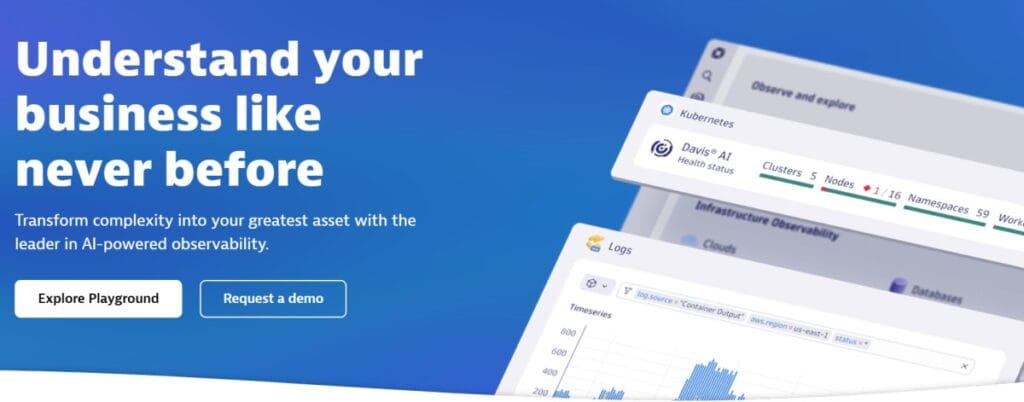
Dynatrace provides automatic Java service discovery and instrumentation through its OneAgent, which attaches to the JVM without requiring code changes or manual configuration. The Davis AI engine maps dependencies across the JVM call chain and performs causal root-cause analysis automatically during incidents.
Key features
- OneAgent auto-attaches to JVM processes, zero code changes required
- Automatically detects Spring, Hibernate, JDBC, and most major Java libraries
- Full JVM metrics captured automatically via OneAgent
- Full signals: APM, distributed tracing, logs, infrastructure, RUM, security
- Davis AI provides causal root-cause analysis across JVM call chains
- SaaS only; ~$0.08/host-hr (Full-Stack), annual commitment required
Why it fits Java teams: When a Java service degradation occurs, Davis AI traces the causal chain across distributed calls and identifies whether the root cause is a database query, a downstream service, or a JVM resource constraint. This is particularly valuable in Java environments where a single user-facing issue can originate several service calls deep through Spring dependency injection chains.
Best for: Enterprise Java teams running complex, multi-service applications who want automatic instrumentation and AI-powered incident triage with minimal manual setup.
Limitations: One of the more expensive options in this comparison. Annual commitment required for standard pricing. Teams wanting full control via OpenTelemetry get a more limited experience than with OneAgent.
4. SigNoz
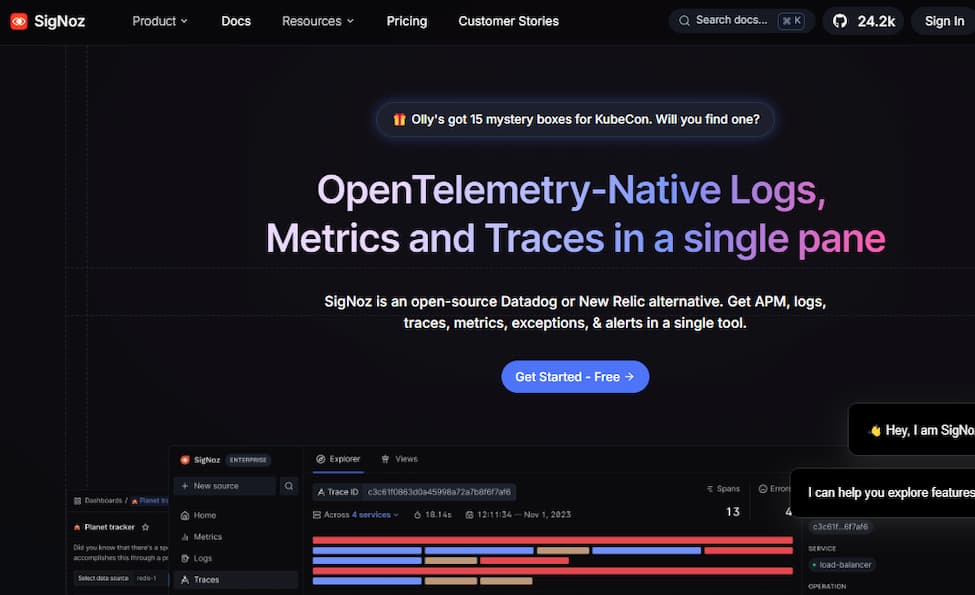
SigNoz is a fully OpenTelemetry-native, open-source observability platform. For Java teams it works directly with the opentelemetry-javaagent.jar with no proprietary agent required. The community edition is free to self-host. SigNoz Cloud starts at $49/month.
Key features
- Java instrumentation via standard opentelemetry-javaagent.jar
- Auto-instruments Spring, Spring Boot, Hibernate, JDBC, Kafka, RabbitMQ, Redis, gRPC
- JVM metrics via the OTel JVM metrics instrumentation library
- Signals: APM, distributed tracing, logs, infrastructure metrics, exception tracking
- Fully OpenTelemetry-native, no proprietary agent required
- Self-hosted free (community); Cloud from $49/mo, $0.30/GB logs and traces, no per-host or per-user fees
Why it fits Java teams: SigNoz ingests OpenTelemetry data natively without translation. Exception tracking links directly to the trace that triggered the error, and trace data correlates with logs and metrics in the same interface. SOC2 Type II and HIPAA compliant on Cloud, with data centers in the US, EU, and India.
Best for: Java teams that want a fully OTel-native platform with an open-source self-hosted path at zero licensing cost, or a predictable volume-based Cloud plan with no seat fees.
Limitations: The community edition has some dashboard panel count limitations. UI is less polished than Datadog or Dynatrace for teams new to observability tooling.
5. Elastic APM
Elastic APM is part of Elastic Observability, built on the Elasticsearch engine. Its Java agent provides auto-instrumentation for Spring, Spring MVC, Spring Boot, Hibernate, JDBC, Kafka, and gRPC. For teams already running the ELK stack for log aggregation, it brings Java APM into the same toolset without adding a separate platform.
Key features
- Elastic Java agent with OTel ingestion also supported
- Auto-instruments Spring, Spring MVC, Spring Boot, Hibernate, JDBC, Kafka, gRPC
- JVM metrics via Elastic Java agent or OTel JVM metrics library
- Signals: APM, distributed tracing, logs, infrastructure (via full Elastic Stack)
- Full trace-to-log correlation within Elasticsearch
- Self-hosted free (OSS); Elastic Cloud from ~$16/mo
Why it fits Java teams: Teams already using Elasticsearch for Java service logs can query traces and logs in the same place, reducing context-switching during incident investigation. Distributed traces, JVM metrics, and application logs are all indexed in Elasticsearch with trace-to-log correlation built in.
Best for: Java teams with existing ELK stack investments who want to add APM and distributed tracing without introducing a separate observability platform.
Limitations: Managing Elasticsearch at scale for high-throughput Java telemetry requires meaningful infrastructure expertise. Elastic Cloud costs can be significant at high ingest volumes.
Monitor Your Java Applications with CubeAPM
CubeAPM is built for Java teams who want complete APM visibility without a proprietary agent and without per-user or per-host pricing that grows independently of the application being monitored.
OpenTelemetry Instrumentation is straightforward. Download the opentelemetry-javaagent.jar, set OTEL_EXPORTER_OTLP_ENDPOINT to point at your CubeAPM instance, and attach the agent at JVM startup with -javaagent:/path/to/opentelemetry-javaagent.jar. Auto-instrumentation handles Spring, Spring Boot, Hibernate, JDBC, Kafka, gRPC, Servlet APIs, and most other major Java frameworks automatically. JVM runtime metrics, including heap usage, GC pause times, and thread counts, are captured alongside traces and logs with no additional configuration. No seat licenses. No per-host charges. No annual commitment.
Summary
New Relic’s Java agent is capable, but per-user pricing and verbose Java telemetry make it expensive at scale. The five alternatives in this guide each address this differently, depending on your team’s priorities around instrumentation approach, deployment model, and cost structure.
| Tool | Best For | OTel Native | Starting Price |
| CubeAPM | No per-user or per-host fees, self-hosted, OTel native | Yes | $0.15/GB |
| Datadog | Enterprise SaaS, deep cloud integrations | Partial | $31/host/mo (APM) |
| Dynatrace | AI-automated root cause, zero-touch JVM discovery | Partial | ~$0.08/host-hr |
| SigNoz | OTel native, open-source or affordable Cloud | Yes | Free / $49/mo |
| Elastic APM | ELK stack teams, trace-to-log correlation | Yes | Free OSS / Cloud |
Disclaimer: All pricing verified as of June 2026 from official vendor pages. New Relic Pro: $349/user/month annual, overages $0.40/GB (Original) or $0.60/GB (Data Plus). Datadog: Infrastructure Pro $15/host/month, APM $31/host/month (annual). Dynatrace: Full-Stack ~$0.08/host-hour, annual commitment required. SigNoz: Community free, Cloud Teams $49/month (reduced from $199/month). Elastic Cloud: from ~$16/month. CubeAPM: $0.15/GB. Pricing subject to change; verify before purchasing.
Also read:
What Are the Best New Relic Alternatives for Microservices?
What Are the Best Datadog Alternatives for Small Teams?
What Are the Best Datadog Alternatives for Python Applications?