










The main difference between Amazon CloudWatch, Grafana, and CubeAPM is that CloudWatch is a cloud-native monitoring service tightly integrated with AWS infrastructure, Grafana is a full-stack observability platform built around an open-source ecosystem of metrics, logs, traces, and profiling components, and CubeAPM is an OpenTelemetry-native observability backend designed for predictable ingestion-based pricing and unified signal correlation across environments.
Amazon CloudWatch works best for teams operating primarily inside AWS who want native service integrations, alarms, and IAM-aligned workflows with minimal setup. Grafana works best for teams that want full-stack observability with intuitive dashboards and control over how metrics, logs, and traces are stored and queried across different backends. CubeAPM works best for teams that need OpenTelemetry-native observability platform with predictable pricing, and unlimited data retention.
In this article, we compare Amazon CloudWatch vs Grafana vs CubeAPM across architecture, MELT coverage, deployment model, sampling strategy, retention behavior, cost predictability, and support response times at production scale.
Amazon CloudWatch vs Grafana vs CubeAPM: Feature Comparison
The comparison below is based on publicly available documentation and typical production usage patterns. Actual pricing, sampling, and retention behavior may vary depending on workload characteristics and system configuration.
| Features | CubeAPM | AWS CloudWatch | Grafana |
| Known for | OpenTelemetry-native observability with predictable costs | Native AWS monitoring for metrics, logs, alarms, and events | End-to-end visualization with OTel-native ingestion and wide plugin ecosystem |
| Multi-Agent Support | Yes (OTel, New Relic, Datadog, Elastic) | Limited (CloudWatch Agent, AWS SDKs, OpenTelemetry, AWS X-Ray) | Yes (Prometheus, OTEL collectors, Loki, Tempo) |
| MELT Support | Full MELT | Full MELT | Full MELT |
| Setup | Self-hosted but vendor-managed | SaaS (Fully managed AWS service) | SaaS & Self-hosted |
| Pricing | Ingestion-based pricing of $0.15/GB | Logs: $0.50/GB Traces(Over 30TB): $0.15/GB | Pro: $19/month + usage Logs: $0.50/GB Traces:$0.50/GB Metrics: $6.50/1k series |
| Sampling Strategy | Smart sampling (95% compression) | Tail-based + Adaptive | Tail + Head-based + probabilistic |
| Log Retention | Unlimited Retention | Indefinite retention | Free: 14 days Pro: 30 days Enterprise: Custom |
| Support TAT | < 10 minutes | Business Plan: 15 minutes | 30 minutes to 6 hours |
Amazon CloudWatch vs Grafana vs CubeAPM: Feature-by-Feature Breakdown
Known For
CubeAPM: Known for being OpenTelemetry-native by design. CubeAPM provides a unified backend for metrics, events, logs, and traces with ingestion-based pricing and centralized control over sampling and retention. It is built for teams that want consistent telemetry semantics across environments and predictable cost behavior as telemetry volume increases.
Amazon CloudWatch: Known as the native monitoring and observability service for AWS. CloudWatch automatically collects telemetry from AWS infrastructure and managed services, including metrics, logs, alarms, and events. It integrates deeply with AWS IAM, regional architecture, and operational workflows, making it a natural fit for AWS-centric environments.
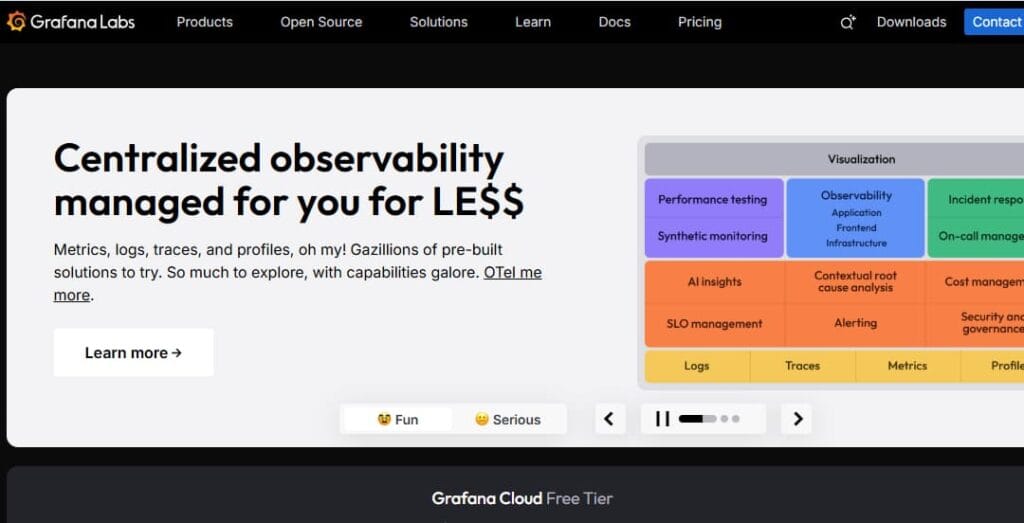
Grafana: Known for combining full-stack observability with powerful visualization and intuitive dashboards. Grafana integrates Prometheus-compatible metrics, Loki log aggregation, and Tempo distributed tracing into a modular ecosystem, while providing highly customizable dashboards, rich query capabilities, and cross-signal exploration. Its visualization layer is often considered one of the strongest in the observability market, enabling teams to build detailed operational views across distributed systems.
Multi-Agent Support
CubeAPM: Designed for heterogeneous environments. CubeAPM natively supports OpenTelemetry collectors and SDKs and can ingest telemetry from Prometheus as well as existing vendor agents such as Datadog, New Relic, and Elastic. This allows teams to migrate incrementally without re-instrumenting services or running parallel observability stacks during transition. It supports mixed environments where multiple telemetry standards coexist.
Amazon CloudWatch: Supports telemetry collection through the CloudWatch Agent, AWS SDK integrations, managed AWS service telemetry, AWS Distro for OpenTelemetry, and AWS X-Ray. OpenTelemetry support enables standardized instrumentation across services while still allowing tight integration with AWS-native monitoring workflows. This makes it possible to instrument applications using open standards while leveraging AWS-managed observability services.
Grafana: Supports multi-agent environments through its ecosystem integrations rather than a single native agent. Grafana works with Prometheus exporters, OpenTelemetry collectors, Loki agents (such as Promtail), and Tempo-compatible tracing pipelines. Telemetry ingestion depends on how the stack is configured, offering flexibility across environments but requiring clear architecture decisions in self-managed deployments.
MELT Coverage & Signal Correlation
CubeAPM: Provides full MELT coverage including metrics, events, logs, and traces within a single unified backend. All signals are built on a consistent OpenTelemetry data model, meaning traces, logs, and metrics share common service and resource attributes. This allows teams to move from a high-level latency spike directly into trace-level analysis and correlated logs without switching systems or reconciling different data schemas.
Amazon CloudWatch: Supports full MELT through a combination of CloudWatch Metrics, CloudWatch Logs, CloudWatch Events, and AWS X-Ray for distributed tracing. Metrics and logs are deeply integrated with AWS service metadata, and traces collected via X-Ray can be analyzed alongside other AWS telemetry. Correlation is typically performed using AWS resource identifiers, service names, and trace IDs, aligning closely with AWS operational workflows.
Grafana: Delivers full MELT coverage through its ecosystem components. Metrics are typically handled by Prometheus or Mimir, logs by Loki, and traces by Tempo. When configured with consistent labeling and trace context propagation, teams can correlate across signals inside the Grafana interface. Because the architecture is modular, correlation quality depends on how consistently telemetry standards and labels are applied across components.
Deployment Model
CubeAPM: Available as a self-hosted offering with vendor-managed support. Telemetry storage, ingestion, and retention policies remain under the customer’s control, while maintenance, upgrades, and platform health can be managed by the CubeAPM team. This model gives teams the flexibility and data ownership of self-hosting without the full operational burden of managing the observability backend themselves.
Amazon CloudWatch: Fully managed SaaS service provided by AWS. All infrastructure, scaling, availability, and upgrades are handled by AWS. Teams do not need to operate or maintain observability infrastructure, which simplifies setup and operations, especially for AWS-centric workloads. Because it is SaaS-only, there is no self-hosted option.
Grafana: Offers both SaaS and self-hosted deployment models. Grafana Cloud provides a managed service where instrumentation, storage, and scaling are operated by Grafana Labs. Many companies choose Grafana Cloud to reduce operational overhead, avoid maintaining and tuning multiple components, and leverage built-in integrations. Alternatively, the open-source and enterprise self-hosted options allow full control over the observability stack, but teams are responsible for deployment, scaling, upgrades, storage configuration, tuning, and operational overhead associated with running Prometheus, Loki, Tempo, and indexing/storage backends effectively.
Pricing: Approximate Cost for Small, Mid-Sized & Large Teams
*All pricing comparisons are calculated using standardized Small/Medium/Large team profiles defined in our internal benchmarking sheet, based on fixed log, metrics, trace, and retention assumptions. Actual pricing may vary by usage, region, and plan structure. Please confirm current pricing with each vendor.
*An APM host is a host that is actively generating trace data, and an Infra host is any physical or virtual OS instance that you monitor with any observability tool.
Below is a cost comparison for small, mid-sized, and large teams.
| Approx. Cost for Teams | Small (~30 APM Hosts) | Mid-sized (~125 APM Hosts) | Large (~250 APM Hosts) |
| CubeAPM | $2,080 | $7,200 | $15,200 |
| Amazon CloudWatch | $5,343.50 | $15,637 | $30,018 |
| Grafana | $3,870 | $11,875 | $26,750 |
What This Comparison Reveals at Scale
At small team sizes, cost differences between Amazon CloudWatch, Grafana, and CubeAPM are present but manageable. Telemetry volume is lower, service architecture is simpler, and observability is often limited to core metrics and logs. At this stage, ecosystem alignment and deployment convenience typically influence decisions more than cost scaling behavior.
As teams grow into mid-sized and large environments, telemetry volume increases significantly. More services generate more logs, traces, and high-cardinality metrics. The cost gap widens because ingestion, storage, and trace depth begin to compound. Observability spend becomes driven less by host count and more by how data is collected, sampled, and retained across the platform.
At large scale, predictability becomes the central concern. Sustained traffic, incident investigations, and broader trace coverage amplify ingestion costs and operational overhead. The comparison shows that platforms behave differently under continuous production load. What appears comparable at 30 hosts can diverge materially at 250 hosts, making long-term cost control and telemetry management strategy critical decision factors.
CubeAPM: Cost for Small, Medium, and Large Teams
CubeAPM follows an ingestion-based pricing model where observability spend scales directly with the volume of telemetry processed. Instead of charging per host, per user seat, or per feature tier, pricing is tied to actual data ingestion. This aligns cost with real system activity rather than infrastructure count.
Pricing:
- Predictable pricing of $0.15 per GB ingested
Using standardized workload assumptions across comparable production environments, estimated monthly costs typically fall into the following ranges:
- Small teams (~30 APM hosts): around $2,080
- Mid-sized teams (~125 APM hosts): around $7,200
- Large teams (~250 APM hosts): around $15,200
As systems grow, cost behavior is influenced primarily by telemetry design decisions such as log verbosity, trace sampling strategy, and retention configuration. Because pricing scales with ingestion rather than host count, cost forecasting becomes more predictable as traffic increases.
Amazon CloudWatch: Cost for Small, Medium, and Large Teams
Amazon CloudWatch uses an ingestion-based pricing model where costs are driven by telemetry ingestion, storage, and feature usage across metrics, logs, and traces. Unlike host-based pricing, spend increases as data volume grows and monitoring coverage expands.
Pricing:
- Logs: $0.50 per GB ingested
- Traces (AWS X-Ray): $0.15 per GB
Using standardized workload assumptions across comparable production environments, estimated monthly costs typically fall into the following ranges:
- Small teams (~30 APM hosts): $5,343.50
- Mid-sized teams (~125 APM hosts): $15,637
- Large teams (~250 APM hosts): $30,018
As environments scale, CloudWatch costs become increasingly sensitive to log verbosity, metric cardinality, trace coverage, and retention configuration. Because many AWS services emit telemetry automatically, observability usage often expands organically over time. This can make cost behavior closely tied to traffic patterns, service count, and investigative depth during incidents.
Grafana: Cost for Small, Medium, and Large Teams
Grafana’s pricing depends on whether teams use Grafana Cloud or deploy the stack in a self-hosted configuration. In both cases, cost is influenced by telemetry ingestion volume, storage retention, and system scale.
Pricing:
- Pro: $19/month + usage
- Logs: $0.50/GB
- Traces: $0.50/GB
- Metrics: $6.50/1k series
Using comparable workload assumptions across production environments, estimated monthly costs typically fall into the following ranges when using a managed cloud model:
- Small teams (~30 APM hosts): varies by plan and ingestion volume
- Mid-sized teams (~125 APM hosts): scales with log, metric, and trace usage
- Large teams (~250 APM hosts): increases significantly with high-cardinality metrics and long retention windows
At scale, Grafana cost behavior is determined by ingestion patterns, retention policy, and architectural decisions around storage and component scaling.
Sampling Strategy
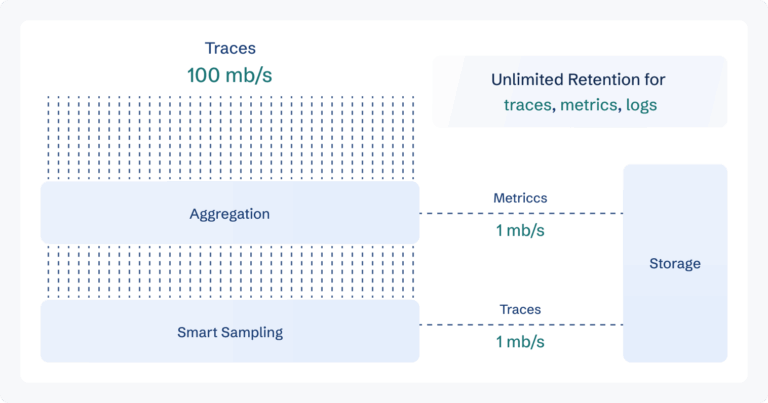
CubeAPM: Uses context-aware smart sampling designed to reduce trace volume while preserving meaningful request-level visibility. Sampling decisions are made with awareness of request attributes, error signals, latency behavior, and system context rather than relying solely on fixed percentages. This allows teams to retain high-value traces during incidents while keeping ingestion predictable as traffic increases. Sampling is centralized at the backend level, giving teams control over cost and visibility without requiring per-service configuration.
Amazon CloudWatch: Supports tail-based sampling and adaptive sampling through AWS X-Ray. Tail-based sampling allows sampling decisions to be made after a trace completes, enabling selection based on full request characteristics such as latency or errors. Adaptive sampling dynamically adjusts sampling rates based on traffic volume to maintain consistent trace targets per second. This approach helps manage ingestion volume automatically during traffic spikes while preserving representative trace coverage.
Grafana: Supports head-based, tail-based, and probabilistic sampling depending on pipeline configuration. Head-based sampling occurs at instrumentation, selecting traces before processing. Tail-based sampling can be configured through Tempo or OpenTelemetry Collector policies, allowing trace decisions after completion based on attributes such as latency or errors. Probabilistic sampling is also available through OpenTelemetry Collector processors, enabling percentage-based trace selection. Sampling behavior is controlled at the collector or backend level and depends on overall stack configuration.
Data Retention
CubeAPM: Offers unlimited retention for metrics, logs, and traces, with policies controlled at the platform level rather than restricted by predefined time tiers. Teams can retain telemetry for as long as operational, investigative, or compliance requirements demand, without different expiration windows per signal type. Retention decisions are centralized and not separated across logs, metrics, and traces.
Amazon CloudWatch: Allows configurable log retention at the log group level, ranging from 1 day up to 10 years, or indefinite storage if no expiration is set. Metric retention follows AWS-defined tiers: one-minute metrics are retained for 15 days, five-minute metrics for 63 days, and one-hour aggregated metrics for approximately 455 days. Retention flexibility exists, but it is signal-specific and governed by AWS service policies rather than a unified retention model across metrics, logs, and traces.
Grafana: Retention depends on the selected deployment model. In Grafana Cloud, the Free tier includes 14 days of retention, the Pro tier includes 30 days, and Enterprise plans provide custom retention. Retention typically applies consistently across logs, metrics, and traces within the selected plan. In self-hosted deployments, retention is fully configurable but depends on how storage backends such as Prometheus, Loki, and Tempo are configured and managed.
Support Channels & Response Time (TAT)
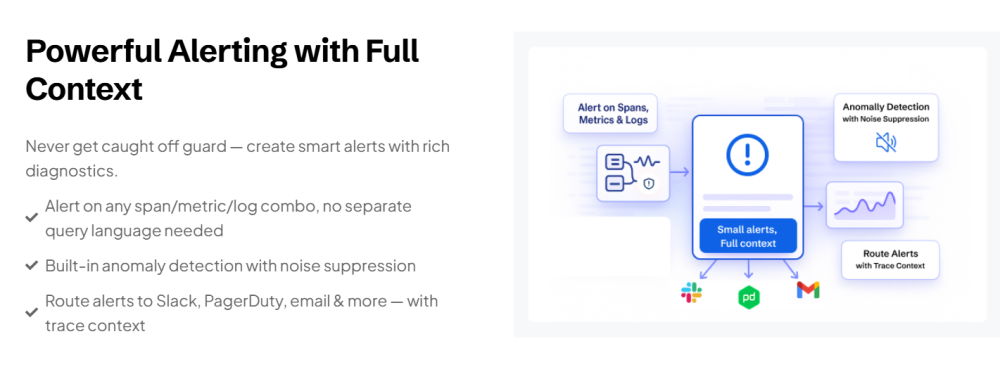
CubeAPM: Provides direct support through Slack and email, with engineering-led assistance. For active production issues, typical response times are under 10 minutes. Support does not require navigating separate pricing tiers for critical response, making it structured for teams operating real-time production systems.
Amazon CloudWatch: Support for CloudWatch is provided through AWS Support plans rather than as a product-specific service. Response time depends on the selected plan and severity level. Under Enterprise Support, critical Severity 1 issues have a target initial response time of 15 minutes. Business Support targets a response time of under 1 hour for critical cases. Developer and Basic plans offer slower response windows, and response times increase as issue severity decreases. SLA targets vary depending on both plan tier and case classification.
Grafana: Grafana provides support through paid subscription plans. The Advanced support tier includes a 1-hour target response time for P1 issues, while the Premium tier includes a 30-minute target response time for P1 cases. Lower-severity issues have progressively longer response windows. Enterprise customers can receive customized support agreements depending on contract terms. Community users of the open-source edition do not receive guaranteed response times.
How Teams Evaluate These Platforms at Scale
As observability programs mature, evaluation shifts from feature comparison to operational resilience. DevOps leaders and CTOs begin focusing on how a platform behaves under sustained production load rather than how quickly it can be deployed. The questions change: How predictable is cost when telemetry volume spikes? Does sampling preserve high-value traces during incidents? How much effort is required to manage retention, cardinality, and governance as systems scale?
At mid to large scale, pricing architecture becomes as important as technical capability. Teams analyze whether spend grows proportionally with workload expansion or increases in step changes based on licensing thresholds, ingestion tiers, or data volume. They examine how retention limits affect long-term investigations and whether data ownership aligns with compliance requirements. Operational overhead, especially in self-managed models, becomes part of total cost of ownership rather than a hidden afterthought.
Ultimately, mature organizations evaluate observability platforms through the lens of long-term control. Predictability, governance flexibility, data residency alignment, and support responsiveness outweigh surface-level feature parity. At scale, observability is no longer just about collecting telemetry. It becomes a financial and architectural discipline that directly shapes system design, incident response depth, and growth strategy.
Amazon CloudWatch vs Grafana vs CubeAPM: Use Cases
Choose CubeAPM if:
- You need predictable ingestion-based pricing that scales with telemetry volume rather than host count or feature tiers.
- You want centralized control over sampling and retention policies without fixed vendor-imposed limits across metrics, logs, and traces.
- You operate across multi-cloud, hybrid, or on-prem environments and require consistent OpenTelemetry-native data semantics.
- You prioritize fast engineering-led support with real-time responsiveness during production incidents.
Choose Amazon CloudWatch if:
- Your workloads run primarily inside AWS and you want deep native integration with AWS services, IAM, regions, and operational workflows.
- You prefer a fully managed SaaS monitoring solution without operating observability infrastructure yourself.
- You rely heavily on AWS service metrics, CloudWatch alarms, and AWS-native telemetry pipelines for day-to-day operations.
- You want built-in adaptive and tail-based sampling integrated directly with AWS X-Ray.
Choose Grafana if:
- You want a full-stack observability platform built around a strong open-source ecosystem.
- You prioritize flexible dashboards, rich querying, and cross-signal exploration across metrics, logs, and traces.
- You prefer the option of either managed SaaS or self-hosted deployment models depending on organizational requirements.
- You are comfortable managing ingestion, retention, and storage configuration across modular components such as Prometheus, Loki, and Tempo.
Conclusion
Amazon CloudWatch, Grafana, and CubeAPM approach observability from different architectural foundations. One emphasizes native cloud integration, another provides a modular full-stack ecosystem with strong visualization capabilities, and the third focuses on OpenTelemetry-native ingestion control and unified signal management. Each model reflects a different philosophy around deployment, cost structure, and operational ownership.
At small scale, the differences between these platforms may appear incremental. As systems grow in complexity, however, factors such as pricing architecture, retention flexibility, sampling behavior, and governance control become more consequential. Observability decisions increasingly influence not only engineering workflows but also financial forecasting and compliance alignment.
Ultimately, the right choice depends on where your workloads run, how much operational control you require, and how you expect telemetry volume to evolve over time. At production scale, teams tend to evaluate platforms based on long-term predictability, data control, and resilience under sustained load rather than feature parity alone.
Disclaimer: The information in this article reflects the latest details available at the time of publication and may change as technologies and products evolve.
FAQs
1. What is the main difference between Amazon CloudWatch, Grafana, and CubeAPM?
The main difference between Amazon CloudWatch, Grafana, and CubeAPM lies in their architecture and deployment models. Amazon CloudWatch is a cloud-native monitoring service tightly integrated with AWS infrastructure. Grafana is a full-stack observability platform built around an open-source ecosystem. CubeAPM is an OpenTelemetry-native observability platform that focuses on ingestion-based pricing, unified signal correlation, and centralized sampling control.
2. Can Grafana replace Amazon CloudWatch?
Grafana does not directly replace Amazon CloudWatch in AWS environments. CloudWatch is responsible for collecting native AWS metrics, logs, and alarms. Grafana can integrate with CloudWatch as a data source for visualization and analysis, but CloudWatch remains the underlying telemetry collection service within AWS. Whether one replaces the other depends on architecture and operational goals.
3. Which platform is more cost-effective at scale?
At production scale, CubeAPM is generally more cost-effective due to its predictable ingestion-based pricing model, which scales linearly with telemetry volume rather than across multiple billing dimensions. Amazon CloudWatch charges separately for logs, metrics, traces, and related features, which can increase costs as monitoring coverage expands. Grafana’s total cost depends on whether teams use Grafana Cloud or manage infrastructure themselves, where storage and operational overhead contribute to overall spend.
4. Do all three platforms support distributed tracing?
Yes. Amazon CloudWatch supports distributed tracing through AWS X-Ray with tail-based and adaptive sampling. Grafana supports tracing through Tempo and OpenTelemetry collectors with head-based and tail-based sampling options. CubeAPM supports distributed tracing using OpenTelemetry with context-aware smart sampling. Implementation and configuration differ across platforms.
5. Which platform is better for multi-cloud or hybrid environments?
Multi-cloud suitability depends on how tightly integrated a platform is with a specific cloud provider. Amazon CloudWatch is optimized for AWS-native environments. Grafana supports multiple data sources and can operate across environments depending on configuration. CubeAPM is built around OpenTelemetry and designed to provide consistent telemetry semantics across cloud, hybrid, and on-prem deployments.