










Application performance monitoring tools help teams find slowdowns, errors, and performance issues before they affect users. As applications spread across microservices, Kubernetes, APIs, and cloud services, teams need more than basic monitoring; they need traces, metrics, logs, infrastructure, and user experience in one place.
This guide compares the top APM tools in 2026 with sourced drawbacks, real pricing scenarios, and a decision framework to help you match the right platform to your team’s stage, stack, and budget.
Quick answer: What are the top APM tools in 2026?
- CubeAPM: Best overall for cost-predictable, self-hosted full-stack observability
- Datadog: Best for broad managed SaaS observability with 1000+ integrations
- Dynatrace: Best for enterprise AI-assisted root cause analysis
- New Relic: Best for full-stack coverage with usage-based pricing
- Motadata ObserveOps: Best for enterprise APM with network and flow observability
- Grafana: Best for open-source flexibility and composable dashboards
- SigNoz: Best open-source OTel-native APM with self-hosted deployment
- Coralogix: Best for log-heavy teams that also need APM and cross-signal correlation
APM tools comparison table: 8 platforms at a glance
Pricing based on a standardized growing team profile (~13 TB/month, 60 hosts). Figures are directional estimates from public rate cards, early 2026. Estimated monthly pricing is based on our internal cost model and a standardized usage profile. Actual pricing may vary by retention, indexing, host size, user seats, discounts, support, and add-ons. Please verify with each vendor directly.
| Tool | Pricing (Small / Mid) | Deployment | OTel-native? | Full MELT? | Pricing model | Best for |
| CubeAPM | $2,080 / $7,200 | Self-hosted, vendor-managed | Yes | Yes | $0.15/GB | Cost control + self-hosted APM |
| Datadog | $8,185 / $27,475 | SaaS only | Yes | Yes | Per-host + usage-based log/spans pricing | Broad SaaS + 1000+ integrations |
| Dynatrace | $7,740 / $21,850 | SaaS + self-hosted | Yes | Yes | Per-host (DPS) + Per memory-GiB-hour + separate log charges | Enterprise automation + AI RCA |
| New Relic | $7,896 / $25,990 | SaaS only | Yes | Yes | Per-GB + per-user | Full-stack SaaS + 100 GB free |
Motadata ObserveOps | Custom quote | Self-hosted, private cloud, public cloud | Yes | Yes | Subscription license tiered by devices, log volume, and modules | Enterprise APM + network and flow observability |
| Grafana | $3,870 / $11,875 | SaaS + self-hosted | Yes | Yes | Platform fee + telemetry usage | Open-source flexible stack |
| SigNoz | $4,600 / $16,000 | SaaS + self-hosted | Yes | Yes | Per-GB ingested | Open-source OTel-first APM |
| Coralogix | $4,090 / $13,200 | SaaS only | Yes | Yes | Per-GB by signal type | Log-heavy teams + APM |
How we evaluated APM tools
- Telemetry coverage: How well the tool supports metrics, logs, traces, events, and infrastructure visibility in one platform.
- OpenTelemetry support: Whether the platform works with OTel natively and reduces long-term vendor lock-in.
- Deployment model: SaaS, self-hosted, or vendor-managed and what operational overhead each actually carries.
- Pricing structure: Whether pricing is transparent and predictable as host counts, log volume, and trace volume increase.
- Troubleshooting depth: How useful the platform is for root cause analysis across services, dependencies, and user-facing issues.
- Kubernetes and microservices support: How well each tool fits cloud-native environments with containers and distributed architectures.
- Retention and data governance: How each platform handles data retention, historical analysis, and compliance needs.
APM vs. observability: What is the difference?
APM and observability are related but not the same. Understanding the distinction helps you evaluate whether you need an APM tool, an observability platform, or both.
APM focuses mainly on application health, things like response time, errors, throughput, and traces, while observability looks at the wider picture by connecting metrics, logs, traces, and events so teams can understand why a problem happened. In practice, many modern APM tools now include broader observability features, which is why the line between the two often feels blurred.
Most of the top APM tools today are actually full observability platforms with strong APM capabilities at their core. When teams compare APM tools, they are usually evaluating observability platforms, and the distinction matters most when evaluating pricing, deployment flexibility, and the depth of cross-signal correlation during incidents.
Open-source APM tools vs commercial APM tools
The right choice depends on your team’s engineering capacity, data residency requirements, and how much operational overhead you are willing to absorb.
| Factor | Open-source APM (SigNoz, Grafana) | Commercial SaaS (Datadog, New Relic) | Vendor-managed self-hosted (CubeAPM) |
| Software cost | Free or low | High ,scales with hosts/GB/users | Usage-based flat rate ($0.15/GB) |
| Operational effort | High; you manage infra + upgrades | Zero fully managed SaaS | Zero, vendor manages the backend |
| Data residency | Full control stays in your cloud | Data goes to vendor cloud | Full control stays in your cloud |
| Time to value | Longer setup + tuning required | Fast SaaS onboarding | Fast vendor-managed deployment |
| Lock-in risk | Low OTel-native, portable data | High proprietary agents + queries | Low OTel-native instrumentation |
| Best for | Teams with DevOps capacity + budget constraints | Teams that want convenience + breadth | Teams wanting control without the ops overhead |
CubeAPM sits in the middle: vendor-managed deployment in your own cloud gives you data residency and cost predictability without requiring your team to operate the platform.
What each APM tool actually costs as you scale: The dimension that matters most
Feature checklists look similar across APM tools. Pricing models do not. The single most consequential difference between these platforms is not what they monitor; it is how they bill as telemetry volume, team size, and instrumentation depth grow.
The four billing model types and what they mean for your bill
Disclaimer: Pricing examples in this table combine publicly available vendor rate cards with standardized modeling assumptions used for comparison. Prices, packaging, included allowances, and billing terms may change over time, so confirm the latest vendor pricing and validate the assumptions against your own usage before making decisions.
| Model type | Who uses it | The hidden growth driver | Risk at scale |
| Per-host + indexed per-span | Datadog | APM $31/host + infra $15/host; about $9,200/month for 200 hosts | High |
| Per-host (DPS) | Dynatrace | Full Stack starts at $58/month per 8 GiB host; about $11,600/month for 200 hosts, before logs and add-ons. | High |
| Per-GB + per-user tiers | New Relic | 100 GB free, then $0.40/GB; 10 Full Platform users cost $3,490/year before ingest. | Medium-High |
| Per-GB ingested (flat) | CubeAPM | $0.15/GB flat, 13 TB ($1,950); 45 TB ($6,750); no host, user, or span fees. | Low |
| Per-GB by signal type | Coralogix | Logs $0.42/GB, traces $0.16/GB, metrics $0.05/GB; 13 TB split costs about $4,090 | Low-Medium |
| Process + write + retain | Grafana Cloud | Three-axis pricing: $0.05 process + $0.40 write + $0.10 retain per GB. Total ~$0.55/GB all-in at standard volumes. | Medium |
Side-by-side cost at two real team profiles
Disclaimer: Estimated costs are modeled from our internal comparison sheet using standardized usage assumptions. Actual pricing may vary based on telemetry mix, retention, event size, host tiers, user seats, and vendor-specific packaging or discounts.
| Tool | Growing team (~13 TB/month, 60 hosts, 4 users) | Mid-market (~45 TB/month, 200 hosts, 10 users) | Cost gap vs CubeAPM (mid-market) |
| CubeAPM | $2,080 | $7,200 | Baseline |
| Grafana | $3,870 | $11,875 | +65% |
| Coralogix | $4,090 | $13,200 | +83% |
| SigNoz | $4,600 | $16,000 | +122% |
| Dynatrace | $7,740 | $21,850 | +203% |
| New Relic | $7,896 | $25,990 | +261% |
| Datadog | $8,185 | $27,475 | +281% |
The cost gap at the mid-market scale is not a marginal difference. A team choosing Datadog over CubeAPM at the mid-market profile pays approximately $20,000 more per month ($240,000 per year) for largely equivalent MELT observability coverage. The decision becomes justified when Datadog’s integration breadth, compliance features, or SaaS convenience materially outweigh that gap for your specific use case.
Real-world scenarios: Which APM tool fits best?
How to find your scenario
| Primary driver | Deployment preference | Best fit |
| Cost predictability as telemetry grows | Any | CubeAPM: $0.15/GB, no per-host/per-user |
| Open-source, no SaaS costs | Self-hosted | SigNoz or Grafana OSS stack |
| Data residency / compliance | Self-hosted | CubeAPM (vendor-managed) or SigNoz (self-managed) |
| Broadest integrations + managed SaaS | SaaS | Datadog, 1000+ integrations, deepest AWS/cloud coverage |
| Enterprise AI-assisted root cause | SaaS | Dynatrace, Davis AI + Smartscape topology mapping |
| Full-stack with large free tier | SaaS | New Relic, 100 GB free ingest/month, no host charges |
| OpenTelemetry-first, open-source preferred | SaaS or self-hosted | SigNoz or Grafana |
| Log-heavy team that also needs APM | SaaS | Coralogix, Streama in-stream processing + APM |
| Kubernetes-heavy microservices | Any | CubeAPM, Datadog, or Dynatrace |
Scenario 1: Growing team choosing their first serious APM platform
Profile: 60 hosts, ~13 TB/month, 4 engineers, 30-day retention. Core observability only, no security, profiling, or synthetics.
Disclaimer: Estimated costs are modeled from our internal comparison sheet using standardized usage assumptions. Actual pricing may vary based on telemetry mix, retention, event size, host tiers, user seats, and vendor-specific packaging or discounts.
| Tool | Est. monthly cost | OTel-native? | Self-hosted option? | Full APM + tracing? |
| CubeAPM | $2,080 | Yes | Yes (vendor-managed) | Yes |
| Grafana | $3,870 | Yes | Yes (self-managed) | Yes (LGTM stack) |
| Coralogix | $4,090 | Yes | No | Yes |
| SigNoz | $4,600 | Yes | Yes (self-managed) | Yes |
| Motadata ObserveOps | Custom quote | Yes | Yes (self-managed) | Yes |
| Dynatrace | $7,740 | Yes | Yes | Yes |
| New Relic | $7,896 | Yes | No | Yes |
| Datadog | $8,185 | Yes | No | Yes |
- CubeAPM: Lowest cost with full MELT coverage and self-hosted deployment. 64% cheaper than Datadog at this profile. “Vendor-managed” means zero backend ops overhead for the team.
- Grafana: Strong option for teams already comfortable with the Prometheus/Grafana stack and wanting open-source control. More setup required.
- SigNoz: Good open-source alternative with OTel-native design. The self-hosted option carries ClickHouse management overhead worth factoring into the real cost.
- Motadata ObserveOps: Fits teams whose 60 hosts include network devices, since APM, flows, and logs come in one license. Quote-based pricing means no self-serve cost check.
Scenario 2: Mid-market team consolidating from multiple monitoring tools
Profile: 200 hosts, ~45 TB/month, 10 users, 30-day retention. Multiple existing tools (separate APM, log management + uptime) creating fragmented investigation workflows.
Disclaimer: Estimated costs are modeled from our internal comparison sheet using standardized usage assumptions. Actual pricing may vary based on telemetry mix, retention, event size, host tiers, user seats, and vendor-specific packaging or discounts.
| Tool | Est. monthly cost | vs CubeAPM | Replaces multiple tools? | Self-hosted? |
| CubeAPM | $7,200 | Baseline | Yes, APM + logs + infra + K8s + RUM | Yes (vendor-managed) |
| Grafana | $11,875 | +65% | Yes LGTM stack consolidation | Yes (self-managed) |
| Coralogix | $13,200 | +83% | Yes, logs + traces + metrics | No |
| SigNoz | $16,000 | +122% | Yes, OTel-native unified | Yes (self-managed) |
| Motadata ObserveOps | Custom quote | – | Yes, APM + logs + infra + network + flows | Yes (self-managed) |
| Dynatrace | $21,850 | +203% | Yes, a full enterprise platform | Yes |
| New Relic | $25,990 | +261% | Yes, full-stack SaaS | No |
| Datadog | $27,475 | +281% | Yes, broadest coverage | No |
Scenario 3: Enterprise team that needs AI-assisted triage
Profile: 500+ hosts, complex distributed systems, multiple teams, Kubernetes across 3+ clusters. The primary need is automated root cause analysis that surfaces incidents without manual correlation.
- Dynatrace: Davis AI and Smartscape topology mapping are the strongest in this category. Automated dependency discovery means teams do not need to configure service maps manually. Best choice when automation and noise reduction matter more than cost.
- Datadog: Watchdog AI surfaces anomalies across infrastructure, APM, and logs automatically. Strongest for teams that need broad integrations (700+) alongside AI-assisted triage. Best choice for multi-cloud AWS/GCP/Azure environments.
- CubeAPM: AI-based trace sampling with full MELT coverage. Best for enterprise teams that want predictable pricing and data residency at this scale. Not a match for fully autonomous AIOps alerting.
Top 8 APM tools: Detailed profiles
1. CubeAPM
Best for: Teams that want unified full-stack observability with vendor-managed self-hosted deployment, predictable single-dimension pricing, and no per-host or per-user charges.
Known for
CubeAPM is a self-hosted, vendor-managed, OpenTelemetry-native observability platform covering APM, logs, infrastructure, Kubernetes, RUM, synthetic monitoring, Kafka monitoring, and error tracking. It runs inside your cloud: no data egress, no external dependency during incidents. Recognized as a High Performer in G2’s Spring 2026 APM Grid Report and ranked #4 among the easiest-to-use APM tools on G2.
Trusted by redBus (part of NASDAQ-listed MakeMyTrip, 8+ countries), Delhivery ($3.5B), Mamaearth ($1.2B), Policybazaar, and Practo.
Key features
- Full-stack unified monitoring: APM, logs, infrastructure, Kubernetes, Kafka, RUM, synthetic monitoring, error tracking
- OpenTelemetry-native: no proprietary agents; works with Prometheus, Datadog, and New Relic agents for incremental migration
- Self-hosted and BYOC data sovereignty by design; SOC 2 and ISO 27001 certified
- Unlimited data retention no egress charges, no retention tier pricing
- AI-based trace sampling retains traces that matter and reduces storage overhead
- Direct engineering support via shared channel responds in minutes during incidents
Pros
- Simplest pricing: $0.15/GB flat, no per-host, per-user, per-span, or per-metric dimensions
- 70–75% lower cost than enterprise APM at scale across documented customer deployments
- Multi-agent compatible runs alongside Datadog, New Relic, Elastic, and Prometheus for incremental migration
- Complete data ownership: nothing leaves your infrastructure
Cons
- Not suited for teams looking for off-prem solutions
- Strictly an observability platform and does not support cloud security management
Pricing
- $0.15/GB ingested. No host charges. No user charges. No event quotas. Unlimited retention.
CubeAPM vs Datadog
CubeAPM is the better choice when cost predictability, data residency, and full-stack observability depth matter more than Datadog’s integration ecosystem breadth. At mid-market scale, CubeAPM runs approximately $20,000/month cheaper. CubeAPM is also vendor-managed in your cloud. Datadog is SaaS-only, and all data routes through Datadog infrastructure.
CubeAPM vs Dynatrace
CubeAPM is the better choice for teams that want predictable pricing and full MELT observability without enterprise-tier cost. Dynatrace leads when fully autonomous AI root cause analysis and Smartscape topology mapping are the primary requirements. At 200 hosts, Dynatrace costs approximately $14,000/month more than CubeAPM.
2. Datadog
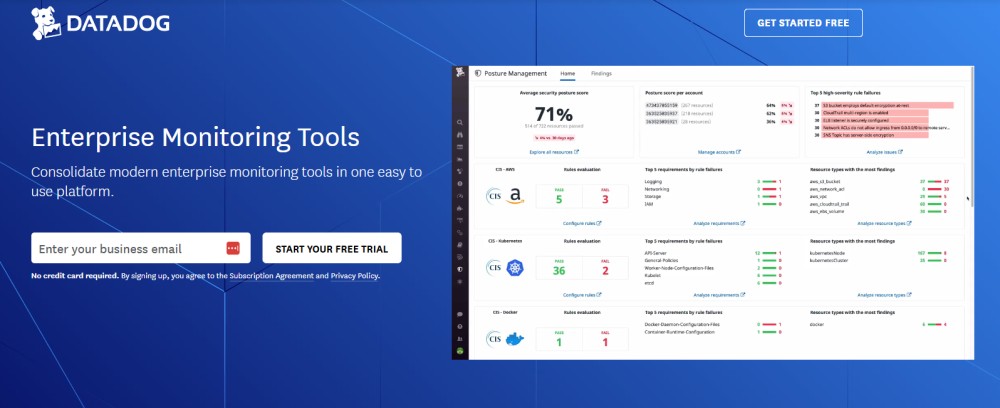
Best for: Teams that need the broadest managed SaaS observability with 1000+ integrations, deep AWS/multi-cloud coverage, full-stack APM, and one platform across infrastructure, logs, traces, RUM, and security.
Known for
Datadog is the leading managed SaaS observability platform. Its strength is integration breadth (1000+ connectors), strong multi-cloud monitoring across AWS, GCP, and Azure, and a mature full-stack APM with code-level CPU profiling that few competitors match.
Key features
- Distributed tracing and APM with code-level CPU profiling
- Log management with pattern detection and real-time search
- Infrastructure monitoring with auto-discovery
- 1000+ integrations across cloud, databases, CI/CD, and SaaS
- RUM and session replay
- Watchdog AI anomaly detection
Pros
- Broadest platform coverage: APM, logs, infrastructure, RUM, security, synthetics in one SaaS
- 1000+ integrations: fastest time to visibility for teams with complex multi-cloud stacks
- Strong Kubernetes Explorer and Service Map for container-heavy environments
- Watchdog AI proactively surfaces anomalies without manual alert configuration
Cons
- Multi-axis pricing (per-host × per-span × per-custom-metric × per-GB logs) compounds unpredictably
- No self-hosted option; all data routes through Datadog infrastructure
- Steep learning curve
Pricing
- APM Pro: $31/APM host/month
- Infrastructure: $15/host/month
- Logs: $0.10/GB ingested
For a more detailed estimate, the Datadog pricing calculator breaks down costs across hosts, indexed spans, logs, custom metrics, and other usage-based charges.
Datadog vs CubeAPM
Choose Datadog when integration breadth and SaaS convenience are worth the cost premium. Choose CubeAPM when data residency requirements, cost predictability, or a 64% cost reduction at scale are the primary drivers.
3. Dynatrace
Best for: Large enterprises that need AI-assisted root cause analysis, automatic topology mapping, and deep full-stack observability across complex hybrid environments.
Known for
Dynatrace is known for Davis AI, an AI engine that automatically detects problems, identifies probable root causes, and suppresses noise across complex distributed environments. Its Smartscape topology mapping automatically discovers and visualizes service dependencies without manual configuration.
Key features
- Davis AI automated root cause analysis with topology awareness
- Smartscape automatic dependency mapping across all monitored entities
- Code-level tracing and distributed tracing
- Kubernetes platform monitoring
- OneAgent automatic instrumentation
- Application security and vulnerability detection
Pros
- Best-in-class automated root cause analysis reduces investigation time in complex systems
- OneAgent automatic instrumentation removes manual SDK setup
- Strong Kubernetes and hybrid-cloud visibility
- Mature enterprise platform with broad compliance support
Cons
- Expensive Full-Stack Monitoring at $58/month per 8 GiB host
- Steep learning curve G2 reviewers consistently flag platform navigation complexity
- UI can feel overwhelming with multiple modules, dashboards, and Davis AI views to master
Pricing
- Infrastructure Monitoring: $29/host/month
- Full-Stack Monitoring: $58/month per 8 GiB host
- Logs ingest and process: $0.20/GiB
Dynatrace vs CubeAPM
Choose Dynatrace when fully automated root cause analysis and OneAgent zero-config instrumentation are worth the premium. Choose CubeAPM when cost predictability and data residency matter more than automated AI triage. At 200 hosts, Dynatrace runs approximately $14,000/month more than CubeAPM.
4. New Relic
Best for: Teams that want broad full-stack observability with 100 GB free ingest, no host-based charges, and a managed platform that supports engineering and operations use cases at scale.
Known for
New Relic is known for its Telemetry Data Platform, a unified NRQL-powered data platform that ingests metrics, events, logs, and traces. Its 100 GB free ingest per month is the most generous free tier in this category, making it a common choice for teams scaling beyond basic monitoring.
Key features
- Unified logs, metrics, traces, and errors via Telemetry Data Platform
- APM with Transaction 360 and distributed tracing
- Kubernetes monitoring
- RUM and synthetics
- NRQL dashboards and analytics
- OpenTelemetry support
Pros
- 100 GB free ingest/month, the best free tier in the APM category
- No per-host charges: pricing based on GB ingest and user seats
- Strong frontend (RUM) and mobile observability
- Mature alerting, SLO tracking, and anomaly detection
Cons
- User-based pricing adds cost as the team grows: $49/Core, $349/year for the Full Platform per user
- Pricing gets hard to forecast beyond the free tier
- Complex initial setup
Pricing
- Free: 100 GB/month ingest
- Pro: $0.40/GB beyond 100 GB
- Core user: $49/user/month
- Full Platform Pro: $349/user/year
For a more detailed cost breakdown, use the New Relic pricing calculator to estimate spend across ingest, user seats, synthetics, and other usage-based charges.
New Relic vs CubeAPM
Choose New Relic when the 100 GB free tier covers your starting volume and managed SaaS convenience is preferred. Choose CubeAPM when data residency requirements apply, when your team is larger (user seat costs add up), or when cost predictability at scale is the primary driver.
5. Motadata ObserveOps
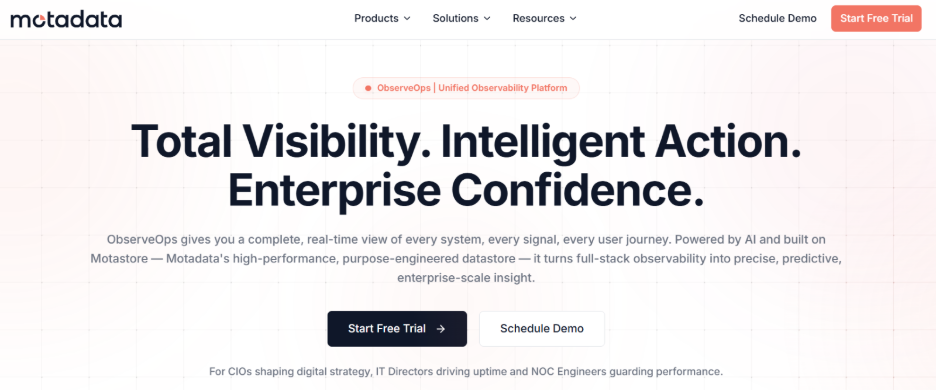
Best for: Teams that need APM alongside network, flow, and log observability in one self-hosted platform, with AI correlation across signals and on-prem deployment for regulated environments.
Known for
Motadata ObserveOps is a unified observability platform built on DFIT, its own deep learning engine for correlation, anomaly detection, and root cause analysis. Its distinguishing strength is signal breadth: traces, metrics, logs, network flows, and topology in one product, so application and network visibility do not need separate tools. Motadata ObserveOps is rated 4.6/5 on G2 and featured in the Gartner Market Guide for IT Operations Platforms.
Key features
- OpenTelemetry-native APM with flame charts and span-level traces
- Instrumentation for Java, .NET, Node.js, Python, Go, PHP, and Kubernetes
- Log Explorer with live tail and ML pattern matching
- Flow analytics across NetFlow, sFlow, jFlow, and IPFIX
- RUM with Core Web Vitals, Apdex, and session replay
- DFIT AI policies for anomaly detection and alert correlation
Pros
- MELT plus network flows and topology in one platform; no separate network tool needed
- On-prem and private cloud deployment keeps telemetry inside your estate
- Adaptive AI works without a pre-training or baselining window
- Six deployment modes including HA, DR, and HA over WAN
Cons
- Pricing is quote-based, with no public rate card to model against
- Evaluation runs on a 30-day trial; no permanent free tier
- Integrations cover core enterprise and cloud stacks, not the long tail larger SaaS platforms carry
Pricing
- Subscription license tiered by monitored devices, log volume, and modules
- On-premises, private cloud, and public cloud licensing
- 30-day free trial; pricing on request
6. Grafana Cloud
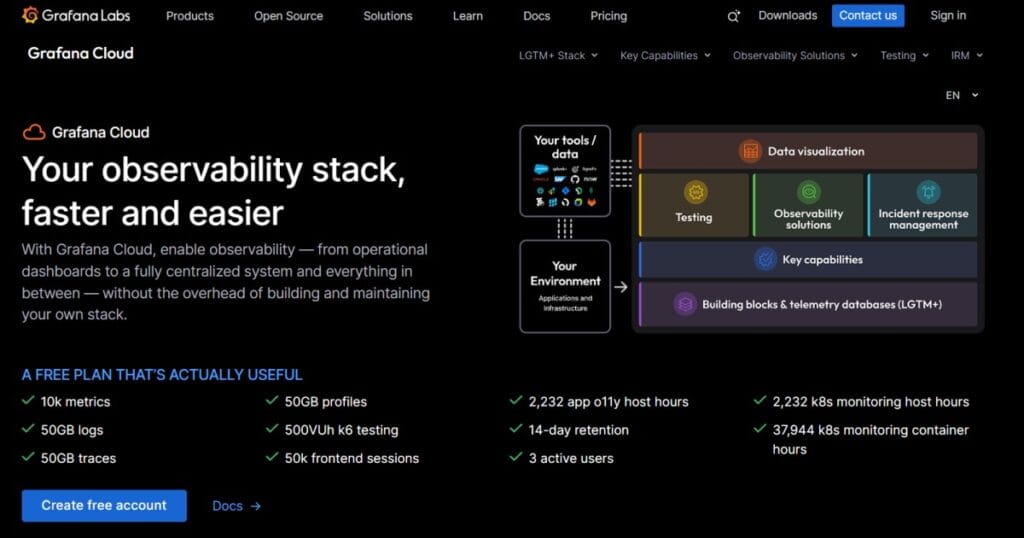
Best for: Teams that want open-source flexibility, composable observability, and strong dashboards, especially if already invested in Prometheus, Loki, or the Grafana ecosystem.
Known for
Grafana is known for the LGTM stack: Loki (logs), Grafana (visualization), Tempo (traces), and Mimir (metrics). It is the most widely used open-source observability visualization tool, and Grafana Cloud brings this stack to a managed deployment with OpenTelemetry-native ingestion.
Key features
- LGTM-based observability stack
- OpenTelemetry and Prometheus-native
- Strong dashboards and visualisations
- Service maps and RED metrics
- Traces and logs correlation
- Self-hosted and cloud deployment
Pros
- Most flexible composable stack: each component is independently configurable
- Strong dashboards and ecosystem community
- Open-source foundation data is portable and not locked to proprietary formats
- Self-hosted option available with full control
Cons
- Three-axis pricing (process + write + retain) makes bill estimation complex
- Expensive as usage grows
- Steep learning curve
Pricing
- Free tier: $0
- Pro: $19/month platform fee
- Logs: $0.05 process + $0.40 write + $0.10 retain per GB ($0.50/GB all-in)
- Traces: same structure as logs
- Enterprise: custom, minimum $25,000/year
Grafana vs CubeAPM
Choose Grafana when your team is already on the Prometheus/Grafana stack and wants to extend it with managed cloud hosting. Choose CubeAPM when you want full-stack APM in one vendor-managed platform without assembling and connecting LGTM components or when support responsiveness during incidents is a requirement.
7. SigNoz
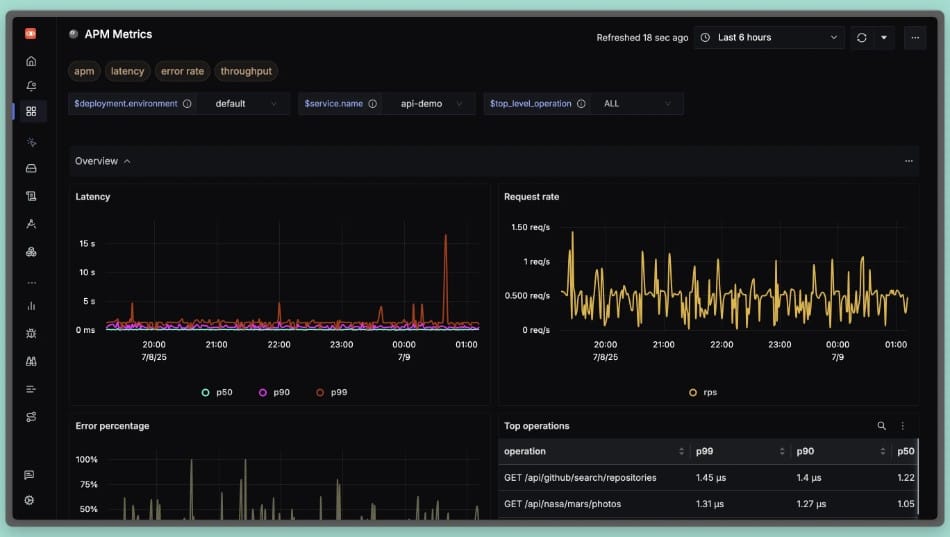
Best for: Teams that want OpenTelemetry-first APM with open-source self-hosted deployment and have DevOps capacity to manage the ClickHouse backend.
Known for
SigNoz is the most prominent open-source, OpenTelemetry-native APM platform. It provides unified logs, metrics, and distributed traces in one interface with no per-host or per-user charges.
Key features
- OpenTelemetry-native APM
- Distributed tracing with service dependency maps
- Unified logs, metrics, and traces
- Prebuilt APM dashboards and RED metrics
- Self-hosted and cloud deployment
- ClickHouse-backed high-performance storage
Pros
- OpenTelemetry-native: no proprietary agents; data is portable
- Strong open-source community and transparent development
- No per-host or per-user charges in any plan
- Self-hosted gives full data residency
Cons
- Self-hosting requires managing the ClickHouse backend upgrades, storage scaling, and index tuning, adding significant ops overhead
- Default retention is 15 days for logs and traces in Community Edition; extending requires ClickHouse storage configuration
Pricing
- Community Edition: free to self-host
- Cloud: from $49/month
- Logs and traces: $0.30/GB
- Metrics: $0.10/million samples
SigNoz vs CubeAPM
Both are OTel-native with predictable pricing. Choose SigNoz when open-source licensing, full community access to code, and the ability to contribute to the platform matter. Choose CubeAPM when you want vendor-managed operations (no ClickHouse management) and engineering support that responds during production incidents.
8. Coralogix
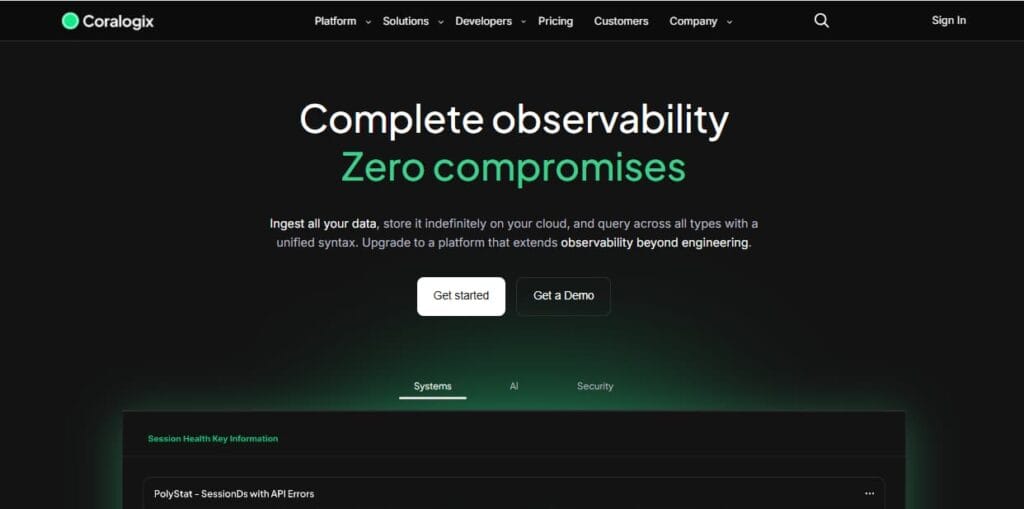
Best for: Teams with high log volumes that need APM and cross-signal correlation, particularly where log analytics and in-stream processing are the primary investigation surface.
Known for
Coralogix is known for its Streama architecture, which processes telemetry in-stream before storage, enabling real-time routing, filtering, and cost control. It is primarily a log analytics and observability platform with APM and tracing built on top.
Key features
- Streama in-stream processing architecture
- Log analytics with real-time routing
- Distributed tracing
- Continuous profiling
- APM alerts and dashboards
- Serverless monitoring
Pros
- Streama reduces indexing overhead; in-stream filtering cuts what gets stored and billed
- Strong log analytics for high-volume environments
- Good OpenTelemetry support
- Per-GB pricing by signal type, no per-host charges
Cons
- Steeper learning curve for new users unfamiliar with streaming pipeline configuration
- Expensive as data volumes grow
- SaaS only, no self-hosted deployment
Pricing
- Logs: $0.42/GB
- Traces: $0.16/GB
- Metrics: $0.05/GB
Coralogix vs CubeAPM
Choose Coralogix when log analytics and in-stream processing are the primary requirement and APM is secondary. Choose CubeAPM when distributed tracing, service maps, and full APM are first-class requirements alongside log management.
Best APM tool by use case
- CubeAPM: Lowest cost at small scale ($2,080/month for 60 hosts). Full MELT coverage with vendor-managed self-hosted deployment.
- SigNoz: Open-source with $49/month cloud entry point. Good OTel-native APM without per-host charges.
- Grafana: Free tier and composable stack for teams already invested in the Prometheus ecosystem.
- Dynatrace: Best for fully automated root cause analysis and hands-off discovery in complex hybrid environments.
- Datadog: Best for the broadest integration ecosystem and multi-cloud SaaS-managed observability.
- New Relic: Strong full-stack platform with flexible user-based pricing and 100 GB free ingest.
- CubeAPM: Best for enterprises that want unified observability, data residency, and cost control at scale.
- CubeAPM: OTel-native Kubernetes monitoring with correlated pod/node metrics, logs, and traces in one workflow.
- Dynatrace: Automated container discovery and topology mapping with Davis AI noise reduction for multi-cluster Kubernetes incidents.
- Datadog: Mature Kubernetes Explorer and Service Map for teams wanting managed Kubernetes monitoring.
- CubeAPM: OTel-native, multi-agent compatible for incremental migration, vendor-managed self-hosted.
- SigNoz: Best open-source OTel-native option. Full data ownership and community-driven development.
- Grafana: Strong OTel integration in a composable open stack.
- CubeAPM: Strong OTel integration in a composable open stack.
- SigNoz: Open-source self-hosted is free (infrastructure costs only). Cloud from $49/month.
- Grafana: Free tier and open-source self-hosted. Three-axis cloud pricing still cheaper than Datadog at moderate volume.
- CubeAPM: Vendor-managed in your cloud data residency with zero backend ops. SOC 2 and ISO 27001.
- SigNoz: Open-source, self-managed. Full control with ClickHouse backend management overhead.
- Grafana OSS: Fully open-source composable stack. Most flexible, highest self-management requirement.
What changes at scale when choosing an APM tool
Feature checklists look similar at the evaluation stage. The differences that actually matter show up when telemetry volume, service count, team size, and compliance requirements grow.
Host-based pricing (Datadog, Dynatrace) ties costs to infrastructure count. Every new host adds a fixed monthly charge regardless of how much data it generates. Ingestion-based pricing (CubeAPM, SigNoz, New Relic) ties costs to actual data volume. Neither model is universally cheaper; the crossover depends on how data-dense your hosts are. As a rule, host-based pricing favors data-heavy environments with few hosts, and ingestion-based pricing favors large host counts with selective telemetry collection.
Metrics grow predictably. Logs and traces do not. A microservices deployment adding three new services can double trace volume overnight. Debug logging left enabled in production can 10x log volume in hours. Teams that chose a platform based on metrics-only pricing often encounter billing surprises when distributed tracing and centralized logging are added to the same platform.
Sampling controls trace volume and cost but removes context. Head-based sampling (decide at trace start) can drop traces from slow or erroring requests before you know they matter. Tail-based sampling (decide after the trace completes) is more accurate but more expensive to compute. The right APM tool for your scale is one that supports intelligent, context-aware sampling, not just blanket percentage-based dropping.
High-cardinality metrics filtered by service, endpoint, region, tenant, container, and deployment version are essential for debugging distributed systems but expensive in platforms that charge per unique metric combination. Datadog custom metric cardinality charges are a frequent source of bill shock for teams with many unique tag combinations. CubeAPM and SigNoz use ingestion-based pricing that does not penalize cardinality.
Short-term debugging only needs 15–30 days of data. Compliance requirements for financial services, healthcare, and government often mandate 90 days, 1 year, or longer. Retention costs vary significantly: CloudWatch charges $0.03/GB/month indefinitely; Datadog retention extensions are separately priced; CubeAPM includes unlimited retention in the base flat rate.
Common mistakes teams make when evaluating APM tools
Always model your specific telemetry volume, host count, and team size against each tool’s pricing model before committing. Comparing feature lists without comparing pricing models.
An APM tool that costs $2,000/month today might cost $20,000/month in 18 months if telemetry volume triples. Evaluate a 12–24 month growth trajectory, not just the current state.
Proprietary agents (Datadog Agent, Dynatrace OneAgent) create instrumentation that is difficult to migrate away from. OTel-native instrumentation is portable; if you switch platforms, you change the exporter endpoint, not the application code.
SigNoz and Grafana OSS are free to license but require engineering time to operate. At $80/hour blended rate, 10 hours/month of ClickHouse or Grafana stack maintenance = $800/month in hidden costs, narrowing the gap to managed alternatives.
APM tools all look polished in demos. The real test is investigation speed during a production incident. How fast can you go from alert → trace → log → root cause? Evaluate this workflow specifically.
Teams that instrument using proprietary agents today face harder migrations later. OpenTelemetry is the CNCF standard, the second-largest CNCF project after Kubernetes, and native OTel support gives you portability.
Migrating to a new APM tool: What to expect
Most APM migrations are less disruptive than teams expect, especially for OTel-native platforms. The main effort is not instrumentation change; it is recreating dashboards, alert rules, and investigation workflows in the new platform.
Migrating to CubeAPM, SigNoz, or Grafana requires updating the OTEL_EXPORTER_OTLP_ENDPOINT environment variable in your application config. Application code does not change. Dashboard and alert recreation is the main effort.
CubeAPM supports multi-agent operation; you can run CubeAPM alongside your existing Datadog or New Relic agent and migrate service by service. Both agents can export to CubeAPM simultaneously. This allows zero-downtime incremental migration without a hard cutover.
Expected migration timeline
| Team profile | Estimated migration effort | Main effort |
| Growing team (10–50 services) | 1–5 days | Update exporter endpoints; recreate key dashboards and alerts |
| Mid-market (50–200 services) | 1–3 weeks | Phased rollout by service; recreate complex alerting logic |
| Enterprise (200+ services) | 4–8 weeks | Governance review; multi-team coordination; staged cutover |
Mamaearth completed its full migration to CubeAPM in under an hour with zero downtime documented directly by the engineering team.
Conclusion: How to choose the right APM tool
The right APM tool depends on what your team needs most as your environment grows. Here is the decision framework that maps the most common requirements to the strongest options:
| Primary requirement | Best fit | Why |
| Cost predictability at scale | CubeAPM | Flat $0.15/GB — no per-host, per-span, or per-user compounding |
| Data residency / compliance | CubeAPM or SigNoz | Data never leaves your cloud; SOC 2 + ISO 27001 (CubeAPM) |
| Broadest integrations + SaaS managed | Datadog | 1000+ integrations; deepest AWS/multi-cloud managed coverage |
| AI-assisted automated root cause | Dynatrace | Davis AI + Smartscape: best automated triage at enterprise scale |
| Full-stack SaaS + large free tier | New Relic | 100 GB free/month; no host-based charges |
| Open-source + OTel-native | SigNoz or Grafana | Free to self-host; full data ownership, and OTel-portable instrumentation |
| Log analytics + APM combined | Coralogix | Streama in-stream processing; strong log analytics with APM depth |
Disclaimer: The information in this article is based on publicly available sources and reflects details available at the time of publication. Pricing, features, and packaging may change. Verify all pricing with each vendor before making decisions.
FAQs
1. What is an APM tool?
An APM tool helps teams monitor application performance, detect slowdowns, track errors, and understand how requests move through services in production. Modern APM tools have expanded into full observability platforms that also cover infrastructure metrics, logs, Kubernetes monitoring, and real user monitoring not just application transaction tracing.
2. What is the difference between APM and observability?
APM traditionally focuses on application response time, error rates, throughput, and transaction tracing. Observability is broader it combines logs, metrics, traces, and infrastructure context to help teams investigate complex distributed systems where a single request can touch dozens of services. Most leading APM tools today are observability platforms with strong APM capabilities, not standalone APM products.
3. Which APM tool is best for Kubernetes?
CubeAPM, Datadog, and Dynatrace are the strongest options for Kubernetes-heavy environments. CubeAPM offers OTel-native Kubernetes monitoring without per-node observation charges. Datadog provides the most mature managed Kubernetes monitoring with Kubernetes Explorer and Service Map. Dynatrace automates container discovery and dependency mapping with Davis AI for noise reduction.
4. What is the cheapest APM tool?
For SaaS deployment, CubeAPM at $0.15/GB flat is consistently the lowest cost at scale 64% cheaper than Datadog and 65% cheaper than Dynatrace at a typical growing-team profile. For open-source self-hosted, SigNoz Community Edition and Grafana OSS are free to license you pay only infrastructure costs. The total cost of self-hosted tools includes engineering time to operate them; at $80/hour, 10 hours/month of ClickHouse management = $800/month in hidden cost.
5. Which APM tool is best for microservices?
Dynatrace leads for large-scale microservices where automated discovery and Davis AI noise reduction matter most. Datadog leads for teams that want the broadest managed coverage with 1000+ integrations across their entire microservices stack. CubeAPM is the strongest cost-effective option full distributed tracing, service dependency maps, and Kubernetes visibility at $0.15/GB flat.
6. Why do APM costs become unpredictable at scale?
APM tools with multi-axis pricing (per-host × per-custom-metric × per-indexed-log × per-span) create compounding charges as telemetry grows. Teams frequently underestimate costs because they only account for one or two dimensions. High-cardinality custom metrics (hundreds of unique label combinations per host) are a particularly common source of bill shock in Datadog environments. Single-dimension ingestion-based pricing (CubeAPM at $0.15/GB, SigNoz at $0.30/GB) eliminates this compounding behaviour.
7. Can I switch APM tools without re-instrumenting my applications?
If you are using OpenTelemetry instrumentation, yes you change the OTEL_EXPORTER_OTLP_ENDPOINT and nothing else. Application code does not change. If you are using proprietary agents (Datadog Agent, Dynatrace OneAgent), CubeAPM supports multi-agent operation so you can run both in parallel during an incremental migration. Full re-instrumentation is only required when moving from one proprietary agent to a different proprietary agent.