










Zabbix is a mature open-source monitoring platform for infrastructure, networks, servers, cloud environments, containers, applications, services, and databases. Its biggest strength is cost control: the core software is free, self-hostable, highly customizable, and not licensed by host, user, metric, or alert volume.
That makes Zabbix pricing and reviews important to evaluate carefully. The software has no license fee, but real costs can still come from support subscriptions, Zabbix Cloud NVPS tiers, professional services, infrastructure, database maintenance, upgrades, and internal engineering time.
In this guide, we break down Zabbix pricing in 2026, including support tiers, Zabbix Cloud costs, professional services, user reviews, estimated monthly cost scenarios, and alternatives including CubeAPM, SigNoz, Datadog, New Relic, Dynatrace, ManageEngine OpManager, Prometheus with Grafana, so you can understand the real total cost before choosing it.
What Is Zabbix?
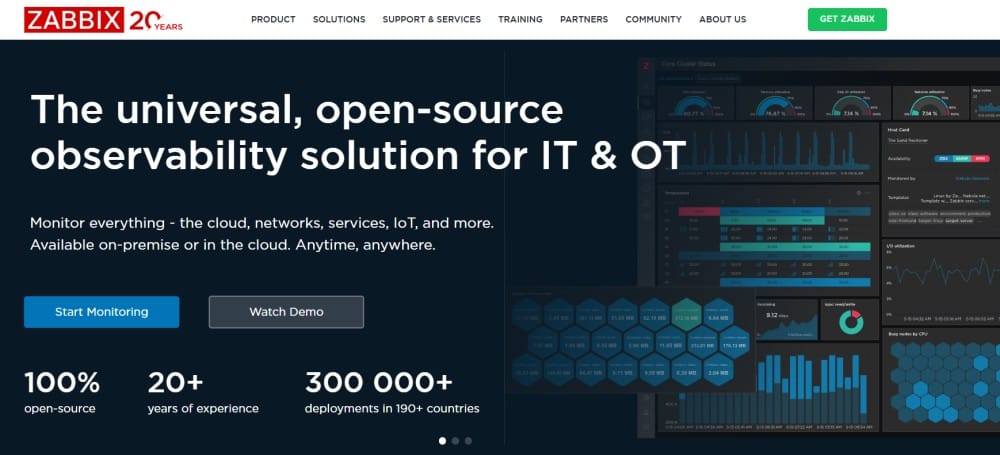
Zabbix is an open-source monitoring solution for IT and OT infrastructure. It monitors networks, servers, cloud environments, containers, VMware, Windows, IoT devices, logs, applications, services, and databases from one platform.
The platform is built for IT operations teams, network administrators, system engineers, DevOps teams, enterprises, and managed service providers that need broad visibility across hybrid environments. It supports agent-based and agentless collection, SNMP, IPMI, JMX, HTTP checks, templates, alerts, dashboards, and automation workflows.
Unlike many monitoring vendors, Zabbix does not separate the product into a limited free edition and a paid commercial edition. The core software is open source and free to use for commercial and non-commercial purposes. Paid subscriptions add support, expert access, response SLAs, and long-term maintenance assurance, but they do not unlock a separate paid-only product edition.
Zabbix 7.4.11 was released on June 2, 2026, and Zabbix 7.0 remains the current LTS line. Starting with Zabbix 7.0, all subsequent Zabbix versions are released under the GNU Affero General Public License version 3, or AGPLv3.
Supported Data Collection Methods, Platforms, and Integrations
Zabbix is built for broad compatibility across legacy infrastructure, modern cloud systems, and network-heavy environments.
- Data collection methods: Zabbix agent, agentless checks, SNMP, IPMI, JMX, HTTP checks, trapper items, calculated items, scripts, and external integrations.
- Platforms: Linux, Windows, UNIX-like systems, VMware, Docker, Kubernetes, Podman, cloud platforms, and network devices.
- Databases: MySQL, MariaDB, PostgreSQL, Oracle, and TimescaleDB are supported database options depending on deployment requirements.
- Deployment options: Self-hosted on-premises, self-hosted in cloud infrastructure, or Zabbix Cloud managed SaaS.
- Integrations and templates: Zabbix provides official and community templates, including more than 300 prepackaged templates for many vendors and endpoint types.
- Languages: Zabbix supports multiple interface languages, including English, German, Italian, Japanese, Portuguese, Russian, Spanish, French, Chinese, and others.
Key Features of Zabbix
Zabbix is strongest in infrastructure and network monitoring. It supports servers, virtual machines, cloud resources, network devices, storage systems, databases, services, and applications.
Zabbix’s network monitoring pages specifically emphasize SNMP-based device monitoring and over 300 templates for popular network hardware vendors.
Zabbix includes highly customizable alerting and escalation workflows. Teams can define trigger expressions, problem thresholds, notification rules, escalation chains, and integrations with tools such as email, Slack, Telegram, and webhooks.
Users frequently praise Zabbix’s flexibility, customization, real-time alerts, and comprehensive monitoring. G2’s review summary also notes that users like its flexibility and real-time alerting, while many mention a steep learning curve during setup.
Zabbix includes dashboards, graphs, maps, reports, and business service views. Teams can build custom views for infrastructure health, network status, SLA tracking, and incident investigation.
This is useful for teams that want a single operational console for network and infrastructure monitoring without paying per dashboard user.
Zabbix includes business service monitoring for mapping technical components to business services. This helps teams understand which infrastructure issues affect customer-facing services, internal applications, or business-level SLAs.
This feature is useful for enterprises and MSPs that need to connect technical monitoring with business impact.
Zabbix ships with hundreds of templates and supports auto-discovery, low-level discovery, and reusable monitoring definitions. Zabbix says it comes with over 300 templates for vendors and endpoint types, which helps reduce manual setup time.
For unsupported or custom systems, Zabbix also sells template building services. The current standard price listed by Zabbix is €5,000 / $6,000.
Every Zabbix subscription includes defined response SLAs, direct access to Zabbix experts, long-term maintenance assurance, and 5 years of guaranteed security fixes.
This does not mean the free software is unsupported by the community. It means contractual vendor-backed support and guaranteed response commitments require a paid subscription.
Zabbix Pricing in 2026
Zabbix pricing has three main parts:
- Free open-source software
- Optional support subscriptions
- Optional Zabbix Cloud hosting and professional services
Zabbix states that its open-source software has no license fee and that subscription pricing is based on response coverage, access, and commitments. It also states that subscriptions include unlimited hosts, devices, applications, users, metrics, and alerts.
Zabbix Support Subscription Tiers
| Plan | Starting price | Support coverage | Best fit |
| Silver | $325/month, billed annually | 8×5 support, 1-day response | Essential support for one Zabbix server |
| Gold | From $825/month, billed annually | 8×5 support, 4-hour response | Growing environments and distributed monitoring |
| Platinum | Custom | 24×7 support, 2-hour emergency response | Critical operations |
| Enterprise | Custom | 24×7 support, 1.5-hour emergency response | Large deployments needing HA and hands-on help |
| Global | Custom | 24×7 support, 1-hour emergency response | Multiple legal entities and global contracts |
Zabbix’s published subscription page lists Silver at $325/month, Gold from $825/month, and Platinum, Enterprise, and Global as custom-priced. It also states that Gold and Platinum are priced per Zabbix server and proxy, while Enterprise and Global include unlimited supported Zabbix servers and proxies.
What Is Included in Zabbix Support?
| Feature | Silver | Gold | Platinum | Enterprise | Global |
| Monitored devices and metrics | Unlimited | Unlimited | Unlimited | Unlimited | Unlimited |
| Supported Zabbix servers | 1 | Priced per server | Priced per server | Unlimited | Unlimited |
| Supported Zabbix proxies | No | Priced per proxy | Priced per proxy | Unlimited | Unlimited |
| Support availability | 8×5 | 8×5 | 24×7 | 24×7 | 24×7 |
| Number of support cases | 8 | Unlimited | Unlimited | Unlimited | Unlimited |
| Initial response time | 1 day | 4 hours | 4 hours | 4 hours | 2 hours |
| Emergency response time | Not included | Not included | 2 hours | 1.5 hours | 1 hour |
| Support contacts | 1 | 2 | 3 | 7 | 20 |
| Remote consultancy hours | Not included | Not included | Not included | 40 hours | 80 hours |
This distinction is important: the Global plan has a 1-hour emergency response time, but the subscription comparison table lists its maximum initial response time as 2 hours.
Zabbix Cloud Pricing
Zabbix Cloud is Zabbix’s managed SaaS option. It is priced by NVPS, or New Values Per Second. Zabbix Cloud starts at $50/month for the Nano tier and includes 10 GB of free storage. Zabbix also offers a 5-day free trial and says annual subscriptions save 10%.
| Zabbix Cloud tier | NVPS limit | Starting monthly price |
| Nano | 50 NVPS | $50/month |
| Micro | 100 NVPS | $100/month |
| Small | 250 NVPS | $250/month |
| Medium | 1,000 NVPS | $750/month |
| Large | 2,500 NVPS | $1,875/month |
| xLarge | 5,000 NVPS | $2,500/month |
| 2xLarge | 10,000 NVPS | $5,000/month |
Zabbix notes that Cloud tier prices are starting points and may vary by configuration and requirements. It also says values above the current tier NVPS limit may be discarded at random once the limit is reached, so teams should size Cloud tiers carefully.
What Is NVPS?
NVPS means New Values Per Second. A simple estimate is:
NVPS = number of hosts × metrics per host ÷ polling interval in seconds
For example, 50 hosts × 200 metrics per host ÷ 60 seconds equals about 167 NVPS.
This means Zabbix Cloud pricing scales with the amount and frequency of metric collection, not simply the number of hosts. A small number of hosts with very high-frequency polling can require a higher tier than a larger fleet with lower-frequency polling.
Professional Services Pricing
Zabbix also sells professional services for teams that need expert help.
| Service | Published price |
| Consulting, 10-hour prepaid package | €2,500 / $2,900 |
| Consulting, 20-hour prepaid package | €4,700 / $5,500 |
| Consulting, 40-hour prepaid package | €8,800 / $10,400 |
| Consulting, 80-hour prepaid package | €15,900 / $19,200 |
Zabbix’s consulting page lists prepaid packages starting at $2,900 for 10 hours, its template building page lists a standard price of $6,000, and its upgrade services page lists $1,500 per day.
What Does Zabbix Really Cost?
⚠️ Disclaimer
The scenarios below are directional editorial estimates, not official Zabbix quotes. Zabbix open-source software has no license fee, and Zabbix says its standard support subscriptions include unlimited hosts, devices, applications, users, metrics, and alerts. Final cost can still change based on deployment model, Zabbix Cloud NVPS tier, selected support plan, number of Zabbix servers and proxies, infrastructure, database/storage needs, professional services, and internal engineering effort.
Zabbix is not priced like a pure ingest-based observability tool. A team producing 5 TB or 27 TB of telemetry does not automatically pay based on that telemetry volume in self-hosted Zabbix. The main cost drivers are usually infrastructure, database/storage, admin time, support tier, and whether the team uses Zabbix Cloud, which starts from $50/month and is priced by NVPS.
The structure below follows the cost-scenario format you shared for Splunk Observability Cloud, but maps the estimates to Zabbix’s pricing model instead.
Pricing Assumptions Used in These Scenarios
These scenarios use the workload profiles from the CubeAPM calculator, but map the Zabbix estimate to practical monthly operating cost. The estimates include infrastructure, database/storage, backups, tuning, upgrades, alert/template maintenance, support where relevant, and internal admin time.
| Scenario | Zabbix pricing anchor | Zabbix estimate | CubeAPM estimate |
| Small team | 10 hosts, self-hosted or low-tier Cloud, light admin effort | ~$600/month | ~$522/month |
| Growing team | 50 hosts, Silver support, regular tuning and admin effort | ~$2,000/month | ~$919/month |
| Mid-market team | 250 hosts, distributed setup, Gold support/proxies, heavier admin effort | ~$7,000/month | ~$4,594/month |
These estimates do not include major professional-services projects, custom enterprise contracts, unusually long retention, premium infrastructure choices, or negotiated Zabbix partner terms.
Workload Assumptions Used for Zabbix Estimates
| Team size | Infrastructure context | Telemetry context | Zabbix usage assumption | Estimated Zabbix cost |
| Small team | 10 hosts | ~1.1 TB/month | Self-hosted or low-tier Zabbix Cloud, no paid support, light admin effort | ~$600/month |
| Growing team | 50 hosts | ~5.4 TB/month | Self-hosted or Zabbix Cloud, Silver support, routine tuning and maintenance | ~$2,000/month |
| Mid-market team | 250 hosts | ~27 TB/month | Distributed Zabbix setup, proxies, Gold support or higher, heavier admin effort | ~$7,000/month |
The telemetry volume is included for comparison with ingest-based tools like CubeAPM. For Zabbix, the public pricing calculation is not based on logs, traces, RUM sessions, or synthetic test runs. Zabbix’s standard subscription pricing is based on support coverage and commitments, while Zabbix Cloud is based on NVPS.
Scenario 1: Small Team, ~10 Hosts
Situation
A small production team runs around 10 hosts and produces roughly 1.1 TB of monthly telemetry across logs, traces/APM, and metrics. The team also has about 5,000 RUM sessions, 50,000 API test runs, and 2,000 browser test runs per month.
For Zabbix, the 1.1 TB/month telemetry estimate does not directly drive the main bill. The stronger cost factor is whether the team self-hosts, uses Zabbix Cloud, and how much internal time is needed for setup, tuning, backups, and maintenance.
Why teams at this stage consider Zabbix
Teams at this stage may consider Zabbix because the software has no license fee and can cover infrastructure, network, server, service, and application monitoring without per-host software licensing. A small team with Linux and database skills can start cheaply, especially if it self-hosts and relies on documentation/community support.
Estimated profile
| Configuration | Detail |
| Infrastructure context | 10 hosts |
| Telemetry context | ~1.1 TB/month |
| Logs | 720 GB/month |
| Traces/APM | 360 GB/month |
| Metrics | 1 GB/month |
| RUM sessions | 5,000/month |
| Synthetic activity | 50,000 API runs + 2,000 browser runs/month |
| Zabbix setup assumption | Self-hosted or low-tier Zabbix Cloud, light admin effort |
| Pricing basis | Infrastructure/Cloud + storage/backups + admin time |
Estimated monthly cost
Disclaimer: This estimate models a paid production operating profile, not only the Zabbix software fee. Zabbix software itself is free, but real operating cost can include infrastructure, storage, backups, tuning, upgrades, and internal admin time.
| Component | Assumption | Monthly cost |
| Zabbix software | Open-source software | $0 |
| Infrastructure or low-tier Cloud | Small self-hosted setup or low NVPS Cloud tier | ~$50–$150 |
| Storage, backups, and maintenance | Database/storage care and basic backup process | ~$100–$200 |
| Setup, tuning, and internal admin time | Light monthly operational effort | ~$300–$450 |
| Estimated total | Small production Zabbix setup | ~$600/month |
CubeAPM cost comparison
| Platform | Pricing basis | Estimated monthly cost |
| Zabbix | Estimated operating cost for 10-host production setup | ~$600/month |
| CubeAPM | ~1.1 TB/month usage estimate | ~$522/month |
| Estimated savings with CubeAPM | Difference vs Zabbix | ~$78/month |
| Percentage savings | $78 ÷ $600 | ~13% lower |
What this scenario shows
For a small team, Zabbix can be very low-cost from a software licensing perspective, but the real operating cost comes from running and maintaining the stack. CubeAPM is slightly lower in this scenario because its cost is tied to the telemetry workload and includes full-stack observability use cases such as logs, metrics, traces, APM, RUM, and synthetics.
Scenario 2: Growing Team, ~50 Hosts
Situation
A growing SaaS team runs around 50 hosts and produces roughly 5.4 TB of monthly telemetry. The workload includes 3,600 GB/month of logs, 1,800 GB/month of traces/APM, 5 GB/month of metrics, 50,000 RUM sessions, 500,000 API test runs, and 20,000 browser test runs.
For Zabbix, the 5.4 TB/month figure is useful for comparison, but it is not the main pricing unit. At this stage, the main cost comes from infrastructure, database/storage, ongoing tuning, support, and the team time needed to keep the monitoring setup reliable.
Why teams at this stage consider Zabbix
At this stage, teams usually need stronger infrastructure visibility, alerting, dashboard customization, and more reliable support coverage. Zabbix becomes attractive because Silver support starts at $325/month, while the core software still has no license fee or standard per-host billing.
Estimated profile
| Configuration | Detail |
| Infrastructure context | 50 hosts |
| Telemetry context | ~5.4 TB/month |
| Logs | 3,600 GB/month |
| Traces/APM | 1,800 GB/month |
| Metrics | 5 GB/month |
| RUM sessions | 50,000/month |
| Synthetic activity | 500,000 API runs + 20,000 browser runs/month |
| Zabbix setup assumption | Self-hosted or Zabbix Cloud, Silver support, regular tuning |
| Pricing basis | Infrastructure/Cloud + Silver support + admin time |
Estimated monthly cost
Disclaimer: This estimate uses Zabbix’s public Silver support price as a planning anchor and adds likely operating costs. It is not an official quote. Actual cost can vary by cloud provider, support plan, database size, retention, team skill, and whether Zabbix Cloud is used.
| Component | Assumption | Monthly cost |
| Zabbix software | Open-source software | $0 |
| Infrastructure, database, storage, and backups | Production self-hosted setup or managed Cloud equivalent | ~$300–$600 |
| Silver support | Published starting price | $325 |
| Setup, tuning, upgrades, and internal admin time | Regular monthly monitoring operations | ~$1,000–$1,300 |
| Estimated total | Growing production Zabbix setup | ~$2,000/month |
CubeAPM cost comparison
| Platform | Pricing basis | Estimated monthly cost |
| Zabbix | Estimated operating cost for 50-host production setup | ~$2,000/month |
| CubeAPM | ~5.4 TB/month usage estimate | ~$919/month |
| Estimated savings with CubeAPM | Difference vs Zabbix | ~$1,081/month |
| Percentage savings | $1,081 ÷ $2,000 | ~54% lower |
What this scenario shows
This is where CubeAPM becomes more cost-effective in the model. Zabbix still avoids software license fees, but the team now has more operational work: database care, alert tuning, template maintenance, upgrades, backups, and support coordination. CubeAPM stays lower because the estimate is based on telemetry usage rather than the operational effort of running a monitoring stack.
Scenario 3: Mid-Market Team, ~250 Hosts
Situation
A mid-market team runs around 250 hosts and produces roughly 27 TB of monthly telemetry. The environment may include multiple Kubernetes clusters, customer-facing applications, backend services, databases, APIs, queues, and frontend user journeys.
The workload includes 18,000 GB/month of logs, 9,000 GB/month of traces/APM, 25 GB/month of metrics, 200,000 RUM sessions, 2,000,000 API test runs, and 80,000 browser test runs.
Why teams at this stage consider Zabbix
At mid-market scale, Zabbix is attractive because the core software remains free and standard subscriptions are not priced by monitored hosts, devices, metrics, users, or alerts. However, large environments often need distributed monitoring, proxies, stronger database architecture, backup planning, admin time, and paid support. Gold support starts at $825/month, and Zabbix states that Gold and Platinum are priced per Zabbix server and proxy.
Estimated profile
| Configuration | Detail |
| Infrastructure context | 250 hosts |
| Telemetry context | ~27 TB/month |
| Logs | 18,000 GB/month |
| Traces/APM | 9,000 GB/month |
| Metrics | 25 GB/month |
| RUM sessions | 200,000/month |
| Synthetic activity | 2,000,000 API runs + 80,000 browser runs/month |
| Zabbix setup assumption | Distributed setup with proxies, Gold support or higher |
| Pricing basis | Infrastructure/Cloud + support/proxy coverage + heavier admin effort |
Estimated monthly cost
Disclaimer: This estimate uses Zabbix’s public Gold support starting price as a planning anchor, but distributed environments may exceed the starting price because Gold and Platinum are priced per Zabbix server and proxy. Buyers should confirm the exact support scope, proxy coverage, and Cloud tier with Zabbix or a partner.
| Component | Assumption | Monthly cost |
| Zabbix software | Open-source software | $0 |
| Larger infrastructure, database, storage, and backups | Distributed production setup | ~$1,000–$2,000 |
| Gold support/proxy coverage | Published Gold starts at $825/month; distributed coverage may cost more | ~$825+ |
| Admin, tuning, upgrades, templates, and operational effort | Heavier ongoing maintenance | ~$4,000–$5,000+ |
| Estimated total | Mid-market Zabbix setup | ~$7,000/month |
CubeAPM cost comparison
| Platform | Pricing basis | Estimated monthly cost |
| Zabbix | Estimated operating cost for 250-host distributed setup | ~$7,000/month |
| CubeAPM | ~27 TB/month usage estimate | ~$4,594/month |
| Estimated savings with CubeAPM | Difference vs Zabbix | ~$2,406/month |
| Percentage savings | $2,406 ÷ $7,000 | ~34% lower |
What this scenario shows
At mid-market scale, Zabbix can still be cost-effective compared with many per-host SaaS tools, but the operational burden becomes more visible. The estimate is not saying Zabbix charges $7,000/month as a license fee. It reflects the likely cost of running a serious production setup with infrastructure, database care, proxies, backups, support, upgrades, and staff time.
CubeAPM is lower in this scenario because it prices the telemetry workload directly and avoids per-host, per-user, and separate signal-based pricing. For teams that need full-stack observability rather than only infrastructure and network monitoring, this can make CubeAPM easier to budget.
Summary: Zabbix vs CubeAPM Estimated Monthly Cost
Disclaimer: These are directional planning estimates, not official quotes. Zabbix’s final cost can change with deployment model, Zabbix Cloud tier, support coverage, number of servers and proxies, professional services, and internal staff time. CubeAPM’s estimate uses the supplied usage profiles and reflects a different pricing model based on telemetry ingestion.
| Team profile | Zabbix estimate | CubeAPM estimate | Monthly savings with CubeAPM | Percentage savings |
| Small team | ~$600/month | ~$522/month | ~$78/month | ~13% |
| Growing team | ~$2,000/month | ~$919/month | ~$1,081/month | ~54% |
| Mid-market team | ~$7,000/month | ~$4,594/month | ~$2,406/month | ~34% |
What This Comparison Shows
Zabbix’s biggest pricing advantage is that the software itself is free and standard support subscriptions are not priced by hosts, users, metrics, or alerts. That makes Zabbix attractive for teams with strong Linux, database, networking, and monitoring skills.
The trade-off is operational responsibility. As the environment grows, Zabbix usually needs more infrastructure planning, database care, backups, upgrades, proxy design, template maintenance, and internal admin time. Those costs are real even when the software license is $0.
CubeAPM becomes more attractive when the team wants full-stack observability across logs, metrics, traces, APM, RUM, and synthetics without taking on the same level of monitoring-stack operations. Zabbix is still a strong fit for infrastructure and network monitoring, while CubeAPM is easier to compare when the primary need is application observability and predictable telemetry-based pricing.
What Drives Zabbix Costs?
- Deployment model: Self-hosting keeps the software cost at zero but adds infrastructure and labor. Zabbix Cloud removes much of the maintenance burden but adds a monthly NVPS-based fee.
- Infrastructure size: Self-hosted Zabbix requires compute, database, and storage resources. The more values you collect and store, the more infrastructure tuning you need.
- Support tier: Silver starts at $325/month, Gold starts at $825/month, and higher tiers are custom-priced.
- Number of Zabbix servers and proxies: Gold and Platinum are priced per Zabbix server and proxy, so distributed deployments can exceed the published starting price.
- Zabbix Cloud NVPS: Zabbix Cloud pricing scales from 50 NVPS at $50/month to 10,000 NVPS at $5,000/month.
- Professional services: Consulting starts at $2,900, template building is listed at $6,000, and upgrade services are listed at $1,500 per day.
- Internal staff time: Setup, database tuning, upgrades, alert design, and template maintenance can become the biggest hidden cost.
Additional Costs Buyers Should Plan For
| Cost area | Why it matters |
| Infrastructure | Self-hosting requires compute, storage, and database capacity |
| Database administration | Zabbix performance depends heavily on a healthy database |
| Upgrades and patching | You own upgrade planning unless you use Cloud or paid services |
| Distributed monitoring | Gold and Platinum price coverage per server and proxy |
| Professional services | Consulting, implementation, upgrades, and templates can increase first-year cost |
| Staff time | The free software still requires skilled engineering hours |
| Training | Zabbix is powerful, but new teams may need structured training |
| Storage growth | Longer retention and high-frequency polling require more database/storage planning |
Zabbix User Reviews
Zabbix has strong user ratings across major review platforms, but the feedback is consistent: users like the flexibility, value, and monitoring depth, while many warn about setup effort and learning curve.
| Review source | Rating |
| G2 | 4.4/5 from 208 reviews |
| Capterra | 4.7/5 from 111 reviews |
| GetApp | 4.7/5 from 111 reviews |
What Users Like
Users frequently praise Zabbix because it can be adapted to many infrastructure, network, and service monitoring needs. G2’s review summary says users consistently praise flexibility and customization.
Users like that Zabbix can monitor networks, servers, applications, and many infrastructure components from one platform. GetApp’s review summary says reviewers appreciate Zabbix for robust monitoring capabilities, customizable alerts, integrations, dashboards, and templates.
The free open-source software is a major advantage. GetApp reports a 4.8 value-for-money score, and reviewers repeatedly mention that Zabbix’s open-source nature and lack of licensing fees make it attractive for budget-conscious teams.
Users value Zabbix’s ability to monitor many systems through agents, SNMP, templates, scripts, and integrations. This is especially useful for hybrid infrastructure and network-heavy environments.
What Users Dislike
This is the most consistent criticism. G2’s review summary says many users note a steep learning curve for new users, especially during initial setup.
Capterra reviewers mention that Zabbix can take time to set up and learn, especially for larger or more customized environments. One reviewer says Zabbix takes time to set up and learn but becomes valuable once configured.
Some Capterra reviewers mention that official documentation can lack enough practical examples for certain advanced use cases.
Some users mention limitations around searching, dashboards, interface results, reporting, or database-level work. These are not universal complaints, but they appear often enough to mention as review-based cautions.
Zabbix Alternatives: How it Compares to Competitors
Zabbix vs. CubeAPM
CubeAPM is an OpenTelemetry-native observability platform focused on metrics, events, logs, traces, application performance monitoring, and full-stack telemetry. Zabbix is strongest in infrastructure, network, server, service, and broad operational monitoring.
| Category | Zabbix | CubeAPM |
| Primary focus | Infrastructure and network monitoring | Full-stack application observability |
| Pricing model | Free software + support or NVPS Cloud | Published usage-based pricing from $0.15/GB |
| Deployment | Self-hosted or Zabbix Cloud | Self-hosted but vendor managed |
| OpenTelemetry | Possible through integrations and ecosystem work | OpenTelemetry-native |
| Logs and traces | Log monitoring supported; not tracing-first | Native logs and distributed traces |
| Best for | Low-license-cost infrastructure monitoring | Application observability with predictable per-GB pricing |
Zabbix vs. Datadog
Datadog is a cloud-first SaaS observability platform with infrastructure monitoring, APM, logs, synthetics, RUM, security, and many integrations. Zabbix is stronger for teams that want open-source control, self-hosting, and fixed support-based pricing. Datadog is stronger for teams that want a managed SaaS observability suite with less infrastructure ownership.
| Category | Zabbix | Datadog |
| Pricing model | Free software + optional support or Cloud | Modular SaaS pricing |
| Infrastructure monitoring | Included in open-source software | Paid per host |
| APM | Basic application/service monitoring, not deep tracing-first APM | Dedicated APM product |
| Logs | Log monitoring supported, not full SaaS log analytics replacement | Dedicated log management |
| Deployment | Self-hosted or Zabbix Cloud | SaaS |
| Best for | Infrastructure and network monitoring with low license cost | Managed full-stack observability |
Zabbix vs. ManageEngine OpManager
ManageEngine OpManager is a commercial network and infrastructure monitoring tool with device-based licensing. It is often easier for teams that want a packaged commercial experience, while Zabbix offers deeper open-source flexibility and no software license fee.
| Category | Zabbix | ManageEngine OpManager |
| Pricing model | Free software + optional support | Device-based commercial licensing |
| Setup | Powerful but more technical | More guided |
| Customization | Very high | Moderate to high |
| Deployment | Self-hosted or Cloud | On-premises and cloud options |
| Best for | Teams with technical depth and low license-cost goals | Teams wanting packaged network monitoring |
ManageEngine states that OpManager uses device-based licensing, where the device license includes interfaces, ports, disks, and performance metrics by default.
Zabbix vs. Prometheus and Grafana
Prometheus and Grafana are popular in cloud-native and Kubernetes-heavy environments. Prometheus is 100% open source and community-driven under the Apache 2.0 license.
| Category | Zabbix | Prometheus + Grafana |
| Primary strength | Broad infrastructure and network monitoring | Cloud-native metrics and time-series monitoring |
| Network devices | Strong SNMP/template support | Usually requires exporters |
| Dashboards | Built in | Grafana is a dashboard standard |
| Alerting | Built-in triggers and escalations | Prometheus Alertmanager/Grafana alerting |
| Best for | Mixed legacy and modern infrastructure | Kubernetes and metrics-heavy systems |
Zabbix is usually better when SNMP devices, legacy systems, and broad infrastructure coverage matter. Prometheus and Grafana are usually better when the main requirement is cloud-native metrics, Kubernetes, and time-series observability.
Zabbix vs. Dynatrace
Dynatrace is an enterprise observability and security platform known for automated discovery, AI-assisted root-cause analysis, APM, infrastructure monitoring, logs, traces, Kubernetes monitoring, and digital experience monitoring. Zabbix is more cost-controlled and self-hostable, while Dynatrace is stronger for enterprises that want advanced automation and managed full-stack observability.
| Category | Zabbix | Dynatrace |
| Pricing model | Free software + optional support or Cloud | Usage-based enterprise SaaS pricing |
| Primary strength | Infrastructure and network monitoring | Automated full-stack observability |
| Deployment | Self-hosted or Zabbix Cloud | SaaS and managed deployment options |
| APM | Limited compared with APM-first tools | Advanced APM and tracing |
| Automation | Highly customizable, manual setup | Strong automated discovery and root-cause analysis |
| Best for | Teams with technical depth and cost-control goals | Enterprises needing automation, AI assistance, and deep application visibility |
Zabbix vs. Better Stack
Better Stack is a modern monitoring platform focused on uptime monitoring, incident management, status pages, logs, and observability workflows. Zabbix is stronger for deep infrastructure and network monitoring, while Better Stack is easier for teams that want fast setup, clean UX, and managed uptime/log monitoring without running their own monitoring stack.
| Category | Zabbix | Better Stack |
| Pricing model | Free software + optional support or Cloud | SaaS subscription pricing |
| Primary strength | Infrastructure and network monitoring | Uptime monitoring, logs, alerts, and status pages |
| Deployment | Self-hosted or Zabbix Cloud | SaaS |
| Setup | Powerful but more technical | Faster and simpler |
| Network monitoring | Strong SNMP/device monitoring | Not its main focus |
| Best for | Teams wanting open-source control and deep customization | Teams wanting simple managed monitoring and incident workflows |
Zabbix vs. Splunk Observability Cloud
Splunk Observability Cloud is a SaaS observability platform for metrics, traces, infrastructure monitoring, Kubernetes monitoring, real user monitoring, synthetics, and incident response workflows. Zabbix is better for open-source infrastructure and network monitoring with lower software licensing cost, while Splunk Observability Cloud is stronger for large teams that need managed, enterprise-grade observability across applications and cloud-native systems.
| Category | Zabbix | Splunk Observability Cloud |
| Pricing model | Free software + optional support or Cloud | Enterprise SaaS pricing |
| Primary strength | Infrastructure and network monitoring | Cloud-native observability |
| Deployment | Self-hosted or Zabbix Cloud | SaaS |
| APM and tracing | Limited compared with tracing-first tools | Native APM and distributed tracing |
| Digital experience | Not a primary strength | RUM and synthetics available |
| Best for | Teams wanting low license cost and infrastructure control | Enterprises needing managed observability across metrics, traces, RUM, and synthetics |
Is Zabbix the Right Choice?
When Zabbix Works Best
Zabbix is a strong fit when:
- Your team has Linux, database, networking, and DevOps skills.
- You want open-source monitoring software with no license fee.
- You monitor hybrid, on-premises, cloud, or network-heavy infrastructure.
- You need strong SNMP, agent-based, and agentless device monitoring.
- You want broad customization, templates, triggers, dashboards, discovery, and optional enterprise support.
When Zabbix May Not Be the Right Fit
Zabbix may not be the best fit when:
- You need plug-and-play monitoring with minimal setup.
- Your team lacks in-house operations, Linux, database, or monitoring administration expertise.
- Your primary need is deep application observability, distributed tracing, RUM, or browser synthetics.
- You need advanced log analytics with high-cardinality search, pipelines, indexing, and long-term retention controls.
- You have a very small environment but still need paid vendor-backed support, since Silver support starts at $325/month billed annually.
Conclusion
Zabbix remains one of the strongest open-source monitoring options for teams that want infrastructure, network, server, service, and device monitoring without software license fees. Its free core, broad customization, SNMP support, templates, and optional enterprise support make it especially useful for technical teams that can run and tune it properly.
The real cost is not the software license, but the operating effort around infrastructure, database care, storage, backups, upgrades, proxies, templates, alert tuning, and support coverage. That is why Zabbix can be very affordable on paper, but still requires careful total-cost planning before production use.
For teams that mainly need infrastructure and network monitoring, Zabbix is hard to beat. For teams that need full-stack observability across logs, metrics, traces, APM, RUM, and synthetics with predictable telemetry-based pricing, CubeAPM is worth comparing alongside Zabbix.
Disclaimer: Pricing, product packaging, review counts, and ratings can change. This article reflects publicly available information verified on June 14, 2026. Confirm current pricing and contract terms directly with Zabbix, Zabbix Cloud, or an authorized partner before making a purchase decision.
FAQs
1. Is Zabbix really free?
Yes. Zabbix open-source software has no license fee and is free to use for commercial and non-commercial purposes. Paid subscriptions add vendor-backed support, expert access, response SLAs, and long-term maintenance assurance.
2. How much does Zabbix support cost?
Zabbix Silver support starts at $325/month, billed annually. Gold starts at $825/month, billed annually. Platinum, Enterprise, and Global are custom-priced.
3. How does Zabbix Cloud pricing work?
Zabbix Cloud is priced by NVPS, or New Values Per Second. Published tiers start at $50/month for 50 NVPS and go up to $5,000/month for 10,000 NVPS.
4. What are the best Zabbix alternatives?
Common Zabbix alternatives include Datadog, ManageEngine OpManager, Prometheus with Grafana, New Relic, Dynatrace, Nagios, Site24x7, and CubeAPM. The best choice depends on whether you need open-source infrastructure monitoring, managed SaaS observability, network monitoring, or OpenTelemetry-native application observability.
5. Is Zabbix good for enterprises and MSPs?
Yes. Zabbix is widely used in large environments and offers enterprise support tiers as well as MSP support options. It is especially attractive where per-device or per-host pricing would become expensive.