










Logit.io is a managed observability and log management platform built around open-source technologies such as OpenSearch, Elasticsearch, Logstash, Kibana, Grafana, Prometheus, Jaeger, and OpenTelemetry. Its main value is giving teams hosted access to familiar open-source observability tools without requiring them to operate the full stack internally.
Logit.io pricing is more transparent than many enterprise observability platforms, but buyers still need to understand the billing units. Public pricing starts from $0.74 per GB for log management, $5 per million APM spans per month when billed annually, and metrics pricing that is shown as both MPM-based plans and $2.80 per 1000 DPM wording on Logit.io’s custom pricing page. Buyers should confirm the exact metrics billing unit before signing.
In this guide, we cover Logit.io pricing, product strengths, cost drivers, review signals, estimated monthly costs, and alternatives including CubeAPM, Logz.io, Datadog, New Relic, Grafana Cloud, Elastic Cloud, and Sumo Logic.
What Is Logit.io?
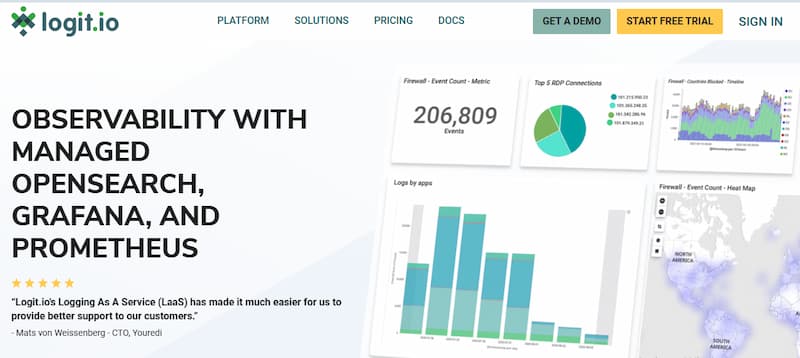
Logit.io is a managed logging, metrics, and observability platform. It gives teams hosted access to common open-source observability tools without having to deploy, scale, secure, maintain, and upgrade those tools themselves.
The platform is especially relevant for teams that like the OpenSearch, Elasticsearch, Prometheus, Grafana, Jaeger, and OpenTelemetry ecosystem but do not want to operate that stack in-house. Logit.io describes its platform as a fully customized logging, metrics, and tracing solution built on open-source software.
Logit.io can be used for log management, hosted OpenSearch, hosted ELK, hosted Grafana, hosted Prometheus, infrastructure metrics, application monitoring, distributed tracing, dashboards, alerting, and compliance-oriented logging workflows.
Who Uses Logit.io?
Logit.io is mainly used by teams that want managed open-source observability without the operational burden of self-hosting.
Common users include:
- DevOps teams
- SRE teams
- Infrastructure teams
- Security teams
- Platform engineering teams
- Cloud operations teams
- Managed service providers
- Small and mid-sized engineering teams
- Enterprises that need dedicated logging and monitoring stacks
- Teams moving away from self-managed ELK or OpenSearch
Logit.io is especially useful when a team wants log search, dashboards, metrics, traces, and alerts in one managed service while still using familiar open-source tools.
Supported Platforms, Integrations, and Data Sources
| Area | Logit.io support |
| Logs | Log management, hosted ELK, hosted OpenSearch, Logstash, Kibana, OpenSearch Dashboards |
| Metrics | Hosted Prometheus, managed Grafana, infrastructure metrics |
| APM and tracing | OpenTelemetry, Jaeger, Zipkin-compatible tracing, trace analytics |
| Cloud and containers | AWS, Azure, GCP, Kubernetes, containers, hybrid environments |
| Security and compliance | RBAC, SSO/SAML, 2FA, audit logs, encryption at rest, SOC 2 Type II, ISO 27001, HIPAA and GDPR claims |
Logit.io’s pricing and feature pages also mention deployment options in the USA, UK, and Europe, plus more than 100 data source integrations.
Key Features of Logit.io
Log management is Logit.io’s core feature. Teams can centralize logs from applications, servers, containers, Kubernetes, cloud platforms, and network systems. Logit.io’s managed logging page lists centralized log management with OpenSearch, real-time log analysis, visualization, parsing, alerting, hosted Logstash pipelines, RBAC, SSO, and dedicated infrastructure.
Logit.io offers managed OpenSearch and hosted ELK-style services for teams that want search, dashboards, and log analytics without maintaining the backend themselves. Its open-source-as-a-service page lists OpenSearch, Elasticsearch, Logstash, Kibana, Prometheus, Grafana, Jaeger, OpenTelemetry, and OpenSearch Dashboards as part of the managed stack.
Logit.io provides managed metrics services built around Prometheus and Grafana. The metrics pricing page describes an enterprise-grade Prometheus and Grafana stack with visualization, alerting, metric collection, dedicated infrastructure, multi-region deployment options, RBAC, SSO, and support.
Logit.io’s APM offering is based on distributed tracing. The pricing page says APM starts from $5 per million spans per month when billed annually and supports Jaeger, Zipkin, and OpenTelemetry OTLP formats.
Logit.io supports OpenTelemetry for traces and observability workflows. Its open-source-as-a-service page lists OpenTelemetry under traces, and the APM pricing page says Logit.io is compatible with OpenTelemetry OTLP formats.
Logit.io includes alerting and notification workflows. Its metrics page lists real-time alerting, Webhooks, PagerDuty, Slack, saved-search-based alerts, anomaly detection, and highly available alerting as part of the broader feature set.
Logit.io lists security and compliance features such as RBAC, SSO/SAML, 2FA, encryption at rest, audit logs, API key management, SOC 2 Type II, ISO 27001, HIPAA, GDPR, custom data residency, and multi-region data centers. Buyers in regulated sectors should still verify which controls apply to their exact plan and contract.
Logit.io Pricing in 2026
Logit.io pricing is modular. Instead of one all-in-one observability price, Logit.io prices its main products separately across logs, metrics, and APM.
The most important thing for buyers is that each product uses a different billing unit. Logs are tied to stored data volume and retention, metrics are tied to metrics per minute, and APM is tied to span volume.
| Product area | Public pricing model | Starting price |
| Logs / Log Management | Stored log volume, retention, plan tier | From $9/month |
| Metrics / Hosted Prometheus / Grafana | Metrics per minute, retention, plan tier | From $5/month |
| APM / Application Monitoring | Million spans per month | From $5 per million spans/month |
Logit.io also has a custom pricing page that gives broader pricing anchors: logs from $0.74 per GB, APM from $5 per million spans per month, and infrastructure metrics at $2.80 per 1000 DPM. However, the product-specific pages show named plans, so the safest way to explain pricing is by product area.
Logit.io Logs Pricing
Logit.io’s log management pricing page shows named plans for managed logging. These plans are based on stored log volume, retention, users, support level, and enterprise features.
| Logs plan | Starting price | Included usage / limits |
| Development | $9/month | 1 GB stored per month, 3-day retention |
| Individual | $25/month | 30 GB stored per month, 15-day retention, single user |
| Small Team | $80/month | 90 GB+ stored per month, 30+ day retention, unlimited users |
| Business | $160/month | 150 GB+ stored per month, 30+ day retention, custom GB/days, priority support |
| Custom / Enterprise | Quote-based | Custom retention, data residency, HA, enterprise support, custom deployment |
This means Logit.io logs should not be described as only “$0.74/GB.” That figure appears on the custom pricing page, but the logs page itself presents plan-based pricing starting at $9/month. For larger log volumes, buyers should expect Business or Custom / Enterprise sizing.
Logit.io Metrics Pricing
Logit.io’s metrics pricing page covers hosted Prometheus, metrics management, and hosted Grafana. The plans are based on metrics per minute, or MPM, with 18-month retention on paid plans above Development.
| Metrics plan | Starting price | Included usage / limits |
| Development | $5/month | 1,000 metrics per minute, 7-day retention |
| Individual | $12/month | 5,000 metrics per minute, 18-month retention, single user |
| Small Team | $36/month | 15,000 metrics per minute, 18-month retention, unlimited users |
| Business | $120/month | 50,000 metrics per minute, 18-month retention, $2.40 per 1000 extra MPM |
| Custom / Enterprise | Quote-based | Custom metrics volume, support, security, deployment, and scale |
There is one wording issue to handle carefully: Logit.io’s custom pricing page mentions infrastructure metrics at $2.80 per 1000 DPM, while the metrics pricing page uses MPM and lists $2.40 per 1000 extra MPM on the Business plan. So in the article, we should say metrics pricing is metrics-volume based, and buyers should confirm whether their quote is calculated using MPM, DPM, included plan volume, or extra usage.
Logit.io APM Pricing
Logit.io’s APM pricing is span-based. The custom pricing page lists Application Monitoring starting from $5 per million spans per month when billed annually. It also says APM requires Log Management.
| APM item | Public pricing detail |
| Starting price | $5 per million spans per month |
| Monthly billing | $6 per million spans/month if billed monthly |
| Requirement | Requires Log Management |
| Supported formats | Jaeger, Zipkin, OpenTelemetry OTLP |
| Main billing driver | Monthly span volume |
This is important because APM cost cannot be estimated from trace GB alone. A team needs to estimate monthly span count, sampling strategy, number of instrumented services, traffic volume, and retention needs.
Is There a Free Trial in Logit.io?
Yes. Logit.io offers a free 14-day trial and says no card is required.
During the trial, buyers should measure:
- Daily log volume
- Stored log volume
- Required retention
- Metrics per minute
- Monthly span volume
- Required region
- Dashboard and alerting needs
- High availability requirements
- Support requirements
- Whether APM requires a logging stack
How Logit.io Measures Pricing
| Product area | Main pricing unit |
| Log Management | GB, daily volume, retention, stack configuration |
| Hosted OpenSearch / ELK | GB/day, retention, deployment tier |
| APM | Million spans per month |
| Metrics / Hosted Prometheus / Grafana | Metrics volume, MPM or DPM-style billing depending on plan page |
| Complete Observability | Bundled logs, metrics, and APM |
| Enterprise | Custom deployment, region, support, security, and scale |
This makes Logit.io different from platforms that price mainly by host, user, or total telemetry GB. Logs, metrics, and APM each have different units, so teams need separate estimates for each signal.
What Does Logit.io Really Cost?
⚠️ Disclaimer
The scenarios below are directional editorial estimates, not official Logit.io quotes. Logit.io pricing can change based on stored log volume, daily ingestion, retention, metrics per minute, span volume, support level, region, high availability, billing term, bundled services, and custom enterprise terms.
Logit.io pricing should be estimated in three parts: Logs, Metrics, and APM. Logs are sold through named plans on the Logit.io logs pricing page, with Development, Individual, Small Team, Business, and Custom / Enterprise options. Metrics are priced by metrics per minute, or MPM. APM is priced by spans, starting from $5 per million spans per month when billed annually.
For comparison, the estimates below use the lower end of the planning range. This gives readers one clear Logit.io figure to compare against CubeAPM. The estimates are still directional because the public Logit.io pricing pages do not provide a simple all-in-one calculator for logs, metrics, and APM combined.
Workload Assumptions Used for Logit.io Estimates
| Team profile | Infrastructure context | Logs | Traces/APM context | Metrics context | Total telemetry |
| Small team | 10 hosts | 720 GB/month | 360 GB/month | 1 GB/month | 1.1 TB/month |
| Growing team | 50 hosts | 3,600 GB/month | 1,800 GB/month | 5 GB/month | 5.4 TB/month |
| Mid-market team | 250 hosts | 18,000 GB/month | 9,000 GB/month | 25 GB/month | 27 TB/month |
The trace/APM and metrics GB figures are included as workload context only. Logit.io does not price APM by trace GB or metrics by metric GB. APM needs a monthly span estimate, while metrics need an MPM estimate.
Pricing Assumptions Used in These Scenarios
| Component | Public Logit.io pricing signal | How it is used in the estimates |
| Logs | Logs plans start at $9/month; Business starts at $160/month for 150 GB+ stored/month; custom pricing also lists logs from $0.74/GB | Used as a log-volume planning anchor |
| Metrics | Development starts at $5/month for 1,000 MPM; Business starts at $120/month for 50,000 MPM | Estimated by likely environment size and MPM needs |
| APM | From $5 per million spans/month when billed annually | Estimated using conservative monthly span assumptions |
| Monthly billing | Logit.io notes monthly billing can be 1.2x annual pricing | Not added to keep estimates conservative |
| Bundles | Logit.io says bundles may reduce cost | Not assumed |
These assumptions intentionally use conservative lower-end figures. A real Logit.io quote may be higher if the team needs longer retention, higher availability, extra MPM, higher span volume, enterprise support, data residency, custom deployment, or monthly billing.
Scenario 1: Small Team, About 10 Hosts
Situation
A small production team runs around 10 hosts and produces about 1.1 TB/month of total telemetry. This includes about 720 GB/month of logs, 360 GB/month of traces/APM context, and 1 GB/month of metrics context.
The team needs managed logging, hosted OpenSearch or ELK, infrastructure metrics, dashboards, alerts, and basic APM or tracing. It may not need enterprise support, multi-region high availability, long retention, or custom compliance architecture.
Why Teams at This Stage Consider Logit.io
Small teams consider Logit.io because it gives them managed open-source observability without running their own ELK, OpenSearch, Prometheus, Grafana, and tracing infrastructure.
This is attractive when the team wants familiar tools, managed infrastructure, support, dashboards, and alerting without taking on the operational burden of self-hosting.
Estimated Profile
| Configuration | Detail |
| Infrastructure context | 10 hosts |
| Logs | 720 GB/month, about 24 GB/day |
| APM | Cost depends on monthly spans, not trace GB |
| Metrics | Cost depends on MPM, not metric GB |
| RUM sessions | Not used because Logit.io does not publish RUM as a standalone pricing line |
| Synthetic activity | Not used because Logit.io does not publish synthetics as a standalone pricing line |
| Likely Logit.io products | Logs, metrics, hosted Grafana, APM |
| Pricing basis | Log plan/custom sizing, MPM, monthly spans |
Estimated Monthly Cost
Disclaimer: This estimate uses public Logit.io pricing signals. It is not an official quote. The logs estimate uses Logit.io’s public plan and custom pricing anchors. The metrics and APM estimates use planning assumptions because the workload profile does not provide MPM or span counts.
| Component | Assumption | Monthly cost |
| Logs | 720 GB/month; above lower published log tiers, likely Business or Custom sizing | ~$530 |
| Metrics | Small setup, likely near lower MPM tiers | ~$40 |
| APM | Light tracing, about 10M spans/month | ~$50 |
| Estimated total | Small full-stack Logit.io setup | ~$620/month |
CubeAPM Cost Comparison
| Platform | Pricing basis | Estimated monthly cost |
| Logit.io | Logs, metrics, and APM estimate | ~$620/month |
| CubeAPM | 1.1 TB/month telemetry estimate | ~$522/month |
| Estimated savings with CubeAPM | Difference vs Logit.io | ~$98/month |
| Percentage savings | Based on Logit.io estimate | ~16% lower |
What This Scenario Shows
For a small team, Logit.io can be competitive if the team mainly wants managed OpenSearch, ELK, Prometheus, Grafana, and light tracing. However, the published $9, $25, and $80 log plans are not a good fit for 720 GB/month unless retention and stored volume are limited.
The safer buying approach is to estimate log volume and retention first, then add metrics MPM and monthly APM spans separately. That gives a more realistic picture than looking only at the lowest public plan price.
Scenario 2: Growing Team, About 50 Hosts
Situation
A growing SaaS or platform team runs around 50 hosts and produces about 5.4 TB/month of total telemetry. This includes about 3,600 GB/month of logs, 1,800 GB/month of traces/APM context, and 5 GB/month of metrics context.
The team likely needs managed logging, dashboards, infrastructure metrics, APM, tracing, alerting, and operational visibility across multiple services or environments.
Why Teams at This Stage Consider Logit.io
At this stage, teams often consider Logit.io because self-managed ELK, OpenSearch, Prometheus, and Grafana can become operationally expensive.
Logit.io gives them managed infrastructure, dashboards, integrations, alerting, support, and open-source-compatible tooling without requiring a dedicated internal team to operate the full stack.
Estimated Profile
| Configuration | Detail |
| Infrastructure context | 50 hosts |
| Logs | 3,600 GB/month, about 120 GB/day |
| APM | Cost depends on monthly spans, not trace GB |
| Metrics | Cost depends on MPM, not metric GB |
| RUM sessions | Not used because Logit.io does not publish RUM as a standalone pricing line |
| Synthetic activity | Not used because Logit.io does not publish synthetics as a standalone pricing line |
| Likely Logit.io products | Logs, metrics, hosted Grafana, APM |
| Pricing basis | Custom log sizing, MPM, monthly spans |
Estimated Monthly Cost
Disclaimer: This estimate uses public Logit.io pricing signals and editorial planning assumptions. Actual cost may change based on retention, stored volume, custom GB/days, region, monthly billing uplift, support, high availability, and bundled discounts.
| Component | Assumption | Monthly cost |
| Logs | 3,600 GB/month; custom-sized log deployment | ~$2,660 |
| Metrics | Growing setup, likely Business tier or extra MPM | ~$120 |
| APM | Moderate tracing, about 50M spans/month | ~$250 |
| Estimated total | Growing full-stack Logit.io setup | ~$3,000/month |
CubeAPM Cost Comparison
| Platform | Pricing basis | Estimated monthly cost |
| Logit.io | Logs, metrics, and APM estimate | ~$3,000/month |
| CubeAPM | 5.4 TB/month telemetry estimate | ~$919/month |
| Estimated savings with CubeAPM | Difference vs Logit.io | ~$2,081/month |
| Percentage savings | Based on Logit.io estimate | ~69% lower |
What This Scenario Shows
For a growing team, Logit.io cost is mostly driven by logs. At 3,600 GB/month of logs, buyers should expect Business or Custom pricing rather than relying on the lower published log plans.
Logit.io may still be attractive if the team specifically values managed OpenSearch, hosted ELK, hosted Grafana, hosted Prometheus, support, and open-source-compatible observability infrastructure.
Scenario 3: Mid-Market Team, About 250 Hosts
Situation
A mid-market team runs around 250 hosts and produces about 27 TB/month of total telemetry. This includes about 18,000 GB/month of logs, 9,000 GB/month of traces/APM context, and 25 GB/month of metrics context.
This environment likely includes multiple applications, Kubernetes clusters, databases, APIs, internal tools, production services, security logs, and customer-facing workloads.
Why Teams at This Stage Consider Logit.io
At this scale, teams consider Logit.io when they want managed open-source observability without operating their own high-volume OpenSearch, ELK, Prometheus, Grafana, and tracing infrastructure.
The value comes from managed operations, high availability options, security controls, data residency options, dashboarding, log analysis, and support. However, large log volumes can make the bill significant.
Estimated Profile
| Configuration | Detail |
| Infrastructure context | 250 hosts |
| Logs | 18,000 GB/month, about 600 GB/day |
| APM | Cost depends on monthly spans, not trace GB |
| Metrics | Cost depends on MPM, not metric GB |
| RUM sessions | Not used because Logit.io does not publish RUM as a standalone pricing line |
| Synthetic activity | Not used because Logit.io does not publish synthetics as a standalone pricing line |
| Likely Logit.io products | Logs, metrics, hosted Grafana, APM, enterprise support |
| Pricing basis | Custom / Enterprise log sizing, MPM, monthly spans |
Estimated Monthly Cost
Disclaimer: This estimate is editorial and not an official Logit.io quote. At this scale, buyers should request a custom quote because retention, span volume, metrics volume, high availability, support, security controls, data residency, and regional deployment can materially change the final price.
| Component | Assumption | Monthly cost |
| Logs | 18,000 GB/month; custom / enterprise log deployment | ~$13,300 |
| Metrics | Larger setup, likely Business plus extra MPM or Enterprise | ~$600 |
| APM | Higher tracing, about 250M spans/month | ~$1,250 |
| Estimated total | Mid-market Logit.io setup | ~$15,000/month |
CubeAPM Cost Comparison
| Platform | Pricing basis | Estimated monthly cost |
| Logit.io | Logs, metrics, and APM estimate | ~$15,000/month |
| CubeAPM | 27 TB/month telemetry estimate | ~$4,594/month |
| Estimated savings with CubeAPM | Difference vs Logit.io | ~$10,406/month |
| Percentage savings | Based on Logit.io estimate | ~69% lower |
What This Scenario Shows
At mid-market scale, Logit.io’s biggest cost driver is log volume. A team sending around 600 GB/day of logs should model stored volume, retention, filtering, sampling, archiving, and support requirements before committing.
Logit.io can still be a strong fit if the team wants managed OpenSearch, hosted ELK, hosted Grafana, hosted Prometheus, APM, OpenTelemetry support, and dedicated managed infrastructure. CubeAPM may be more cost-effective if the buyer wants a simpler per-GB full-stack observability model.
Summary: Logit.io vs CubeAPM Estimated Monthly Cost
Disclaimer: These are directional planning estimates, not official quotes. Logit.io’s final pricing can change based on log volume, retention, span count, metrics volume, region, annual or monthly billing, bundled discounts, support tier, and custom enterprise terms. For comparison, this table uses the lower end of the Logit.io estimated cost range.
| Team profile | Logit.io estimated monthly cost | CubeAPM estimated monthly cost | Estimated monthly savings with CubeAPM | Percentage savings |
| Small team | ~$620/month | ~$522/month | ~$98/month | ~16% lower |
| Growing team | ~$3,000/month | ~$919/month | ~$2,081/month | ~69% lower |
| Mid-market team | ~$15,000/month | ~$4,594/month | ~$10,406/month | ~69% lower |
What This Cost Comparison Shows
Logit.io is attractive for teams that want managed open-source observability based on OpenSearch, ELK, Grafana, Prometheus, Jaeger, and OpenTelemetry. Its pricing is transparent at the product level, but the final bill depends heavily on how logs, metrics, and APM are configured.
For the workload assumptions used here, log volume is the largest cost driver. Metrics and APM add cost, but they need different inputs: MPM for metrics and monthly spans for APM. That is why the estimates use conservative span and metrics assumptions instead of converting trace GB or metric GB directly into price.
CubeAPM is easier to estimate from the provided workload assumptions because the workload maps directly to its per-GB pricing. Logit.io is better for teams that specifically want hosted OpenSearch, hosted ELK, hosted Grafana, hosted Prometheus, and managed open-source observability infrastructure.
What Drives Logit.io Costs?
Log volume is the main cost driver in most Logit.io deployments. Public pricing starts from $0.74 per GB, with plans starting at $56/month for 2 GB/day on the custom pricing page.
Retention affects how much data is stored and how large the stack needs to be. Logit.io’s hosted ELK pricing notes mention a starting point of 2 GB/day and 3 days retention, while the logging plan page shows higher plan tiers with longer retention.
Logit.io states that monthly billing can be 1.2x the annual price. Buyers should confirm whether quoted prices are annual-rate monthly equivalents or true month-to-month prices.
APM is priced by million spans per month, not by host or trace GB. Teams using OpenTelemetry, Jaeger, or Zipkin-style tracing should estimate span volume before enabling full tracing across every service.
Metrics pricing needs extra care. Logit.io’s metrics plan page lists MPM-based plans, while the custom pricing page uses “$2.80 per 1000 DPM” wording and gives an example based on hosts ingesting metrics per minute. Buyers should confirm the exact billing unit with Logit.io.
Logit.io says customers can save up to 30% when bundling multiple products. Buyers using logs, metrics, and APM together should ask for bundle pricing instead of pricing each service separately.
Logit.io User Reviews
Logit.io has a limited public review footprint compared with larger observability vendors. Capterra lists Logit.io at 5.0/5 based on 1 review, while G2 lists logit.io at 3.5/5 based on 1 review and explicitly says there are not enough reviews to provide buying insight.
| Review source | Public rating | Review count | Note |
| Capterra | 5.0/5 | 1 review | Positive, but very limited sample |
| G2 | 3.5/5 | 1 review | Not enough reviews for buying insight |
| GetApp | 5.0/5 | 1 review | Same small-sample issue |
| Gartner Peer Insights | Not verified for Logit.io | Not used | Search results surfaced Logility, not Logit.io |
| Overall takeaway | Limited | Limited | Trial testing matters more than review averages |
Because review volume is low, buyers should treat public review ratings cautiously. A 5.0 rating from one review is positive, but it is not the same as hundreds of verified reviews.
What Users Like
- Managed ELK/OpenSearch reduces the burden of running a custom ELK setup.
- Logging, monitoring, and dashboards are described as useful in the available G2 review.
- Capterra describes Logit.io as a full-service log management and data analysis platform with monitoring, alerting, metrics, and notifications.
- The open-source ecosystem is a major strength for teams already familiar with OpenSearch, Elasticsearch, Kibana, Grafana, Prometheus, Jaeger, and OpenTelemetry.
- Modular pricing can help teams buy logs, metrics, and APM separately instead of committing to a large all-in-one platform.
The available G2 review specifically praises ELK as a service and says logging, monitoring, and dashboards are handled easily.
What Users Criticize
⚠️ Disclaimer
These points reflect public review themes and buyer considerations, not universal platform limitations.
- Review volume is very small, so buyers should not rely heavily on public ratings.
- One G2 reviewer reported delays in CPU and memory alerts.
- High log volume can increase cost quickly because logs are priced around GB and retention.
- APM requires span planning because pricing is span-based.
- Metrics estimation can be confusing because Logit.io’s pages use MPM plan language and DPM wording in different places.
Logit.io Alternatives: How It Compares to Competitors
Logit.io vs CubeAPM
Logit.io is a managed open-source observability platform built around OpenSearch, ELK, Prometheus, Grafana, Jaeger, and OpenTelemetry. CubeAPM is a self-hosted, vendor-managed observability platform with per-GB pricing and full-stack observability features. CubeAPM’s pricing page lists $0.15/GB ingestion and includes APM, distributed tracing, logs, infrastructure monitoring, RUM, synthetics, SLOs, RBAC, SSO, MFA, and audit logs.
| Category | Logit.io | CubeAPM |
| Best for | Managed OpenSearch, ELK, Grafana, Prometheus | Full-stack observability with predictable per-GB pricing |
| Pricing model | Modular by logs, metrics, spans | $0.15/GB ingestion |
| Deployment | Managed SaaS / dedicated stacks | Self-hosted, vendor-managed |
| Open-source alignment | Strong | OpenTelemetry-native |
| Best buyer | Teams wanting managed open-source tools | Teams wanting cost control and data control |
Choose Logit.io if your team wants managed OpenSearch, ELK, Grafana, and Prometheus. Choose CubeAPM if your team wants simpler per-GB pricing across logs, traces, metrics, APM, RUM, synthetics, and dashboards.
Logit.io vs Logz.io
Logz.io is one of the closest alternatives because it also focuses on open-source-based observability. Logz.io positions itself around logs, metrics, traces, and AI-powered observability workflows.
| Category | Logit.io | Logz.io |
| Best for | Managed OpenSearch, ELK, Grafana, Prometheus | Open-source-based observability and AI workflows |
| Pricing model | Logs, metrics, spans | Consumption-based telemetry budget |
| Open-source alignment | Strong | Strong |
| Review footprint | Smaller | Larger than Logit.io |
| Best buyer | Teams wanting hosted stack control | Teams wanting broader SaaS observability |
Choose Logit.io if you want hosted ELK or OpenSearch with modular pricing. Choose Logz.io if you want a broader open-source-based SaaS observability platform with more mature market visibility.
Logit.io vs Datadog
Datadog is a broad SaaS observability and security platform. Its pricing is modular across products such as infrastructure monitoring, logs, APM, synthetics, and other services. Datadog’s official pricing list shows infrastructure pricing by host and separate product billing units.
| Category | Logit.io | Datadog |
| Best for | Managed open-source logging and metrics | Broad SaaS observability and security |
| Pricing model | Logs, metrics, spans | Modular by host, logs, APM, RUM, synthetics, and more |
| Logs | OpenSearch or ELK-based | Native Datadog logs |
| Review footprint | Smaller | Much larger |
| Best buyer | Teams wanting open-source tools managed | Teams wanting one broad SaaS platform |
Choose Datadog if the team wants a large proprietary SaaS ecosystem. Choose Logit.io if the team wants managed open-source observability tools and more control over stack style.
Logit.io vs New Relic
New Relic uses a data-ingest and user-based pricing model. Its official pricing page lists 100 GB/month of free data ingest and $0.40/GB beyond the free 100 GB limit for Original Data ingest under Standard and Pro.
| Category | Logit.io | New Relic |
| Best for | Managed OpenSearch, ELK, Grafana, Prometheus | Broad SaaS observability with ingest-based pricing |
| Pricing model | Modular logs, metrics, spans | Data ingest plus users |
| Open-source tooling | Stronger | Less open-source-stack focused |
| Free allowance | Free trial | 100 GB/month free ingest |
| Best buyer | Teams wanting hosted open-source stack | Teams wanting all-in-one SaaS observability |
New Relic is easier for teams that want one broad SaaS observability platform. Logit.io is better when the team specifically wants managed OpenSearch, ELK, Prometheus, and Grafana.
Logit.io vs Grafana Cloud
Grafana Cloud is strong for teams that want Grafana dashboards, Prometheus-compatible metrics, Loki logs, Tempo traces, profiles, and k6 performance testing. Grafana’s pricing page lists a Free plan and a Pro plan starting at $19/month plus usage.
| Category | Logit.io | Grafana Cloud |
| Best for | Managed OpenSearch, ELK, Prometheus, Grafana | Grafana-native observability |
| Logs | OpenSearch or ELK-based | Loki-based |
| Metrics | Hosted Prometheus | Prometheus/Mimir-based |
| Dashboards | Hosted Grafana available | Core strength |
| Best buyer | Teams wanting OpenSearch and ELK options | Teams standardized on Grafana ecosystem |
Choose Grafana Cloud if Grafana-native observability is the priority. Choose Logit.io if OpenSearch, ELK, and hosted logging are more important.
Logit.io vs Elastic Cloud
Elastic Cloud is Elastic’s official managed platform for Elasticsearch, Kibana, Observability, and Security. Elastic’s pricing page presents hosted and serverless options for search, observability, and security.
| Category | Logit.io | Elastic Cloud |
| Best for | Managed ELK and OpenSearch flexibility | Official Elastic Stack and Elastic Observability |
| Search stack | OpenSearch and ELK-style options | Elasticsearch and Kibana |
| Pricing model | GB, spans, metrics | Hosted or serverless resource/usage pricing |
| Managed service | Yes | Yes |
| Best buyer | Teams wanting hosted open-source flexibility | Teams wanting Elastic’s official platform |
Choose Elastic Cloud if the team wants the official Elastic ecosystem. Choose Logit.io if the team wants managed ELK, managed OpenSearch, and more stack flexibility.
Logit.io vs Sumo Logic
Sumo Logic is a cloud-native logs, analytics, SIEM, and observability platform. Its website emphasizes Cloud SIEM, security analytics, log analytics, Flex Licensing, and more than 450 integrations.
| Category | Logit.io | Sumo Logic |
| Best for | Managed open-source observability | Enterprise logs, analytics, SIEM, security operations |
| Pricing model | Logs, metrics, spans | Sales-led / flexible licensing |
| Security analytics | Available through logging workflows | Stronger Cloud SIEM positioning |
| Open-source tooling | Stronger | Less open-source-stack focused |
| Best buyer | Teams wanting OpenSearch or ELK | Enterprises needing SIEM and analytics scale |
Sumo Logic may be stronger for large enterprise security and analytics programs. Logit.io may be better for teams wanting managed OpenSearch, ELK, Grafana, and Prometheus.
Is Logit.io the Right Choice?
Logit.io Works Best For
Logit.io is a strong fit for teams that want ELK or OpenSearch workflows without running their own clusters.
Logit.io is useful for teams that already understand Grafana, Prometheus, OpenSearch, Kibana, Jaeger, and OpenTelemetry.
Smaller teams can benefit from managed support, dashboards, alerting, and integrations without hiring specialists to run ELK or OpenSearch.
Logit.io lets teams pay for logs, metrics, and APM separately. This can be useful when one team needs only logging while another needs metrics or tracing.
Logit.io offers deployment options in the USA, UK, and Europe, which can help teams with data residency and compliance requirements.
Logit.io May Not Be the Right Fit For
Logit.io is strongest for logs, metrics, OpenSearch, ELK, Grafana, Prometheus, and APM. Teams that need deep RUM and synthetic monitoring may prefer Datadog, New Relic, Dynatrace, or CubeAPM.
Logit.io is modular, so logs, metrics, and APM are priced differently. Teams that want one simple cost model may prefer CubeAPM or New Relic.
High log volume can increase cost quickly. Teams sending hundreds of GB per day should model pricing carefully and ask for bundle or custom pricing.
Logit.io has limited public review volume compared with larger observability vendors. Buyers should validate the platform through a trial.
Logit.io is built around open-source tools. That is a strength for many teams, but teams wanting a fully proprietary all-in-one interface may prefer Datadog, Dynatrace, or New Relic.
Conclusion
Logit.io pricing and review in 2026 should be understood through its modular managed open-source model. Logs, metrics, and APM each have different billing units, so the real bill depends on log volume, retention, metrics volume, and span count.
Public pricing starts from $0.74 per GB for logs, $5 per million APM spans per month when billed annually, and metrics plans that start at $5/month, with Business at $120/month for 50,000 MPM. The custom pricing page also uses $2.80 per 1000 DPM wording, so buyers should confirm metrics billing directly with Logit.io before purchasing.
Logit.io is best for teams that want managed OpenSearch, ELK, Grafana, Prometheus, and OpenTelemetry workflows. If the team wants simpler per-GB observability across logs, traces, metrics, APM, RUM, synthetics, and dashboards, CubeAPM may be easier to estimate. If the team wants a large proprietary SaaS ecosystem, Datadog, New Relic, Elastic Cloud, Grafana Cloud, or Sumo Logic may also be worth comparing.
Disclaimer: Pricing, packaging, retention options, plan names, support terms, regions, discounts, and product features can change. The cost examples in this article are editorial estimates based on publicly available pricing information reviewed in June 2026. Always confirm final pricing, limits, discounts, and contract terms directly with Logit.io before purchase.
FAQs
1. How much does Logit.io cost?
Logit.io public pricing starts from $0.74 per GB for log management, $5 per million APM spans per month when billed annually, and metrics plans starting at $5/month. Real cost depends on log volume, retention, spans, metrics volume, region, and support needs.
2. Does Logit.io have a free trial?
Yes. Logit.io offers a free 14-day trial and says no card is required.
3. Is Logit.io priced per host?
Not mainly. Logs are priced by GB and retention, APM is priced by spans, and metrics are priced by metrics volume. Host count matters indirectly because more hosts usually produce more logs, metrics, and spans.
4. How does Logit.io price logs?
Logit.io log management starts from $0.74 per GB. Its custom pricing page says plans start at $56/month with 2 GB per day and that monthly billing is 1.2x the annual price.
5. How does Logit.io price APM?
Logit.io APM starts from $5 per million spans per month when billed annually. The pricing page also says APM requires Log Management.
6. How does Logit.io price metrics?
Logit.io’s metrics plan page lists MPM-based plans, including $5/month for 1,000 MPM, $36/month for 15,000 MPM, and $120/month for 50,000 MPM. Its custom pricing page also uses $2.80 per 1000 DPM wording, so buyers should confirm the exact billing unit with Logit.io.
7. Does Logit.io support OpenTelemetry?
Yes. Logit.io lists OpenTelemetry as part of its traces stack, and its APM pricing page says it is compatible with OpenTelemetry OTLP formats.
8. Does Logit.io support Prometheus?
Yes. Logit.io offers hosted Prometheus and managed metrics workflows built around Prometheus and Grafana.