










Aspecto now BugSnag, is an OpenTelemetry-native distributed tracing platform for teams running microservices. It helped developers visualize traces, find bottlenecks, and understand how requests moved across distributed services.
Aspecto pricing and review matters in 2026 because Aspecto is no longer sold as a separate standalone product. SmartBear acquired Aspecto in March 2023, and its OpenTelemetry-based tracing technology now sits inside BugSnag’s distributed tracing and performance monitoring offering.
In this guide, we’ll cover where Aspecto’s technology lives today, how BugSnag prices distributed tracing, what the free and paid tiers include, what public reviews say, and which OpenTelemetry-friendly alternatives are worth comparing.
What Is Aspecto?
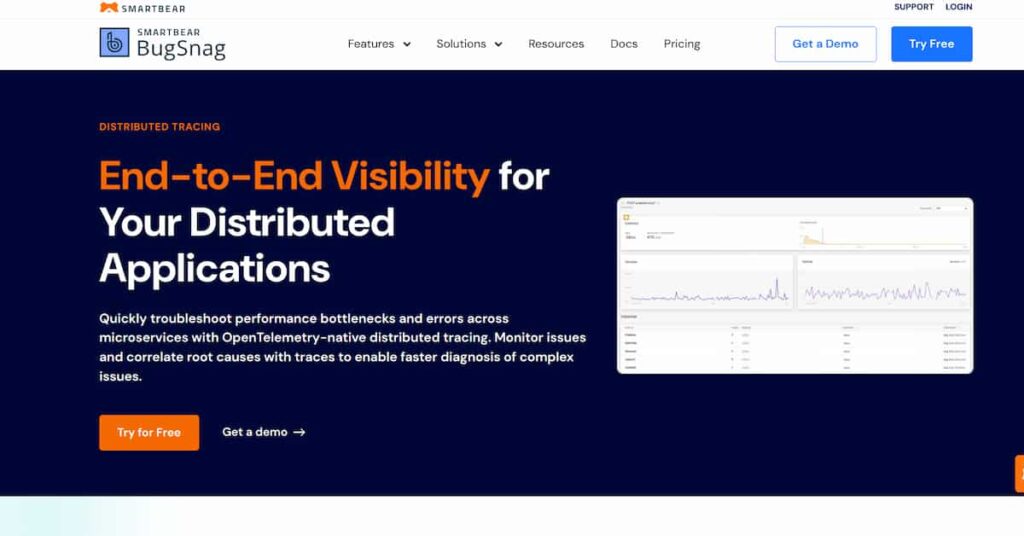
Aspecto is a distributed tracing and observability platform focused on OpenTelemetry-based visibility for microservices. SmartBear described Aspecto as an OpenTelemetry pioneer and said the acquisition would extend BugSnag into a broader OTel-compliant observability platform.
Aspecto now BugSnag helps developers visualize complex traces, optimize performance, explore microservices, and analyze staging and production environments. Those capabilities now sit under BugSnag’s distributed tracing and performance monitoring experience rather than under a separate Aspecto product name.
Aspecto was founded in 2019. SmartBear’s acquisition announcement says Aspecto had been involved in driving and defining the OpenTelemetry project and community since its founding.
Supported Languages, Integrations, and Data Sources
BugSnag’s distributed tracing is built on OpenTelemetry. Its documentation says OpenTelemetry SDKs can be used to instrument applications and send trace telemetry to BugSnag, either directly or through an OpenTelemetry Collector. BugSnag supports OTLP trace export over gRPC and HTTP.
| Area | Aspecto / BugSnag tracing support |
| Instrumentation | OpenTelemetry SDKs and instrumentation |
| Collection | Direct OTLP export or OpenTelemetry Collector |
| Trace export | OTLP over gRPC or HTTP/protobuf |
| Signals | Distributed traces inside BugSnag Performance Monitoring |
| Correlation | Error-to-trace linking and trace visualization |
A key part of Aspecto’s appeal was OpenTelemetry portability. That remains relevant because BugSnag’s tracing workflow supports OpenTelemetry instrumentation instead of forcing teams to start with a closed tracing SDK.
Key Features of Aspecto, Now Delivered Through BugSnag
Aspecto’s core capability was OpenTelemetry-based distributed tracing. BugSnag now describes distributed tracing as a way to track performance across an entire system, analyze bottlenecks, and understand how backend errors affect end-user experience.
BugSnag distributed tracing lets teams visualize request paths across distributed services. This fits the original Aspecto use case: making complex trace data easier for developers to inspect and act on.
BugSnag supports error linking, which lets teams connect errors with performance data and navigate from an error to the related distributed trace in the BugSnag dashboard.
BugSnag supports OpenTelemetry Collectors for trace management. Its documentation says collectors can help with batching, retries, filtering sensitive data, forwarding data to multiple backends, and making tail-based sampling decisions on whole traces.
Sampling is important because distributed tracing can generate high span volume. BugSnag’s documentation recommends using collectors for trace management and sampling decisions, especially when teams need more control over what gets sent and retained.
Aspecto Pricing in 2026
Aspecto does not have a separate public pricing page in 2026. Since Aspecto’s technology is now delivered through BugSnag, Aspecto pricing should be treated as BugSnag pricing for distributed tracing and performance monitoring.
BugSnag prices Error Monitoring by monthly events and Performance Monitoring by monthly spans. Its pricing page lists four plan categories: Free, Select, Preferred, and Enterprise. The Free plan includes one user, error and performance monitoring, 7.5K events per month, 1M spans per month, 50+ platforms, and 30+ third-party integrations. Select starts at $20/month, Preferred starts at $33/month, and Enterprise is quote-based.
| Plan | Public starting price | What it includes |
| Free | $0/month | 1 user, 7.5K events/month, 1M spans/month |
| Select | From $20/month | 50K to 3M monthly events, 1M to 150M monthly spans |
| Preferred | From $33/month | 100K to 3M monthly events, 1M to 300M monthly spans |
| Enterprise | Custom | Custom scale, premium support, CSM, SaaS or on-premises deployment |
Distributed tracing sits inside BugSnag Performance Monitoring, so the main pricing unit for tracing is monthly spans. Teams should estimate both event volume and span volume before comparing BugSnag with per-GB observability platforms.
Is There a Free Tier for Aspecto?
Yes, through BugSnag. BugSnag’s Free plan includes error and performance monitoring, 7.5K events per month, 1M spans per month, one user, 50+ platforms, and 30+ third-party integrations.
This makes BugSnag a practical way to evaluate the tracing capability that came from Aspecto. Teams that want a fully free self-hosted tracing backend can also compare Jaeger, which is a CNCF-graduated open-source distributed tracing project.
What Does Aspecto (BugSnag) Really Cost?
⚠️ Disclaimer
The scenarios below are directional editorial estimates, not official BugSnag quotes. Aspecto’s tracing capability is now delivered through BugSnag, which prices Error Monitoring by monthly events and Performance Monitoring by monthly spans. Final pricing depends on selected event tier, span tier, sampling strategy, retention, support, deployment needs, billing term, and contract terms.
BugSnag’s pricing model is different from full-stack observability tools that charge by host, GB, or module. For Aspecto-style tracing, the most important cost drivers are application error events and performance spans. BugSnag’s pricing page lists a Free plan with 7.5K events and 1M spans per month, Select from $20/month, Preferred from $33/month, and Enterprise as a custom plan.
For cost planning, the clearest formula is:
Monthly spans = monthly application requests × trace sampling rate × average spans per sampled trace
Error events should be modeled separately because errors can spike during bad releases, dependency failures, mobile crashes, or noisy handled exceptions.
Scenario 1: Small Team
A small engineering team runs several production services and wants Aspecto-style distributed tracing, error monitoring, and basic performance visibility. This is not a hobby workload; it is a real production setup with enough traffic and errors to outgrow the Free plan.
| Usage assumption | Estimate |
| Monthly application requests | 5M |
| Trace sampling rate | 10% |
| Average spans per sampled trace | 20 |
| Estimated monthly spans | 10M |
| Estimated monthly error events | 75K |
| Likely BugSnag fit | Select |
| Estimated monthly cost | ~$200/month |
Key takeaway: BugSnag can still be affordable for small teams, but “free” only works for light usage. Once production traffic, handled exceptions, and sampled traces increase, a realistic small-team budget is closer to the low hundreds per month.
Scenario 2: Growing Team
A growing SaaS team has more users, more services, and more backend traffic. The team needs broader trace coverage, frontend-to-backend visibility, release-stage filtering, and enough quota to avoid losing useful diagnostic data during normal production traffic.
| Usage assumption | Estimate |
| Monthly application requests | 25M |
| Trace sampling rate | 10% |
| Average spans per sampled trace | 24 |
| Estimated monthly spans | 60M |
| Estimated monthly error events | 300K |
| Likely BugSnag fit | Select or Preferred |
| Estimated monthly cost | ~$700/month |
Key takeaway: At this stage, the bill is not driven by hosts or telemetry GB. It is driven by how much trace data the team chooses to capture and how many error events the application reports. Sampling strategy becomes a real cost-control lever.
Scenario 3: Mid-Market Team
A mid-market team runs many production services across multiple environments. It needs higher trace volume, stronger segmentation, SSO, longer retention, support, and possibly procurement-level requirements that push it toward Preferred or Enterprise.
| Usage assumption | Estimate |
| Monthly application requests | 100M |
| Trace sampling rate | 10% |
| Average spans per sampled trace | 20 |
| Estimated monthly spans | 200M |
| Estimated monthly error events | 1M |
| Likely BugSnag fit | Preferred or Enterprise |
| Estimated monthly cost | ~$2,500/month |
Key takeaway: BugSnag can look inexpensive at low usage, but at mid-market scale, tracing and error volume compound. A realistic estimate should include both span tier and event tier, not just the base plan price.
Summary: Estimated BugSnag Cost by Team Size
| Team profile | Monthly requests | Monthly spans | Monthly events | Likely plan fit | Estimated monthly cost |
| Small team | 5M | 10M | 75K | Select | ~$200/month |
| Growing team | 25M | 60M | 300K | Select or Preferred | ~$700/month |
| Mid-market team | 100M | 200M | 1M | Preferred or Enterprise | ~$2,500/month |
Cost Takeaways
BugSnag’s entry pricing can look very cheap because the public paid plans start low. But that does not mean every production team will pay only the starting price. Once teams increase span volume, report more handled exceptions, need advanced filtering, require SSO, or want stronger support, the practical monthly cost rises.
For Aspecto-style tracing, the most important question is not “how many hosts do we run?” It is “how many spans and events will we send every month?” A team with fewer hosts but high request volume can pay more than a larger infrastructure footprint with aggressive sampling and cleaner error handling.
The cleanest way to control BugSnag cost is to manage sampling, reduce noisy handled exceptions, separate production from non-production environments, and review event capture rules before traffic grows. For smaller teams, BugSnag can remain affordable. For larger teams, the bill becomes a span-and-event planning exercise, and Enterprise pricing should be verified directly with SmartBear/BugSnag.
What Drives the Cost of Aspecto-Grade Observability?
For BugSnag, spans are the key unit for Performance Monitoring and distributed tracing. The larger your service count, request volume, and trace coverage, the more carefully you need to model span usage.
BugSnag prices Error Monitoring by monthly events. An event is generally tied to errors or exceptions that BugSnag captures, so high-error applications can move up pricing tiers faster.
Sampling affects both cost and visibility. BugSnag’s Collector documentation says collectors can help with tail-based sampling decisions, batching, retries, filtering sensitive data, and forwarding traces to multiple backends.
Select, Preferred, and Enterprise unlock different levels of usage and features. Enterprise is the custom tier for teams needing premium support, a dedicated CSM, automatic provisioning, sensitive data management, and SaaS or on-premises deployment.
Retention can affect total cost and procurement decisions. BugSnag’s pricing page lists different retention levels across plans, with custom retention available on Enterprise.
BugSnag’s Enterprise plan includes SaaS or on-premises deployment, premium support, and dedicated customer success. Those requirements should be confirmed directly during procurement.
Aspecto User Reviews
Independent public reviews specifically under the Aspecto brand are limited because Aspecto was acquired and folded into BugSnag. For current buying decisions, BugSnag reviews are more useful than old standalone Aspecto references.
| Review source | Rating shown publicly | Review count shown publicly |
| G2 | 4.3/5 | 38 reviews |
| Gartner Peer Insights | 5.0/5 | 1 rating |
| Capterra / GetApp network | 4.7/5 | 16 reviews |
| TrustRadius | 8.0/10 | 5 to 7 reviews/ratings shown across comparison pages |
What Users Like
Users commonly praise BugSnag for real-time error tracking, clear dashboards, and helping developers identify issues quickly. G2’s public review summary says users consistently praise the intuitive dashboard and real-time error tracking.
Capterra reviews highlight simple integration, useful platform details, and helpful integrations such as Slack and email. This matches BugSnag’s developer-focused positioning.
BugSnag’s product capabilities include stack traces, breadcrumbs, error grouping, release-stage tracking, and end-to-end diagnostics, which are useful for debugging production errors.
What Users Should Be Aware Of
⚠️ Disclaimer
These points reflect public product and review signals, not universal limitations of BugSnag or Aspecto’s technology.
Some G2 users feel BugSnag lacks certain advanced capabilities compared to broader observability platforms, particularly for teams looking beyond error tracking and application stability.
A few G2 reviewers mention that bug management workflows could be more flexible, especially when organizing and tracking large numbers of issues.
Some users report that parts of the dashboard could be improved, particularly when navigating large volumes of errors or performance data.
As projects grow, some reviewers say configuration and managing larger deployments can become more complex.
A small number of users mention that the interface can feel cluttered when many error groups or alerts accumulate.
Aspecto Alternatives: How It Compares to Competitors
If you are evaluating Aspecto today, start by comparing BugSnag’s distributed tracing against other OpenTelemetry-friendly observability tools.
Aspecto via BugSnag vs CubeAPM
CubeAPM is worth comparing if the main attraction of Aspecto was OpenTelemetry-native observability and cost control. CubeAPM is a self-hosted, vendor-managed observability platform that runs in the customer’s infrastructure, while BugSnag is primarily SaaS with an Enterprise option for on-premises deployment. CubeAPM publicly lists $0.15/GB ingestion.
| Category | Aspecto via BugSnag | CubeAPM |
| Deployment | SaaS; on-premises on Enterprise | Self-hosted, vendor-managed |
| Pricing model | Events and spans | $0.15/GB ingestion |
| Primary strength | Error monitoring plus tracing | Full-stack MELT observability |
| Data control | Vendor SaaS by default | Runs in customer environment |
| Best for | Teams focused on app errors and tracing | Teams wanting predictable full-stack observability pricing |
Aspecto via BugSnag vs Grafana Cloud
Grafana Cloud is a strong alternative for teams that want open standards, dashboards, and the Grafana LGTM ecosystem. Grafana’s OpenTelemetry documentation describes OTel as a vendor-neutral framework for collecting metrics, logs, traces, and profiles while preserving portability across observability platforms.
| Category | Aspecto via BugSnag | Grafana Cloud |
| Core focus | Error monitoring and distributed tracing | Metrics, logs, traces, dashboards |
| Open standards | OpenTelemetry tracing | OpenTelemetry, Prometheus, Loki, Tempo |
| Pricing model | Events and spans | Free tier plus usage-based pricing |
| Deployment | SaaS; Enterprise on-prem option | Managed cloud and Enterprise options |
| Best for | App stability plus traces | Open observability stack and dashboards |
Aspecto via BugSnag vs Datadog
Datadog is a broad SaaS observability platform covering infrastructure monitoring, APM, logs, RUM, synthetics, and related products. Datadog’s APM billing documentation lists APM at $31 per underlying APM host per month, with included indexed and ingested span allowances.
| Category | Aspecto via BugSnag | Datadog |
| Core focus | Error monitoring and tracing | Broad SaaS observability suite |
| Pricing model | Events and spans | Per-host, per-module, and usage-based |
| Logs | Not a full log platform | Native log management |
| Trace model | OpenTelemetry-based BugSnag tracing | Datadog APM with span allowances |
| Best for | Developers focused on app stability | Enterprises wanting broad SaaS observability |
Aspecto via BugSnag vs New Relic
New Relic uses a data-ingest and user-based pricing model. New Relic’s pricing page says its free tier includes 100 GB/month of data ingest, and its billing documentation confirms that data is billed by GB ingested across data types.
| Category | Aspecto via BugSnag | New Relic |
| Pricing model | Events and spans | Data ingest plus users |
| Free entry | 7.5K events and 1M spans | 100 GB/month free ingest |
| Core focus | Error monitoring and tracing | Full-stack observability |
| Billing unit | Events and spans | GB ingested and user seats |
| Best for | Teams focused on app stability | Teams wanting ingest-based SaaS observability |
Is Aspecto via BugSnag the Right Choice for You?
Choose Aspecto via BugSnag If
Choose Aspecto via BugSnag if you want tracing plus error monitoring in one developer-focused product. BugSnag’s distributed tracing is built on OpenTelemetry and helps teams connect frontend errors with backend traces.
It is also a good fit if you are comfortable sizing usage by spans and events. That model can work well when your main need is application stability and distributed tracing, not full MELT ingestion.
Choose CubeAPM If
Choose CubeAPM if you want OpenTelemetry-native full-stack observability, data control, and predictable per-GB pricing. CubeAPM runs in the customer’s environment and publicly lists $0.15/GB ingestion.
It is a better fit when the team wants metrics, events, logs, traces, infrastructure monitoring, RUM, synthetics, and APM under one pricing model.
Choose Grafana Cloud If
Choose Grafana Cloud if you want dashboards, open standards, and the Grafana ecosystem. Grafana is especially strong for teams already using Prometheus, Loki, Tempo, or OpenTelemetry.
Choose Datadog If
Choose Datadog if you want a large managed SaaS observability suite and are comfortable with modular pricing. Datadog is stronger when teams need many monitoring products from one vendor.
Choose New Relic If
Choose New Relic if you prefer ingest-based SaaS pricing with a 100 GB/month free data ingest allowance. New Relic can be easier to start with when teams want broad observability and a free data tier.
Choose Jaeger or Uptrace If
Choose Jaeger or Uptrace if you want free or low-cost OpenTelemetry-friendly tracing and have the engineering capacity to operate or manage more of the backend yourself.
Conclusion
Aspecto built its reputation around OpenTelemetry-native distributed tracing for microservices. In 2026, the important buying reality is that Aspecto is no longer a standalone product. SmartBear acquired Aspecto in March 2023 and integrated its OpenTelemetry-based tracing direction into BugSnag.
For pricing, buyers should evaluate BugSnag rather than search for a separate Aspecto rate card. BugSnag prices error monitoring by monthly events and performance monitoring by monthly spans. Its Free plan includes 7.5K events and 1M spans per month, while Select starts at $20/month, Preferred starts at $33/month, and Enterprise is custom.
OpenTelemetry remains highly relevant. CNCF announced OpenTelemetry’s graduation on May 21, 2026, describing it as a vendor-neutral open-source observability framework for standardizing telemetry collection, processing, and export across metrics, logs, and traces.
The right choice depends on scope. BugSnag is a strong fit for teams that want application stability, errors, performance, and tracing. CubeAPM is stronger if the buyer wants full-stack OTel-native observability with predictable per-GB pricing and data control. Grafana Cloud, Datadog, New Relic, Jaeger, and Uptrace are also credible alternatives depending on budget, deployment preference, and operational maturity.
Disclaimer
Pricing, packaging, entitlements, support terms, data retention, and product availability can change. This article is based on publicly available information verified in June 2026. Aspecto’s tracing capability is now delivered through BugSnag, and BugSnag pricing depends on events, spans, and plan tier. Always confirm final pricing and contract terms directly with each vendor before purchase.
FAQs
1. Is Aspecto still available in 2026?
Aspecto is not available as a separate standalone product in the same way it was before acquisition. SmartBear acquired Aspecto in March 2023, and Aspecto’s OpenTelemetry-based tracing direction is now part of BugSnag’s observability offering.
2. How much does Aspecto cost?
Aspecto does not publish a separate 2026 rate card. Its tracing capability is now evaluated through BugSnag, where pricing is based on monthly events for Error Monitoring and monthly spans for Performance Monitoring.
3. Does BugSnag have a free tier for Aspecto-style tracing?
Yes. BugSnag Free includes one user, 7.5K events per month, 1M spans per month, error and performance monitoring, 50+ platforms, and 30+ third-party integrations.
4. Who acquired Aspecto?
SmartBear acquired Aspecto on March 21, 2023. SmartBear said the acquisition would combine Aspecto’s OpenTelemetry-based distributed tracing with BugSnag’s error and performance monitoring.
5. Does Aspecto support OpenTelemetry?
Yes. Aspecto was built around OpenTelemetry, and BugSnag’s current distributed tracing is also built on OpenTelemetry. BugSnag documentation says OpenTelemetry SDKs can be used to instrument applications and export traces to BugSnag.
6. What are the best Aspecto alternatives?
The best alternatives depend on scope. BugSnag is the current home of Aspecto-style tracing. CubeAPM is a strong OTel-native full-stack alternative. Grafana Cloud is strong for open observability and dashboards. Datadog is strong for broad SaaS observability. New Relic is strong for ingest-based SaaS observability. Jaeger is strong for open-source self-hosted tracing.
7. Is CubeAPM a good Aspecto alternative?
CubeAPM is worth evaluating if you liked Aspecto’s OpenTelemetry-native direction but need broader full-stack observability, data control, and predictable per-GB pricing. CubeAPM publicly lists $0.15/GB ingestion and runs in the customer’s infrastructure.