








Runtime security monitoring has shifted from optional to mandatory as cloud native architectures become standard. According to the CNCF’s 2024 Annual Survey, 96% of organizations now use containers in production, and 71% use Kubernetes to orchestrate them. That density and ephemeral nature create an expanded attack surface where traditional perimeter security fails. A compromised container can escalate privileges, escape to the host, or pivot laterally across microservices before static security tools even detect it.
Runtime security tools observe containers, processes, and system calls in real time to detect suspicious behavior, policy violations, and exploits as they happen. But choosing the right tool requires understanding three dimensions: detection method (syscall monitoring, eBPF, behavioral analysis), deployment model (agent-based, agentless, kernel module), and total cost of ownership (licensing, infrastructure overhead, operational complexity).
This guide compares 10 runtime security monitoring tools across open source projects, enterprise platforms, and unified observability solutions. Each is assessed on detection depth, Kubernetes compatibility, pricing transparency, and ease of deployment. If you are also evaluating broader security monitoring tools for your infrastructure, that guide covers network security, SIEM platforms, and vulnerability scanners alongside runtime-focused options.
Quick Comparison: 10 Runtime Security Tools at a Glance
| Tool | Best For | Pricing Model | eBPF Native? | Kubernetes Ready? |
|---|---|---|---|---|
| Falco | Open source teams, policy driven detection | Free (open source) | ✓ Yes | ✓ Native |
| Sysdig Secure | Enterprise container security, compliance automation | $25/host/month+ | ✓ Yes | ✓ Native |
| Aqua Security | Full lifecycle container security, image scanning + runtime | Custom pricing | ✓ Yes | ✓ Native |
| CubeAPM | Teams needing runtime monitoring + APM + infra in one platform | $0.2/GB pricing | ✓ Yes | ✓ Native |
| Wiz | Cloud security posture + runtime threat detection | Custom pricing | ✓ Yes | ✓ Multi cloud |
| Prisma Cloud | Multi cloud security, DevSecOps automation | $300/workload/year+ | ✓ Yes | ✓ Native |
| Lacework | Anomaly detection, automated baseline building | $0.10/resource hour | ✓ Yes | ✓ Native |
| Tetragon | eBPF based, kernel level visibility, CNCF project | Free (open source) | ✓ Native | ✓ Native |
| KubeArmor | Kubernetes native, least privilege enforcement | Free (open source) | ✓ Yes | ✓ Native |
| Tracee | Open source runtime security, event tracing | Free (open source) | ✓ Native | ✓ Yes |
Why Runtime Security Monitoring Matters in 2026
Traditional security tools scan container images before deployment and check configurations at rest. Runtime security monitors what actually happens when containers execute: which processes spawn, which files are accessed, which network connections open, and which syscalls are made. That visibility catches three categories of threats that pre deployment scanning misses entirely.
Zero day exploits and novel attack techniques: A vulnerability disclosed today may already be exploited in production containers running last month’s image. Runtime monitoring detects the exploit behavior even when the CVE is unknown.
Configuration drift and policy violations: A container deployed with correct settings can have its configuration altered at runtime through privilege escalation, container escape, or compromised init processes. Runtime tools detect deviation from policy.
Lateral movement and post compromise activity: After initial compromise, attackers move laterally across services, exfiltrate data, or establish persistence. Runtime security surfaces suspicious network activity, unexpected process execution, and anomalous syscall patterns that indicate post breach behavior.
1. Falco
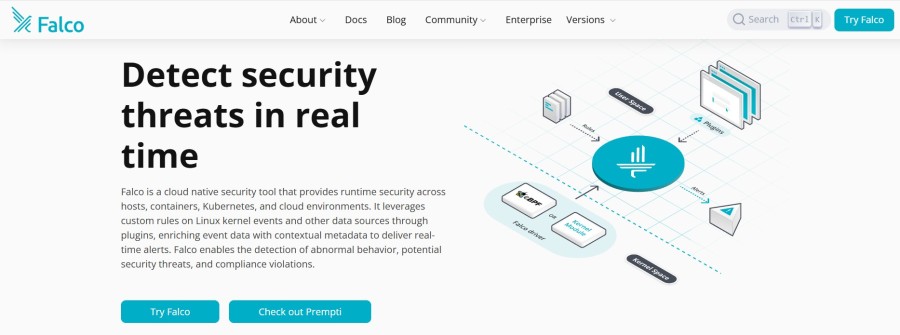
Falco is an open source runtime security project under the CNCF. It monitors Linux syscalls, Kubernetes audit logs, and cloud platform events to detect suspicious behavior in real time. Falco uses kernel level instrumentation via eBPF or a kernel module to capture system activity without modifying application code.
Key Features:
- Real time syscall monitoring with eBPF or kernel module drivers
- Pre built detection rules covering container escapes, privilege escalation, and suspicious file access
- Kubernetes audit log integration for control plane visibility
- Extensible rule engine using YAML policy definitions
- Native support for Prometheus metrics export and Slack/webhook alerting
Pricing: Free and open source. Infrastructure and operational costs apply if self hosting.
Pros:
- Fully open source with strong community and vendor neutral governance
- Lightweight eBPF based collection with minimal performance overhead
- Rich rule library covering MITRE ATT&CK techniques for containers
- Integrates with Kubernetes RBAC and pod security standards
Cons:
- Requires operational expertise to deploy, tune rules, and manage false positives
- No built in incident response or automated remediation
- Alert fatigue common without careful rule tuning and contextual enrichment
Best for: Teams that want open source runtime security, have Kubernetes expertise, and can invest in rule tuning and alert integration.
2. Sysdig Secure
Sysdig Secure is an enterprise runtime security platform built on Falco’s open source detection engine. It adds unified visibility across containers, Kubernetes, and cloud services with automated compliance reporting, image scanning, and incident response workflows.
Key Features:
- eBPF based runtime threat detection with Falco rules plus proprietary detections
- Unified dashboards for runtime threats, vulnerabilities, and compliance posture
- Image scanning integrated with runtime context for exploitability analysis
- Automated compliance reporting for PCI DSS, NIST, SOC 2, and CIS benchmarks
- Incident response playbooks with automated container quarantine and forensic capture
Pricing: Starts at $25 per host per month. Volume discounts available. Contact sales for custom pricing.
Pros:
- Managed Falco with enterprise support and turnkey deployment
- Deep Kubernetes visibility including service mesh and Istio integration
- Strong compliance automation reduces manual audit prep work
- Single platform for vulnerability management, runtime security, and posture management
Cons:
- Per host pricing can scale expensively in large Kubernetes clusters
- Some features require Sysdig’s proprietary agent rather than open Falco
- Complex UI with steep learning curve for teams new to runtime security
Best for: Enterprises needing compliance automation, deep Kubernetes security, and managed runtime detection without building internal tooling.
3. Aqua Security
Aqua Security provides full lifecycle container security from image scanning through runtime protection. Its runtime component focuses on drift prevention, behavioral monitoring, and automated policy enforcement across containers and serverless workloads.
Key Features:
- Runtime drift prevention blocking unauthorized processes, file changes, and network activity
- Behavioral profiling with machine learning baselines for normal container activity
- Secrets detection and data loss prevention at runtime
- Integration with CI/CD pipelines for shift left security
- Multi cloud support for AWS ECS, EKS, Azure AKS, Google GKE, and on premises Kubernetes
Pricing: Custom pricing based on workload count and deployment model. Typically starts around $30 per workload per month for enterprise plans.
Pros:
- Strong drift prevention reduces attack surface by blocking unauthorized runtime changes
- Unified platform covering image scanning, runtime security, and network policy
- Good cloud native architecture support including AWS Fargate and Lambda
- Active threat intelligence integration for emerging container threats
Cons:
- Pricing opacity requires sales engagement for accurate cost estimates
- Some users report performance overhead on high density Kubernetes nodes
- Complex policy configuration can lead to operational friction during initial deployment
Best for: Enterprises running containers across multiple clouds, needing both image scanning and runtime protection, with budget for commercial tooling.
4. CubeAPM
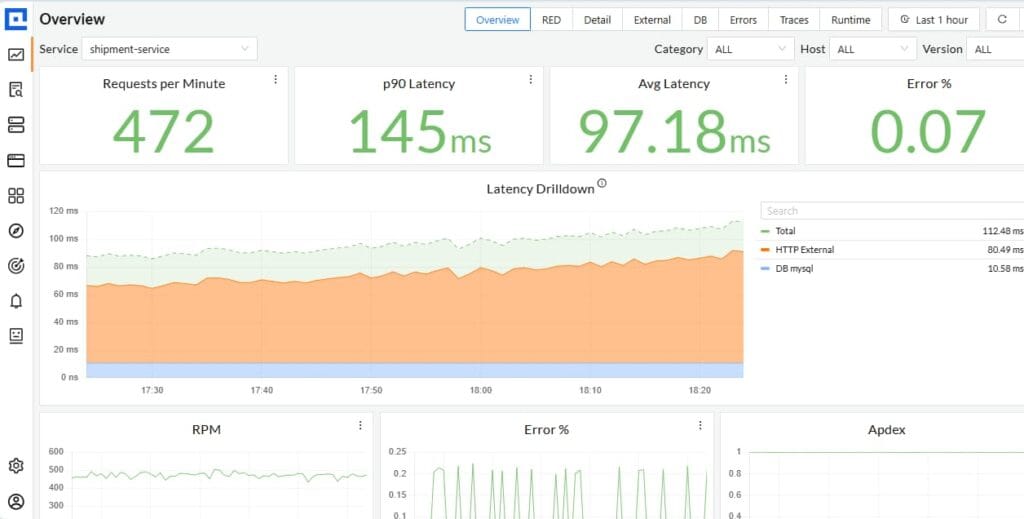
CubeAPM is a unified observability platform that combines runtime security monitoring with APM, infrastructure monitoring, and log management in a single self-hosted deployment. It monitors container behavior, process execution, and Kubernetes events alongside application traces and infrastructure metrics.
Key Features:
- eBPF-based runtime monitoring tracking process spawns, file access, and network connections
- Integrated correlation between runtime events and APM traces for root cause analysis
- Kubernetes native monitoring at cluster, node, and pod levels
- Self-hosted deployment keeps security telemetry inside your VPC with no egress costs
- Unified alerting across runtime events, application errors, and infrastructure anomalies
Pricing: $0.2/GB flat rate for all ingested data (runtime events, traces, logs, metrics). No per host or per user fees. Unlimited retention included.
Pros:
- Single platform eliminates the need for separate APM and runtime security tools
- Predictable pricing with no surprise scaling costs as container count grows
- Self hosted model ensures data sovereignty and eliminates public cloud egress fees
- Fast deployment with native Kubernetes operator and Helm chart support
Cons:
- Requires infrastructure management for self hosted deployment
- Runtime security rule library less mature than specialized tools like Falco or Sysdig
- Smaller community compared to established open source projects
Best for: Teams needing unified runtime monitoring plus full stack observability, prioritizing data control and cost predictability over specialized security features.
5. Wiz
Wiz is a cloud security platform that combines cloud security posture management (CSPM) with runtime threat detection. It scans cloud workloads agentlessly to identify vulnerabilities, misconfigurations, and active threats across AWS, Azure, and Google Cloud.
Key Features:
- Agentless scanning of VMs, containers, and serverless functions
- Runtime threat detection using cloud provider APIs and kernel telemetry
- Vulnerability prioritization based on exploitability and lateral movement risk
- Kubernetes security posture analysis covering RBAC, network policies, and secrets
- Unified graph view showing relationships between vulnerabilities, identities, and data stores
Pricing: Custom pricing based on cloud resource count and feature mix. Enterprise only.
Pros:
- Agentless deployment reduces operational overhead
- Strong cloud native coverage including AWS ECS, Lambda, and Azure Container Instances
- Excellent vulnerability prioritization reduces noise from unexploitable CVEs
- Unified visibility across cloud posture and runtime threats
Cons:
- No pricing transparency requires sales engagement
- Agentless model may have visibility gaps compared to eBPF based tools
- Primarily cloud focused with limited support for on premises Kubernetes
Best for: Cloud first enterprises needing unified posture management and runtime threat detection without deploying agents.
6. Prisma Cloud
Prisma Cloud (formerly Twistlock) is Palo Alto Networks’ cloud native security platform. It provides runtime defense, vulnerability management, and compliance automation across containers, Kubernetes, and serverless workloads.
Key Features:
- Runtime defense with automated policy enforcement and anomaly detection
- Image scanning with CI/CD integration and registry monitoring
- Compliance automation for CIS benchmarks, PCI DSS, and GDPR
- Cloud workload protection for VMs, containers, and serverless functions
- Network segmentation with microsegmentation and zero trust policies
Pricing: Starts around $300 per workload per year for enterprise plans. Volume discounts available.
Pros:
- Comprehensive platform covering runtime, vulnerability, and compliance
- Strong Kubernetes support including service mesh integration
- Automated remediation capabilities reduce manual incident response work
- Good integration with Palo Alto’s broader security ecosystem
Cons:
- Expensive at scale especially for large Kubernetes clusters
- Complex UI with steep learning curve
- Some features require proprietary agents rather than standard instrumentation
Best for: Large enterprises with existing Palo Alto deployments, needing full lifecycle container security and compliance automation.
7. Lacework
Lacework is a cloud security platform using machine learning to automate threat detection, anomaly analysis, and compliance monitoring. Its runtime component builds behavioral baselines for workloads and alerts on deviations.
Key Features:
- Automated behavioral baselining using machine learning
- Anomaly detection for process execution, network activity, and file access
- Agentless and agent based deployment options
- Kubernetes security monitoring with control plane audit log analysis
- Integration with CI/CD pipelines and cloud provider security services
Pricing: Usage based pricing around $0.10 per resource hour. Contact sales for accurate estimates.
Pros:
- Automated baseline building reduces manual policy configuration
- Good anomaly detection with low false positive rates after initial learning period
- Unified platform for cloud posture and runtime security
- Strong AWS integration including CloudTrail and VPC Flow Logs analysis
Cons:
- Machine learning baseline requires 7 to 14 days to stabilize
- Pricing can be unpredictable for workloads with variable resource usage
- Limited support for on premises Kubernetes clusters
Best for: Cloud native teams wanting automated threat detection without extensive rule tuning, willing to invest in a learning period.
8. Tetragon
Tetragon is a CNCF project providing eBPF based security observability and runtime enforcement. It hooks directly into the Linux kernel to observe process execution, file access, network activity, and system calls with minimal overhead.
Key Features:
- Native eBPF instrumentation with no kernel module required
- Real time policy enforcement at kernel level
- Integration with Kubernetes pod security standards
- JSON event export for SIEM and log aggregation systems
- Low overhead suitable for high density container environments
Pricing: Free and open source.
Pros:
- True kernel level visibility without modifying applications or containers
- Extremely low performance overhead compared to traditional security agents
- Strong Kubernetes integration with native CRD based policy definitions
- Active CNCF community and vendor neutral governance
Cons:
- Requires eBPF capable kernel (Linux 4.19+)
- Limited pre built detection rules compared to Falco
- Smaller community and fewer third party integrations than established projects
Best for: Teams with eBPF expertise wanting kernel level security observability, comfortable building custom detection logic.
9. KubeArmor
KubeArmor is an open source Kubernetes native runtime security enforcement tool. It uses Linux Security Modules (LSM) including AppArmor and SELinux to enforce least privilege policies at the pod level.
Key Features:
- Least privilege enforcement using LSM based policies
- Kubernetes native CRD based policy definitions
- Process, file, and network access control at pod and namespace levels
- Integration with Kubernetes admission controllers for policy validation
- Visibility mode for observing behavior before enforcing restrictions
Pricing: Free and open source.
Pros:
- True least privilege enforcement reduces attack surface
- Kubernetes native design with simple CRD based policies
- Lightweight deployment with minimal performance overhead
- Good documentation and active community
Cons:
- Requires LSM support (AppArmor or SELinux) in the kernel
- Policy creation can be complex for large multi tenant clusters
- Limited threat detection capabilities compared to behavioral analysis tools
Best for: Kubernetes focused teams wanting least privilege enforcement, willing to invest in policy definition and tuning.
10. Tracee
Tracee is an open source runtime security and forensics tool using eBPF. It traces system events, detects suspicious behavior, and provides detailed forensic data for incident investigation.
Key Features:
- eBPF based event tracing with rich syscall and kernel event capture
- Pre built detection signatures for common container threats
- Forensic mode capturing detailed event data for post incident analysis
- Lightweight deployment suitable for edge and resource constrained environments
- Integration with Falco rules for unified detection logic
Pricing: Free and open source.
Pros:
- Deep forensic visibility useful for incident response and threat hunting
- Lightweight and performant even in high density container environments
- Compatible with Falco rules for unified detection across tools
- Active development with frequent signature updates
Cons:
- Primarily focused on detection and forensics rather than enforcement
- Requires operational expertise to deploy and interpret events
- Smaller community compared to Falco or Tetragon
Best for: Security teams prioritizing deep forensic visibility and incident investigation over automated enforcement.
How to Choose the Right Runtime Security Tool
Choosing a runtime security tool depends on three primary factors: your deployment model (cloud native, hybrid, on premises), your team’s operational capacity, and your budget. Here is how to evaluate tools against those dimensions.
Deployment model and data residency requirements: If you run on premises Kubernetes or have data residency constraints, cloud only SaaS tools like Wiz are eliminated immediately. Self hosted options like Falco, Tetragon, or CubeAPM keep security telemetry inside your infrastructure. If you are fully cloud native on AWS, Azure, or GCP, agentless tools like Wiz or Lacework reduce deployment complexity.
Detection depth vs operational overhead: Open source tools like Falco and Tetragon provide deep visibility but require expertise to deploy, tune rules, and integrate with alert systems. Enterprise platforms like Sysdig Secure or Prisma Cloud offer turnkey deployment with pre built integrations but come with per host or per workload pricing that scales expensively. If you need runtime security as part of broader observability, unified platforms like CubeAPM eliminate the need for separate tools.
Budget and pricing predictability: Runtime security pricing varies wildly. Open source tools are free but require infrastructure and engineering time. Per host pricing from vendors like Sysdig or Datadog can hit $25 to $50 per host per month in large clusters. Usage based models like Lacework or Wiz require careful estimation. Flat ingestion pricing like CubeAPM’s $0.15/GB model offers predictability at scale.
Kubernetes maturity and policy complexity: If your Kubernetes deployment is mature with well defined RBAC, network policies, and pod security standards, least privilege tools like KubeArmor complement existing controls. If you are early in Kubernetes adoption, behavioral tools like Lacework or Aqua that build baselines automatically reduce initial configuration burden.
Compliance and audit requirements: If you need automated compliance reporting for PCI DSS, HIPAA, SOC 2, or CIS benchmarks, enterprise platforms like Sysdig Secure or Prisma Cloud provide turnkey compliance dashboards. Open source tools require manual policy mapping and report generation.
Unified Observability vs Specialized Runtime Security
Most teams evaluate runtime security tools in isolation. But runtime events (process spawns, file access, network connections) are most valuable when correlated with application behavior, infrastructure health, and user experience. A suspicious process execution means little without knowing which API request triggered it, which pod it ran in, and whether it caused user facing errors.
Unified observability platforms that include runtime monitoring alongside APM, logs, and infrastructure metrics provide that correlation automatically. CubeAPM, for example, links runtime events to distributed traces, allowing teams to see exactly which application endpoint triggered a suspicious container behavior. That context speeds investigation and reduces false positives.
Specialized runtime security tools like Falco, Sysdig, or Aqua provide deeper threat detection capabilities but require manual integration with APM and log management systems. If your team already operates separate APM, logging, and security tools, adding a specialized runtime security tool is straightforward. If you are building observability from scratch or consolidating tools, a unified platform reduces operational complexity.
Runtime Security for Docker Monitoring Tools
Docker containers running outside Kubernetes orchestration still require runtime security monitoring. Standalone Docker deployments, Docker Compose stacks, and Docker Swarm clusters all benefit from syscall monitoring, process whitelisting, and network policy enforcement. Tools like Falco, Aqua Security, and CubeAPM support Docker runtime monitoring with similar detection capabilities as Kubernetes focused tools.
The main difference is policy enforcement. Kubernetes provides native RBAC, network policies, and pod security standards that runtime security tools can leverage. Standalone Docker deployments require runtime tools to provide their own policy frameworks, often using Linux Security Modules or custom iptables rules.
Disclaimer: The information in this article reflects the latest details available at the time of publication and may change as technologies and products evolve. Features, pricing, and plan limits can change over time. Always verify the latest information directly with the vendor before making purchasing or deployment decisions.
Frequently Asked Questions
What is runtime security monitoring?
Runtime security monitoring continuously observes containers, processes, and system calls in production to detect suspicious behavior, policy violations, and exploits as they happen. It complements pre deployment security scanning by catching threats that only appear when applications execute.
Why is eBPF important for runtime security?
eBPF allows runtime security tools to hook directly into the Linux kernel to observe process execution, file access, and network activity without modifying applications or deploying kernel modules. This provides deep visibility with minimal performance overhead.
Can runtime security tools prevent container escapes?
Yes. Tools like Falco, Sysdig Secure, and KubeArmor detect and can block container escape attempts by monitoring syscalls associated with privilege escalation, namespace manipulation, and kernel exploits. Enforcement capabilities vary by tool.
How do runtime security tools handle false positives?
Behavioral baseline tools like Lacework and Aqua Security learn normal application behavior over 7 to 14 days to reduce false positives. Policy based tools like Falco and Tetragon require manual rule tuning to match your environment. Enterprise platforms provide managed rules with lower false positive rates.
Do runtime security tools work with serverless functions?
Some do. Aqua Security, Sysdig Secure, and Wiz support AWS Lambda and Azure Functions runtime monitoring using cloud provider APIs and function instrumentation. Traditional eBPF based tools require container or VM deployment.
What is the difference between runtime security and CSPM?
Cloud Security Posture Management (CSPM) scans cloud configurations at rest to identify misconfigurations and compliance violations. Runtime security monitors workload behavior in real time to detect active threats and exploits. Many enterprise platforms like Wiz and Prisma Cloud provide both.
Can open source runtime security tools replace commercial platforms?
For teams with Kubernetes and security expertise, yes. Falco, Tetragon, and KubeArmor provide deep runtime visibility and enforcement capabilities comparable to commercial tools. However, they require operational investment in deployment, rule tuning, and alert integration that commercial platforms provide turnkey.