









KubeSense is an AI-powered observability platform for Kubernetes and cloud-native teams. It combines APM, infrastructure monitoring, logs, traces, Real User Monitoring, alerts, dashboards, and AgentSRE intelligence, with eBPF-based auto-instrumentation as one of its main differentiators.
In this guide, we break down KubeSense pricing, plan limits, public review signals, cost scenarios, and alternatives such as CubeAPM, Datadog, Dynatrace, and New Relic.
What Is KubeSense?
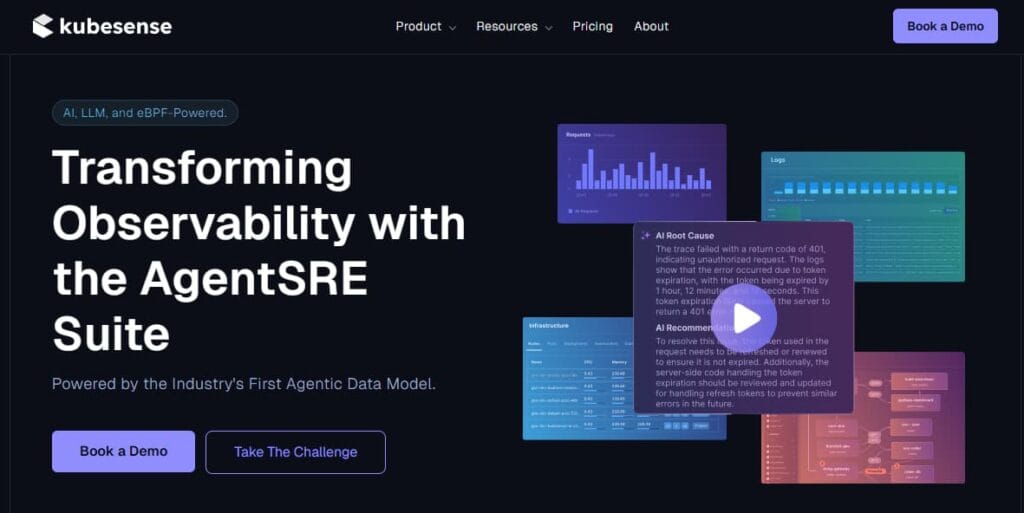
KubeSense is a full-stack observability platform built mainly for Kubernetes environments. Its documentation describes the platform as covering monitoring, logging, tracing, metrics collection, dashboards, alerts, APM, RUM, infrastructure visibility, and AgentSRE intelligence.
The platform’s APM module uses eBPF-based auto-instrumentation to capture traces, metrics, and service dependencies without requiring code changes. It includes service monitoring, service maps, distributed traces, endpoint analysis, database monitoring, and data stream monitoring.
KubeSense also positions itself around AI-assisted troubleshooting. Its pricing page lists AI Root Cause Analysis, AI solution recommendation, AgentSRE powered by a DevOps LLM, AI crash analytics, error grouping, AI RCA, AI alert insights, AI log analytics, and AI trace analytics. Some AI and LLM-related capabilities are still marked as coming soon, so buyers should confirm what is generally available before purchase.
Tyke.ai’s own website says it has paused new customer onboarding for Tyke while transitioning to KubeSense, an observability platform for cloud and AI applications.
Supported Environments, Integrations, and Data Sources
KubeSense supports Kubernetes-first observability with eBPF at its core. Its docs say it provides real-time infrastructure and application visibility, with APM, RUM, logs, infrastructure monitoring, dashboards, alerts, AgentSRE intelligence, and OpenTelemetry ingestion support.
| Area | KubeSense support |
| Telemetry capture | eBPF-based auto-instrumentation and OpenTelemetry support |
| Infrastructure | Kubernetes resources, nodes, pods, deployments, jobs, CronJobs, ConfigMaps, PVs, PVCs |
| APM | Services, service maps, traces, endpoints, database monitoring, data streams |
| RUM | Web and mobile performance, crashes, sessions, session metrics |
| Integrations | Datadog, OpenTelemetry, Redis, PostgreSQL, MySQL, MongoDB, AWS, GCP, Azure, Microsoft Entra ID, Google OAuth, Google SAML |
KubeSense docs list Datadog and OpenTelemetry as monitoring/tracing integrations, database integrations including Redis, PostgreSQL, MySQL, MongoDB Atlas, MongoDB, and Microsoft SQL Server, and cloud integrations for AWS, GCP, and Azure.
KubeSense also claims support for 25+ protocols through eBPF-based auto-detection, including HTTP, gRPC, GraphQL, WebSocket, MySQL, PostgreSQL, MongoDB, Redis, Kafka, RabbitMQ, NATS, MQTT, DNS, TCP, UDP, TLS/SSL, SMTP, and LDAP.
Important note: KubeSense makes strong marketing claims around cost reduction, speed, compression, and petabyte-scale telemetry. These should be treated as vendor claims unless validated in a proof of concept. Its homepage, for example, claims up to 10x value and over 90% operational cost reduction, while AWS Marketplace copy claims 95% log compression and 40–100x faster queries.
Key Features of KubeSense
KubeSense APM provides visibility into Kubernetes applications using eBPF-based auto-instrumentation. It captures traces, metrics, and service dependencies without code changes. APM modules include services, service maps, traces, endpoints, database monitoring, and data streams.
KubeSense infrastructure monitoring covers Kubernetes resources and real-time event visibility. Its docs list nodes, pods, deployments, DaemonSets, StatefulSets, ReplicaSets, Jobs, CronJobs, ConfigMaps, PersistentVolumes, and PersistentVolumeClaims.
The pricing page also lists host and VM metrics monitoring, node and pod metrics monitoring, container monitoring, serverless monitoring, Kubernetes monitoring, Jobs and CronJobs monitoring, ConfigMaps monitoring, service-level monitoring, workload-level monitoring, noisy-neighbor monitoring, standard alerts, process monitoring, customer metrics, dashboards, and alerting.
KubeSense includes centralized log management with search, filtering, and transformation pipelines. Its docs list Log Explorer and Log Pipelines, while the pricing page lists log collection and parsing, log classification via pipelines, log-to-metric correlation, log-to-trace correlation, attribute-level grouping and search, advanced log filters, querying, time-based retention, and compliance log pipelines.
The original draft said RUM was out of scope, but KubeSense documentation shows that RUM is part of the product. KubeSense says RUM captures real-time performance data from mobile and web applications, including user experience, crashes, app performance, crash-free rates, session metrics, performance trends, and session exploration.
However, KubeSense does not publish separate public RUM session pricing. For cost modeling, RUM should be treated as an included feature or quote-dependent entitlement, not as a separately priced public meter.
KubeSense docs describe AgentSRE Intelligence as AI-powered observability with automated root cause analysis, error grouping, and anomaly detection. The feature overview includes a conversational AI assistant for SRE investigations, AI error analytics, and AI anomalies.
The pricing page lists AI Root Cause Analysis, AI solution recommendation, AgentSRE powered by DevOps LLM, AI crash analytics, error grouping and AI RCA, AI alert insights, AI log analytics, and AI trace analytics. It also marks several AI/LLM capabilities as coming soon, including AI deployment performance tracking, AI code fix suggestions, BizDevOps LLM, LLM Observability, LLM usage monitoring, automated error monitoring and incident creation, and incident RCA labeling.
KubeSense documentation explicitly says LLM Observability is an upcoming feature and that the described functionality reflects planned capabilities. Planned LLM features include inference latency, token usage, cost visibility, request tracing, model comparison, prompt analytics, and integrations with OpenAI, Anthropic Claude, AWS Bedrock, Google Vertex AI, self-hosted models, LangChain, and LlamaIndex.
That means the article should not present LLM Observability as fully available unless KubeSense confirms general availability directly.
KubeSense pricing pages list advanced features such as conditional retention policies, compliance and audit support, sensitive data masking, SSO/SAML, performance degradation monitoring, multi-tier storage, cross-tier querying, unlimited querying, Slack and email alerts, Datadog/New Relic integration, OpenTelemetry integration, deployment markers, advanced retention policies, PagerDuty/Opsgenie integration, Alert Manager integration, Jira/incident tool
KubeSense Pricing in 2026
KubeSense publishes two public pricing models: Bring Your Own Cloud (BYOC) and KubeSense Cloud. The BYOC model is priced per node/host, while the KubeSense Cloud model is priced per GB ingested.
This distinction is important because the two models behave differently. BYOC pricing is driven mainly by node or host count, tier minimums, and cluster limits. KubeSense Cloud pricing is driven mainly by telemetry ingestion volume, included monthly data allowance, retention, and Enterprise contract scope.
KubeSense Bring Your Own Cloud Pricing
The Bring Your Own Cloud pricing tab lists four plans: Basic, Standard, Premium, and Enterprise. Basic starts at $20 per node/host per month, Standard at $25, Premium at $30, and Enterprise is custom from $9,999/month. The page also lists monthly plan minimums and lower annual-billing equivalents.
| Plan | Per node/host | Monthly plans start at | Billed annually at | Scope |
| Basic | $20/month | $1,199/month | $999/month | One cluster, up to 60 hosts/nodes |
| Standard | $25/month | $2,499/month | $1,999/month | One cluster, up to 100 hosts/nodes |
| Premium | $30/month | $5,999/month | $4,999/month | Multiple clusters, up to 200 hosts/nodes |
| Enterprise | Custom | From $9,999/month | Custom | Unlimited clusters and hosts/nodes |
The key point is that the monthly minimum can matter more than the raw node math for smaller teams. For example, 10 hosts on Basic would be $200/month by raw node math, but the public BYOC plan starts at $1,199/month.
KubeSense Cloud Pricing
The KubeSense Cloud pricing tab uses ingestion-based pricing instead of node/host pricing. Based on the pricing page shown, Basic is $0.25/GB ingested, Standard is $0.30/GB ingested, Premium is $0.35/GB ingested, and Enterprise is custom starting at $14,999/month.
| Plan | Price | Included ingestion | Retention |
| Basic | $0.25/GB ingested | 2 TB/month | 15 days for logs/events/traces; 1 month metrics |
| Standard | $0.30/GB ingested | 4 TB/month | 15 days for logs/events/traces; 1 month metrics |
| Premium | $0.35/GB ingested | 15 TB/month | 15 days for logs/events/traces; 3 months metrics |
| Enterprise | Custom, starts at $14,999/month | Custom | Custom retention; 15-month metrics |
This means the original article should show both models separately. The earlier draft mixed third-party GB pricing with official node pricing, but your screenshot shows that GB-ingested pricing is official under the KubeSense Cloud tab.
What Each KubeSense Plan Includes
Basic
Basic is listed at $20 per node/host per month. It includes one cluster, up to 60 hosts/nodes, time-based retention for logs, metrics, events, and traces, and email support. Monthly plans start at $1,199/month, or $999/month when billed annually.
Standard
Standard is listed at $25 per node/host per month. It includes one cluster, up to 100 hosts/nodes, time-based retention for logs, metrics, events, and traces, plus email and dedicated Slack support. Monthly plans start at $2,499/month, or $1,999/month when billed annually.
Premium
Premium is listed at $30 per node/host per month. It includes multiple clusters, up to 200 hosts/nodes, time-based retention for logs, metrics, events, and traces, plus email, dedicated Slack, and migration assistance. Monthly plans start at $5,999/month, or $4,999/month when billed annually.
Enterprise
Enterprise is custom and starts at $9,999/month. It includes unlimited clusters and hosts/nodes, advanced retention policies, customized feature packaging and integrations, SSO, RBAC, dedicated 24/7 Slack and on-call support, migration and configuration assistance, free non-prod usage, and price capping on multi-year licenses.
Is There a Free Tier in KubeSense?
KubeSense does not publish a free production tier on its pricing page. It does, however, advertise unlimited free monitoring for Dev, UAT, and Pre-Prod environments.
The homepage also says non-production usage is free on all plans, and the pricing page lists free non-prod usage under Enterprise plan benefits.
For buyers, the safe interpretation is this: KubeSense offers free non-production monitoring, but production usage is covered by paid plans. Teams should confirm the exact non-prod entitlement, environment definitions, data volume rules, and retention limits directly with KubeSense before relying on it for long-term planning.
How KubeSense Measures Cost
KubeSense’s official pricing page uses a per-node/host model with plan minimums and host caps. The main public cost drivers are:
| Cost driver | Why it matters |
| Node/host count | Public plans are priced per node/host per month |
| Plan minimums | Minimums can exceed raw node math for smaller teams |
| Cluster scope | Basic and Standard cover one cluster; Premium supports multiple clusters |
| Host/node caps | Basic caps at 60, Standard at 100, Premium at 200 |
| Enterprise terms | Unlimited hosts/nodes, advanced retention, support, and price capping are custom |
There is also a third-party CubeAPM alternatives article that describes KubeSense pricing in per-GB terms: Basic at $0.25/GB ingested, Standard at $0.20/GB ingested, Premium at $0.20/GB ingested, and Enterprise as custom. This is not the current official KubeSense pricing page, so it should be clearly labeled as a third-party reference rather than official KubeSense pricing.
For accuracy, the safest article position is: KubeSense’s official public pricing is node/host-based, while older or third-party comparison content may mention per-GB pricing. Buyers should request a written quote that states whether their deal is billed by node/host, telemetry volume, contract tier, AWS Marketplace private offer, or a hybrid model.
What Does KubeSense Really Cost?
⚠️ Disclaimer
The scenarios below are directional editorial estimates, not official KubeSense quotes. They use KubeSense’s public node/host pricing and published monthly plan minimums as of June 2026. Final pricing can change based on selected tier, host count, cluster count, retention, support, discounts, AWS Marketplace terms, private offers, and contract length.
Workload Assumptions Used Across Scenarios
| Team size | Hosts | Logs | Traces/APM | Metrics | Total telemetry |
| Small team | 10 | 720 GB/mo | 360 GB/mo | 1 GB/mo | ~1.1 TB/mo |
| Growing team | 50 | 3,600 GB/mo | 1,800 GB/mo | 5 GB/mo | ~5.4 TB/mo |
| Mid-market team | 250 | 18,000 GB/mo | 9,000 GB/mo | 25 GB/mo | ~27 TB/mo |
The KubeSense official cost estimate below is based on node/host pricing and plan minimums, not RUM sessions, synthetic tests, or per-GB telemetry billing.
Scenario 1: Small Team, 10 Hosts
Scenario
A small production team runs about 10 hosts and produces roughly 1.1 TB of telemetry per month. The team needs infrastructure monitoring, APM, logs, RUM, dashboards, and basic AI-assisted troubleshooting.
Estimated Monthly Cost
| Item | Estimate |
| Relevant KubeSense tier | Basic |
| Raw node math | 10 × $20 = $200/month |
| Published monthly minimum | $1,199/month |
| Estimated KubeSense cost | ~$1,199/month |
| Free non-prod | Dev, UAT, and Pre-Prod |
At 10 hosts, the Basic tier minimum matters more than the raw per-node price. Even though 10 × $20 equals $200/month, KubeSense publishes Basic monthly plans starting at $1,199/month, so the public estimate should use the plan minimum.
CubeAPM comparison
| Platform | Pricing basis | Estimated monthly cost | Savings with CubeAPM |
| KubeSense BYOC | Basic monthly minimum | ~$1,199/month | ~$677/month lower, ~56% savings |
| KubeSense Cloud | ~1.1 TB at $0.25/GB | ~$275/month | CubeAPM costs ~$247/month more |
| CubeAPM | ~1.1 TB at $0.15/GB | ~$522/month | Baseline |
What this shows
For very small production environments, KubeSense’s plan minimum can make the official node-tier model more expensive than raw per-node math suggests. CubeAPM is lower in this scenario because it prices by ingestion volume rather than a node-tier floor.
Scenario 2: Growing Team, 50 Hosts
Scenario
A growing SaaS team runs about 50 hosts and produces roughly 5.4 TB of monthly telemetry. The team has more services, more production traffic, and needs stronger incident workflows.
Estimated Monthly Cost
| Item | Estimate |
| Relevant KubeSense tier | Standard |
| Raw node math | 50 × $25 = $1,250/month |
| Published monthly minimum | $2,499/month |
| Estimated KubeSense cost | ~$2,499/month |
| Free non-prod | Dev, UAT, and Pre-Prod |
At 50 hosts, the Standard tier is within the 100-host cap, but the raw node calculation is still below the published $2,499/month Standard minimum.
CubeAPM comparison
| Platform | Pricing basis | Estimated monthly cost | Savings with CubeAPM |
| KubeSense BYOC | Standard monthly minimum | ~$2,499/month | ~$1,580/month lower, ~63% savings |
| KubeSense Cloud | ~5.4 TB at $0.30/GB | ~$1,620/month | ~$701/month lower, ~43% savings |
| CubeAPM | ~5.4 TB at $0.15/GB | ~$919/month | Baseline |
What this shows
CubeAPM is cheaper than both KubeSense models at this scale. The biggest saving is against BYOC because the Standard tier minimum applies, while Cloud pricing rises with telemetry volume.
Scenario 3: Mid-Market Team, 250 Hosts
Scenario
A mid-market team runs about 250 hosts and produces roughly 27 TB of monthly telemetry. The environment may include multiple Kubernetes clusters, backend services, databases, APIs, queues, and customer-facing applications.
Estimated Monthly Cost
| Item | Estimate |
| Relevant KubeSense tier | Enterprise likely required |
| Premium cap | Up to 200 hosts/nodes |
| 250 hosts at Premium rate | 250 × $30 = $7,500/month |
| Enterprise starting price | From $9,999/month |
| Safer public estimate | Custom, likely from $9,999/month |
Because KubeSense Premium is listed for up to 200 hosts/nodes, a 250-host environment exceeds the Premium public cap. The safer estimate is therefore Enterprise, which starts at $9,999/month, rather than presenting $7,500 as a clean public price.
CubeAPM comparison
| Platform | Pricing basis | Estimated monthly cost | Savings with CubeAPM |
| KubeSense BYOC | Enterprise starting price | From ~$9,999/month | ~$5,405/month lower, ~54% savings |
| KubeSense Cloud | Enterprise starting price | From ~$14,999/month | ~$10,405/month lower, ~69% savings |
| CubeAPM | ~27 TB at $0.15/GB | ~$4,594/month | Baseline |
What this shows
CubeAPM is materially cheaper at mid-market scale in this model. KubeSense BYOC likely moves to Enterprise because 250 hosts exceeds the Premium 200-host cap, while KubeSense Cloud likely moves to Enterprise because 27 TB exceed the Premium 15 TB/month included scope.
Summary: KubeSense vs CubeAPM Estimated Monthly Cost
| Team profile | KubeSense BYOC | KubeSense Cloud | CubeAPM | Best CubeAPM savings |
| Small team | ~$1,199/month | ~$275/month | ~$522/month | Saves ~$677 vs BYOC, ~56% |
| Growing team | ~$2,499/month | ~$1,620/month | ~$919/month | Saves ~$1,580 vs BYOC, ~63% |
| Mid-market team | From ~$9,999/month | From ~$14,999/month | ~$4,594/month | Saves ~$10,405 vs Cloud, ~69% |
What Drives KubeSense Costs?
Node and host count is the main published cost driver. KubeSense lists Basic at $20/node/host, Standard at $25/node/host, and Premium at $30/node/host.
Each public plan has a minimum monthly starting point. Basic starts at $1,199/month, Standard at $2,499/month, and Premium at $5,999/month. This means smaller teams may pay the plan floor rather than the raw node calculation.
Basic supports one cluster and up to 60 hosts/nodes. Standard supports one cluster and up to 100 hosts/nodes. Premium supports multiple clusters and up to 200 hosts/nodes. Enterprise supports unlimited clusters and hosts/nodes.
Basic, Standard, and Premium list time-based retention for logs, metrics, events, and traces. Enterprise adds advanced retention policies. KubeSense also lists multi-tier storage and cross-tier querying among advanced capabilities.
Support increases by tier. Basic includes email support, Standard adds dedicated Slack support, Premium adds migration assistance, and Enterprise includes dedicated 24/7 Slack and on-call support, migration, and configuration assistance.
AWS Marketplace pricing is contract-based, and AWS says additional AWS infrastructure costs may apply. The KubeSense AI listing shows a 1-month Enterprise License at $10,000/month and notes that deployment and onboarding are performed by the KubeSense team in the customer AWS environment.
AWS Marketplace lists contract discounts of up to 17% for 12 months, up to 25% for 24 months, and up to 28% for 36 months on the KubeSense AI listing. KubeSense’s own pricing page also emphasizes price capping on multi-year licenses.
KubeSense User Reviews
| Source | Public signal |
| AWS Marketplace | KubeSense AI listing shows 0 ratings and 0 reviews |
| PeerSpot | KubeSense AI appears in the AI Observability category, ranked #167 in comparison pages |
| Trustpilot | kubesense.ai has 2 public Trustpilot reviews with a rating of 2.9/5, but this is a very small sample |
AWS Marketplace shows no customer reviews yet for the KubeSense AI listing. PeerSpot comparison pages list KubeSense in the AI Observability category and show it ranked #167 in those comparisons. Trustpilot shows that 2 people have reviewed kubesense.ai, but that sample is too small to use as a reliable product-review base.
What Buyers May Like
| Theme | Why it matters |
| eBPF-based APM | Captures traces, metrics, and dependencies without code changes |
| Kubernetes focus | Strong fit for teams that think in clusters, nodes, pods, and services |
| Unified observability | Covers APM, logs, infrastructure, RUM, dashboards, alerts, and AI workflows |
| AgentSRE positioning | AI RCA, error analytics, and alert insights can help incident response |
| Free non-prod usage | Dev, UAT, and Pre-Prod monitoring can reduce evaluation and testing cost |
What Buyers Should Validate
⚠️ Disclaimer
These are buyer considerations, not universal product limitations.
| Consideration | Why to validate it |
| Plan minimums | Small teams may pay plan floors, not raw node math |
| Enterprise scope | 200+ hosts likely require Enterprise pricing |
KubeSense Alternatives: How It Compares to Competitors
KubeSense vs CubeAPM
KubeSense is a Kubernetes-focused, eBPF-based observability platform with official node/host pricing, plan minimums, and AI/AgentSRE positioning. CubeAPM is an OpenTelemetry-native, self-hosted, vendor-managed observability platform with flat per-GB pricing. CubeAPM is stronger for teams that want predictable ingestion-based pricing, no per-host fees, OpenTelemetry-native instrumentation, and data control inside their own environment.
| Category | KubeSense | CubeAPM |
| Deployment | KubeSense Cloud, BYOC, on-prem support listed | Self-hosted, vendor-managed |
| Pricing model | Per node/host with minimums | $0.15/GB ingestion |
| Instrumentation | eBPF + OpenTelemetry support | OpenTelemetry-native |
| Strongest fit | Kubernetes-heavy teams wanting eBPF and AgentSRE | Teams wanting predictable per-GB full-stack observability |
| Cost behavior | Tier floors and host caps matter | Scales with telemetry ingestion |
KubeSense vs Datadog
Datadog is a broad SaaS observability platform with infrastructure monitoring, APM, logs, RUM, synthetics, security, and a large integration ecosystem. Datadog’s official pricing list shows Infrastructure Pro at $15 per host per month when billed annually, while Datadog APM billing docs list APM Host at $31 per underlying APM host per month.
| Category | KubeSense | Datadog |
| Infrastructure pricing | From $20/node/host | Infrastructure Pro from $15/host |
| APM pricing | Included in KubeSense tiers | APM Host from $31/host |
| Instrumentation | eBPF + OpenTelemetry support | Datadog agent, integrations, OpenTelemetry support |
| Strongest fit | Kubernetes/eBPF-first observability | Broad SaaS observability ecosystem |
| Cost behavior | Node tiers and minimums | Modular product-by-product billing |
KubeSense vs Dynatrace
Dynatrace is an enterprise observability and AIOps platform known for automated discovery, full-stack monitoring, and Davis AI. Dynatrace pricing lists Full-Stack Monitoring at $58/month per 8 GiB host and notes infrastructure monitoring is billed at $0.04 per hour per host, which is roughly $29/month.
| Category | KubeSense | Dynatrace |
| Pricing model | Per node/host with minimums | Host/memory-based usage model |
| AI approach | AgentSRE, AI RCA, AI error analytics | Davis AI and automated RCA |
| Instrumentation | eBPF + OpenTelemetry support | OneAgent + OpenTelemetry support |
| Strongest fit | Kubernetes-first eBPF observability | Large enterprises needing automation |
| Cost behavior | Tier floors and host caps | Host/memory usage and add-on services |
KubeSense vs New Relic
New Relic uses a data-ingest and user-based model. Its pricing page lists 100 GB of free data ingest per month, $0.40/GB beyond that, and user pricing based on user type and edition.
| Category | KubeSense | New Relic |
| Pricing model | Per node/host with minimums | Data ingest + users |
| Free allowance | Free non-prod monitoring | 100 GB/month free ingest |
| Instrumentation | eBPF + OpenTelemetry support | Agents + OpenTelemetry |
| Strongest fit | Kubernetes-heavy teams wanting node-based pricing | Teams preferring mature ingest-based SaaS |
| Cost behavior | Nodes, tiers, support, retention | Data volume plus user seats |
Is KubeSense the Right Choice?
KubeSense Works Best For
| Best fit | Why |
| Kubernetes-heavy teams | KubeSense is built around Kubernetes resources, services, nodes, pods, and eBPF |
| Teams wanting eBPF auto-instrumentation | APM captures traces, metrics, and service dependencies without code changes |
| Teams evaluating AI-assisted incident response | AgentSRE, AI RCA, and AI error analytics are central to positioning |
| Enterprises needing BYOC/on-prem support | Pricing page lists BYOC and on-prem deployment support |
| Buyers wanting non-prod monitoring included | Dev, UAT, and Pre-Prod monitoring is advertised as free |
KubeSense May Not Be the Right Fit For
| Not ideal for | Why |
| Buyers needing many independent reviews | Public review volume is still limited |
| Very small teams with tight budgets | Plan minimums can outweigh raw per-node pricing |
| Teams needing LLM Observability today | KubeSense docs mark LLM Observability as upcoming |
| Teams wanting pure OpenTelemetry-first architecture | KubeSense supports OpenTelemetry but positions eBPF as a core capture method |
| Buyers avoiding quote complexity | Enterprise, AWS Marketplace, retention, and support terms may require private offers |
Conclusion
KubeSense is a credible Kubernetes-focused observability platform for teams that want eBPF-based auto-instrumentation, APM, logs, infrastructure monitoring, RUM, dashboards, alerts, and AI-assisted troubleshooting in one platform. Its strongest positioning is around Kubernetes visibility, AgentSRE, AI RCA, and reducing observability overhead.
Its public pricing is clearer than many enterprise observability vendors, but buyers need to account for plan minimums. Basic starts at $20/node/host with monthly plans from $1,199, Standard starts at $25/node/host with monthly plans from $2,499, Premium starts at $30/node/host with monthly plans from $5,999, and Enterprise starts at $9,999/month. AWS Marketplace also shows a KubeSense AI Enterprise License at $10,000/month, with private-offer scope and contract discounts.
The main trade-offs are thin public review coverage, plan floors that can affect small teams, Enterprise pricing for environments above Premium’s 200-host cap, and roadmap-dependent AI/LLM features. For buyers who want self-hosted, OpenTelemetry-native observability with predictable per-GB pricing, CubeAPM is a strong alternative to evaluate alongside KubeSense, while Datadog, Dynatrace, and New Relic remain mature options for broader enterprise observability.
Disclaimer: Pricing, packaging, plan limits, feature availability, support terms, retention, and AWS Marketplace offers can change. The cost examples in this article are editorial estimates based on public information available as of June 2026. Always confirm final pricing, included entitlements, deployment model, discounts, and contract terms directly with KubeSense before purchase.
FAQs
1. How much does KubeSense cost?
KubeSense pricing starts at $20 per node/host per month for Basic, $25 for Standard, and $30 for Premium. Monthly plans start at $1,199 for Basic, $2,499 for Standard, and $5,999 for Premium. Enterprise is custom and starts at $9,999/month.
2. Is KubeSense priced per GB or per node?
KubeSense’s official public pricing page uses per-node/host pricing with monthly plan minimums. A third-party CubeAPM alternatives article mentions per-GB KubeSense pricing, but that is not the current official KubeSense pricing page, so buyers should confirm the billing model in writing.
3. Does KubeSense have a free tier?
KubeSense does not list a free production tier. It does advertise unlimited free monitoring for Dev, UAT, and Pre-Prod environments.
4. Does KubeSense include RUM?
Yes. KubeSense documentation includes Real User Monitoring for mobile and web applications, with visibility into user experience, crashes, app performance, session metrics, and session exploration. However, KubeSense does not publish separate public RUM session pricing.
5. Does KubeSense include LLM Observability?
KubeSense documentation lists LLM Observability as an upcoming feature. The page describes planned capabilities such as token usage, latency, cost visibility, prompt analytics, and integrations with OpenAI, Anthropic Claude, AWS Bedrock, Google Vertex AI, self-hosted models, LangChain, and LlamaIndex.
6. What drives KubeSense cost?
The biggest public cost drivers are node/host count, plan tier, monthly minimums, cluster scope, host caps, retention requirements, support level, Enterprise terms, and AWS Marketplace contract scope.
7. What are the best KubeSense alternatives?
The strongest alternatives are CubeAPM, Datadog, Dynatrace, and New Relic. CubeAPM is best for self-hosted, OpenTelemetry-native observability with predictable per-GB pricing. Datadog is best for broad SaaS observability. Dynatrace is best for enterprise automation and AI-assisted RCA. New Relic is best for teams that prefer ingest-based pricing with a mature APM platform.