









Kloudfuse is an AI-powered observability platform built for teams that want more control over their telemetry data. It brings metrics, events, logs, traces, RUM, profiling, and AI workload monitoring into one platform, while running inside the customer’s own cloud or VPC instead of a fully vendor-hosted SaaS environment.
That is why Kloudfuse pricing and review research matters. Unlike tools with simple public ingestion-based rates, Kloudfuse uses a quote-based pricing model, so buyers need to understand how data volume, retention, infrastructure, query load, and deployment architecture affect the final cost.
In this Kloudfuse Pricing and Review guide, we break down its pricing model, what is included, real cost drivers, deployment considerations, user review signals, pros and cons, and how Kloudfuse compares with alternatives like Datadog, New Relic, Dynatrace, Grafana, Amazon CloudWatch, and CubeAPM.
What Is Kloudfuse?
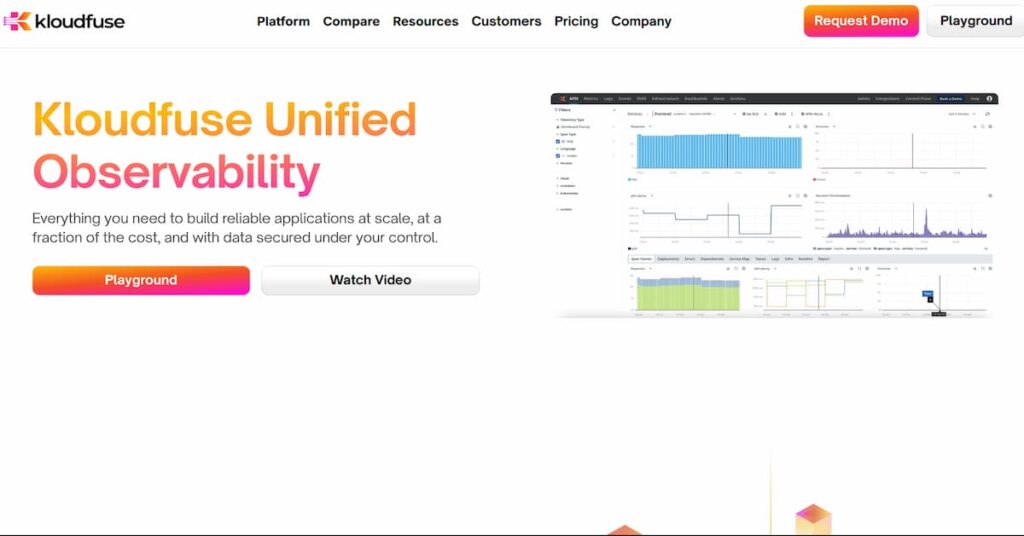
Kloudfuse is a unified observability platform for metrics, events, logs, traces, digital experience monitoring, profiling and AI workload monitoring. Its main difference from many SaaS observability platforms is deployment: Kloudfuse is designed to run in the customer’s cloud or VPC, using a “Self-SaaS” or BYOC-style model where the customer owns the data location while Kloudfuse manages the product experience.
In simple terms, Kloudfuse helps engineering, SRE, DevOps, platform and infrastructure teams answer questions like:
- Which service is unhealthy or degrading?
- Which logs, metrics and traces explain the incident?
- Which labels, services or tenants are driving observability cost?
- Can production telemetry stay inside our own cloud?
- Can we monitor AI-native and LLM workloads safely?
- Can we reduce vendor SaaS overages and egress concerns?
- Can we consolidate several monitoring tools into one observability data lake?
Kloudfuse is best understood as a unified observability data lake plus analytics layer. It is most relevant for teams that care about privacy, compliance, cost governance, OpenTelemetry, and control over telemetry infrastructure.
Key Features of Kloudfuse
Kloudfuse consolidates metrics, events, logs and traces into a unified observability workflow. AWS Marketplace says Kloudfuse merges MELT data into one consolidated view and supports more than 700 integrations across infrastructure, cloud services and applications.
Kloudfuse runs inside the customer’s cloud environment. This is useful for teams that want telemetry data to remain inside their own infrastructure for security, compliance, privacy or cost-control reasons. Kloudfuse’s homepage describes this as deploying in the customer’s cloud for control over data, security and cost.
Kloudfuse positions its platform as a unified observability data lake for metrics, logs, traces, RUM, profiling and LLM monitoring. This helps teams investigate incidents without moving between separate tools for each signal.
Kloudfuse uses AI and ML for anomaly detection, correlation analysis and root-cause analysis. AWS Marketplace also describes the platform as using AI/ML for anomaly detection, correlation analysis and faster troubleshooting.
Kloudfuse publicly positions itself around OpenTelemetry and open standards. Its homepage says teams can collect data from open-source or vendor-specific agents and use open query languages or embedded Grafana dashboards.
Kloudfuse includes digital experience monitoring, allowing teams to connect backend health with frontend user experience. Its homepage lists real user monitoring and digital experience signals as part of the unified platform.
Kloudfuse includes continuous profiling as part of its observability coverage. This helps teams understand CPU, memory and code-level performance bottlenecks beyond logs, metrics and traces.
Kloudfuse supports observability for LLMs, agentic workflows and AI-native pipelines. Its homepage specifically calls out LLM monitoring and AI-native workloads.
Kloudfuse 4.0 introduced an MCP Server for governed natural-language access to observability data. The release states that every query is authenticated to a user identity, includes query safety controls and is audit-logged.
Kloudfuse 4.0 introduced workload isolation so ingestion, query and control-plane workloads can scale independently based on demand. This matters for larger environments where ingestion load and query load do not grow at the same pace.
What Does Kloudfuse Monitor?
| Monitoring Area | What It Covers | Buyer Relevance |
| Metrics | Infrastructure, service, application and time-series data | Useful for SLOs, alerts and health dashboards |
| Events | Deployments, changes and operational events | Helps connect incidents to system changes |
| Logs | Application, infrastructure, Kubernetes and service logs | Useful for troubleshooting and audit trails |
| Traces | Distributed traces across services and requests | Useful for latency and dependency analysis |
| Digital Experience | RUM and frontend performance signals | Connects backend issues to user experience |
| Profiling | CPU, memory and code-level behavior | Helps find expensive functions and bottlenecks |
| AI and LLM Workloads | AI-native and agentic workflow telemetry | Useful for teams deploying LLM applications |
| Control Plane | RBAC, governance, access and platform operations | Important for enterprise administration |
Kloudfuse Pricing in 2026
Kloudfuse does not publish fixed public dollar prices for its plans. Its pricing page says buyers submit current data volumes, receive a TCO estimate covering license plus infrastructure, and then pick a bucket: S, M, L, XL or XXL.
This means Kloudfuse pricing should not be modeled like a simple per-GB, per-host or per-user SaaS tool. Buyers can verify the pricing structure publicly, but they cannot calculate an exact monthly bill without sharing usage details with Kloudfuse or requesting a custom quote.
Kloudfuse Pricing Plans 2026
| Pricing Path | Public Price | Best For | What Buyers Should Know |
| Bucket S | Quote-based | Smaller production teams | Public volume threshold is not listed |
| Bucket M | Quote-based | Growing teams | Likely depends on higher volume and infrastructure needs |
| Bucket L | Quote-based | Teams consolidating several signals | Confirm retention, query load and data shape |
| Bucket XL | Quote-based | Large production environments | Needs full TCO modeling |
| Bucket XXL | Quote-based | Enterprise-scale environments | Best handled through enterprise procurement |
What Counts Toward Kloudfuse Cost?
Because Kloudfuse does not publish per-unit prices, buyers should model cost through the drivers that shape the quote and infrastructure footprint.
| Cost Driver | How It Affects Cost | How to Model It |
| Telemetry volume | More logs, metrics, traces, events, profiles and RUM data need more ingest and storage capacity | Estimate daily GB, active series, spans and events |
| Retention | Longer retention increases storage needs | Multiply daily ingest by retention days before compression |
| Cardinality | High-cardinality labels increase metric and query complexity | Audit labels like user ID, pod ID, endpoint and tenant |
| Query load | Heavy dashboards and searches need more compute | Estimate users, dashboards, alerts and incident queries |
| Deployment model | VPC deployment shifts infrastructure cost to the customer | Model Kubernetes, storage, networking and backup costs |
| Workload isolation | Ingest, query and control plane may scale separately | Size each layer based on real usage |
| Security requirements | FIPS, RBAC, audit and AI governance can affect packaging | Confirm during quote |
| Migration support | Moving from another tool may require services | Ask what is included |
Add-Ons and Optional Costs to Confirm
Kloudfuse does not publish a detailed add-on price sheet like many SaaS vendors. Buyers should still ask about the following areas:
| Area to Confirm | Why It Matters |
| FIPS and compliance controls | Kloudfuse 4.0 messaging emphasizes FIPS 140-3 validated security |
| MCP Server and AI governance | Governed AI access may be important for production AI workflows |
| Workload isolation | Independent scaling can change infrastructure sizing |
| Migration support | Dashboard, alert and pipeline migration may require services |
| Cloud infrastructure | The platform runs in the customer’s cloud |
| Long retention | Storage tiering, compression and archive needs can change TCO |
| Support level | Enterprise support may affect the final quote |
Kloudfuse User Reviews in 2026
Kloudfuse has a much smaller public review footprint. Gartner Peer Insights lists Kloudfuse with 5 reviews and an overall rating of 4.6/5 in the Observability Platforms market. Kloudfuse is listed on G2 but with no ratings so far.
Kloudfuse Review Summary
| Review Source | Rating or Signal | Interpretation |
| Gartner Peer Insights | 4.6/5 from 5 reviews | Positive but low-volume signal |
| Capterra | 0.0 based on 0 user reviews; contact vendor pricing | No meaningful user sentiment yet |
What Users and Evaluators Praise
Kloudfuse is valued for bringing logs, metrics, traces and other signals into one observability data lake. This reduces context switching during incidents.
Kloudfuse keeps telemetry in the customer’s cloud environment. This is useful for teams with strict privacy, compliance or data-residency needs.
Kloudfuse’s pricing page states no per-user pricing, no overage fees and no egress fees because data stays in the customer’s infrastructure.
Kloudfuse supports OpenTelemetry and several familiar query languages, including PromQL, LogQL, TraceQL, GraphQL and FuseQL.
Kloudfuse materials and AWS Marketplace describe AI/ML capabilities for anomaly detection, correlation and faster troubleshooting.
Kloudfuse 4.0 adds workload isolation, governed AI access and FIPS-oriented security messaging, making it more relevant for enterprise buyers.
What Buyers Should Watch
⚠️ Disclaimer
These are buyer considerations based on Kloudfuse’s public pricing model, deployment approach, and limited public review footprint. They are not universal product flaws, and teams should validate each point during a demo, quote review, or proof of concept.
Because Kloudfuse runs in the buyer’s cloud, infrastructure sizing and cloud cost remain part of the buyer’s cost model.
VPC deployment gives more control, but platform teams still need to understand Kubernetes capacity, storage, networking, upgrades and observability platform health.
S, M, L, XL and XXL buckets are visible publicly, but exact thresholds and dollar values are not.
Kloudfuse Alternatives: How it Compares with Competitors
Kloudfuse competes with broad observability platforms, managed open-source stacks, cloud-native monitoring systems and cost-conscious APM platforms. The right alternative depends on whether the buyer values SaaS simplicity, VPC data control, OpenTelemetry, predictable pricing, AI features or ecosystem depth.
Kloudfuse vs CubeAPM
Kloudfuse and CubeAPM both appeal to buyers who want more control and better cost predictability than traditional SaaS observability. They are not identical. Kloudfuse emphasizes a customer-cloud observability data lake with quote-based pricing buckets. CubeAPM positions itself as a full-stack APM and observability platform with public ingestion-based pricing.
| Category | Kloudfuse | CubeAPM |
| Primary role | Unified observability data lake inside customer cloud | Full-stack APM and observability |
| Pricing model | Quote-based buckets: S, M, L, XL, XXL | Public Pro pricing at $0.15/GB ingestion |
| Pricing transparency | No public dollar buckets | Public per-GB price |
| Deployment | Customer cloud / VPC model | Deploys in customer infrastructure with managed-service experience |
| OpenTelemetry | OpenTelemetry and open standards positioning | OpenTelemetry-native positioning |
| Best fit | Enterprises prioritizing VPC control and governance | Teams wanting predictable per-GB pricing and full-stack APM |
CubeAPM publicly lists predictable pricing at $0.15/GB for data ingestion and says it deploys in the customer’s infrastructure while upgrades, patches and support are handled by the CubeAPM tea
Kloudfuse vs Datadog
Kloudfuse and Datadog serve the same broad observability market, but they take very different approaches. Datadog is a mature SaaS observability platform with a large product ecosystem, while Kloudfuse is better suited for teams that want telemetry to stay inside their own cloud or VPC. The main tradeoff is simplicity versus control: Datadog is easier to adopt as SaaS, while Kloudfuse gives buyers more control over data location and infrastructure.
| Category | Kloudfuse | Datadog |
| Deployment | Customer cloud / VPC model | Fully managed SaaS |
| Pricing | Quote-based buckets | Public modular pricing by product and usage |
| Data control | Data stays in customer infrastructure | Data is sent to Datadog SaaS |
| Best for | Teams prioritizing data control and VPC deployment | Teams wanting a mature SaaS ecosystem |
| Tradeoff | More infrastructure planning | Cost can spread across many modules |
Kloudfuse vs New Relic
Kloudfuse and New Relic both help teams monitor applications, infrastructure, logs, traces, and user experience, but their pricing and deployment models are different. New Relic is a SaaS platform with public usage-based pricing and user-based plan considerations, while Kloudfuse uses quote-based buckets and runs inside the customer’s cloud. Kloudfuse may fit teams that want stronger data control, while New Relic may fit teams that want faster SaaS onboarding.
| Category | Kloudfuse | New Relic |
| Deployment | Customer-cloud model | SaaS |
| Primary strength | Data control and unified data lake | Developer-friendly SaaS observability |
| Pricing style | Quote-based buckets | Data ingest plus user/edition model |
| Best for | Teams needing observability inside their own cloud | Teams wanting simpler SaaS onboarding |
| Tradeoff | Infrastructure cost must be modeled | User and ingest costs can grow with adoption |
Kloudfuse vs Dynatrace
Kloudfuse and Dynatrace are both enterprise-focused observability platforms with AI-assisted troubleshooting, but they are built for different buyer priorities. Dynatrace is known for automated discovery, dependency mapping, and Davis AI, while Kloudfuse focuses more on customer-cloud deployment, open standards, and governed access to observability data. Teams choosing between them should compare automation depth, deployment control, and total cost of ownership.
| Category | Kloudfuse | Dynatrace |
| Deployment | Customer-cloud / VPC model | Enterprise SaaS and managed deployment options |
| AI focus | Governed AI observability and MCP Server | Davis AI and enterprise automation |
| Pricing | Quote-based | Platform and usage-based pricing |
| Best for | Teams needing data control and open standards | Large enterprises wanting mature automated observability |
| Tradeoff | Requires infrastructure planning | Enterprise pricing can be complex |
Kloudfuse vs Grafana Cloud
Kloudfuse and Grafana Cloud both appeal to teams that care about open standards and flexible observability workflows. Grafana Cloud is strongest for teams already using Grafana, Prometheus, Loki, Tempo, Pyroscope, or k6, while Kloudfuse is more focused on running a unified observability data lake inside the customer’s cloud. The choice depends on whether the team prefers managed Grafana workflows or a customer-cloud observability platform.
| Category | Kloudfuse | Grafana Cloud |
| Core idea | Unified observability data lake in customer cloud | Managed Grafana stack |
| Open standards | OpenTelemetry and open query languages | Grafana ecosystem: metrics, logs, traces, profiles and k6 |
| Pricing | Quote-based buckets | Public usage-based pricing |
| Best for | Teams prioritizing in-VPC deployment | Teams already standardized on Grafana |
| Tradeoff | Quote and infrastructure modeling needed | Usage pricing needs careful monitoring |
Kloudfuse vs Amazon CloudWatch
Kloudfuse and Amazon CloudWatch can both support AWS observability, but they are not the same type of product. CloudWatch is AWS-native and works well for teams mainly monitoring AWS resources, while Kloudfuse is a broader observability platform that can cover logs, metrics, traces, RUM, profiling, and AI workloads across cloud environments. AWS-heavy teams may start with CloudWatch, but Kloudfuse becomes more relevant when they need a unified cross-signal observability layer.
| Category | Kloudfuse | Amazon CloudWatch |
| Primary role | Unified observability platform | AWS-native monitoring and logs |
| Deployment | Customer cloud with Kloudfuse platform | Native AWS service |
| Multi-cloud | Supports AWS, Azure, GCP and self-hosted environments | Primarily AWS-focused |
| Best for | Cross-signal observability inside customer cloud | AWS teams needing native monitoring |
| Tradeoff | Needs quote and platform setup | Can become fragmented across AWS services |
Is Kloudfuse the Right Choice?
When Kloudfuse Is the Right Fit
Kloudfuse is a strong fit when:
- You want observability data to remain inside your own cloud or VPC.
- You need a unified platform for metrics, events, logs, traces, RUM, profiling and AI workload telemetry.
- You prefer no per-user pricing.
- You want to avoid vendor egress fees.
- You have cloud credits, committed spend or negotiated cloud discounts.
- You need compliance, audit, FIPS-oriented or AI-governance features.
- You want OpenTelemetry and open query language support.
- You have enough platform engineering maturity to support a Kubernetes-based observability platform.
- You are comparing high-volume observability costs against Datadog, New Relic, Dynatrace or Grafana Cloud.
When Kloudfuse May Not Be the Right Fit
Kloudfuse may not be the best fit when:
- You need self-serve public pricing before talking to sales.
- You want a fully vendor-hosted SaaS product with minimal infrastructure ownership.
- Your team does not have Kubernetes or platform operations capacity.
- You do not want to model cloud infrastructure separately from license cost.
Practical Buying Advice
Before choosing Kloudfuse, prepare these details:
- Daily log volume by environment and service.
- Active time-series metrics and high-cardinality labels.
- Daily trace span volume and sampling strategy.
- RUM, profiling and AI workload telemetry requirements.
- Retention needs for hot, warm and archive data.
- Cloud provider, region and Kubernetes architecture.
- Existing cloud discounts, credits or committed spend.
- Security requirements such as FIPS, RBAC, SSO, audit logs and data residency.
- Migration needs from Datadog, New Relic, Grafana, Splunk or CloudWatch.
- Expected query users, dashboards, alert rules and AI workflows.
Ask Kloudfuse for a TCO that separates license and infrastructure. Then compare that number against SaaS spend, projected telemetry growth, internal open-source operations and alternatives such as CubeAPM.
Conclusion
Kloudfuse is a strong option for teams that want unified observability, data control and more predictable cost behavior inside their own cloud environment. Its VPC deployment model, open standards positioning, AI/ML analytics, workload isolation and governed AI observability make it especially relevant for enterprises that care about privacy, compliance and scale.
The main caveat is pricing transparency. Kloudfuse does not publish fixed public prices for S, M, L, XL and XXL buckets. Buyers need to request a quote, validate infrastructure footprint and compare full TCO against SaaS observability platforms and managed alternatives.
For teams with high telemetry volume, strict data-control requirements and cloud infrastructure maturity, Kloudfuse is worth evaluating. For buyers that need public per-GB pricing and full-stack APM with simpler cost modeling, CubeAPM and other alternatives should also be compared.
Disclaimer: This review is based on publicly available Kloudfuse pricing pages, product materials, documentation, AWS Marketplace information, Gartner Peer Insights, PeerSpot, Capterra, Grafana, New Relic, Datadog and CubeAPM sources available at the time of writing. Pricing, packaging and product capabilities may change. Buyers should verify current terms directly with the vendor before purchase.
FAQs
1. What is Kloudfuse?
Kloudfuse is an AI-powered unified observability platform for metrics, events, logs, traces, RUM, profiling and AI workload telemetry. It is designed to run inside the customer’s cloud or VPC.
2. How much does Kloudfuse cost?
Kloudfuse does not publish fixed public dollar pricing. Its pricing page says buyers submit current data volumes, receive a license plus infrastructure TCO estimate and choose a bucket: S, M, L, XL or XXL.
3. Does Kloudfuse charge per user?
Kloudfuse’s public pricing page says there is no per-user pricing. Buyers should still confirm user, admin and permission details in the final quote.
4. What are Kloudfuse pricing buckets?
Kloudfuse publicly lists S, M, L, XL and XXL pricing buckets. Exact dollar amounts and volume thresholds are not public.
5. What does Kloudfuse monitor?
Kloudfuse monitors metrics, events, logs, traces, real user monitoring, profiling, LLM monitoring and AI-native workload telemetry.
6. Is Kloudfuse OpenTelemetry-compatible?
Yes. Kloudfuse publicly positions itself around OpenTelemetry and open standards, and its materials describe support for open-source and vendor-specific agents. Buyers should validate OTLP collector setup and migration steps during a POC.
7. How does Kloudfuse compare with CubeAPM?
Kloudfuse uses quote-based buckets and runs inside customer cloud infrastructure. CubeAPM offers full-stack observability and APM with public Pro pricing at $0.15/GB ingestion. The better choice depends on deployment preference, pricing transparency needs and observability scope.