







Middleware.io has become one of the most-discussed platforms in this space, an AI-driven, full-stack observability platform that competes directly with Datadog, New Relic, and Dynatrace on capability while offering significantly more transparent and affordable pricing. Its pay-as-you-go model at $0.30 per GB of ingested data, anchored by a free 14-day trial, has attracted strong attention from startups, SMEs, and cost-conscious enterprise teams.
In this review, we cover Middleware.io’s 2026 pricing plans in full detail, walk through three real-world cost scenarios to show what the platform actually costs at different scales, break down verified user pros and cons, and compare Middleware.io against its main competitors, including Datadog, New Relic, Dynatrace, Grafana Cloud, and CubeAPM.
💡 Quick Answer: Middleware.io offers a 14-day FREE trial, a Pay-As-You-Go plan at $0.30/GB, and custom Enterprise pricing. It holds a 4.7/5 rating on G2 from 55+ verified reviews as of 2026. Source: middleware.io/pricing
What Is Middleware.io?
Platform Overview
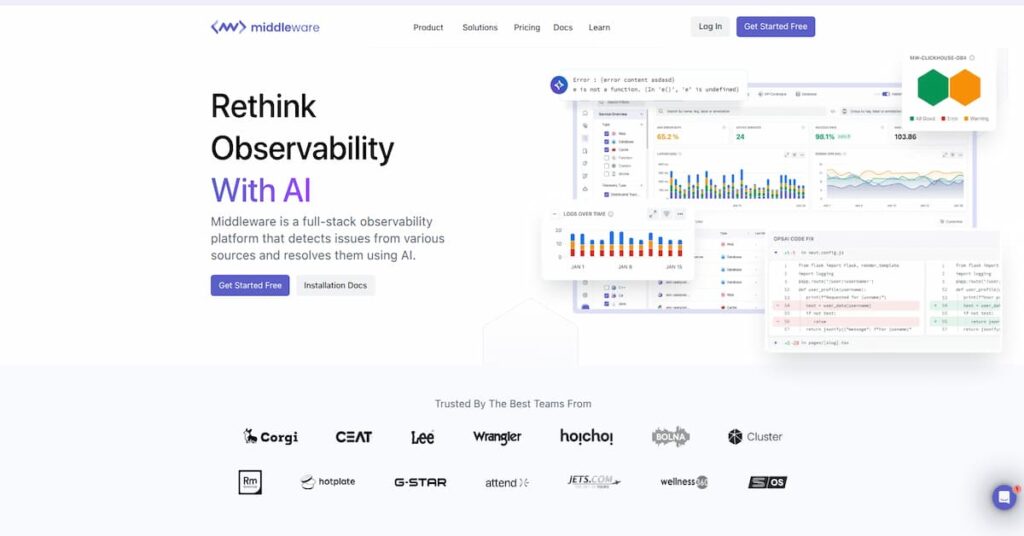
Middleware.io is a full-stack cloud observability platform designed to give developers and DevOps/SRE teams unified, real-time visibility into the performance, health, and behavior of applications and infrastructure. Its core value proposition is the consolidation of metrics, logs, distributed traces, and events into a single unified interface, eliminating the tool fragmentation that forces engineers to pivot between five different dashboards during an incident.
The platform is built for three primary audiences:
- Startups and individual developers: A 14-day free trial (14-day retention) helps early-stage teams try the product before committing to a paid plan.
- SMEs and mid-market engineering teams: The Pay-As-You-Go model gives predictable, linear cost scaling as environments grow, with unlimited users on all plans.
- Enterprises with data residency requirements: The Enterprise plan supports on-premise deployment and Bring Your Own Cloud (BYOC), keeping telemetry inside your own infrastructure.
Middleware.io is available on G2, Capterra, Gartner Peer Insights, and Software Advice, where it consistently scores highly for value for money and ease of setup.
Middleware.io’s Market Positioning in 2026
The observability market in 2026 has roughly three tiers:
At the top end are premium full-stack platforms such as Datadog, Dynatrace, Splunk, and New Relic. These tools offer broad feature sets and deep enterprise integrations, but costs can rise quickly once APM, logs, custom metrics, retention, and user access are fully enabled.
At the other end are open-source and self-managed tools such as Prometheus, Grafana, and OpenTelemetry-based stacks. These give teams more flexibility and more control over deployment, but they also require significant engineering effort to deploy, operate, and scale.
CubeAPM sits between these two ends of the market. It gives teams the control benefits associated with self-hosted observability while removing much of the operational burden through a vendor-managed model. Because CubeAPM runs in the customer’s own cloud or on-prem environment, teams keep control over data location and infrastructure. At the same time, they avoid the day-to-day overhead that usually comes with managing open-source observability stacks themselves.
Middleware.io occupies a position as a commercially supported, SaaS-delivered, usage-based platform that delivers full-stack observability (APM, logs, traces, RUM, synthetics) at a fraction of the cost of Datadog, without the operational overhead of self-managed open-source stacks. It is particularly well-suited for:
- Teams that want unified observability across a modern cloud stack without building and maintaining their own tooling
- Organizations that have grown past the Datadog free tier and need a cost-effective commercial alternative
- Engineering teams where unlimited user access to observability dashboards is operationally important
- Companies in regulated industries that need on-premise or BYOC deployment on the Enterprise tier
Key Features of Middleware.io
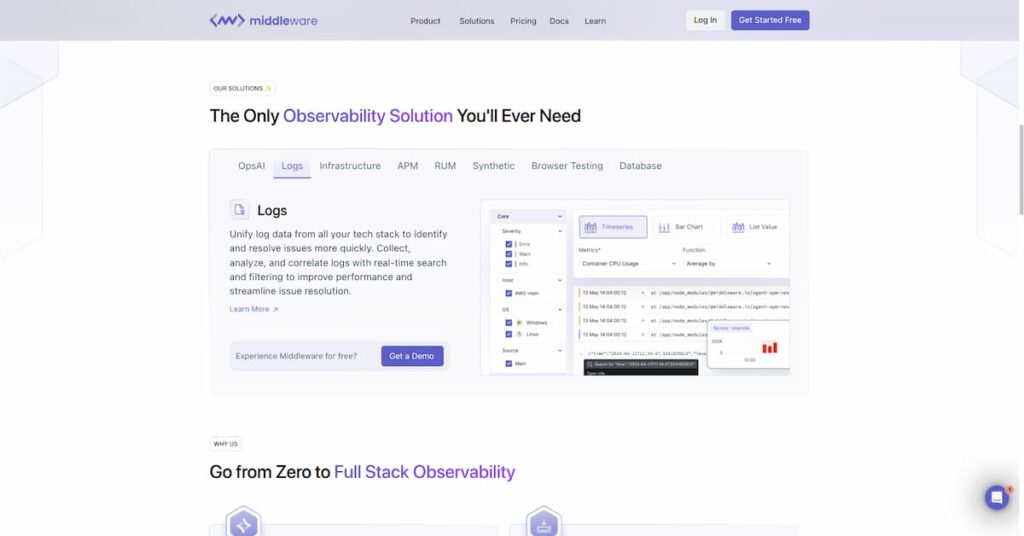
Middleware.io brings together metrics, logs, traces, events, and RUM data in a unified real-time timeline. Its platform is designed to help engineering teams investigate issues from one interface instead of switching between separate monitoring tools. Middleware also emphasizes telemetry correlation, which helps teams connect symptoms with likely causes faster.
OpsAI is Middleware.io’s built-in AI observability feature. It supports automatic issue detection, root cause analysis, and automatic PR generation. Its documentation also shows that OpsAI can connect observability signals with GitHub-linked code context, identify the likely source of an issue, and generate suggested fixes for some problems. This is one of the platform’s clearer differentiators in its product positioning.
Middleware.io supports infrastructure monitoring across hosts, containers, Kubernetes, and major cloud environments such as AWS, Azure, and GCP. The company highlights one-command installation through an OpenTelemetry-based agent, which supports its claim of faster setup and lower deployment friction for standard environments.
Middleware.io supports OpenTelemetry-based tracing, metrics, and logs through standard OTLP endpoints. Its documentation also describes how frontend RUM can be linked with backend traces and correlated logs. This makes it easier for teams to trace requests across services, identify latency bottlenecks, and investigate application issues alongside infrastructure behavior.
Middleware.io includes log monitoring and log ingestion as part of its full-stack observability platform. Logs are priced under the same GB-based usage model as other telemetry, and the platform correlates them with traces, metrics, and events on the same timeline. Middleware also provides dashboard and query-building tools for exploring telemetry data.
Middleware.io offers RUM for tracking frontend performance and user-side issues. Its browser monitoring materials highlight page performance, JavaScript errors, user interactions, and correlation with backend traces. The free plan includes 1,000 RUM sessions per month, while paid usage is billed separately on the pay-as-you-go plan.
Middleware.io supports synthetic monitoring for API and endpoint checks as well as browser-based testing. The product supports several protocol types, including HTTP, DNS, SSL, WebSocket, UDP, ICMP, TCP, and gRPC. The free tier includes 20,000 synthetic checks and 10 browser test runs, with usage-based charges applying on paid plans.
Middleware.io includes ingestion control and data pipeline features on its pay-as-you-go tier. According to its docs, these controls help teams decide what data to collect, parse, enrich, filter, or protect before it is fully processed. This is important for reducing noisy telemetry, controlling costs, and improving data handling practices.
Middleware.io advertises 450+ built-in integrations across cloud platforms, containers, databases, infrastructure services, and developer tools. Its product and documentation support broad coverage across modern cloud environments, and it also supports OpenTelemetry ingestion. This helps reduce instrumentation lock-in and makes the platform easier to fit into existing observability workflows.
How Middleware.io Works: Architecture and Deployment
Middleware.io uses a lightweight agent and OpenTelemetry-based collection approach to gather telemetry from customer environments. Its product and comparison pages describe setup as a one-script installation that can get monitoring running in minutes. Once installed, the platform can collect infrastructure metrics, logs, and traces and send that telemetry into Middleware’s observability platform for processing, storage, and analysis through its unified interface.
Middleware.io is built around OpenTelemetry for telemetry collection and instrumentation. That means teams can use OpenTelemetry SDKs and OTLP-based export instead of depending entirely on vendor-specific instrumentation. This supports a more portable observability setup and reduces lock-in risk compared with platforms that rely more heavily on proprietary collection models.
- Standard SaaS Deployment: In its standard cloud model, telemetry is collected from the customer environment and sent to Middleware’s hosted backend, where it is processed, stored, and queried. This is the simplest deployment model because teams do not need to operate the observability backend themselves. Middleware’s pricing page and product positioning align with this usage-based SaaS approach.
- Enterprise SaaS with Bring Your Own Cloud: Middleware says it offers bring-your-own-cloud flexibility for enterprise customers. This suggests a deployment option designed for teams that want more control over where observability data is handled and stored while still using Middleware’s commercial platform. However, unless you have direct product documentation or confirmation from Middleware, it is safer not to state that telemetry never passes through Middleware infrastructure.
- On-Premise Enterprise: Middleware also advertises on-premise deployment for enterprise customers. This makes it relevant for organizations that need stronger control over deployment location, data handling, or compliance requirements. Middleware positions this option alongside its enterprise support and compliance messaging.
What Are Middleware.io’s Plan Tiers?
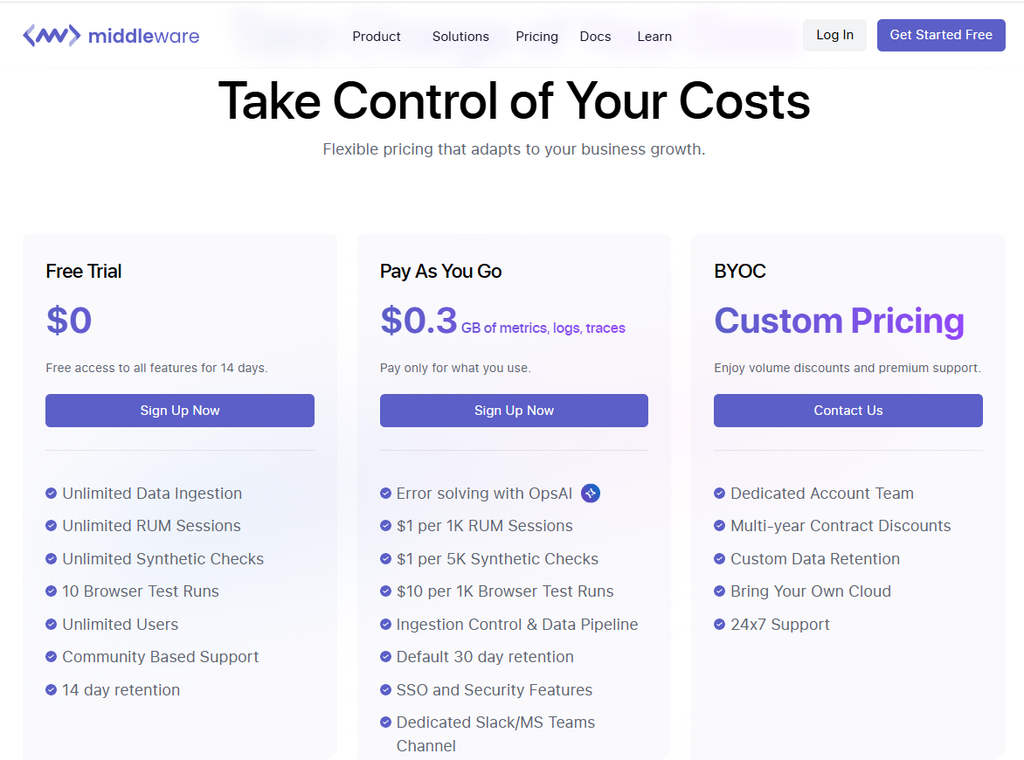
Middleware.io uses a usage-based pricing model built mainly around observability data volume rather than host-based pricing. On its pricing page, the company charges by GB for metrics, logs, and traces instead of charging by server or container. Middleware also positions this against host- or node-based pricing on its Datadog comparison page.
What Is the Billing Unit?
The main billing unit in Middleware.io is data volume. Its pricing page says data volume is the sum total of uncompressed logs, metrics, and traces. Data dropped through Middleware’s pipeline is not charged. Additional usage-based charges apply to RUM sessions, synthetic checks, browser test runs, and some OpsAI usage.
Plan Tiers Overview
Disclaimer: Plan feature lists and pricing are based on Middleware.io’s publicly available pricing page as of August 2026. Data volume is the sum of uncompressed logs, metrics, and traces. Verify current pricing at middleware.io/pricing before making purchasing decisions.
Free Trial
Pricing: $0/month. No credit card required. This solution is designed for individual developers and early-stage teams who need to try out production-grade observability without any upfront cost. It lets you try all the features for 14 days and with 14-day retention.
| Price | $0 / month, no credit card required |
| Best For | Individual developers, early-stage startups, teams evaluating the platform |
| Data | Unlimited data ingestion |
| RUM | Unlimited RUM sessions |
| Synthetics | Unlimited synthetic checks |
| Browser Test Runs | 10 |
| Users | Unlimited users |
| Retention | 14-day data retention |
| Support | Community-based support |
Pay As You Go
Starting price: $0.30 per GB of ingested data. Positioned for growing teams and SMEs that need full observability capabilities with transparent, linear cost scaling and no per-seat pricing.
| Price | $0.30 per GB of ingested logs, metrics, and traces |
| Best For | Growing startups, SMEs, and mid-market engineering teams |
| Error solving with OpsAI | Included |
| RUM | $1.00 per 1k RUM sessions |
| Synthetics | $1.00 per 5k synthetic checks |
| Browser tests | $10.00 per 1k browser test runs |
| Retention | 30-day default data retention |
| Ingestion Control & Data Pipeline | Included; filter and reduce data before ingestion to manage cost |
| SSO & security | Included |
| Support | Dedicated Slack / MS Teams support channel |
Enterprise
For custom pricing, contact Middleware.io sales. Positioned for regulated industries, large-scale deployments, and organizations with strict data residency or on-premise requirements.
| Price | Custom, requires a quote from Middleware.io sales |
| Best For | Regulated industries, large-scale teams, and organizations with strict data residency requirements |
| Deployment | On-premise deployment or Bring Your Own Cloud (BYOC) |
| Data residency | Telemetry stays inside your own infrastructure, no SaaS routing |
| Retention | Custom data retention periods available |
| Support | 24/7 dedicated support; dedicated account team |
| Contracts | Multi-year contract discounts |
| Browser tests | Custom browser test run volumes |
How Much Does Middleware.io Really Cost?
Middleware.io’s public pricing of $0.30 per GB is straightforward, but the real cost depends on your team’s actual data ingest volume, RUM session usage, synthetic check frequency, and whether you need Enterprise features. The sections below walk through the assumptions, then three real-world scenarios at different team sizes.
Assumptions Used in the Cost Scenarios
- All figures below are directional list-price estimates based on Middleware.io’s publicly available pricing. They are not official quotes.
- Scenarios do not include negotiated discounts, Enterprise contract terms, professional services costs, or custom retention pricing.
- Data ingest volumes are estimated based on typical observability footprints for each scenario type, using common industry benchmarks for log verbosity and metric cardinality.
- RUM and synthetic usage is estimated proportionally to the likely application and user base scale of each scenario.
Scenario 1: Growing SaaS Team — 15 Services, 50,000 Monthly Active Users
Situation: Consider a Series A SaaS company with a 20-person engineering team. They run 15 microservices across AWS and GCP, a Kubernetes cluster with 30 nodes, a PostgreSQL and Redis data layer, and a React frontend serving about 50,000 monthly active users. They need full APM, log management, distributed tracing, RUM for frontend performance, and synthetic monitoring across critical user flows. They are currently splitting monitoring between multiple tools and want to consolidate onto one platform.
Why teams at this stage consider Middleware.io
- Consolidating APM, logs, traces, and RUM onto one platform eliminates context-switching during incidents and reduces the engineering overhead of maintaining multiple integrations.
- The pay-as-you-go model means cost scales linearly with data volume; unlike per-host pricing, adding a new microservice does not trigger a discrete pricing step.
- Ingestion Control lets the team filter high-volume debug logs in non-production environments before they reach billing, actively managing cost without losing production visibility.
- At 20 engineers plus product and leadership stakeholders needing dashboard access, unlimited users is a significant cost advantage over seat-based competitors.
- OpsAI root cause analysis is practically valuable at this stage; a 20-person team without dedicated SRE capacity benefits substantially from automated incident triage.
Estimated ingest profile
Disclaimer: These figures are directional estimates for editorial comparison only. They are not official quotes. Actual pricing will vary based on actual data volumes, ingestion control configuration, contract terms, discounts, and add-on usage. Use Middleware.io’s pricing calculator at middleware.io/pricing for a personalized estimate.
| Telemetry source | Monthly estimate | Estimated GB/month | Notes |
| Application, infrastructure, and log telemetry | Combined observability data | ~5,000 GB/month | Logs, metrics, and traces combined |
| RUM sessions | ~50,000 sessions/month | Counted separately | 50K – 1K free = 49K billable |
| Synthetic checks (5 flows) | ~500,000 checks/month | Counted separately | 500K – 20K free = 480K billable |
| Total estimated ingest | (~5,000 – 1000) ~4,900 GB/month. | ~15 GB above the free tier |
Estimated monthly cost calculation
| Charge component | Calculation | Monthly cost | Annual cost |
| Data ingest above free tier | ((5,000 GB – 100 GB) × $0.30 | $1,470.00 | $17,640 |
| RUM sessions above free tier | 49K × ($1 / 1K) | $$49.00 | $588 |
| Synthetic checks above free tier | 480K × ($1 / 5K) | $96.00 | $1,152 |
| Browser test runs (no overage assumed) | Within free 10 runs/month | $0.00 | $0 |
| Total estimated cost | ~$1,615/month | ~$1,9380/year |
What this scenario shows
- The free tier absorbs nearly all data cost. At this level, the free tier no longer changes the economics much. Once the environment reaches about 5 TB per month, almost the full bill is driven by usage-based ingest pricing.
- RUM and synthetics dominate the bill at moderate usage. They become meaningful line items once usage scales. At 50,000 monthly RUM sessions and 500,000 synthetic checks, those two items add about $145 per month on top of the ingest bill.
- Middleware’s cost structure is driven mainly by telemetry volume, not just infrastructure size. For a growing SaaS team, the biggest cost lever is usually not the number of services by itself, but how much log, metric, and trace data those services generate and keep.
Scenario 2: Mid-Market Enterprise — 50 Services, Multi-Cloud, Regulated Industry
Situation: Consider a mid-sized fintech company with a 100-person engineering organization. They run 50 services across AWS and Azure, a Kubernetes platform with 150 nodes, multiple PostgreSQL and MongoDB database clusters, and customer-facing web and mobile applications. Their observability footprint is now much larger, generating about 27 TB of logs, metrics, and traces per month. They also run around 2,000,000 synthetic checks per month and about 200,000 RUM sessions per month. Compliance requirements mean they need stronger control over where telemetry is handled, so they are evaluating Middleware.io’s Enterprise deployment options alongside other vendors.
Why teams at this size consider Middleware.io
- The Enterprise BYOC deployment means all telemetry is processed and stored in their own AWS VPC, satisfying SOC 2 and PCI-DSS data residency requirements without an on-premise installation.
- At 100 engineers, the unlimited-users policy provides direct cost savings versus seat-based competitors. Datadog’s APM Full Host + Log Management on 150 Kubernetes nodes alone would exceed $30,000/month at list pricing.
- OpenTelemetry-native instrumentation means the company can switch observability backends in the future without re-instrumenting 50 services.
- OpsAI automated root cause analysis reduces the need for overnight on-call escalations for common failure patterns.
- its pricing model remains usage-based for data, RUM, synthetics, and browser testing rather than host-based.
Estimated ingest profile
| Telemetry source | Monthly estimate | Billing treatment | Notes |
| Logs, metrics, and traces | ~27,000 GB/month | Usage-based | Combined observability data |
| RUM sessions | ~200,000/month | Counted separately | 200K – 1K free = 199K billable |
| Synthetic checks | ~2,000,000/month | Counted separately | 2M – 20K free = 1.98M billable |
| Browser test runs | ~500/month | Counted separately | 500 – 10 free = 490 billable |
Estimated monthly cost calculation
Middleware’s public pricing page lists:
- $0.30 per GB for metrics, logs, and traces
- $1 per 1,000 RUM sessions
- $1 per 5,000 synthetic checks
- $10 per 1,000 browser test runs
- Free tier includes 100 GB, 1,000 RUM sessions, 20,000 synthetic checks, and 10 browser test runs.
| Charge component | Calculation | Monthly cost | Annual cost |
| Data ingest above free tier | (27,000 GB – 100 GB) × $0.30 | $8,070.00 | $96,840 |
| RUM sessions above free tier | 199K × ($1 / 1K) | $199.00 | $2,388 |
| Synthetic checks above free tier | 1,980K × ($1 / 5K) | $396.00 | $4,752 |
| Browser test runs above free tier | 490 × ($10 / 1K) | $4.90 | $58.80 |
| Total estimated cost | ~$8,669.90/month | ~$104,038.80/year |
What Actually Drives Middleware.io Costs
Understanding Middleware.io pricing requires understanding the levers that move your bill both upward and downward.
The primary cost driver. Every GB above 100 GB/month costs $0.30. The composition of your telemetry log verbosity and metric cardinality, and trace sampling rate determines this number. Middleware.io’s Ingestion Control pipeline is the single most effective cost management tool: filtering high-volume debug logs or low-priority metrics before ingestion directly reduces the billing meter. Teams that instrument aggressively without ingestion control can see ingest volumes 2–4× higher than operationally necessary.
At $1.00 per 1,000 sessions above the free 1K/month, RUM costs scale with your user base. For applications with 50K–500K MAUs, RUM can become the second-largest cost component after data ingest. Model your monthly active user session count carefully. Consider whether full session replay is necessary or whether aggregate RUM metrics serve your operational needs at lower session volumes.
The 20,000 free synthetic checks/month cover most SME use cases. Teams running dozens of critical user flow checks at high frequency can exceed this. At $1.00 per 5,000 checks, the per-check cost is low, but it accumulates for comprehensive synthetic coverage. Browser test runs are more expensive at $10/1,000 runs; use these selectively for critical paths.
The gap between Pay-As-You-Go and Enterprise is not published; it requires a direct quote. However, Enterprise’s value proposition is clear for teams that need on-premise or BYOC deployment, 24/7 support, and custom retention. For organizations paying $20,000+/month on Datadog, the Enterprise premium is almost certainly recoverable in cost savings.
Unlike most observability platforms where all instrumented data is billed, Middleware.io’s Ingestion Control allows teams to filter, transform, and drop telemetry before it reaches the billing meter. This is a significant structural advantage: teams can instrument broadly at the application level (capturing maximum context) and then selectively ingest only production-relevant data. Mature teams regularly achieve 30–60% reductions in billable ingest versus raw instrumentation volume through disciplined ingestion control configuration.
Enterprise contracts typically include annual price escalators. Third-party procurement benchmarks suggest annual increases in the 3–5% range are common. Negotiate escalator caps before signing multi-year agreements. Teams that present competitive alternatives (CubeAPM, Grafana Cloud, New Relic) during enterprise negotiation consistently report better pricing outcomes.
Hidden Costs Buyers Should Plan For
Middleware.io’s list pricing is among the most transparent in the observability market. But the total cost of operating any observability platform extends beyond the subscription line. The Salesforce Connectivity Report 2025 found that 81% of IT leaders say data silos hinder digital transformation, a finding that underscores that poorly managed observability infrastructure carries real business costs beyond the tool subscription itself.
For standard environments, Middleware.io’s single-script installation minimizes onboarding effort. For complex environments, large Kubernetes fleets, custom OTel pipelines, legacy application instrumentation, or multi-cloud setups, initial configuration can require meaningful engineering time.
- Standard setup: 1–2 engineer-days for a typical 10–20 service environment
- Complex enterprise deployment: 5–20 engineer-days for Kubernetes-heavy or multi-cloud environments with custom OTel pipeline configuration
- Third-party implementation support, if required, typically ranges from $5,000 to $30,000 depending on scope
The Ingestion Control pipeline is a genuine cost-saving tool, but it requires upfront investment to configure effectively. Identifying which telemetry streams are high-volume and low-value, building filter rules, and testing pipeline logic takes engineering time. Budget 1–3 engineer-days initially, with ongoing maintenance as services evolve. The ROI is typically strong: a 40% ingest reduction at 500 GB/month saves ~$180/month.
Effective synthetic monitoring requires deliberate check design, identifying critical user flows, setting appropriate check frequencies, and calibrating browser test runs to high-value paths. Under-designed synthetic coverage misses incidents; over-designed coverage inflates costs. Budget engineering time to audit and tune synthetic coverage quarterly.
The Pay-As-You-Go plan includes a dedicated Slack/MS Teams support channel, which is meaningfully better than community-only support. For production-critical deployments, the 24/7 support included in Enterprise plans provides a materially different SLA. Understand which support tier you need before selecting a plan.
The default 30-day retention on Pay-As-You-Go covers most operational needs. Compliance-driven organizations’ financial services (SOX, PCI-DSS), healthcare (HIPAA), or government (FedRAMP) may require 90-day or 1-year retention. Extended retention is available on Enterprise at custom pricing. Model this into your total cost estimate if your compliance posture requires it.
Annual price escalators in the 3–5% range are common across the observability market on enterprise contracts. A year-one deal that looks very competitive becomes materially less so if 5% annual escalators are written into a 3-year agreement. Negotiate escalator caps at signing; this is one of the easiest contract terms to overlook and one of the most impactful over a multi-year term.
If your team is migrating from Datadog, New Relic, or another platform, budget for migration effort: updating instrumentation, migrating dashboard configurations, recreating alert rules, and validating data parity. Middleware.io’s OpenTelemetry-native architecture means existing OTel instrumentation migrates with minimal changes. Migration from vendor-SDK-instrumented platforms (Datadog, Dynatrace) requires re-instrumentation of application code, typically 5–15 engineer-days depending on service count.
Middleware.io User Reviews (2026)
Middleware.io holds a 4.7/5 rating on G2 from 55+ verified reviews as of April 2026. On Capterra, it scores comparably well, with consistent praise for value for money and setup simplicity. The following is a balanced synthesis of verified user feedback across G2, Capterra, and Software Advice.
- Unified dashboard: The single timeline view consolidating logs, metrics, and traces is the most frequently cited strength. Users consistently describe it as ‘clean,’ ‘intuitive,’ and ‘eliminating tool-switching during incidents.’
- Fast setup: Single-script agent installation. Most users report being live with infrastructure monitoring in under an hour and full APM + logging in under a day for standard environments.
- Value for money: Compared to Datadog, New Relic, and Dynatrace, Middleware.io is cited as dramatically more cost-effective for comparable feature coverage — particularly by teams that were previously spending $5,000–$20,000/month on incumbent platforms.
- OpsAI: AI-powered root cause analysis and automated PR generation are highlighted as genuinely useful, especially for teams without dedicated SRE capacity who benefit from automated first responses to common failure patterns.
- Ingestion Control: Teams that have configured the Ingestion Control pipeline cite it as a meaningful cost management advantage, filtering high-volume, low-value data before billing, not after.
- Unlimited users: Consistent positive feedback from teams that have outgrown seat-based pricing. Product managers, customer success leads, and engineering managers access dashboards without incremental cost.
- Support quality: Dedicated Slack/Teams support channels on Pay-As-You-Go are frequently mentioned as a genuine differentiator versus community-only support at comparable price points.
- Learning curve for advanced features: Custom query building, advanced alert configuration, and ingestion control pipeline setup have a steeper learning curve than the initial setup. Users with more complex requirements report spending additional time in documentation.
- Initial configuration complexity: For non-standard environments, custom OTel pipeline configuration or legacy application instrumentation can be more involved than the quick-start documentation suggests.
- Enterprise pricing opacity: Enterprise BYOC and on-premise pricing require direct sales engagement; there is no self-serve pricing calculator for this tier. Teams evaluating Enterprise need to build more time into their procurement process.
Representative Verified User Feedback
“Comprehensive monitoring capabilities—Middleware.io offers a wide range of monitoring capabilities, allowing deeper insights into system performance than many alternatives at this price point. The unified dashboard is genuinely useful during incidents.” — Verified G2 Review (2026)
“The AI capabilities for error resolution are a standout. OpsAI catches things we’d miss in the noise and surfaces root causes we’d spend hours finding manually.” — Verified G2 Review (2026)
“Initial configuration was more complex than expected for our Kubernetes environment. Once we had it dialled in, the day-to-day experience is smooth, and the cost versus Datadog is not even a comparison.” — Verified Capterra Review (2026)
Summary Rating Breakdown (G2, April 2026)
| Overall rating | 4.7/5 (55+ verified reviews) |
| Ease of Use | High single-script setup, intuitive unified UI |
| Customer Support | Strong, dedicated Slack/Teams channel praised consistently |
| Value for Money | Very high, the most consistent competitive advantage cited by users |
| Feature Set | Strong, APM, logs, traces, RUM, synthetics, OpsAI in one platform |
| Number of reviews | 55+ verified reviews on G2; additional coverage on Capterra and Software Advice |
Middleware Pricing Comparison: All Major Tools (2026)
The table below compares current publicly available pricing across major observability and middleware platforms.
| Tool / Platform | Pricing Model | Starting Price (2026) | Free Trial |
| Middleware.io | Pay-as-you-go (per GB) | $0.30/GB ingested | Yes, 14 days |
| Datadog | Per host + usage-based | ~$15/host/month (Infra Pro) | 14-day trial only |
| New Relic | Ingest-based + user seats | Free up to 100 GB/month | Yes, 100 GB/month |
| Dynatrace | Host-based + ingestion | Infra: ~$29/host/monthFull-stack monitoring: $58 / mo / 8 GiB host* | 15-day trial |
| Grafana Cloud | ingestion-based | Free tier; $0.50/GB logs | Yes |
| CubeAPM | Per GB ingested | From $0.20/GB | No |
| Splunk Observability | Per host / per GB | App & Infra: $60/host/monthEnd-to-End: $75/host/month | 14-day trial |
| Splunk AppDynamics | Per agent/unit | Infrastructure Edition: $6Per vCPU/monthPremium Edition: $33Per vCPU/month | 15-day trial |
Note: Pricing is sourced from publicly available vendor pricing pages as of August 2026. Enterprise negotiations and volume discounts may result in significantly different pricing. Always request current quotes directly from vendors before making purchasing decisions.
Feature Comparison: Middleware.io vs. Key Competitors
| Feature / Criteria | Middleware.io | Datadog | New Relic | CubeAPM |
| Pricing model | Per GB ingested | Per host + usage | Ingest + seat | Per GB ingested |
| Free tier | No, free trial only | Trial only | Yes (100 GB/mo) | No |
| Infra monitoring | Yes | Yes | Yes | Yes |
| APM / Distributed tracing | Yes | Yes | Yes | Yes |
| Log management | Yes | Yes | Yes | Yes |
| Real User Monitoring (RUM) | Yes | Yes | Yes | Yes |
| Synthetic monitoring | Yes | Yes | Yes | Yes |
| AI root cause analysis | Yes (OpsAI) | Yes (Watchdog) | Yes | Yes |
| On-premise deployment | Enterprise plan | No | No | Yes (core) |
| Full data residency | Enterprise (BYOC) | No | No | Yes |
| OpenTelemetry-native | Yes | Yes | Yes | Yes (full) |
| Unlimited users | Yes, all plans | No (seat-based) | No (seat-based) | Yes |
| G2 rating (2026) | 4.7/5 (55+ reviews) | 4.3/5 | 4.3/5 | 4.9/5 |
Middleware.io Alternatives: Detailed Comparisons
Middleware.io vs Datadog?
Datadog is the market-leading cloud-native observability platform. Its Infrastructure Monitoring Pro plan starts at approximately $15/host/month, but total costs escalate sharply once APM (~$31/host/month), log ingestion (~$0.10/GB), and additional products are enabled. A Growing team running 50 hosts with full observability on Datadog typically spends $5,000–$15,000/month. Middleware.io’s equivalent configuration typically costs under $200/month on Pay-As-You-Go.
| Pricing component | Middleware.io | Datadog |
| Pricing model | Per GB ingested (pay-as-you-go) | Per host/month + usage-based add-ons |
| Starting price | $0.30/GB | Infra Pro ~$15/host/month |
| Main billing unit | GB of logs + metrics + traces | 1 host; separate charges for APM, logs, RUM, spans |
| What drives cost most | Data ingest volume; RUM sessions; synthetic checks | Host count + enabled products (APM, logs, spans) |
| Cost predictability | High, scales linearly with data volume | Lower, multiple usage meters compound |
| Unlimited users | Yes | No, per-seat charges on dashboards/views |
| On-premise option | Yes (Enterprise plan, BYOC) | No |
| Best fit | Cost-sensitive teams wanting unified observability | Cloud-native orgs with broad compliance requirements |
Middleware.io vs New Relic?
New Relic moved to an ingest-based model similar to Middleware.io, with a free tier offering 100 GB/month. The platforms are broadly comparable in cost for moderate data volumes. The key pricing difference: New Relic charges per user seat for full-platform access (~$549/user/month for Full Platform users), while Middleware.io includes unlimited users on all plans. For organizations with 20+ people needing dashboard access, this difference compounds significantly.
If you want to model your current New Relic bill, the New Relic pricing calculator breaks down every cost dimension: data ingest, user seats, synthetics, and the cloud egress fees most teams overlook.
| Pricing component | Middleware.io | New Relic |
| Pricing model | Per GB ingested | Ingest-based + user/platform tiers |
| Starting price | $0.30/GB | Free 100 GB/month; $0.40/GB above |
| Main billing unit | GB of logs + metrics + traces | GB ingest + user access tier |
| What drives cost most | Data ingest volume | Data volume + user tier (Core/Full/Admin seats) |
| User pricing | Unlimited users on all plans | Full platform users ~$549/user/month |
| Cost predictability | High | Medium, user seat costs compound in large orgs |
| On-premise option | Yes (Enterprise) | No |
| Best fit | Teams wanting predictable, seat-free cost | Teams with small user bases and diverse telemetry |
Middleware.io vs Dynatrace?
Dynatrace is a full-stack AI-driven observability platform with mature code-level APM and its Davis AI engine for root cause analysis. It commands premium pricing (~$58+/host/month for full-stack) and is typically best suited to large enterprises where APM depth and application-layer AIOps are the primary requirements. Middleware.io’s OpsAI provides analogous AI root cause analysis capabilities at a fraction of the cost, though Davis AI is generally regarded as more mature for complex enterprise application performance scenarios.
| Pricing component | Middleware.io | Dynatrace |
| Pricing model | Per GB ingested | Host-based + DEM units |
| Starting price | $0.30/GB | ~$29/host/month (full-stack) |
| Main billing unit | GB of logs + metrics + traces | Host capacity + DEM consumption units |
| What drives cost most | Data ingest volume | Host count + deployment scope + product mix |
| AI capability | OpsAI (root cause, auto PR generation) | Davis AI (mature app-layer AIOps) |
| Cost predictability | High | Medium, layered as scope expands |
| On-premise option | Yes (Enterprise) | Managed cluster option available |
| Best fit | Teams prioritising cost efficiency | Enterprises needing deep APM AIOps at scale |
Middleware.io vs Grafana Cloud?
Grafana Cloud is a popular open-source-based observability platform with flexible usage-based pricing. It is highly customizable but has a steeper configuration learning curve; teams need Grafana expertise to build effective dashboards, alert rules, and query logic. Middleware.io offers a more opinionated, integrated experience with significantly less configuration overhead. For teams with strong Grafana expertise who want maximum flexibility, Grafana Cloud is compelling. For teams that want fast time-to-value, Middleware.io is the better choice.
| Pricing component | Middleware.io | Grafana Cloud |
| Pricing model | Per GB ingested | Usage-based (logs, metrics, traces separate) |
| Starting price | $0.30/GB | Free tier; $0.50/GB logs; $6.50/1k series |
| Main billing unit | GB of unified logs + metrics + traces | Separate meters per telemetry type |
| What drives cost most | Total ingest volume | Log volume + metric cardinality + trace volume |
| Configuration effort | Low opinion unified UI | High, requires Grafana expertise to configure |
| Cost predictability | High | Medium |
| On-premise option | Yes (Enterprise) | Self-hosted Grafana OSS available |
| Best fit | Teams wanting fast setup with less config | Teams with strong Grafana expertise wanting flexibility |
Middleware.io vs CubeAPM?
CubeAPM is a full-stack observability platform built on OpenTelemetry-native architecture with a strong emphasis on data residency and on-premise deployment. It is designed for teams that require all observability telemetry to remain within their own infrastructure; no data transits third-party SaaS backends. CubeAPM’s pricing starts from approximately $0.15/GB, making it the most cost-effective option for teams with high data volumes where self-hosted infrastructure cost is manageable. For regulated industries in financial services, healthcare, or government, CubeAPM is a strong alternative or complement to Middleware.io’s Enterprise BYOC option.
| Pricing component | Middleware.io | CubeAPM |
| Pricing model | Per GB ingested (SaaS-first) | Per GB ingested (on-premise-first) |
| Starting price | $0.30/GB | $0.20/GB |
| Main billing unit | GB of logs + metrics + traces | GB of ingested telemetry |
| Data residency | SaaS default; BYOC on Enterprise | 100% on-premise data never leaves your infra |
| Deployment | Cloud-hosted SaaS (or BYOC Enterprise) | Your own cloud or data centre |
| On-premise cost | Enterprise custom pricing | No |
| OTel support | Yes | Yes, fully OTel-native |
| Best fit | Teams wanting SaaS simplicity and low cost | Regulated industries needing full data sovereignty |
Enterprise Integration Middleware in 2026: A Separate Landscape
When engineers and IT leaders search for ‘middleware pricing,’ they may be looking for observability middleware (covered above) or enterprise integration middleware, a fundamentally different software category. For completeness, here is a brief pricing orientation for the major integration middleware platforms.
MuleSoft is the leading enterprise iPaaS for API-led integration. Entry-level packages start at approximately $2,800/month, with full enterprise licensing typically reaching $100,000–$500,000+ annually for large organizations. MuleSoft is purpose-built for connecting ERP, CRM, and SaaS systems, a fundamentally different use case from application performance observability.
IBM WebSphere and Oracle Fusion Middleware are enterprise-grade application server and integration platforms embedded in large financial institutions, government agencies, and manufacturing organizations. Both use complex per-processor or named-user licensing models, and the total cost of ownership (including support, upgrade cycles, and operational overhead) typically runs $50,000–$500,000+ annually for enterprise deployments. These are strategic infrastructure investments, not commodity tooling. Evaluation should include total implementation and maintenance cost alongside license fees.
For SMEs and mid-market teams needing application integration rather than observability, Boomi, Jitterbit, Microsoft Azure Logic Apps, and Zapier offer more accessible price points. Azure Logic Apps and Zapier offer consumption-based pricing that makes them cost-effective for moderate integration volumes without large upfront commitments.
When to Use Middleware.io: A Decision Framework
- You want unified full-stack observability at low cost: APM, logs, traces, RUM, and synthetics in one platform, with predictable pay-as-you-go pricing and unlimited users.
- Cost efficiency is a priority: Teams migrating from Datadog or New Relic who want comparable feature coverage at significantly lower cost.
- You need fast time-to-value: Single-script agent installation and an opinionated unified UI mean you can be in production with full observability in hours, not weeks.
- Your team is growing: Unlimited users mean dashboards can be shared with product, customer success, and leadership without incremental seat costs.
- You want AI-assisted incident response: OpsAI automated root cause analysis and PR generation is particularly valuable for teams without dedicated SRE capacity.
- Strict data residency without cloud routing: If compliance requires all telemetry to remain within your own infrastructure with no SaaS transit, even BYOC CubeAPM provides a fully on-premise alternative at $0.15/GB.
- Very high MAU / RUM session volumes: At 1M+ MAU, RUM session costs ($1/1K sessions) can become the dominant cost driver. Model this carefully before committing.
- Enterprise integration middleware requirements: If you need to connect ERP, CRM, and SaaS systems rather than monitor application performance, MuleSoft, Boomi, or Azure Logic Apps are the appropriate categories.
The Cost of Poor Observability: Why This Matters
The DORA 2024 State of DevOps Report found that elite DevOps teams, those with mature observability and incident response practices, restore service from incidents 182 times faster than low-performing teams and deploy code 127 times more frequently. The productivity compounding effect of good observability is not incremental; it is structural.
Separately, Gartner estimates that IT downtime costs enterprises an average of $5,600 per minute. For a team running Scenario 2 above (15 services, 50K MAUs) spending ~$50/month on Middleware.io, preventing a single hour of production downtime per year delivers an ROI measured in hundreds of thousands of dollars, making the observability spend trivially justified on incident-prevention grounds alone.
📊 DORA 2024: Elite DevOps teams restore service 182× faster than low performers. The right observability platform is not a cost centre, it is leverage on engineering productivity and system reliability.
Conclusion
Middleware.io is a credible lower-cost observability platform in 2026. It offers a free trial tier for 14 days, Pay As You Go pricing at $0.30/GB, full-stack observability across APM, logs, traces, RUM, and synthetics, plus OpsAI features. Middleware also currently shows a 4.7/5 G2 rating from 55+ verified reviews.
Its pricing can still rise fast at scale because ingest remains the main cost driver. Teams with high telemetry volume, RUM traffic, or heavy synthetic usage should model those costs carefully before committing. The main caveat is the deployment model. Middleware’s standard setup is SaaS, while Enterprise adds Bring Your Own Cloud and on-premises deployment options. For teams with stricter data residency needs, CubeAPM is the stronger fit because it is self-hosted but vendor-managed, giving teams tighter infrastructure control without the normal operational burden.
Disclaimer: The information in this article reflects the latest details available at the time of publication and may change as technologies and products evolve.
FAQs
1. What is Middleware.io?
Middleware.io is a full-stack observability platform that brings together infrastructure monitoring, APM, distributed tracing, log monitoring, real user monitoring, and synthetic monitoring in one platform for engineering and operations teams.
2. How much does Middleware.io cost in 2026?
Middleware.io publicly lists three plans: Free trial, Pay As You Go, and Enterprise. The Pay As You Go plan is priced at $0.30 per GB for logs, metrics, and traces, while Enterprise uses custom pricing and includes options such as on-premise deployment, Bring Your Own Cloud, 24×7 support, and a dedicated account team.
3. Is Middleware.io free?
No, it currently offers a 14-day free trial, not a free tier. It comes with 14-day retention, unlimited users, community support, 10 browser test runs, and unlimited data ingestion, synthetic tests, and RUM checks.
4. What is the Middleware.io billing unit?
Middleware.io’s main billing unit is data volume. Its pricing page defines this as the total uncompressed logs, metrics, and traces stored on the platform. The company also says usage is measured daily by data type and source, and that data dropped through the pipeline is not billed. Additional usage charges apply to RUM sessions, synthetic checks, browser test runs, and some OpsAI usage.
5. What is OpsAI in Middleware.io?
OpsAI is Middleware.io’s AI feature set for automatic issue detection, root cause analysis, faster issue solving, and automatic PR generation. Middleware’s pricing FAQ also notes that advanced root cause analysis and automated fixes are tied to token usage.
6. Does Middleware.io support on-premise deployment?
Yes. Middleware.io’s Enterprise plan includes both On-Premise Deployment and Bring Your Own Cloud options. Teams that need strict control over deployment location and data handling should still confirm the exact architecture with Middleware’s sales team before buying.
7. Does Middleware.io support OpenTelemetry?
Yes. Middleware.io supports OpenTelemetry-based instrumentation and ingestion, and its docs include OpenTelemetry setup guidance. That makes it easier for teams to use standard telemetry collection rather than relying only on proprietary collection methods.
8. How does Middleware.io handle data retention?
The free trial plan includes 14-day retention, while the Pay As You Go plan includes 30-day retention by default. Middleware also says custom contracts can include custom retention settings.