










The main difference between SigNoz, Splunk AppDynamics, and CubeAPM is their platform design. SigNoz is an OpenTelemetry-native tool built on open-source infrastructure. Splunk AppDynamics is an enterprise APM platform with unified MELT. CubeAPM unifies application, infrastructure, logs, and user monitoring in a single observability platform.
As software architectures shift toward microservices, Kubernetes, and distributed cloud environments, observability tools are expected to go beyond basic metrics and traces. Teams now evaluate platforms based on deployment model, data retention, sampling strategy, and how easily telemetry can be correlated across services.
This comparison examines how SigNoz, Splunk AppDynamics, and CubeAPM differ across core observability capabilities, deployment approaches, pricing models, and use cases.
SigNoz vs Splunk AppDynamics vs CubeAPM: Feature Comparison
| Features | CubeAPM | SigNoz | Splunk AppDynamics |
| Known for | Unified OpenTelemetry-native observability with predictable pricing | OpenTelemetry-first, open-source observability | Enterprise-grade application performance monitoring |
| Multi-Agent Support | Yes (OTel, New Relic, Datadog, Elastic) | Limited (OTel) | Limited (OTel) |
| MELT Support | Full MELT | Full MELT | Full MELT |
| Setup | Self-hosted but vendor-managed | SaaS & Self-hosted | SaaS & Self-hosted |
| Pricing | Ingestion-based pricing of $0.15/GB | Logs: $0.3/GB Traces: $0.3/GB Metrics: $0.1/mil samples | APM: $33/month/CPU core Infra: $6/month/CPU core |
| Sampling Strategy | Smart sampling | Head + Tail-based | Head + Tail-based |
| Log Retention | Infinite Retention | 15 days | 14 days |
| Support TAT | < 10 minutes | No details | 30mins to 1 day |
Known for
CubeAPM: Known for providing full-stack observability across applications, infrastructure, logs, and user experience in a single platform. It is built with native OpenTelemetry support and is commonly used by teams looking for unified visibility without managing multiple backends.
SigNoz: Known for being an OpenTelemetry-native, open-source observability platform. It is often adopted by engineering teams that want flexibility and control over their observability stack.
Splunk AppDynamics: Known for enterprise-grade application performance monitoring with deep transaction tracing and business transaction visibility. It is widely used in large organizations that require detailed application insights and centralized APM governance.
Multi-Agent Support
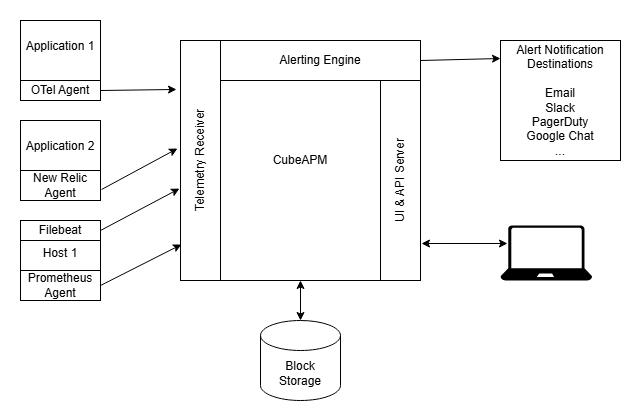
CubeAPM: Supports multi-agent ingestion, allowing teams to ingest telemetry from multiple agent ecosystems alongside OpenTelemetry. This includes vendor agents such as New Relic, Datadog, and Elastic, which help teams migrate gradually without re-instrumenting existing services all at once.
SigNoz: Provides limited multi-agent support, basically OTel and Prometheus. SigNoz relies on OpenTelemetry as the documented and primary ingestion mechanism, with no documented support for third-party vendor agents like New Relic and Datadog.
Splunk AppDynamics: Provides limited multi-agent support. It primarily uses proprietary AppDynamics agents, with OpenTelemetry supported as an additional ingestion option. There is no documented support for ingesting telemetry directly from other vendor agents such as New Relic, Datadog, or Elastic.
MELT Support (Metrics, Events, Logs, Traces)
CubeAPM: Provides full MELT support across metrics, logs, traces, and events within a single observability platform. All telemetry is collected using OpenTelemetry and stored together, enabling teams to analyse application performance, infrastructure behaviour, and system events from one place. This approach supports full-stack observability across cloud, Kubernetes, and microservices environments.
SigNoz: Supports full MELT coverage through OpenTelemetry-based ingestion of metrics, logs, and traces. These signals are available within the platform and can be explored together for troubleshooting and performance analysis. Event-related information is typically represented through trace spans and log attributes rather than as a separate event pipeline.
Splunk AppDynamics: Supports full MELT coverage. Metrics, traces, events, and logs are collected through AppDynamics agents and OpenTelemetry integrations.
Setup and Deployment

CubeAPM: Deployed inside a customer’s VPC or on-prem environment. The platform is self-hosted, while core operations such as upgrades, scaling, and maintenance are handled by the vendor. This model allows teams to retain full control over data location without managing day-to-day observability operations.
SigNoz: Supports both SaaS and self-hosted deployments. In self-hosted setups, teams are responsible for deploying, operating, and scaling ClickHouse backend components such as storage and query services. This provides flexibility but requires internal expertise to manage production reliability.
Splunk AppDynamics: Supports SaaS and on-premises deployments. In the self-hosted model, the AppDynamics controller runs as a virtual appliance or controller node inside the customer environment, and teams install agents and configure the controller according to documented steps for on-prem deployments.
Pricing: Approximate Cost for Small, Mid-Sized & Large Teams
*All pricing comparisons are calculated using standardized small/medium/large team profiles defined in our internal benchmarking sheet, based on fixed log, metrics, trace, and retention assumptions. Actual pricing may vary by usage, region, and plan structure. Please confirm current pricing with each vendor.
*An APM host is a host that is actively generating trace data, and an Infra host is any physical or virtual OS instance that you monitor with any observability tool.
Below is a cost comparison for small, mid-sized, and large teams.
| Approx. Cost for Teams | Small (~30 APM Hosts) | Mid-sized (~125 APM Hosts) | Large (~250 APM Hosts) |
| CubeAPM | $2,080 | $7,200 | $15,200 |
| SigNoz | $4,600 | $16,000 | $34,000 |
| Splunk APM | $2,290 | $8,625 | $17,750 |
Teams switching to CubeAPM save roughly 55% compared to SigNoz and about 17% compared to Splunk APM for mid-sized environments.
CubeAPM: Cost for Small, Medium, and Large Teams
CubeAPM follows a straightforward and predictable ingestion-based pricing model. There are no charges based on the number of users, hosts, or enabled features, which helps teams avoid unexpected cost increases as their environments scale.
Pricing details:
- Ingestion pricing of $0.15 per GB
Based on comparable production workloads, the approximate monthly costs are:
- Small teams (~30 APM hosts): $2,080
- Mid-sized teams (~125 APM hosts): $7,200
- Large teams (~250 APM hosts): $15,200
Because CubeAPM supports self-hosted and BYOC deployment models, all telemetry data remains within the customer’s own cloud or on-prem environment. This approach allows organizations to scale observability usage predictably, without incurring additional fees for data retention or storage.
SigNoz: Cost for Small, Medium, and Large Teams
SigNoz uses an ingestion-based pricing model where costs are driven mainly by telemetry ingestion. Pricing can increase as data volumes and retention requirements grow.
Pricing details:
- Logs: $0.3/GB ingested
- Traces: $0.3/GB ingested
- Metrics: $0.1/mil samples
Based on comparable production workloads, the approximate monthly costs are:
- Small teams (~30 APM hosts): $4,600
- Mid-sized teams (~125 APM hosts): $16,000
- Large teams (~250 APM hosts): $34,000
In self-hosted deployments, additional infrastructure and operational costs may apply, since teams manage storage, scaling, and retention themselves.
Splunk AppDynamics: Cost for Small, Medium, and Large Teams
Splunk AppDynamics follows a host-based pricing model, with costs typically based on the number of monitored hosts and selected capabilities.
Pricing details:
- AppDynamics APM: $33/month/CPU core
- AppDynamics Infra: $6/month/CPU core
Based on comparable production workloads, the approximate monthly costs are:
- Small teams (~30 APM hosts): $2,290
- Mid-sized teams (~125 APM hosts): $8,625
- Large teams (~250 APM hosts): $17,750
In self-hosted deployments, additional infrastructure and operational overhead may apply, including controller management and storage requirements.
Sampling Strategy
CubeAPM: Uses smart sampling to control telemetry volume while retaining meaningful traces for analysis. Sampling decisions help reduce low-value data while preserving representative requests and error paths.
SigNoz: SigNoz supports sampling through OpenTelemetry configuration, primarily using head-based + tail-based sampling via the OTEL Collector. Users can apply sampling rules at the collector level to control which traces are sent for storage and analysis. Additionally, span drop rules can be used to filter out low-value spans before ingestion.
Splunk AppDynamics: Supports both head-based and tail-based sampling for distributed traces. Sampling policies can be configured to limit the number of traces collected while preserving complete traces for selected transactions or conditions.
Data Retention
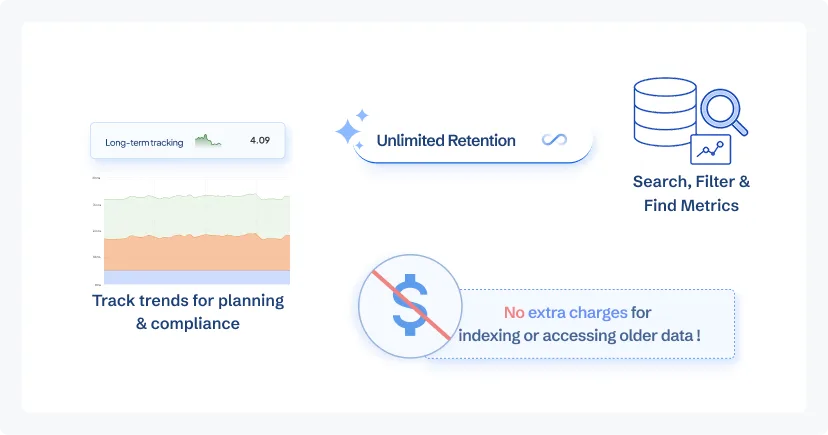
CubeAPM: Supports unlimited data retention by default. Logs, metrics, and traces can be retained indefinitely without enforced time limits, allowing teams to keep historical telemetry for audits, long-term trend analysis, and incident investigations. Because data is stored within the customer’s own cloud or on-prem environment, retention does not increase costs or require upgrading to higher tiers.
SigNoz: Applies capped default retention across telemetry types. Logs are retained for 15 days, traces for up to 30 days, and metrics for roughly one month. Extending these retention periods increases cost because pricing scales with per-GB ingestion. For example, increasing log retention from 15 days to 30 days can raise pricing from about $0.3 per GB to roughly $0.4 per GB, which can significantly increase spending as data volume scales.
Splunk AppDynamics: Retention varies by metric resolution and data type. By default, one-minute resolution metrics are retained for around 4 hours, ten-minute resolution metrics for about 48 hours, and one-hour aggregated metrics for up to 13 months. Event data is typically retained for approximately 8 days. Retention settings can be modified through controller configuration, but increasing retention requires additional database capacity and storage planning.
Support Channel and TAT
CubeAPM: Provides support through multiple direct channels, including Slack, email, and WhatsApp. Support requests are handled by the core engineering team, with response times typically under 10 minutes. This model is designed to help teams resolve production issues quickly without navigating ticket backlogs.
SigNoz: Offers support through Slack, email, and its GitHub community. Support is largely community-driven, with assistance provided through discussions and issue tracking. There is no publicly documented information about guaranteed response times or turnaround SLAs.
Splunk AppDynamics: Offers tiered enterprise support through Splunk’s official support programs. Support is provided via ticket-based channels, with response times defined by the selected support level. Based on Splunk’s support plans, the fastest response time can be as low as 30 minutes for critical issues, while lower-priority cases may have response times of up to 1 business day.
Which Tool Is Best for You? Why Brands Choose CubeAPM
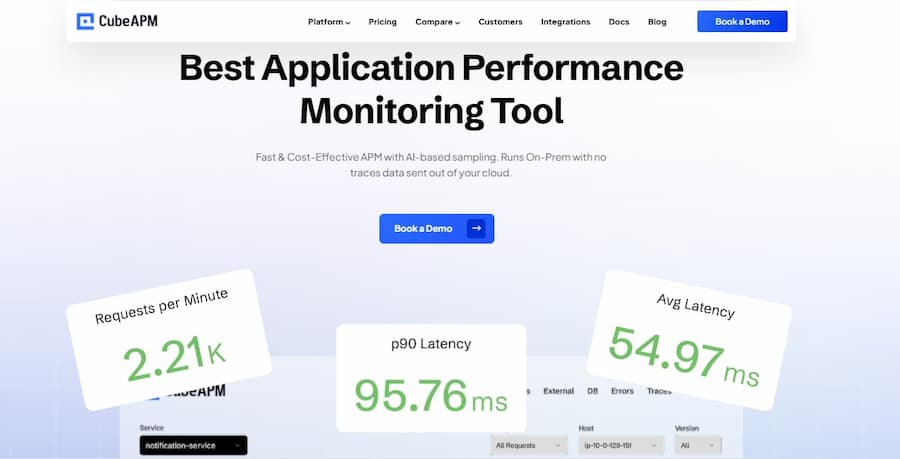
Benefits of Choosing CubeAPM
- Full data sovereignty: All telemetry stored inside the customer’s own cloud or on-prem environment to support data residency and compliance requirements.
- Unified MELT visibility: bringing metrics, events, logs, and traces together in a single platform to reduce context switching during investigations.
- Predictable pricing: based on a single ingestion model at $0.15 per GB, helping teams plan observability costs as telemetry volume grows.
- Unlimited data retention: allowing long-term storage of historical telemetry without retention limits becoming a cost driver.
- Smart sampling: reduces telemetry volume while preserving high-value signals such as errors and latency anomalies.
- Multi-agent compatibility: enables teams to migrate from existing observability setups without immediately re-instrumenting services.
- API access to all observability data without additional charges, supporting integrations, automation, and custom analysis workflows.
SigNoz vs Splunk AppDynamics vs CubeAPM: Use Cases
Choose CubeAPM if:
- You need full-stack observability across applications, infrastructure, logs, traces, and events in one platform.
- You require strict data residency and want all telemetry to remain inside your own cloud or on-prem environment.
- You want unlimited data retention for investigations and long-term analysis without retention becoming a cost factor.
- You prefer predictable ingestion-based pricing that scales with data volume instead of users or hosts.
- You rely on fast issue resolution and need real-time support access through direct channels.
Choose SigNoz if
- You want an OpenTelemetry-native observability platform built around open-source components.
- You need flexibility to customize telemetry pipelines and sampling using OpenTelemetry collectors.
- You are a startup or engineering-led team optimizing for control and extensibility over operational simplicity.
- You prefer a community-driven support model with optional paid plans.
Choose Splunk AppDynamics if
- You operate in a large enterprise environment that requires deep application performance monitoring and transaction-level visibility.
- You need mature APM capabilities focused on business transactions and application health.
- You already use Splunk products and want tighter integration within the Splunk ecosystem.
- You require enterprise-grade, SLA-backed support with defined response times.
Conclusion
SigNoz, Splunk AppDynamics, and CubeAPM each address observability with different priorities. SigNoz focuses on OpenTelemetry-native flexibility, Splunk AppDynamics targets enterprise application performance monitoring, and CubeAPM delivers full-stack observability with strong data control. The right choice depends on operational effort, retention needs, pricing predictability, and support expectations.
Disclaimer: The information in this article reflects the latest details available at the time of publication and may change as technologies and products evolve.
FAQ
1. What is the main difference between SigNoz, Splunk AppDynamics, and CubeAPM?
CubeAPM provides full-stack observability with unified metrics, logs, traces, and events, while supporting self-hosted and BYOC deployments. SigNoz is an OpenTelemetry-native observability platform built around open-source components and user-managed infrastructure. Splunk AppDynamics is an enterprise APM tool focused on deep application and transaction monitoring.
2. How do SigNoz vs Splunk AppDynamics vs CubeAPM compare in data retention?
CubeAPM supports unlimited data retention by default. SigNoz and Splunk AppDynamics apply time-based retention limits that vary by data type and configuration, with longer retention requiring additional cost or infrastructure planning.
3. Do all three tools support OpenTelemetry?
Yes, all three support OpenTelemetry. SigNoz is built entirely around OpenTelemetry ingestion. Splunk AppDynamics supports OpenTelemetry alongside its proprietary agents. CubeAPM is OpenTelemetry-native and designed to ingest telemetry using standard instrumentation.
4. How do pricing models differ between SigNoz, Splunk AppDynamics, and CubeAPM?
CubeAPM uses a simple ingestion-based pricing model. SigNoz pricing is driven by data ingestion and selected plans, with costs increasing as retention and volume grow. Splunk AppDynamics uses enterprise, host-based pricing that also increases as costs scale.
5. Which platform offers the fastest support response times?
CubeAPM provides direct support through Slack, email, and WhatsApp with response times typically under 10 minutes. SigNoz relies mainly on community support channels with no documented turnaround guarantees. Splunk AppDynamics offers tiered enterprise support, with response times ranging from 30 minutes to one business day, depending on the support plan.