



Zabbix has been around since 2001 and remains one of the best-known open-source monitoring platforms. But as teams move toward Kubernetes, microservices, and cloud-native systems, many need broader observability across metrics, logs, traces, and events.
That shift is part of a larger market trend: one industry estimate puts the IT infrastructure monitoring market at $6.49 billion in 2024, growing to $17.69 billion by 2032 at a 13.34% CAGR. That growth reflects rising cloud adoption, more distributed systems, and higher demand for platforms that bring metrics, logs, traces, and events together in one place.
Top 10 Zabbix alternatives
- CubeAPM
- Prometheus + Grafana
- Datadog
- Checkmk
- Nagios
- PRTG Network Monitor
- New Relic
- Dynatrace
- Netdata
Quick comparison table: Best Zabbix alternatives at a glance
* The pricing (Datadog, Grafana, Dynatrace, New Relic) comparisons are calculated using standardized small/medium/large team profiles defined in our internal benchmarking sheet, based on fixed log, metric, trace, and retention assumptions. Actual pricing may vary by usage, region, and plan structure. Please confirm current pricing with each vendor.
*Other tool costs are directional estimates based on public pricing and standard assumptions. Actual pricing may vary.
| Tool | Est. Monthly Costs (Small / Mid / Large) | OTEL Native | Self-hosted? | Pricing Model |
|---|---|---|---|---|
| CubeAPM | $2,080 / $7,200 / $15,200 | Yes | Yes (vendor-managed) | $0.15/GB flat |
| Zabbix | $2,500 / $8,000 / $15,000+ | No | Yes (self-managed) | Tiered, pay-as-you-go |
| Grafana | $3,870 / $11,875 / $26,750 | Yes | Yes (self-managed) | Free OSS and ingestion and usage-based for the cloud option |
| Checkmk | $0 /$210 / $275+/ | Yes | Yes | Free community / paid by monitored services |
| Nagios | $500 / $2,000 / $8,000 | Strong | Yes | Free Core / $2,495+ per 100 nodes |
| PRTG | $900 / $2,800 / $7,500 | Partial | Yes | Sensor-based |
| Datadog | $8,185 / $27,475 / $59,050 | Strong | No | $15/host + $0.10/GB + add-ons |
| New Relic | $7,896 / $25,990 / $57,970 | Strong | No | 100 GB free / $0.40/GB + users |
| Dynatrace | $7,740 / $21,850 / $46,000 | Strong | Limited | Per host-based |
| Netdata | $0 / $500 / $2,000 | Strong | Yes (agent) | Free agent / Cloud plans |
Why teams are moving away from Zabbix
Zabbix continues to serve large legacy infrastructure deployments well. The following friction points are consistently cited across G2, Reddit, and community forums as the primary reasons teams start looking elsewhere.
Why Zabbix’s operational overhead becomes a real engineering cost
Zabbix can create significant operational overhead as environments grow, especially when teams need distributed monitoring, more scaling work, and broader observability workflows. Zabbix’s own documentation highlights the role of proxies in offloading the server for larger environments, while user feedback on G2 often points to setup complexity and a steep learning curve.
Where the overhead shows up
- Setup and tuning: Templates, thresholds, triggers, and alerts need regular adjustment as services change.
- Scaling work: Larger environments often need proxy planning and performance review.
- Maintenance load: Upgrades and routine admin work still take time.
- Broader observability gaps: Teams may need separate tools for logs, traces, or app-level investigation.
Assumption: A mid-market team runs 200 hosts and 3 Kubernetes clusters and needs infrastructure monitoring plus faster incident triage. Assume the team spends:
- 8 to 12 hours a month on template, alert, and monitoring changes
- 6 to 10 hours a month on scaling and architecture upkeep
- 4 to 8 hours a month on upgrades and routine maintenance
- 6 to 12 hours a month on connecting Zabbix with other tooling for broader observability
That puts the total at roughly 24 to 42 engineering hours per month.
| Operational task | Assumed monthly time | Why it matters |
| Monitoring changes and tuning | 8–12 hrs | New services, thresholds, alerts, and templates need regular adjustment |
| Scaling and architecture upkeep | 6–10 hrs | Larger environments often need proxy planning and performance review |
| Maintenance and upgrades | 4–8 hrs | Routine admin work still consumes engineering time |
| Tool stitching for broader observability | 6–12 hrs | Teams may need extra tools for logs, traces, or app-level workflows |
| Total monthly overhead | 24–42 hrs | Roughly 3 to 5 engineering days per month |
This can translate directly to financial costs.
For example, at a loaded engineering rate of $35 to $60 per hour, 24 to 42 hours per month works out to about $840 to $2,520 in internal operating cost. That is not a Zabbix invoice. It is an assumption model to show how “free” software can still carry meaningful engineering overhead.
| Monthly time | Assumed loaded rate | Estimated internal cost |
| 24 hrs | $35/hr | $840 |
| 30 hrs | $45/hr | $1,350 |
| 42 hrs | $60/hr | $2,520 |
The key message is simple: Zabbix’s limitation here is not just feature depth. It is the amount of internal effort needed to keep the platform effective as requirements become more complex. For infra-only environments, that tradeoff can still make sense. But for teams that also want modern telemetry workflows, faster incident investigation, and less platform upkeep, operational overhead becomes part of the total cost comparison.
Why Zabbix’s lack of native OpenTelemetry and tracing-first workflows becomes a modernization gap
Zabbix is still strong for infrastructure monitoring, but modern teams increasingly want telemetry that flows cleanly across metrics, logs, and traces. Zabbix’s own roadmap still lists OpenTelemetry data collection as “In design,” with a planned release date of Q3 2026. That means teams already standardizing on OpenTelemetry may still need extra integration work today.
The gap is not that Zabbix cannot monitor applications at all. Its features page shows broad metric collection across applications, services, logs, cloud services, containers, and more. But that is different from having a mature, native tracing-first workflow for modern distributed systems. Even Zabbix’s own long-running feature requests point to APM and tracing as areas users have wanted extended further.
Modernization gap snapshot
Teams moving to microservices and Kubernetes often need more than infrastructure metrics. They need native OpenTelemetry ingestion, trace-led investigation, and faster app-to-infra correlation. Today, Zabbix is still earlier in that transition than newer observability platforms.
| What modern teams want | Where Zabbix stands today | Team impact |
| Native OpenTelemetry ingestion | Still listed as “In design” on the roadmap | More integration work today |
| Tracing-first investigation | Not yet a mature native core workflow | Slower root-cause analysis across services |
| Unified app-to-infra workflow | Stronger in monitoring than trace-led observability | More friction in cloud-native environments |
For traditional infrastructure monitoring, Zabbix still does a lot well. But for teams building around OpenTelemetry and distributed tracing, the product is still catching up to a workflow many engineering teams already use.
Why Zabbix Cloud pricing can be hard to forecast at scale
Zabbix On-Prem is free to license, but Zabbix Cloud follows a tiered model that becomes less straightforward as environments grow. Zabbix’s own pricing page says plans start at $50/month, with multiple cloud tiers and pricing that may vary based on configuration and requirements. That makes Zabbix Cloud easier to start with than a fully self-managed deployment but not always easy to forecast long-term.
| What teams want | What Zabbix Cloud shows today | Team impact |
| Easy cost forecasting | Tiered plans with pricing that varies by configuration | Harder long-term budget planning |
| Clear scaling model | Multiple cloud tiers from Nano upward | Cost grows less transparently than flat per-GB pricing |
| Simple comparisons | Starting prices are published, but final cost depends on requirements | More vendor discussion needed at larger scale |
For smaller teams, the entry price is easy to understand. But as monitoring scope grows, Zabbix Cloud becomes less predictable than a simpler flat pricing model
Real-world scenarios: Which Zabbix alternative fits your situation?
How to find your scenario:
| Primary reason for evaluating alternatives | Deployment preference | Likely best fit |
|---|---|---|
| Need stronger OpenTelemetry support today | Any | CubeAPM, Grafana |
| Need full APM and distributed tracing alongside infra monitoring | Any | CubeAPM, Datadog, or New Relic |
| Need self-hosting or on-premises data control | Self-hosted | CubeAPM (vendor-managed) or Prometheus / Nagios (self-managed) |
| Replacing Zabbix for network-only SNMP monitoring | On-premises | PRTG, or Checkmk |
| Want open-source with zero licensing cost | Self-hosted | Prometheus + Grafana |
| Need enterprise AI root cause analysis | Managed SaaS | Dynatrace or Datadog |
| Data residency or compliance requirement | Self-hosted | CubeAPM (vendor-managed) or Nagios |
| Need more predictable pricing than Zabbix Cloud | Any | CubeAPM, Checkmk Raw, or Grafana(OSS) |
Scenario 1: Growing team moving beyond infrastructure-first monitoring
The situation: Your team started with Zabbix for server, network, and core infrastructure monitoring. That worked when the main goal was visibility into hosts, devices, and service health. But now the environment is growing, telemetry volume is increasing, and engineers need stronger application-level visibility, including traces, logs correlated with metrics, and Kubernetes monitoring. Zabbix can cover parts of this, but the bigger question is whether your current setup can support broader observability without adding more complexity.
Reference profile
- Data ingested: ~13 TB/month (6 TB logs, 4 TB traces, 3 TB metrics)
- Infrastructure: 60 hosts
- Users: 4
- Retention: 30 days
- Scope: Core observability only, with no security or synthetics
Approximate monthly costs for a mid-market team
Disclaimer: Estimated monthly costs are based on public pricing, standard assumptions, and our internal benchmark sheet where available. Tools not covered in the sheet use scenario-based estimates. Actual costs may vary.
| Tool | Est. Monthly Cost | vs Zabbix Cloud ($2,500) | Self-hosted? | Pricing model |
| CubeAPM | $2,080 | -16.8% | Yes (vendor-managed) | Per-GB ingest |
| Zabbix Cloud | $2,500 | Baseline | Yes (Manage it yourself) | Tiered cloud |
| Grafana | ~$3,870 | +54.8% | Yes (manage it yourself) | Usage-based by signal |
| Checkmk | $0 | -100% | Yes (manage it yourself) | Free community / commercial tier |
| Nagios | ~$500 | -80.0% | Yes (manage it yourself) | Free core / node-based XI |
| PRTG | ~$900 | -64.0% | Yes | Sensor-based |
| Datadog | $8,185 | +227.4% | No | Per-host + product usage |
| New Relic | $7,896 | +215.8% | No | Per-GB ingest + users |
| Dynatrace | $7,740 | +209.6% | Limited | Usage-based |
| Netdata | ~$500 | -80.0% | Yes (manage it yourself) | Free tier / per-node cloud |
Best fits
Best overall fit for teams moving beyond infrastructure-first monitoring into logs, traces, metrics, and APM in one place. It fits this scenario well because the team now needs broader observability, not just host and network visibility.
Best for teams that want to expand into a full observability stack while keeping open-source flexibility. It addresses this scenario by supporting metrics, logs, and traces, which matters once the team needs more than infrastructure monitoring.
Best for teams that want a managed platform for broader observability without running the stack themselves. It fits this scenario because it brings infrastructure monitoring, APM, logs, and traces together for faster investigation as systems grow.
Scenario 2: Mid-market team hitting operational overhead at scale
The situation: Your team is now operating at mid-market scale, where operational overhead starts to matter as much as feature coverage. With 100 hosts, 3 Kubernetes clusters, and full observability needs, the question is not just what the platform can monitor, but how much effort it takes to run well.
Reference profile
- Data ingested: approximately 25 TB/month (10 TB logs, 8 TB traces, 7 TB metrics)
- Infrastructure: 100 hosts, 3 Kubernetes clusters
- Users: 8 platform users
- Retention: 30 days
- Scope: Full observability, APM, and network metrics
Approximate monthly costs for a mid-market team
Disclaimer: Estimated monthly costs are based on public pricing, standard assumptions, and our internal benchmark sheet where available. Tools not covered in the sheet use scenario-based estimates. Actual costs may vary.
| Tool | Est. Monthly Cost | vs Zabbix Cloud ($6,500) | Self-hosted? | Pricing model |
| CubeAPM | $7,200 | +11% | Yes | Per-GB ingest |
| Zabbix Cloud | $6,500 | Baseline | No | Tiered cloud |
| Grafana | ~$11,875 | +83% | Yes | Usage-based by signal |
| Checkmk | $0 | -100% | Yes | Free community / commercial tier |
| Nagios | ~$2,000 | -69% | Yes | Free core / node-based XI |
| PRTG | ~$2,800 | -57% | Yes | Sensor-based |
| Datadog | $27,475 | +323% | No | Per-host + product usage |
| New Relic | $25,990 | +300% | No | Per-GB ingest + users |
| Dynatrace | $21,850 | +236% | Limited | Usage-based |
| Netdata | ~$2,000 | -69% | Yes | Free tier / per-node cloud |
Best fits:
Best for mid-market teams that want full observability without taking on the same level of day-two operational burden as a fully self-managed stack. It fits this scenario because the team now needs logs, traces, metrics, APM, and network visibility in one workflow.
Best for teams that want broad observability coverage with open-source flexibility and can handle more platform operations internally. It fits this scenario because it can cover metrics, logs, and traces, but the team must manage more moving parts.
Best for teams that want to reduce operational overhead by using a managed platform. It fits this scenario because it brings infrastructure monitoring, APM, logs, and traces together as the environment becomes harder to manage manually.
Scenario 3: Compliance-driven team needing stronger data control
The situation: Your organization operates in a regulated environment and needs tighter control over where observability data lives. GDPR does not require on-prem deployment, but it does place restrictions and safeguards around transfers of personal data outside the EEA. That makes self-hosting or keeping telemetry in your own cloud a practical option for some teams.
Best fits:
Best fit when the goal is keeping telemetry inside your own cloud or data center while still using a broader observability platform. CubeAPM is self-hosted but vendor-managed and supports SOC 2 and ISO 27001 compliance standards. That makes it a strong fit when teams want tighter data control without taking on the full operational burden of running the backend themselves.
Best when maximum self-managed control is the priority and the team is comfortable operating the stack themselves. Prometheus is 100% open source, and both Prometheus and Grafana have official self-managed installation paths. This makes the stack a strong fit for organizations that want observability components to stay under their own operational control, though it also means the team owns deployment, scaling, and maintenance.
Scenario takeaway
Compliance-driven teams do not always need a public-SaaS observability model. When data governance, residency, or transfer controls matter, the better fit is usually a platform that can run in the organization’s own environment. The real choice then becomes how much observability breadth the team needs and how much operational responsibility it is willing to keep in-house.
10 best Zabbix alternatives
1. CubeAPM
Best for: DevOps and platform teams that want full-stack observability inside their own cloud, without SaaS data egress, OTEL workarounds, or the APM gap Zabbix leaves behind.
Known for
CubeAPM is a self-hosted, OpenTelemetry-native observability platform covering APM, logs, infrastructure, Kubernetes, RUM, synthetic monitoring, Kafka monitoring, and error tracking. It runs inside your cloud or on-prem, so there is no data egress and no external dependency during incidents.
Recognized as a High Performer in G2’s Spring 2026 APM Grid Report and ranked #4 among the easiest-to-use APM tools on G2. Trusted by redBus (part of NASDAQ-listed MakeMyTrip, 8+ countries), Delhivery ($3.5B valuation), Mamaearth ($1.2B valuation), Policybazaar, Practo, and others.
Key features
- Full-stack unified monitoring: APM, logs, infrastructure, Kubernetes, Kafka, RUM, synthetic monitoring, and error tracking
- OpenTelemetry-native; no proprietary agents. Compatible with Prometheus and existing Datadog and New Relic agent configs for incremental migration
- Vendor-managed self-hosted deployment: data sovereignty by design, zero backend operations overhead for the customer
- Data compliance and security: SOC 2 and ISO 27001 certified
- Unlimited data retention with no egress surprises or extension costs
- AI-based trace sampling retains traces that matter while reducing storage overhead
- Direct engineering support via shared Slack channel — not a ticket queue
Pros
- Simplest pricing model: $0.15/GB with no per-host, per-node, per-module, or per-user dimensions
- Full MELT coverage replaces Zabbix plus a separate APM tool in one platform
- Predictable, flat pricing that does not compound as infrastructure scales
- Complete data ownership: no telemetry leaves your infrastructure
Cons
- Strictly an observability platform and does not support cloud security management
- Not suited for teams requiring fully off-prem SaaS with no internal infrastructure commitment
Pricing
- $0.15/GB ingested. No host charges. No user charges. No per-node charges. No module add-ons. Unlimited retention.
CubeAPM vs Zabbix
CubeAPM fits teams that want to reduce operational overhead while moving to an OpenTelemetry-native observability model. Zabbix remains strong for infrastructure monitoring, but its roadmap still lists OpenTelemetry data collection as “In design.” CubeAPM is already positioned as self-hosted, vendor-managed, and OTel-native, which makes it a better fit for teams that want less platform upkeep and stronger modern telemetry support.
2. Grafana
Best for: Teams that want flexible, open-source observability across metrics, logs, traces, and dashboards and are comfortable managing more of the stack themselves.
Known for
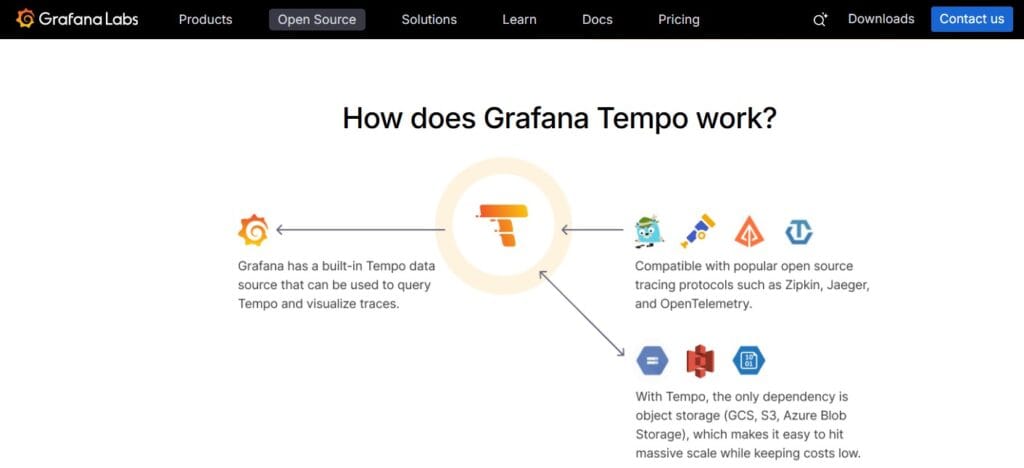
Grafana is known for intuitive dashboards and visualization, but today it is also widely used as a broader observability platform for metrics, logs, traces, and Kubernetes monitoring. Its biggest strength is flexibility: teams can connect many data sources and build one view across their stack instead of working in separate tools.
Key features
- Pull-based metrics collection with auto-discovery via Kubernetes service discovery
- PromQL: expressive query language for aggregation, rates, and alerting across high-cardinality metrics
- Alertmanager: centralized routing, grouping, deduplication, and notification
- Grafana LGTM stack: Loki (logs), Grafana (dashboards), Tempo (traces), Mimir (long-term storage) for full MELT coverage
- OpenTelemetry Collector support for standards-based telemetry ingestion
Pros
- Grafana OSS is completely free and open-source
- Largest cloud-native monitoring ecosystem with thousands of community exporters
- CNCF graduated project with active long-term development
- Native OTel support via the OTel Collector
Cons
- Steep learning curve
- Complex initial setup and configuration
Pricing
- Grafana OSS: Free to self-host.
- Grafana Cloud Pro: $19/month platform fee.
- Metrics: $6.50 per 1,000 series.
- Logs: $0.05/GB (process), $0.40/GB (write), $0.10/GB (retain).
- Traces: $0.05/GB (process), $0.40/GB (write), $0.10/GB (retain).
- Profiles: $0.05/GB (process), $0.40/GB (write), $0.10/GB (retain).
Grafana vs Zabbix
Grafana is the stronger fit when the goal is broader observability across metrics, logs, and traces in one flexible interface. Zabbix can monitor a wide range of infrastructure, applications, logs, and Kubernetes resources, but Grafana is built more directly around correlating observability data across dashboards and workflows, especially in modern cloud-native setups. Zabbix remains a solid choice for infrastructure-heavy monitoring, while Grafana is usually the better fit for teams that want a more flexible observability stack.
3. Datadog

Best for: Cloud-first or hybrid organizations that need unified infrastructure monitoring, APM, and log management in one managed SaaS platform and are comfortable with the pricing model.
Known for
Datadog is a cloud-native observability platform with 1000+ pre-built integrations combining infrastructure metrics, distributed traces, log management, real user monitoring, and security monitoring. Its AI-powered Watchdog engine surfaces anomalies, error spikes, and latency issues automatically.
Key features
- 1000+ integrations across cloud providers, container orchestration, and DevOps tools
- ML-powered anomaly detection, forecasting, and outlier analysis via Watchdog
- Unified view correlating metrics, traces, and logs in a single interface
- Strong Kubernetes, Docker, and serverless monitoring
- Code-level CPU profiling via Continuous Profiler
- HIPAA and FedRAMP compliance options
Pros
- 1000+ integrations; the broadest managed observability ecosystem available
- Strong Kubernetes and cloud-native monitoring
- Code-level CPU profiling and compliance options not available in Zabbix
- No polling engines, no module fragmentation
Cons
- Pricing is complex and compounds at scale: APM, infra, logs, synthetics, and RUM each carry separate billing
- Not suited for teams requiring an on-prem option
- Steep learning curve; UI can feel overwhelming for teams coming from infrastructure-focused tools like Zabbix
- Significantly more expensive for teams that only need network monitoring \
Pricing
- Infrastructure Pro: $15 per host/month billed annually.
- Infrastructure Enterprise: $23 per host/month billed annually.
- APM Host: $31 per host/month, with 1 million indexed spans and 150 GB of ingested spans included per host each month.
- APM Pro: $35 per host/month.
- APM Enterprise: $40 per host/month.
- Log Management: starts from $0.10 per GB ingested.
Datadog vs Zabbix
Datadog is the stronger fit when a team wants managed full-stack observability across infrastructure, APM, logs, and traces in one SaaS platform. Zabbix is still a solid choice for self-hosted infrastructure and network monitoring, but Datadog is built more directly for broader cloud-native observability and faster cross-signal investigation. The tradeoff is that Datadog’s pricing is split across products and host-based charges, while Zabbix gives teams a free self-hosted option and a more infrastructure-first model.
4. Checkmk
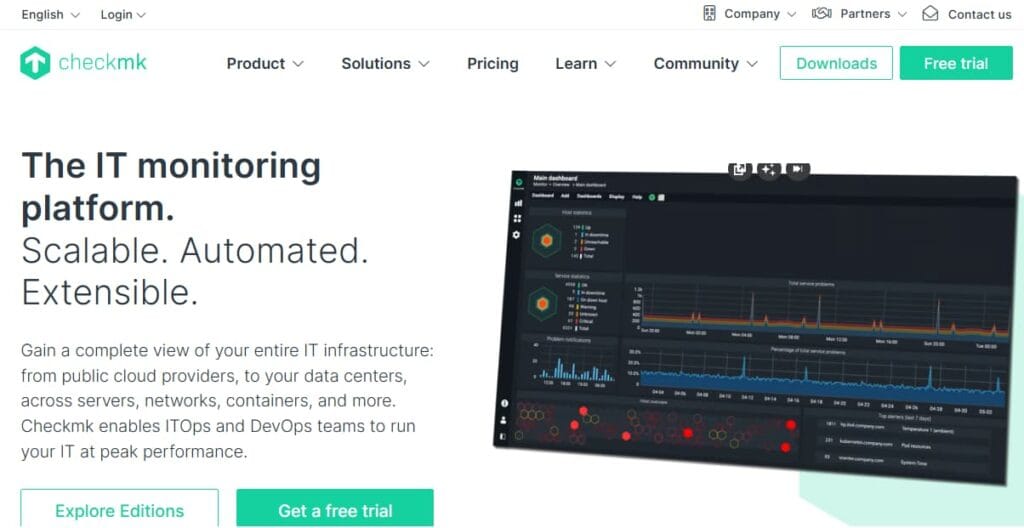
Best for: Organizations that want self-hosted infrastructure monitoring with faster setup, strong auto-discovery, and a more modern interface than older monitoring tools.
Known for
Checkmk is an infrastructure and application monitoring platform that emphasizes fast deployment, auto-discovery, and broad built-in monitoring coverage. Its official site describes Community as free and open source, while the paid editions add more scale, automation, and enterprise features.
Key features
- Auto-discovery for hosts and services.
- 2,000+ built-in integrations and plug-ins, plus additional plug-ins through the Checkmk Exchange.
- Single-package installation without separately installing and maintaining databases and web servers.
- Hybrid deployment support across Linux, AWS, Azure, Docker, and virtual or physical appliances.
Pros
- Free and open-source Community edition.
- Strong auto-discovery and broad out-of-the-box monitoring coverage.
- Easier installation than tools that require separate database and web-server setup.
- Good fit for hybrid infrastructure monitoring.
Cons
- Commercial editions are not free and pricing scales by monitored services.
- Self-hosted deployment still requires Linux and ongoing platform management.
- Steep learning curve
Pricing
- Community: Free.
- Pro: from €190/month for 3,000 services, roughly 100 hosts.
- Cloud and higher editions: available, with pricing depending on edition and monitored services.
Checkmk vs Zabbix
Choose Checkmk over Zabbix when your priority is faster deployment, easier service discovery, and a cleaner self-hosted monitoring experience. Both tools are strong for infrastructure monitoring, but Checkmk’s integrated installation and auto-discovery make it easier to get value faster in many environments.
5. Nagios
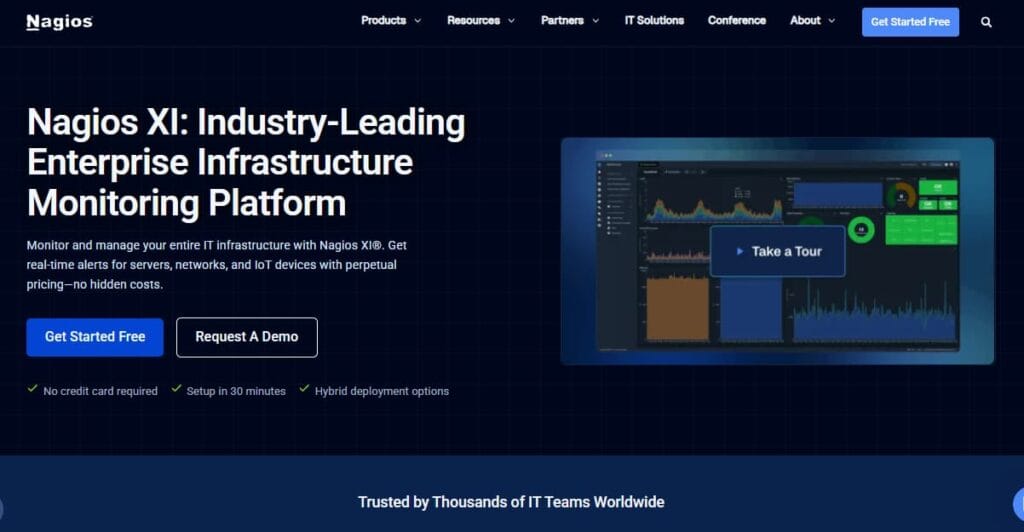
Best for: Organizations with strong technical expertise that need flexible monitoring for legacy, custom, or mixed-vendor infrastructure.
Known for
Nagios is one of the longest-standing infrastructure monitoring platforms and is widely used for host, service, and network monitoring. Icinga 2 began as a fork of Nagios and adds stronger support for distributed monitoring, clustering, and a REST API while keeping a similar monitoring foundation.
Key features
- Large Nagios plugin ecosystem for servers, applications, and network devices.
- Distributed monitoring with agents, satellites, and clustering in Icinga 2.
- REST API in Icinga 2 for configuration and automation.
- Nagios XI adds configuration wizards, reporting, and a more polished GUI on top of Core.
Pros
- Nagios Core is free and open-source.
- Very flexible for mixed and legacy environments.
- Icinga 2 is stronger than classic Nagios for distributed setups and clustering.
- Broad customization through plugins and checks.
Cons
- Steep learning curve and heavier manual configuration than newer tools.
- Complex initial setup and configuration
Pricing
- Nagios Core: Free and open-source.
- Nagios XI Standard: starts at $2,495 for 100 nodes.
- Nagios XI Enterprise: starts at $4,690 for 100 nodes.
- Icinga 2: Free and open-source software.
Nagios vs Zabbix
Choose Nagios or Icinga when plugin flexibility and heterogeneous infrastructure coverage matter more than ease of setup. Zabbix is usually the cleaner choice for teams that want one integrated platform for infrastructure monitoring, while Nagios and Icinga are stronger fits for teams comfortable with more manual configuration and customization.
6. PRTG Network Monitor
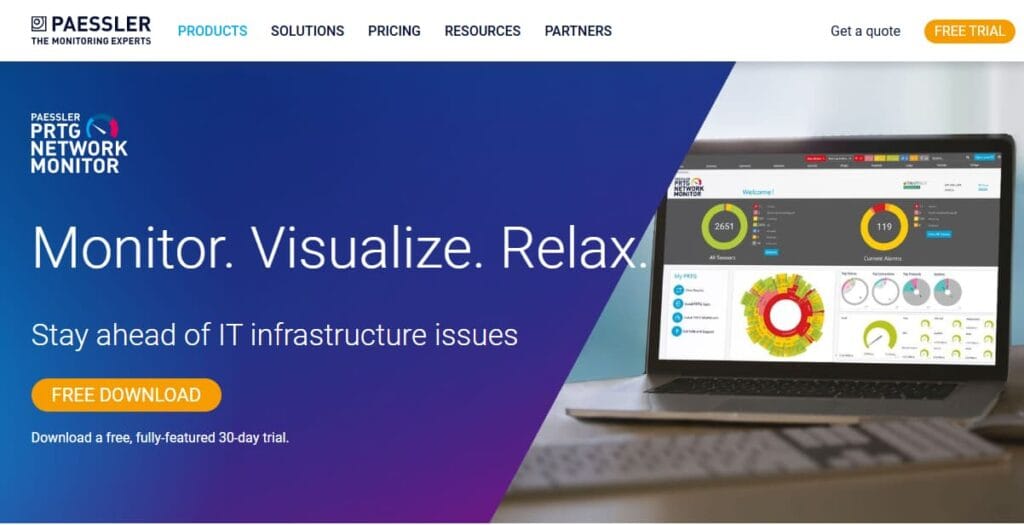
Best for: Small to mid-sized teams that want faster deployment and strong network monitoring with a simpler, sensor-based model.
Known for
PRTG is an all-in-one monitoring platform focused on network, server, and infrastructure monitoring. Paessler positions it around sensor-based monitoring and broad protocol coverage rather than full-stack observability.
Key features
- 200+ sensor types across SNMP, WMI, HTTP, flow technologies, Syslog, and APIs.
- Auto-discovery for devices and services.
- Remote probes for distributed monitoring.
- Mobile apps and reporting features.
Pros
- Faster to start than more manual tools for network-focused use cases. This is a reasonable inference from its auto-discovery and sensor-based setup.
- Strong network and device monitoring depth.
- Clear commercial pricing tiers by sensor count.
Cons
- Costs rise as sensor count grows.
- Steep learning curve
- Complex setup and management
Pricing
- PRTG 1000: $358/month paid annually.
- PRTG 2500: $742/month paid annually.
- PRTG 5000: $1,300/month paid annually.
PRTG vs Zabbix
Choose PRTG over Zabbix when your priority is faster setup and simpler network monitoring. Choose Zabbix when you want zero license cost and are comfortable with more setup and operational overhead
7. New Relic
Best for: Engineering teams that want SaaS-based full-stack observability across APM, infrastructure, logs, and digital experience monitoring.
Known for
New Relic is known for full-stack observability with a broad platform covering APM, infrastructure, logs, browser, and mobile monitoring. Its pricing model is mainly based on data ingest plus user tiers.
Key features
- 100 GB/month free ingest on the free tier.
- A broad platform with APM, infrastructure monitoring, logs, RUM, and synthetic capabilities.
- User tiers including Core and Full Platform users.
Pros
- Broad observability coverage in one managed platform.
- No host-based pricing for infrastructure in the way some competitors use it. Pricing is primarily ingest and user-based.
Cons
- Costs rise with higher ingest volume.
- Paid user tiers add cost as teams grow.
- SaaS-first model, so it is not a fit for teams that need full self-hosting.
Pricing
- Free: 100 GB/month ingest included.
- $0.40/GB beyond the 100 GB limit
- Core users: $49/user on Standard.
- Full Platform users: Standard $10 first user / $99 additional users; Pro $349/user annual upfront, with higher monthly/pay-as-you-go equivalents listed in docs.
New Relic vs Zabbix
Choose New Relic over Zabbix when your team wants SaaS-based full-stack observability and stronger application visibility. Choose Zabbix when self-hosting and infrastructure-first monitoring matter more.
8. Dynatrace
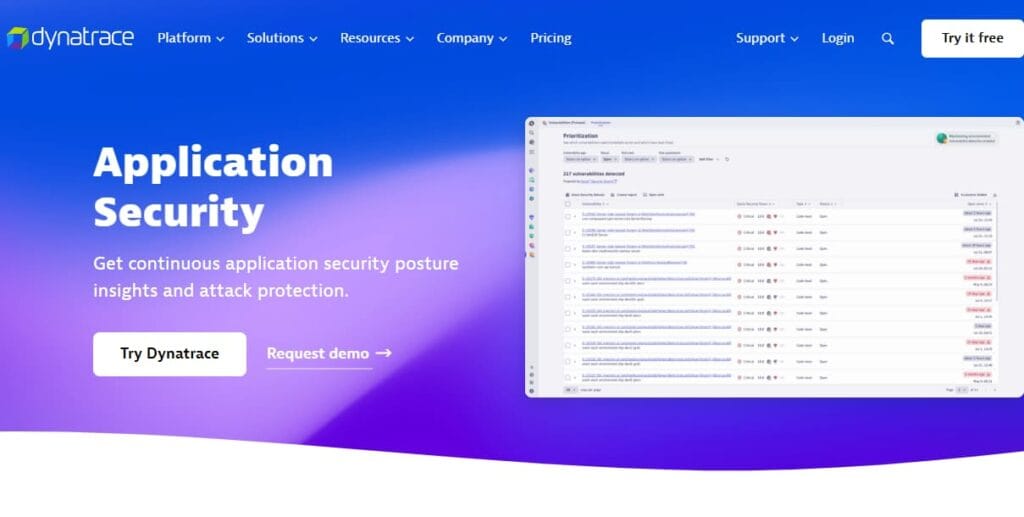
Best for: Enterprise teams that want AI-assisted root cause analysis and broad full-stack observability.
Known for
Dynatrace is known for enterprise observability, topology-aware monitoring, and AI-driven analysis through Davis and Smartscape. Its pricing is usage-based and can span hosts, memory, logs, and other platform components.
Key features
- Full-stack observability across infrastructure, applications, logs, and more.
- AI-assisted analysis through Davis.
- Smartscape topology mapping.
- Kubernetes and cloud-platform monitoring.
Pros
- Strong enterprise automation and topology awareness.
- Broad platform coverage for complex environments.
- Flexible usage-based pricing rather than a single fixed license.
Cons
- Expensive for smaller teams once multiple data types and products are involved.
- Pricing is more complex than simple flat models.
- Steep learning curve
Pricing
- Infrastructure Monitoring: $29/month/host
- Full-stack Monitoring: $58/host per 8 GiB
- Log ingest and process: $0.20/GiB.
Dynatrace vs Zabbix
Choose Dynatrace over Zabbix when automated root-cause analysis and full-stack enterprise observability matter more than self-hosted simplicity. Choose Zabbix when infrastructure-first monitoring and on-prem control are the priority.
9. Netdata
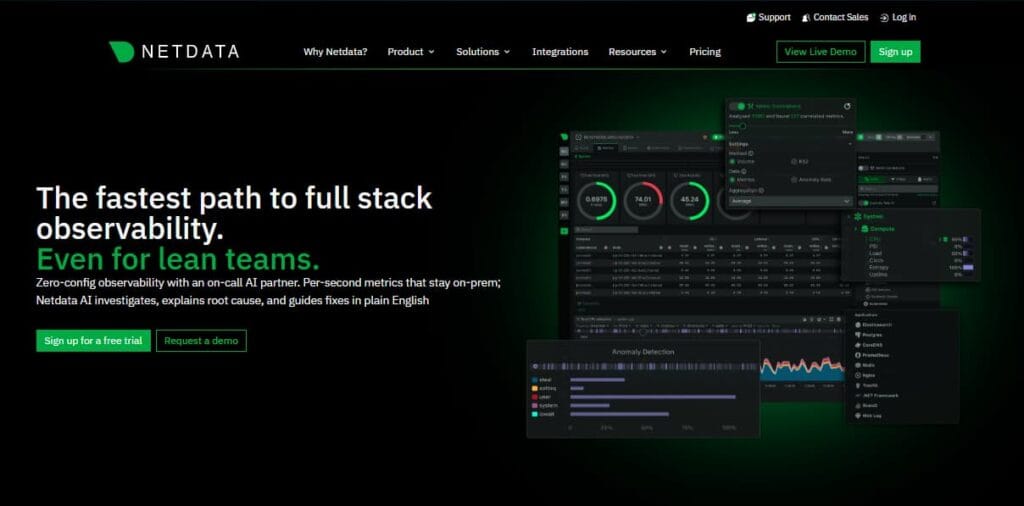
Best for: Small teams, developers, and edge environments that want immediate real-time visibility with very little setup.
Known for
Netdata is known for per-second infrastructure monitoring, built-in ML anomaly detection, and a lightweight open-source agent. Its cloud offering adds centralized views and paid business features.
Key features
- Per-second metrics.
- Built-in ML on every metric.
- Open-source agent free forever.
- Paid cloud plans with per-node pricing.
Pros
- Very fast to start.
- Strong real-time visibility and troubleshooting focus.
- Predictable per-node pricing in paid plans.
Cons
- Cloud features are paid and not the same as the open-source agent.
- Steep learning curve
Pricing
- Open-source agent: Free forever for unlimited nodes.
- Netdata Cloud Community: Free for up to 5 nodes.
- Business: From $4.50/node/month billed annually.
- Enterprise on-prem: Custom pricing.
Netdata vs Zabbix
Choose Netdata over Zabbix when the priority is instant, real-time host visibility with very low setup friction. Choose Zabbix when you need broader, more traditional infrastructure monitoring across larger mixed environments.
A note on migration from Zabbix
Migration from Zabbix is often less about licensing and more about execution effort. The timeline usually depends on how many hosts, templates, proxies, scripts, and integrations need to be replaced or validated. Larger environments with proxy architecture and more customization generally take longer to migrate cleanly than smaller, simpler deployments.
As a directional planning assumption, small environments with simpler setups may take a few weeks, mid-market environments may take several weeks, and larger environments can take a few months. These are planning estimates, not vendor-published benchmarks. Teams should validate timelines against their own templates, alerting rules, integrations, and operational dependencies.
For platforms like CubeAPM that support existing Datadog-, New Relic-, and Prometheus-compatible agent configurations, phased migration is more practical because teams can move selected services or clusters first while keeping the old setup in place during validation. For self-managed replacements like Prometheus-based stacks, a parallel run is still the safer approach so teams can compare coverage before fully decommissioning Zabbix.
Conclusion
Zabbix alternatives in 2025 largely depend on what you are trying to fix. If the goal is still infrastructure monitoring, tools like Prometheus, Checkmk are strong options. If the goal is broader observability across logs, traces, and APM, tools like CubeAPM, New Relic, and Datadog are better fits.
The key decision is scope. Are you replacing Zabbix just for infrastructure monitoring, or do you also want application visibility in the same workflow? That answer narrows the list quickly.
FAQs
1. What is the best free alternative to Zabbix?
For cloud-native metrics, Prometheus is one of the strongest free options, and many teams pair it with Grafana for dashboards. For network-focused monitoring, Checkmk Community is also free and open source. All of them require self-hosting, so the software may be free, but the team still owns setup, maintenance, and scaling.
2. Does Zabbix support OpenTelemetry?
Not natively today. Zabbix’s roadmap lists “OpenTelemetry data collection” as “In design,” with a planned release date of Q3 2026. That means native OTel support should be described as planned, not currently available.
3. What is the best Zabbix alternative for APM?
If the main goal is stronger APM and broader observability, CubeAPM, New Relic, and Datadog are among the most relevant alternatives. New Relic and Datadog clearly offer full-stack SaaS observability, while CubeAPM positions itself as a self-hosted, managed, OpenTelemetry-based observability platform.
4. Is Prometheus a direct replacement for Zabbix?
Not really. Prometheus is an open-source monitoring and alerting toolkit that is especially strong for modern metrics and alerting workflows, but it is not a direct drop-in replacement for Zabbix in SNMP-heavy or legacy device environments. Teams often add Grafana for dashboards and other components for logs and traces.
5. How does Checkmk compare to Zabbix?
Checkmk is a strong fit for teams that want faster setup and more automation in infrastructure monitoring. Its official site emphasizes auto-discovery, 2,000+ integrations, and a free Community edition. The safer comparison is that Checkmk is often easier to get running quickly, not that it is universally better than Zabbix.
6. Which Zabbix alternative is best for network monitoring?
For network-centric monitoring, PRTG is one of the strong alternative. PRTG is commercial and sensor-based.
7. Can Zabbix be replaced by one tool, or does it take multiple?
It depends on what Zabbix is doing today. If the goal is mainly infrastructure and network monitoring, one tool can often replace it. If the goal also includes logs, traces, and APM, teams usually either move to a broader platform or assemble a multi-tool stack around Prometheus, Grafana, and other components. Zabbix itself now covers more than classic host monitoring, including Kubernetes and container visibility, so this is really a scope question, not a simple yes-or-no answer.
8. How long does it take to migrate from Zabbix?
The exact timelines in your draft are not something I can verify as official benchmarks. The safe version is that migration time depends on the size of the environment, the number of templates, proxies, scripts, and integrations, and whether the team runs both systems in parallel during validation. Treat any week or month ranges as planning assumptions, not verified vendor benchmarks.