



ClickStack and Grafana are both open-source observability platforms used by engineering teams who want to self-host their telemetry stack. That is where most of the similarity ends.
Grafana, via the LGTM stack (Loki, Grafana, Tempo, and Mimir), has been the default open-source observability foundation for years. ClickStack launched in May 2025 with a fundamentally different architectural bet: store all four signal types in a single ClickHouse backend and query everything with SQL. The ClickStack vs Grafana decision ultimately comes down to whether your team wants a unified single-backend stack or a composable multi-component system. Both are free to self-host. Both accept OpenTelemetry. But they make opposite trade-offs on operational complexity, query experience, signal correlation, and what teams need to bring to the table.
This comparison covers each dimension directly, drawing only from the official documentation and licensing pages of Grafana and ClickStack.
Key Takeaways
- ClickStack is one unified stack: one backend (ClickHouse), one UI (HyperDX), one OTel Collector. Grafana LGTM is four separate systems: Loki for logs, Mimir for metrics, Tempo for traces, and Grafana for visualization, each with its own scaling model and failure modes.
- ClickStack stores all four signal types (logs, metrics, traces, and session replays) in the same ClickHouse tables, enabling native SQL joins across signals. Grafana LGTM correlates signals at the UI level across four separate backends, which requires manual configuration.
- Grafana LGTM uses three query languages: LogQL for logs, PromQL for metrics, TraceQL for traces. ClickStack uses SQL for all signals, plus an intuitive Lucene-style search syntax for routine tasks.
- All core Grafana LGTM components (Grafana, Loki, Tempo, Mimir) are licensed under AGPLv3. ClickStack’s ClickHouse and OTel Collector are Apache 2.0; the HyperDX UI is MIT.
- Session replay is built into ClickStack. Grafana has no equivalent native capability.
- Grafana LGTM includes Grafana Pyroscope for continuous profiling. ClickStack currently has no profiling equivalent.
- Grafana LGTM has the largest dashboard and plugin ecosystem of any open-source observability stack. ClickStack’s ecosystem is newer and smaller.
- Managed ClickStack on ClickHouse Cloud stores data at under $0.03/GB/month plus variable compute costs. Grafana Cloud Pro charges $0.50/GB for logs and traces and $6.50/1,000 active metric series.
What is ClickStack?
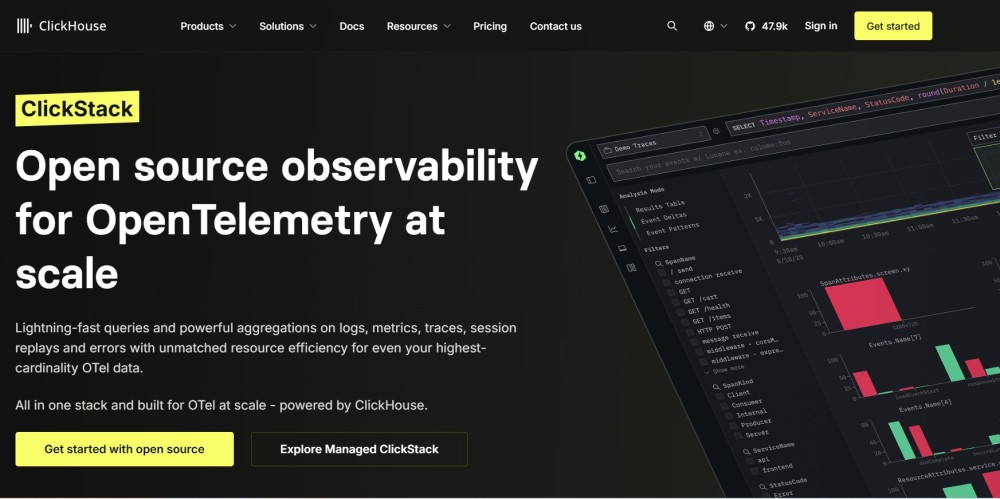
ClickStack is the open-source observability stack from ClickHouse Inc., launched in May 2025. It bundles three components: a pre-configured OpenTelemetry Collector for ingestion, ClickHouse as the storage and query engine, and HyperDX as the frontend UI. All four observability signals, logs, metrics, traces, and session replays, land in a single ClickHouse instance and are queryable with SQL or Lucene-style syntax.
According to the ClickStack architecture documentation, ClickStack also uses a MongoDB instance to store application-level state: dashboards, user accounts, and configuration settings. This separation of state from event data simplifies backup and configuration.
Managed ClickStack is available in beta on ClickHouse Cloud, with compute and storage scaling independently through compute-compute separation.
What is the Grafana LGTM stack?
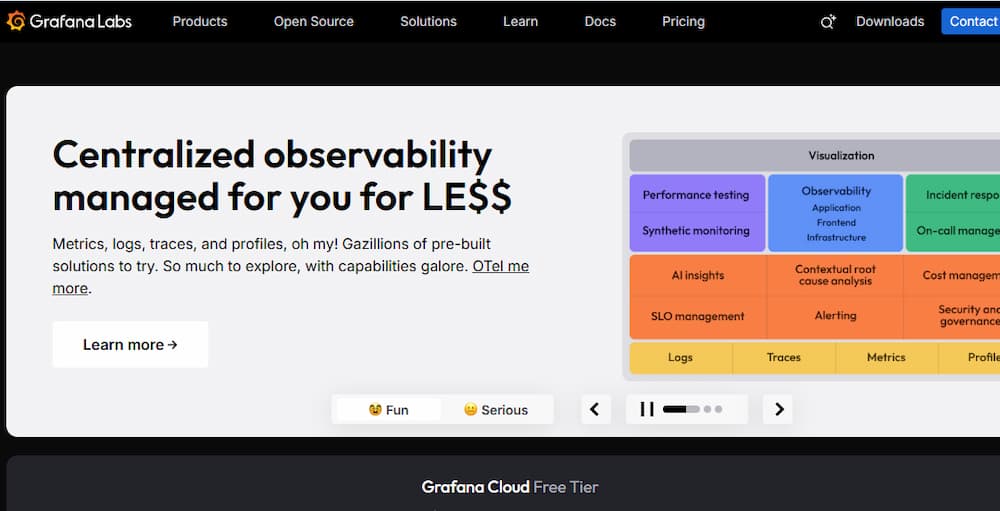
The Grafana LGTM stack is the combination of four open-source components maintained by Grafana Labs: Loki (log aggregation), Grafana (visualization and dashboards), Tempo (distributed tracing), and Mimir (metrics storage, Prometheus-compatible). Each component is a separate stateful system with its own deployment, scaling, and query interface.
Grafana itself is the unified frontend that pulls from all four backends and presents a single observability dashboard. Grafana Alloy is the recommended telemetry collector for the LGTM stack. Grafana Agent reached end-of-life on November 1, 2025, and Alloy is its supported replacement. Alloy is 100% OTLP-compatible and supports OpenTelemetry and Prometheus telemetry formats.
All four core components (Grafana, Loki, Tempo, Mimir) are licensed under AGPLv3. Plugins, agents (including Alloy), and certain libraries remain under Apache 2.0.
Architecture: Unified vs Composable
This is the most fundamental difference between the two platforms and shapes every other dimension of the comparison.
ClickStack: Unified backend
ClickStack stores all signal types in a single ClickHouse instance. Logs go into otel_logs, traces into otel_traces, metrics into otel_metrics_* tables, and session replay data into hyperdx_sessions. Because all four signal types share the same database, joining them at query time is a native SQL operation. You can write a query that pulls a log event, the correlated trace span, and the user session that triggered it in one statement using standard SQL joins on trace_id and session identifiers.
ClickHouse’s columnar engine, ZSTD compression (typically 8x to 12x on observability data), and vectorized execution deliver sub-second aggregations across billions of events. ClickStack is schema-agnostic: it works on top of any existing ClickHouse schema, so teams that already use ClickHouse for analytics can co-locate observability data without running a separate instance.
Grafana LGTM: Composable multi-backend
Grafana LGTM stores each signal type in a purpose-built backend. Logs go to Loki, which uses object storage or filesystem chunks with an inverted index. Metrics go to Mimir, a Prometheus-compatible TSDB. Traces go to Tempo, an object-storage-first tracing backend. Grafana connects to all three as data sources and provides a unified visualization layer.
Signal correlation in Grafana LGTM happens at the UI level through Grafana’s Explore view and derived fields. For example, you can configure Loki to extract trace IDs from log lines and create a link to the correlated Tempo trace. This requires configuring each data source and does not happen automatically. Each backend uses its own query language: LogQL for Loki, PromQL or MetricsQL for Mimir, TraceQL for Tempo.
The composable model gives teams flexibility. They can swap individual components, choose different storage backends per signal type, and scale each component independently based on its own resource profile.
Signal coverage
| Signal | ClickStack | Grafana LGTM |
| Logs | Yes (otel_logs, ClickHouse) | Yes (Loki) |
| Metrics | Yes (otel_metrics_*, ClickHouse) | Yes (Mimir, Prometheus-compatible) |
| Traces | Yes (otel_traces, ClickHouse) | Yes (Tempo) |
| Session replay | Yes (hyperdx_sessions, ClickHouse) | No |
| Continuous profiling | No | Yes (Grafana Pyroscope) |
Session replay is built into ClickStack’s HyperDX UI and stored in ClickHouse alongside all other signals. Grafana has no equivalent native session replay capability; adding it requires an external tool.
Grafana LGTM includes Grafana Pyroscope for continuous profiling. Pyroscope 2.0 was released at GrafanaCON 2026 in April 2026, adding support for object storage as the required backend for distributed deployments. It integrates with Grafana to correlate profiling data with metrics, logs, and traces. ClickStack has no equivalent profiling component.
Query experience
ClickStack: The HyperDX UI provides Lucene-style search syntax for routine queries (for example, level:err service.name:api-gateway) without requiring SQL. For advanced analysis, full SQL access to all ClickHouse tables is always available, including over 100 built-in ClickHouse analytical functions. The ClickStack docs also document a Text-to-Chart feature that converts natural language prompts into SQL-based visualizations, and AI Notebooks support interactive SQL analysis alongside visual output.
Grafana LGTM: Each signal uses a purpose-built query language. LogQL for Loki is a log-focused pipeline language that filters log streams and runs metric queries over logs. PromQL (or Mimir’s MetricsQL superset) is the standard for metrics. TraceQL is Tempo’s query language for selecting spans by attribute. These are widely known in the industry and purpose-optimized for their respective signal types. However, there is no shared query surface across signals. Correlating a metric anomaly with the logs that coincide requires switching between query languages and data sources.
As the ClickHouse observability resource notes: “In Grafana, ClickHouse is a data source plugin, not a native backend. This limits its integration into Grafana’s core, opinionated workflows. Furthermore, any deep analysis in Grafana requires the engineer to write and optimize raw SQL.”
Cross-signal correlation
ClickStack: Native. All signals share trace_id and session_id as common identifiers stored in the same ClickHouse database. Clicking on a trace in the HyperDX UI automatically surfaces correlated logs. Clicking a timestamp in a session replay jumps to the corresponding backend trace. These correlations are resolved at the database level and require no manual configuration.
Grafana LGTM: Configured. Signal correlation relies on derived fields in Loki data sources (to extract and link trace IDs), Tempo’s service graph feature (to link traces back to metrics), and Grafana’s Explore Correlations feature introduced in Grafana 10. These work well once configured, but they are UI-level links rather than database-level joins, and setup requires non-trivial configuration of each data source. The ClickHouse observability resource describes this pattern as “swivel-chair analysis”: switching between tools or tabs to correlate signals rather than having them natively joined.
Operational complexity
ClickStack (self-hosted): A Docker quickstart runs with a single command and takes under 15 minutes. Helm charts support Kubernetes deployment. A production high-availability deployment requires at least two ClickHouse nodes, a ZooKeeper or ClickHouse Keeper implementation, a load balancer, and ongoing upgrade management. The MongoDB instance for application state is an additional stateful dependency to manage.
The upside of one backend: you have one system to monitor, scale, and back up for your observability data store.
Grafana LGTM (self-hosted): Self-hosting the full LGTM stack means running four separate stateful systems. Each has its own storage backend requirements, retention configuration, scaling parameters, and upgrade process. Loki requires object storage plus an index store. Mimir requires object storage plus block storage. Tempo requires object storage. Grafana itself requires a database for dashboard state. Running LGTM at scale is well understood in the industry but is a significant operational investment. Cross-component upgrades need to be managed carefully to avoid breaking data source compatibility.
Dashboards and ecosystem
Grafana LGTM: Grafana has the largest open-source dashboard and plugin ecosystem of any observability tool. Grafana.com hosts thousands of community dashboards for common infrastructure and application stacks. The plugin marketplace covers data source plugins, panel plugins, and app plugins across a wide range of systems. This ecosystem represents years of community contributions and is a genuine differentiator.
ClickStack: The HyperDX UI includes built-in dashboard templates and SQL-based visualizations. Dashboard import and export was added in September 2025. The ClickHouse observability resource acknowledges this directly: “Dashboard capabilities are less mature than Grafana.”
Alerting
ClickStack: Alerting is built into the HyperDX UI. Alerts can be created directly from searches or charts and can target log patterns, metric thresholds, error rates, latency, throughput, or any SQL-derived metric. Built-in integrations with PagerDuty and Incident.io are available, along with generic webhooks for custom pipelines.
Grafana LGTM: Grafana Alerting is a mature, centralized alerting system that evaluates alert rules against any connected data source using that source’s query language. It supports multi-dimensional alerting, silences, contact points (Slack, PagerDuty, OpsGenie, email, webhooks, and more), and notification policies. It is more feature-complete for enterprise alerting workflows than ClickStack’s current alerting.
Licensing
| Component | ClickStack | Grafana LGTM |
| Core database / backends | ClickHouse: Apache 2.0 | Loki, Mimir, Tempo: AGPLv3 |
| Frontend UI | HyperDX: MIT | Grafana: AGPLv3 |
| Telemetry collector | OpenTelemetry Collector: Apache 2.0 | Grafana Alloy: Apache 2.0 |
AGPLv3 is an OSI-approved open-source license. For teams that simply use the LGTM stack internally to monitor their own systems, it has no practical difference from Apache 2.0. For companies building observability products or services on top of Loki, Grafana, or Mimir, the AGPLv3 requirement to release modified source code is a material compliance consideration.
ClickStack’s Apache 2.0 and MIT licensing impose no such requirement.
Pricing
ClickStack Pricing:
- Self-hosted open source: Free; you pay for your own infrastructure
- Managed ClickStack (ClickHouse Cloud, beta): Storage under $0.03/GB/month; compute billed separately at variable rates based on query workload; new accounts receive a $300 credit
Grafana LGTM:
- Self-hosted: Free; you pay for your own infrastructure; core components are AGPLv3
- Grafana Cloud Free: $0; includes 10,000 active metric series, 50 GB logs and traces, 14-day retention, 3 users
- Grafana Cloud Pro: $19/month platform fee, then $6.50/1,000 active metric series (13-month retention) and $0.50/GB for logs and traces (30-day retention)
- Enterprise/Advanced: Starts at $25,000/year spend commit
On the managed path, ClickStack’s storage rate is significantly lower, but its variable compute costs make total monthly spend harder to predict. Grafana Cloud’s per-GB and per-series model is more predictable for teams that can estimate data volumes in advance.
Who should use ClickStack?
ClickStack is a strong fit for teams that:
- Want a single self-hosted backend for all four signal types, including session replay, with no need to integrate separate log, metrics, and trace systems
- Have or are building ClickHouse operational expertise, or want to co-locate observability alongside existing ClickHouse analytics workloads
- Need SQL-level access to raw telemetry data for custom analysis, compliance, or cost attribution
- Want to correlate frontend user sessions with backend traces natively, without a separate session recording tool
- Are building on OpenTelemetry and want an opinionated, pre-configured stack with no manual OTel Collector setup
Who should use Grafana LGTM?
Grafana LGTM is the better choice for teams that:
- Are already running Prometheus and Grafana and want to extend to full log and trace coverage within their existing toolchain
- Need the Grafana plugin and dashboard ecosystem for existing integrations and infrastructure visibility
- Prefer purpose-optimized query languages (PromQL, LogQL) over SQL for routine observability tasks
- Need Pyroscope for continuous profiling alongside metrics, logs, and traces, particularly after the Pyroscope 2.0 release in April 2026
- Have existing Grafana, Loki, and Tempo operational experience and do not want to migrate
APM visibility for both stacks: where CubeAPM completes the picture
Both ClickStack and Grafana LGTM focus primarily on the telemetry storage and exploration layer. Neither is a purpose-built APM platform with structured service health views, latency distributions, error tracking, and deployment-correlated performance data out of the box.
- For teams on ClickStack: CubeAPM provides the structured APM layer that HyperDX does not offer out of the box. ClickStack handles deep SQL-based telemetry exploration and session replay; CubeAPM handles service maps, latency percentile dashboards, error rate tracking, and deployment-correlated performance monitoring. The same OTLP data stream feeds both, with no duplication required.
- For teams on Grafana LGTM: CubeAPM similarly provides the opinionated APM layer that Grafana’s visualization UI does not provide by default, without requiring you to build and maintain complex Grafana dashboards for service-level performance views.
CubeAPM fills that gap for teams on either stack. It is a self-hosted, OpenTelemetry-native APM platform that accepts the same OTLP telemetry your applications already send, with no re-instrumentation required. Pricing is ingestion-based at $0.15/GB with no per-host, per-user, or per-series fees.
Summary
ClickStack and Grafana LGTM solve the same problem through opposite architectural choices. Grafana LGTM is composable: four purpose-built components, each optimized for one signal, each with its own mature query language, tied together by Grafana’s visualization layer. ClickStack is unified: one backend, one UI, one query language across all signals, with native correlation. The right choice depends on what your team already operates, what signals matter most, and whether the single-backend or composable model fits your operational capability better.
For teams who want to add structured APM visibility on top of either stack without rebuilding their instrumentation, CubeAPM provides self-hosted, ingestion-based APM pricing at $0.15/GB with full OpenTelemetry compatibility.
| Dimension | ClickStack | Grafana LGTM |
| Architecture | Unified (single ClickHouse backend) | Composable (Loki + Mimir + Tempo + Grafana) |
| Signals | Logs, metrics, traces, session replay | Logs, metrics, traces, profiling (Pyroscope) |
| Query language | SQL + Lucene-style search | LogQL, PromQL/MetricsQL, TraceQL |
| Cross-signal correlation | Native (database-level SQL joins) | Configured (UI-level derived fields) |
| Self-hosted license | Apache 2.0 (ClickHouse), MIT (HyperDX) | AGPLv3 (Grafana, Loki, Tempo, Mimir) |
| Telemetry collector | OpenTelemetry Collector (Apache 2.0) | Grafana Alloy (Apache 2.0; Grafana Agent EOL Nov 2025) |
| Session replay | Yes | No |
| Continuous profiling | No | Yes (Pyroscope, v2.0 released April 2026) |
| Dashboard ecosystem | Growing (newer) | Largest open-source observability ecosystem |
| Alerting | Built-in (HyperDX UI) | Grafana Alerting (mature, full-featured) |
| Managed cloud cost | Under $0.03/GB/month storage + compute | $0.50/GB logs/traces; $6.50/1K metric series |
| Best for | Teams wanting a unified SQL-first stack with session replay | Teams already on Prometheus/Grafana extending to full MELT |
Disclaimer: Feature details and pricing are sourced directly from clickhouse’s docs and grafana’s docs, and reflect publicly available information as of June 2026. Always verify current pricing before making deployment decisions. CubeAPM is referenced as a complementary tool; evaluate all platforms against your own requirements.
Also read:
ClickStack Alternatives in 2026: 6 Tools Compared for Self-Hosted and Managed Observability