





SEO Metadata URL Slug: signoz-self-hosted-alternatives Meta Title: 9 Best SigNoz Self-Hosted Alternatives in 2026 (Compared) Meta Description:
SigNoz promised a self-hosted, open-source Datadog alternative with unified logs, metrics, and traces. For many teams, it delivers until ClickHouse memory usage becomes a second full-time job, or rough edges in the UI slow down incident triage when every second counts.
According to Grafana Labs’ 2026 Observability Survey, complexity and operational overhead are now the top concern for observability practitioners, cited by 38% of respondents, with self-managed teams most likely to name it as their primary challenge.
Beyond ClickHouse complexity, three other issues drive most evaluations: the AGPL-3.0 license creates compliance friction for commercial products, query performance degrades unpredictably at high cardinality, and critical enterprise features like SSO and RBAC lag behind SaaS competitors.
This guide compares 9 SigNoz alternatives covering self-hosted, hybrid, and SaaS options, evaluated on total cost of ownership, OpenTelemetry compatibility, and operational overhead.
Quick Comparison: 9 SigNoz Self-Hosted Alternatives
| Tool | Best For | Pricing Model | OTel Native | Self-Host | Maintenance Burden |
| CubeAPM | On-prem teams wanting managed observability | $0.15/GB, vendor-managed | Native | Your VPC | Vendor-managed |
| Grafana OSS + Cloud | Teams already using Prometheus ecosystem | Free OSS; Cloud $0.40/GB written | Strong | Yes | High (DIY stack) |
| OpenObserve | Cost-sensitive teams, S3-based storage | Free OSS; Cloud $0.50/GB | Native | Yes | Medium |
| Uptrace | Small teams, PostgreSQL-based simplicity | Free OSS; managed from $1,000/month | Native | Yes | Low-Medium |
| Dash0 | OTel-first teams, SIFT workflow | Per million data points | Native | No (SaaS) | Zero |
| Datadog | Enterprises prioritizing breadth | $15/host/month infra + APM $36/host/month standalone | Partial | No (SaaS) | Zero |
| New Relic | Full-platform observability | $0.40/GB after 100GB free | Strong | No (SaaS) | Zero |
| Elastic APM | Teams on ELK stack | Free OSS; Cloud from ~$0.105/GB serverless | Strong | Yes | High |
| Logfire | AI/LLM observability | $49/month + $2/million spans after 10M | Native | No (SaaS) | Zero |
Pricing data sourced from official vendor pricing pages as of June 2026. Prices may vary; verify directly with each vendor before making a decision.
1. CubeAPM
CubeAPM is a self-hosted, OpenTelemetry-native observability platform covering APM, distributed tracing, logs, infrastructure, Kubernetes, and error tracking. It runs inside your cloud or on-premises environment with vendor-managed upgrades and support, which is the key differentiator from SigNoz: your team provisions the infrastructure, but CubeAPM handles all platform operations, upgrades, and patches. This gives teams the data sovereignty of self-hosted deployment without the Day 2 operational burden that makes ClickHouse-based stacks expensive to run.
Migration from SigNoz is a one-line change. Because both platforms are OpenTelemetry-native, you point your OTEL_EXPORTER_OTLP_ENDPOINT at CubeAPM and data flows immediately.
Key Features
- Full-stack unified monitoring: APM, distributed tracing, logs, infrastructure, Kubernetes, error tracking
- OpenTelemetry-native with compatibility for Datadog, New Relic, Prometheus, and Elastic agents
- AI-based Smart Sampling retains high-value traces while reducing storage overhead by up to 70%
- Unlimited data retention with no egress charges
- SOC 2 and ISO 27001 certified for compliance requirements
Pricing
$0.15/GB for all ingested data with unlimited users. No per-host, per-metric, or per-user fees. For a 30 TB/month workload, that is $4,500/month all-in.
Pros
- Single billing dimension with no pricing surprises as workloads scale
- Multi-agent compatible for incremental migration without hard cutover
- Complete data ownership with no telemetry leaving your infrastructure
- Engineering-level support via WhatsApp and Slack with rapid incident response
- Vendor-managed operations: upgrades, patches, and platform scaling handled for you
Cons
- Requires BYOC or on-premises deployment; your team provisions the infrastructure
- SSO and RBAC less mature than enterprise SaaS platforms
- No autonomous anomaly detection; Smart Sampling is not full AIOps
Best for: DevOps teams that need full data control for compliance but want SaaS-like operations without DIY backend burden. Ideal for regulated industries and teams burned by unpredictable SaaS bills.
2. Grafana OSS + Cloud
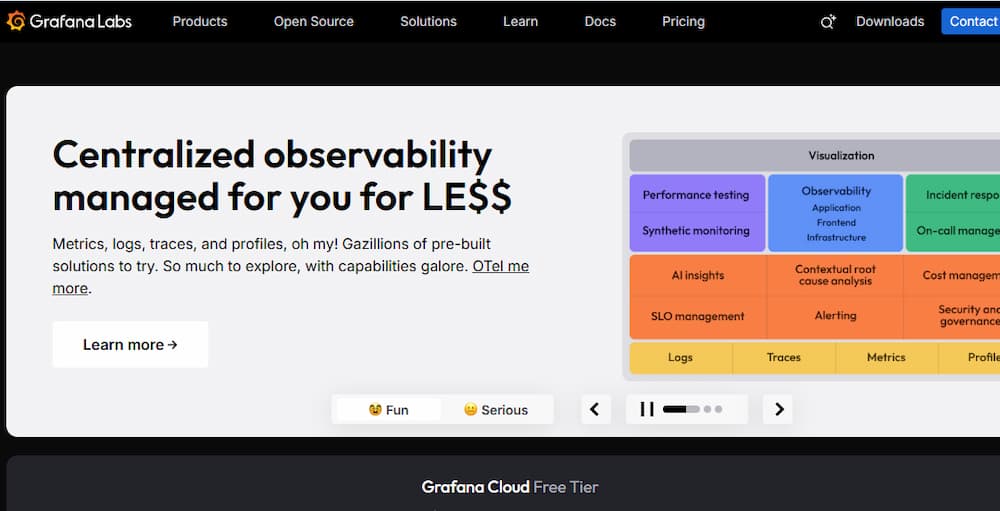
Grafana is the most widely adopted open-source observability stack, combining Loki for logs, Tempo for traces, Mimir for metrics, and Grafana for dashboards and alerting. Together they cover the full observability surface with no vendor lock-in: every query language (PromQL, LogQL, TraceQL) is open standard, every component is independently deployable, and the plugin ecosystem spans 80+ data sources. The kube-prometheus-stack Helm chart makes Kubernetes deployment relatively accessible for teams already familiar with the ecosystem.
The tradeoff is operational complexity. Running four separate components in production requires dedicated platform engineering capacity for scaling, upgrades, retention management, and alert routing. Grafana Cloud removes that burden but at a cost that scales quickly with data volume.
Key Features
- Best-in-class visualization with 80+ data source integrations
- Native Prometheus support with PromQL for metrics
- LogQL for logs (Loki) and TraceQL for traces (Tempo)
- Grafana Cloud managed service with free tier (10k series, 50 GB logs, 50 GB traces)
- Large plugin ecosystem and active community
Pricing
OSS is free but requires self-managing Loki, Tempo, Mimir, and Grafana. Grafana Cloud logs and traces are billed at $0.40/GB written after 50 GB/month free, plus a $0.05/GB processing fee before the write charge. Metrics are billed at $0.50/1,000 active series beyond the free tier. All pricing from grafana.com/pricing.
Pros
- Zero vendor lock-in with fully open-source components
- Powerful querying with PromQL, LogQL, TraceQL
- Massive integration ecosystem with extensive community support
- Strong Kubernetes monitoring through kube-prometheus-stack
Cons
- High operational burden managing four separate components self-hosted
- Loki query performance degrades with high-cardinality labels at scale
- Grafana Cloud costs scale quickly with data volume
- Requires deep expertise in the Prometheus ecosystem
Best for: Teams already invested in Prometheus with engineers who know the ecosystem well and value query flexibility over operational simplicity.
3. OpenObserve
OpenObserve is an open-source observability platform optimized for S3-compatible storage, designed to reduce storage costs compared to Elasticsearch or ClickHouse-based platforms. Its architecture stores all data directly to S3, GCS, or Azure Blob Storage rather than a local disk-backed index. The platform covers logs, metrics, traces, RUM, and error tracking in a single unified interface, with SQL-based querying that is more accessible than LogQL or ClickHouse SQL for teams without dedicated observability engineers.
Note: OpenObserve made a significant pricing change effective June 2, 2025. The free cloud tier was discontinued and the platform moved to a fully usage-based pay-as-you-go model at $0.50/GB. The OSS self-hosted version remains free. A 14-day free trial is available.
Key Features
- S3-native architecture avoids disk provisioning overhead of ClickHouse or Elasticsearch
- SQL-based querying for logs, metrics, and traces
- Vector Remap Language (VRL) for data transformation pipelines
- Works with FluentBit, Vector, Logstash, and OpenTelemetry collectors
- Apache 2.0 license (more permissive than SigNoz’s AGPL-3.0)
Pricing
OSS is free for self-hosting. Cloud Pay As You Go is $0.50/GB ingested for logs, metrics, and traces with 30-day default retention. No free cloud tier; 14-day free trial available. All pricing from openobserve.ai/pricing.
Pros
- S3-native architecture avoids disk provisioning overhead at scale
- SQL querying is accessible to engineers without observability-specific query language expertise
- Apache 2.0 license removes the AGPL compliance friction of SigNoz
- No per-host, per-user, or per-seat fees
Cons
- Smaller community and ecosystem than Grafana or Elastic
- APM and tracing features less mature than SigNoz or Grafana Tempo
- No free cloud tier; only self-hosted OSS is free
- Cloud pricing at $0.50/GB is higher than SigNoz Cloud at $0.30/GB
Best for: Teams prioritizing storage cost reduction for long-term log retention where S3 economics matter, and where SQL familiarity is more valuable than PromQL fluency.
4. Uptrace
Uptrace is an OpenTelemetry-native observability platform using PostgreSQL for metadata storage and ClickHouse for telemetry, designed to offer a simpler architecture than SigNoz while retaining fast trace querying. The key operational advantage over SigNoz is that PostgreSQL handles the configuration and metadata layer, which reduces the tuning surface teams need to manage. The self-hosted OSS version is free. Uptrace also offers private managed deployments where they operate the platform on dedicated Hetzner hardware on your behalf.
Note: Uptrace announced a price increase of up to 15% effective April 10, 2026, due to Hetzner infrastructure cost increases, and switched metrics billing from timeseries-based to datapoints-based. Verify current rates at uptrace.dev before committing.
Key Features
- PostgreSQL for metadata, ClickHouse for telemetry data
- Clean UI focused on distributed tracing with service maps
- Built-in alerting with Slack, PagerDuty, and Opsgenie integrations
- SQL-based alerting rules
- Private managed deployment option available
Pricing
OSS is free for self-hosting. Managed and private deployments use tiered volume pricing with a minimum fee of $1,000/month (infrastructure costs paid separately). Higher tiers unlock lower per-unit rates. All pricing from uptrace.dev.
Pros
- Simpler architecture than SigNoz (PostgreSQL metadata layer reduces ClickHouse surface area)
- PostgreSQL familiarity reduces operational learning curve
- Lower resource overhead than full SigNoz for small-to-medium workloads
- Private managed deployment option with Uptrace handling operations
Cons
- Minimum $1,000/month for managed deployments
- PostgreSQL becomes a bottleneck at very high scale metadata volumes
- Smaller feature set than SigNoz or Grafana
- Limited ecosystem and third-party integrations
Best for: Small engineering teams that want OpenTelemetry observability without heavy infrastructure overhead and have modest data volumes.
5. Dash0
Dash0 is a SaaS observability platform built natively on OpenTelemetry with a developer-first workflow centered on cost control. Its standout feature is the SIFT workflow (Spam removal, Improve telemetry, Filter/group, Triage) that lets teams drop noisy telemetry before it is stored, directly reducing costs without losing signal on what matters. All querying uses PromQL, which means dashboards and alerts are portable across platforms. Dashboards are built on the open-source Perses project, and the platform includes Log AI for automatic log parsing and severity assignment.
Dash0 is SaaS-only, which rules it out for teams with data residency requirements. For cloud-native teams committed to OpenTelemetry standards, it removes the operational burden of self-hosting without creating proprietary lock-in.
Key Features
- SIFT workflow for pre-storage spam filtering and telemetry cost control
- PromQL for all queries across logs, metrics, and traces
- Dashboards built on open-source Perses (fully portable)
- Log AI for automatic log parsing and severity assignment
- No per-user fees; entire team gets access
Pricing
Consumption-based, billed per million data points (metrics, spans, log records, web events). No base fee, no per-seat fees. All features included in one plan. 14-day free trial with no credit card required. Full rate card at dash0.com/pricing.
Pros
- Pre-storage filtering directly reduces waste and cost
- PromQL expertise transfers across platforms with no proprietary lock-in
- No per-user fees regardless of team size
- Transparent public pricing with no custom quotes required
Cons
- SaaS-only; no self-hosted option for compliance-sensitive teams
- Newer platform with a smaller customer base than Grafana or Datadog
- Requires teams already familiar with OpenTelemetry and Prometheus concepts
Best for: Cloud-native teams committed to OTel standards who want managed observability without proprietary lock-in and value telemetry cost control.
6. Datadog
Datadog is one of the most widely deployed commercial observability platforms, covering infrastructure, APM, logs, RUM, synthetics, security, and CI/CD visibility under 700+ integrations. For teams replacing SigNoz, Datadog represents the opposite end of the spectrum: maximum feature breadth and managed operations at premium cost, with no data residency option. Its multi-dimensional billing model means costs compound across every expansion of your stack.
OpenTelemetry support exists but carries overhead: custom metrics ingested via OTel count toward Datadog’s custom metrics pricing, which can significantly inflate bills for OTel-heavy workloads. For teams evaluating the cost tradeoffs, the CubeAPM guide to the best Datadog alternatives covers migration patterns and cost methodology.
Key Features
- Comprehensive feature set: APM, logs, RUM, synthetics, security monitoring, CI/CD visibility
- 700+ vendor-supported integrations
- Unified dashboarding across all signal types
- Strong anomaly detection and ML-based alerting
- Best-in-class log indexing and search
Pricing
Infrastructure Monitoring starts at $15/host/month (Pro plan, billed annually). Standalone APM is $36/host/month (billed annually). When APM is purchased alongside Infrastructure Monitoring Pro, it is $31/host/month. Log ingestion is $0.10/GB plus additional indexing and retention fees. All pricing from datadoghq.com/pricing.
Pros
- Most comprehensive feature set in the market
- Polished UI and mature product across all modules
- Massive integration library with vendor-supported connectors
- Strong enterprise support and customer success programs
Cons
- Expensive at scale with multi-dimensional billing complexity
- Custom metrics charges penalize OpenTelemetry usage patterns
- SaaS-only; rules out data residency requirements
- Per-host pricing compounds in Kubernetes auto-scaling environments
Best for: Large enterprises with a budget for best-of-breed across every observability category. Poor fit for cost-sensitive teams or those requiring data sovereignty.
7. New Relic
New Relic is a SaaS observability platform with a usage-based pricing model and a generous free tier that makes it accessible for smaller teams. Its single data ingest pricing dimension is simpler than Datadog’s multi-vector model, though per-user licensing adds a second cost dimension for larger engineering organizations. New Relic’s Pixie integration provides eBPF-based Kubernetes observability without code changes, and CodeStream integrates observability data directly into IDEs for code-level context during incident response.
For teams migrating from SigNoz, the primary query migration cost is rewriting ClickHouse SQL to NRQL, New Relic’s proprietary query language. NRQL creates migration lock-in that makes switching platforms later more expensive.
Key Features
- Full-stack monitoring: APM, infrastructure, logs, browser, mobile, synthetics
- NRQL query language for all telemetry types
- 100 GB/month free data ingest plus 1 full-platform user on free tier
- Good OpenTelemetry support via OTLP endpoint
- CodeStream IDE integration for code-level observability
Pricing
100 GB free per month, then $0.40/GB for additional ingest (Original Data tier). Data Plus tier is $0.60/GB with extended retention. Full Platform User Standard tier: $99/user/month. Core User: $49/user/month. Pro and Enterprise pricing requires contacting sales. All pricing from newrelic.com/pricing.
Pros
- Generous free tier for small teams and early-stage startups
- Simpler pricing model than Datadog
- Strong APM heritage with code-level insights
- Good OpenTelemetry OTLP compatibility
Cons
- Per-user pricing creates access gatekeeping for larger engineering teams
- NRQL lock-in makes dashboards and alerts non-portable
- SaaS-only deployment
- Ingest costs scale steeply for high-volume Kubernetes clusters
Best for: Mid-sized teams that want managed observability with relatively predictable costs and can accept per-user licensing.
8. Elastic APM
Elastic APM is the application monitoring component of the Elastic Stack, making it a natural extension for teams already running Elasticsearch for log management. The unified search across logs, metrics, and traces stored in Elasticsearch is powerful for teams doing high-volume log analysis where full-text search and complex aggregations matter. Elastic announced in July 2025 that Elastic Observability is now 100% OTel-native on Cloud Serverless, meaning OTel data is retained natively without schema translation. Elastic Cloud Serverless removes the need to provision and size Elasticsearch clusters, which was historically the primary operational barrier.
For teams evaluating Elastic as a SigNoz replacement, the honest assessment is that self-hosted Elasticsearch’s operational overhead still exceeds SigNoz’s ClickHouse burden. Elastic APM is most practical as a SigNoz alternative when you are already invested in the ELK stack.
Key Features
- Native integration with Elasticsearch for logs and metrics correlation
- Elastic Agents for auto-instrumentation across services
- Machine learning anomaly detection included
- Service maps and distributed tracing
- Fleet management for deploying agents at scale across Kubernetes clusters
Pricing
Self-hosted Elastic Stack is free (OSS). Elastic Cloud Serverless Observability is consumption-based with volume tiering: Logs Essentials starts at approximately $0.105/GB ingested and Observability Complete starts at approximately $0.150/GB ingested, reaching lower rates at high volume. Retention is billed separately. All pricing from elastic.co/pricing/serverless-observability.
Pros
- Powerful full-text search and analytics via Elasticsearch
- 100% OTel-native on Cloud Serverless as of July 2025
- Machine learning anomaly detection included at no extra tier cost
- Excellent log correlation for teams with complex log analysis needs
Cons
- Self-hosted Elasticsearch remains resource-intensive; high memory and storage requirements
- Multiple components to manage self-hosted (Elasticsearch, Kibana, APM server, Beats/Elastic Agent)
- Elastic Cloud Serverless pricing compounds with retention costs billed separately from ingest
- Self-hosted operational burden exceeds SigNoz’s
Best for: Teams already committed to Elasticsearch for logging who want to add APM without introducing a new platform.
9. Logfire (Pydantic)
Logfire is an OpenTelemetry-native observability platform built by the Pydantic team, optimized specifically for AI and LLM application observability. Its one-function instrumentation (logfire.instrument_openai()) captures traces from OpenAI, Anthropic, LangChain, and PydanticAI with automatic token and cost tracking, producing a unified trace that spans from user request through LLM call to database query. The PostgreSQL-compatible SQL querying interface is deliberately chosen so AI coding assistants like Claude or Cursor can write queries directly against your observability data.
The Logfire SDK is backend-agnostic: you can use it for instrumentation while keeping SigNoz or any other OTel backend, or switch to Logfire Cloud for the AI-native UI. Enterprise plans support self-hosting.
Key Features
- Purpose-built UI for LLM traces (OpenAI, Anthropic, LangChain, PydanticAI)
- One-function instrumentation: logfire.instrument_openai()
- PostgreSQL-compatible SQL for querying (works with AI coding assistants)
- Automatic token and cost tracking for LLM calls
- MCP server integration for debugging production errors directly from an IDE
Pricing
Personal plan is free with 10M spans per month and 30-day retention. Team plan is $49/month with 10M spans included, then $2/million spans beyond that. Growth plan is $249/month with higher included spans and 90-day retention. Enterprise self-hosting available on request. All pricing from pydantic.dev/logfire.
Pros
- Simplest setup for Python and TypeScript AI apps (3 lines of code)
- SQL querying works seamlessly with AI coding assistants
- SDK is backend-agnostic; works with SigNoz as the backend if preferred
- Purpose-built panels for LLM debugging that general observability tools lack
Cons
- SaaS for standard plans (Enterprise self-hosting requires contacting sales)
- Less mature for non-AI workloads compared to general-purpose platforms
- Smaller integration ecosystem outside the AI/LLM tooling space
Best for: AI and ML teams building with LLMs who want observability that understands agent workflows and where SQL compatibility with AI assistants adds value.
How to Choose the Right SigNoz Self-Hosted Alternative
Choose based on deployment requirements first
If data residency, HIPAA compliance, or GDPR requirements mandate that telemetry cannot leave your infrastructure, SaaS platforms are immediately ruled out. That eliminates Dash0, Datadog, New Relic, and Logfire standard plans. The self-hosted field narrows to CubeAPM, Grafana OSS, OpenObserve, Uptrace, and Elastic APM.
Within self-hosted options, the key distinction is whether you want vendor-managed operations or full DIY control. CubeAPM provides vendor-managed self-hosting (you own the infrastructure, they handle operations). Grafana OSS, OpenObserve, Uptrace, and Elastic APM are fully DIY and require your team to handle upgrades, scaling, backup, and maintenance.
Choose based on operational capacity and team size
The hidden cost of self-hosted observability is engineering time. Grafana’s four-component stack and Elastic’s cluster management are genuinely complex to operate at production scale. If your team does not have dedicated platform engineering capacity, the operational burden will exceed the SaaS cost savings within months.
For small teams without dedicated DevOps, Uptrace or Logfire provide the lowest operational overhead. For teams with DevOps capacity wanting full OSS control, Grafana or OpenObserve are the strongest options. For teams wanting self-hosted data sovereignty without DIY operations, CubeAPM is the intended fit. For a broader view of how self-hosted and SaaS options compare, see the CubeAPM guide to the best observability tools.
Choose based on cost model and workload type
For high-volume workloads (10 TB/month or more), per-GB SaaS pricing is the dominant cost factor. At 30 TB/month: CubeAPM costs $4,500, OpenObserve Cloud costs $15,000, Grafana Cloud costs approximately $23,950 in write costs before processing fees, New Relic costs approximately $12,000 in data ingest, and Datadog costs $27,000 or more depending on host count.
For AI and LLM workloads where trace count matters more than raw data volume, Logfire’s per-span model may be more cost-effective than per-GB platforms. For Kubernetes-heavy workloads where node count fluctuates, avoid per-host pricing entirely.
Cost Comparison (30 TB/month workload)
| Tool | Estimated Monthly Cost | Notes |
| CubeAPM | $4,500 | All-in, unlimited users, vendor-managed |
| Uptrace (managed) | $1,000+ minimum | Tiered pricing; hosting costs extra |
| OpenObserve Cloud | $15,000 | $0.50/GB; no per-seat fees |
| Dash0 | Varies by data points | See dash0.com/pricing for rate card |
| New Relic | ~$12,000+ | Data ingest only, before user fees |
| Grafana Cloud | ~$24,000+ | Write costs, before processing fees |
| Datadog | $27,000+ | Before custom metrics, 50 hosts |
| Elastic (self-hosted) | $8,000–$12,000 | Infrastructure costs only |
| Logfire | $1,500–$3,000 | For trace-heavy AI workloads |
What to Expect During Migration
Most teams complete the technical migration in 2 to 8 hours. Dashboard and alert recreation adds 1 to 2 weeks depending on complexity.
The steps are: audit current telemetry (identify all SigNoz data sources and volumes), configure the new platform in parallel (avoid hard cutover), reconfigure OpenTelemetry collectors to point at the new endpoint, validate data flow (confirm logs, metrics, and traces arriving correctly), recreate critical dashboards first, update alert rules in the new platform’s syntax, run both platforms in parallel until confidence is high, then cut over.
Common migration pitfalls include underestimating the ClickHouse SQL to PromQL or NRQL query translation effort, not testing alert noise levels before cutover, and missing egress costs when switching to SaaS platforms (budget $0.08 to $0.10/GB for AWS or GCP egress fees when sending data outside your cloud region).
Conclusion
SigNoz is a solid open-source observability platform, but ClickHouse operational complexity and AGPL-3.0 licensing are not the right fit for every team. The best alternative comes down to three questions: do you need data sovereignty, how much operational overhead can your team absorb, and what is your cost tolerance at scale?
CubeAPM delivers the self-hosted data control teams chose SigNoz for, without the DIY backend burden, at $0.15/GB with vendor-managed operations. For teams committed to full OSS control, Grafana remains the most powerful option if you have the engineering capacity. For AI workloads specifically, Logfire’s purpose-built UI and SQL querying are uniquely valuable. Ready to evaluate CubeAPM as your SigNoz alternative? Start with the documentation.
Disclaimer: Pricing data was sourced from official vendor websites and documentation as of June 2026. Vendor pricing changes frequently; verify all figures directly with each vendor before making purchasing decisions. CubeAPM is the platform behind this blog.
FAQs
What is the best self-hosted SigNoz alternative?
CubeAPM is the strongest self-hosted alternative for most teams: $0.15/GB with vendor-managed operations inside your VPC. For teams wanting full OSS control, Grafana (Loki + Tempo + Mimir) is the most powerful option if you have Prometheus ecosystem expertise.
How does CubeAPM compare to SigNoz on cost?
SigNoz Cloud costs $0.30/GB for logs and traces ($49/month minimum), or approximately $9,000/month for 30 TB. Self-hosted SigNoz eliminates SaaS fees but adds infrastructure and engineering overhead. CubeAPM costs $4,500/month for the same volume with vendor-managed operations, typically 50% lower total cost than SigNoz Cloud.
Can I migrate from SigNoz to CubeAPM without downtime?
Yes. Both platforms are OpenTelemetry-native. Point your OTEL_EXPORTER_OTLP_ENDPOINT at CubeAPM, validate data flow, then shift traffic. Technical migration typically takes under 2 hours. Dashboard and alert recreation adds 1 to 2 weeks for a full cutover.
Is Grafana Cloud cheaper than SigNoz?
No. Grafana Cloud write costs of $0.40/GB (after 50 GB free) plus processing fees make it more expensive than SigNoz Cloud at $0.30/GB for most workloads. The tradeoff is Grafana’s superior query flexibility and zero vendor lock-in.
What are the hidden costs of self-hosting SigNoz?
ClickHouse infrastructure ($2,000–$4,000/month for 30 TB), engineering time for maintenance and upgrades (estimated 10–20 hours/month), monitoring the monitoring stack, and backup and disaster recovery setup. Total cost of ownership typically matches or exceeds SigNoz Cloud once engineering time is factored at market rates.
Does OpenObserve work well as a SigNoz replacement?
OpenObserve is a practical alternative for teams prioritizing S3 storage economics and long-term retention. Its $0.50/GB cloud ingestion rate (as of June 2025) is higher than SigNoz Cloud’s $0.30/GB, but S3-native architecture eliminates disk provisioning overhead. APM features are less mature; best fit for log-heavy workloads.
Which SigNoz alternative is best for AI and LLM observability?
Logfire, built by the Pydantic team. It provides one-function instrumentation for OpenAI, Anthropic, and LangChain, automatic token and cost tracking, and PostgreSQL-compatible SQL querying that works directly with AI coding assistants. Plans start at $49/month with 10M spans included. The Logfire SDK can also export to SigNoz if you want AI-native instrumentation with a self-hosted backend.