










Papertrail’s headline pricing looks simple: $5 per GB per month with unlimited systems and users. But retention caps, archive limitations, and the cost of actually searching older logs make real-world pricing more complex than the rate card suggests. A team ingesting 30TB monthly pays $150,000/month for live search with 7-day retention and manually exporting archives to S3 for offline analysis when issues span weeks.
According to the 2024 CNCF Annual Survey, 87% of organizations use logs as their primary observability signal, making log retention and search speed critical for root cause analysis across distributed systems. This guide covers the Papertrail pricing model, what the retention limits actually mean in practice, where archives fit, and how its cost structure compares to alternatives built for high-volume log ingestion.
What Is Papertrail?
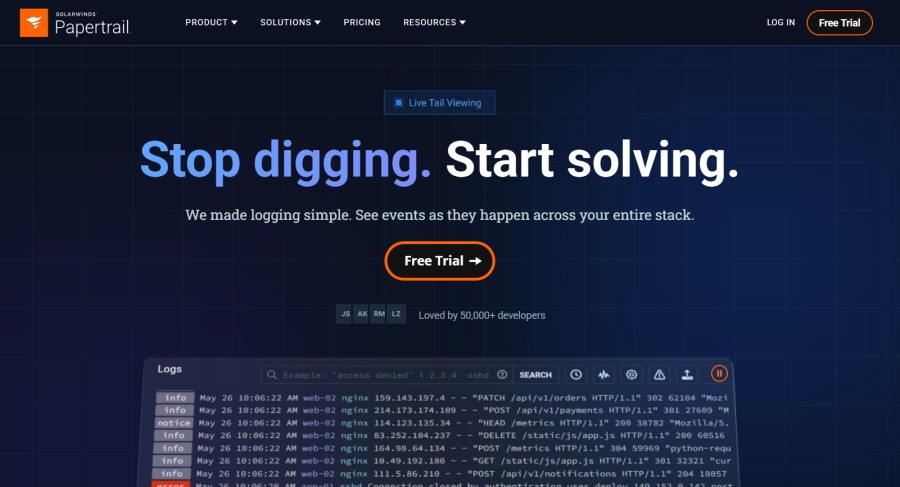
Papertrail is a cloud-based log aggregation and search platform owned by SolarWinds. It centralizes log streams from servers, containers, applications, and cloud services into a single web-based interface with real-time search, alerting, and team collaboration features.
Papertrail was built for simplicity: no local collectors to configure, no backend database to manage, and no retention planning required until you hit plan limits. Logs are ingested via syslog or HTTP, indexed automatically, and searchable immediately through a fast web UI or REST API.
The platform targets teams that want managed log aggregation without the infrastructure overhead of self-hosted tools like ELK or the cost unpredictability of broader observability platforms. It works well for startups and small teams monitoring modest log volumes where 3 to 7 days of live retention covers most debugging needs and long-term compliance logs are exported to S3.
Papertrail supports structured logs, custom log parsing, and team-based search groups. It integrates natively with PagerDuty, Slack, webhooks, and Datadog for downstream alerting and incident workflows.
How Papertrail Pricing Works
Papertrail uses volume-based pricing measured in gigabytes of log data transferred per month. Every plan includes unlimited systems, unlimited users, and encrypted log transfer. Pricing starts at $5/GB/month with no base fee or per-seat charges.
Pricing Tiers and Retention Limits
Papertrail offers tiered plans based on monthly transfer volume. Each tier comes with a fixed live search retention window ranging from 3 to 7 days depending on the plan. Once logs age out of the retention window, they are archived to Amazon S3 and are no longer searchable via the Papertrail web UI.
| Monthly Transfer | Price per Month | Live Search Retention | Archive Included |
|---|---|---|---|
| 1GB | $5 | 7 days | Yes |
| 16GB | $49 | 7 days | Yes |
| 50GB | $99 | 7 days | Yes |
| 100GB | $199 | 7 days | Yes |
| 500GB | $999 | 7 days | Yes |
| 5TB | $4,999 | 7 days | Yes |
| 10TB | $9,999 | 7 days | Yes |
| Custom | Custom pricing | Up to 30 days | Yes |
Pricing is based on publicly available information as of April 2026 from Papertrail’s pricing page. Verify current rates directly with SolarWinds before purchasing.
What Happens When You Hit the Limit?
When your monthly transfer reaches the plan limit, you have two options: stop logging or continue as usage-based overage. Overage costs are 30% higher per GB than your base plan rate and are capped at 200% of your plan limit. You receive notifications before hitting the cap and can adjust settings at any time.
For a team on the 100GB plan ($199/month), hitting 150GB would cost $199 base + $97.50 overage = $296.50 total. Logs stop ingesting entirely if you exceed the 200% hard cap unless you upgrade mid-month.
Archive Storage and Search
All logs are automatically archived to Amazon S3 once they age out of the live retention window. Archives are downloadable text files that can be analyzed using external tools like Amazon Athena, Redshift, or Hadoop on EMR. Papertrail does not charge for archiving, but searching archived logs requires exporting them from S3 and running queries in a separate system.
This works well for compliance where logs need to exist for regulatory purposes but are rarely accessed. It breaks down when a production incident spans more than 7 days and root cause analysis requires correlating recent logs with archived data from two weeks prior.
How Transfer Volume Is Calculated
Papertrail measures log transfer based on the length of each log message plus 50 bytes of metadata. One gigabyte equals approximately 6.6 million 100-character log messages. Transfer is measured monthly, so daily spikes are averaged out as long as total monthly volume stays within the plan limit.
JSON-structured logs, stack traces, and verbose debug logs increase per-message size significantly. A typical Spring Boot application with debug logging enabled can generate 200 to 300-character messages, reducing effective capacity to 3 to 4 million messages per GB.
Key Features of Papertrail
Papertrail’s feature set is focused on fast log ingestion, real-time search, and team collaboration without the operational complexity of self-hosted platforms.
Real-Time Log Ingestion and Search
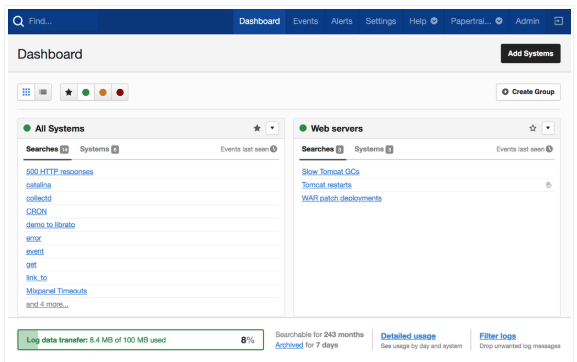
Logs appear in the Papertrail web interface within seconds of being sent. Search supports full-text queries, regex patterns, field filtering, and time range selection. The interface updates live as new logs arrive, making it useful for watching application behavior during deployments or incident triage.
Search results can be saved as named queries, shared with team members, and embedded in dashboards or external tools via the REST API.
Team-Based Search Groups
Papertrail allows you to organize logs into search groups by service, environment, or team. Each group can have its own saved searches, alert rules, and access controls. This keeps production logs separate from staging and prevents junior engineers from accidentally exposing sensitive data.
Alerting and Integrations
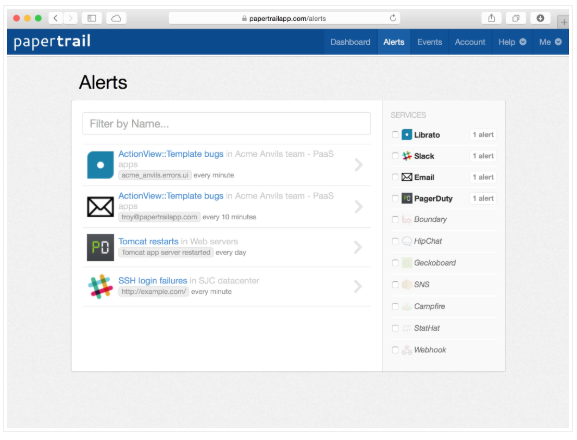
Papertrail supports search-based alerts that trigger when a log pattern matches or a threshold is exceeded. Alerts can route to email, Slack, PagerDuty, webhooks, or third-party incident management platforms.
Integration examples:
- PagerDuty for on-call escalation
- Slack for team notifications
- Datadog for forwarding log events into broader observability workflows
- Custom webhooks for in-house incident tooling
Encrypted Log Transfer
All log data is encrypted in transit using TLS. Papertrail stores logs in SolarWinds-managed infrastructure, which may not meet data residency requirements for teams in regulated industries or jurisdictions requiring logs to remain on-premises.
REST API for Programmatic Access
Papertrail provides a REST API for querying logs, managing systems, and retrieving archived data. This is useful for integrating Papertrail search into CI/CD pipelines, custom dashboards, or automated incident response workflows.
Papertrail Pricing at Scale: Real Cost Scenarios
Pricing based on public rate cards as of April 2026. These scenarios model production-ready workloads at different scales. Your actual costs will vary based on log verbosity, retention requirements, and team workflow.
Small Team: 500GB per Month
A startup running 10 to 15 microservices on AWS ECS with moderate logging generates 500GB per month. At $999/month, this includes 7-day live retention and automatic S3 archiving. Searching older logs requires exporting from S3 and querying in Athena, adding $50 to $100 monthly in AWS costs depending on query frequency.
Total cost: approximately $1,050 to $1,100/month including AWS egress and Athena.
Mid Market Team: 5TB per Month
A SaaS platform with 50 services across staging and production environments ingests 5TB monthly. The base plan costs $4,999/month for 7-day retention. When a production incident requires searching logs from 14 days ago, the engineering team exports 2TB of archives from S3 and runs Redshift queries, adding $200 in one-time analysis costs.
Total cost: $4,999/month base + occasional $200 analysis spikes.
Enterprise Team: 30TB per Month
A large fintech company with strict compliance requirements ingests 30TB monthly and needs 30-day live retention for SOC 2 audits. This requires a custom enterprise plan with negotiated pricing. Publicly available pricing does not extend beyond 10TB, but industry estimates suggest $25,000 to $35,000 monthly for this tier with extended retention.
Total cost: estimated $30,000/month, verified via direct SolarWinds contact.
Papertrail Pros and Cons
Pros
Fast setup with zero infrastructure overhead. No backend database to configure, no Elasticsearch cluster to size, and no retention policies to tune. Logs start appearing in the web UI minutes after signup.
Unlimited systems and users. No per-host or per-seat fees. A team of 100 engineers monitoring 500 containers pays the same rate as a 5-person team monitoring 50 VMs.
Strong search performance within the retention window. Real-time indexing and fast full-text search make it effective for active debugging and incident triage.
Automatic archiving to S3. Logs are preserved for compliance without manual intervention. Archives can be queried offline using standard AWS tools.
Cons
Short live retention limits troubleshooting. Seven-day retention works for recent incidents but fails when root cause analysis requires correlating logs from before the retention window. Reddit users document needing to export and rehydrate archives mid-incident, adding 20 to 30 minutes to mean time to resolution.
Archives are not searchable in the UI. Archived logs must be downloaded from S3 and queried in external tools. This breaks the unified search experience and requires proficiency with Athena, Redshift, or Hadoop.
Volume-based pricing compounds at scale. A 10x increase in log volume results in a 10x cost increase with no pricing tiers or volume discounts beyond the published rate card. Teams generating 100TB monthly face $50,000+ bills with no way to reduce costs without dropping logs.
Cloud-only architecture. Papertrail runs entirely in SolarWinds infrastructure. Logs cannot be kept on premises or in a customer-controlled VPC, making it unsuitable for data residency or air-gapped environments.
No correlation with traces or metrics. Papertrail is logs only. Teams using distributed tracing or infrastructure metrics need separate tools, increasing total observability cost and fragmenting root cause workflows.
Papertrail Alternatives for Log Management at Scale
Papertrail works well for small teams with low to moderate log volumes where 7-day retention covers most use cases. Teams with higher volumes, longer retention needs, or data residency requirements should evaluate alternatives.
CubeAPM
CubeAPM is a self-hosted observability platform covering logs, APM, distributed tracing, and infrastructure monitoring in a single deployment. It runs inside your own VPC or data center, keeping logs fully under your control with unlimited retention at $0.20/GB ingested.
Unlike Papertrail, CubeAPM correlates logs with traces and metrics automatically, making root cause analysis faster. Logs remain searchable indefinitely without exporting to external storage. The platform is OpenTelemetry native and compatible with existing Datadog, New Relic, or Prometheus agents.
Pricing: $0.20/GB all-in, no retention limits, no seat fees
Deployment: Self-hosted (vendor-managed updates)
Best for: Teams needing unified logs, APM, and traces with full data control
More details: CubeAPM log management platform
Datadog Log Management
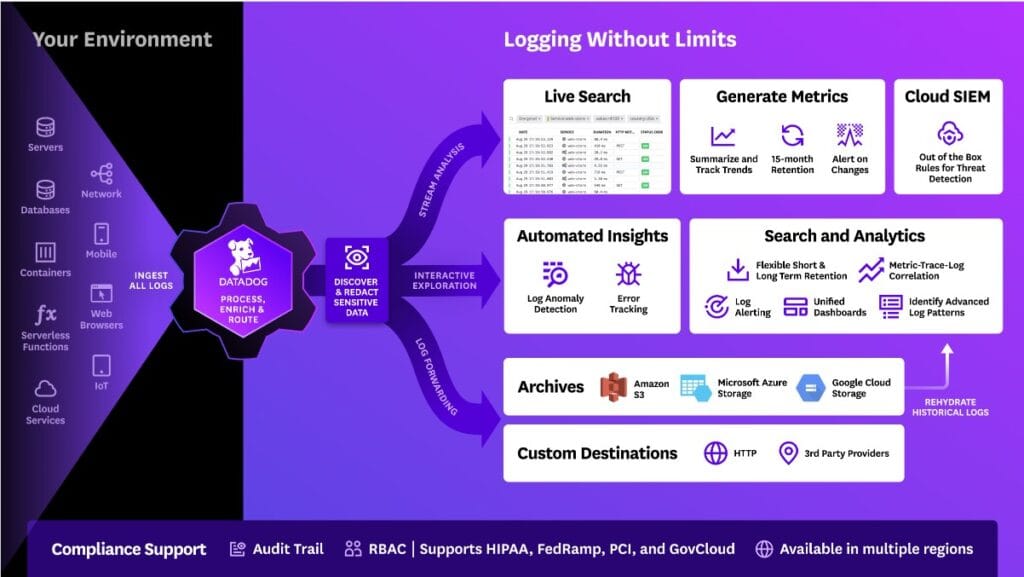
Datadog provides managed log ingestion and search with correlation across logs, traces, metrics, and RUM in a unified SaaS platform. Logs are indexed automatically and searchable for 15 days by default, with extended retention available at additional cost.
Pricing is dual-layered: $0.10/GB for ingestion and $1.70 per million indexed log events. For verbose applications generating 50 million log events from 10GB of data, the effective cost is $17.10 ingestion + indexing per 10GB, not $1.00. Datadog’s pricing page details current rates.
Pricing: $0.10/GB ingest + $1.70/million indexed events
Deployment: SaaS only
Best for: Teams already using Datadog for APM or infrastructure monitoring
Graylog
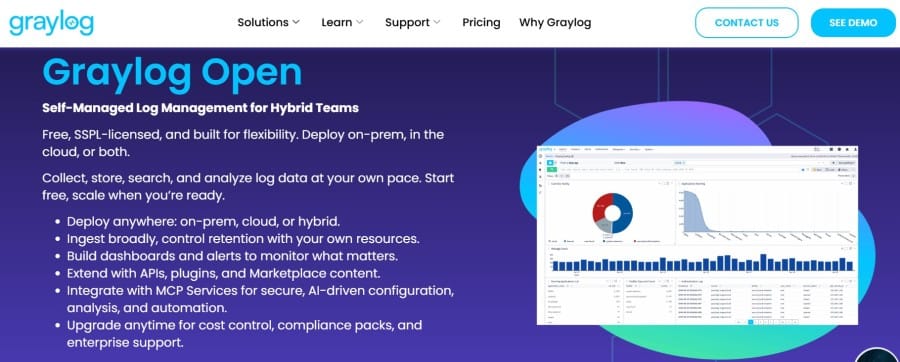
Graylog is an open source log management platform with both self hosted and cloud deployment options. It supports centralized log collection, structured log parsing, and full text search with no licensing fees for the open source version. Enterprise features include archiving, compliance workflows, and advanced alerting.
The self-hosted deployment gives full control over retention and data location. Graylog scales horizontally using Elasticsearch or OpenSearch as the backend, making it suitable for high-volume environments.
Pricing: Free open source; Enterprise starts at $15,000/year
Deployment: Self-hosted or SaaS
Best for: Teams wanting open source log management with enterprise support
Splunk
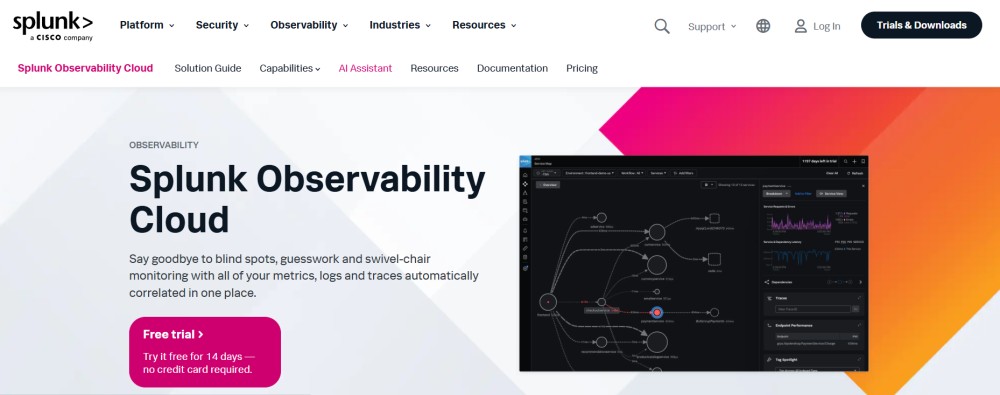
Splunk is an enterprise log analytics and SIEM platform widely used in security- and compliance-heavy industries. It ingests logs, metrics, and events from any source and provides powerful search, alerting, and visualization capabilities.
Splunk pricing is based on daily ingestion volume with tiered rates. A typical mid-market deployment ingesting 100GB daily costs $15,000 to $25,000 monthly depending on support tier and retention. Splunk Cloud offers managed deployment, while Splunk Enterprise allows on-premises installation.
Pricing: Custom, starts around $150/GB/month for enterprise tier
Deployment: SaaS or on-premises.
Best for: Regulated industries needing SIEM and compliance workflows
Better Stack
Better Stack (formerly Logtail) offers developer-friendly log management with fast setup, modern UI, and incident management integration. Pricing includes per-responder fees and bundled log volume, making it predictable for small teams.
Plans start at $29/month for 5GB and scale to custom enterprise pricing. The platform emphasizes fast search, live tailing, and integration with incident response tools like PagerDuty and Opsgenie.
Pricing: Starts at $29/month for 5GB, scales with bundles
Deployment: SaaS only
Best for: Startups and small teams prioritizing developer experience
How to Evaluate Papertrail Against Alternatives
When comparing Papertrail to other log management platforms, consider these decision criteria:
Retention requirements: If live search beyond 7 days is critical for your workflows, Papertrail’s archive model will slow down incident response. Platforms with 30 to 90-day live retention reduce the need for offline archive queries.
Data residency and compliance: Papertrail runs in SolarWinds cloud infrastructure. Regulated teams requiring on-premises or regional data residency need self-hosted or BYOC deployment models.
Cost at scale: Papertrail pricing is linear with volume. If you generate 50TB monthly and expect 10x growth over two years, model the cost trajectory against alternatives with volume discounts or flat retention pricing.
Unified observability: Logs alone do not solve distributed system debugging. If your stack includes microservices, consider platforms that correlate logs with traces and metrics natively instead of maintaining separate log and APM tools.
Search and query depth: Papertrail’s search is fast but limited to text matching and basic field filtering. Teams needing advanced log analytics (SQL queries, aggregations, anomaly detection) should evaluate tools with richer query languages.
Frequently Asked Questions
What happens to logs after the retention period ends in Papertrail?
Logs are automatically archived to Amazon S3 as downloadable text files. They are no longer searchable in the Papertrail web UI but can be analyzed using AWS tools like Athena, Redshift, or Hadoop.
Can I extend live search retention beyond 7 days?
Yes, custom enterprise plans support up to 30 day live retention. Contact SolarWinds directly for pricing.
Does Papertrail support structured log parsing?
Yes, Papertrail automatically parses JSON logs and supports custom parsing rules for other structured formats. Parsed fields can be filtered and searched individually.
How does Papertrail pricing compare to ELK stack self hosting?
Papertrail removes infrastructure management overhead but costs more per GB at scale. A team ingesting 10TB monthly pays $9,999 with Papertrail versus $2,000 to $4,000 in AWS costs for a self managed ELK cluster, depending on instance size and retention.
Can Papertrail ingest logs from Kubernetes?
Yes, Papertrail supports log collection from Kubernetes using Fluentd, Fluent Bit, or rsyslog sidecars. Logs can be tagged by namespace, pod, or container for filtering.
Does Papertrail integrate with APM or tracing tools?
Papertrail forwards log events to external platforms via webhooks but does not natively correlate logs with distributed traces or metrics. Teams needing unified observability require separate APM tools.
What is the maximum log retention available?
Live search retention caps at 30 days on custom enterprise plans. Archived logs in S3 can be retained indefinitely based on your AWS S3 lifecycle policies.
Disclaimer: The information in this article reflects the latest details available at the time of publication and may change as technologies and products evolve. Features, pricing, and plan limits can change over time. Always verify the latest information directly with the vendor before making purchasing or deployment decisions.