








The main difference between New Relic, IBM Instana, and CubeAPM is how they approach deployment, cost predictability, and data control.
New Relic is a fully SaaS, usage-based observability platform optimized for ease of adoption. IBM Instana focuses on automated discovery and real-time dependency mapping for complex enterprise systems. CubeAPM is a self-hosted, OpenTelemetry-native platform built for predictable pricing, data residency, and faster incident response.
This article compares New Relic vs IBM Instana vs CubeAPM across deployment model, pricing behavior, sampling strategy, data retention, and real-world use cases.
New Relic vs IBM Instana vs CubeAPM Comparison
This comparison below is based on publicly available documentation and typical production usage patterns. The actual pricing, sampling, and retention behavior may vary depending on workload characteristics and system configuration.
| Feature | CubeAPM | IBM Instana | New Relic |
| Known for | Unified MELT, native OTEL, self-hosting, cost predictability | Automated APM, real-time dependency discovery, AI insights | Full-stack APM, service maps, advanced analytics |
| Multi-Agent Support | Yes (OTel, New Relic, Datadog, Elastic, etc.) | Yes (OTel, multiple Instana agents for hosts, K8s, cloud services) | Yes (New Relic Agent, OTel, Prometheus) |
| MELT Support | Full MELT coverage | MELT coverage | Full MELT coverage |
| Deployment | Self-hosted with vendor-managed | SaaS & self-hosted | SaaS-only |
| Pricing | Ingestion-based: $0.15/GB | Essentials: $75/MVS/ month; Standard: $150/ MVS/month; Logs: $0.35/GB; Synthetics: $0.0003 per execution | Free 100 GB/month; beyond: $0.40/GB. Per-user license: $49-$349/month |
| Sampling Strategy | Smart sampling, automated, context-aware | Unsampled distributed tracing; statistical; head or tail via OTel | Adaptive, head- based, & tail-based |
| Data Retention | Unlimited Retention | Logs/traces: 7d; logs extended:30d, 60d, 90d; synthetics: 60d | 30d for logs/events; add-on retention |
| Support Channel & TAT | Slack, WhatsApp; response in minutes | Community-based; paid: support portal; Enterprise SLAs | Community, docs, ticket-based; TAT: 2d-2 hrs; 1hr priority |
New Relic vs IBM Instana vs CubeAPM: Feature Breakdown
Known for
CubeAPM is known for providing unified MELT observability on top of OpenTelemetry, with a self-hosted but vendor-managed deployment model. Its official documentation emphasizes predictable, ingestion-based pricing, data residency by running inside the customer’s cloud, and end-to-end visibility across applications, infrastructure, logs, traces, RUM, synthetics, and error tracking.
IBM Instana is known for automated application performance monitoring with real-time dependency discovery and continuous tracing. According to IBM’s product documentation, Instana automatically discovers services, infrastructure components, and their relationships, and provides contextual performance insights with minimal manual configuration, which is positioned for complex and large-scale environments.
New Relic is known for full-stack observability delivered as a SaaS platform, combining APM, infrastructure monitoring, logs, metrics, traces, and user experience monitoring in a single cloud interface. Its official documentation highlights service maps, advanced querying, dashboards, and broad cloud and language support aimed at fast adoption and centralized visibility.
Multi-Agent Support
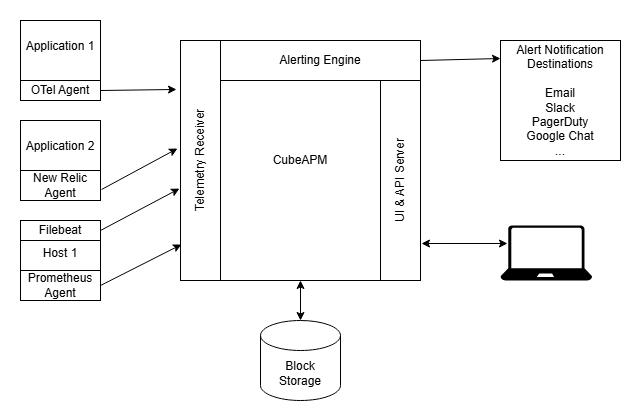
CubeAPM supports multiple agents and data sources natively, with OpenTelemetry as the primary standard. According to its official documentation, CubeAPM can ingest telemetry from OpenTelemetry SDKs and collectors, Prometheus exporters, and is compatible with agents from New Relic, Datadog, and Elastic, allowing teams to reuse existing instrumentation and migrate incrementally.
IBM Instana supports multiple agent types tailored to different environments rather than a single universal agent. IBM’s documentation describes dedicated agents for hosts, Kubernetes, cloud services, and application runtimes, along with OpenTelemetry support for ingesting external telemetry. These agents automatically deploy sensors based on the detected technology stack.
New Relic supports its own language-specific agents for applications and infrastructure, along with OpenTelemetry and Prometheus ingestion. Official New Relic documentation positions its native agents as the primary way to access full platform capabilities, while OpenTelemetry is supported for vendor-neutral instrumentation and data collection.
MELT Support (Metrics, Events, Logs, Traces)
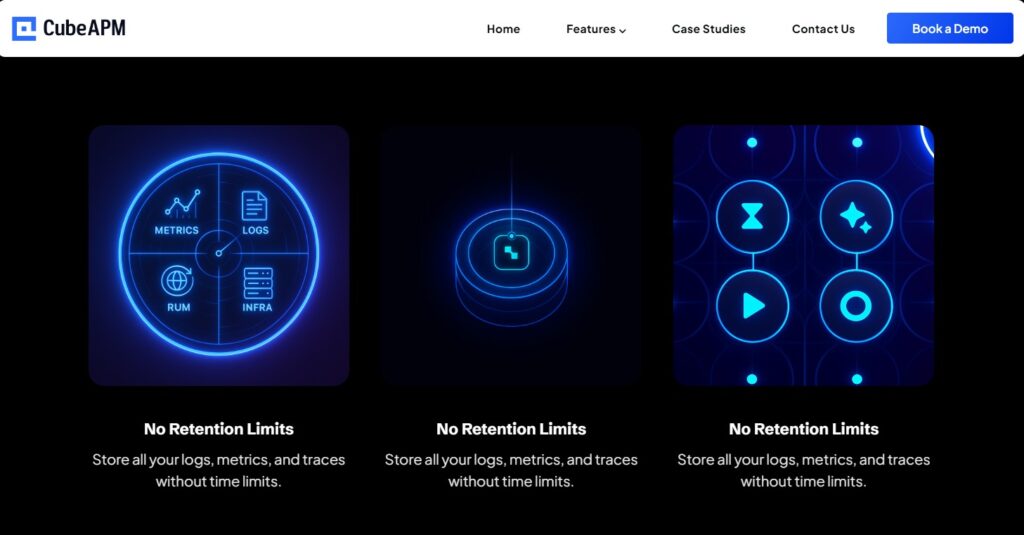
CubeAPM provides full MELT support as first-class signals within a single observability backend. Its official documentation describes native support for metrics, logs, traces, and events, all correlated at request and service level without requiring separate products or pipelines. This unified design is intended to support end-to-end troubleshooting and incident analysis from one platform.
IBM Instana supports metrics, traces, logs, and events as part of its observability offering, with a strong emphasis on real-time metrics and continuous tracing. According to IBM documentation, logs can be collected and correlated with traces and metrics. Log ingestion and retention may require additional configuration or licensed capabilities, depending on deployment and plan. Events are automatically generated from health rules, incidents, and detected anomalies.
New Relic provides full MELT coverage across its SaaS platform, combining metrics, events, logs, and traces into a unified cloud experience. Official New Relic documentation highlights the tight correlation between these signals through service maps, distributed tracing, and queryable telemetry using NRQL, with each signal managed as part of the broader observability platform.
Deployment
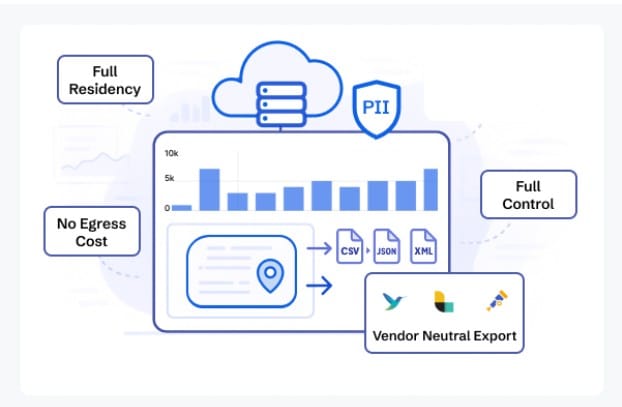
CubeAPM is deployed as a self-hosted observability platform that runs inside the customer’s own cloud or infrastructure, with the platform lifecycle managed by CubeAPM. According to its official website and documentation, this model is designed to support data residency, compliance requirements, and lower network latency, while avoiding the operational burden of fully self-managing the observability stack.
IBM Instana supports both SaaS and self-hosted deployment models. IBM’s documentation describes options to run Instana as a managed SaaS service or deploy it within a customer’s own data center or cloud environment, allowing enterprises to choose based on regulatory, security, and architectural needs. Hybrid and enterprise-managed deployments are also supported through IBM contracts.
New Relic is offered exclusively as a SaaS platform. Official New Relic documentation states that all telemetry data is sent to and processed within New Relic’s cloud infrastructure, with no option to self-host the control plane or data backend, which simplifies setup but limits deployment flexibility.
Pricing for Small, Mid, and Large Teams
To summarize the pricing:
*All pricing comparisons are calculated using standardized Small/Medium/Large team profiles defined in our internal benchmarking sheet, based on fixed log, metrics, trace, and retention assumptions. Actual pricing may vary by usage, region, and plan structure. Please confirm current pricing with each vendor.
| Approx. cost for teams (size) | Small (~30) | Mid-Sized (~125) | Large (~250) |
| CubeAPM | $2,080 | $7,200 | $15,200 |
| New Relic | $7,896 | $25,990 | $57,970 |
| IBM Instana | $4,950 | $17,375 | $37,000 |
CubeAPM Costs in Detail
CubeAPM uses a single ingestion-based pricing model, charging $0.15 per GB of data ingested. According to CubeAPM’s official pricing and documentation, there are no per-user licenses, host-based fees, or retention surcharges, and data retention is included by default. This model is intended to keep costs predictable as telemetry volume grows.
- Small teams (~ 30): $2,080
- Mid-sized teams (~ 125): $7,200
- Large teams (~250): $15,200
New Relic Cost in Detail
New Relic uses a consumption-based pricing model combined with user licensing. Official New Relic pricing includes a free tier with 100 GB per month of data ingestion, after which ingestion is billed at $0.40 per GB. In addition, user access is licensed separately, with per-user pricing ranging from $49 to $349 per month depending on role and capabilities.
- Small teams: $7,896
- Mid-size teams: $25,990
- Large teams: $57,970
IBM Instana Cost in Detail
IBM Instana pricing is based on Managed Virtual Servers (MVS). For full-stack observability, IBM’s official pricing lists an Essentials tier at $75 per MVS per month and a Standard tier at $150 per MVS per month, with additional charges for certain data types and capabilities, such as log ingestion at $0.35 per GB and synthetics at $0.0003 per execution. Final pricing can vary based on deployment model and enterprise contracts.
- Small teams: $4,950
- Mid-size teams: $17, 375
- Large teams: $37,000
As systems scale, these pricing differences become more visible in day-to-day operations. Teams usually feel the impact once data volumes rise due to sustained traffic, increasing service count, or high-cardinality telemetry. At that point, observability costs tend to move from a predictable line item to a dynamic variable that engineering and finance teams must actively track and manage.
Sampling Strategy

CubeAPM uses automated, context-aware smart sampling. According to CubeAPM’s official documentation, sampling decisions consider request context such as latency, errors, and signal importance, allowing high-value traces to be retained while reducing noise and ingestion volume without manual rule tuning.
IBM Instana captures unsampled distributed traces by default and applies statistical sampling when workloads generate very high volumes. IBM documentation also states that when telemetry is ingested via OpenTelemetry, Instana can honor head-based or tail-based sampling decisions defined upstream in the SDK or collector. This approach prioritizes trace completeness while managing storage and processing impact.
New Relic supports adaptive sampling along with configurable head-based and tail-based sampling. Official New Relic documentation describes how sampling can be applied at the agent or collector level to balance observability depth and data volume, with configuration often influenced by usage limits and cost controls.
Data Retention

CubeAPM provides unlimited data retention by default across metrics, logs, and traces. According to CubeAPM’s official product and documentation pages, retention is not tied to pricing tiers or time-based limits, allowing teams to perform long-term analysis, historical comparisons, and post-incident reviews without additional cost or rehydration workflows.
IBM Instana applies time-based retention limits depending on data type and configuration. Official IBM documentation and pricing pages state that logs and traces are retained for 7 days by default, with extended log retention options available at 30, 60, or 90 days. Synthetic monitoring data is retained for up to 60 days, while longer retention generally requires licensed add-ons or enterprise configurations.
New Relic uses retention policies tied to plan and data type. According to New Relic’s official documentation, logs and events are retained for 30 days on standard plans, with longer retention available as paid add-ons. Metrics retention varies by resolution and plan, and extended historical access is typically governed by account tier and usage limits.
Support Channel & TAT
CubeAPM provides direct support through Slack and WhatsApp, with responses handled by core product engineers. Based on CubeAPM’s official support description and customer-facing material, typical response times are measured in minutes rather than hours or days, which is intended to reduce mean time to resolution during active incidents.
IBM Instana offers community support and paid support via the IBM support portal. For customers on paid plans, response times and availability are governed by enterprise SLAs defined in contracts, with severity-based targets rather than fixed public turnaround times. This model is consistent with IBM’s broader enterprise support framework.
New Relic provides community resources, documentation, and ticket-based support through its support portal. According to New Relic’s official support and pricing pages, response times vary by subscription tier, typically ranging from ~2 days on standard plans to ~2 hours on higher tiers, with a 1-hour response time available for priority support on eligible plans.
If you want to dive deeper into feature and pricing comparison, check out our CubeAPM vs New Relic page.
How Teams Typically Decide Between IBM Instana, New Relic, and Self-Hosted Observability
Choosing an observability platform is rarely a purely technical decision. As systems grow and telemetry volume increases, platform selection becomes a cross-functional discussion shaped by operational risk, cost behavior, and data ownership.
Who Is Involved
Engineering teams usually lead the evaluation, focusing on troubleshooting speed, trace reliability, and ease of instrumentation. Finance teams get involved once observability spend becomes variable and harder to forecast. Security and compliance teams weigh in when telemetry includes sensitive data or must stay within specific regions or accounts. In practice, the final decision reflects a balance across all three perspectives.
What Questions Block Decisions
Teams often stall on questions like where observability data will live, how pricing behaves under sustained load, and whether costs scale linearly with growth. Other common blockers include migration effort, agent compatibility, retention limits, and how much operational control the team retains once the platform is in place.
Why Comparisons Alone Aren’t Enough
Feature comparisons explain what a platform can do, but they don’t reveal how it behaves under real production pressure. Teams typically validate decisions by running pilots, replaying incidents, modeling higher data volumes, and testing support responsiveness. At scale, observability choices are shaped less by feature checklists and more by long-term cost behavior, operational ownership, and how quickly teams can respond when things break.
New Relic vs IBM Instana vs CubeAPM: Use Cases
The right observability platform depends less on feature parity and more on how teams operate at scale, where data must live, and how costs behave as telemetry grows.
Choose CubeAPM if:
CubeAPM is a strong fit for teams that want full-stack observability with predictable costs and operational control, without running their own observability infrastructure.
- You need a self-hosted, OpenTelemetry-based observability platform for strict data residency, compliance, or customer data isolation requirements, based on CubeAPM’s deployment model and documentation.
- You want predictable, ingestion-based pricing as telemetry volume grows, without per-user licenses or retention upcharges, based on CubeAPM pricing and sales data.
- You operate microservices or distributed systems and need end-to-end tracing across services with smart, context-aware sampling to reduce noise while preserving high-value traces.
- You are a startup or mid-sized SaaS team looking for a lightweight, easy-to-deploy APM that does not require managing multiple observability products or complex pricing meters.
- You want to reduce mean time to resolution (MTTR) through unified MELT visibility and real-time access to engineers via Slack or WhatsApp support, based on CubeAPM’s support model.
- You run Java-based applications (Spring Boot, JVM microservices) and need detailed transaction traces, database call visibility, and performance analysis without excessive sampling loss, based on CubeAPM’s Java APM capabilities and OpenTelemetry support.
- You want unlimited data retention for long-term performance analysis, audits, or post-incident reviews without rehydration workflows, based on CubeAPM documentation.
Choose IBM Instana if:
IBM Instana is well-suited for large enterprises that prioritize automated discovery and minimal manual configuration in complex environments.
- You operate large, dynamic environments with frequent infrastructure and service changes and need automatic discovery of application dependencies and service topology, based on IBM Instana’s product design.
- You want continuous, unsampled distributed tracing with strong correlation between application and infrastructure metrics for real-time troubleshooting.
- You are already aligned with IBM’s enterprise ecosystem and prefer SLA-driven support and contract-based pricing models, based on IBM Instana’s official pricing and support structure.
- You need flexibility to deploy observability either as SaaS or self-hosted to meet internal security or regulatory requirements.
- You run high-throughput Java or JVM workloads where automatic instrumentation and low manual overhead are prioritized over cost optimization.
Choose New Relic if:
New Relic is a good fit for teams that want a fully managed, SaaS-first observability platform with broad feature coverage and minimal setup.
- You want fast onboarding and a cloud-hosted experience without managing infrastructure or self-hosted components, based on New Relic’s SaaS-only model.
- You need full-stack observability across applications, infrastructure, logs, user experience, and synthetics in a single platform.
- You are comfortable with consumption-based pricing and per-user licensing, based on New Relic’s published pricing model and usage tiers.
- You have diverse teams that benefit from advanced querying, dashboards, and service maps for exploratory analysis and reporting.
- You operate in environments where data residency is not a primary constraint and prefer centralized observability across multiple teams and services.
Conclusion
New Relic, IBM Instana, and CubeAPM all address modern observability needs, but they differ in how they handle deployment, cost scaling, and operational control. SaaS-first platforms prioritize convenience, while enterprise tools emphasize automation and managed experiences.
CubeAPM stands out for teams that value predictable pricing, OpenTelemetry-native instrumentation, self-hosted deployment, unlimited retention, and fast human support. These characteristics make it well-suited for reducing MTTR as systems and data volumes grow.
If you’re evaluating observability beyond features alone, reviewing CubeAPM alongside real workloads is a practical next step.
Disclaimer: The information in this article reflects the latest details available at the time of publication and may change as technologies and products evolve.
FAQs
1. Which platform is easier to migrate to from an existing APM setup?
CubeAPM is often easier to migrate to if teams already use OpenTelemetry or existing agents from other vendors, since it can ingest telemetry without requiring a full re-instrumentation. IBM Instana and New Relic typically require adopting or standardizing on their preferred agents to access the complete feature set.
2. How do these tools handle observability in hybrid or multi-cloud environments?
IBM Instana and CubeAPM both support hybrid and multi-cloud setups, with CubeAPM running inside customer infrastructure and Instana offering SaaS or self-hosted options. New Relic supports multi-cloud monitoring but processes all telemetry through its SaaS platform.
3. Can these platforms be used by small teams as well as large enterprises?
Yes, but with different trade-offs. New Relic is commonly used by small teams due to quick setup, while IBM Instana is typically adopted by large enterprises. CubeAPM is used by startups and mid-sized teams that want enterprise-grade observability with predictable and simple cost behavior as they scale.
4. How do these tools compare in terms of data privacy and control?
CubeAPM provides the highest level of data control by running entirely within the customer’s cloud or infrastructure. IBM Instana offers both SaaS and self-hosted options for regulated environments. New Relic processes all observability data in its managed cloud, which may be a consideration for teams with strict data residency requirements.
5. Do these platforms support future observability standards like OpenTelemetry?
All three platforms support OpenTelemetry, but in different ways. CubeAPM is built natively on OpenTelemetry. IBM Instana supports OpenTelemetry ingestion alongside its own agents. New Relic supports OpenTelemetry but also promotes its proprietary agents for deeper platform integration.