








Last9 is a unified observability platform for logs, metrics, and traces, built for cloud-native and high-cardinality environments. It is OpenTelemetry native, Prometheus compatible, and positioned for SRE, platform, DevOps, and engineering teams that need correlated telemetry across modern distributed systems.
In this guide, we break down Last9 pricing, plan limits, retention, what drives cost, public review themes, and how Last9 compares with alternatives such as CubeAPM, Datadog, Dynatrace, and New Relic.
What Is Last9?
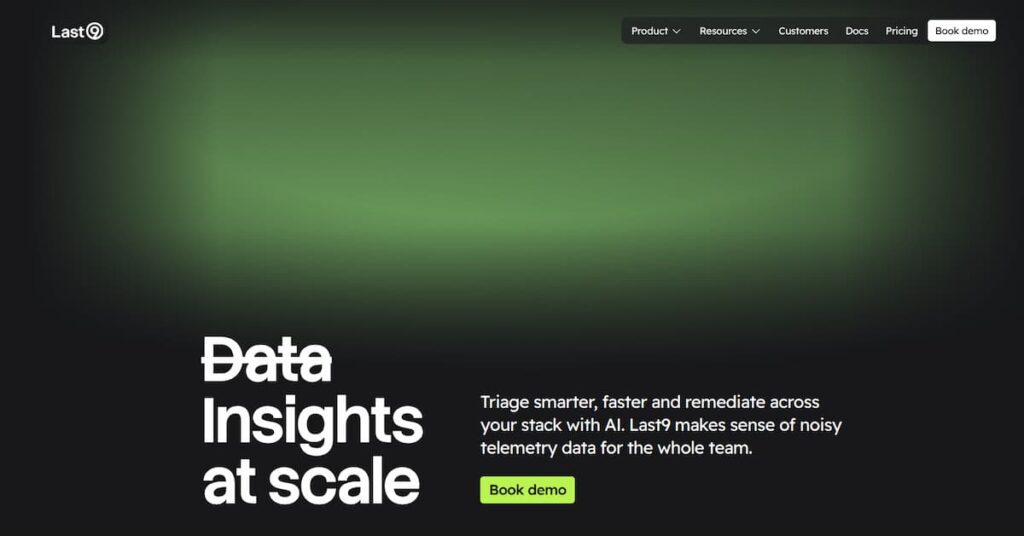
Last9 is an observability platform for logs, metrics, and traces. Its documentation describes the platform as built on OpenTelemetry and Prometheus, with high-cardinality storage, alerting, and SLOs.
Last9 is especially relevant for Prometheus-heavy and Kubernetes-heavy teams because it focuses on high-cardinality telemetry. G2’s product profile says Last9 supports OpenTelemetry, Prometheus compatibility, 100+ integrations, a Control Plane for telemetry lifecycle and cost management, and up to 20 million active time series per metric per day.
Teams can use Last9 as SaaS, while Bring Your Own Cloud is available under the Enterprise plan. Last9’s pricing FAQ states that BYOC is part of Enterprise and is a managed deployment.
Supported Languages, Integrations, and Data Sources
Last9 supports OpenTelemetry ingestion, Prometheus compatibility, log analytics, distributed tracing, browser monitoring, synthetic monitoring, dashboards, alerting, SLO monitoring, and Control Plane workflows. Its pricing page lists Browser Monitoring/RUM, Distributed Tracing, Log Analytics, Service Discovery/APM, Custom Dashboards, Alerting, Changeboards, and SLO Monitoring in the plan comparison.
| Area | Last9 support |
| Standards | OpenTelemetry native, Prometheus compatible |
| Core telemetry | Logs, metrics, traces |
| Frontend and checks | Browser Monitoring/RUM and Synthetic Monitoring |
| Dashboards and alerts | Custom dashboards, alerting, SLO monitoring, changeboards |
| Integrations | 100+ integrations listed by Last9/G2 |
Key Features of Last9
Last9’s high-cardinality positioning is one of its clearest differentiators. G2’s product profile says Last9 supports 20 million active time series per metric per day, with Cardinality Explorer and Streaming Aggregations for high-cardinality telemetry. Last9’s pricing page also lists a 20M timeseries/metrics/day cardinality quota for Pro and customizable cardinality quotas for Enterprise.
This is important for Kubernetes, Prometheus, and multi-tenant environments where label dimensions can grow quickly. Teams with per-pod, per-service, per-region, or per-customer labels should evaluate cardinality as carefully as event volume.
Last9 includes log analytics and distributed tracing. G2 describes its native explorer as a way to jump between logs, traces, and metrics without changing context, and its media section mentions log analytics without LogQL complexity, full attribute search, and correlation with traces and metrics.
On Pro, Last9 lists 14-day retention for logs and traces. Metrics get 90-day retention. Custom retention is available on Enterprise.
Last9’s pricing comparison includes Service Discovery/APM, Distributed Tracing, dashboards, alerting, and SLO monitoring. Its AWS Marketplace page also lists application performance monitoring, infrastructure and log monitoring, anomaly detection, and multi-source telemetry ingestion.
This makes Last9 more than a metrics warehouse. It is positioned as a unified observability platform where teams can correlate infrastructure, application, logs, traces, metrics, and alert context.
Last9 includes Browser Monitoring/RUM in its plan comparison. It also has a dedicated Real User Monitoring page focused on connecting frontend signals to backend traces.
Last9’s Synthetic Monitoring page says it probes endpoints from three regions and records every run as an OpenTelemetry trace, with phase timing from DNS to download. A May 2026 changelog also says HTTP checks are available in every Last9 workspace.
Last9’s Control Plane is central to its cost-control story. G2 describes it as a first-class developer experience for managing telemetry lifecycle and cost, with pre-ingestion workflows to filter, drop, and enrich data before storage without code changes.
Last9’s pricing page also lists ingestion rules for sensitive data, forwarding, dropping, and remapping. Pro and Enterprise both list unlimited ingestion rules.
Last9’s site positions the platform around “AI Native Teams,” natural-language insights, debugging in IDEs, and agent workflows. The pricing/product pages also list Last9 MCP and AI-related workflows.
This is useful for teams that want observability data available inside developer tools and incident workflows, but buyers should still validate which AI features are included in their plan and which are roadmap, beta, or workspace-specific.
Last9 Pricing in 2026
Last9 has two public plan categories: Pro and Enterprise. The Pro plan starts at $1,150 per month and includes 1 billion events per month. Enterprise is custom-priced and adds commitment pricing, custom retention, custom cardinality quotas, Bring Your Own Cloud, 24x7x365 support, PoC support, and migration support.
| Plan | Starting price |
| Pro | $1,150/month |
| Enterprise | Custom |
Last9 Plan Comparison
| Feature | Pro | Enterprise |
| Events | 1B events/month included; unlimited with usage pricing | Unlimited with usage pricing |
| Users | Unlimited | Unlimited |
| Retention | 90 days metrics; 14 days logs/traces | Customizable |
| Deployment | SaaS | SaaS or BYOC managed deployment |
Last9 also lists SSO, access controls, SOC 2 Type 2, ISO 27001, HIPAA, PCI DSS, SLAs, and audit trails in the pricing comparison. Pro lists 99.9% write and 99.5% read SLAs, while Enterprise lists the same SLA values plus enterprise support.
Is There a Free Tier in Last9?
Last9’s pricing page says users can “start observing for free,” and the app has a sign-up path. However, the public pricing page does not show full free-tier production limits in the same structured way as the Pro plan. Buyers should confirm free workspace limits, event caps, retention, and feature availability directly with Last9 before relying on it for production use.
How Last9 Measures Events
Last9 defines an event as a log line, trace span, or metric sample. That means Last9 pricing is driven by event count, not raw GB, host count, RUM sessions, or synthetic test runs.
This matters because telemetry GB does not convert cleanly into Last9 events. A small JSON log line, a large structured log event, a trace span, and a metric sample can all affect event counts differently from how a per-GB platform would price the same workload.
Last9 also says users can view the last 30 days of usage in the Control Plane, broken down by total, logs, traces, and metrics, with hourly detail by date. The pricing FAQ says Last9 sends email notifications at 50%, 75%, 90%, and 100% of limits.
What Does Last9 Really Cost?
⚠️ Disclaimer
The scenarios below are directional editorial estimates, not official Last9 quotes. Last9 publishes the Pro starting price and included baseline, but it does not publish a public per-event overage rate. Final cost can change based on event volume, retention, cardinality, deployment model, support level, discounts, and Enterprise contract terms.
The key point: Last9 does not price by GB. The workload profiles below include GB because they are useful for comparing with per-GB tools, but Last9’s actual bill depends on events, cardinality, and plan limits.
Pricing Assumptions Used
| Item | Verified basis |
| Last9 Pro floor | $1,150/month with 1B events/month |
| Last9 overage | Usage-based, public per-event overage rate not published |
| Last9 Pro retention | 90 days metrics; 14 days logs/traces |
| Last9 Pro cardinality | 20M timeseries/metrics/day |
| CubeAPM comparison | Ingestion-only estimate using $0.15/GB from CubeAPM pricing |
CubeAPM’s pricing page lists Pro at $0.15/GB for data ingestion. It also separately shows data transfer and infrastructure unit pricing, so the comparison below should be read as an ingestion-only estimate, not a final contract quote.
Workload Assumptions
| Team | Hosts | Logs | Traces/APM | Metrics | Total telemetry |
| Small team | 10 | 720 GB/mo | 360 GB/mo | 1 GB/mo | 1,081 GB/mo |
| Growing team | 50 | 3,600 GB/mo | 1,800 GB/mo | 5 GB/mo | 5,405 GB/mo |
| Mid-market team | 250 | 18,000 GB/mo | 9,000 GB/mo | 25 GB/mo | 27,025 GB/mo |
Scenario 1: Small Team, Around 10 Hosts
Scenario
A small team sends about 1,081 GB of telemetry per month across logs, traces, and metrics. It also needs basic RUM and synthetic coverage, but Last9 does not publish separate per-session or per-run RUM and synthetic pricing on the public pricing page.
For Last9, the planning anchor is the Pro floor: $1,150/month for 1 billion included events. If the workload stays inside the included event baseline, the public estimate is $1,150/month.
Estimated monthly cost
| Component | Assumption | Monthly cost |
| Last9 Pro | 1B events/month included | $1,150 |
| Usage above baseline | Not modeled if within 1B events | $0 |
| Public estimate | Pro floor | ~$1,150/month |
What this shows
Last9 has a meaningful fixed floor for small teams. CubeAPM is cheaper on an ingestion-only basis at this telemetry level, while Last9’s advantage is that it bundles users, hosts, alert rules, ingestion rules, and multiple signals into the Pro model rather than charging per host or per user.
Scenario 2: Growing Team, Around 50 Hosts
Scenario
A growing SaaS team sends about 5,405 GB of telemetry per month. For Last9, this may or may not exceed 1 billion events depending on log density, trace span volume, metric scrape frequency, and how much pre-ingestion filtering the team applies.
Because Last9 does not publish a per-event overage rate, the only public estimate is the $1,150/month Pro floor plus usage-based charges if event volume exceeds the included baseline.
Estimated Monthly Cost
| Component | Assumption | Monthly cost |
| Last9 Pro | 1B events/month included | $1,150 |
| Usage above baseline | Applies if events exceed 1B; rate not public | Usage-based |
| Public estimate | Floor plus possible overage | $1,150+/month |
What this shows
At this scale, CubeAPM remains lower on an ingestion-only basis before any Last9 overage. Last9’s appeal is stronger for teams that value no per-host or per-user fees and need high-cardinality Prometheus workflows. The risk is that chatty logs, unsampled spans, or high-frequency metrics can push event usage beyond the included baseline.
Scenario 3: Mid-Market Team, Around 250 Hosts
Scenario
A mid-market team sends about 27,025 GB of telemetry per month. At this scale, Last9 cost becomes harder to model publicly because the workload may exceed the Pro event baseline, may approach cardinality limits, and may require longer log or trace retention than the 14 days included in Pro.
For Last9, Enterprise becomes likely if the team needs custom retention, custom cardinality quotas, or BYOC. Enterprise is custom-priced.
Estimated Monthly Cost
| Component | Assumption | Monthly cost |
| Last9 Pro floor | Starting point before usage | $1,150 |
| Usage above baseline | High event volume; rate not public | Usage-based |
| Enterprise | Likely if custom retention, BYOC, or higher quotas are needed | Custom |
| Public estimate | Not publicly calculable | Custom |
What this shows
This is no longer a clean dollar-for-dollar comparison. CubeAPM provides a public ingestion-based estimate, while Last9 requires a quote if Enterprise limits are involved. Last9 may be more attractive for teams whose biggest problem is high-cardinality Prometheus scale.
What Drives Last9 Costs?
Event volume is the main Last9 cost driver. The Pro plan includes 1 billion events per month, and Last9 defines an event as a log line, trace span, or metric sample.
Cardinality is a major planning factor. Pro includes a 20M timeseries/metrics/day quota, while Enterprise offers customizable cardinality quotas.
Pro includes 90-day metrics retention and 14-day logs/traces retention. Teams that need longer retention should evaluate Enterprise or cold storage/rehydration options with Last9.
Pro is SaaS. BYOC is listed under Enterprise, and Last9’s FAQ says BYOC is a managed deployment available as part of Enterprise.
Pro includes Slack/MS Teams support, while Enterprise adds 24x7x365 enterprise support, assigned FDE, PoC support, and migration support.
Last9 User Reviews
G2 lists Last9 at 4.7/5 from 51 reviews, with 84% 5-star reviews and 15% 4-star reviews. AWS Marketplace also shows 4.7/5 from 51 ratings, with those reviews marked as external reviews from G2.
| Review source | Public rating shown |
| G2 | 4.7/5 from 51 reviews |
| AWS Marketplace | 4.7/5 from 51 external G2 ratings |
What Users Like
G2’s AI-generated review summary says users praise Last9 for reliable observability, intuitive dashboards, actionable metrics, proactive alerting, and faster issue identification. G2’s pros/cons summary lists Ease of Use, Customer Support, Reliability, Monitoring, and Integrations as the top positive themes.
Users also highlight clean dashboards, Slack-based support, SLO visibility, fast debugging, and consolidated observability workflows in public G2/AWS Marketplace review snippets.
What Users Criticize
⚠️ Disclaimer
The following points reflect public user-review themes and should not be treated as universal platform limitations.
G2 lists Dashboard Issues, Learning Curve, Difficult Learning, Learning Difficulty, and Insufficient Information as negative themes in its pros/cons summary. AWS Marketplace review snippets also mention dashboard logging issues, documentation gaps, manual workflow steps, and some latency when checking high-volume logs.
| Theme | What it means for buyers |
| Learning curve | Teams may need Prometheus/SRE familiarity |
| Dashboard issues | Some users mention dashboard lag or update issues |
| Documentation gaps | Some workflows may need clearer onboarding |
| Log latency | High-volume log use cases should be tested |
| Retention limits | 14-day logs/traces retention on Pro may be short |
Last9 Alternatives: How It Compares to Competitors
Last9 vs CubeAPM
Last9 is a SaaS-first, event-based observability platform with a $1,150/month Pro floor and Enterprise BYOC. CubeAPM is a managed, self-hosted observability platform with public ingestion pricing at $0.15/GB and native support for APM, logs, infrastructure monitoring, RUM, synthetics, error tracking, and Kubernetes monitoring.
| Category | Last9 | CubeAPM |
| Deployment | SaaS; BYOC on Enterprise | Self-hosted / customer environment |
| Pricing | Event-based from $1,150/mo | $0.15/GB ingestion |
| Users | Unlimited | No user-license charge shown for Pro |
| Retention | 90 days metrics; 14 days logs/traces on Pro | 3 months Pro; unlimited on Enterprise |
| Best for | High-cardinality Prometheus teams | Teams wanting self-hosted, per-GB pricing |
CubeAPM is stronger for teams that want telemetry to stay in their own environment and prefer per-GB pricing. Last9 is stronger for teams that need high-cardinality Prometheus workflows and want an event-based SaaS model.
Last9 vs Datadog
Datadog is a broad SaaS observability platform with infrastructure monitoring, APM, logs, RUM, synthetics, security, and more than 1,000 integrations. Datadog’s pricing list shows Infrastructure Pro at $15 per host/month and Infrastructure Enterprise at $23 per host/month when billed annually.
| Category | Last9 | Datadog |
| Pricing model | Event-based | Modular, per-host and usage-based |
| Infrastructure pricing | Included in event model | Starts at $15/host/month |
| Users | Unlimited on Pro | Depends on Datadog product/contract |
| Integrations | 100+ listed by Last9/G2 | 1,000+ built-in integrations |
| Best for | High-cardinality telemetry | Broad SaaS observability ecosystem |
Datadog is stronger for teams that want the widest integration ecosystem and a mature SaaS observability suite. Last9 is more focused on high-cardinality telemetry and avoiding per-host or per-user pricing.
Last9 vs Dynatrace
Dynatrace is an enterprise observability platform known for automation, topology mapping, and AI-driven analysis. Its pricing page uses usage-based components and lists prices such as log ingest/process at $0.20 per GiB, metrics ingest/process at $0.15 per 100k datapoints, and Kubernetes Platform Monitoring billed at $0.002 per hour per pod.
| Category | Last9 | Dynatrace |
| Pricing model | Event-based | Usage-based platform subscription |
| AI/automation | AI-native workflows and MCP | Dynatrace Intelligence, Smartscape, Grail |
| Logs | Included in Last9 platform | Log Analytics usage pricing |
| Deployment | SaaS; BYOC on Enterprise | SaaS and enterprise deployment options |
| Best for | High-cardinality observability | Enterprise automation and root-cause analysis |
Dynatrace is stronger for enterprises that prioritize automation, topology discovery, and enterprise-grade analysis. Last9 is stronger for teams specifically focused on high-cardinality Prometheus and OpenTelemetry workflows.
Last9 vs New Relic
New Relic uses data ingest plus user pricing or compute-based pricing options. Its pricing page lists 100 GB/month of free ingest, $0.40/GB beyond the free 100 GB for original data ingest, $0.60/GB for Data Plus, $49/month for Core users, and Full Platform user pricing that varies by edition.
| Category | Last9 | New Relic |
| Pricing model | Event-based, no per-user fees | Data ingest plus user or compute pricing |
| Free tier | Free sign-up; public limits should be confirmed | 100 GB/month free ingest |
| Users | Unlimited on Pro | Basic free; Core and Full Platform paid |
| Data model | Events | GB ingest plus user/compute |
| Best for | Unlimited users and high-cardinality workflows | Teams wanting broad platform capabilities and a free ingest tier |
New Relic can be easier to start with because of its 100 GB/month free ingest tier. Last9 may be more attractive for teams that want unlimited users and event-based pricing without per-host fees.
Is Last9 the Right Choice?
Last9 Works Best For
| Best fit | Why |
| High-cardinality Prometheus teams | 20M timeseries/metrics/day quota on Pro |
| Kubernetes-heavy teams | Strong fit for labels, services, pods, and remote-write workflows |
| Teams avoiding per-host pricing | No per-host, per-node, or per-user charges |
| SRE teams | SLOs, alerting, telemetry correlation, Control Plane workflows |
| Teams wanting event-based pricing | Pricing maps to log lines, trace spans, and metric samples |
Last9 May Not Be the Right Fit For
| Concern | Why it matters |
| Very small teams | $1,150/month Pro floor may be high |
| Long log/trace retention needs | Pro keeps logs/traces for 14 days |
| Strict self-hosting needs | BYOC requires Enterprise |
| Teams without Prometheus/SRE depth | Learning curve appears in user-review themes |
| Buyers needing exact public overage math | Per-event overage rate is not published |
Conclusion
Last9 is a strong observability platform for teams that care about high-cardinality telemetry, Prometheus compatibility, OpenTelemetry ingestion, correlated logs/metrics/traces, and SRE-focused workflows. Its public Pro plan is clear at the starting point: $1,150/month with 1 billion events, unlimited users, unlimited ingestion rules, unlimited alert rules, 90-day metrics retention, and 14-day logs/traces retention.
The biggest pricing trade-off is that Last9 publishes the Pro floor but not a public per-event overage rate. That makes small-team pricing easy to anchor but larger-team pricing harder to calculate without a quote. Teams also need to watch retention, cardinality, and BYOC requirements because those can push the buying conversation toward Enterprise.
Last9 is best for high-cardinality, Prometheus-heavy, cloud-native teams that want event-based pricing and no per-host or per-user fees. Teams that want self-hosted observability, data residency by default, and public per-GB pricing should also evaluate CubeAPM alongside Last9.
Disclaimer: Pricing, packaging, plan limits, retention, support terms, and product capabilities can change. The cost examples in this article are editorial estimates based on publicly available information as of June 2026. Last9 does not publish a public per-event overage rate, so usage above the 1 billion event baseline cannot be calculated precisely from public sources. Always confirm final pricing, discounts, contract terms, and usage limits directly with Last9 before purchase.
FAQs
1. How much does Last9 cost?
Last9 Pro starts at $1,150 per month and includes 1 billion events per month. Enterprise uses custom pricing.
2. What counts as an event in Last9?
Last9 defines an event as a log line, trace span, or metric sample.
3. Does Last9 charge per host?
No. Last9’s pricing page says there are no per-host, per-node, or per-user charges.
4. Does Last9 include log management?
Yes. Last9 includes Log Analytics, and Pro includes 14-day retention for logs and traces.
5. Does Last9 offer BYOC?
Yes, but BYOC is part of the Enterprise plan and is described as a managed deployment.
6. What are the best Last9 alternatives?
The strongest alternatives are CubeAPM, Datadog, Dynatrace, and New Relic. CubeAPM is strongest for self-hosted per-GB pricing, Datadog for a broad SaaS ecosystem, Dynatrace for enterprise automation, and New Relic for ingest-plus-user pricing with a free ingest tier.