










Highlight.io is an open-source, developer-focused monitoring platform best known for combining session replay, error monitoring, logs, traces, dashboards, and OpenTelemetry-based debugging. Its biggest strength is context: teams can connect a user session to the errors, console logs, network activity, and backend traces behind a broken experience.
A Highlight.io pricing and review is especially important in 2026 because the product is no longer best evaluated as a standalone SaaS tool. After LaunchDarkly acquired Highlight, legacy Highlight.io pricing became historical context, while current buyers need to review LaunchDarkly Observability pricing, migration requirements, usage limits, retention, and enterprise controls.
In this guide, we’ll break down Highlight.io’s legacy plans, LaunchDarkly Observability pricing, real cost drivers, key features, user feedback signals, tradeoffs, and alternatives. We’ll also compare Highlight.io with tools such as CubeAPM, Sentry, LogRocket, PostHog, Datadog, New Relic, and Fullstory.
Important Update: Highlight.io Is Now Part of LaunchDarkly
Highlight.io is no longer best evaluated as a normal standalone SaaS product. LaunchDarkly announced the acquisition of Highlight in April 2025 to strengthen its observability capabilities around guarded software releases.
Highlight’s own migration post says Highlight.io services were scheduled to end on February 28, 2026, with customers asked to migrate SDK snippets to LaunchDarkly Observability before March 1, 2026.
That means the old Highlight.io pricing page is useful as legacy context, but current buyers should evaluate LaunchDarkly Observability pricing instead.
What Is Highlight.io?
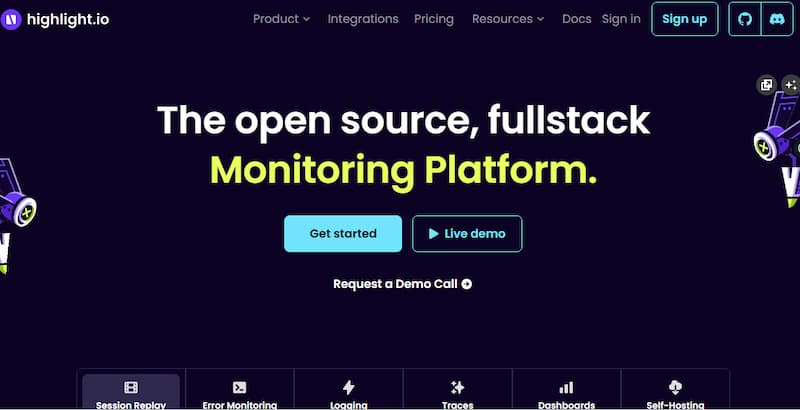
Highlight.io is an open-source, full-stack monitoring platform for web application debugging. Its GitHub repository describes the product as covering error monitoring, session replay, logging, distributed tracing, and more.
In practical terms, Highlight.io helped developers answer questions such as:
- What did the user do before the bug happened?
- Which frontend or backend error was triggered?
- Which logs and traces explain the issue?
- Can engineering reproduce the bug without asking the user for screenshots?
What Highlight.io Covers
| Area | What it means |
| Session replay | Replays user sessions so developers can see what happened before an issue |
| Error monitoring | Captures and groups frontend and backend exceptions |
| Logs | Helps teams search and correlate application logs |
| Traces | Tracks request latency and distributed performance issues |
| Dashboards | Visualizes sessions, errors, logs, and traces |
| OpenTelemetry support | Supports standards-based observability workflows |
| Self-hosting | Historically supported hobby and enterprise self-hosting |
| LaunchDarkly migration | Current users are expected to move to LaunchDarkly Observability |
Key Features of Highlight.io
Session replay was Highlight.io’s strongest feature. It helped developers see what users clicked, viewed, and experienced before a bug or error occurred. LaunchDarkly’s current observability pages continue this concept by positioning session replay alongside errors, logs, and traces.
Highlight.io supported error monitoring for application debugging, including error context tied to sessions. LaunchDarkly’s observability SDK now includes error monitoring, logging, tracing, and a separate session replay plugin.
Highlight.io included log search and log correlation. In LaunchDarkly Observability, logs are now one of the core observability signals, and LaunchDarkly pricing includes monthly log entitlements.
Highlight.io supported distributed tracing for backend performance visibility. LaunchDarkly’s current observability documentation also includes traces as a supported signal.
Highlight.io dashboards represented sessions, errors, logs, and traces in visual form. The legacy Highlight.io pricing page also listed dashboard limits by plan, with Pay-as-you-go allowing up to three dashboards and Business allowing unlimited dashboards.
Highlight.io’s open-source positioning was one of its biggest differentiators against closed-source session replay tools. Its GitHub repository remains public and describes Highlight as an open-source, full-stack monitoring platform.
Highlight.io historically supported self-hosting, including a Self-Hosted Enterprise option for large enterprises. The legacy pricing page still lists Self-Hosted Enterprise as a separate option for large enterprises hosting Highlight on their own infrastructure.
Highlight.io Pricing in 2026
Highlight.io’s public pricing page still lists legacy plans, but the page also points users toward LaunchDarkly migration. The most accurate 2026 view is:
- Legacy Highlight.io pricing explains what Highlight previously charged.
- LaunchDarkly pricing explains what new or migrated users should evaluate now.
Legacy Highlight.io Pricing
| Plan | Legacy price | Best for | Verified limits and features |
| Free | $0/month | Small projects and trials | 500 monthly sessions, AI error grouping, up to 15 seats |
| Pay-as-you-go | Starts at $50/month | Small teams using hosted Highlight | Up to 3 dashboards, up to 2 projects, up to 15 seats, up to 7-day retention |
| Business | Starts at $800/month | Larger teams needing more scale | Unlimited dashboards, unlimited projects, unlimited seats, custom retention policies, ingest filters |
| Enterprise | Custom | Enterprises needing governance | SAML/SSO, custom MSAs and SLAs, RBAC, audit logs, data export, user reporting |
| Self-Hosted Enterprise | Custom | Large self-hosted deployments | Enterprise self-hosting option |
Source: Highlight.io legacy pricing page.
Legacy Highlight.io Usage Quotas
The legacy pricing calculator showed included Pay-as-you-go usage for 500 session replays, 1,000 errors, 1 million logs, and 25 million traces, with additional fees if teams exceeded quota.
| Usage area | Legacy included usage shown on pricing page |
| Session replay | 500 sessions |
| Error monitoring | 1,000 errors |
| Logging | 1 million logs |
| Traces | 25 million traces |
LaunchDarkly Observability Pricing Context
After Highlight.io became part of LaunchDarkly, current buyers should evaluate LaunchDarkly’s pricing plans instead of relying only on the legacy Highlight.io pricing page. LaunchDarkly currently presents four main plan categories: Developer, Foundation, Enterprise, and Guardian.
| Plan | Pricing status | Best for |
| Developer | $0/month | Small teams, testing, and early usage |
| Foundation | Starts at $10 per service connection/month | Growing teams moving features and observability into production |
| Enterprise | Custom pricing | Larger engineering teams needing platform controls |
| Guardian | Custom pricing | Enterprises needing guarded release workflows |
What Does Highlight.io / LaunchDarkly Observability Really Cost?
⚠️ Disclaimer
The scenarios below are directional editorial estimates, not official LaunchDarkly quotes. Final pricing can change based on service connections, session replay volume, errors, logs, traces, retention, feature flag usage, client-side MAU, enterprise controls, support level, volume discounts, and contract terms.
Highlight.io is now part of LaunchDarkly, so current buyers should evaluate LaunchDarkly Observability rather than legacy Highlight.io pricing alone. LaunchDarkly Observability is not priced like a simple host-based APM tool or a pure GB-ingestion platform. The main pricing drivers are service connections and observability usage across sessions, errors, logs, and traces.
Pricing Assumptions Used in These Scenarios
These scenarios use the workload profiles from the CubeAPM calculator, but map the LaunchDarkly estimate to LaunchDarkly’s public Foundation-style pricing model and observability usage structure.
| Scenario | LaunchDarkly pricing anchor | LaunchDarkly estimate | CubeAPM estimate |
| Small team | 10 service connections + light observability usage | ~$600/month | ~$522/month |
| Growing team | 50 service connections + moderate observability usage | ~$1,200/month | ~$919/month |
| Mid-market team | 250 service connections + high observability usage | ~$5,000/month | ~$4,594/month |
These estimates do not include enterprise discounts, support upgrades, custom LaunchDarkly contract terms, feature flag MAU charges, experimentation usage, or AI-related usage.
Workload Assumptions Used for LaunchDarkly Estimates
| Team size | Infrastructure context | Telemetry context | LaunchDarkly usage assumption | Estimated LaunchDarkly cost |
| Small team | 10 hosts | ~1.1 TB/month | Light sessions, logs, traces, and errors | ~$600/month |
| Growing team | 50 hosts | ~5.4 TB/month | Moderate sessions, logs, traces, and errors | ~$1,200/month |
| Mid-market team | 250 hosts | ~27 TB/month | High session replay, logs, traces, and governance needs | ~$5,000/month |
The telemetry volume is included for comparison with ingest-based platforms like CubeAPM. For LaunchDarkly Observability, the main public pricing calculation is not based directly on GB alone. It depends on service connections and observability usage.
Scenario 1: Small Team, ~10 Hosts
Situation
A small production team runs around 10 hosts and produces roughly 1.1 TB of monthly telemetry across logs, traces, and metrics. The team has light frontend traffic, limited session replay volume, and modest debugging needs.
For LaunchDarkly Observability, the 1.1 TB/month telemetry estimate does not directly create the bill. The stronger pricing factors are service connections, session replays, errors, logs, and traces.
Why teams at this stage consider LaunchDarkly Observability
Teams at this stage may consider LaunchDarkly Observability if they already use LaunchDarkly for feature flags or want debugging tied to releases. The value is not only monitoring; it is seeing how sessions, errors, logs, and traces connect to feature rollouts.
Estimated profile
| Configuration | Detail |
| Infrastructure context | 10 hosts |
| Telemetry context | ~1.1 TB/month |
| Logs | 720 GB/month |
| Traces/APM | 360 GB/month |
| Metrics | 1 GB/month |
| RUM sessions | 5,000/month |
| Synthetic activity | 50,000 API runs + 2,000 browser runs/month |
| Pricing basis | Service connections + light observability usage |
Estimated monthly cost
Disclaimer: This estimate uses LaunchDarkly’s public pricing structure as a planning anchor. It assumes a paid production setup rather than relying only on the free Developer plan.
| Component | Assumption | Monthly cost |
| Service connections | 10 × $10/service connection | ~$100 |
| Session replay, errors, logs, and traces | Light production usage | ~$500 |
| Estimated total | Small team setup | ~$600/month |
CubeAPM cost comparison
| Platform | Pricing basis | Estimated monthly cost |
| LaunchDarkly Observability | 10 service connections + light observability usage | ~$600/month |
| CubeAPM | ~1.1 TB/month telemetry estimate | ~$522/month |
| Estimated savings with CubeAPM | Difference vs LaunchDarkly | ~$78/month |
| Percentage savings | $78 ÷ $600 | ~13% lower |
What this scenario shows
For a small team, LaunchDarkly Observability can be reasonably priced if usage stays light. CubeAPM is slightly cheaper in this scenario because it follows a simpler ingestion-based model and does not require buyers to think separately about service connections, sessions, logs, traces, and feature-platform packaging.
Scenario 2: Growing Team, ~50 Hosts
Situation
A growing SaaS team runs around 50 hosts and produces roughly 5.4 TB of monthly telemetry. The team has more services, more production traffic, and more frontend debugging needs.
For LaunchDarkly Observability, this usually means more service connections, more session replay volume, and higher logs and traces usage.
Why teams at this stage consider LaunchDarkly Observability
At this stage, teams may consider LaunchDarkly Observability because it connects application behavior to feature rollouts. This is useful when teams want to understand whether new releases increase errors, degrade sessions, or affect backend traces.
Estimated profile
| Configuration | Detail |
| Infrastructure context | 50 hosts |
| Telemetry context | ~5.4 TB/month |
| Logs | 3,600 GB/month |
| Traces/APM | 1,800 GB/month |
| Metrics | 5 GB/month |
| RUM sessions | 50,000/month |
| Synthetic activity | 500,000 API runs + 20,000 browser runs/month |
| Pricing basis | Service connections + moderate observability usage |
Estimated monthly cost
Disclaimer: This estimate uses LaunchDarkly’s public pricing structure as a planning model. Actual cost can change if feature flag MAU, experimentation usage, retention, support, or enterprise terms are added.
| Component | Assumption | Monthly cost |
| Service connections | 50 × $10/service connection | ~$500 |
| Session replay, errors, logs, and traces | Moderate production usage | ~$700 |
| Estimated total | Growing team setup | ~$1,200/month |
CubeAPM cost comparison
| Platform | Pricing basis | Estimated monthly cost |
| LaunchDarkly Observability | 50 service connections + moderate observability usage | ~$1,200/month |
| CubeAPM | ~5.4 TB/month telemetry estimate | ~$919/month |
| Estimated savings with CubeAPM | Difference vs LaunchDarkly | ~$281/month |
| Percentage savings | $281 ÷ $1,200 | ~23% lower |
What this scenario shows
For a growing team, the cost gap becomes more visible. LaunchDarkly Observability can make sense when the team wants observability tied to feature flags and releases. CubeAPM is lower in this scenario because it is priced around telemetry ingestion rather than service connections and LaunchDarkly platform packaging.
Scenario 3: Mid-Market Team, ~250 Hosts
Situation
A mid-market team runs around 250 hosts and produces roughly 27 TB of monthly telemetry. The environment may include multiple services, customer-facing applications, APIs, queues, frontend user journeys, and backend traces.
At this stage, the team likely needs higher retention, governance, SSO, RBAC, audit controls, and support. That can push LaunchDarkly buyers toward Enterprise or Guardian-style packaging.
Why teams at this stage consider LaunchDarkly Observability
At mid-market scale, LaunchDarkly Observability is most attractive when the company already uses LaunchDarkly for release management and wants observability tied to guarded releases. It can help teams connect feature rollouts with user sessions, errors, logs, and traces.
Estimated profile
| Configuration | Detail |
| Infrastructure context | 250 hosts |
| Telemetry context | ~27 TB/month |
| Logs | 18,000 GB/month |
| Traces/APM | 9,000 GB/month |
| Metrics | 25 GB/month |
| RUM sessions | 200,000/month |
| Synthetic activity | 2,000,000 API runs + 80,000 browser runs/month |
| Pricing basis | Service connections + high observability usage + governance needs |
Estimated monthly cost
Disclaimer: This estimate uses LaunchDarkly’s public Foundation-style pricing structure as a planning anchor, but a team at this size may require custom Enterprise or Guardian pricing. Buyers should confirm included usage, retention, overages, support terms, and discounts directly with LaunchDarkly.
| Component | Assumption | Monthly cost |
| Service connections | 250 × $10/service connection | ~$2,500 |
| Session replay, errors, logs, and traces | High production usage | ~$2,500 |
| Estimated total | Mid-market setup | ~$5,000/month |
CubeAPM cost comparison
| Platform | Pricing basis | Estimated monthly cost |
| LaunchDarkly Observability | 250 service connections + high observability usage | ~$5,000/month |
| CubeAPM | ~27 TB/month telemetry estimate | ~$4,594/month |
| Estimated savings with CubeAPM | Difference vs LaunchDarkly | ~$406/month |
| Percentage savings | $406 ÷ $5,000 | ~8% lower |
What this scenario shows
At mid-market scale, LaunchDarkly Observability may still be a reasonable fit when the buyer wants observability connected to release workflows. CubeAPM remains lower in this estimate and may be more direct for teams that mainly want full-stack observability, APM, logs, metrics, traces, RUM, and synthetics without tying the pricing model to feature-management platform packaging.
Summary: LaunchDarkly Observability vs CubeAPM Estimated Monthly Cost
Disclaimer: These are directional planning estimates, not official quotes. LaunchDarkly’s final pricing can change based on contract terms, retention, usage, support level, and whether the buyer also uses feature management, experimentation, or AI-related capabilities. CubeAPM’s comparison value is strongest for teams that want full-stack observability without per-host fees, per-user fees, or separate pricing complexity across observability signals.
| Team profile | LaunchDarkly estimate | CubeAPM estimate | Monthly savings with CubeAPM | Percentage savings |
| Small team | ~$600/month | ~$522/month | ~$78/month | ~13% |
| Growing team | ~$1,200/month | ~$919/month | ~$281/month | ~23% |
| Mid-market team | ~$5,000/month | ~$4,594/month | ~$406/month | ~8% |
What Actually Drives Highlight.io and LaunchDarkly Observability Costs?
| Cost driver | Why it matters |
| Service connections | LaunchDarkly defines these as microservices, replicas, and environments connected for one month |
| Session replays | Replay volume grows quickly if every user session is captured |
| Errors | Error spikes can increase usage and noise |
| Logs | Logs often become one of the biggest observability volume drivers |
| Traces | Distributed tracing grows with request volume and sampling strategy |
| Retention | Longer retention usually requires higher plans |
| Client-side MAU | LaunchDarkly feature-management pricing may add MAU-based cost |
| Governance | SSO, RBAC, audit logs, SLAs, and support can push buyers to enterprise plans |
| Migration | Existing Highlight.io users must plan SDK and workflow migration |
💡 Important Pricing Context
The old question was: “How much does Highlight.io cost?” In 2026, the better question is: “How much will LaunchDarkly Observability cost for our sessions, errors, logs, traces, service connections, retention, and governance needs?”
This matters because Highlight.io used to compete directly with tools like Sentry, LogRocket, PostHog, and Fullstory. After the LaunchDarkly acquisition, it is now tied to a broader release-management and guarded-release platform.
CubeAPM, for example, lists pricing at $0.15/GB of ingested data and includes APM, distributed tracing, log management, infrastructure monitoring, RUM, synthetic monitoring, error tracking, dashboards, SSO, RBAC, and audit logs.
Additional Costs and Operational Overhead Buyers Should Plan For
The biggest 2026 issue is migration. Highlight’s migration post says customers should migrate SDK snippets to LaunchDarkly Observability before March 1, 2026 to avoid disruption.
Session replay, errors, logs, and traces are the core usage units. LaunchDarkly also supports ingestion filters to exclude sessions, errors, logs, or traces that are not relevant, and excluded signals do not count against observability quotas.
LaunchDarkly lists 14 days of retention on Developer, 30 days on Foundation, and 100 days on Enterprise. Teams needing longer retention should verify current plan terms.
Legacy Highlight.io Enterprise listed SAML/SSO, custom MSAs and SLAs, RBAC, audit logs, data export, and user reporting. LaunchDarkly Enterprise and Guardian plans are custom-priced and include more advanced controls.
LaunchDarkly is primarily a runtime control and feature management platform. That can be valuable if the buyer wants observability connected to feature flags, releases, rollbacks, and guarded releases. But teams that only want APM, logs, metrics, traces, and infrastructure monitoring should compare standalone observability platforms too.
Highlight.io historically offered self-hosting, including Self-Hosted Enterprise. However, production self-hosting requires planning for infrastructure, upgrades, backups, storage, scaling, security, and support.
Highlight.io User Reviews and Public Feedback in 2026
Highlight.io does not have the same large verified review footprint as bigger observability tools like Datadog, New Relic, Sentry, or LogRocket. Searches for Highlight.io on G2, Capterra, TrustRadius, and AWS Marketplace do not show a strong, clearly verified review profile for the monitoring product. Some “Highlight” results on review sites refer to unrelated products, so they should not be used as Highlight.io evidence.
Because of that, the safest review approach is to treat Highlight.io’s GitHub repository, Product Hunt feedback, official testimonials, and LaunchDarkly migration documentation as the main public signals. Product Hunt feedback describes Highlight as useful for session replay, debugging, easy setup, and cost-effectiveness, while Highlight’s own site includes testimonials about faster debugging and better visibility into how customers use the product.
LaunchDarkly has a stronger review footprint, including AWS Marketplace feedback, but those reviews mostly discuss feature flags, rollout control, rollback speed, and release management. They are useful for understanding LaunchDarkly as the current vendor, but they should not be presented as direct Highlight.io observability reviews.
Review Source Summary
| Source | What we found |
| G2 | No clear Highlight.io monitoring profile |
| Capterra | No clear Highlight.io profile found |
| TrustRadius | No clear Highlight.io profile found |
| AWS Marketplace | LaunchDarkly reviews exist |
| Product Hunt | Relevant Highlight feedback exists |
| GitHub | Strong open-source signal |
What Users and Developers Tend to Like
| Positive signal | What it means |
| Session replay | Helps developers see what users did before an issue |
| Error context | Connects errors with sessions, logs, and traces |
| Easy setup | Developer-friendly onboarding is a repeated public signal |
| Open-source model | Gives technical teams more transparency |
| Full-stack debugging | Combines replay, errors, logs, traces, and dashboards |
What Users and Buyers May Criticize
⚠️ Disclaimer
The points below should be framed as buyer cautions, not as proven platform-wide failures. Because Highlight.io has limited verified third-party review volume, these are based on public product context, migration documentation, and comparison against larger observability platforms.
| Caution | Why it matters |
| Limited review data | Harder to benchmark customer sentiment |
| Product transition | Standalone Highlight.io services were scheduled to end in 2026 |
| LaunchDarkly dependency | Buyers must now evaluate LaunchDarkly Observability |
| Limited enterprise depth | May not replace broad APM/infrastructure suites |
| Pricing comparison complexity | Legacy Highlight and current LaunchDarkly pricing differ |
Review Takeaway
Highlight.io’s public feedback is strongest around session replay, debugging context, developer-friendly setup, and open-source transparency. However, it does not have enough verified G2, Capterra, TrustRadius, or AWS Marketplace review volume to support a normal rating-based review section.
For buyers, the review should be split into two parts: Highlight.io for historical product feedback, and LaunchDarkly for current vendor context. This avoids the mistake of using LaunchDarkly feature-management reviews as if they were direct reviews of Highlight.io’s observability product.
Highlight.io Alternatives: How It Compares to Competitors
Highlight.io vs CubeAPM
Highlight.io was strongest for session replay, frontend debugging, and error context. CubeAPM is more directly positioned as a full-stack observability and APM platform for logs, metrics, traces, infrastructure, RUM, synthetics, dashboards, and application monitoring. CubeAPM is especially relevant for teams that want OpenTelemetry-native observability with predictable ingestion pricing and managed self-hosting. Its public pricing lists $0.15/GB of ingested data.
| Category | Highlight.io / LaunchDarkly Observability | CubeAPM |
| Primary role | Session replay, errors, logs, traces, release-aware observability | Full-stack observability and APM |
| Pricing model | Legacy Highlight plans; current LaunchDarkly service connections and observability units | $0.15/GB ingestion pricing |
| Session replay | Core strength | Not the main positioning |
| Logs, metrics, traces | Logs and traces supported; metrics are newer/early-access in LaunchDarkly docs | Core platform coverage |
| Deployment | LaunchDarkly SaaS path; legacy Highlight self-hosting context | Managed self-hosted / customer environment positioning |
| Best fit | Teams needing replay and release context | Teams needing broader observability with cost predictability |
Highlight.io vs Sentry
Sentry is one of the closest alternatives for error monitoring and developer debugging. It offers error monitoring, performance monitoring, session replay, logs, tracing, and event-based pricing across errors, traces, replays, and logs.
| Category | Highlight.io / LaunchDarkly Observability | Sentry |
| Primary strength | Replay-linked debugging and release context | Error monitoring and developer workflow |
| Session replay | Strong | Available |
| Error monitoring | Strong | Very strong |
| Logs/traces | Supported | Supported |
| Pricing style | LaunchDarkly observability units | Event-based pricing |
| Best fit | Teams moving into LaunchDarkly Observability | Teams prioritizing code-level debugging |
Highlight.io vs LogRocket
LogRocket is a mature session replay and frontend monitoring platform. Its pricing page emphasizes Galileo AI, conditional recording, auto capture, and SaaS or self-hosted deployment.
| Category | Highlight.io / LaunchDarkly Observability | LogRocket |
| Primary strength | Open-source replay roots plus observability context | Session replay and frontend UX analytics |
| Error monitoring | Supported | Strong for frontend issues |
| Logs/traces | Supported | Less central than replay and product analytics |
| Open source | Yes historically | No |
| Deployment | LaunchDarkly SaaS path; legacy Highlight self-hosting context | SaaS and self-hosted options |
| Best fit | Developer teams wanting replay plus release context | Product and engineering teams focused on UX debugging |
Highlight.io vs PostHog
PostHog is broader than Highlight.io because it combines product analytics, session replay, feature flags, experiments, surveys, data warehouse features, logs, and error tracking. PostHog’s pricing page lists a usage-based model with free monthly allowances across many product areas.
| Category | Highlight.io / LaunchDarkly Observability | PostHog |
| Primary strength | Replay and error debugging | Product analytics plus replay and feature tools |
| Session replay | Core strength | Strong |
| Error tracking | Supported | Supported |
| Product analytics | Not the main focus | Core product |
| Feature flags | Now through LaunchDarkly context | Core product |
| Pricing style | LaunchDarkly usage units | Usage-based by product |
| Best fit | Engineering debugging tied to releases | Product-led teams needing analytics and experimentation |
Highlight.io vs Datadog
Datadog is much broader than Highlight.io. It covers infrastructure monitoring, APM, logs, metrics, synthetics, RUM, security, network monitoring, database monitoring, and many integrations. Datadog’s own docs include RUM, session replay, synthetics, APM, infrastructure, logs, and many other billing categories.
| Category | Highlight.io / LaunchDarkly Observability | Datadog |
| Primary role | Replay, errors, logs, traces, release-aware observability | Enterprise observability platform |
| Infrastructure monitoring | Limited | Strong |
| APM | Basic-to-moderate compared with full APM suites | Strong |
| Session replay/RUM | Strong replay focus | Strong RUM and replay ecosystem |
| Pricing model | LaunchDarkly service connections and observability units | Modular host and usage-based pricing |
| Best fit | Developer teams needing replay context | Larger teams needing broad observability |
Highlight.io vs New Relic
New Relic is a full observability platform with APM, infrastructure monitoring, logs, browser monitoring, synthetics, mobile monitoring, dashboards, and AI-assisted operations. Its pricing page lists 100 GB free monthly data ingest and $0.40/GB for original data ingest beyond the free limit on Standard and Pro.
| Category | Highlight.io / LaunchDarkly Observability | New Relic |
| Primary role | Replay-linked debugging and release context | Full-stack observability |
| APM | Supported but not as broad | Core strength |
| Infrastructure monitoring | Limited | Strong |
| Session replay | Core strength | Available through digital experience workflows |
| Pricing model | LaunchDarkly usage units | Data ingest plus user-based model |
| Best fit | Frontend-heavy debugging tied to releases | Enterprise observability and APM |
Is Highlight.io the Right Choice?
When Highlight.io or LaunchDarkly Observability Works Best
Highlight.io or LaunchDarkly Observability is a strong fit for:
- Teams already using LaunchDarkly for feature flags, releases, or experimentation
- Teams that want observability connected to feature flags and release workflows
- Frontend-heavy products that need session replay
- Developers who want errors, logs, traces, and user replay in the same debugging workflow
- Existing Highlight.io customers migrating to LaunchDarkly Observability
- Teams that want to monitor how releases affect user sessions, errors, logs, and traces
When Highlight.io May Not Be the Right Fit
Disclaimer: The points below are buyer-fit considerations, not claims that Highlight.io or LaunchDarkly Observability is a weak product. LaunchDarkly’s current observability product is strongest when buyers want session replay, errors, logs, traces, and release-aware debugging tied to LaunchDarkly workflows.
Highlight.io may not be the right fit for:
- Teams looking for a new standalone Highlight.io purchase in 2026
- Buyers who do not want to migrate into the LaunchDarkly platform
- Companies that mainly need deep infrastructure, Kubernetes, database, network, or cloud monitoring
- Buyers who want a large independent review footprint specifically for Highlight.io
- Organizations that prefer vendor-neutral observability not tied to feature management or release workflows
- Buyers who want one ingestion-based price across logs, metrics, traces, RUM, synthetics, and infrastructure monitoring
Conclusion
Highlight.io earned attention because it made debugging more visual and developer-friendly. Session replay, errors, logs, and traces helped reduce the back-and-forth that usually happens when users report vague bugs.
The main caution in 2026 is the product transition. Highlight.io is now part of LaunchDarkly, and standalone services were scheduled to end on February 28, 2026. Buyers should verify pricing, packaging, retention, support, and migration details through LaunchDarkly.
For buyers, the best approach is to treat legacy Highlight.io pricing as historical context, model current costs through LaunchDarkly Observability, and compare against dedicated observability platforms like CubeAPM if the main need is full-stack monitoring rather than release-management observability.
FAQs
1. What is Highlight.io?
Highlight.io is an open-source, full-stack monitoring platform for session replay, error monitoring, logs, traces, dashboards, and application debugging.
2. How much did Highlight.io cost?
The legacy Highlight.io pricing page listed Free at $0/month, Pay-as-you-go starting at $50/month, Business starting at $800/month, Enterprise custom pricing, and Self-Hosted Enterprise custom pricing.
3. Is Highlight.io still available as a standalone product in 2026?
Highlight.io was acquired by LaunchDarkly, and Highlight’s migration post says standalone Highlight.io services were scheduled to end on February 28, 2026. Buyers should verify current availability through LaunchDarkly.
4. What happened to Highlight.io after LaunchDarkly acquired it?
LaunchDarkly acquired Highlight to add observability capabilities to its guarded release and feature management platform.
5. What is LaunchDarkly Observability?
LaunchDarkly Observability includes session replay, errors, logs, and traces. It helps teams connect application issues to releases, flags, and runtime behavior.
6. What did the Highlight.io Free plan include?
The legacy Highlight.io Free plan listed 500 monthly sessions, AI error grouping, and up to 15 seats.