









The main difference between Grafana, New Relic, and CubeAPM is how they handle observability ownership, cost behavior at scale, and deployment control.
Grafana is a modular, open ecosystem centered around visualization and composable tooling, and New Relic is a fully managed SaaS observability platform optimized for fast adoption. CubeAPM is a self-hosted, OpenTelemetry-native platform built for predictable pricing, full data ownership, and long-term scalability.
Teams evaluating these tools are reacting to growing telemetry, rising SaaS bills, or the need for tighter control over where and how observability data is stored. This Grafana vs New Relic vs CubeAPM comparison examines these tools’ pricing, deployment, features, and more.
Grafana vs New Relic vs CubeAPM Comparison
The table summarizes the core differences between Grafana, New Relic, and CubeAPM across deployment, pricing, sampling, retention, and support. While all three offer full MELT observability, they differ in how costs scale, how much control teams have over data, and how observability is operated at scale.
| Feature | CubeAPM | Grafana | New Relic |
| Known for | Unified MELT, native OTEL, self-hosting, cost predictability | Open-source dashboards, composable observability stack | Full-stack APM, service maps, advanced analytics |
| Multi-Agent Support | Yes (OTel, New Relic, Datadog, Elastic) | Yes (OTel, Tempo, Loki, Prometheus exporters) | Yes (New Relic Agent, OTel, Prometheus) |
| MELT Support | Full MELT coverage | Full MELT coverage | Full MELT coverage |
| Deployment | Self-hosted with vendor-managed | SaaS, self-hosted, & self-managed | SaaS-only |
| Pricing | Ingestion-based: $0.15/GB | OSS: Free; Cloud: $19/month; Enterprise: $25,000/yr | 100 GB/month free; beyond: $0.40/GB. Per-user: $49-$349/month |
| Sampling Strategy | Smart sampling, automated, context-aware | Head-based & tail-based | Adaptive, head- based, & tail-based |
| Data Retention | Unlimited Retention | Free: 14d; paid logs/ traces: 30d, metrics: 13m | Logs/events: 30d; add-on retention |
| Support Channel & TAT | Slack, WhatsApp; response in minutes | Free: Community; Pro: 8×5 email; Enterprise: 24×7, custom SLAs | Community, docs, ticket; TAT: 2d-2 hrs; 1hr priority |
Grafana vs New Relic vs CubeAPM: Feature Breakdown
Known for
CubeAPM is positioned as a full-stack observability and APM platform built around OpenTelemetry, designed to unify metrics, logs, traces, infrastructure, synthetic monitoring, and real-user monitoring while giving teams control over deployment and data residency. It emphasizes predictable pricing, unlimited retention, and self-hosted or managed options, making it suitable for compliance-sensitive environments and cost-conscious scaling.
Grafana is best known as an open-source composable observability and analytics platform that lets teams build custom dashboards and visualizations on top of virtually any data source. Grafana Cloud extends this with a fully managed observability experience combining metrics, logs, traces, alerting, incident response, and more, while Grafana OSS remains a flexible visualization layer that integrates with the broader ecosystem.
New Relic is known as an all-in-one SaaS observability platform that provides deep full-stack visibility into applications, infrastructure, logs, and digital experience with built-in analytics, service maps, and AI-powered insights. Its cloud-native architecture and extensive integrations are designed to help teams monitor and troubleshoot their entire stack from a single platform.
Multi-Agent Support
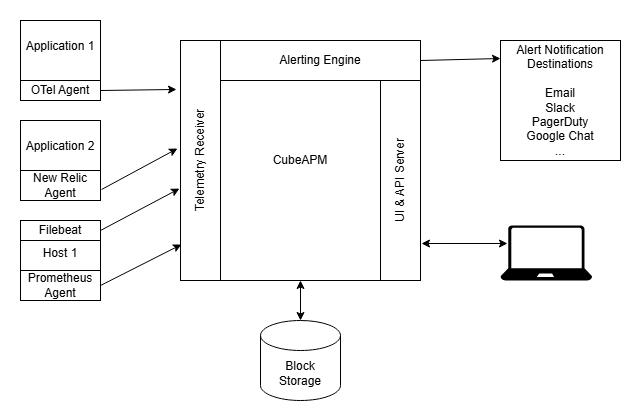
CubeAPM supports telemetry data from a broad range of agents and instrumentation sources, including native OpenTelemetry, as well as compatibility with existing agents from vendors like New Relic, Datadog, Elastic, and Prometheus ecosystems. This allows teams to reuse existing instrumentation or adopt a phased migration without being locked into a single agent type.
Grafana’s observability stack collects telemetry via OpenTelemetry-compatible pipelines and supports integrations through the OpenTelemetry Collector (such as Grafana Alloy) and Prometheus exporters, enabling data ingestion from multiple sources, including metrics, logs, and traces, into Grafana dashboards.
New Relic supports both its native language-specific agents for applications and infrastructure as well as OpenTelemetry SDKs and collectors. This mixed approach lets teams use New Relic’s traditional agents where preferred or standardize on OpenTelemetry while still leveraging New Relic’s unified backend for analysis and visualization.
MELT Support
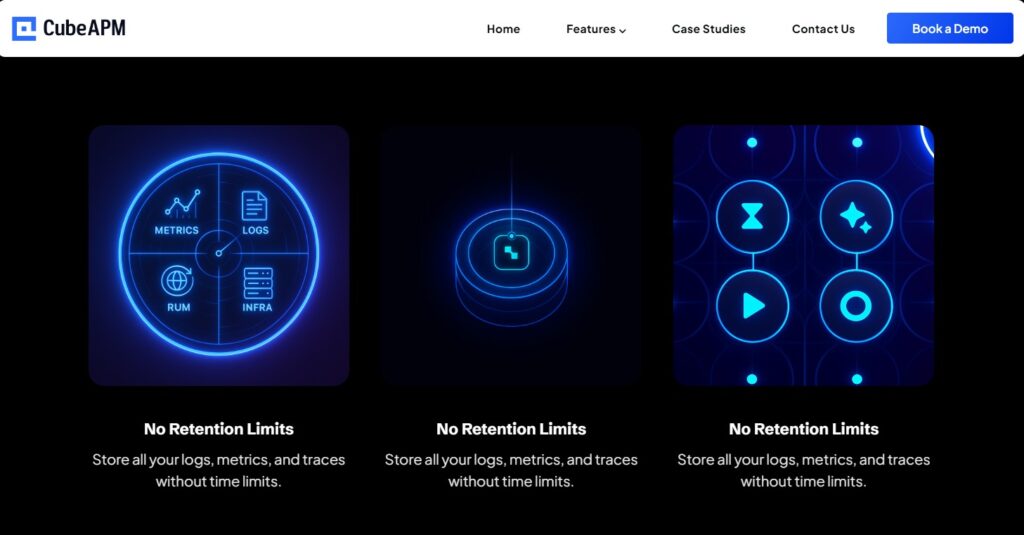
CubeAPM provides full MELT (Metrics, Events, Logs, and Traces) coverage out of the box, enabling teams to ingest, correlate, and visualize all four key telemetry data types in a unified observability experience. This integration helps engineers bridge high-level performance signals with detailed request flow and logs for better root-cause analysis.
Grafana supports full MELT observability by combining separate open-source components in its stack, such as Grafana for visualization, Prometheus/Mimir for metrics, Loki for logs, and Tempo for traces, allowing teams to visualize metrics, logs, and traces together on a single dashboard. This composable model lets users correlate data across signals even though each signal is stored in a dedicated system.
New Relic’s platform is built on the four fundamental telemetry types, metrics, events, logs, and traces, often referred to as MELT, providing integrated ingestion and analysis of all telemetry types. This unified MELT model lets teams query and correlate different signals within the New Relic UI to understand performance and behavior holistically.
Deployment
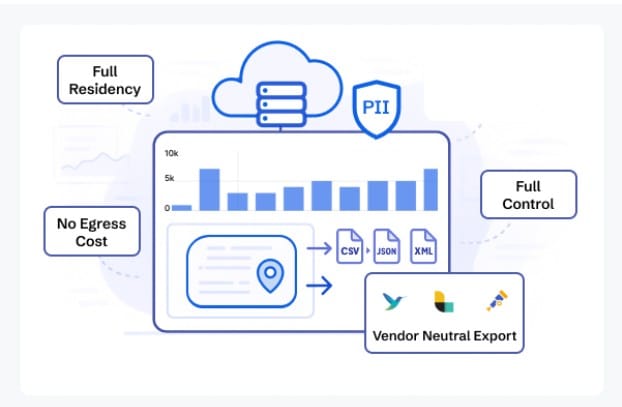
CubeAPM supports self-hosting deployment that runs inside the customer’s environment, either on-premises or in the customer’s cloud, with vendor-managed deployment. This model gives teams direct control over data locality, infrastructure, and compliance boundaries, while still offering a managed operational experience if needed.
Grafana supports self-hosting, self-managed, and SaaS-hosted deployment options. Teams can self-host Grafana Open Source or Grafana Enterprise along with backend components such as Prometheus or Mimir (metrics), Loki (logs), and Tempo (traces), retaining full control over storage, scaling, and retention. Alternatively, Grafana Cloud provides a managed SaaS option where Grafana Labs operates the infrastructure.
New Relic is delivered exclusively as a SaaS observability platform, where ingestion, processing, storage, and visualization are fully managed by New Relic. Customers deploy agents and collectors in their environments, but the core platform and data storage remain vendor-hosted, with no self-managed or on-premises deployment option.
Pricing for Small, Mid, and Large Teams
To summarize the pricing:
*All pricing comparisons are calculated using standardized Small/Medium/Large team profiles defined in our internal benchmarking sheet, based on fixed log, metrics, trace, and retention assumptions. Actual pricing may vary by usage, region, and plan structure. Please confirm current pricing with each vendor.
| Approx. cost for teams (size) | Small (~30) | Mid-Sized (~125) | Large (~250) |
| CubeAPM | $2,080 | $7,200 | $15,200 |
| New Relic | $7,896 | $25,990 | $57,970 |
| Grafana | $2,290 | $8,625 | $17,750 |
CubeAPM Costs in Detail
CubeAPM uses a predictable ingestion-based pricing model that charges $0.15 per GB of telemetry ingested with no per-user licensing. This approach applies uniformly across metrics, logs, and traces and is designed to help teams forecast costs without host or user count variables. Long-term data retention is possible without additional platform fees, as customers manage storage on their infrastructure.
- Small teams (~ 30): $2,080
- Mid-sized teams (~ 125): $7,200
- Large teams (~250): $15,200
New Relic Cost in Detail
New Relic’s pricing combines usage-based data ingestion and per-user licensing. Every account includes 100 GB of free ingest per month. Beyond the free tier, data ingest is commonly billed at approximately $0.40 per GB for traditional telemetry, with additional advanced pricing options available via Data Plus or enterprise contracts.
Core users are typically priced at around $49 per user per month, while Full Platform user licenses can range up to $349 per user per month in Pro and Enterprise usage models after free allocations are consumed.
- Small teams: $7,896
- Mid-size teams: $25,990
- Large teams: $57,970
Grafana Cost in Detail
Grafana pricing depends on deployment and signal type. Grafana Cloud has a free tier with up to 50 GB of logs and traces per month and 10k metric series, and Pro plans with a $19 monthly platform fee plus usage-based charges of approximately $0.50 per GB for logs and traces and around $6.50 per 1,000 metric series for metrics.
Grafana Enterprise pricing is custom and typically starts from $25,000/year. The self-managed open-source stack remains free software with operational costs borne by customers.
- Small teams: $2,290
- Mid-size teams: $8,625
- Large teams: $17,750
Teams start to notice these differences when observability moves past early experimentation and into sustained production use. As traffic stabilizes, microservices multiply, and log and trace volumes grow, observability spend stops feeling like a fixed tool cost. It becomes a moving part of operations that teams need to watch, forecast, and consciously control.
Sampling Strategy

CubeAPM applies automated, context-aware Smart Sampling designed to preserve high-signal telemetry, such as errors and slow requests, while reducing overall data volume. Sampling decisions take into account attributes like latency and error state, and are designed to work natively with OpenTelemetry pipelines, allowing teams to tune sampling without losing critical diagnostic context during incidents.
Grafana supports head-based and tail-based sampling, typically implemented through the OpenTelemetry Collector, Grafana Alloy, or Tempo. Head-based sampling makes decisions at the trace start to control volume early, while tail-based sampling evaluates traces after completion to retain those that match conditions such as errors or high latency. Grafana Cloud also provides managed tail-sampling capabilities, but sampling behavior ultimately depends on how collectors and backends are configured.
New Relic supports adaptive, head-based, and tail-based sampling across its ingestion pipeline. Adaptive sampling dynamically adjusts sampling rates based on traffic patterns to balance cost and visibility, while tail-based sampling allows retention of traces that meet specific conditions, such as failures or slow transactions. Sampling behavior can vary by data type and feature set, depending on the agent and account configuration.
Data Retention
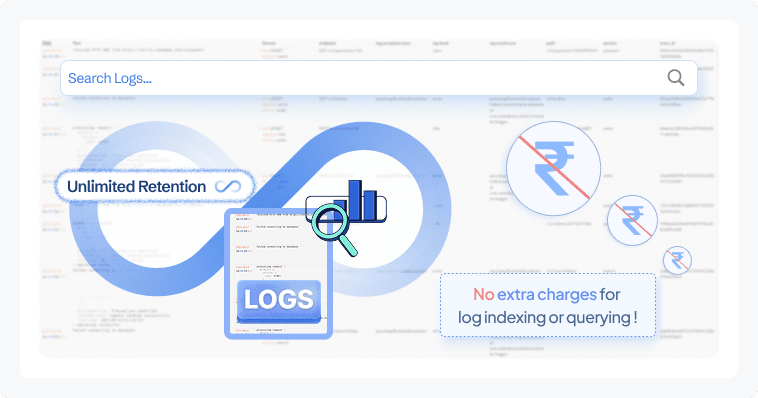
CubeAPM allows teams to retain unlimited observability data for as long as required, with retention controlled by the customer’s own infrastructure and policies. Because CubeAPM is deployed in the customer environment, there are no platform-imposed retention limits or forced upgrades for a longer history. Retention duration is therefore governed by storage capacity and compliance needs rather than licensing tiers.
Grafana’s data retention depends on the deployment model and backend configuration. In Grafana Cloud, retention varies by plan and signal type, with free tiers typically offering around 14 days, and Pro tiers providing approximately 30 days for logs and traces and up to 13 months for metrics. In self-managed deployments using Loki, Mimir, or Tempo, retention is fully configurable by administrators through storage and compactor settings, allowing teams to define their own retention policies.
New Relic applies default retention periods based on data type and plan, with logs and events typically retained for around 30 days under standard configurations. Longer retention is available through paid add-ons and features such as extended retention or archival options. Retention policies are managed within New Relic’s SaaS platform and are tied to account configuration and subscription level.
Support Channel & TAT
CubeAPM provides direct access to support engineers via Slack and WhatsApp, enabling fast, real-time assistance for troubleshooting and architectural questions. Customers typically receive responses within minutes, as support is included with the platform and does not require separate premium licensing.
Grafana support varies by plan and deployment. Grafana Cloud Free users rely on community forums and official documentation for help, with no formal SLA response times. Grafana Cloud Pro includes 8×5 email support for business-hour assistance. For contracted Grafana Enterprise plans, official SLAs guarantee first response times of:
- 2 hours for critical issues (Severity 1),
- 4 hours for production issues (Severity 2), and
- 6 hours for general issues (Severity 3) with 24×7×365 support availability under the enterprise SLA.
New Relic offers tiered support depending on subscription level. Standard plans include access to documentation and community forums. Paid support tiers provide ticket-based support with documented response targets, such as up to 2 business days for standard severity issues and faster turnaround (e.g., 2 hours or 1 hour) on higher priority support packages. Enterprise contracts may include accelerated SLAs and dedicated support engineers for critical issues.
If you want to dive deeper into feature and pricing comparison, check out our CubeAPM vs New Relic page.
How Teams Typically Decide Between Grafana, New Relic, and Self-Hosted Observability
Choosing an observability platform is rarely a purely technical decision. As environments scale, the evaluation process usually expands beyond features and dashboards to include cost control, operational ownership, and risk management.
Who is involved
Engineering teams assess how well the platform fits existing architectures, instrumentation standards, and incident workflows. Finance teams focus on how pricing behaves as telemetry volume grows and whether costs can be forecast reliably. Security and compliance stakeholders evaluate data residency, access controls, and whether observability data can remain within approved environments. Final decisions are often a balance between these perspectives rather than a single team’s preference.
What questions block decisions
Teams frequently stall on questions like how costs scale during high-traffic periods, what happens to retention when data volumes increase, and how much operational effort is required to run or manage the platform. Unclear pricing mechanics, hidden limits on retention, and uncertainty around long-term ownership of observability data are common sources of hesitation.
Why comparisons alone aren’t enough
Feature checklists and side-by-side tables help narrow options, but they rarely answer how a platform behaves under sustained load or during real incidents. Teams ultimately need to understand how each approach performs over time, how costs evolve with usage, and how much control they retain as their systems and requirements grow.
Grafana vs New Relic vs CubeAPM: Use Cases
Each of these platforms serves a different type of team and operating model. Choosing an observability platform usually depends on how much control, predictability, and operational ownership a team needs as observability scales.
Choose CubeAPM if:
CubeAPM fits teams looking for a self-hosted, OpenTelemetry-native observability platform with predictable cost behavior and full data ownership.
- For startups and growing SaaS teams that want full-stack observability without per-user pricing, based on demo and sales data.
- For organizations with strict data residency, compliance, or on-prem requirements, where telemetry must remain inside their cloud or data center.
- For teams operating Java-heavy microservices architectures (Spring Boot, JVM-based backends) that need deep transaction tracing, JVM metrics, and end-to-end request visibility across services.
- For engineering teams focused on reducing MTTR, where context-rich traces, logs, and metrics need to be correlated quickly during incidents.
- For companies dealing with high telemetry volumes that want predictable ingestion-based pricing and unlimited data retention, based on internal research and usage patterns.
- For platform teams standardizing on OpenTelemetry and avoiding vendor lock-in while still supporting existing agents during migration.
Choose Grafana if:
Grafana is a strong fit for teams that prioritize flexibility, open tooling, and composability over an all-in-one managed platform.
- For infrastructure and SRE teams already running Prometheus-based monitoring and wanting to extend visibility using Loki for logs and Tempo for traces.
- For teams that prefer to build and customize their own observability stack, selecting best-of-breed components rather than adopting a single vendor platform.
- For cost-conscious teams in early or mid stages that are comfortable with self-managing storage, retention, and scaling, based on their deployment model.
- For use cases focused heavily on dashboards, visualization, and cross-source analytics rather than deep application-level APM workflows.
- For organizations that want the option to choose between self-managed open-source deployments or Grafana Cloud, based on operational maturity.
Choose New Relic if:
New Relic works best for teams that want a fully managed SaaS observability experience with minimal setup and operational overhead.
- For teams that value quick onboarding and out-of-the-box instrumentation, especially in cloud-native environments.
- For organizations that prefer vendor-managed infrastructure and do not want to operate observability backends themselves.
- For product and engineering teams that rely on service maps, built-in analytics, and curated UI workflows for monitoring applications and infrastructure.
- For teams comfortable with usage-based pricing combined with per-user licensing, based on New Relic’s published pricing model.
- For companies where speed of adoption is more important than long-term control over retention, deployment, or data locality.
Conclusion
Grafana, New Relic, and CubeAPM represent three distinct approaches to observability. Grafana emphasizes flexibility and composability, New Relic prioritizes managed convenience and fast adoption, and CubeAPM focuses on operational control, predictable cost behavior, and long-term scalability.
As teams grow, decisions increasingly hinge on how pricing scales, where data lives, and how easily signals can be correlated to reduce MTTR. These factors often matter more than individual features.
For teams seeking a self-hosted, OpenTelemetry-native platform with predictable pricing and full data ownership, CubeAPM stands out as a strong option. Explore CubeAPM to see how it fits your observability needs.
Disclaimer: The information in this article reflects the latest details available at the time of publication and may change as technologies and products evolve.
FAQs
1. Can teams use Grafana, New Relic, and CubeAPM together instead of choosing one?
Yes. Some teams use Grafana primarily for visualization while sending telemetry to platforms like New Relic or CubeAPM for storage and analysis. CubeAPM can also work alongside Grafana dashboards, allowing teams to keep existing visualization workflows while changing how observability data is ingested, stored, or managed.
2. How difficult is it to migrate from New Relic or Grafana to CubeAPM?
Migration complexity depends on current instrumentation. Teams already using OpenTelemetry generally find migration easier since CubeAPM is OpenTelemetry-native. Based on demo and sales data, many teams migrate incrementally by running CubeAPM alongside their existing setup before fully switching.
3. Which platform is better suited for hybrid or multi-cloud environments?
CubeAPM and Grafana are often preferred in hybrid or multi-cloud environments because they support self-hosted or self-managed deployments. New Relic can monitor multi-cloud infrastructure, but the platform itself remains SaaS-hosted, which may influence data residency and network egress considerations.
4. How do these tools compare in terms of learning curve for engineers?
Grafana can have a steeper learning curve due to its composable architecture and reliance on multiple backend systems. New Relic focuses on ease of onboarding with prebuilt views and guided workflows. CubeAPM aims to balance simplicity with control by offering integrated observability while still supporting advanced configurations when needed.
5. What happens to observability data if teams stop using the platform?
With SaaS platforms like New Relic, access to historical data depends on account status and retention policies. In self-hosted or self-managed platforms such as CubeAPM or Grafana OSS, observability data remains within the customer’s infrastructure, allowing teams to retain or archive data independently of the vendor.