




Enterprise monitoring software has become non-negotiable as infrastructure scales beyond what manual oversight can handle. A 2025 CNCF survey found that 78% of enterprises now run production Kubernetes workloads, and 64% operate multi-cloud environments across AWS, Azure, and GCP. That complexity creates blind spots where a single misconfigured pod or unindexed log can cascade into a revenue-impacting outage.
This guide compares 10 enterprise monitoring platforms across pricing transparency, deployment model, signal coverage (metrics, traces, logs, RUM, synthetics), and what breaks at scale. Every limitation cited includes a source link to documentation, community threads, or customer reviews confirming the issue.
Quick Comparison: 10 Enterprise Monitoring Platforms at a Glance
| Tool | Best For | Pricing Model | Self Hosted? | Full Stack? |
|---|---|---|---|---|
| CubeAPM | Teams requiring data residency, predictable costs | $0.15/GB ingestion based | ✓ VPC or on prem | ✓ APM, logs, infra, K8s, RUM |
| Datadog | Multi cloud enterprises prioritizing breadth | Per host + ingestion + add ons | ✗ SaaS only | ✓ 700+ integrations |
| Dynatrace | Large enterprises needing AI assisted root cause | Per host + monitoring units | ✓ Managed SaaS or on prem | ✓ Full stack + AIOps |
| New Relic | Teams consolidating observability under one vendor | Per user + ingestion (CCU model) | ✗ SaaS only | ✓ APM, logs, infra, synthetics |
| Splunk | Security heavy enterprises, SIEM + logs | Per GB ingested | ✓ On prem or cloud | ✓ Logs, SIEM, APM add on |
| Elastic | Teams already on ELK stack | Free OSS / Cloud plans $99/mo+ | ✓ Self hosted | ✓ Logs, APM, metrics |
| Zabbix | Cost conscious enterprises, network focused | Free open source | ✓ Self hosted | ✓ Network, infra, app monitoring |
| ManageEngine OpManager | Windows heavy IT environments | Per device licensing $245+ | ✓ On prem | ✓ Network, server, app monitoring |
| SolarWinds | IT ops teams, network + infra focus | Per node, ~$2,955 for 100 nodes | ✓ On prem or hybrid | ✓ Network, server, database |
| Grafana + Prometheus | Teams wanting open source, full control | Free OSS / Grafana Cloud $0.50/GB+ | ✓ Self hosted | ✓ Metrics, logs (via Loki), traces (Tempo) |
Pricing based on publicly available information as of June 2026. Enterprise discounts, custom contracts, and negotiated rates are not reflected here.
1. CubeAPM
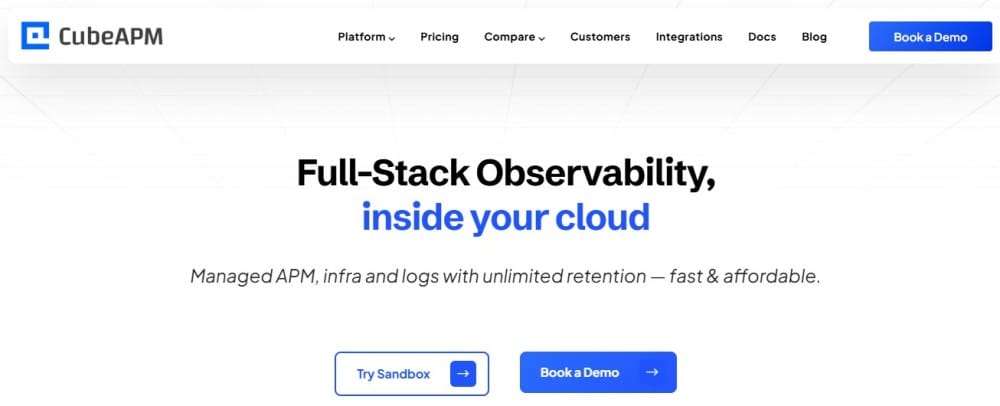
CubeAPM is a self hosted, OpenTelemetry native observability platform covering APM, logs, infrastructure, Kubernetes, RUM, synthetic monitoring, and error tracking. It runs inside your cloud or on premises, eliminating data egress costs and ensuring full data sovereignty.
Key Features:
- Full-stack unified monitoring across APM, logs, infrastructure, Kubernetes, RUM, synthetics
- OpenTelemetry native with compatibility for Datadog, New Relic, Prometheus agents
- AI-based smart sampling reduces storage overhead while retaining critical traces
- Unlimited data retention with no surprise egress charges
- SOC 2 and ISO 27001 certified
Pricing: $0.15/GB ingestion-based, no per-seat or per-host fees. Self-hosting requires your infrastructure, but CubeAPM manages platform updates.
Pros:
- Predictable, transparent pricing with a single billing dimension
- 70–75% cost savings vs enterprise SaaS at scale documented by customers
- Complete data ownership, no telemetry leaves your infrastructure
- Direct engineering support via WhatsApp and Slack during incidents
Cons:
- Requires BYOC or on-prem deployment; your team manages underlying infrastructure
- SSO and RBAC less mature than enterprise incumbents
- No autonomous anomaly detection (smart sampling is not full AIOps)
Best for: DevOps and platform teams needing full stack observability inside their own cloud with predictable costs and data residency compliance.
2. Datadog
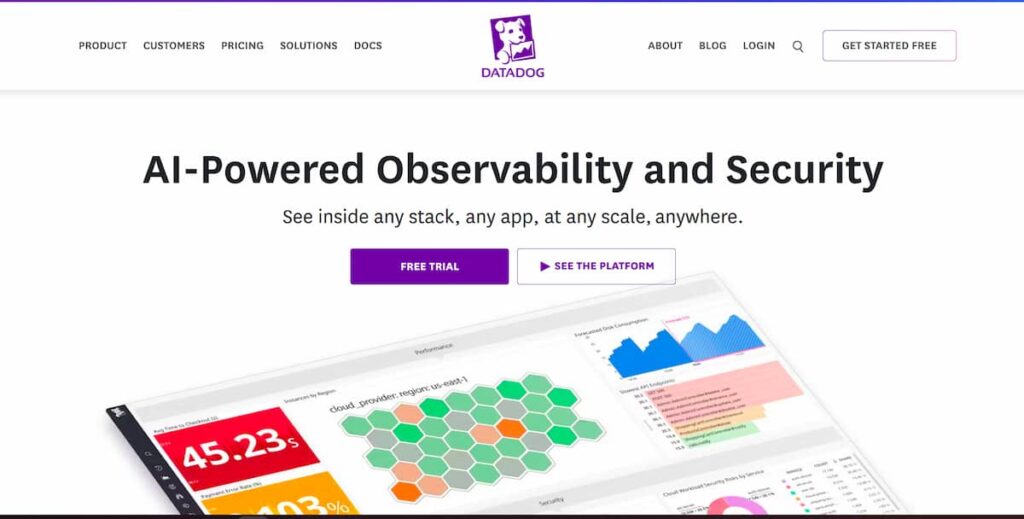
Datadog is a multi-cloud SaaS observability platform with 700+ integrations covering infrastructure, APM, logs, RUM, synthetics, and security monitoring. It is widely adopted across enterprises for breadth but scales expensively.
Key Features:
- Unified dashboards for infrastructure, APM, logs, RUM, synthetics
- 700+ integrations including AWS, Azure, GCP, Kubernetes, databases
- AI powered anomaly detection and alerting
- Log management with pattern detection and archive to S3
Pricing: Infrastructure monitoring at $18/host/month for 15 month retention, APM at $42/host/month, plus separate charges for logs ($0.10/GB ingested), RUM, synthetics, and cloud security monitoring. Data egress to analyze telemetry outside Datadog adds ~$0.10/GB in AWS transfer fees.
For a 100 host cluster ingesting 30TB/month across logs, traces, and metrics, monthly costs exceed $27,000 before security or RUM add ons. This estimate models a production-ready setup with high availability.
Pros:
- Deepest integration catalog across cloud providers and tools
- Strong out-of-box dashboards and monitors
- Enterprise SSO, RBAC, audit logs
Cons:
- Per-host pricing compounds fast as infrastructure scales, documented in multiple Reddit threads where bills tripled during auto-scaling events
- SaaS only architecture rules out data residency compliance
- Log indexing at $1.70/million events creates unpredictable costs
Best for: Multi-cloud enterprises prioritizing integration breadth over cost control.
3. Dynatrace
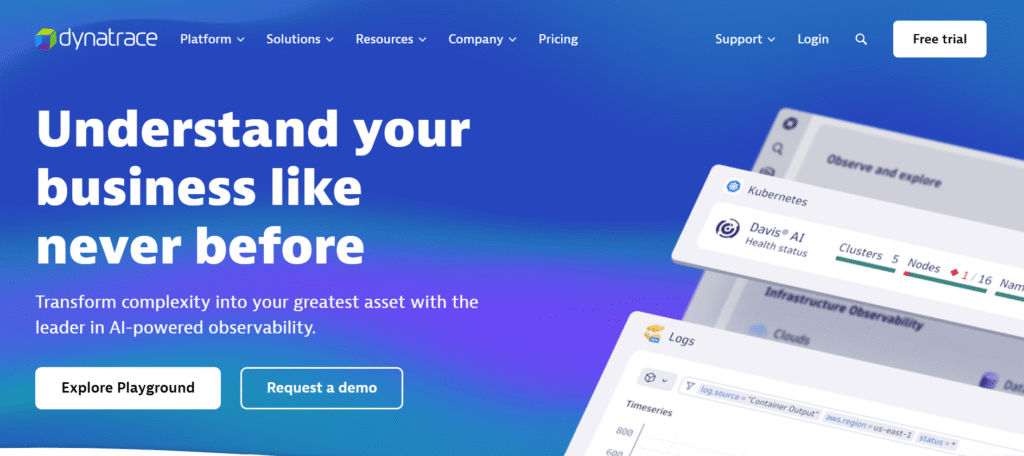
Dynatrace is an enterprise full-stack monitoring platform emphasizing AI-assisted root cause analysis through its Davis AI engine. It monitors applications, infrastructure, and user experience with automatic dependency mapping.
Key Features:
- OneAgent auto-discovers applications, services, and dependencies
- Davis AI correlates anomalies across metrics, traces, and logs for root cause
- Full stack monitoring across cloud, on-prem, hybrid environments
- Application security monitoring integrated
Pricing: Host-based licensing starting around $0.08/hour per host (~$58/host/month) plus consumption-based monitoring units for logs, synthetics, and session replay. Enterprise deployments often reach $50,000–$150,000 annually.
Pros:
- AI-driven root cause analysis reduces manual troubleshooting
- Strong auto discovery and dependency mapping
- On-prem deployment option available
Cons:
- Complex licensing model combining host fees and monitoring units
- High total cost of ownership documented in Gartner peer reviews
- Steep learning curve for teams new to the platform
Best for: Large enterprises with budget for AI-assisted monitoring and complex distributed environments.
4. New Relic
New Relic offers a unified observability platform with APM, infrastructure monitoring, logs, synthetics, and RUM. It shifted from per-host to per-user pricing in 2020, then introduced a consumption-based Compute Capacity Unit (CCU) model in 2024.
Key Features:
- Full platform access with APM, logs, infrastructure, RUM, synthetics
- Custom dashboards using NRQL query language
- Incident intelligence and anomaly detection
- Vulnerability management integrated
Pricing: Per-user pricing at $99/user/month for full platform or CCU-based consumption model charging for data ingestion and query compute. Data beyond 100GB free tier costs $0.40/GB. Reddit threads document bills jumping from $900 to $8,000 after traffic spikes in the CCU model.
Pros:
- Single platform consolidates multiple observability tools
- Strong APM and distributed tracing capabilities
- Good documentation and onboarding
Cons:
- Proprietary NRQL creates vendor lock-in; dashboards not portable
- SaaS only, no on-prem deployment
- CCU billing model difficult to forecast accurately
Best for: Teams consolidating observability under one vendor and willing to trade flexibility for managed convenience.
5. Splunk
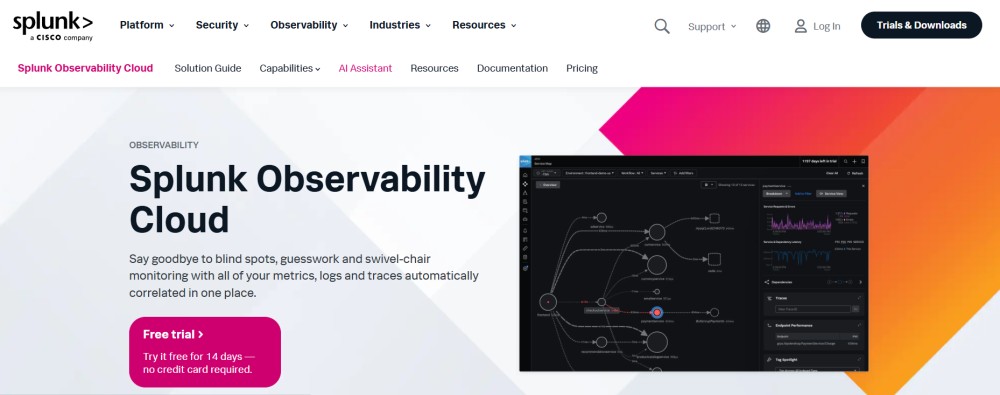
Splunk is an enterprise platform for log management, SIEM, and security analytics. It ingests machine data from any source and provides powerful search, correlation, and alerting capabilities.
Key Features:
- Universal data ingestion from logs, metrics, events
- Splunk Processing Language (SPL) for querying and correlation
- SIEM capabilities with threat detection and compliance reporting
- APM and infrastructure monitoring via add-ons
Pricing: Ingestion-based, starting around $150/GB/year for Splunk Enterprise or workload-based pricing for Splunk Cloud. A 30TB/month deployment costs ~$50,000–$80,000 annually before add-ons.
Pros:
- Industry-leading log analytics and search capabilities
- Strong SIEM and security monitoring features
- On-prem deployment available
Cons:
- Expensive at scale, ingestion costs grow linearly with data volume
- Steep learning curve for SPL query language
- Licensing complexity across workload pricing, ingest pricing, infrastructure monitoring
Best for: Security-heavy enterprises needing SIEM integrated with log analytics.
6. Elastic (ELK Stack)
Elastic provides the ELK stack (Elasticsearch, Logstash, Kibana) for log analytics, search, and observability. It offers both open source self-hosted and managed cloud options.
Key Features:
- Powerful full-text search across logs and structured data
- APM capabilities via Elastic APM agents
- Infrastructure and uptime monitoring
- Security analytics and SIEM features
Pricing: Free open source or Elastic Cloud starting at $99/month for standard tier. Usage scales based on data volume, compute, and storage. Enterprise features require Gold or Platinum subscriptions.
Pros:
- Free open source option with full control
- Excellent log search and analytics capabilities
- Active community and ecosystem
Cons:
- Self-hosted ELK requires significant operational expertise to manage at scale, documented in GitHub issues
- Upgrading between major versions can be complex
- APM features are less mature than purpose-built APM vendors
Best for: Teams already invested in ELK stack infrastructure or needing powerful log analytics with self-hosted control.
7. Zabbix
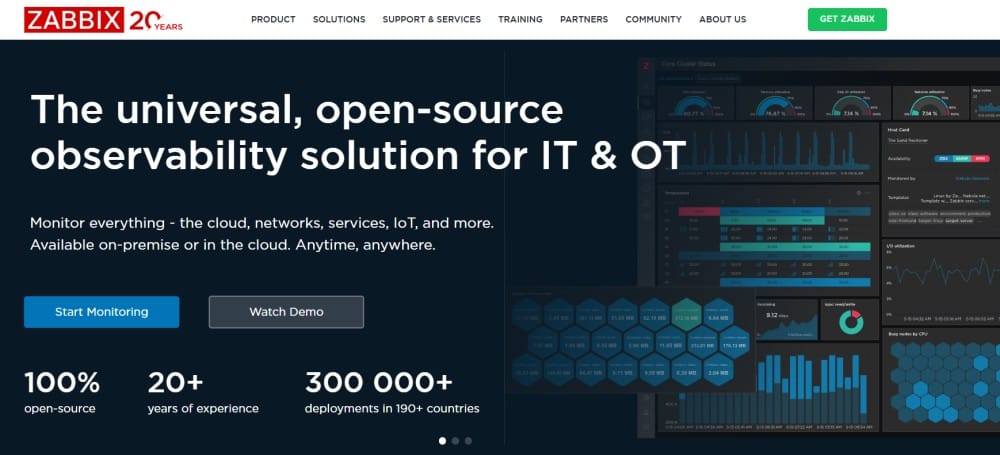
Zabbix is a free open source enterprise monitoring platform for networks, servers, cloud services, and applications. It is widely deployed in cost-conscious enterprises and service providers.
Key Features:
- Agentless and agent-based monitoring
- Network discovery and auto registration
- Flexible alerting with escalations
- Custom dashboards and templates
Pricing: Free open source. Costs include infrastructure for hosting and staff time for setup and maintenance.
Pros:
- Zero licensing cost
- Highly customizable and extensible
- Strong network monitoring capabilities
Cons:
- UI feels dated compared to modern tools, noted frequently in community discussions
- Steeper learning curve for complex configurations
- Limited native APM and distributed tracing vs commercial tools
Best for: Cost-conscious enterprises with in-house expertise to manage open source monitoring infrastructure.
8. ManageEngine OpManager
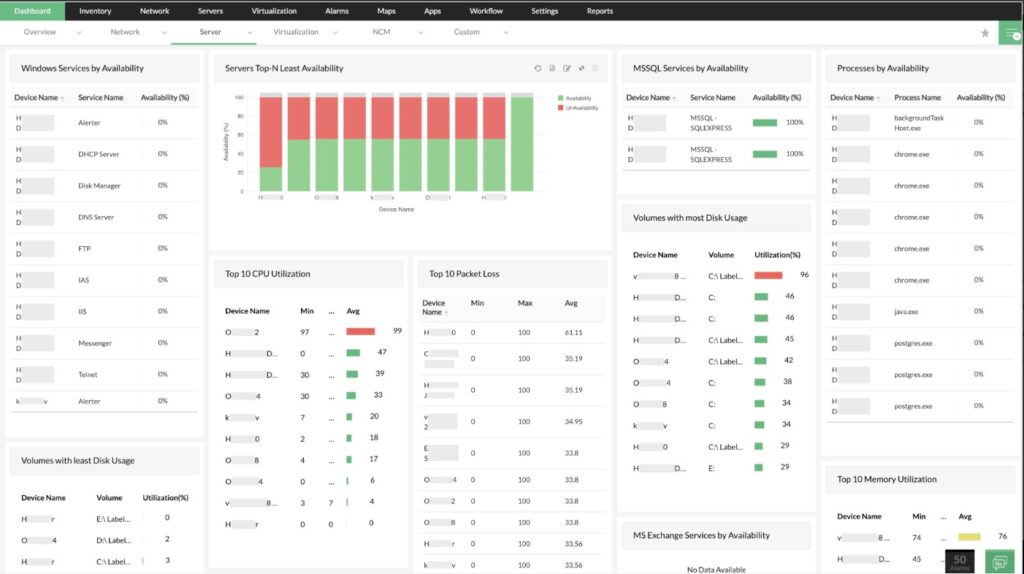
ManageEngine OpManager is a network and infrastructure monitoring tool focused on IT operations in Windows-heavy environments. It provides fault and performance monitoring with NetFlow analysis.
Key Features:
- Network performance monitoring with SNMP, WMI
- Server and application monitoring
- NetFlow, sFlow, and bandwidth analysis
- Automated network mapping
Pricing: Starts at $245 for 10 devices, scaling to ~$5,995 for 500 devices annually. Enterprise edition adds distributed monitoring and failover.
Pros:
- Strong Windows and Active Directory integration
- User-friendly interface for IT operations teams
- Affordable for mid-sized deployments
Cons:
- Limited cloud native and container monitoring compared to modern platforms
- Less extensible than open source alternatives
- APM capabilities less mature
Best for: IT ops teams in Windows-heavy enterprises needing network and server monitoring.
9. SolarWinds
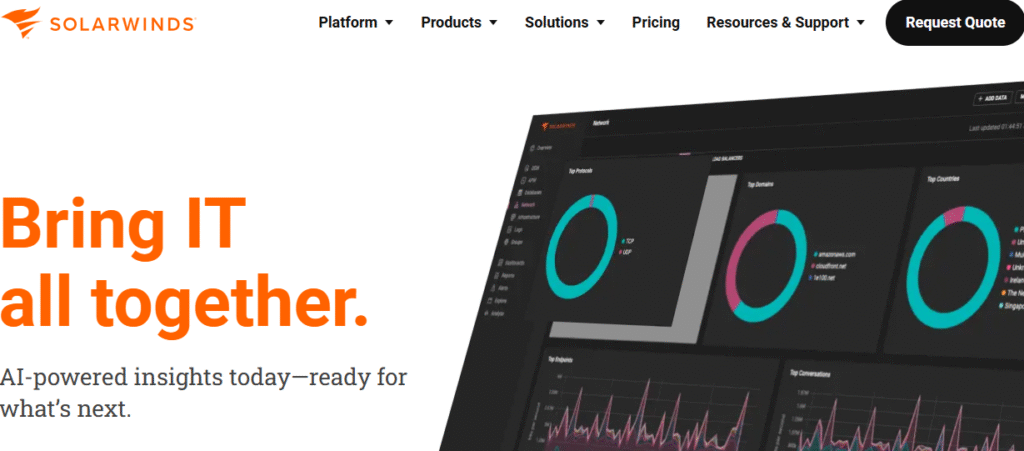
SolarWinds offers a suite of IT management tools including Network Performance Monitor, Server and Application Monitor, and Database Performance Analyzer. It is popular in traditional IT operations.
Key Features:
- Network topology mapping and performance monitoring
- Server health and application performance monitoring
- Database query performance analysis
- Log and event management
Pricing: Per-node licensing, approximately $2,955 for 100 nodes for Network Performance Monitor. Additional modules priced separately.
Pros:
- Comprehensive network monitoring features
- Strong database performance diagnostics
- On-prem deployment with full control
Cons:
- Security concerns following 2020 supply chain attack documented by CISA
- Primarily focused on traditional infrastructure vs cloud native workloads
- Licensing costs scale linearly with infrastructure growth
Best for: IT operations teams managing traditional on-prem infrastructure and databases.
10. Grafana + Prometheus
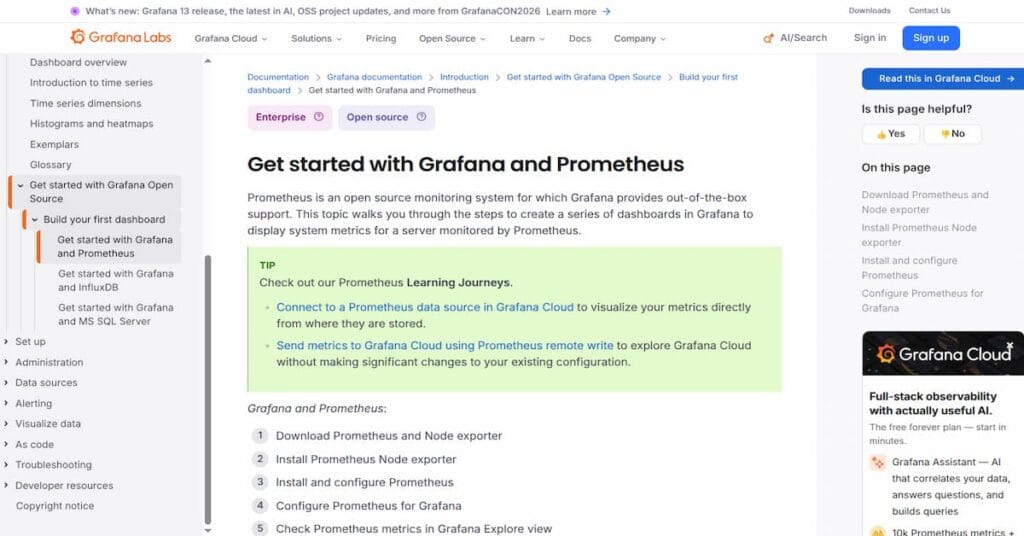
Grafana and Prometheus together form a popular open source monitoring stack. Prometheus handles metrics collection and storage, while Grafana provides visualization. Adding Loki for logs and Tempo for traces creates a full observability stack.
Key Features:
- Prometheus for time series metrics with PromQL queries
- Grafana for customizable dashboards and alerting
- Loki for log aggregation
- Tempo for distributed tracing
Pricing: Free open source. Grafana Cloud offers managed hosting starting at $0.50/GB for logs, $8/active series for metrics.
Pros:
- Complete control over data and infrastructure
- Highly customizable and extensible
- Strong Kubernetes integration
Cons:
- Requires significant operational expertise to run at scale, documented in Prometheus GitHub issues
- High cardinality metrics can strain Prometheus storage
- No unified APM like commercial tools without additional components
Best for: Teams wanting full open source control with in-house expertise to manage the operational overhead.
How to Choose the Right Enterprise Monitoring Software
Selecting enterprise monitoring software requires evaluating several dimensions based on your team’s scale, compliance needs, and operational maturity.
1. Deployment Model: SaaS, Self-Hosted, or Hybrid
If your team operates in a regulated industry (healthcare, finance, government) or has data residency requirements, SaaS only tools like Datadog and New Relic are ruled out. Self-hosted options (CubeAPM, Elastic, Zabbix, Prometheus/Grafana) keep telemetry data inside your infrastructure. Hybrid models (Dynatrace, Splunk) offer both but often at premium pricing.
2. Pricing Transparency and Predictability
Enterprise monitoring costs spiral when pricing has multiple dimensions (per host, per user, per GB ingested, per indexed event). Datadog combines per-host fees with separate charges for logs, RUM, synthetics, and cloud security, making forecasts difficult. New Relic’s CCU model bills for both ingestion and query compute, creating month-to-month variability. Flat ingestion-based pricing (CubeAPM at $0.15/GB, Splunk at ~$150/GB/year) is easier to model but requires estimating data volume accurately.
3. Signal Coverage: Metrics, Traces, Logs, RUM, Synthetics
Full stack observability requires correlating metrics, traces, and logs in one platform. Tools like Datadog, Dynatrace, and CubeAPM provide this natively. Others require assembling multiple products: Prometheus for metrics, Loki for logs, Tempo for traces, each adding operational complexity.
4. Operational Overhead vs. Managed Convenience
Self-hosted open source tools (Zabbix, Elastic, Prometheus/Grafana) eliminate licensing costs but require staff time for setup, upgrades, scaling, and troubleshooting. Managed SaaS platforms (Datadog, New Relic, Dynatrace) remove that burden but export your telemetry data and bill unpredictably as usage grows. CubeAPM offers a middle path: self-hosted for data control but vendor-managed for platform updates.
5. OpenTelemetry Compatibility
OpenTelemetry is becoming the standard for vendor-neutral telemetry instrumentation. Tools with native OpenTelemetry support (CubeAPM, Grafana, Elastic) avoid proprietary agent lock-in. Others (Datadog, Dynatrace, New Relic) support OpenTelemetry but optimize for their own agents, creating friction during migration.
6. Cost at Scale: Small vs. Mid-Sized vs. Enterprise
For a 100-host deployment ingesting 30TB/month:
- CubeAPM: ~$5,000/month ($0.15/GB × 30TB + infrastructure)
- Zabbix/Prometheus/Grafana: Infrastructure only, ~$2,000–$4,000/month depending on hosting
- Elastic Cloud: ~$8,000–$12,000/month depending on tier
- Splunk: ~$6,000–$8,000/month ($150–$200/GB/year ÷ 12)
- Datadog: ~$27,000/month (100 hosts × $180 + logs + traces)
- Dynatrace: ~$15,000–$25,000/month depending on monitoring units
- New Relic: ~$20,000–$30,000/month (CCU model, 20 users + ingestion)
This estimate models a production-ready setup with high availability. A smaller or simpler deployment may cost significantly less.
Choose based on your budget ceiling, not just per unit costs. A “cheap” per GB rate that compounds with indexing fees, seat taxes, or egress charges often exceeds flat ingestion pricing at scale.
Disclaimer: The information in this article reflects the latest details available at the time of publication and may change as technologies and products evolve. Features, pricing, and plan limits can change over time. Always verify the latest information directly with the vendor before making purchasing or deployment decisions.
Frequently Asked Questions
What is enterprise monitoring software?
Enterprise monitoring software tracks the health, performance, and availability of IT infrastructure, applications, and services across distributed systems at organizational scale, providing real time alerts, root cause analysis, and unified visibility.
What is the difference between APM and infrastructure monitoring?
APM focuses on application performance, tracing requests through code and services to identify bottlenecks. Infrastructure monitoring tracks servers, networks, databases, and cloud resources. Full stack platforms combine both.
How much does enterprise monitoring software cost?
Enterprise monitoring costs range from free open source tools requiring self hosting to $50,000–$150,000 annually for managed SaaS platforms at scale, depending on data volume, host count, features, and deployment model.
What are the best free enterprise monitoring tools?
Zabbix, Prometheus with Grafana, and Elastic Stack (open source edition) are the leading free enterprise monitoring options, but require operational expertise to deploy and maintain at scale.
Can enterprise monitoring software run on premises?
Yes. CubeAPM, Dynatrace, Splunk, Elastic, Zabbix, SolarWinds, and ManageEngine OpManager all support on premises or BYOC deployment for data residency and compliance requirements.
What is the best enterprise monitoring tool for Kubernetes?
CubeAPM, Datadog, Dynatrace, and Prometheus with Grafana provide strong Kubernetes monitoring with pod level visibility, resource tracking, and cluster health metrics. Choice depends on deployment model and cost tolerance.
How does OpenTelemetry affect enterprise monitoring tool selection?
OpenTelemetry provides vendor neutral instrumentation, avoiding proprietary agent lock in. Tools with native OpenTelemetry support (infrastructure monitoring platforms like CubeAPM, Grafana, Elastic) simplify migration and multi vendor strategies compared to those requiring proprietary agents.