









The main difference between Datadog, Uptrace, and CubeAPM lies in pricing, deployment flexibility, and observability depth.
Datadog is a SaaS-only tool with powerful full-stack observability capabilities, but at a higher cost, whereas Uptrace is an open-source metrics and tracing tool with lightweight monitoring needs. CubeAPM comes with the right balance: cost-effective observability suitable for businesses of all sizes and the option for self-hosting in your on-premise or cloud infrastructure.
This Datadog vs Uptrace vs CubeAPM comparison guide is based on features, deployment, sampling, pricing, and support.
Datadog vs Uptrace vs CubeAPM Comparison
| Feature | CubeAPM | Datadog | Uptrace |
| Known for | Unified MELT, self-hosting, Otel-native, cost predictability | Large enterprise SaaS ecosystem with 900+ integrations. | Open-source, developer-friendly MELT observability at low cost |
| Multi-Agent Support | Yes (OTel, New Relic, Datadog, Elastic, etc.) | Yes (Datadog Agent, third-party agents). | Yes (native OTel, third-party integrations) |
| MELT Support (Metrics, Events, Logs, Traces) | Full MELT coverage | Full MELT coverage | Full MELT coverage |
| Deployment (Self-Host / Setup) | Self-hosted but vendor-managed | Cloud-only; no self-hosting | Free self-hosted; fully-managed Cloud, optional on-prem |
| Pricing | Ingestion-based pricing of $0.15/GB | APM: $31/host/ month; Infra: $15 /host/month; Logs: $0.10/GB | Cloud edition starts $0.08/GB (1.22TB), $0.025/GB (100 TB) |
| Sampling Strategy | Smart sampling – fully automated, context-aware | Head-based and tail-based sampling | Head-based, tail-based, and rate-limiting sampling |
| Data Retention | Unlimited Retention (no extra cost) | 15-30 days based on plan | 14-day free data retention; paid (for up to 100 weeks) |
| Support Channel & TAT & Pricing | Slack, WhatsApp; response in minutes | Community-based; email & chat (paid plan); TAT: <2-48 hrs; | Community-based: email, Slack; response in hours to minutes |
Datadog vs Uptrace vs CubeAPM: Feature-by-Feature Breakdown
Known For
CubeAPM is known for its OpenTelemetry-native architecture, self-hosted deployment, and predictable $0.15/GB pricing. It combines full MELT observability (Metrics, Events, Logs, Traces) with smart sampling and unlimited retention, making it a favorite for teams seeking control, cost efficiency, and compliance-friendly observability. It’s often chosen by fintechs, SaaS providers, and DevOps teams that need full-stack visibility without the cost inflation.
Datadog is recognized as a comprehensive SaaS observability suite with 900+ native integrations across cloud, container, and infrastructure ecosystems. It’s widely adopted by large enterprises for its breadth and ease of integration.
Uptrace is known for being a lightweight, developer-friendly, open-source tracing tool that’s fully OpenTelemetry-compatible. It’s great for smaller teams or startups looking to build an observability pipeline quickly and affordably.
Multi-Agent Support
The biggest difference among the three platforms begins with their agent flexibility and interoperability.
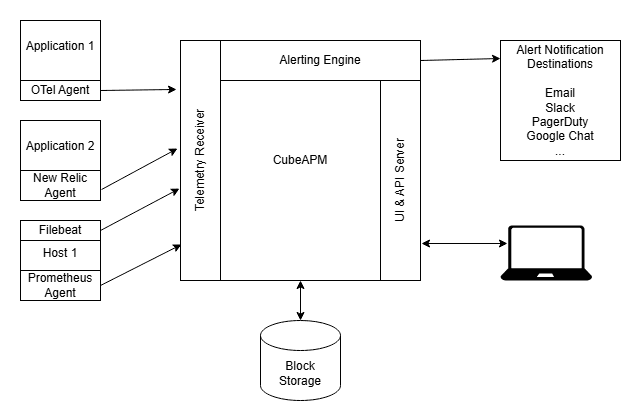
CubeAPM offers true multi-agent support, integrating seamlessly with OpenTelemetry, Prometheus, Elastic, Datadog, and New Relic agents. Teams can bring their existing instrumentation setups without rewriting pipelines or replacing collectors. For hybrid and multi-cloud environments, this flexibility helps CubeAPM connect metrics, logs, and traces from diverse agent ecosystems.
Datadog offers a proprietary Datadog Agent, which offers deep integration with 900+ services. It also supports OpenTelemetry collectors and other third-party agents.
Uptrace adopts an OpenTelemetry-native approach, offering direct support for OTel SDKs and exporters. It also integrates with Prometheus, Vector, and Fluent Bit, making it a good choice for developers building observability pipelines from scratch..
MELT Support
All three tools Datadog, Uptrace, and CubeAPM claim full observability, but the depth and integration of their MELT capabilities (Metrics, Events, Logs, Traces) differ significantly.
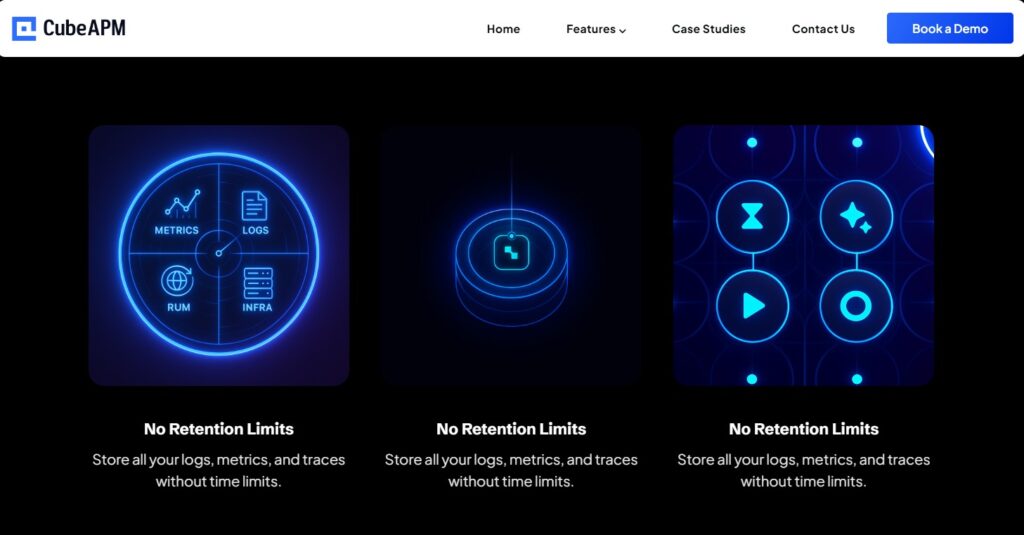
CubeAPM delivers unified MELT observability in one platform, built natively for OpenTelemetry data ingestion. It correlates metrics, traces, and logs in a single pane eliminating the module-based fragmentation seen in many legacy tools. Whether it’s infrastructure metrics, application traces, or user events, CubeAPM ties them together contextually, enabling faster root-cause analysis and real-time insights.
Datadog also supports all MELT pillars. But there are separate pricing modules for different services. For example, logs are priced per GB, but infrastructure and APM are priced per host per month.
Uptrace started as a tracing-first platform and has since expanded into metrics and logs. It supports OpenTelemetry metrics natively and integrates with Prometheus for system metrics. However, its event and log correlation capabilities remain limited compared to CubeAPM or Datadog. For many users, Uptrace serves as a strong developer-focused tracing tool but lacks the comprehensive full-stack analytics or alerting workflows.
Deployment
The deployment model defines how much control, compliance, and scalability teams have over their observability stack, and here, the three tools take completely different approaches.
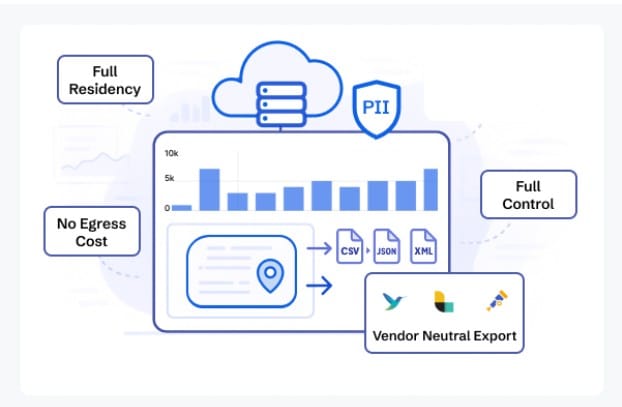
CubeAPM gives teams the choice to self-host the service on their cloud or on-premise infrastructure. CubeAPM stores all telemetry within the user’s own cloud or infrastructure, ensuring data sovereignty and eliminating egress costs. The setup is also streamlined, and most migrations from existing APMs can be completed in under an hour using pre-built OpenTelemetry connectors.
Datadog, by contrast, is a SaaS-only platform. It simplifies initial onboarding and maintenance, but provides no self-hosted or on-prem option. All telemetry is stored within Datadog’s managed cloud, which may not suit organizations with strict data residency requirements; hence, it needs careful validation.
Uptrace strikes a balance between flexibility and simplicity. It provides a free self-hosted Community Edition for open-source users and a fully managed Cloud Edition for businesses that prefer SaaS convenience. Larger enterprises can also opt for on-premise installations through custom enterprise licensing.
Pricing for Small, Medium, & Large Teams
Understanding how each platform prices its service is crucial to choosing the right observability tool. Cost surprises can undermine even the best-implemented solution.
Here’s the pricing for CubeAPM, Datadog, and Uptrace:
*All pricing comparisons are calculated using standardized Small/Medium/Large team profiles defined in our internal benchmarking sheet, based on fixed log, metrics, trace, and retention assumptions. Actual pricing may vary by usage, region, and plan structure. Please confirm current pricing with each vendor.
| Approx. Cost for teams | Small (~30) | Mid-Sized (~125) | Large (~250) |
| CubeAPM | $2,080 | $7,200 | $15,200 |
| Datadog | $8,185 | $27,475 | $59,050 |
| Uptrace | $1,695 | $5,600 | $12,500 |
CubeAPM Costs: Detailed Calculation
CubeAPM uses a straightforward, ingestion-based pricing model of $0.15 per GB (based on our research and demo data) with no host-, user-, or module-based surcharges. This makes cost forecasting far simpler.
- Small teams (~ 30): ~ $2,080
- Mid-sized teams (~ 125): ~ $7,200
- Large teams (~250): ~ $15,200
Datadog Costs: Detailed Calculation
Datadog has a bit complex pricing: you pay per host (e.g., $31/host/month for APM) and per GB for log ingestion (e.g., ~$0.10/GB) and indexing, plus additional custom metric and retention fees.
- Small teams: ~ $8,185
- Mid-size teams: ~ $27,475
- Large teams: ~ $59,050
Uptrace Costs: Detailed Calculation
Uptrace offers a volume-based pricing model for its managed cloud plan: for example, ingestion tiers start at $0.08/GB for up to 1.22TB, $0.025/GB for up to 100 TB, and so on. The self-hosted community edition is free, but lacks enterprise features and support. On-premise enterprise edition comes with dedicated support and advanced features, but can be costly for smaller teams due to management overhead.
- Small teams: $1,695
- Mid-size teams: $5,600
- Large teams: $12,500
Sampling Strategy
Sampling determines how much data is collected, stored, and analyzed. This directly affects both accuracy and cost efficiency, and each platform approaches it differently.

CubeAPM implements an advanced Smart Sampling engine designed to preserve contextual insight while cutting down on redundant trace data. It evaluates telemetry based on latency, error rates, and traffic patterns to decide which traces to retain, thereby achieving higher sampling efficiency and lower cost. This adaptive model means CubeAPM can retain the most valuable performance data while reducing ingestion volume and costs.
Datadog’s official sampling strategy for traces centers on head-based sampling, where the decision to keep or drop a trace is made at the start of the request (at the root span) and then propagated through the trace, with default sampling rates targeting a fixed number of traces per second per Agent. You can override this with sampling rules (for specific services or resources) to adjust which traces are kept, and Datadog also supports adaptive sampling to automatically adjust rates based on budget and traffic patterns. Documentation also notes that when using OpenTelemetry, head-based sampling is done at the SDK level, and tail-based sampling can be configured at the collector level for more advanced control.
Uptrace’s sampling strategy supports both head-based sampling and tail-based sampling through its use of OpenTelemetry’s sampling model. Head-based sampling makes the decision at the start of a trace (in the SDK), letting you decide a percentage of traces to keep early and efficiently before exporting to Uptrace. Tail-based sampling evaluates completed traces before deciding what to retain, enabling retention of traces based on latency, errors, or other criteria. Uptrace also supports ratio sampling to manage volume and cost.
Data Retention
Data retention plays a vital role in cost control, compliance, and long-term observability, especially for audit-heavy industries like finance, healthcare, and SaaS.
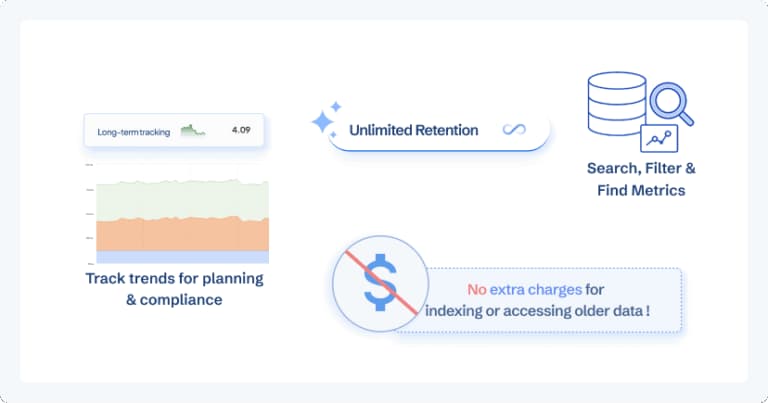
CubeAPM offers unlimited data retention at no extra cost. It’s one of the most predictable solutions for organizations that deal with high-volume telemetry. All logs, traces, and metrics are stored under a single ingestion plan, meaning retention duration does not affect pricing. This flexibility helps engineering and compliance teams maintain historical data for regulatory audits, root-cause analysis, and trend baselining without escalating storage bills.
Datadog’s data retention varies by data type and product. Metrics (including tags and values) are typically retained for up to 15 months, while APM data, such as indexed spans are retained for 15 or 30 days, depending on the plan, and service/resource statistics are kept for around 30 days. Logs do not have a single fixed retention period; instead, retention is configured per log index based on account settings and plan, after which logs are automatically deleted. Security signals and events are generally retained for up to 15 months, and audit logs are stored for 7 days by default or 90 days when Audit Trail is enabled.
Uptrace includes 14-day free data retention on its community edition. With the Premium, Managed, or Cloud editions, you get custom data retention, meaning you can configure how long spans, logs, and metrics are kept according to your needs rather than being limited to the default 14-day period. This flexible retention control lets you balance storage costs and historical visibility for different types of telemetry.
Support Channel & Turnaround Time (TAT)
Support responsiveness can make or break incident resolution. Here’s how the three platforms compare:
CubeAPM delivers instant access to engineers via Slack and WhatsApp, with response times in minutes. No ticket queues, no escalation layers. Users chat directly with core developers for debugging, setup, or optimization. This real-time support is included in all plans, making CubeAPM ideal for teams with strict uptime SLAs.
Datadog uses a tiered support model – email, Slack, and chat for standard users (TAT: 2-48 hours). Premier support with even faster response time and phone support is available at extra cost (8% of monthly billing).
Uptrace’s support depends on the edition: the free Community Edition relies on community support primarily through GitHub and community channels, while Premium and Managed editions include official support via email and Slack (16/5) with comprehensive assistance and onboarding, aligning support availability to priority and plan level as defined on Uptrace’s own editions page.
Which tool is best for you? Why brands choose CubeAPM
If you’re looking for a full-stack, flexible, and cost-predictable observability platform, CubeAPM is best for organizations that need self-hosting, OpenTelemetry-native support, unlimited retention, and single-line ingestion pricing.
Datadog works well for large enterprises that need a mature SaaS ecosystem with 900+ integrations and are less concerned about per-host costs. Uptrace is ideal for developer teams or smaller startups who want an open-source tracing-and-metrics stack with minimal setup and low cost.
Why do brands choose CubeAPM?
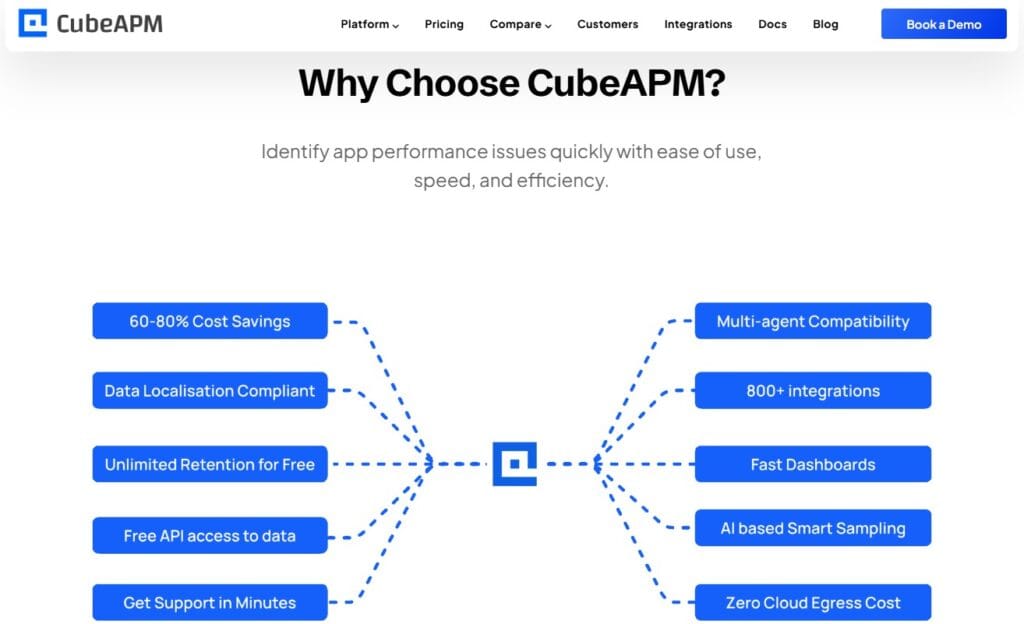
- Predictable Pricing: At $0.15/GB ingestion, you avoid host- or user-based surcharges that inflate other platforms.
- Deployment Freedom: Offers self-hosted – BYOC, or vendor-managed options—perfect for compliance, data sovereignty, and hybrid clouds.
- OpenTelemetry-Native: Seamlessly supports OTel collectors and multi-agent ecosystems so you can migrate or mix agents without vendor lock-in.
- Unlimited Retention: Store logs, traces, and metrics indefinitely without hidden storage fees; ideal for audits, forensics, and long-term trend analysis.
Brands pick CubeAPM because it combines full MELT (Metrics, Events, Logs, Traces) observability, smart sampling, and enterprise-grade support, while keeping cost, complexity, and vendor lock-in low.
Datadog vs Uptrace vs CubeAPM: Use Cases
Each observability platform serves a distinct type of organization depending on its scale, compliance needs, and observability goals. Here’s when you should choose CubeAPM, Datadog, or Uptrace based on real-world deployments and demo data insights.
Choose CubeAPM if:
CubeAPM is best for teams seeking end-to-end observability with cost predictability and control. It’s designed for organizations that want self-hosting (on-prem or BYOC) flexibility, OpenTelemetry-native integrations, and unlimited retention at a rate of $0.15/GB.
- For startups and mid-sized SaaS teams: Simplifies full-stack observability with transparent pricing and no per-host or per-user charges.
- For enterprises needing compliance or data localization: BYOC and on-prem deployment ensure full data control and adherence to data localization mandates.
- For modern DevOps teams: Smart sampling helps reduce MTTR (Mean Time to Resolution) while keeping valuable traces intact, which is ideal for microservices-heavy environments.
- For cost-conscious observability: Predictable ingestion pricing enables long-term scaling without billing shocks, unlike host-based SaaS models.
- For OpenTelemetry adoption: Supports OTel, Prometheus, Elastic, Datadog, and New Relic agents, making it perfect for hybrid monitoring and vendor transitions.
- For 24/7 operations: Slack and WhatsApp-based real-time support with minute-level TAT ensures faster issue resolution and zero downtime.
Choose Datadog if:
Datadog fits large-scale cloud environments that require deep integrations and enterprise-ready SaaS monitoring. It’s best for teams with established budgets and operations that can manage per-host pricing and multiple module subscriptions.
- For multi-cloud enterprises: Its 900+ native integrations cover AWS, GCP, Azure, and container orchestration tools like Kubernetes and ECS.
- For teams needing plug-and-play SaaS: Managed hosting eliminates the need for maintenance or infrastructure management.
- For global-scale operations: Advanced dashboards, RUM, and synthetic monitoring provide visibility across distributed teams and environments.
- For companies with strong budgets: Although expensive ($31/host for APM, $15/host for infra, and $0.10/GB for logs), Datadog remains reliable for enterprises prioritizing convenience over cost control.
- For lighter compliance requirements: Its cloud-only architecture is easy to deploy but less suited for regulated or data-localized industries.
Choose Uptrace if:
Uptrace is ideal for developers and small teams looking for a lightweight, open-source observability stack with OpenTelemetry at its core. It focuses on simplicity, fast setup, and affordability rather than enterprise-scale governance.
- For startups or side projects: Free community edition with quick setup makes it perfect for individual developers and small-scale workloads.
- For tracing-focused teams: Built around distributed tracing with clean UIs for span-level insights and service latency analysis.
- For hybrid cloud or cost-sensitive users: Cloud edition starts at $0.08/GB, a good entry point for small workloads.
- For self-hosted open-source enthusiasts: Easy to deploy with PostgreSQL or ClickHouse backends; suitable for teams preferring local data ownership.
Conclusion
While Datadog offers broad integrations, it has high per-host pricing and a lack of self-hosting. Uptrace is simple and affordable, but mainly metrics and trace-focused.
CubeAPM bridges both worlds, delivering OpenTelemetry-native observability, self-hosting deployment, smart sampling, and unlimited data retention at $0.15/GB. It empowers teams to scale confidently, meet compliance needs, and cut costs.
Book a free demo with CubeAPM today to modernize your observability stack.
Disclaimer: The information in this article reflects the latest details available at the time of publication and may change as technologies and products evolve.
FAQs
1. Which tool offers the most predictable pricing model?
CubeAPM provides the most predictable pricing, charging $0.15 per GB of data ingested with no extra costs for users or hosts. Datadog follows a complex per-host and per-feature pricing system, while Uptrace uses tiered ingestion pricing that varies with data volume.
2. Can these tools be self-hosted?
Yes, CubeAPM and Uptrace both offer self-hosting options. CubeAPM supports on-prem or BYOC (Bring Your Own Cloud) deployments for compliance and data sovereignty. Datadog, however, is SaaS-only and doesn’t support on-prem hosting.
3. Which platform provides the best data retention policy?
CubeAPM allows unlimited data retention at no additional cost, making it ideal for regulated industries. Datadog offers 15 days by default, extendable with paid add-ons, while Uptrace provides 14 days free, expandable up to 100 weeks on paid tiers.
4. What’s the main technical difference between CubeAPM and Uptrace?
CubeAPM and Uptrace are both full MELT observability platforms. CubeAPM offers unlimited data retention, but Uptrace offers 14-days of free data retention; longer retention is available in paid plans.
5. Which tool offers the fastest customer support response times?
CubeAPM provides real-time support via Slack and WhatsApp, connecting users directly with engineers in minutes. Datadog relies on ticket-based email/chat support with a 2–48 hour turnaround, while Uptrace depends on community channels and email with standard response times.