










The main difference between Coralogix, Honeycomb, and CubeAPM is that CubeAPM offers predictable pricing, self-hosted or vendor-managed deployment, and OpenTelemetry-native observability. However, Coralogix and Honeycomb rely on SaaS-only, credit, or event-based pricing that becomes expensive at scale.
All three platforms support distributed tracing and modern telemetry pipelines, but they differ in data ownership, compliance, and cost efficiency. With enterprises prioritizing data localization, predictable observability spend, and faster MTTR, teams are shifting from opaque SaaS models to transparent, OpenTelemetry-native platforms, such as CubeAPM. It offers 95 % compression via Smart Sampling, full MELT visibility, and real-time Slack support.
In this Coralogix vs Honeycomb vs CubeAPM comparison, we evaluate three tools across pricing, deployment, retention, support, use cases, and more.
Coralogix vs Honeycomb vs CubeAPM Comparison
| Features | CubeAPM | Coralogix | Honeycomb |
| Multi-Agent Support | Yes (OTel, New Relic, Datadog, Elastic) | Yes (OTel, Prometheus) | Limited (OTel; native Honeytail |
| MELT Support (Metrics, Events, Logs, Traces) | Full MELT coverage | Full MELT coverage | Full MELT coverage |
| Deployment (Self-Host / Setup) | Self-hosted but vendor-managed | Mostly SaaS-based | SaaS-only; no self-host |
| Pricing | Ingestion-based pricing of $0.15/GB | Logs: $0.42/GB, Traces: $0.16/GB, Metrics:$0.05/GB, AI: 1.5 per 1M tokens | Starts at 0.10/GB; $130/100M events per month |
| Sampling Strategy | Smart sampling – fully automated, context-aware | Multiple, including streama-based control, tail-based sampling, and Conditional error sampling | Head & tail-based (via Refinery) |
| Data Retention | Infinite Retention (no extra cost) | Infinite retention | 60 days by default; longer retention in the Enterprise plan |
| Support Channel / TAT / Pricing | Slack, WhatsApp; response in minutes | 24/7 chat, Email; response in minutes | Email and community-based support; limited real-time assistance |
| Known For | Unified MELT + self-hosting+ OpenTelemetry-native + cost predictability | Log analytics + archival flexibility | Event-driven tracing and debugging for microservices-based systems |
Coralogix vs Honeycomb vs CubeAPM: Feature-by-Feature Breakdown
Let’s compare Coralogix vs Honeycomb vs CubeAPM based on features, pricing, support, and other aspects.
Multi-Agent Support
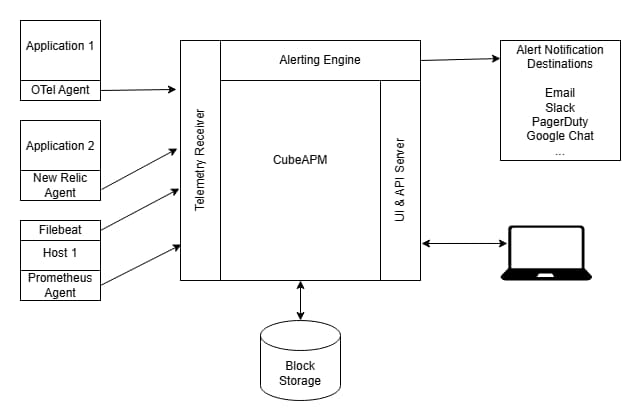
CubeAPM offers the broadest multi-agent compatibility among the three tools. It supports OpenTelemetry, Prometheus, Datadog, Elastic, and New Relic agents, allowing teams to migrate seamlessly from existing observability stacks without re-instrumentation. Its ingestion layer is agent-agnostic and OTel-native, so developers can redirect data from other APM tools within minutes. This makes CubeAPM ideal for hybrid or multi-vendor environments where agent diversity and rapid onboarding matter.
Coralogix supports OpenTelemetry and Prometheus exporters but relies heavily on its Streama-based SDKs for data ingestion and transformation. While this provides good control over data streaming, it limits flexibility when migrating from third-party agents. Most integrations may require adapting to Coralogix’s proprietary ingestion format.
Honeycomb focuses primarily on OpenTelemetry ingestion, supplemented by its Honeytail log shipper and Kubernetes Agent for cluster-level telemetry. It also maintains Honeycomb Distributions for Java and .NET that wrap OpenTelemetry SDKs. However, it doesn’t support legacy agents like Datadog or New Relic, positioning Honeycomb more as an OTel-first solution than a broadly multi-agent platform.
MELT Support (Metrics, Events, Logs, Traces)
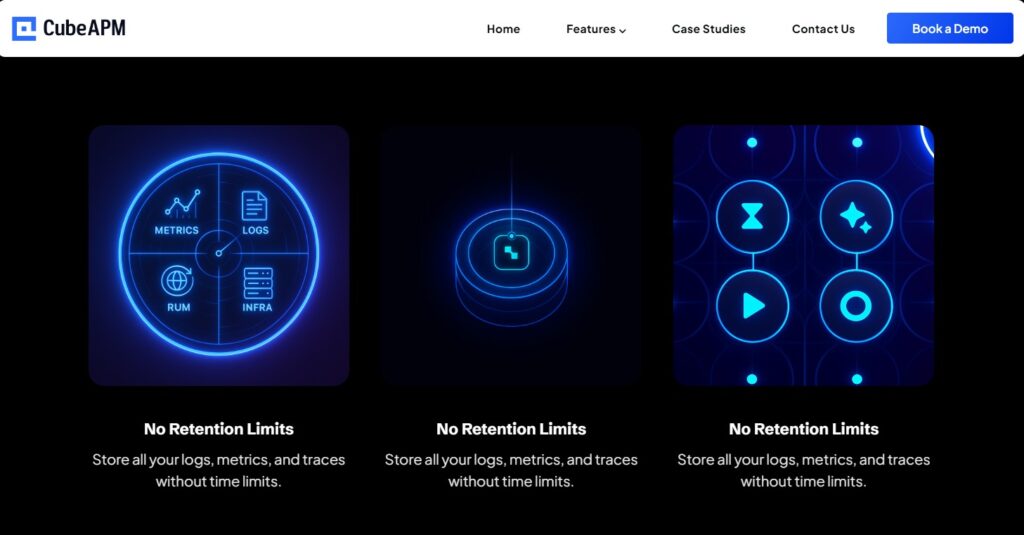
CubeAPM delivers full MELT observability—Metrics, Events, Logs, and Traces—across APM, infrastructure, RUM, synthetics, and error tracking. Built on OpenTelemetry, it correlates all signals automatically, providing end-to-end visibility and faster root-cause detection under one unified dashboard.
Coralogix also supports all four telemetry types via its DataPrime engine and Streama pipeline, offering strong real-time correlation between logs, metrics, and traces. However, since each signal type is priced separately, large-scale MELT adoption can increase costs over time.
Honeycomb supports Metrics, Events, Logs, and Traces through its “wide event” data model. It excels in trace and event analysis, with growing support for metrics and logs via OpenTelemetry collectors. Its MELT coverage is solid, though primarily trace-focused compared to CubeAPM’s balanced approach.
Deployment (Self-Host/Setup)
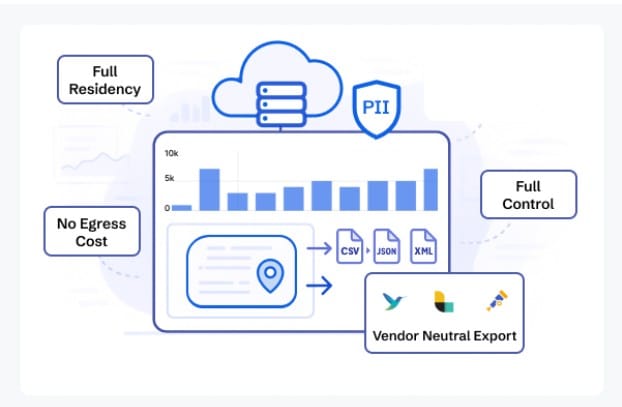
CubeAPM offers both self-hosted and vendor-managed deployment, giving teams complete control over data location, security, and compliance. It can be set up in under an hour and runs inside the customer’s cloud—ensuring compliance while minimizing latency and data-egress costs.
Coralogix is primarily a cloud-based SaaS platform, but it allows customers to archive data in their own cloud storage. While this helps reduce retention costs, telemetry still flows through Coralogix servers first, leading to public-egress fees and limited data-localization control.
Honeycomb is a SaaS-only solution with no self-hosted option. All data is processed and stored within Honeycomb’s managed cloud, which simplifies setup but restricts customization and on-prem compliance flexibility for regulated environments
Pricing for Small, Medium, & Large Teams
Here’s the pricing calculation for this Coralogix vs Honeycomb vs CubeAPM comparison guide:
*All pricing comparisons are calculated using standardized Small/Medium/Large team profiles defined in our internal benchmarking sheet, based on fixed log, metrics, trace, and retention assumptions. Actual pricing may vary by usage, region, and plan structure. Please confirm current pricing with each vendor.
Cost for Small Teams (~30):
- CubeAPM: $2,080
- Coralogix: $4,090
- Honeycomb: $3,000
Cost for Mid-Sized Teams (~125):
- CubeAPM: $7,200,
- Coralogix: $13,200
- Honeycomb: $8,100
Cost for Large Teams (~250):
- CubeAPM: $15,200
- Coralogix: $29,000
- Honeycomb: $17,200
CubeAPM Costs: Detailed Calculation
CubeAPM follows a simple ingestion-based pricing model at $0.15 per GB. There are no extra charges for modules, retention, or support. This transparent, all-inclusive model keeps costs predictable and typically 60–70% lower than most SaaS APMs at a similar scale.
- Small teams (~ 30): $2,080
- Mid-sized teams (~ 125): $7,200
- Large teams (~250): $15,200
Coralogix Costs: Detailed Calculation
Coralogix uses a signal-specific pricing model, charging separately for logs ($0.42/GB), traces ($0.16/GB), metrics ($0.05/million samples), and AI queries ($1.5 per million tokens). While this modular pricing helps optimize per-signal usage, it makes total cost forecasting complex and often higher at scale.
- Small teams: $4,090
- Mid-size teams: $13,200
- Large teams: $29,000
Honeycomb Costs: Detailed Calculation
Honeycomb follows an event-based pricing structure, starting at $130 per 100 million events—roughly $1.30 per GB for standard workloads, dropping to $0.35–$0.40/GB for enterprise volumes. While this offers flexibility, mapping telemetry volume to event count can be unpredictable, especially for large-scale microservices environments.
- Small teams: $3,000
- Mid-size teams: $8,100
- Large teams: $17,200
In this Coralogix vs Honeycomb vs CubeAPM comparison guide, CubeAPM seems to be the most affordable one with its simpler, ingestion based pricing of just $0.15/GB.
Sampling Strategy

CubeAPM uses an intelligent Smart Sampling system that automatically prioritizes high-value traces based on context such as latency, errors, and throughput. It achieves up to 95% data compression without losing diagnostic accuracy. This adaptive approach ensures reduced ingest cost and faster querying while preserving critical anomaly data — all fully automated with no manual tuning required.
Coralogix relies on its Streama-based data pipeline for flow control. Sampling can be configured manually through stream rules. Other sampling strategies, such as conditional error sampling for RUM and tail-based sampling via OTEL, is also supported.
Honeycomb supports both head and tail-based sampling, implemented through its Refinery proxy. Teams can configure rule-based or dynamic sampling — for example, keeping all error traces or specific service paths. While this provides fine-grained control, it requires additional configuration and infrastructure to manage Refinery, making it less turnkey than CubeAPM’s automated Smart Sampling.
Data Retention

CubeAPM offers unlimited log and trace retention at no additional cost. Since all data is stored within the customer’s own cloud, teams can retain telemetry for as long as needed to meet compliance or audit requirements. This model eliminates the tiered retention pricing common in SaaS tools and supports long-term analytics without extra charges.
Coralogix provides infinite data retention for logs, traces, and metrics. There’s an option to archive data in the customer’s cloud bucket. While this helps reduce long-term storage costs, data first passes through Coralogix infrastructure, resulting in egress costs and potential data localization concerns.
Honeycomb retains data for 60 days by default across most plans, with options to extend retention for enterprise users at an additional fee. Its short default window works well for active debugging but limits long-term performance analysis and compliance tracking unless upgraded.
Support Channel, TAT & Pricing
CubeAPM provides real-time developer support through Slack and WhatsApp, with direct access to core engineers. Typical response times are in minutes, and support is included at no extra cost. This hands-on model helps DevOps teams resolve integration or performance issues rapidly, without ticketing delays.
Coralogix offers 24/7 support via chat and email, with a claim – a 17-second median response time for all support requests. While overall coverage is strong, real response time and resolution time could vary.
Honeycomb provides email and community-based support for standard plans, with dedicated customer success resources available only on enterprise tiers. This approach suits experienced observability teams but may feel slower compared to CubeAPM’s immediate, developer-led support structure.
Known For
CubeAPM is known for its OpenTelemetry-native, full-stack observability and predictable $0.15/GB pricing. It combines APM, infrastructure, logs, RUM, synthetics, and error tracking in one platform, making it ideal for teams seeking self-hosted deployment, data compliance, and cost-efficient observability at scale.
Coralogix is recognized for its log analytics and streaming pipeline (Streama) that enables powerful data processing and flexible archival. It’s a strong choice for organizations prioritizing real-time log correlation, AI-powered insights, and long-term data retention—though at a higher operational cost.
Honeycomb stands out for trace-driven debugging and high-cardinality event analysis, offering deep visibility into microservices performance. It’s favored by engineering teams focusing on distributed tracing, event analytics, and high-frequency debugging workflows, especially in cloud-native environments.
Which Tool Is Best for You? Why Brands Choose CubeAPM
Now that we have compared Coralogix vs Honeycomb vs CubeAPM based on different factors, let’s understand which tool is best for you.
Coralogix and Honeycomb both offer capable observability solutions but cater to narrower use cases. Coralogix excels at log analytics and streaming pipelines, while Honeycomb shines in event-driven tracing and high-cardinality debugging. However, both rely on SaaS-only architectures and complex, usage-based pricing that can escalate quickly at scale.
CubeAPM, on the other hand, combines self-hosted control, transparent pricing, and full-stack visibility, making it the most balanced observability platform for modern DevOps teams, SaaS companies, and compliance-driven enterprises.
Key Benefits of Choosing CubeAPM
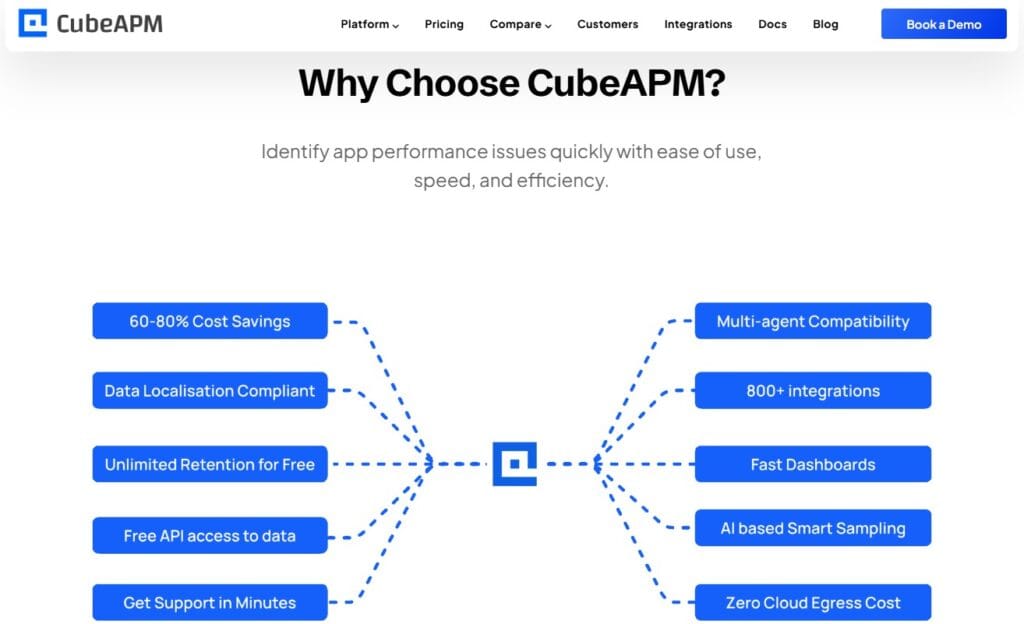
- Predictable Pricing: $0.15/GB ingestion across logs, metrics, and traces—no per-signal or retention charges.
- Unified MELT Visibility: Complete coverage across APM, infrastructure, logs, RUM, synthetics, and error tracking in a single dashboard.
- Smart Sampling: Context-aware, automated sampling that compresses data by 95% while retaining critical error and latency traces.
- Self-Hosting & Compliance: Runs fully in your cloud for compliance with zero data egress.
- Faster MTTR: Built-in correlation across all telemetry signals reduces investigation time from hours to minutes.
- Instant Support: Direct Slack and WhatsApp access to core engineers—responses in minutes, not days.
Coralogix vs Honeycomb vs CubeAPM: Use Cases
Each of these observability platforms serves distinct engineering needs and team priorities. Here’s Coralogix vs Honeycomb vs CubeAPM compared based on usage.
Choose Coralogix if:
Coralogix is designed for teams that rely heavily on real-time log analytics and streaming pipelines. It’s ideal for organizations prioritizing deep log visibility and automated insights.
- Log-heavy Environments: Excellent for teams processing large volumes of structured and unstructured logs using its Streama pipeline for near real-time indexing.
- SaaS-first Teams: Best suited for organizations comfortable with cloud-only architecture and pay-per-GB pricing ($0.42/GB for logs, $0.16/GB for traces, based on official pricing).
- AI-driven Analytics: Ideal for teams leveraging anomaly detection and AI-powered pattern recognition through Coralogix’s ML-based log correlation engine.
- Archival Flexibility: Suitable when long-term retention is needed, provided egress and compliance costs are manageable.
- Regulated Log Analytics: Good for enterprises needing secure log archival but not strict end-to-end data localization.
Choose Honeycomb if:
Honeycomb is built for trace-centric, event-driven debugging across distributed systems. It excels in environments that value granularity and fast query performance.
- Microservices Debugging: Ideal for engineering teams managing high-cardinality, event-driven architectures and distributed traces.
- Developer-centric Teams: Built for developers who prefer real-time, ad hoc queries for root-cause analysis.
- Event-based Workloads: Suitable for organizations generating high-frequency events, where Honeycomb’s pricing ($130/100M events on standard plans, based on vendor data) aligns with volume.
- Dynamic Sampling: Best when teams want customizable head and tail-based sampling via Refinery for fine-grained data control.
- SaaS Flexibility: Recommended for startups or teams seeking minimal setup overhead without self-hosting complexity.
Choose CubeAPM if:
CubeAPM is the most balanced and cost-predictable OpenTelemetry observability platform, offering unified MELT visibility and self-hosted control. Based on our demo and customer data, it’s 60–70% more cost-effective than comparable SaaS tools.
- Startups & Scale-ups: Ideal for teams wanting predictable pricing ($0.15/GB ingestion) without separate costs for logs, traces, or metrics.
- Full-Stack Observability: Suited for organizations seeking unified APM, infra monitoring, logs, RUM, synthetics, and error tracking in one dashboard.
- Compliance-Driven Teams: Perfect for industries requiring data localization with in-cloud deployment and zero data egress.
- Cost & Performance Optimization: Designed for teams needing smart sampling (95% compression) to manage large data volumes efficiently.
- Enterprise & Multi-Cloud Environments: Enables self-hosted deployment in AWS, Azure, or GCP environments with end-to-end traceability across services.
- MTTR Reduction: For DevOps teams focused on faster root-cause detection and issue resolution through correlated MELT telemetry.
Coralogix vs Honeycomb vs CubeAPM: Conclusion
Coralogix and Honeycomb both offer capable observability solutions, but they come with trade-offs in cost predictability, deployment flexibility, and long-term data control.
Coralogix delivers powerful log analytics and streaming pipelines but introduces higher costs due to per-signal pricing and egress charges. Honeycomb excels in event-driven tracing and developer-centric debugging but remains a SaaS-only option with limited control over retention and data locality.
CubeAPM, by contrast, provides the best balance of price, control, and visibility. With predictable $0.15/GB ingestion pricing, self-hosted deployment, and OTel-native MELT observability, it delivers enterprise-grade performance at a fraction of the cost of legacy tools. Teams switching to CubeAPM typically see 60–70% cost savings while gaining faster MTTR and stronger compliance alignment.
In this Coralogix vs Honeycomb vs CubeAPM comparison, CubeAPM is the clear winner for engineering teams seeking unified full-stack observability, end-to-end traceability, and transparent pricing. Book a free CubeAPM demo to experience it yourself.
Disclaimer: The information in this article reflects the latest details available at the time of publication and may change as technologies and products evolve.
FAQs
1. What is the main difference between Coralogix, Honeycomb, and CubeAPM?
The main difference is in deployment flexibility and pricing. CubeAPM is self-hosted and OpenTelemetry-native with predictable $0.15/GB pricing, while Coralogix and Honeycomb are SaaS-only tools that charge separately per data type or event volume.
2. Which tool is more affordable for large-scale observability?
Based on vendor pricing and CubeAPM demo data, CubeAPM is 60–70% cheaper at similar data volumes. Coralogix’s per-signal model and Honeycomb’s event-based billing can scale unpredictably with ingestion, whereas CubeAPM offers a predictable cost per GB.
3. Can I self-host Coralogix or Honeycomb?
No. Both Coralogix and Honeycomb operate mostly as SaaS-only platforms. CubeAPM, however, allows self-hosting or vendor-managed deployment directly in your cloud.
4. Which platform offers the best full-stack MELT observability?
All three provide MELT coverage (Metrics, Events, Logs, Traces), but CubeAPM offers the most balanced full-stack implementation—covering APM, infra, logs, RUM, synthetics, and error tracking in one unified platform. Honeycomb is trace-focused, and Coralogix focuses more on logs.
5. Who should choose CubeAPM over Coralogix or Honeycomb?
Choose CubeAPM if you want predictable pricing, OpenTelemetry-native observability, and full control over your data. It’s ideal for startups, SaaS companies, and compliance-driven enterprises that need unlimited retention, reduced MTTR, and self-hosted flexibility.