


Platform engineering treats observability as a core platform capability, not an afterthought. 33% of platform teams identify observability as their primary area of focus, according to the 2024 Platform Engineering Maturity Model report by the CNCF. That makes it the single most common platform responsibility after infrastructure provisioning.
But observability for platform engineering is not about buying a tool and handing engineers a dashboard. It is about building a system where telemetry collection is automatic, consistent, and low-friction so that application teams can debug production issues without first learning how to instrument code, configure pipelines, or tune sampling rates.
This guide covers what makes observability a platform capability, the dual role platform engineers play, the open source tools that form the backbone of modern observability stacks, and how to implement automation and standards that scale.
What Is Observability for Platform Engineering
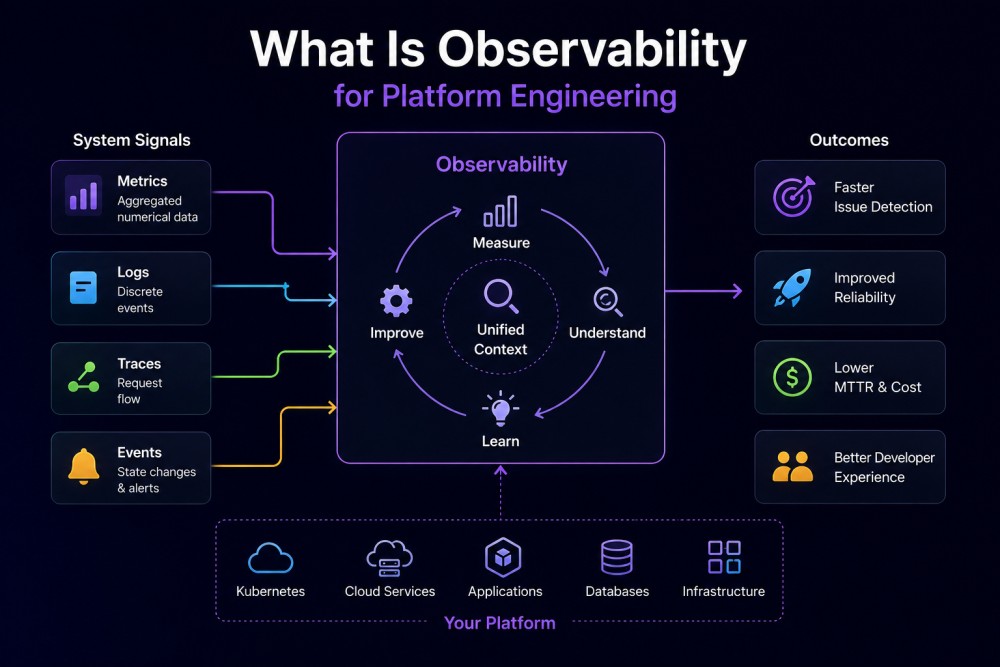
Observability for platform engineering means treating observability infrastructure as a product that internal teams consume. Platform engineers build and maintain the telemetry collection pipeline, storage backends, dashboards, alerting templates, and instrumentation tooling so that application developers can deploy code and immediately see traces, logs, and metrics without custom setup per service.
The platform team owns the observability stack the same way they own CI/CD pipelines or Kubernetes clusters. They provide defaults, handle upgrades, enforce standards, and reduce the cognitive load on application teams who just want their service to emit telemetry without having to become observability experts.
This shifts observability from a per-team activity to a centralized capability. Instead of 15 teams each running their own Prometheus instance with inconsistent labels, the platform team provides a unified Prometheus deployment, standardized metric naming through semantic conventions, and auto instrumentation that works out of the box for common frameworks.
The outcome: faster incident response because all telemetry follows the same structure, lower operational overhead because one team manages the stack, and higher adoption because the barrier to entry drops from hours of setup to zero.
Why Platform Engineers Care About Observability
Platform engineers care about observability because they are accountable for reliability, developer experience, and infrastructure efficiency across the entire organization. Observability is the feedback loop that makes those responsibilities actionable.
Without observability built into the platform, every service outage becomes a fire drill. Application teams have no baseline to compare against, no shared vocabulary for describing problems, and no structured way to correlate events across services. Incident resolution depends on who knows which log file to check or which dashboard to open, and that knowledge rarely transfers across teams.
When observability is treated as a platform capability, those problems shrink. A slow API call automatically links to the trace showing which database query caused the delay. A pod eviction event in Kubernetes correlates with memory pressure metrics and application logs without anyone manually stitching data sources together. New services inherit observability configuration by default instead of starting from zero.
Platform engineers also care about cost. Observability tools can consume 15 to 25% of total cloud spend if left unchecked. Centralizing the stack, standardizing on open formats like OpenTelemetry, and implementing smart sampling at the platform level directly control that cost instead of letting it grow per team or per service.
The Platform Engineer’s Dual Role in Observability
Platform engineers play two distinct roles in observability: they are both operators of the observability infrastructure and enablers of application teams who consume that infrastructure.
- As operators, they deploy, configure, and maintain the telemetry backend. That means running Prometheus for metrics, Jaeger or Tempo for traces, and a log aggregation system like Loki or OpenSearch. It includes managing data retention, storage backends, query performance, and alerting pipelines. This is the infrastructure reliability side of the job.
- As enablers, they build the abstraction layer that makes observability easy for application teams. That means providing auto instrumentation libraries, creating default dashboards and alert templates, standardizing metric labels through semantic conventions, and documenting how to emit custom telemetry when the defaults do not cover a use case. This is the developer experience side of the job.
The tension between these two roles is real. Application teams want unlimited retention, high cardinality metrics, and full fidelity traces. The platform team has to balance those requests against storage costs, query performance, and system stability. The solution is not to say no, but to provide sensible defaults, allow overrides where needed, and automate the parts that do not require case-by-case decisions.
For example: The platform provides 30-day retention by default but allows teams to extend it to 90 days for business-critical services by adding a single annotation to their Kubernetes deployment. That keeps storage costs predictable without blocking legitimate needs.
Main Challenges in Platform Observability
Platform observability introduces challenges that do not appear when individual teams manage their own monitoring. These challenges show up consistently across distributed, multi-cluster, and multi-tenant environments.
Inconsistent Telemetry Across Services
When application teams instrument their services independently, telemetry formats diverge. One team uses Datadog agents, another uses Prometheus exporters, a third manually logs to stdout with no structured format. Correlating data across these services during an incident requires manual translation and guesswork.
The platform solution: standardize on OpenTelemetry for instrumentation and enforce semantic conventions so that every service emits telemetry in the same format with the same labels. This turns correlation from a manual task into an automatic query.
High Cardinality Metrics Overload
High cardinality metrics happen when a metric has many unique label combinations, like tagging every HTTP request with a unique user ID. This explodes the number of time series stored in Prometheus or similar systems, degrading query performance and increasing storage costs exponentially.
The platform solution: define allowed label sets at ingestion time, reject high cardinality labels that violate policy, and provide tracing as the tool for high cardinality debugging instead of forcing everything into metrics.
Distributed Systems Debugging Without Context
A request that touches five microservices can fail in any one of them. Without distributed tracing, debugging means checking logs in five places, guessing the order of execution, and hoping timestamps align. With tracing, the entire request path is captured in a single trace span tree.
The platform solution: deploy OpenTelemetry collectors that automatically propagate trace context across service boundaries and ensure that every service uses a library that respects W3C Trace Context headers.
Alert Fatigue and Noise
Platform teams often inherit noisy alerting systems where every metric threshold triggers a notification, but 90% of alerts are false positives or low severity. This trains engineers to ignore alerts, which means real incidents go unnoticed.
The platform solution: implement alert grouping, define SLO based alerting instead of threshold based, and use anomaly detection to reduce noise. The goal is not zero alerts but high signal alerts that correlate with real user impact.
Data Residency and Compliance Constraints
Regulated industries require telemetry data to stay within specific geographic regions or never leave the organization’s infrastructure. SaaS observability tools that send data to external clouds do not meet these requirements.
The platform solution: deploy observability infrastructure on premises or inside the organization’s VPC. Tools like CubeAPM, Grafana, and SigNoz support this model. For teams evaluating on premises options, the guide on data privacy and on-prem security in modern observability architectures covers deployment considerations and compliance requirements in depth.
The Open Source Observability Tool Landscape
The open source observability ecosystem provides the building blocks for platform teams to construct their own stack. These tools are modular: you can run Prometheus for metrics, Jaeger for traces, and Loki for logs, or combine them under a unified query layer like Grafana.
OpenTelemetry: The Standard for Instrumentation
OpenTelemetry is the standard for collecting traces, metrics, and logs from applications. It provides vendor neutral SDKs for most programming languages and a collector that receives telemetry, processes it, and exports it to any backend.
OpenTelemetry replaces proprietary instrumentation libraries from vendors like Datadog or New Relic. Once your services are instrumented with OpenTelemetry, switching backends becomes a configuration change instead of a code rewrite.
The OpenTelemetry Collector is the central piece. It runs as a sidecar or daemonset in Kubernetes, receives telemetry from application services, applies transformations like sampling or redaction, and exports the data to Prometheus, Jaeger, or any OTLP compatible backend.
Prometheus: Metrics for Modern Systems
Prometheus is the de facto standard for metrics collection in cloud native environments. It scrapes metrics from HTTP endpoints, stores them as time series, and provides a query language called PromQL for aggregation and alerting.
Prometheus integrates natively with Kubernetes, automatically discovering services and pods through service discovery. This makes it the default choice for infrastructure and application metrics in containerized environments.
The main limitation: Prometheus is not designed for long term storage. Teams typically pair it with a remote write backend like Thanos, Cortex, or Mimir for retention beyond 15 days.
Jaeger and Tempo: Distributed Tracing
Jaeger and Tempo are open source tracing backends. Jaeger was one of the first CNCF projects for tracing and remains widely used. Tempo, built by Grafana Labs, is newer and optimized for cost efficient trace storage using object storage backends like S3.
Both accept traces in OpenTelemetry format. The choice between them often comes down to whether you are already using Grafana (Tempo integrates more tightly) or need Jaeger’s mature feature set like span analytics and service dependency graphs.
Loki and OpenSearch: Log Aggregation
Loki is a log aggregation system designed to integrate with Prometheus and Grafana. It indexes logs by labels, not full text, which reduces storage costs but limits search capabilities compared to full text search systems.
OpenSearch, the open source fork of Elasticsearch, provides full text log search, complex queries, and rich visualization. It requires more infrastructure to run but is the right choice when log search depth matters more than cost.
Grafana: Unified Visualization and Dashboards
Grafana provides the query and visualization layer for metrics, logs, and traces. It connects to Prometheus for metrics, Loki or OpenSearch for logs, and Jaeger or Tempo for traces, allowing platform teams to build dashboards that combine all three signals in one view.
Grafana also provides alerting, templating, and dashboard as code through tools like Grafonnet or Terraform. This makes it the control plane for most open source observability stacks.
For platform teams evaluating whether to build on open source tools or adopt a managed platform, the guide on how to evaluate an observability platform provides a decision framework covering operational overhead, feature depth, and cost.
Simplifying Observability with Automation and Standards
The difference between observability that works and observability that becomes a maintenance burden is automation. Platform teams that manually configure instrumentation for every service, hand tune dashboards per deployment, or rely on tribal knowledge for alert thresholds do not scale.
Automation and standards turn observability into infrastructure. Once the system is configured, new services inherit observability automatically, dashboards update with each deployment, and alerts fire based on actual SLOs instead of guessed thresholds.
Auto Instrumentation with OpenTelemetry
Auto instrumentation means applications emit telemetry without developers writing instrumentation code. The OpenTelemetry Operator for Kubernetes enables this by injecting instrumentation libraries at runtime through sidecar containers or init containers.
For example: a Java service running in Kubernetes gets automatic tracing by adding a single annotation to the pod spec. The operator injects the OpenTelemetry Java agent, configures it to send traces to the collector, and applies semantic conventions for HTTP, database, and RPC calls.
This reduces instrumentation effort from hours per service to zero. It also ensures consistency because every service uses the same instrumentation library configured by the platform team.
GitOps for Dashboards and Alerts
Dashboards and alerts should live in version control, not in a UI. Grafana supports dashboards as JSON, Prometheus alerting rules are YAML files, and both can be deployed through GitOps tools like ArgoCD or Flux.
This approach has three benefits: changes are auditable through Git history, dashboards can be reviewed before deployment through pull requests, and rolling back a broken alert rule is a Git revert instead of manual UI changes.
A typical workflow: a platform engineer updates a dashboard JSON file in the observability repo, opens a pull request, and once merged, ArgoCD syncs the change to Grafana. Application teams consume these dashboards without needing Grafana editor access.
Provide Defaults, Allow Overrides
The platform should provide sensible defaults that work for 80% of use cases and allow overrides for the remaining 20%. For example: the platform provides a default retention period of 30 days for traces, but services can extend retention to 90 days by setting a custom annotation.
This pattern keeps the platform opinionated enough to avoid configuration sprawl while flexible enough to support edge cases. The key is making overrides explicit and tracked so that platform teams can see which services deviate from defaults and why.
Data Control for Platform Engineers
Platform engineers need visibility into the cost and volume of telemetry data across all teams. This means instrumenting the observability stack itself: tracking bytes ingested per service, cardinality of metrics, trace sampling rates, and query costs.
This data is used to set budgets, enforce limits, and optimize the stack. For example: If one service generates 40% of total trace volume, the platform team can work with that team to tune sampling rates or identify noisy spans.
Data control also includes the ability to redact sensitive information at the collector level before telemetry leaves the application. This protects against accidental logging of PII or credentials and is a compliance requirement in regulated industries. For teams managing observability costs as data volume grows, the guide on why observability costs become unpredictable at scale explains cost drivers and control strategies.
Tools and Implementation: CubeAPM as a Platform Capability
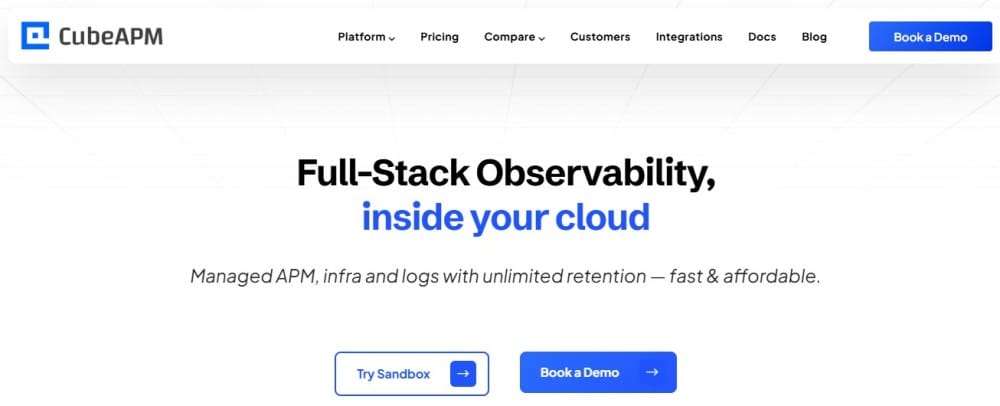
Most open source observability stacks require platform teams to deploy, configure, and maintain multiple components. Prometheus for metrics, Jaeger for traces, Loki for logs, and Grafana for visualization. Each component has its own configuration, upgrade cycle, and operational requirements.
CubeAPM provides an alternative: a unified observability platform that runs on premises or inside your VPC but is managed by the vendor. This removes the Day 2 operational burden patches, upgrades, scaling, and backup while keeping telemetry data under your control.
CubeAPM is built natively on OpenTelemetry, which means it accepts telemetry in the same format your services already emit if they are instrumented with OpenTelemetry SDKs. There is no agent lock-in and no proprietary instrumentation.
The platform includes APM, distributed tracing, log management, infrastructure monitoring, real user monitoring, and synthetic monitoring in a single system. This reduces integration complexity for platform teams who would otherwise need to connect Prometheus, Jaeger, and Loki through Grafana and manually correlate data across backends.
Pricing is usage-based at $0.15/GB of ingested telemetry with unlimited retention and no per-seat fees. This makes cost predictable as data volume grows and removes the rationing dynamic where junior engineers are locked out to control seat costs.
CubeAPM fits the platform engineering model because it provides a managed backend with full data sovereignty. Platform teams deploy it once, configure OpenTelemetry collectors to send telemetry to CubeAPM, and application teams get observability without managing the stack themselves. The operational model is simpler than running open source at scale, but retains the data control and compliance properties of on-premises deployment.
For platform teams deciding between SaaS, open source, or on-premises managed options, the guide on how observability platforms fail and what high availability actually means covers architecture patterns, failure modes, and deployment trade-offs.
Observability Becomes Infrastructure
The goal of observability for platform engineering is not to give every team a monitoring tool. It is to make observability invisible. Application teams deploy code, telemetry flows automatically, dashboards populate, alerts fire when SLOs are violated, and incidents resolve faster because all the signals are correlated.
This happens when platform teams treat observability as infrastructure: automated, standardized, and maintained centrally. The application team does not configure Prometheus, write PromQL queries, or debug OpenTelemetry pipelines. They write code, and the platform handles the rest.
That is the end state. Getting there requires choosing the right tools, automating instrumentation, enforcing semantic conventions, and building dashboards and alerts as code. The path is not short, but the outcome is a platform where observability is a built-in capability instead of a per-team burden.
Disclaimer: The information in this article reflects the latest details available at the time of publication and may change as technologies and products evolve. Features, pricing, and plan limits can change over time. Always verify the latest information directly with the vendor before making purchasing or deployment decisions.
Frequently Asked Questions
What is the difference between observability and monitoring in platform engineering?
Monitoring tracks known failure modes with predefined dashboards and alerts. Observability provides the raw telemetry traces, metrics, logs to debug unknown issues. Platform engineers provide both: monitoring for known problems and observability tools for everything else.
Why do platform engineers prefer OpenTelemetry over vendor agents?
OpenTelemetry is vendor neutral. Once services are instrumented with OpenTelemetry, switching backends requires a configuration change not a code rewrite. This prevents lock in and gives platform teams flexibility to change tools without re-instrumenting every service.
How do platform teams control observability costs at scale?
Platform teams control costs by standardizing on OpenTelemetry, implementing sampling at the collector level, enforcing cardinality limits on metrics, and tracking telemetry volume per service. Centralized observability infrastructure also reduces duplicate tooling across teams.
What is auto instrumentation and why does it matter for platform engineering?
Auto instrumentation means applications emit telemetry without developers writing instrumentation code. The OpenTelemetry Operator injects instrumentation at runtime. This reduces setup time from hours to zero and ensures consistency across all services.
Should platform teams use SaaS observability tools or self hosted?
It depends on data residency requirements and cost sensitivity. SaaS tools are faster to deploy but send telemetry outside your infrastructure and charge per GB ingested. Self hosted tools keep data local and reduce egress costs but require operational overhead. Managed on premises platforms like CubeAPM provide a middle ground.
How does observability for platform engineering differ from traditional APM?
Traditional APM is a per application activity where each team configures their own monitoring. Observability for platform engineering treats telemetry collection and storage as a centralized platform capability that all teams consume. The platform team owns the stack, and application teams just emit telemetry.
What role does Grafana play in a platform observability stack?
Grafana provides the visualization and query layer for metrics, logs, and traces. Platform teams use it to build dashboards that combine signals from Prometheus, Jaeger, and Loki in one view. Grafana also supports alerting and dashboards as code for GitOps workflows.