










Azure Kubernetes Service (AKS) runs mission-critical workloads for thousands of organizations, but monitoring it effectively requires more than CloudWatch-style metrics. A production AKS cluster generates control plane logs, node-level resource metrics, pod lifecycle events, container performance data, and application traces, all of which must be correlated to diagnose real incidents. According to the CNCF 2024 Annual Survey, 80% of organizations now run Kubernetes in production, and monitoring complexity is cited as the second most common operational challenge after security.
This guide compares 10 AKS monitoring tools across pricing models, native OpenTelemetry support, Kubernetes signal depth, and deployment flexibility. Each tool is evaluated with real cost scenarios, sourced drawbacks, and a decision framework for teams running AKS at any scale.
This comparison includes CubeAPM, which is the platform behind this blog. All tools are evaluated on the same criteria.
Quick Comparison: 10 AKS Monitoring Tools at a Glance
| Tool | Best For | Pricing Model | OTel Native | On-Prem |
| CubeAPM | On-prem teams, unified observability, cost control | $0.15/GB · unlimited users | Native | Yes |
| Azure Monitor Container Insights | Teams already on Azure, tight Azure integration | Log Analytics ingestion $2.99/GB + retention | Partial | No |
| Datadog | Multi-cloud enterprises, breadth over cost | Infrastructure $15/host/month (Pro) + APM + logs $0.10/GB ingestion | Strong | No |
| Prometheus + Grafana | Teams wanting open-source flexibility | Free OSS · Grafana Cloud usage-based (free tier available) | Native | Yes |
| Dynatrace | Large enterprises, AI-driven automation | Full-Stack $58/mo per 8 GiB host · Infra $29/mo per host | Partial | Yes |
| New Relic | Broad observability platform users | $0.40/GB data ingest + user-based licensing | Strong | No |
| SigNoz | OTel-first teams, open-source priority | Free OSS · Cloud from $49/month | Native | Yes |
| Elastic APM | Teams on ELK stack | Free OSS · Serverless Observability from ~$0.105/GB ingested | Partial | Yes |
| Sysdig | Security + monitoring in one platform | Custom pricing · ~$50/host/month estimated | Strong | Yes |
| Splunk | Enterprise SIEM + observability | Observability Cloud from $15/host/month · Enterprise log ingest volume-based | Partial | Yes |
Pricing data sourced from official vendor pricing pages as of June 2026. Prices may vary; verify directly with each vendor before making a decision.
1. Azure Monitor Container Insights
Azure Monitor Container Insights is Microsoft’s built-in monitoring solution for AKS, available directly from the Azure portal with no additional agent installation. For teams already operating within the Azure ecosystem, it is the path of least resistance: it connects to Log Analytics, feeds into Azure alerting pipelines, and surfaces Kubernetes-specific dashboards without requiring a separate observability platform.
Key Features
- Native integration with AKS control plane logs and Azure Resource Manager
- Automatic collection of container stdout/stderr logs and Kubernetes events
- Pre-built workbooks for node health, pod performance, and cluster capacity
- Integration with Azure Managed Prometheus and Azure Managed Grafana
- Live container logs and Kubernetes object state visibility in Azure portal
Pricing
Container Insights uses a Log Analytics workspace for storage: $2.99/GB for ingestion (first 5 GB free per subscription), plus retention costs after 31 days. A 50-node AKS cluster generating 15 TB/month costs approximately $44,850/month before retention fees.
Pros
- Zero setup friction for AKS users; enabled via Azure portal checkbox
- Native Azure RBAC and Microsoft Entra ID integration
- Integrated with Azure alerting, action groups, and Azure Resource Graph queries
- Microsoft support included with Azure support plans
Cons
- Log Analytics pricing becomes expensive at scale; data ingest and retention are billed separately
- Kusto Query Language (KQL) learning curve for custom queries and dashboards
- Limited customization compared to open-source observability stacks
- No multi-cloud support; Azure-only visibility
Best for: Teams running AKS exclusively on Azure who prioritize native integration and are already familiar with Azure Monitor and KQL.
2. CubeAPM
CubeAPM is a self-hosted, OpenTelemetry-native observability platform that deploys inside your own VPC or data center. Unlike SaaS tools that send telemetry to third-party infrastructure, CubeAPM keeps all cluster data within your environment, making it well-suited for teams with data residency or compliance requirements. Its ingestion-based pricing model means costs scale with data volume rather than node or container count, which makes budgeting predictable at any cluster size.
Key Features
- Full-stack AKS monitoring covering cluster health, node and pod metrics, container performance, application traces, and logs.
- Native OpenTelemetry support; works with OTel Collector, Prometheus, and Datadog agents
- Unified view correlating Kubernetes events with APM traces and infrastructure metrics
- Unlimited data retention with no egress or indexing fees
- AI-driven smart sampling reduces storage overhead while preserving critical traces
- Self-hosted deployment keeps telemetry data within your infrastructure
Pricing
$0.15/GB ingestion-based pricing with no user seat fees. A 50-node AKS cluster generating 15 TB/month costs $2,250/month. Infrastructure costs approximately $300/month for a self-hosted deployment.
Pros
- Predictable single-dimension pricing with no surprise add-ons
- Complete data sovereignty; AKS telemetry never leaves your environment
- Fast migration; customers report sub-60-minute onboarding
- Direct engineering support via Slack and WhatsApp
- Full signal correlation: Kubernetes events to pod logs to APM traces
Cons
- Requires self-hosted or BYOC deployment; your team provisions the infrastructure
- Smaller third-party integration ecosystem compared to Datadog or New Relic
- SSO and RBAC maturity lags enterprise SaaS platforms
Best for: Teams running AKS with data residency requirements, predictable cost control needs, or those currently spending over $5,000/month on observability.
3. Datadog
Datadog is one of the most widely deployed commercial observability platforms, with deep Kubernetes support and 700+ out-of-the-box integrations that make it attractive for teams monitoring heterogeneous environments. Its AKS integration covers infrastructure metrics, APM traces, log management, and security monitoring under a single agent and UI. The primary challenge is cost: Datadog bills across multiple independent dimensions simultaneously, and a full-stack AKS deployment accumulates charges from infrastructure, APM, logs, and custom metrics all at once.
Key Features
- Real-time container metrics, Kubernetes events, and live container process monitoring
- Automatic service discovery and tagging across AKS clusters
- Pre-built AKS dashboards with cluster overview, node health, and pod resource usage
- Native integration with Azure Monitor metrics and Azure Active Directory
- Deep APM correlation linking Kubernetes events to distributed traces
Pricing
Infrastructure monitoring starts at $15/host/month on the Pro plan (billed annually). Logs are billed at $0.10/GB ingestion plus additional indexing and retention fees. APM is host-based and billed separately. A 50-node AKS cluster incurs a minimum of $750/month in infrastructure fees before any APM, log, or custom metrics charges.
Pros
- Exceptional integration breadth; 700+ technologies supported
- Mature alerting with anomaly detection and forecasting
- Strong security monitoring features (Cloud SIEM, runtime security)
- Excellent mobile app for on-call incident response
Cons
- Cost compounds quickly across multiple pricing dimensions (hosts, logs, custom metrics, APM)
- Vendor lock-in through proprietary agents and DQL query language
- Azure egress fees add $0.10/GB when sending telemetry to Datadog SaaS
- No on-premises deployment option for data sovereignty requirements
Best for: Multi-cloud enterprises already using Datadog who prioritize integration breadth and can absorb variable month-to-month costs.
4. Prometheus + Grafana
Prometheus and Grafana are the de facto open-source monitoring stack for Kubernetes environments. Prometheus handles metric collection via a pull-based scraping model, while Grafana provides dashboarding and alerting on top. Teams typically add Loki for logs and Tempo for traces to achieve full-stack observability. The combination offers maximum flexibility and zero licensing cost, but shifts all operational responsibility onto your team.
Key Features
- Open-source metric collection with PromQL query language
- Kubernetes-native service discovery and pod and node metric scraping
- Extensive exporter ecosystem for Kubernetes components and applications
- Grafana dashboards with rich visualization and alerting capabilities
- Azure Managed Prometheus and Azure Managed Grafana options available
Pricing
Self-hosted deployment is free (OSS). Grafana Cloud offers a free tier with access to the full platform under generous usage limits; paid plans are usage-based, billed by host-hours and telemetry volume with no per-user fees.
Pros
- No vendor lock-in; fully open source with portable configurations
- Strong community support and extensive documentation
- Deep Kubernetes integration via kube-state-metrics and node-exporter
- Flexible alerting with Alertmanager and multi-channel notification support
Cons
- Significant operational overhead; teams manage upgrades, scaling, high availability, and disaster recovery
- Prometheus lacks native distributed tracing and log aggregation; Tempo and Loki are required for full-stack coverage
- Long-term metric retention requires external storage (Thanos, Cortex, or Mimir)
- Alert routing and on-call management less mature than commercial platforms
Best for: Teams with deep Kubernetes expertise who prioritize open-source flexibility and can handle the operational complexity of managing infrastructure monitoring tools themselves.
5. Dynatrace
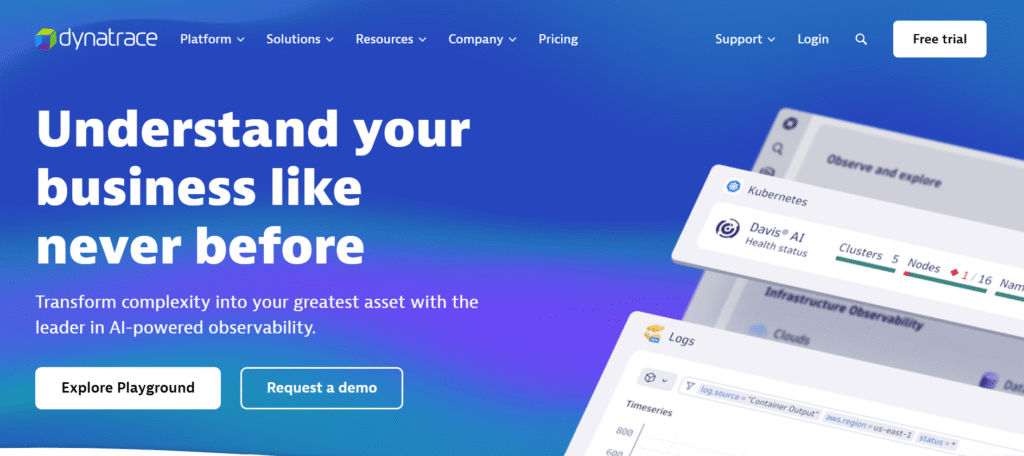
Dynatrace positions itself as an AI-driven observability and security platform with automatic discovery and dependency mapping across AKS environments. Its Davis AI engine continuously analyzes behavior to surface anomalies and determine root cause without requiring engineers to write queries. Dynatrace publishes its full rate card openly; pricing is GiB-hour based for full-stack and host-hour based for infrastructure-only tiers.
Key Features
- Automatic discovery and dependency mapping of AKS workloads
- Davis AI engine for anomaly detection and root cause determination
- Full-stack observability linking AKS infrastructure to application code paths
- Native Azure integration including Azure Monitor metrics and Azure Active Directory SSO
- Business KPI tracking and user experience correlation
Pricing
All prices are from dynatrace.com/pricing as of June 2026:
- Full-Stack Monitoring: $58/month per 8 GiB host (billed at $0.01/GiB-hour); includes APM, Kubernetes Platform Monitoring, and automated root cause analysis
- Infrastructure Monitoring: $29/month per host
- Kubernetes Platform Monitoring standalone: $1.40/month per pod (included free on Full-Stack hosts)
- Log Analytics: $0.20/GB ingestion
Pros
- Advanced AI-driven automation reduces manual triage effort
- Strong enterprise governance features (RBAC, audit logs, compliance reporting)
- Excellent Azure and .NET application monitoring depth
- No per-user fees; unlimited user access included
Cons
- Full-stack pricing compounds with host memory size; large-memory hosts cost significantly more
- Complex learning curve due to platform breadth and depth
- OpenTelemetry support exists but is less mature than OTel-native platforms
Best for: Large enterprises running business-critical AKS workloads who require AI-assisted triage and automated root cause analysis.
6. New Relic
New Relic offers a unified observability platform covering infrastructure, APM, logs, and real user monitoring under a single data ingest pricing model. Its Kubernetes cluster explorer gives live visibility into node, pod, and container health, while the Pixie integration enables auto-instrumented application tracing without code changes. The per-GB data ingest model is transparent, but costs climb steeply for clusters generating high telemetry volumes.
Key Features
- Kubernetes cluster explorer with real-time node, pod, and container views
- Pixie integration for auto-instrumented application tracing without code changes
- Pre-built AKS dashboards and alert policies
- NRQL query language for custom analysis and reporting
- Native Azure integration with Azure Monitor metrics ingestion
Pricing
$0.40/GB data ingestion after 100 GB/month free. Full platform users are billed separately depending on edition (Standard, Pro, Enterprise). A 50-node AKS cluster generating 15 TB/month costs approximately $5,960/month in data ingest alone (14,900 GB × $0.40), before user licensing.
Pros
- Pixie auto-instrumentation reduces deployment friction for new services
- Single platform for APM, logs, infrastructure, and real user monitoring
- Strong query capabilities with NRQL for complex analysis
- Good documentation and active community support
Cons
- Per-user licensing creates cost rationing for larger engineering teams
- NRQL lock-in makes migration to other platforms difficult
- 100 GB free ingest exhausted quickly by production AKS clusters
- No on-premises deployment option for regulated industries
Best for: Teams seeking unified observability who are already on New Relic’s platform or can absorb per-user licensing costs.
7. SigNoz
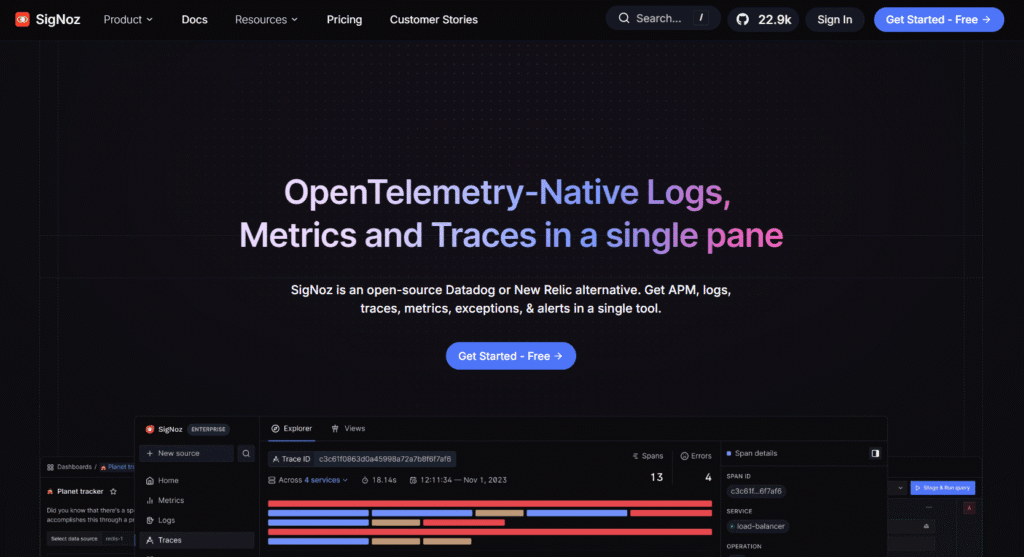
SigNoz is an open-source observability platform built natively on OpenTelemetry, designed as a self-hostable alternative to Datadog and New Relic. It covers metrics, traces, and logs in a single UI backed by ClickHouse, which provides fast query performance at scale. Because it is OTel-native from the ground up, teams avoid re-instrumentation when adopting or migrating to it.
Key Features
- Native OpenTelemetry support for metrics, traces, and logs
- AKS monitoring with pod-level metrics, Kubernetes events, and node health
- Unified dashboard correlating traces, logs, and infrastructure metrics
- ClickHouse backend for fast querying at scale
- Managed cloud offering or self-hosted deployment
Pricing
Open-source version is free. SigNoz Cloud starts at $49/month (Teams plan), which includes usage worth $49 in data. Beyond that, logs and traces are billed at $0.30/GB and metrics at $0.10/million samples.
Pros
- True OpenTelemetry-native architecture eliminates vendor lock-in
- Lower cost than commercial APM platforms, especially self-hosted
- Active open-source community and rapid feature development
- Simple transparent pricing compared to multi-dimensional alternatives
Cons
- Smaller integration ecosystem compared to mature commercial platforms
- Self-hosted deployment requires Kubernetes and ClickHouse operational expertise
- Less mature alerting and notification routing than enterprise tools
- Limited enterprise features (SSO, RBAC, audit logging) on lower tiers
Best for: OpenTelemetry-first teams who prioritize vendor neutrality and can handle self-hosting operational overhead.
8. Elastic APM

Elastic APM sits within the broader Elastic Stack, meaning teams that already use Elasticsearch for log search and analytics can extend the same platform to cover APM and AKS infrastructure visibility. The Kibana interface provides a familiar query and dashboard experience, and Elastic Cloud Serverless (GA from late 2024) removes the need to provision and size Elasticsearch clusters manually.
Key Features
- Metricbeat and Filebeat for Kubernetes metrics and log collection
- Elastic APM agents for distributed tracing across microservices
- Kibana dashboards with cluster overview, node health, and pod performance
- Correlation between AKS infrastructure metrics, application traces, and logs
- Machine learning anomaly detection for resource usage patterns
Pricing
Self-hosted Elastic Stack is free (OSS). Elastic Cloud Serverless Observability uses consumption-based pricing: ingestion starts at approximately $0.105/GB for the Logs Essentials tier and $0.150/GB for the Complete tier, plus separate retention and egress fees. (Pricing effective November 2025.)
Pros
- Powerful search and analytics via Elasticsearch query DSL
- Unified platform for logs, metrics, traces, and security (SIEM)
- Strong log aggregation and full-text search capabilities
- Active open-source community with an extensive plugin ecosystem
Cons
- Steep learning curve; Elasticsearch expertise required for production deployment
- Resource-intensive; Elasticsearch clusters demand significant infrastructure overhead
- Complex operational management (cluster sizing, shard management, replication)
- OpenTelemetry support exists but is not as mature as OTel-native platforms
Best for: Teams already running the ELK stack who need to add AKS monitoring without introducing new platforms.
9. Sysdig
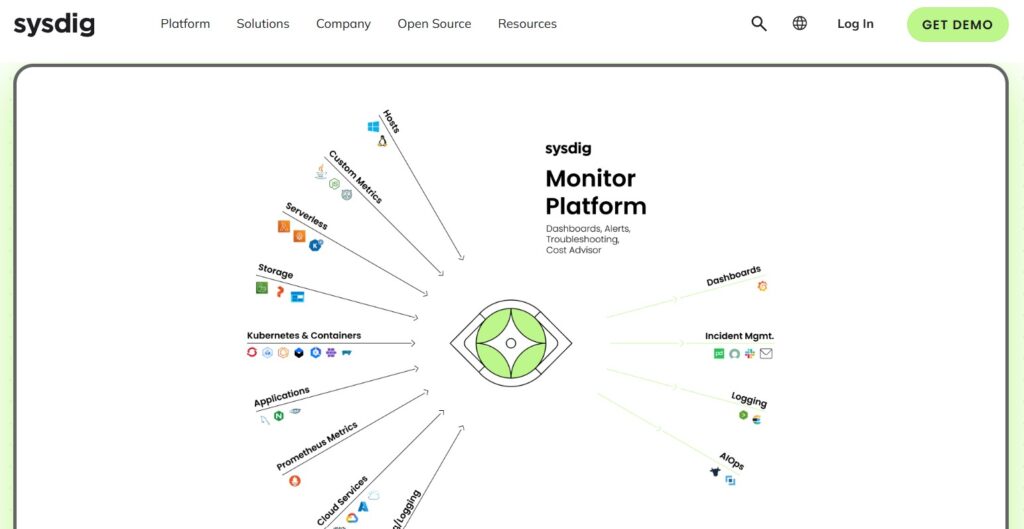
Sysdig differentiates itself by combining infrastructure monitoring with runtime security in a single Kubernetes-native platform. Where most observability tools focus on performance visibility, Sysdig adds vulnerability scanning, Falco-based threat detection, and CIS benchmark compliance reporting alongside the standard metrics and traces layer. Its eBPF-based instrumentation captures deep kernel-level signals without sidecars or code changes.
Key Features
- Deep kernel-level visibility via eBPF for container activity monitoring
- Kubernetes security posture management and vulnerability scanning
- Real-time performance metrics, distributed tracing, and log aggregation
- Compliance reporting for CIS Kubernetes benchmarks and regulatory requirements
- Native Prometheus compatibility for metric collection
Pricing
Custom pricing; not publicly listed. Estimated at approximately $50/host/month based on available market data. Contact Sysdig directly for accurate pricing.
Pros
- Unified security and monitoring reduces tool sprawl
- eBPF-based instrumentation provides deep visibility without sidecars
- Strong compliance and audit capabilities for regulated industries
- Good Azure integration with native Azure Monitor metric ingestion
Cons
- Pricing not publicly listed; requires sales contact for accurate costs
- More complex than pure monitoring solutions due to security feature breadth
- Smaller community compared to open-source alternatives
Best for: Organizations requiring combined runtime security and AKS monitoring with compliance reporting.
10. Splunk Observability Cloud
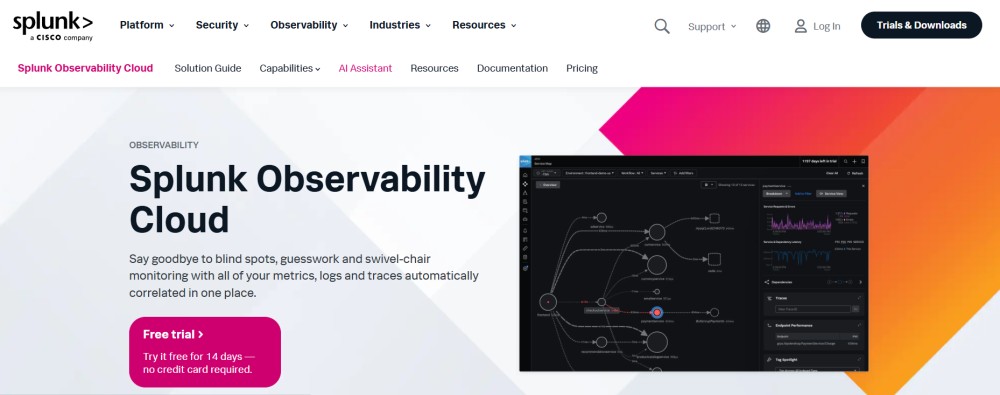
Splunk is an enterprise-grade platform with a long history in log management and SIEM, and its Observability Cloud product extends that foundation into infrastructure monitoring and APM. The Kubernetes Navigator gives live cluster and pod visibility, and SignalFx-based metrics provide fast streaming analytics for real-time alerting. Splunk’s primary audience is organizations that need observability and security event analysis under one platform and already have Splunk enterprise agreements in place.
Key Features
- Kubernetes Navigator for real-time cluster, node, and pod visualization
- Automatic service discovery and dependency mapping
- SignalFx-based metrics and APM with distributed tracing
- Deep Azure integration including Azure Monitor metrics ingestion
- Correlation between AKS monitoring and security event analysis
Pricing
Splunk Observability Cloud infrastructure monitoring starts at $15/host/month (billed annually). Splunk Enterprise and Splunk Cloud Platform log ingestion uses volume-based pricing measured in GB per day; list pricing ranges from $150 to $225 per GB/day depending on commitment tier.
Pros
- Mature enterprise platform with extensive compliance and audit capabilities
- Strong SIEM integration for security operations teams
- Powerful search and analytics across all telemetry types
- Excellent support and professional services for large deployments
Cons
- Log ingestion pricing compounds quickly at high volumes
- Complex pricing structure with multiple SKUs and add-ons
- Steep learning curve; SPL query language and platform breadth require training
Best for: Large enterprises with existing Splunk investments who need unified observability and SIEM capabilities.
How to Choose the Right AKS Monitoring Tool
Selecting an AKS monitoring platform depends on factors that compound differently at different scales. Teams running 10 AKS nodes have different constraints than teams managing 500 nodes across multiple regions.
Start with the deployment model
If data residency, HIPAA compliance, or GDPR requirements mandate that telemetry cannot leave your infrastructure, your options narrow immediately. Azure Monitor Container Insights, Datadog, New Relic, and most SaaS platforms are ruled out. Self-hosted options like CubeAPM, Prometheus + Grafana, SigNoz, and Elastic APM become the only viable choices. For teams without these constraints, SaaS platforms offer faster time-to-value with zero infrastructure management burden.
Model your actual costs
Take your current AKS cluster metrics, including node count, container count, monthly log volume, and trace volume, and run them through each vendor’s pricing calculator. Pay special attention to hidden multipliers: per-host pricing scales linearly with cluster size, per-container pricing can spike during auto-scaling events, and data ingestion pricing can be deceptive when vendors charge separately for ingestion and indexing. A tool that appears affordable at 20 nodes can become prohibitively expensive at 200 nodes.
Evaluate Kubernetes signal depth
Generic monitoring tools that bolt Kubernetes support onto existing infrastructure monitoring often miss critical signals. Look for native Kubernetes event correlation (pod evictions, HPA scaling, node pressure), control plane health metrics (API server latency, etcd performance), and the ability to correlate container-level metrics with application traces.
Full-Stack AKS Observability Without the Cost Ceiling: CubeAPM
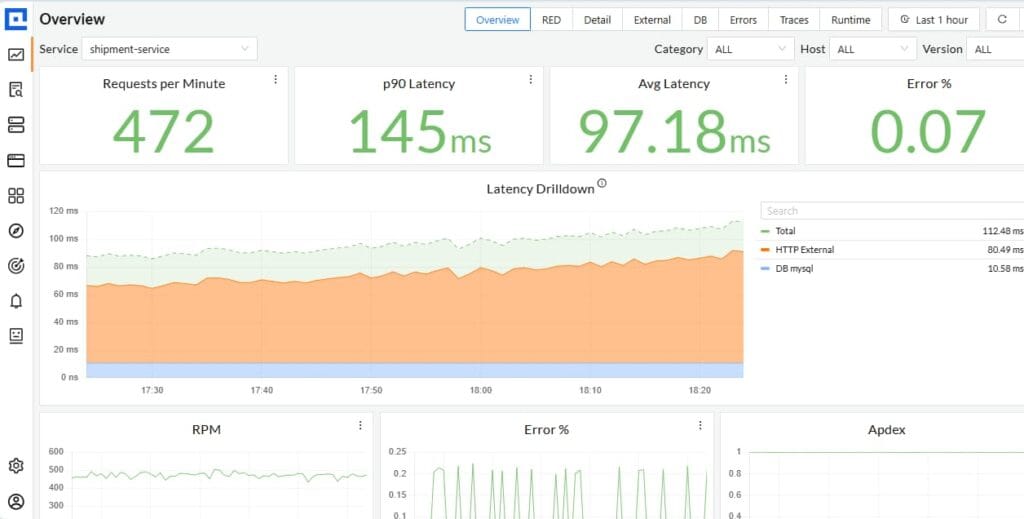
Most AKS monitoring tools force a tradeoff: SaaS platforms give you deep signal coverage but pricing scales sharply with cluster size, while open-source stacks give you full control but require sustained engineering effort to operate reliably at scale.
CubeAPM addresses both problems. It deploys inside your own infrastructure so AKS telemetry, including control plane logs, pod metrics, traces, and Kubernetes events, never leaves your environment. Pricing is a single dimension: $0.15/GB, with no per-host fees, no per-user seats, and no egress charges.
At 15 TB/month across a 50-node cluster:
- CubeAPM: $2,250/month (plus ~$300/month self-hosted infrastructure)
- Azure Monitor Container Insights: ~$44,850/month
- New Relic: ~$5,960/month in data ingest alone
- Datadog: $750/month minimum before APM, logs, and custom metrics
CubeAPM ingests data from the OpenTelemetry Collector, Prometheus exporters, and existing agents, so current instrumentation is preserved. Smart Sampling retains high-value traces (latency spikes, errors) and drops low-signal data, reducing storage overhead without losing diagnostic coverage. Teams with GDPR, HIPAA, or data localization requirements find that self-hosted deployment eliminates the legal complexity of routing production telemetry through third-party SaaS. Onboarding averages under 60 minutes.
Conclusion
The right AKS monitoring tool depends on whether you optimize for Azure integration depth, cost predictability, data control, or feature breadth. Azure Monitor Container Insights offers zero-friction setup for Azure-native teams but becomes expensive at moderate data volumes. OpenTelemetry-native platforms like CubeAPM and SigNoz provide vendor neutrality with self-hosted deployment suited to data sovereignty requirements. Enterprise platforms like Datadog and Dynatrace deliver breadth and automation at premium pricing.
Before committing to any platform, model your actual costs at current and projected scale. A tool that looks cost-effective at 10 nodes can become the largest line item on your infrastructure bill at 100 nodes. Start with the decision framework above, run a proof of concept against real cluster data, and validate costs against official pricing pages.
Disclaimer: Pricing data was sourced from official vendor websites and documentation as of June 2026. Vendor pricing changes frequently; verify all figures directly with each vendor before making purchasing decisions. CubeAPM is the platform behind this blog.
FAQs
How do you monitor AKS?
Deploy the OpenTelemetry Collector or Azure Monitor Container Insights agents across your node pools to collect control plane logs, pod metrics, and application traces. The key is correlating these signals in one place so a pod restart, its OOMKill condition, and the underlying memory leak in application traces all point to the same incident.
What is AKS?
Azure Kubernetes Service is Microsoft’s managed Kubernetes offering. Microsoft manages the control plane (API server, etcd, upgrades) while customers manage worker nodes and workloads. It integrates natively with Azure CNI, Azure Active Directory, and Azure Monitor.
What is the AWS equivalent of AKS?
Amazon Elastic Kubernetes Service (EKS). Organizations running multi-cloud Kubernetes use both, which is why cross-cloud correlation matters when evaluating observability platforms.
What are AKS monitoring best practices?
Configure alerts for node NotReady conditions, persistent CrashLoopBackOff states, HPA max replica limits, and API server latency spikes. Set resource quotas per namespace to prevent resource starvation. Correlate infrastructure metrics with application traces to cut mean time to resolution.
Can I use Prometheus for AKS monitoring?
Yes. Deploy kube-state-metrics and node-exporter for cluster and node visibility, and use Azure Managed Prometheus to avoid managing the Prometheus cluster yourself. For long-term retention, pair with Thanos or Cortex since Prometheus local storage is not designed for extended retention.
What is the difference between Azure Monitor and Container Insights?
Azure Monitor is the umbrella platform covering all Azure observability. Container Insights is a Kubernetes-specific feature within it that deploys collection agents to AKS, stores data in Log Analytics, and provides pre-built Kubernetes dashboards.
How much does AKS monitoring cost?
Azure Monitor Container Insights: ~$44,850/month for 15 TB. New Relic: ~$5,960/month in data ingest for the same volume. Dynatrace Full-Stack: $58/month per 8 GiB host, so approximately $2,900/month for 50 nodes with 8 GiB RAM each, before logs. CubeAPM: $2,250/month at $0.15/GB, plus ~$300/month self-hosted infrastructure. Prometheus and Grafana are free but carry operational overhead. Always model your actual telemetry volume before committing.