










Chaos Genius was built for teams trying to control Snowflake and Databricks costs. Its main strength was helping teams find expensive queries, oversized warehouses, inefficient clusters, abnormal usage, and team-level cost drivers without relying only on manual billing analysis.
Pricing and review details matter more in 2026 because Chaos Genius is no longer a standalone product. Flexera acquired Chaos Genius on January 6, 2026, and its capabilities now sit under Flexera Data Cloud Optimization. That changes how buyers should evaluate pricing, contracts, roadmap availability, and small-team fit.
In this Chaos Genius pricing and review guide, we cover pricing status, key features, real cost estimates, buyer tradeoffs, user feedback signals, and alternatives like Snowflake native tools, Databricks native tools, CloudZero, Anodot, Datadog, New Relic, and CubeAPM.
What Is Chaos Genius?
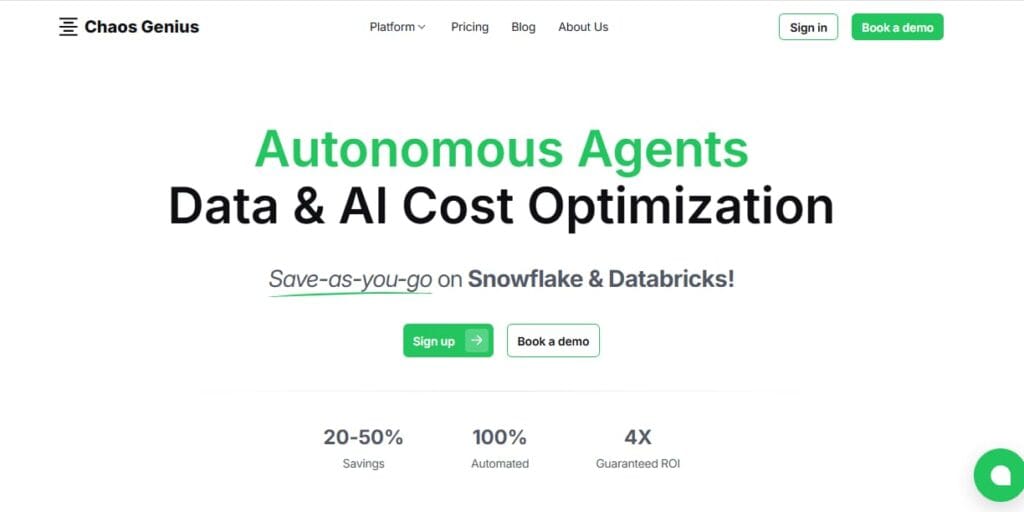
Chaos Genius was a DataOps observability and FinOps platform for Snowflake and Databricks cost optimization. It helped data teams understand cloud data warehouse spend, identify inefficient workloads, and act on cost-saving recommendations.
In simpler terms, Chaos Genius helped teams answer three practical questions:
- What is driving the Snowflake or Databricks bill?
- Which queries, warehouses, clusters, jobs, or teams are inefficient?
- What should the team change to reduce spend without hurting performance?
Chaos Genius focused mainly on the data cloud cost layer, not general application observability. It was designed for data teams, analytics engineering teams, platform teams, and FinOps teams managing Snowflake and Databricks spend.
Key Features of Chaos Genius
Chaos Genius helped teams understand Snowflake costs beyond the invoice. It provided visibility into warehouse compute, cloud services, storage, users, roles, and workload-level spend.
This mattered because Snowflake costs are consumption-based. Compute usage, warehouse sizing, idle time, query behavior, storage, and data transfer can all affect the final bill. Flexera’s Snowflake cost guidance also highlights compute, storage, and data transfer as the main areas to consider when reducing Snowflake costs.
Chaos Genius also supported Databricks cost monitoring and optimization. It helped teams understand which clusters, jobs, notebooks, and workloads were contributing to Databricks usage.
This is useful because Databricks pricing is consumption-based. Teams pay based on usage, and inefficient clusters or long-running jobs can quickly increase cost.
Chaos Genius analyzed expensive and inefficient SQL workloads. It helped teams find high-cost queries, long-running queries, repeated workloads, queue time issues, and queries that needed tuning.
For Snowflake-heavy teams, query behavior directly affects compute usage. Poorly written or poorly scheduled queries can keep warehouses running longer than necessary.
Chaos Genius helped identify Snowflake warehouses that were oversized, underused, or idle for too long. It also helped teams review utilization, idle credits, queue times, and other performance signals.
This made it useful for teams trying to reduce unnecessary compute cost without blindly downsizing warehouses.
Chaos Genius helped teams review Databricks cluster usage and cost patterns. It could surface underused clusters, expensive jobs, long-running workloads, and unusual cost spikes.
This was especially relevant for analytics, ETL, data engineering, and machine learning workloads where compute patterns change often.
Chaos Genius monitored unusual cost and usage behavior. Teams could use this to detect sudden warehouse spikes, unexpected cluster activity, abnormal job behavior, or rising team-level spend before the monthly bill arrived.
Chaos Genius supported cost centers and chargeback-style reporting. Teams could group costs by project, department, account, warehouse, role, user, or other business logic.
This helped central data and FinOps teams allocate spend more fairly across business units.
Chaos Genius helped identify tables and storage objects that were unused, stale, rarely accessed, or expensive to retain. Storage savings may be smaller than compute savings in many Snowflake environments, but storage analysis still supports data hygiene and long-term cost control.
After the Flexera acquisition, Chaos Genius is positioned more strongly around AI-assisted and autonomous cost optimization. Flexera describes Chaos Genius as an innovator in agentic AI for optimizing Snowflake and Databricks.
Chaos Genius Pricing in 2026
Chaos Genius no longer has standalone public pricing.
Before the Flexera acquisition, Chaos Genius appeared to use a mix of free, flat subscription, and value-based pricing signals. However, those historical numbers should not be treated as current pricing because the product is now part of Flexera Data Cloud Optimization.
In 2026, buyers need to contact Flexera for current pricing. Flexera does not publish a standalone Chaos Genius pricing page, and its current Data Cloud Optimization page directs buyers toward a Flexera sales conversation.
Verified Pricing Status
| Plan or pricing signal | Current status | Buyer note |
| Former free tier | Historical | Confirm current trial or assessment options with Flexera |
| Former lower-spend paid plan | Historical | Do not treat old pricing as current |
| Former value-based plan | Historical | Pricing was tied to Snowflake or Databricks spend |
| Flexera Data Cloud Optimization | Current product path | Contact Flexera for pricing |
| Public self-serve pricing | Not available | No current standalone Chaos Genius pricing page found |
Current Flexera Product Availability
Flexera’s current Data Cloud Optimization page says Databricks savings recommendations are generally available in June 2026. It also says Snowflake support is planned for general availability in Q3 2026.
This is an important buyer detail. Chaos Genius originally had a strong Snowflake optimization focus, but buyers evaluating the current Flexera product should confirm the exact Snowflake feature scope, availability, roadmap, and contract terms before purchasing.
Chaos Genius Plan Limits and Feature Coverage
Because Chaos Genius no longer publishes standalone plan pages, the table below should be treated as a buyer checklist, not an official plan matrix.
| Feature area | Historical Chaos Genius | Flexera Data Cloud Optimization in 2026 |
| Snowflake cost visibility | Core original focus | Planned GA in Q3 2026; confirm current scope |
| Databricks cost visibility | Supported | Databricks recommendations GA in June 2026 |
| Query optimization | Core Snowflake feature | Confirm Snowflake roadmap and availability |
| Warehouse rightsizing | Core Snowflake feature | Confirm current Flexera availability |
| Cluster optimization | Supported for Databricks | Current Flexera focus area |
| Anomaly detection | Supported | Confirm alerting and automation scope |
| Cost allocation | Supported through cost centers | Confirm chargeback/showback features |
| Storage optimization | Supported for Snowflake | Confirm current availability |
| Autonomous optimization | Emerging positioning | Core Flexera positioning |
| Public pricing | Previously more visible | Contact Flexera |
Additional Costs and Operational Overhead
The biggest pricing change is that Chaos Genius is now part of Flexera. Buyers should expect a sales-led process, pricing conversation, security review, and possible enterprise procurement workflow.
Buyers should confirm the latest status of Databricks and Snowflake support. Flexera says Databricks savings recommendations are generally available in June 2026 and Snowflake support is planned for GA in Q3 2026.
Chaos Genius is not a full APM, log management, distributed tracing, infrastructure monitoring, RUM, or synthetics platform. Teams that need application troubleshooting will still need observability tools alongside it.
CubeAPM, for example, is better positioned for teams that need logs, metrics, traces, dashboards, infrastructure monitoring, and application performance visibility. Chaos Genius is better treated as a data cloud FinOps layer, not a full observability layer.
Chaos Genius and Flexera Data Cloud Optimization need access to usage, billing, and workload metadata. Buyers should review Snowflake Account Usage access, Databricks billing data access, RBAC, governance policies, and compliance requirements.
A tool alone does not guarantee savings. Teams still need owners to review recommendations, approve changes, track savings, manage alerts, optimize queries, and allocate costs.
Buyers should ask how savings are calculated. Important questions include:
What is the baseline?
Are avoided costs counted?
Are savings recurring or one-time?
Who validates savings?
How are workload changes handled?
Are savings guaranteed or only estimated?
Chaos Genius User Reviews and Public Feedback in 2026
Chaos Genius has a limited public review footprint compared with larger FinOps, data observability, and cloud cost management platforms. I could not find meaningful verified review coverage for Chaos Genius on Capterra, Product Hunt, AWS Marketplace, or Gartner Peer Insights.
G2 has a Chaos Genius seller/profile page, but it shows 0 verified reviews and says there are not enough reviews for G2 to provide buying insight. That means buyers should not treat Chaos Genius as a product with broad public review validation on major software review sites.
Because of that, this review does not use the usual “what users praise” and “what users criticize” format. There is not enough public review volume to support that confidently. Instead, buyers should evaluate Chaos Genius through Flexera’s current product information, historical Chaos Genius documentation, customer references, demos, and proof-of-concept testing with real Snowflake or Databricks usage data.
Public Signals Buyers Can Still Use
Even without many public reviews, buyers can still evaluate Chaos Genius through product documentation, acquisition materials, current Flexera product pages, and hands-on validation.
| Public signal | What buyers can learn |
| Flexera acquisition | Confirms Chaos Genius is now part of Flexera’s broader FinOps and optimization strategy |
| Chaos Genius documentation | Shows the original focus on Snowflake cost visibility, query optimization, and warehouse tuning |
| Flexera Data Cloud Optimization page | Shows the current product direction, including Databricks availability and Snowflake roadmap status |
| Demo or proof of concept | Best way to test recommendation quality against real Snowflake or Databricks usage |
| Customer references | Important because public review sites do not provide enough user feedback |
| Savings validation | Helps confirm whether projected savings are real, recurring, and worth the contract cost |
What Buyers May Like
Chaos Genius was built to help teams understand which Snowflake and Databricks workloads were driving cost. That is useful for teams that cannot easily connect spend to warehouses, clusters, queries, jobs, users, projects, or business units.
Chaos Genius went deeper than high-level billing dashboards. Its original product focus included query optimization, warehouse tuning, and workload-level cost analysis, which can be valuable for teams where expensive SQL or inefficient compute patterns drive the bill.
Chaos Genius supported cost centers and chargeback-style reporting. This can help data leaders and FinOps teams explain spend by team, project, department, user, or workload instead of treating the data cloud bill as one shared cost.
The Flexera acquisition gives Chaos Genius a broader enterprise platform path. For larger organizations already evaluating Flexera One or FinOps tooling, this may make procurement, governance, and executive reporting easier than buying a small standalone tool.
What Buyers Should Be Careful About
⚠️ Disclaimer
The points below are buyer considerations, not claims that the product is unsuitable or unreliable. Because Chaos Genius is now part of Flexera Data Cloud Optimization and does not publish detailed current pricing, packaging, roadmap, or broad public review data, buyers should verify plan availability, feature scope, support terms, and final commercial pricing directly with Flexera before making a decision.
Chaos Genius no longer publishes standalone pricing. Buyers must contact Flexera for current pricing, packaging, contract terms, and product scope.
Chaos Genius does not have enough public review volume on major review platforms to build a strong user-sentiment section. Buyers should ask Flexera for customer references and validate the tool with their own data.
Chaos Genius is now part of Flexera Data Cloud Optimization. Buyers should confirm what has changed after the acquisition, especially around packaging, roadmap, onboarding, support, and feature availability.
Chaos Genius historically had a strong Snowflake focus, but Flexera’s current Data Cloud Optimization page says Snowflake support is planned for GA in Q3 2026. Teams that need Snowflake optimization immediately should confirm the latest availability directly with Flexera before buying.
Chaos Genius is not a full observability platform. It does not replace APM, infrastructure monitoring, log management, distributed tracing, synthetics, RUM, or incident troubleshooting tools. It is best evaluated as a data cloud FinOps layer for Snowflake and Databricks.
Chaos Genius Alternatives: How It Compares to Competitors
Chaos Genius vs CubeAPM
Chaos Genius and CubeAPM are not direct replacements for each other. Chaos Genius is focused on Snowflake and Databricks cost optimization. CubeAPM is a full-stack observability and APM platform for logs, metrics, traces, dashboards, infrastructure, and application performance.
CubeAPM is best treated as a complementary observability layer. It helps engineering teams find root causes in applications and infrastructure, while Chaos Genius focuses on data cloud cost control.
| Category | Chaos Genius / Flexera | CubeAPM |
| Primary role | Data cloud cost optimization | Full-stack observability and APM |
| Main focus | Snowflake and Databricks spend | Logs, metrics, traces, dashboards, app performance |
| Pricing model | Custom Flexera pricing | Usage-based ingestion pricing |
| Deployment | Flexera-led product path | Self-hosted or managed self-hosted |
| Best fit | Data and FinOps teams | Engineering, DevOps, and SRE teams |
Chaos Genius vs Snowflake Native Tools
Snowflake includes native usage and cost visibility through query history, warehouse usage, account usage views, and resource monitors. These tools are useful because they are already part of the Snowflake environment.
Chaos Genius becomes more useful when teams need automation, anomaly detection, cost allocation, and less manual SQL analysis.
| Category | Chaos Genius / Flexera | Snowflake Native Tools |
| Primary role | Automated Snowflake optimization | Native Snowflake visibility |
| Pricing model | Paid custom pricing | Included with Snowflake usage |
| Query analysis | Recommendation-driven | Manual analysis |
| Warehouse rightsizing | Automated recommendations | Manual review |
| Best fit | Teams needing automation | Teams with SQL expertise and lower budget |
Chaos Genius vs Databricks Native Tools
Databricks provides native billing, usage, and monitoring capabilities. These may be enough for teams with disciplined governance and internal FinOps processes.
Chaos Genius adds a more optimization-focused layer for teams that need recommendations, anomaly detection, workload-level visibility, and cross-team accountability.
| Category | Chaos Genius / Flexera | Databricks Native Tools |
| Primary role | Databricks cost optimization | Native usage visibility |
| Pricing model | Paid custom pricing | Included with Databricks usage |
| Cluster optimization | Recommendation-driven | Manual or native controls |
| Job-level visibility | Yes | Available with setup |
| Best fit | Teams needing FinOps automation | Teams with mature governance |
Chaos Genius vs Datadog
Datadog is a broad observability platform for infrastructure monitoring, APM, logs, traces, synthetics, RUM, security, and network monitoring.
Chaos Genius is narrower and more specialized. It does not replace Datadog for application or infrastructure monitoring. Datadog is better for full-stack technical observability, while Chaos Genius is better for Snowflake and Databricks cost optimization.
| Category | Chaos Genius / Flexera | Datadog |
| Primary role | Data cloud FinOps | Full-stack observability |
| Best for | Snowflake and Databricks cost control | Apps, infrastructure, logs, traces, RUM |
| Pricing model | Custom Flexera pricing | Modular usage-based pricing |
| APM | No | Yes |
| Best fit | Data platform and FinOps teams | Engineering and SRE teams |
Chaos Genius vs New Relic
New Relic is a full-stack observability platform for APM, infrastructure monitoring, logs, traces, synthetics, browser monitoring, and troubleshooting.
Chaos Genius does not compete directly with New Relic on application observability. It focuses on the data cloud cost layer.
| Category | Chaos Genius / Flexera | New Relic |
| Primary role | Data cloud cost optimization | Full-stack observability |
| Best for | Snowflake and Databricks cost control | Application performance and troubleshooting |
| Pricing model | Custom Flexera pricing | Data ingest and user-based pricing |
| Logs, metrics, traces | Not core focus | Core platform coverage |
| Best fit | Data FinOps teams | Engineering and DevOps teams |
Chaos Genius vs Dynatrace
Dynatrace is a full-stack observability platform for application performance monitoring, infrastructure monitoring, logs, metrics, traces, digital experience monitoring, security, and AI-powered root-cause analysis. Dynatrace is stronger when engineering teams need end-to-end visibility across applications, services, Kubernetes, cloud infrastructure, and user experience. Chaos Genius is much narrower: it focuses on Snowflake and Databricks cost optimization, not application troubleshooting.
| Category | Chaos Genius / Flexera | Dynatrace |
| Primary role | Data cloud cost optimization | Full-stack observability |
| Best for | Snowflake and Databricks cost control | Apps, infra, logs, traces, RUM, synthetics |
| Pricing model | Custom Flexera pricing | Usage-based Dynatrace pricing |
| Root-cause analysis | Data cloud cost focus | AI-powered app and infra analysis |
| Best fit | Data and FinOps teams | Engineering, DevOps, and SRE teams |
Is Chaos Genius the Right Choice?
When Chaos Genius Works Best
Chaos Genius / Flexera Data Cloud Optimization is a better fit when the buyer’s main problem is Snowflake or Databricks cost control.
| Situation | Why it fits |
| You use Databricks heavily | Flexera lists Databricks savings recommendations as generally available. |
| You need Snowflake optimization | Chaos Genius was originally built around Snowflake cost and query optimization. |
| You need query-level cost analysis | It helps connect expensive workloads to cost drivers. |
| You need cost allocation | Useful for showback, chargeback, teams, projects, and business units. |
| You want automated recommendations | Flexera positions it around AI-assisted data cloud optimization. |
| You already use Flexera | It may fit better inside a broader Flexera FinOps workflow. |
When Chaos Genius May Not Be the Right Fit
Chaos Genius / Flexera Data Cloud Optimization may not fit every buyer. Based on current public product information, buyers should be careful in these cases:
| Situation | Why it matters |
| You need public pricing | Current pricing requires a Flexera sales conversation. |
| You only need basic Snowflake visibility | Native Snowflake tools may be enough. |
| You need full-stack observability | Chaos Genius is not for APM, logs, traces, RUM, or synthetics. |
| You want open-source tooling | Chaos Genius is now part of Flexera’s commercial product path. |
| You need Snowflake GA support now | Flexera says Snowflake support is planned for GA in Q3 2026. |
| You want the old standalone product | Flexera acquired Chaos Genius and moved it into its FinOps portfolio. |
Conclusion
Chaos Genius was built for teams trying to control Snowflake and Databricks costs. Its strengths are cost visibility, query-level analysis, workload optimization, anomaly detection, and cost allocation.
The main 2026 change is the Flexera acquisition. Chaos Genius is no longer a standalone product, and buyers now need to evaluate it through Flexera Data Cloud Optimization, including pricing, packaging, roadmap status, and support terms.
For teams with serious Snowflake or Databricks cost challenges, it is worth evaluating. For teams that need APM, logs, traces, infrastructure monitoring, RUM, or synthetics, Chaos Genius is not the right layer and should be compared with observability tools like CubeAPM, Datadog, Dynatrace, New Relic, Grafana, or Elastic.
Disclaimer: Pricing, packaging, roadmap dates, and feature availability can change after publication. Buyers should confirm current Chaos Genius / Flexera Data Cloud Optimization details directly with Flexera before making a purchasing decision.
FAQs
1. What is Chaos Genius?
Chaos Genius was a DataOps observability and FinOps platform for Snowflake and Databricks cost optimization. It helped teams analyze spend, detect anomalies, optimize queries, rightsize compute, and allocate costs.
2. How much does Chaos Genius cost?
Chaos Genius no longer has standalone public pricing. Current pricing requires contacting Flexera because Chaos Genius capabilities are now part of Flexera Data Cloud Optimization.
3. Does Chaos Genius have a free plan?
Chaos Genius previously had a free tier. Since the Flexera acquisition, buyers should confirm current trial, assessment, or entry-level availability directly with Flexera.
4. What happened to Chaos Genius?
Flexera acquired Chaos Genius on January 6, 2026. Chaos Genius capabilities are now positioned under Flexera Data Cloud Optimization.
5. What is Chaos Genius called now?
Chaos Genius is now associated with Flexera Data Cloud Optimization.
6. Does Chaos Genius support Snowflake?
Chaos Genius originally focused strongly on Snowflake cost optimization. Flexera’s current product page says Snowflake support is planned for general availability in Q3 2026, so buyers should confirm the latest availability directly with Flexera.
7. Does Chaos Genius support Databricks?
Yes. Flexera’s current Data Cloud Optimization page says Databricks savings recommendations are generally available in June 2026 and that Databricks deployments across AWS, Azure, and Google Cloud are supported.