





Better Stack has become one of the most frequently evaluated uptime monitoring and incident management platforms in 2026. Originally launched as Better Uptime in 2021, it has expanded from a focused uptime monitor into a unified observability platform that covers uptime monitoring, log management, on-call scheduling, status pages, and AI-powered incident investigation.
This review provides an independent, vendor-neutral analysis of Better Stack in 2026, covering its current pricing structure, core product capabilities, real user sentiment from verified reviews, deployment architecture, and the alternatives that deserve a formal evaluation before any commitment is made.
Disclaimer: This review is an independent editorial analysis based on publicly available Better Stack documentation, pricing pages, and product materials, supplemented by verified user reviews from Capterra, Findstack, Product Hunt, Trustpilot, and Gartner Peer Insights at the time of writing (April 2026). Pricing, feature availability, and plan terms may change; readers should verify current details directly with Better Stack at betterstack.com/pricing before making purchasing or implementation decisions.
What Is Better Stack?
Platform Overview
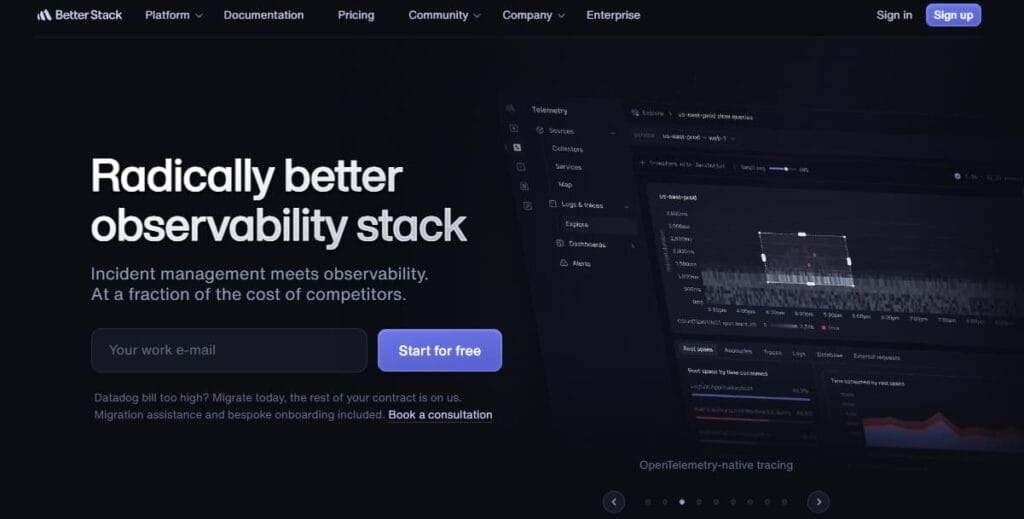
Better Stack grew out of Better Uptime and Logtail, which were later brought together under the Better Stack brand. Better Uptime became the Uptime product, while Logtail became the Logs product inside the broader Better Stack platform.
Today, Better Stack covers uptime monitoring, incident management and on-call, status pages, log management, infrastructure monitoring, OpenTelemetry-native tracing, real user monitoring, error tracking, session replay, and AI-assisted incident response.
The platform serves three main audiences:
- Startups and solo developers: The free plan includes 10 monitors and heartbeats, 1 status page, Slack and email alerts, 3 GB of logs retained for 3 days, metrics allowance, basic web events, warehouse events, exceptions, and session replays. This makes it useful for small teams that need basic production monitoring without starting with a paid plan.
- Growing SaaS and engineering teams: Paid responder plans add on-call scheduling, incident management, unlimited team members, phone and SMS alerts, AI-assisted workflows, and broader observability features under a responder-based pricing model.
- Enterprises and regulated organizations: Enterprise plans add custom pricing, advanced security controls, SSO, custom retention, reporting and analytics, dedicated support, and support for larger-scale observability and incident response needs.
Better Stack is listed on review platforms such as G2, Capterra, and Product Hunt, where users often praise its clean interface, ease of setup, alerting reliability, and generous free tier. G2 currently shows a 4.8-star rating from 315 verified reviews, while Capterra lists a 4.8 overall rating from 37 reviews. Product Hunt lists Better Stack at 4.9 from 9 reviews.
Better Stack’s Market Positioning in 2026
The uptime monitoring and incident management market in 2026 sits in three broad groups.
1. On-call, alerting, and uptime monitoring tools
This group includes tools such as PagerDuty, OpsGenie, UptimeRobot, StatusCake, Pingdom, and Freshping.
- Best suited for uptime checks, alert routing, escalation, and basic incident response.
- Helpful for teams that mainly need to know when a service is down.
- Often limited when teams also need logs, status pages, infrastructure visibility, and deeper incident workflows.
- Many teams end up using separate tools for monitoring, alerting, logs, and incident communication.
2. Full-stack observability platforms
This group includes platforms such as Datadog, Dynatrace, New Relic, and CubeAPM.
- Built for deeper application and infrastructure monitoring.
- Covers areas such as APM, distributed tracing, logs, metrics, infrastructure telemetry, and service-level investigation.
- Stronger fit for cloud-native teams debugging issues across apps, services, infrastructure, and user experience.
- CubeAPM fits in this category with a self-hosted deployment model.
- CubeAPM gives teams enterprise-grade observability while keeping telemetry inside their own infrastructure.
- This helps with data control and sovereignty without forcing teams to manage a full open-source stack themselves.
3. Unified incident management and monitoring platforms
Better Stack sits between basic uptime tools and heavier enterprise observability platforms.
- Combines uptime monitoring, on-call scheduling, incident management, status pages, logs, metrics, traces, error tracking, session replay, and AI-assisted incident response.
- Works well for teams that have outgrown simple uptime monitors.
- Useful when teams want production-grade alerting, phone escalation, on-call workflows, and unified monitoring in one cleaner platform.
- Offers broader incident workflow coverage than basic uptime tools.
- Lighter and easier to adopt than many full enterprise observability platforms
Key Features of Better Stack
Better Stack monitors websites, APIs, servers, SSL certificates, domains, DNS, ping, TCP/UDP ports, SMTP, POP3, IMAP, and CRON jobs through Heartbeats. The free plan includes 10 monitors and 10 heartbeats with 3-minute checks, while paid plans support faster check intervals of up to 30 seconds.
It also supports multi-location and geo-specific checks, screenshots of errors, traceroute and MTR diagnostics, maintenance windows, response-time tracking, and uptime SLA reporting. These features help teams reduce false positives and understand what actually failed during an outage.
Better Stack’s log management product grew out of Logtail. It collects structured logs, supports live tail, SQL querying, drag-and-drop querying, VRL transformations, JavaScript transformations, anomaly detection alerts, and logs-to-metrics workflows.
Logs and traces are priced through a mix of ingestion and retention. The free plan includes 3 GB of logs retained for 3 days. Paid usage starts around $0.15/GB for ingestion and $0.08/GB/month for retention, with lower effective rates available on some bundles.
Better Stack includes on-call scheduling, escalation policies, smart incident merging, push notifications, email alerts, Slack incident management, Google and Outlook calendar integration, ICS export, Zapier integration, webhooks, REST API access, and Terraform support.
The Responder plan includes unlimited phone call alerts and unlimited SMS. Better Stack also supports AI post-mortems, incident timelines, manual post-mortems, MTTA/MTTR tracking, reporting, and analytics.
Better Stack includes one branded status page, with support for custom subdomains, maintenance notices, embedded status widgets, public subscriptions, screenshots, error logs, and status-page integrations.
Some status-page features are paid add-ons. These include additional public status pages, custom CSS and JavaScript, white-labeling, password authentication, IP allowlisting, SSO, extra subscribers, and sending emails from your own domain.
Better Stack’s AI SRE agent works inside Slack and MS Teams. It investigates incidents using logs, metrics, traces, errors, and web events, then helps with root-cause analysis and incident follow-up.
Its pricing page lists support for agentic root-cause analysis, AI-created dashboards, Datadog and Grafana connections, Grafana and Datadog dashboard imports, GitHub pull requests, Notion, Linear, Sentry, and a robust MCP server. AI SRE chat is priced at $0.00003 per token.
Better Stack’s Telemetry product covers logs, traces, metrics, real user monitoring, error tracking, session replay, web events, and warehouse events.
The pricing model is not one flat telemetry rate. Logs and traces use ingestion plus retention pricing. Metrics have their own retention pricing. Error tracking is priced by exceptions above the included allowance, while session replay is priced by additional replay volume. This is still simpler than many enterprise observability tools, but it is not a single universal GB-retained price.
Better Stack supports a wide integration ecosystem across incident management, observability, and engineering workflows. It connects with Slack, MS Teams, Zapier, Terraform, REST API, webhooks, Linear, Jira, Notion, Sentry, Datadog, Grafana, and more.
It also supports OpenTelemetry-native ingestion for traces and can collect logs, metrics, and telemetry data through modern observability pipelines. This helps teams reduce lock-in and connect Better Stack with existing monitoring and incident workflows.
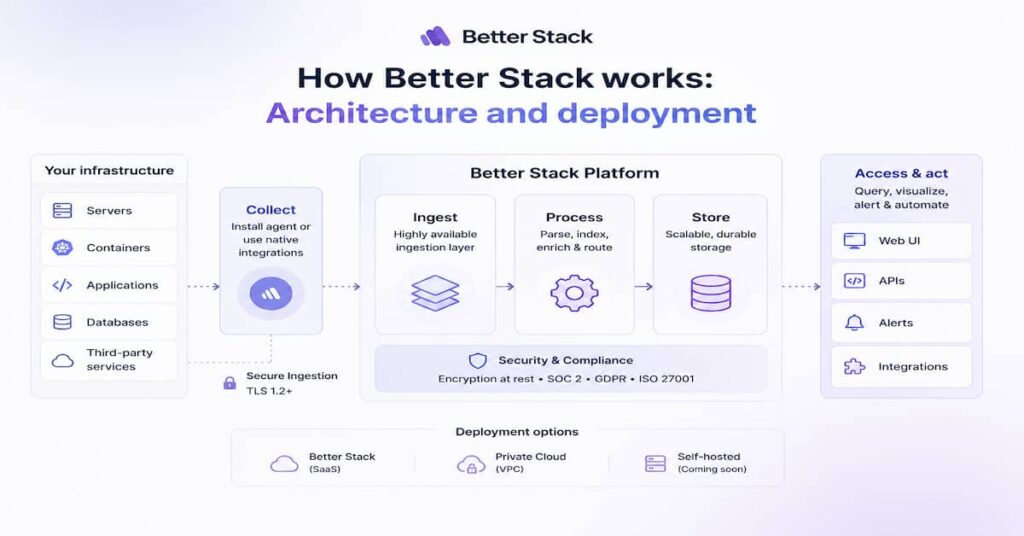
How Better Stack works: Architecture and deployment
Global uptime monitoring network
Better Stack’s uptime checks run from a distributed global monitoring network. No local agent is required for basic uptime monitoring. Teams add a URL, API endpoint, server address, or heartbeat, then configure check frequency, regions, and alert rules.
By default, Better Stack checks monitors from at least four locations. To reduce false positives, it creates an incident only after a check fails from at least three locations. Free checks run every 3 minutes, while paid plans can support faster checks, including 30-second checks.
Agent and collector-based telemetry collection
For logs, metrics, and traces, Better Stack supports several collection paths. Teams can use language and framework integrations, Vector-based log and metric forwarding, the Better Stack collector, direct HTTP ingestion, or OpenTelemetry Collector-based ingestion.
For Kubernetes and Docker, Better Stack recommends its collector, which gathers logs, metrics, and traces using eBPF-based auto-instrumentation and OpenTelemetry under the hood. For servers and containers, Better Stack also documents Vector-based setup for collecting logs and metrics.
OpenTelemetry-compatible ingestion
Better Stack accepts traces, logs, and metrics through OpenTelemetry Collector setup and OTLP-compatible ingestion. Teams can instrument applications with standard OpenTelemetry SDKs or route telemetry through the OpenTelemetry Collector instead of relying only on vendor-specific libraries.
This reduces instrumentation lock-in because the application code can stay based on OpenTelemetry standards, while the backend can be changed later by updating the collector/exporter configuration. Better Stack’s own docs describe sending traces, logs, and metrics through OpenTelemetry Collector, and OpenTelemetry itself is designed as a vendor-neutral observability framework.
Deployment model
Standard SaaS is the default model for most Better Stack customers. Uptime checks run from Better Stack’s monitoring network, while logs, metrics, traces, RUM, errors, incidents, and status page workflows are handled through Better Stack’s hosted platform.
What Are Better Stack’s Pricing Options?
Better Stack pricing is split across several areas: incident management, Telemetry, RUM, status pages, warehouse, add-ons, and AI SRE.
For incident management, Better Stack charges per Responder license. A Responder includes uptime monitoring, on-call scheduling, incident management, status pages, unlimited phone call alerts, and unlimited SMS alerts. Current pricing is $34/month, or $29/month with annual billing.
Telemetry is usage-based, but it does not use one single billing unit. Logs and traces are billed by ingestion plus retention. Metrics are billed by retained data. Web events, exceptions, and session replays have their own usage meters.
AI SRE is billed separately by token usage. Better Stack lists AI SRE chat at $0.00003 per token.
Pricing Options
Free Plan
Starting price: $0/month. No credit card required. Best for solo developers, personal projects, hobby apps, and small teams testing Better Stack.
| Attribute | Details |
| Price | $0/month, no credit card required |
| Best for | Solo developers, personal projects, small hobby apps |
| Monitors and heartbeats | 10 monitors and heartbeats |
| Status pages | 1 status page |
| Exceptions | 100,000 exceptions/month |
| Session replays | 5,000 session replays |
| Logs | 3 GB logs retained for 3 days |
| Metrics | 30 GB metrics |
Responder plan
Starting price: $29/license/month with annual billing, or $34/license/month with monthly billing. This is Better Stack’s core paid plan for teams that need on-call scheduling, incident management, phone alerts, and SMS alerts.
| Attribute | Details |
| Price | $29/license/month annual, or $34/license/month monthly |
| Best for | Teams with active on-call rotations and production incident response |
| Billing unit | Per Responder license. Non-responder team members are $0/month |
| Alerts | Unlimited phone call and SMS alerts per license |
| Incident workflow | On-call schedules, escalation policies, smart incident merging, MTTA/MTTR tracking, AI post-mortems, REST API, Terraform, and webhooks |
| Key add-ons | Thread-based Slack/Teams workflows, advanced status page options, and usage-based Telemetry charges |
Slack and MS Teams incident management add-on
Starting price: $9/responder/month. This add-on is for teams that want advanced incident workflows inside Slack or MS Teams, beyond the basic single-channel integration included in the Responder plan.
| Attribute | Details |
| Price | $9/responder/month |
| Best for | Teams that manage incidents directly inside Slack or MS Teams |
| Included by default | Basic single-channel Slack/Teams integration |
| What it adds | Channel-based and thread-based workflows, private channels, shareable dashboards, quick status page updates, and AI post-mortems |
| Extra workflow features | Incident ownership, advanced automations, user sync, MTTA/MTTR tracking, and reporting |
Telemetry pricing
Better Stack Telemetry is usage-based, but it does not use one flat GB-retained rate across everything. Logs and traces are billed by ingestion and retention, while metrics are billed by retained metric data.
| Attribute | Details |
| Free allowance | 3 GB logs retained for 3 days, plus 30 GB metrics |
| Logs and traces | From $0.15/GB ingested, plus retention from $0.08/GB/month |
| Metrics | From $0.75/GB/month for retained metric data |
| Querying | Standard querying included. Query boost costs $0.001/GB scanned |
| Note | Higher bundles can reduce effective rates, so exact pricing depends on usage and plan |
AI SRE pricing
Better Stack’s AI SRE is usage-based and billed separately from Responder licenses and Telemetry. It works inside Slack and MS Teams to help investigate incidents using logs, metrics, traces, errors, and web events.
| Attribute | Details |
| Rate | $0.00003 per token |
| Billing unit | AI SRE chat token usage |
| Capabilities | Agentic root-cause analysis, AI dashboard creation, Datadog/Grafana connections, GitHub PR creation, Notion/Linear/Sentry integrations, and MCP server |
Enterprise plan
Custom pricing. Better Stack’s Enterprise-ready options are for teams that need stronger security, SSO, audit logs, custom telemetry data residency, and larger-scale deployment requirements.
| Attribute | Details |
| Price | Custom quote, contact Better Stack sales |
| Best for | Larger teams with security, compliance, SSO, and data-residency needs |
| Security | SSO, SSO enforcement, 2FA enforcement, audit logs, SCIM, RBAC, and team-level isolation |
| Data controls | Custom Telemetry data residency and custom VPC deployment options |
| Reporting | Advanced reporting and analytics are available as a paid add-on |
What this means for buyers
Better Stack pricing is easiest to understand when you separate it into three parts:
- Incident management is seat-based. Count the engineers who need on-call, phone alerts, or SMS alerts, then multiply by $29/month on annual billing, or $34/month on monthly billing.
- Telemetry is usage-based. Logs, traces, metrics, web events, exceptions, and session replays use different meters, so teams should model their expected usage instead of assuming one flat telemetry rate.
- AI SRE is token-based. Better Stack lists AI SRE chat at $0.00003 per token, so buyers should budget carefully during the first 30 to 60 days until they understand real usage patterns.
What Does Better Stack Really Cost?
Better Stack’s headline Responder price of $29/license/month is clear, but the real total cost depends on your responder count, AI SRE token usage, telemetry volume, and whether you add the Slack incident management module. The four scenarios below walk through realistic team configurations at different scales.
Assumptions Used in the Cost Scenarios
- All figures are directional list-price estimates based on Better Stack’s publicly available pricing as of April 2026. They are not official quotes.
- The 30 GB free monthly telemetry allowance is applied first in each scenario.
- Annual billing rates are used throughout ($29/responder/month and $0.50/GB telemetry).
- Scenarios do not include negotiated Enterprise discounts, professional services, or custom retention pricing.
- Responder counts represent only engineers who need phone call or SMS on-call alerting. Non-alerting team members are $0/month.
Scenario 2: Growing team, 50 hosts, about 5.4 TB/month
Situation: A growing SaaS company runs about 50 hosts across application services, Kubernetes workloads, databases, and frontend systems. The team generates about 5.4 TB/month of telemetry across logs, traces, and metrics, and has a 5-person on-call rotation. They want uptime monitoring, Slack thread-per-incident workflows, AI-assisted incident summaries, and shared access for the broader engineering team.
Why teams at this stage consider Better Stack
Better Stack is attractive here because it combines uptime monitoring, on-call scheduling, incident management, logs, traces, metrics, status pages, and AI SRE in one SaaS platform.
The team only needs to pay for the 5 engineers who are actually on call. The remaining engineers can still view telemetry and incidents without a separate responder license.
Slack thread-per-incident workflows also make sense at this stage because incident coordination starts becoming harder once more services and engineers are involved.
Estimated profile
| Configuration item | Detail |
| Hosts | 50 hosts |
| Telemetry volume | About 5.4 TB/month across logs, traces, and metrics |
| Responders | 5-person on-call rotation |
| Incident workflow | Slack/Teams thread-based incident management |
| AI SRE | Estimated 3M tokens/month |
Estimated monthly cost
Disclaimer: These are directional editorial estimates based on Better Stack’s public pricing. They are not official Better Stack quotes. Actual costs depend on billing term, telemetry mix, retention, bundle selection, monitor count, add-ons, and AI SRE token usage.
| Component | Calculation | Monthly cost |
| Responder licenses | 5 × $29/month | $145 |
| Slack/Teams incident add-on | 5 × $9/month | $45 |
| Telemetry bundles | Approx. 8 × Tera bundle at $420/month annual billing | ~$3,360 |
| AI SRE | 3M tokens × $0.00003 | $90 |
| Total estimated | ~$3,640/month |
What this scenario shows
At small monitoring volumes, Better Stack can look very inexpensive. But at a growing-team scale of about 5.4 TB/month, telemetry becomes the main cost driver.
Responder pricing is still predictable, but telemetry volume changes the picture. In this scenario, Better Stack is no longer a few-hundred-dollar tool. It becomes closer to a few-thousand-dollar monthly observability and incident-management setup.
Scenario 3: Mid-market engineering team, 250 hosts, about 27 TB/month
Situation: A mid-market B2B SaaS company runs about 250 hosts across AWS and GCP, with Kubernetes workloads, databases, backend services, and customer-facing web applications. The team generates about 27 TB/month of telemetry across logs, traces, and metrics. They have two 5-person on-call rotations and want Slack thread-per-incident workflows, uptime monitoring, status pages, and AI-assisted incident response.
Why teams at this size consider Better Stack
Better Stack is attractive because it combines incident management, on-call scheduling, uptime monitoring, status pages, logs, traces, metrics, and AI SRE in one SaaS platform.
The team only pays responder licenses for the 10 engineers who are actually on call. The remaining engineers can access Telemetry without separate responder seats.
Slack/Teams incident workflows also help at this stage because multi-region teams need cleaner ownership, incident channels, MTTA/MTTR tracking, and post-incident summaries.
Estimated profile
| Configuration item | Detail |
| Hosts | 250 hosts |
| Telemetry volume | About 27 TB/month: 18 TB logs, 9 TB traces, 25 GB metrics |
| Responders | 10 responders across two on-call rotations |
| Incident workflow | Slack/Teams thread-based incident management |
| AI SRE | Estimated 8M tokens/month |
Estimated monthly cost
Disclaimer: These are directional editorial estimates based on public Better Stack pricing. They are not official Better Stack quotes. Actual costs depend on billing term, telemetry mix, retention, bundle selection, monitor count, add-ons, and AI SRE token usage.
| Component | Calculation | Monthly cost |
| Responder licenses | 10 × $29/month annual billing | $290 |
| Slack/Teams incident add-on | 10 × $9/month | $90 |
| Telemetry bundles | Approx. 26 × Tera bundle at $420/month annual billing | ~$10,920 |
| AI SRE | 8M tokens × $0.00003 | $240 |
| Total estimated | ~$11,540/month |
What this scenario shows
At mid-market scale, Better Stack’s main cost driver is telemetry, not responder seats. The responder and Slack workflow costs are predictable, but 27 TB/month changes the economics quickly.
Scenario 4: Enterprise engineering organization, 1000 hosts, about 108 TB/month
Situation: A large B2B SaaS company runs about 1000 hosts across AWS and Azure, with Kubernetes workloads, 50+ services, multiple database clusters, and customer-facing web and mobile applications.
The team generates about 108.1 TB/month of telemetry across logs, traces, and metrics:
| Telemetry type | Monthly volume |
| Logs | 72 TB/month |
| Traces | 36 TB/month |
| Metrics | 100 GB/month |
| Total | ~108.1 TB/month |
Why teams at this size consider Better Stack
Better Stack can make sense for enterprise teams that want SaaS-based observability and incident response in one platform. It combines uptime monitoring, on-call scheduling, status pages, logs, traces, metrics, Slack/Teams incident workflows, and AI-assisted incident investigation.
The team only pays Responder licenses for engineers who need phone and SMS alerting. Other engineers can access telemetry without a separate Responder seat.
Estimated profile
Disclaimer: These are directional editorial estimates based on public Better Stack pricing references and enterprise-scale assumptions. They are not official Better Stack quotes.
| Configuration item | Detail |
| Hosts | 1000 hosts |
| Telemetry volume | About 108.1 TB/month across logs, traces, and metrics |
| Responders | 15 responders across three on-call rotations |
| Incident workflow | Slack/Teams thread-based incident management |
| AI SRE | Estimated 20M tokens/month |
| Plan needs | SSO, audit controls, advanced security, custom retention/data options |
Estimated monthly cost
| Component | Calculation | Monthly cost |
| Responder licenses | 15 × $29/month annual billing | $435 |
| Slack/Teams incident add-on | 15 × $9/month | $135 |
| Telemetry reference | Enterprise-scale custom/bundled pricing for ~108 TB/month | ~$49,000 |
| AI SRE | 20M tokens × $0.00003 | $600 |
| Total estimated | ~$50,170/month |
What this scenario shows
At enterprise scale, Better Stack is no longer mainly a responder-seat cost. The biggest cost driver becomes telemetry volume.
What actually drives Better Stack costs
Understanding Better Stack pricing means looking beyond the headline Responder license. The final bill usually depends on six separate cost drivers.
This is the most predictable cost driver. Better Stack charges $29/month per Responder on annual billing, or $34/month on monthly billing. Engineers who only need Telemetry access do not need a paid Responder license.
The easiest way to control this part of the bill is to keep the paid Responder group limited to engineers who actually need phone or SMS alerting.
Telemetry can become the largest cost driver at scale. Better Stack does not use one flat rate across all telemetry types. Logs and traces are billed by ingestion plus retention, metrics use retained-data pricing, and RUM, exceptions, and session replays use separate meters.
Teams can reduce this cost by tuning log volume, lowering non-production telemetry, sampling high-volume traces, and choosing retention carefully.
Better Stack lists AI SRE chat at $0.00003 per token. The per-token price looks small, but usage can grow during active incident investigation, dashboard creation, and repeated RCA workflows.
Teams should monitor AI SRE usage during the first 30 to 60 days before assuming it will stay small.
The Slack/Teams incident management add-on costs $9/responder/month. For 10 responders, that adds $90/month. For 50 responders, it adds $450/month.
Teams that do not need thread-based or channel-based incident workflows can stay with the basic integration included in the Responder plan.
Better Stack includes 10 monitors and heartbeats on the free plan, but larger teams often need more. Extra monitor capacity is sold in monitor bundles, so uptime-heavy teams should include monitor count in their estimate.
This matters for teams monitoring many APIs, regions, domains, cron jobs, and customer-facing endpoints.
Annual billing lowers Responder pricing from $34/month to $29/month, saving about 15%. Some usage-based rates and bundles are also cheaper on annual billing.
For larger teams, Enterprise pricing may include custom terms, committed-use discounts, data residency options, or bundle pricing. That means public PAYG pricing is useful for estimates, but not always the final enterprise quote.
Hidden costs buyers should plan for
Better Stack includes 1 status page, but some status page features cost extra. These include additional public status pages, custom CSS/JavaScript, white-labeling, password protection, IP allowlisting, SSO protection, extra subscribers, and sending emails from your own domain. Teams that rely heavily on public customer communication should include these in their estimate. Better Stack’s pricing page lists 1 status page included and separate charges for additional status page features.
The free plan includes 10 monitors and heartbeats. Larger teams often need more checks for APIs, regions, domains, cron jobs, and customer-facing endpoints. Extra monitor capacity should be modelled separately, especially for uptime-heavy teams.
AI SRE is billed by token usage at $0.00003 per token. The per-token price is small, but usage can rise during early adoption when teams test RCA, dashboard creation, incident summaries, and automation workflows. Budget cautiously for the first 30 to 60 days until real usage patterns are clear.
Teams with audit, compliance, or customer-contract requirements may need longer retention, stricter data residency, or custom deployment/storage options. These are usually Enterprise-level discussions, not simple PAYG assumptions. Better Stack’s enterprise materials mention custom clusters and customer VPC/S3-compatible storage options on request.
Teams moving from PagerDuty, OpsGenie, Datadog, or Grafana should budget time for rebuilding on-call schedules, alert rules, status page workflows, dashboards, and integrations. Better Stack promotes Datadog and Grafana connections/imports through AI SRE, which can reduce part of the dashboard migration work, but teams should still plan engineering time for validation and cleanup.
For Enterprise deals, the final cost may depend on negotiated volume discounts, committed usage, retention needs, data residency, support terms, and renewal language. Price escalators are common in enterprise SaaS contracts, so buyers should negotiate renewal caps before signing rather than waiting until renewal.
Is Better Stack the Right Choice?
When Better Stack works best
Better Stack works well when teams want uptime monitoring, incident management, on-call scheduling, status pages, logs, metrics, traces, and AI-assisted investigation in one SaaS platform.
Per-Responder pricing works best when only a small group needs phone and SMS alerting. Better Stack lists Responder pricing at $29/month annually or $34/month monthly, with unlimited phone and SMS alerts.
Basic uptime monitoring does not require local setup. Teams can add monitors, alert rules, and status pages quickly, then expand into logs, metrics, traces, and incident workflows.
Better Stack lists unlimited team members and free Telemetry access for non-responder members. This helps product, support, and leadership teams view incidents or telemetry without adding paid responder seats.
Better Stack can replace parts of a PagerDuty + uptime monitor + status page + log tool setup, especially when teams want tighter incident workflows in Slack or MS Teams.
When Better Stack may not be the right fit
Better Stack is primarily SaaS. Enterprise options include custom clusters and customer-controlled S3-compatible storage, but this is not the same as running the full observability platform inside your own infrastructure.
Better Stack supports traces, logs, metrics, RUM, error tracking, and AI SRE. But teams mainly buying for deep application performance diagnostics should still compare it with CubeAPM, Datadog, Dynatrace, or New Relic.
If the team only needs uptime checks and a status page, a flatter uptime-monitoring tool may be cheaper. Better Stack makes more sense when on-call, incident response, logs, and telemetry are part of the need.
Better Stack lists AI SRE chat at $0.00003 per token. Teams expecting high AI investigation usage should model token costs early and discuss enterprise options if usage becomes material.
Per-responder pricing is predictable, but it compounds as rotations grow. Teams with 15+ responders should compare the full cost, including Slack/Teams workflows, monitor bundles, telemetry, AI SRE, and enterprise add-ons.
Better Stack user reviews in 2026
Better Stack has strong review scores across major software review platforms. SoftwareAdvice/Capterra lists it at 4.8/5 from 37 reviews, with especially high scores for ease of use and customer support. Product Hunt shows 4.9/5 from 9 reviews, while Gartner Peer Insights lists 4.8/5 from 13 ratings.
Findstack also shows a 4.8 rating from 166 aggregated reviews, but this should be treated as aggregated review data rather than a single verified-review source.
What users consistently praise
Users often praise Better Stack for being easy to set up and simple to use. G2’s review summary also highlights ease of use, intuitive interface, quick setup, and fast alerting as common positive themes.
Many reviewers describe getting uptime monitoring live quickly. SoftwareAdvice includes reviews that mention easy deployment, quick setup, and monitors being configured in minutes.
Notification speed is one of the strongest review themes. Gartner reviews mention email and phone notifications, while SoftwareAdvice reviewers describe fast downtime alerts and reliable monitoring.
Reviewers like that the free plan is useful, not just a limited demo. One Capterra/SoftwareAdvice review says the free version is powerful for basic systems, while another praises the free features and monitoring experience.
Users often mention the clean interface and smooth user experience. SoftwareAdvice reviews call out the UX, clean dashboard, and easy-to-use interface as strengths.
What users criticise
Some users like the free plan but feel the paid plans are more expensive than other monitoring platforms. Capterra includes this as a direct user complaint.
G2’s review summary notes that some users find advanced features limited in the free plan. This is not unusual for freemium monitoring tools, but buyers should check which features require paid plans.
Some reviewers ask for more integrations, although Better Stack has expanded its integration ecosystem over time. This is worth framing as a minor historical complaint rather than a major current limitation.
Better Stack’s review data includes “expensive” and “pricing issues” among repeated review themes on G2. For teams with many responders, high telemetry volume, Slack/Teams incident workflows, or heavy AI SRE usage, pricing should be modelled before adoption.
Summary rating breakdown (April 2026)
| Platform | Rating and sample |
| Capterra | 4.8/5 from 37 reviews. Ease of Use: 4.9/5. Customer Service: 4.8/5. |
| Findstack | 4.8/5 from 166 aggregated reviews. Treat as aggregated review data. |
| Product Hunt | 4.9/5 from 9 community reviews. |
| Trustpilot | 4.0/5 from 3 reviews. Very limited sample, so treat with caution. |
| Gartner Peer Insights | 4.8/5 from 13 reviews, listed under Event Intelligence Solutions. |
Better Stack Alternatives: How It Compares to Competitors
Better Stack vs CubeAPM
Better Stack and CubeAPM fit different needs. Better Stack is better for SaaS-based uptime monitoring, on-call, incidents, status pages, logs, and AI-assisted response. CubeAPM is stronger for deep APM, OpenTelemetry-native observability, predictable $0.15/GB pricing, and self-hosted deployment.
For regulated teams, the biggest difference is data control. Better Stack is SaaS-first, while CubeAPM runs inside the customer’s own infrastructure.
| Category | Better Stack | CubeAPM |
| Pricing model | Responders + usage + add-ons | $0.15/GB ingested |
| Deployment | SaaS-first | Self-hosted |
| Best fit | Monitoring + on-call in one SaaS tool | Deep APM + data control |
| APM depth | Logs, metrics, traces, RUM | Deeper APM + OTel-native |
| Data residency | SaaS by default | Customer infrastructure |
Better Stack vs Datadog
Better Stack is simpler for teams that want uptime monitoring, on-call, incidents, status pages, logs, and AI-assisted response in one SaaS platform. Datadog is deeper for full-stack observability, APM, infrastructure monitoring, security, and enterprise-scale telemetry, but its pricing is more modular and harder to predict. Datadog Status Pages are part of its Incident Response suite, and Datadog On-Call is a seat-based SKU.
| Category | Better Stack | Datadog |
| Pricing model | Responders + usage + add-ons | Hosts + usage + seats |
| Starting point | $29/responder/month annually | Infra Pro starts at $15/host/month |
| On-call and incidents | Built in | Built in, seat-based |
| Status pages | Built in | Part of Incident Response suite |
| APM depth | Good | Stronger APM depth |
| Best fit | Monitoring + on-call in one tool | Deep cloud observability |
Better Stack vs Hyperping
Hyperping is a focused uptime monitoring, status page, and lightweight on-call platform. Its Essentials plan starts at $24/month annually and includes 2 seats, 50 monitors, 30-second checks, 1 status page, DNS monitoring, on-call, and escalation policies. Better Stack is broader, adding logs, metrics, traces, incident management, AI SRE, error tracking, and session replay.
| Category | Better Stack | Hyperping |
| Pricing model | Responders + usage + add-ons | Flat monitor tiers |
| Starting point | $29/responder/month annually | $24/month annually |
| Core strength | Monitoring + incidents + telemetry | Uptime + status pages |
| Logs/APM | Yes | No |
| On-call | Full incident workflows | Lightweight on-call |
| Best fit | Teams needing broader observability | Teams needing simple uptime monitoring |
Better Stack vs New Relic
Better Stack is simpler for teams that want uptime monitoring, on-call, incidents, status pages, logs, and AI-assisted response in one platform. New Relic is broader for full-stack observability, with APM, infrastructure monitoring, logs, RUM, synthetics, mobile monitoring, AIOps, and 50+ platform capabilities. New Relic pricing is mainly based on users plus data ingest, while Better Stack combines Responder licenses, telemetry usage, monitors, and add-ons.
| Category | Better Stack | New Relic |
| Pricing model | Responders + usage + add-ons | Users + data ingest |
| Starting point | $29/responder/month annually | Full platform users start at $10/user |
| Core strength | Incidents + uptime + status pages | Full-stack observability |
| APM depth | Good, but lighter | Stronger APM platform |
| User access | Unlimited non-responder members | User-based pricing |
| Best fit | On-call + monitoring in one SaaS tool | Engineering-wide observability |
Better Stack vs Dynatrace?
Better Stack is easier to adopt for teams focused on uptime monitoring, incident workflows, on-call scheduling, status pages, logs, and AI SRE. Dynatrace is a deeper enterprise observability platform with full-stack monitoring, infrastructure monitoring, log analytics, traces, digital experience monitoring, Kubernetes monitoring, and application security. Its pricing is more granular, using host, memory-GiB-hour, data ingest, retention, query, and session-based meters.
| Category | Better Stack | Dynatrace |
| Pricing model | Responders + usage + add-ons | Host, GiB-hour + usage |
| Starting point | $29/responder/month annually | Infra from $0.04/host-hour |
| Core strength | Incidents + uptime + telemetry | Enterprise observability |
| APM depth | Good, but lighter | Stronger APM depth |
| Cost model | Simpler at small scale | More granular at scale |
| Best fit | Teams wanting simpler incident ops | Enterprises needing deep monitoring |
Conclusion
Better Stack has earned a strong reputation for uptime monitoring, on-call scheduling, incident management, status pages, logs, and AI-assisted incident response in one SaaS platform. Review scores support that: Capterra/SoftwareAdvice lists 4.8/5 from 37 reviews, and Product Hunt shows 4.9/5 from 9 community reviews. Users often praise its clean UI, fast setup, reliable alerts, and useful free tier.
The cost story is simple at a small scale but changes as telemetry grows. Responder pricing is clear at $29/month annually or $34/month monthly, and AI SRE is listed at $0.00003 per token. But at growing, mid-market, and enterprise scale, telemetry becomes the main cost driver, especially when teams move from a few GBs to several TBs per month.
The main caveat is deployment and data control. Better Stack is primarily SaaS, with Enterprise options available for larger buyers. Teams that need observability to run fully inside their own infrastructure should compare CubeAPM, especially if predictable ingestion-based pricing and telemetry control are key buying factors.
FAQs
1. How much does Better Stack cost in 2026?
Better Stack starts with a free plan. Paid incident management uses Responder licenses at $29/license/month annually, or $34/license/month monthly. Slack/Teams incident workflows cost $9/responder/month. Telemetry is usage-based, and AI SRE chat is listed at $0.00003 per token. Enterprise pricing requires a custom quote.
2. Does Better Stack support on-premises deployment?
Better Stack is primarily SaaS. Enterprise options may include custom clusters and data-location controls, but it is not the same as a fully self-hosted observability platform. Teams that need telemetry to stay fully inside their own infrastructure should compare CubeAPM.
3. What changed about Better Stack Telemetry billing in 2026?
Avoid saying all Telemetry is billed at one flat retained-GB rate. Better Stack pricing separates logs, traces, metrics, web events, exceptions, session replays, and warehouse events. Buyers should model each usage type separately.
4. Is Better Stack good for startups?
Yes. The free plan is useful for startups that need basic uptime monitoring, alerts, and a status page. Once phone/SMS alerts and on-call rotations are needed, the Responder plan becomes the main paid step.
5. What are the main Better Stack alternatives?
Datadog and New Relic are stronger for broad enterprise observability. CubeAPM is stronger for self-hosted, OpenTelemetry-native observability with full data control. Hyperping is simpler for uptime monitoring and status pages. PagerDuty is stronger for mature on-call and incident workflows.
6. Does Better Stack support OpenTelemetry?
Yes. Better Stack supports OpenTelemetry-based telemetry collection for logs, metrics, and traces through OTLP/OpenTelemetry Collector workflows.
7. How does Better Stack handle data retention?
Retention depends on the telemetry type, plan, and bundle. The free plan includes 3-day log and web event retention. Enterprise buyers can discuss custom retention and data-location needs with Better Stack sales.