










Data Build Tool (dbt) has become the standard for analytics engineering, but without proper monitoring, pipeline failures, stale data, and slow transformations go unnoticed until they break downstream dashboards or reports. According to the dbt Labs 2024 State of Analytics Engineering report, 67% of data teams running dbt in production face challenges around pipeline observability and data quality validation.
This guide compares 9 dbt monitoring tools built specifically to track model runs, test failures, freshness issues, and pipeline health. Each tool is evaluated on how it monitors dbt pipelines, pricing transparency, deployment model, and integration depth with your data stack.
Quick Comparison: 9 dbt Monitoring Tools at a Glance
| Tool | Best For | Pricing | Self Hosted | Free Plan |
|---|---|---|---|---|
| CubeAPM | Full stack observability with dbt pipeline monitoring | $0.20/GB ingested | Yes | Trial available |
| Elementary | Native dbt monitoring with Slack alerts | Free open source | Yes | Yes |
| Monte Carlo | Data reliability across entire pipeline | Custom pricing | No | Trial available |
| Datafold | dbt CI/CD testing and production monitoring | Starting at $50/month per developer | No | 14 day trial |
| Metaplane | Automated data observability for dbt pipelines | Starting at $1,500/month | No | Trial available |
| Soda | Data quality checks embedded in dbt workflows | Free tier available | Yes | Yes |
| Lightup | Enterprise data observability with dbt support | Custom pricing | No | Demo available |
| Great Expectations | Open source data validation framework | Free open source | Yes | Yes |
| dbt Cloud | Native dbt orchestration with built-in monitoring | Starting at $100/month per developer | No | 14 day trial |
1. CubeAPM
CubeAPM is a full-stack observability platform that extends beyond traditional APM to monitor data pipelines, including dbt workflows. It tracks dbt model execution times, test failures, and freshness checks while correlating them with infrastructure metrics and application traces.
Key Features:
- Monitor dbt run duration, test failures, and model dependencies
- Correlate dbt pipeline performance with database query latency
- Track data freshness and pipeline SLOs
- Alert on dbt job failures with full context
- Self-hosted deployment keeps telemetry data inside your infrastructure
Pricing: $0.20/GB for all telemetry data ingested. No per-seat fees or separate charges for metrics, logs, or traces. Unlimited retention included.
Pros:
- Unified view of dbt pipelines alongside application and infrastructure monitoring
- Self-hosted option ensures data residency compliance
- Predictable flat rate pricing regardless of team size
- Fast search across all dbt run metadata and logs
Cons:
- Requires setting up OpenTelemetry or Prometheus exporters for dbt metrics
- Best suited for teams already using CubeAPM for broader observability
Best for: Engineering teams running dbt in production who need pipeline monitoring integrated with their existing observability stack.
2. Elementary
Elementary is an open source dbt monitoring tool built as a dbt package. It runs inside your dbt project and generates observability reports directly from dbt metadata and test results.
Key Features:
- Native dbt package installation with zero external dependencies
- Generates HTML reports showing model runs, test failures, and lineage
- Slack notifications for test failures and pipeline issues
- Schema change detection across dbt models
- Anomaly detection for row counts and null rates
Pricing: Free and open source. Cloud version with enhanced features starts at $500/month.
Pros:
- Zero setup complexity if you already use dbt
- Works entirely within your data warehouse
- Open source with active community contributions
- No telemetry data leaves your infrastructure
Cons:
- HTML reports require manual hosting or distribution
- Limited real-time alerting without the paid cloud version
- No unified view with application or infrastructure metrics
- Lacks support for non-dbt data sources
Best for: Small to midsize data teams using dbt Core who want lightweight monitoring without adding external tools.
3. Monte Carlo
Monte Carlo is a data reliability platform focused on detecting data quality issues across the entire data pipeline, including dbt transformations. It monitors for freshness, volume, schema, and distribution anomalies.
Key Features:
- Automated lineage mapping across dbt models and downstream tables
- Machine learning-based anomaly detection for data freshness and volume
- Integration with dbt Cloud and dbt Core
- Incident management workflow with Slack and PagerDuty integration
- Impact analysis showing which dashboards break when a model fails
Pricing: Custom pricing based on data volume and number of tables monitored. Enterprise contracts start around $30,000 annually according to community discussions on Reddit.
Pros:
- Deep focus on data quality beyond just pipeline execution
- Strong lineage visualization across the data stack
- Machine learning detects issues without manual rule configuration
- Covers data sources beyond dbt
Cons:
- Pricing opacity makes budgeting difficult before sales conversations
- SaaS only deployment may conflict with data residency requirements
- Can generate noisy alerts without tuning
- High cost barrier for smaller teams
Best for: Enterprise data teams managing complex pipelines where data quality issues have high business impact.
4. Datafold
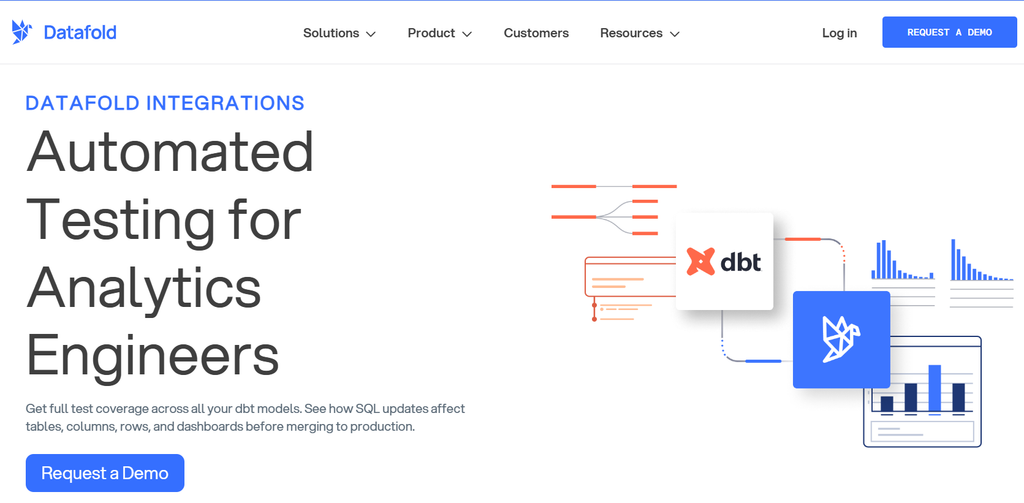
Datafold specializes in dbt CI/CD testing and production monitoring. It compares query results before and after code changes to catch breaking changes early.
Key Features:
- Automated data diffing for pull requests
- Column-level lineage across dbt models
- Integration with GitHub, GitLab, and Bitbucket
- Production monitoring for dbt model freshness and row counts
- Query profiling to identify slow transformations
Pricing: Starting at $50/month per developer. Enterprise pricing available for larger teams.
Pros:
- Catches breaking changes before merge with automated diffing
- Strong focus on CI/CD workflows
- Clear per-developer pricing model
- Good documentation and onboarding experience
Cons:
- Per-developer pricing scales quickly for large teams
- Limited observability outside dbt workflows
- SaaS only with no self hosted option
- Diffing runs require warehouse compute credits
Best for: Data teams prioritizing CI/CD quality gates over production runtime monitoring.
5. Metaplane
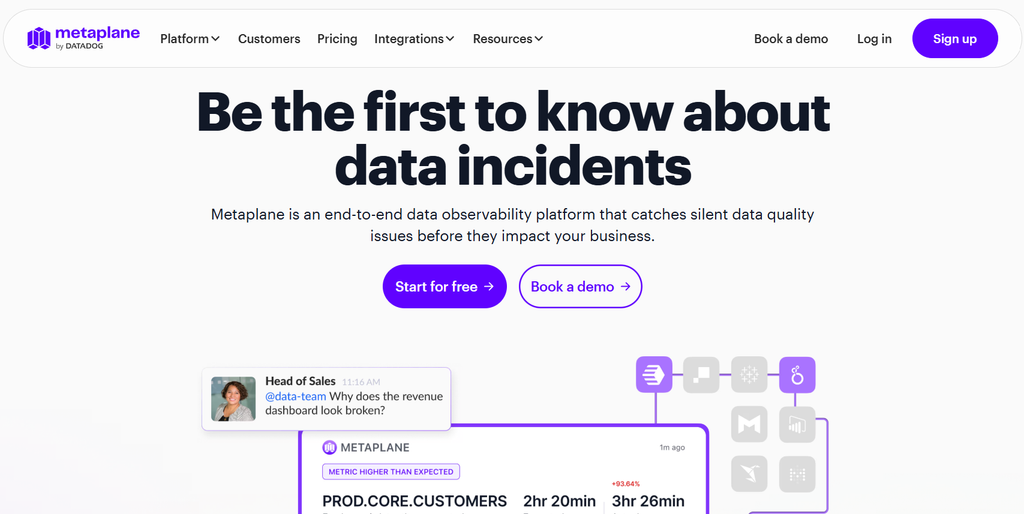
Metaplane provides automated data observability for dbt pipelines with a focus on anomaly detection and incident management. It monitors schema changes, freshness, volume, and null rates.
Key Features:
- Automated monitors for freshness, volume, and schema changes
- dbt test result collection and visualization
- Lineage graph showing upstream and downstream dependencies
- Slack and email notifications for pipeline failures
- Integration with dbt Cloud, Airflow, and Fivetran
Pricing: Starting at $1,500/month for small teams. Pricing scales with number of tables and data volume according to their pricing page.
Pros:
- Quick setup with automated monitor creation
- Good balance between ease of use and feature depth
- Strong Slack integration for incident response
- Clear pricing tiers published on website
Cons:
- Minimum $1,500/month may be steep for small teams
- SaaS only with no self hosted deployment
- Limited customization of anomaly detection thresholds
- Focused primarily on structured data pipelines
Best for: Midsize data teams running dbt in production who want automated monitoring without heavy configuration.
6. Soda
Soda is a data quality platform that embeds validation checks directly into dbt workflows using YAML-based configuration. It focuses on data quality testing rather than pipeline orchestration monitoring.
Key Features:
- Write data quality checks as code in YAML
- Integrate checks into dbt tests or run separately
- Support for multiple data warehouses
- Anomaly detection for numeric and categorical columns
- Open source core with enterprise features available
Pricing: Free open source core. Soda Cloud starts at $500/month for small teams according to their website.
Pros:
- Treats data quality as code with version control
- Works alongside existing dbt tests
- Open source option for full control
- Clear separation between checks and orchestration
Cons:
- Requires manual check authoring for comprehensive coverage
- No native lineage visualization
- Learning curve for YAML syntax
- Limited real-time monitoring without Soda Cloud
Best for: Data engineers who prefer defining data quality rules as code and want flexibility in how checks run.
7. Lightup
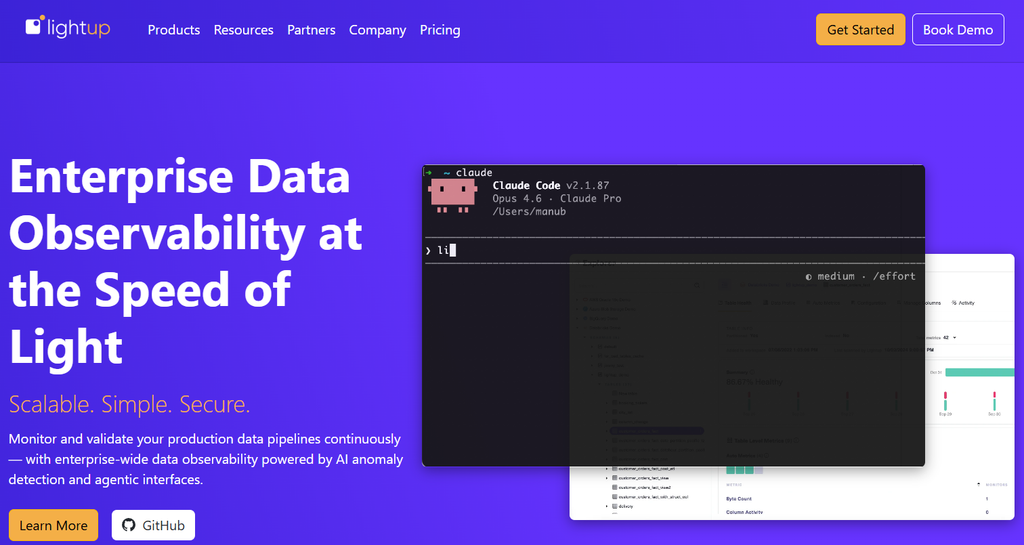
Lightup is an enterprise data observability platform with dbt integration. It focuses on automated anomaly detection across data warehouses, lakes, and transformation layers.
Key Features:
- Automated discovery of metrics to monitor
- Integration with dbt models and tests
- Machine learning-based anomaly detection
- Root cause analysis for data incidents
- Support for Snowflake, Databricks, BigQuery, and Redshift
Pricing: Custom enterprise pricing. No public rate card available. Sales required for quotes.
Pros:
- Enterprise-grade platform with strong security features
- Automated metric discovery reduces setup time
- Deep integration with cloud data warehouses
- Good lineage visualization
Cons:
- Pricing opacity requires lengthy sales conversations
- Designed for enterprise budgets only
- SaaS only with no self hosted option
- Overkill for smaller teams running simple pipelines
Best for: Large enterprises with complex data estates who need automated observability at scale.
8. Great Expectations
Great Expectations is an open source data validation framework that integrates with dbt to validate data quality during transformation workflows.
Key Features:
- Python based framework for writing data expectations
- Generates documentation from validation results
- Integration with dbt via custom tests
- Support for all major data warehouses and file formats
- Active open source community
Pricing: Free and open source. Great Expectations Cloud starts at $50/month per user.
Pros:
- Completely free for core functionality
- Highly flexible validation logic with Python
- Strong community and documentation
- Works across any data platform
Cons:
- Significant setup and configuration required
- Steeper learning curve than YAML-based tools
- No native UI without the paid cloud version
- Requires Python skills to write custom expectations
Best for: Data engineers comfortable with Python who want maximum flexibility in data validation logic.
9. dbt Cloud
dbt Cloud is the managed offering from dbt Labs that includes native job orchestration, monitoring, and debugging features built into the platform.
Key Features:
- Native job scheduling and run history
- Model timing and resource usage metrics
- Test failure tracking and notifications
- Integrated development environment
- Semantic layer for metrics definitions
Pricing: Developer plan starts at $100/month per developer. Team plan at $250/month per developer adds advanced features. Enterprise pricing available.
Pros:
- Native integration eliminates compatibility concerns
- All features maintained by the dbt Labs team
- Simplest setup for teams already using dbt
- Good documentation and support
Cons:
- Per developer pricing compounds quickly for larger teams
- SaaS only with no self-hosted option
- Monitoring features less mature than dedicated observability tools
- Limited visibility into infrastructure and warehouse performance
Best for: Teams using dbt Core who want to adopt managed orchestration without adding separate monitoring tools.
How to Choose the Right dbt Monitoring Tool
Selecting a dbt monitoring tool depends on five key factors: deployment model, pricing structure, integration depth, team size, and observability scope.
Deployment model matters for compliance If your organization has data residency requirements or restricts telemetry export, eliminate SaaS only tools immediately. CubeAPM, Elementary, Great Expectations, and Soda all support self-hosted deployment. Monte Carlo, Datafold, Metaplane, Lightup, and dbt Cloud require sending metadata to their infrastructure.
Pricing structure determines cost at scale. Per-developer pricing like Datafold and dbt Cloud becomes expensive as teams grow. A 20-person data team pays $1,000 to $5,000/month before ingesting a single data point. Volume-based tools like CubeAPM and table-based tools like Metaplane scale more predictably. Open source tools like Elementary and Great Expectations avoid SaaS fees entirely but require internal maintenance.
Integration depth affects setup effort. Native dbt packages like Elementary require minimal configuration. API based integrations like Monte Carlo and Metaplane need credentials and network access to your warehouse. Full stack platforms like CubeAPM require setting up exporters but provide unified visibility across applications, infrastructure, and data pipelines.
Team size influences feature needs. Small teams under 10 people benefit from lightweight tools like Elementary or Soda that avoid vendor lock-in. Midsize teams between 10 and 50 people need automated anomaly detection and incident management from tools like Metaplane or Datafold. Enterprise teams over 50 people require lineage visualization, impact analysis, and integrations with existing incident response workflows found in Monte Carlo or Lightup.
Observability scope determines tool choice. If you only need dbt monitoring, dedicated tools like Elementary or Datafold provide focused functionality. If you need unified observability across applications, infrastructure, and data pipelines, full stack platforms that extend beyond dbt become more valuable. Teams running Kubernetes alongside dbt benefit from platforms that monitor both like CubeAPM.
Frequently Asked Questions
What is dbt monitoring and why does it matter?
dbt monitoring tracks the execution, performance, and data quality of dbt transformation pipelines. It surfaces model failures, test failures, freshness issues, and slow queries before they break downstream dashboards or reports. Without monitoring, data teams discover problems only after users report stale or incorrect data.
How do you monitor dbt pipelines in production?
Monitor dbt pipelines by collecting metadata from dbt run results, test outcomes, and model timing. Tools like Elementary parse dbt artifacts directly. Platforms like CubeAPM ingest dbt logs and metrics via OpenTelemetry. dbt Cloud provides native monitoring in its UI. All approaches track the same core signals: run duration, test pass rate, model freshness, and row counts.
What is the difference between dbt monitoring and data observability?
dbt monitoring focuses specifically on dbt transformation logic, model execution, and test results. Data observability covers the entire data pipeline including ingestion, storage, transformation, and consumption layers. Tools like Monte Carlo and Metaplane provide broader data observability that includes dbt as one component. Tools like Elementary focus only on dbt workflows.
Can you monitor dbt Core without using dbt Cloud?
Yes. Open source tools like Elementary and Great Expectations work with dbt Core. Self hosted platforms like CubeAPM monitor dbt Core by ingesting logs and metrics from your orchestration layer. Monte Carlo, Metaplane, and Datafold all integrate with dbt Core without requiring dbt Cloud.
How much does dbt monitoring cost at scale?
Cost varies widely by tool and pricing model. Open source tools like Elementary cost only infrastructure to run them. Per developer tools like Datafold and dbt Cloud cost $50 to $250 per user per month. Volume-based tools like CubeAPM cost $0.20/GB ingested. Enterprise platforms like Monte Carlo and Lightup require custom contracts starting around $30,000 annually.
What metrics should you track for dbt pipeline health?
Track model run duration to catch performance degradation, test pass rate to detect data quality issues, model freshness to ensure timely updates, row count changes to spot missing or duplicate data, and query execution time to identify warehouse bottlenecks. Alert on test failures, models running longer than SLO thresholds, and freshness violations.
Do dbt monitoring tools work with all data warehouses?
Most tools support Snowflake, BigQuery, Redshift, and Databricks. Elementary works with any warehouse dbt supports since it runs as a dbt package. CubeAPM monitors pipelines regardless of warehouse by ingesting telemetry from orchestration tools. Check each vendor’s documentation for specific warehouse compatibility before adopting.
Disclaimer: The information in this article reflects the latest details available at the time of publication and may change as technologies and products evolve. Features, pricing, and plan limits can change over time. Always verify the latest information directly with the vendor before making purchasing or deployment decisions.