










Without a coherent log retention policy, teams either pay to store years of unused logs or delete audit trails they needed for compliance. A production incident that requires forensic analysis six months after it happened becomes impossible to investigate if logs were already purged. According to NIST SP 800-92, log retention should be “archiving logs on a regular basis as part of standard operational activities,” but the practical question is how long, in what storage tier, and at what cost.
Most organizations keep security and audit logs for one to seven years depending on regulatory requirements, while operational and application logs are retained for 14 to 90 days based on debugging needs. This guide compares 8 log retention strategies across compliance requirements, storage cost models, and real-world retention timelines used by teams managing everything from startup applications to enterprise SIEM platforms.
Quick Comparison: 8 Log Retention Strategies at a Glance
| Strategy | Best For | Typical Retention | Storage Model | Compliance Fit |
|---|---|---|---|---|
| Unlimited retention (CubeAPM) | Teams with data sovereignty, self hosted infrastructure | Unlimited, searchable | Hot storage, self-hosted | GDPR, HIPAA, SOC 2, full residency |
| Tiered retention (Datadog) | Multi cloud SaaS teams willing to pay for long retention | 15 months default, paid extensions | Hot + archive tiers | Limited; cloud only |
| Hot + cold storage (Splunk) | Enterprise security teams, SIEM workflows | 90 days hot, 1–7 years cold | Hot + S3/cold archive | Strong; built for compliance |
| Short term operational (Better Stack) | Startups, fast moving dev teams | 14–30 days | Hot storage only | Low; operational focus |
| Compliance driven (Coralogix) | Regulated industries, audit heavy workflows | 1–7 years based on compliance | Streama + archive | Strong; compliance first |
| Retention by log type (New Relic) | Teams with mixed log priorities | 30 days default, 13 months for security | Tiered by log type | Moderate; SaaS limited |
| Elastic retention (Elastic APM) | Teams on ELK stack, self managed | Custom, ILM based | Hot + warm + cold tiers | Strong if self-hosted |
| Minimal retention (open source) | Small teams, cost sensitive | 7–14 days | Local disk or object storage | None — manual compliance |
Storage model definitions: Hot storage is always online, searchable in seconds, and most expensive. Warm storage is slower to query but cheaper, typically used for 30–90 day retention. Cold storage is archival, retrieved in minutes to hours, and used for multi-year compliance retention.
Why Log Retention Policy Matters More Than Most Teams Realize
Log retention is not just a compliance checkbox. It determines whether you can investigate a security breach six months after it happened, whether you can prove regulatory compliance during an audit, and whether your monitoring bill doubles unexpectedly when you extend retention without planning for storage cost.
Three problems surface when retention policy is missing or poorly defined:
Compliance failures during audits. HIPAA requires six years of audit log retention for healthcare organizations. PCI DSS mandates three months of hot access plus one year of archive for payment data. SOC 2 auditors expect evidence of security event retention aligned with your stated policy. If logs are deleted early or retention is inconsistent across log types, audit findings and penalties follow.
Incident forensics that hit a retention wall. A database compromise detected in March may have started with reconnaissance activity in October. If application and security logs were purged after 30 days, the full attack timeline is lost. Advanced persistent threats often go undetected for 100 to 200 days – longer than most default retention policies.
Runaway storage costs with no lifecycle plan. A team ingesting 10 TB of logs per month at $0.10/GB ingest plus $0.02/GB/month storage will pay $1,000/month for ingest and $2,400/month for storage after 12 months if every log is kept in hot storage. Adding cold archive tiers or lifecycle policies can cut storage costs by 70% without losing compliance coverage.
According to the NIST SP 800-92 log management guide, organizations should define retention periods based on “applicable laws and regulations, operational and technical requirements, and investigation needs.” The challenge is translating that guidance into a real policy that covers each log type, storage tier, and cost implication.
1. Unlimited Retention with Self-Hosted Storage (CubeAPM)
CubeAPM runs inside your own cloud or on-premises infrastructure, which removes the SaaS billing model entirely. Every log ingested is searchable with no separate indexing fee, no cold archive upcharge, and no retention limit. You control how long logs are kept based on disk capacity and compliance requirements, not vendor pricing tiers.
Retention model: Unlimited. Logs remain searchable for as long as you allocate storage.
Storage tiers: Single hot tier. No warm or cold storage; everything is indexed and queryable at the same speed.
Pricing: $0.20/GB ingestion. Storage cost is your own infrastructure; typically $0.02/GB/month on block storage or object storage in AWS, Azure, or GCP.
Compliance fit: Strong. Data never leaves your infrastructure, which satisfies GDPR data residency, HIPAA audit retention, and SOC 2 data sovereignty requirements without third-party subprocessor agreements.
Best for: Teams with data residency requirements, regulated industries that need multi-year audit trails, and organizations that want predictable log costs without SaaS retention premiums.
Pros:
- No retention limits; logs are kept as long as you want
- No separate indexing or archive fees
- Full data residency; logs never egress to third-party SaaS
- $0.20/GB pricing; no per-user or per-host charges
Cons:
- Requires managing your own storage infrastructure
- You handle capacity planning and disk scaling
- Less mature SSO and RBAC compared to enterprise SaaS platforms
Real-world retention example: A healthcare SaaS platform ingesting 15 TB/month keeps all logs for 7 years to meet HIPAA requirements. At $0.20/GB ingest, the total cost after 7 years is $3,000/month for ingest and $2,520/month for storage – $5,520/month total. The same retention on Datadog would cost over $20,000/month after factoring in extended retention fees and indexed log pricing.
2. Tiered Retention with SaaS Pricing (Datadog)
Datadog offers 15 months of default retention for indexed logs, with options to extend retention or move older logs to archive storage. The pricing model charges separately for ingestion, indexing, and archive storage, which creates three cost dimensions that compound as retention increases.
Retention model: 15 months default for indexed logs. Extended retention available for additional cost.
Storage tiers: Hot indexed logs (15 months), archive storage (up to 5 years), and rehydration required to query archived logs.
Pricing: $0.10/GB ingestion, $1.70/million events indexed, archive storage additional per GB/month, rehydration $0.02/GB scanned.
Compliance fit: Moderate. Datadog is SOC 2 and ISO 27001 certified, but data is stored in Datadog cloud infrastructure, which may not satisfy strict data residency requirements.
Best for: Multi-cloud teams that want managed log analytics with broad integration coverage and are willing to pay SaaS premiums for retention.
Pros:
- Fully managed; no infrastructure to maintain
- 1,000+ integrations for cloud, containers, databases
- Advanced log correlation with APM, RUM, and infrastructure metrics
- Strong anomaly detection and machine learning features
Cons:
- Retention beyond 15 months requires paid archive storage
- Rehydration required to query archived logs adds cost and latency
- Indexed log pricing compounds fast with high event volume
- No on-premises deployment option for data residency
Real-world retention example: A SaaS platform ingesting 10 TB/month with 30% indexed keeps logs for 15 months in hot storage and archives 2 years for compliance. At $0.10/GB ingest, $1.70/million events indexed, and archive storage, the monthly cost is approximately $1,000 ingest, $5,100 indexing (assuming 3 billion events/month), and $600 archive – $6,700/month total before rehydration costs.
This estimate models a production workload with 30% of logs indexed for real-time search. Actual costs will vary based on indexing percentage, retention extension, and rehydration frequency.
3. Hot + Cold Storage with Enterprise SIEM Focus (Splunk)
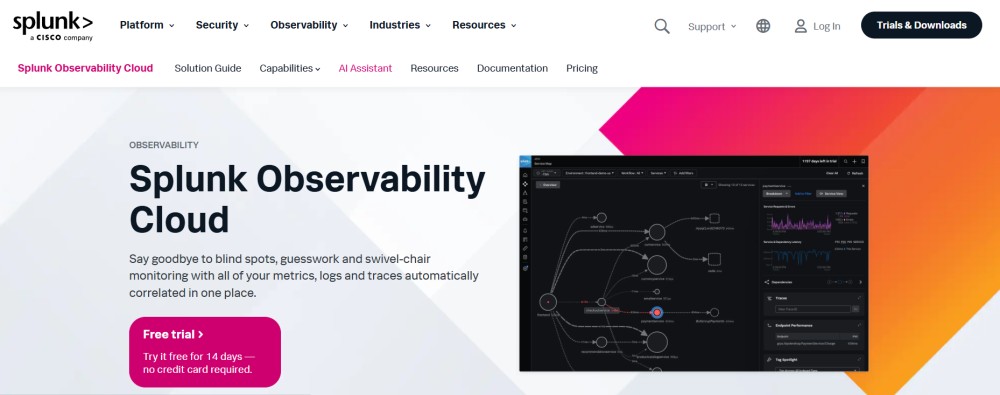
Splunk is built for enterprise security and compliance workflows, with strong support for multi-year log retention using tiered storage. The Splunk SmartStore architecture separates hot indexed storage from cold S3 or object storage, allowing teams to keep years of logs searchable without paying hot storage premiums for old data.
Retention model: 90 days hot by default, 1 to 7 years in cold archive depending on compliance needs.
Storage tiers: Hot indexed storage for recent logs, warm storage for less frequently accessed data, and cold archive on S3 or equivalent for compliance retention.
Pricing: Starts at $15/host/month for infrastructure monitoring. Ingest volume pricing varies by deployment size and licensing model. Enterprise licenses typically range from $50,000 to $500,000+ annually depending on data volume.
Compliance fit: Strong. Splunk is widely used for SIEM, PCI DSS, HIPAA, and SOX compliance, with built-in retention policies, audit trails, and role-based access controls.
Best for: Enterprise security teams, regulated industries with multi-year audit requirements, and organizations that need deep log analysis with correlation across security and operational data.
Pros:
- Industry standard for SIEM and security log analysis
- SmartStore architecture reduces storage costs for old logs
- Strong compliance reporting and audit trail features
- Mature RBAC, data masking, and access controls
Cons:
- High licensing costs; enterprise pricing starts well above $50K/year
- Complex deployment and tuning for optimal performance
- Ingest volume pricing can be unpredictable at scale
- Requires trained Splunk administrators to manage effectively
Real-world retention example: A financial services company ingesting 20 TB/month keeps 90 days in hot storage and 7 years in cold archive to meet SOX and PCI DSS requirements. At enterprise license pricing, the annual cost is approximately $150,000 for the platform license plus $0.03/GB/month for cold storage – $1,800/month for storage after 7 years.
4. Short Term Operational Retention for Fast Moving Teams (Better Stack)
Better Stack is designed for developer-focused log monitoring with fast setup and minimal retention overhead. The platform keeps logs for 14 to 30 days in hot storage, optimized for real-time debugging and incident response rather than long-term compliance.
Retention model: 14 to 30 days depending on plan.
Storage tiers: Hot storage only; no cold archive option.
Pricing: Free tier available. Paid plans start at $29/month with per responder bundles and volume-based pricing.
Compliance fit: Low. Short retention and SaaS only deployment make it unsuitable for regulated industries requiring multi-year audit trails.
Best for: Startups, small engineering teams, and developers who prioritize fast log search and incident response over long-term retention.
Pros:
- Fast setup; production-ready in under 60 minutes
- Developer-friendly UI with fast full-text search
- Affordable for small teams with low log volume
- Strong integrations with Slack, PagerDuty, and incident management tools
Cons:
- Short retention limits rule out compliance use cases
- No cold storage or long-term archive option
- SaaS only; no on-premises deployment
- Limited log correlation with infrastructure or APM signals
Real-world retention example: A 10-person startup ingesting 500 GB/month keeps logs for 30 days to debug production issues. At Better Stack pricing, the monthly cost is approximately $150/month; significantly cheaper than enterprise platforms but insufficient for compliance-driven retention.
5. Compliance-Driven Retention with Real-Time Analytics (Coralogix)
Coralogix uses a Streama architecture that processes logs in stream before storing them, allowing teams to filter, aggregate, and alert on log data without indexing everything. This reduces storage costs while maintaining compliance retention for filtered logs that match audit or security criteria.
Retention model: 1 to 7 years based on compliance requirements, with Streama filtering to reduce indexed volume.
Storage tiers: Streama (real-time processing), indexed storage (searchable), and cold archive for compliance.
Pricing: $0.42/GB for logs after Streama filtering. Archive storage additional.
Compliance fit: Strong. Coralogix supports GDPR, HIPAA, and SOC 2 compliance with role-based access, audit trails, and long-term retention policies.
Best for: Regulated industries with high log volume that need real-time analytics without indexing every log for long-term storage.
Pros:
- Streama filtering reduces indexed volume and storage costs
- Real-time log analytics without full indexing overhead
- Strong compliance features for regulated industries
- Built-in anomaly detection and security alerting
Cons:
- Pricing complexity; Streama filtering, indexing, and archive each have separate costs
- Higher per GB cost compared to self-hosted options
- SaaS only; no on-premises deployment option
- Streama configuration requires upfront planning to optimize cost
Real-world retention example: A healthcare SaaS platform ingesting 12 TB/month uses Streama to filter 70% of logs, indexing 3.6 TB for real-time search and archiving 12 TB for compliance. At $0.42/GB indexed and additional archive fees, the monthly cost is approximately $1,512 for indexing plus archive storage – $2,000 to $3,000/month total depending on retention length.
Pricing based on publicly available information as of early 2026. Streama filtering percentage and archive costs may vary by workload and retention policy.
6. Retention by Log Type with Platform Flexibility (New Relic)

New Relic allows teams to set different retention policies by log type, keeping security and audit logs for 13 months while operational logs are retained for 30 days. This reduces storage costs for high-volume application logs while maintaining compliance coverage for audit trails.
Retention model: 30 days default for operational logs, 13 months for security logs, custom retention available with additional cost.
Storage tiers: Hot storage for default retention, extended retention available as paid add-on.
Pricing: $0.40/GB beyond 100 GB free tier. Extended retention priced separately.
Compliance fit: Moderate. New Relic is SOC 2 and ISO 27001 certified, but SaaS only deployment limits data residency options.
Best for: Teams that want to integrate log retention with broader observability coverage across APM, infrastructure, and RUM.
Pros:
- Flexible retention by log type reduces storage costs
- Unified platform for logs, traces, metrics, and RUM
- Strong integration with cloud providers and container platforms
- Built-in anomaly detection and alerting
Cons:
- Per GB pricing compounds fast with high log volume
- Extended retention requires additional paid plans
- SaaS only; no on-premises deployment option
- NRQL query language creates lock-in
Real-world retention example: A SaaS platform ingesting 8 TB/month keeps application logs for 30 days and security logs for 13 months. At $0.40/GB after the free tier, the monthly cost is approximately $3,160 for ingest plus extended retention fees for security logs – $4,000 to $5,000/month total.
7. Elastic Retention with Index Lifecycle Management (Elastic APM)
Elastic APM and the ELK stack offer full control over retention using Index Lifecycle Management (ILM), which automates log transitions from hot to warm to cold storage based on age and access frequency. This gives teams enterprise-grade retention flexibility without SaaS pricing constraints if self-hosted.
Retention model: Custom, defined by ILM policies. Teams typically keep 7 to 30 days hot, 90 days warm, and 1 to 7 years cold.
Storage tiers: Hot indexed storage, warm storage for less frequent queries, and cold archive on S3 or equivalent.
Pricing: Free if self-hosted. Elastic Cloud starts at $99/month for managed hosting.
Compliance fit: Strong if self-hosted. Data residency, GDPR, HIPAA, and SOC 2 compliance depend on where the stack is deployed.
Best for: Teams already using Elasticsearch, Logstash, and Kibana who want full control over retention without SaaS vendor lock-in.
Pros:
- Full retention control with ILM automation
- No per GB pricing if self-hosted
- Strong integration with Elastic ecosystem (Beats, APM, SIEM)
- Mature RBAC, data masking, and audit features
Cons:
- Requires operational expertise to manage and tune
- High infrastructure overhead for large deployments
- Slow query performance on warm and cold tiers without tuning
- No vendor-managed support unless using Elastic Cloud
Real-world retention example: A mid-size engineering team ingesting 6 TB/month self-hosts Elastic on AWS, keeping 30 days hot, 90 days warm, and 2 years cold. At AWS storage costs ($0.10/GB hot, $0.023/GB cold), the monthly cost is approximately $600 hot storage, $140 warm, and $276 cold after 2 years – $1,016/month total plus EC2 compute costs.
8. Minimal Retention with Open Source Tools (Loki, Fluentd, Promtail)
Open source log aggregation using Loki, Fluentd, or Promtail offers the lowest cost option for teams willing to manage their own infrastructure. Retention is limited by local disk or object storage capacity, with no built-in lifecycle management or compliance features.
Retention model: 7 to 14 days typical, limited by disk capacity.
Storage tiers: Local disk or object storage; no automated tiering.
Pricing: Free software. Storage cost depends on infrastructure provider (AWS S3, Azure Blob, GCP Cloud Storage).
Compliance fit: None unless manually configured. No built-in audit trails, RBAC, or compliance reporting.
Best for: Small teams, cost-sensitive projects, and developers who need basic log aggregation without compliance requirements.
Pros:
- Zero software licensing cost
- Full control over log data and infrastructure
- Lightweight compared to enterprise platforms
- Easy integration with Prometheus and Grafana
Cons:
- No automated retention or lifecycle management
- Manual compliance configuration required
- Limited query performance compared to indexed platforms
- No vendor support or managed updates
Real-world retention example: A startup ingesting 500 GB/month stores logs on AWS S3 for 30 days. At $0.023/GB/month S3 storage, the monthly cost is approximately $11.50 – minimal cost but zero compliance features or automated lifecycle management.
How to Choose the Right Log Retention Strategy for Your Team
Retention policy decisions come down to four dimensions: compliance requirements, storage cost tolerance, query performance needs, and operational complexity you are willing to manage.
If compliance drives retention: Choose platforms with built-in compliance features, audit trails, and automated lifecycle policies. Splunk, Coralogix, and CubeAPM all support multi-year retention with role-based access and compliance reporting. Elastic APM offers strong compliance features if self-hosted.
If cost is the priority: Self-hosted options like CubeAPM, Elastic APM, or open source Loki eliminate SaaS per GB pricing. For SaaS platforms, Coralogix Streama filtering and tiered storage models reduce indexed volume, cutting storage costs by 50 to 70% compared to full indexing.
If query performance matters more than cost: Keep logs in hot indexed storage for as long as budget allows. Datadog, New Relic, and Better Stack all offer fast query performance on recent logs, with trade-offs in retention length and cost.
If operational simplicity is critical: Fully managed SaaS platforms like Datadog, New Relic, and Better Stack remove infrastructure overhead but lock you into vendor pricing models. Self-hosted platforms like CubeAPM and Elastic APM give you cost control but require managing storage scaling and lifecycle automation.
Conclusion
Log retention is not a one-size-fits-all decision. Security and audit logs often require one to seven years of retention to meet HIPAA, PCI DSS, or SOX compliance, while operational and application logs are typically kept for 14 to 90 days based on debugging needs. The gap between those timelines is where storage cost, query performance, and compliance overlap.
Teams with data residency requirements or multi-year audit obligations should prioritize self-hosted platforms like CubeAPM or Elastic APM, which eliminate SaaS data egress and retention premiums. Teams that prioritize managed simplicity over cost can use tiered retention on Datadog or New Relic, accepting higher per GB pricing in exchange for no infrastructure burden. Startups and small teams can use short-term retention on Better Stack or open source Loki to minimize cost while keeping recent logs searchable.
The best retention strategy aligns log type with business need. Archive what compliance requires, keep recent logs hot for debugging, and move everything else to cold storage before it compounds your bill.
Disclaimer: The information in this article reflects the latest details available at the time of publication and may change as technologies and products evolve. Features, pricing, and plan limits can change over time. Always verify the latest information directly with the vendor before making purchasing or deployment decisions.
Frequently Asked Questions
How long should logs be retained?
Security and audit logs typically require one to seven years of retention depending on compliance requirements like HIPAA, PCI DSS, or SOX. Operational and application logs are usually retained for 14 to 90 days based on debugging needs. Retention length depends on regulatory obligations, incident investigation timelines, and storage cost tolerance.
What is the 7 year retention policy?
The 7 year retention policy is a common requirement in regulated industries like healthcare and finance, where audit logs, access records, and transaction logs must be kept for at least 7 years to comply with HIPAA, SOX, or financial recordkeeping laws. Some industries require even longer retention for legal discovery purposes.
How long should audit logs be retained?
Audit logs should be retained based on compliance requirements, which typically range from one to seven years. HIPAA requires six years for healthcare audit logs. PCI DSS mandates three months of hot access plus one year of archive. SOC 2 expects retention aligned with your stated security policy and incident investigation needs.
How long should event logs be retained?
Event logs used for operational debugging are typically retained for 14 to 90 days depending on how frequently issues are discovered and investigated. Security event logs may require one to five years of retention to support forensic analysis, compliance audits, and breach investigation timelines that average 100 to 200 days from initial compromise to detection.
What should security controls on log data reflect?
Security controls on log data should reflect access restrictions based on sensitivity, role based permissions to prevent unauthorized viewing, integrity protections to prevent tampering, and encryption both in transit and at rest. Audit trails should track who accessed logs, when, and what queries were run to support compliance and incident investigation.
How often should logs be reviewed?
Security logs should be reviewed continuously using automated anomaly detection and alerting, with manual review during incident response and quarterly compliance audits. Operational logs are typically reviewed during troubleshooting and post incident analysis. Automated log monitoring reduces manual review burden while catching anomalies in real time.
What is log retention period best practice?
Best practice is to define retention by log type, aligning security and audit logs with compliance requirements (one to seven years) and operational logs with debugging needs (14 to 90 days). Use tiered storage to move older logs from hot indexed storage to cold archive, reducing cost while maintaining compliance coverage and forensic investigation capability.