










SIEM (Security Information and Event Management) tools aggregate security events from across your infrastructure, correlate them to identify threats, and give security teams the visibility needed to respond before an incident escalates. The problem: most SIEM platforms were built for a pre-cloud world. Per-host licensing models compound as you scale Kubernetes pods. Log ingestion pricing explodes when auto-scaling spins up new containers during traffic spikes. And closed-source query languages create lock-in that makes every alert rule and dashboard vendor-specific.
This guide compares 10 SIEM tools across enterprise platforms, cloud native options, and open source alternatives. Each is evaluated on total cost of ownership, deployment model (SaaS vs on-prem vs hybrid), threat detection depth, and whether it supports modern cloud environments without forcing you into vendor lock-in.
Quick Comparison: 10 SIEM Tools at a Glance
| Tool | Best For | Pricing Model | Cloud Native? | Open Source? |
|---|---|---|---|---|
| CubeAPM | Teams needing unified SIEM + APM + logs on prem | $0.20/GB ingestion, no seat fees | ✓ Full support | ✗ Proprietary |
| Splunk Enterprise Security | Enterprise SIEM with deep integration ecosystem | $150/GB ingestion (typical) | ✓ Yes | ✗ Proprietary |
| IBM QRadar SIEM | Large orgs with IBM stack, compliance-heavy industries | $2,000–$4,000/EPS bracket | Partial | ✗ Proprietary |
| Microsoft Sentinel | Azure heavy orgs, Microsoft ecosystem integration | $2.76/GB ingestion + LA costs | ✓ Native Azure | ✗ Proprietary |
| Datadog Cloud SIEM | Teams already on Datadog APM wanting unified security | $0.20/GB logs analyzed + host costs | ✓ Yes | ✗ Proprietary |
| Rapid7 InsightIDR | Mid market SOC teams, endpoint focused threat detection | $2,500/mo base + per asset | ✓ Yes | ✗ Proprietary |
| CrowdStrike Falcon Next Gen SIEM | Endpoint security teams extending to SIEM | $8–$15/endpoint/mo (estimate) | ✓ Yes | ✗ Proprietary |
| Wazuh | Open source SIEM for teams with in house security engineering | Free (self hosted) | ✓ Yes | ✓ Open source |
| Elastic Security | ELK users wanting built in SIEM, threat hunting capabilities | Free tier, Elastic Cloud from $95/mo | ✓ Yes | ✓ Open source core |
| SentinelOne Singularity | AI driven autonomous threat detection, SOC automation | Custom pricing (contact sales) | ✓ Yes | ✗ Proprietary |
Pricing estimates based on mid-market team profile (500 endpoints, 15 TB/month log ingestion, 60-day retention). Actual costs vary by retention, user seats, add-ons, and enterprise discounts. Verify current rates directly with each vendor.
1. CubeAPM
CubeAPM is a full-stack observability platform covering APM, logs, infrastructure monitoring, and security event correlation in one self-hosted deployment. Unlike traditional SIEM tools that charge separately for log ingestion, analysis, and storage, CubeAPM uses a single $0.20/GB ingestion rate with unlimited retention and no per-user fees.
Key Features:
- Unified SIEM + APM + logs in one platform; correlates security events with application traces and infrastructure metrics
- Self-hosted deployment keeps telemetry data inside your VPC or on-prem
- OpenTelemetry native ingestion; no proprietary agents required
- AI-based smart sampling reduces storage overhead while retaining security-relevant events
- Unlimited data retention at no extra cost
- Role-based access control (RBAC) and audit logs for compliance
Pricing:
$0.20/GB ingestion, all-inclusive. No seat fees, no separate indexing charges, no retention limits. Enterprise support and SSO add-ons available.
Pros:
- Predictable ingestion-based pricing; no surprises from log spikes or user growth
- Full data sovereignty; telemetry never leaves your infrastructure
- Fast onboarding; documented zero downtime migrations from Datadog and New Relic
- Direct engineering support via Slack and WhatsApp during incidents
Cons:
- Requires BYOC or on-prem deployment; you manage the underlying infrastructure
- SIEM-specific features (threat intel feeds, automated playbooks) are less mature than enterprise-only platforms
- SSO and advanced RBAC capabilities still evolving compared to incumbents
Best for:
DevSecOps teams needing unified observability and security event correlation in one self-hosted platform with full data control and predictable pricing.
2. Splunk Enterprise Security
Splunk Enterprise Security is one of the most established SIEM platforms, known for deep integration breadth and enterprise-grade threat detection. It excels at correlating events across massive volumes of machine data but comes with a reputation for high cost and operational complexity at scale.
Key Features:
- Pre-built security dashboards and correlation searches for common threats
- Deep integration with 2,000+ data sources including cloud platforms, EDR tools, and network devices
- Machine learning-driven anomaly detection and user behavior analytics (UBA)
- Incident review workflows with case management and automated response actions
- Asset and identity correlation to map threats to specific users and systems
Pricing:
Splunk charges based on daily ingestion volume. Typical enterprise pricing starts around $150/GB/day ingested, with volume discounts at higher tiers. A 15 TB/month deployment (~500 GB/day) costs approximately $6,750/month before retention add-ons or premium support.
Pros:
- Industry-leading integration ecosystem; connects to virtually any log source
- Proven at enterprise scale; handles petabytes of data across global deployments
- Strong community and third-party app marketplace for extending functionality
Cons:
- High cost at scale; pricing can reach $100,000+/year for mid-size SOC teams
- Complex licensing model makes cost forecasting difficult
- SPL (Splunk Processing Language) creates vendor lock-in; queries and dashboards are not portable
Best for:
Large enterprises with complex security stacks and budget to match. Best fit for teams already using Splunk for log management or needing deep third-party integrations.
3. IBM QRadar SIEM
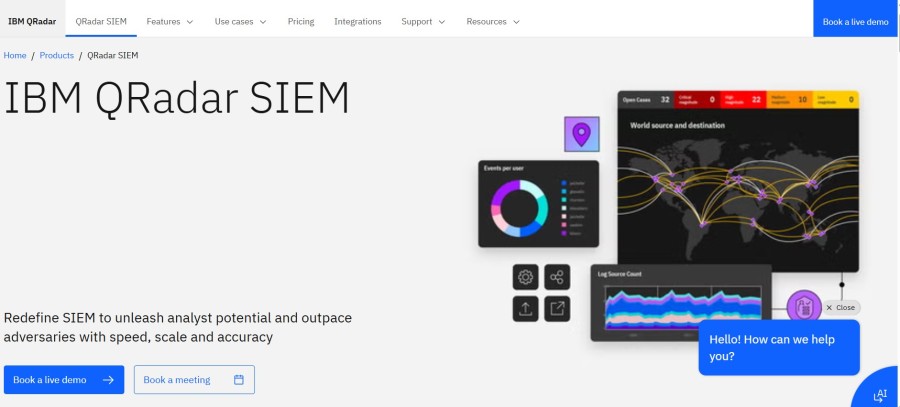
IBM QRadar SIEM is a long-standing enterprise SIEM platform designed for heavily regulated industries. It uses a flows and events per second (EPS) licensing model rather than data volume-based pricing. QRadar is commonly deployed in finance, healthcare, and government sectors where compliance requirements demand on-premises data control.
Key Features:
- Events per second (EPS) licensing model; not volume-based like Splunk or Sentinel
- Strong compliance support for PCI DSS, HIPAA, SOX, and GDPR
- Built-in threat intelligence feeds and vulnerability data correlation
- On-prem and hybrid deployment options for data residency requirements
- Deep integration with IBM security products (Guardium, Resilient, X Force)
Pricing:
QRadar pricing is based on events per second (EPS) tiers. A typical mid-market deployment handling 5,000 EPS costs approximately $50,000–$80,000/year for licenses, plus additional costs for support, training, and hardware if self-hosting.
Pros:
- EPS based pricing can be more predictable than volume-based models for teams with consistent event rates
- Strong compliance and audit features for regulated industries
- On-prem deployment keeps data fully within customer infrastructure
Cons:
- High upfront licensing costs; significant budget barrier for smaller teams
- Complex setup and tuning; requires dedicated security engineering resources
- IBM stack integration is strong, but third-party integrations lag behind Splunk
Best for:
Large enterprises in regulated industries (finance, healthcare, government) needing on-prem SIEM with strong compliance features and IBM ecosystem integration.
4. Microsoft Sentinel
Microsoft Sentinel is a cloud native SIEM built on Azure, designed for organizations already invested in the Microsoft ecosystem. It uses Azure Log Analytics as its backend and charges based on data ingestion volume plus underlying Azure storage and query costs.
Key Features:
- Native integration with Microsoft 365, Azure AD, Defender, and Azure services
- Built-in threat intelligence from Microsoft’s global security research team
- Automated investigation and response (SOAR) capabilities using Logic Apps
- KQL (Kusto Query Language) for building custom detection rules and dashboards
- Scalable cloud native architecture; no infrastructure to manage
Pricing:
Microsoft Sentinel charges $2.76/GB for data ingestion, plus Azure Log Analytics costs (approximately $2.30/GB for ingestion and $0.12/GB/month for retention). A 15 TB/month deployment costs roughly $7,590/month for Sentinel ingestion alone, before adding Log Analytics storage, retention, and query costs.
Pros:
- Deep integration with Microsoft ecosystem; frictionless for Azure and M365 heavy orgs
- Pay-as-you-go pricing; no upfront licensing fees
- Automated playbooks reduce manual triage for common threats
Cons:
- Pricing compounds quickly; ingestion + Log Analytics + retention adds up at scale
- KQL creates vendor lock-in; queries are Azure-specific
- Limited value outside Microsoft ecosystem; weaker third-party integrations compared to Splunk
Best for:
Azure-heavy organizations needing cloud native SIEM with tight integration to Microsoft 365, Defender, and Azure security services.
5. Datadog Cloud SIEM
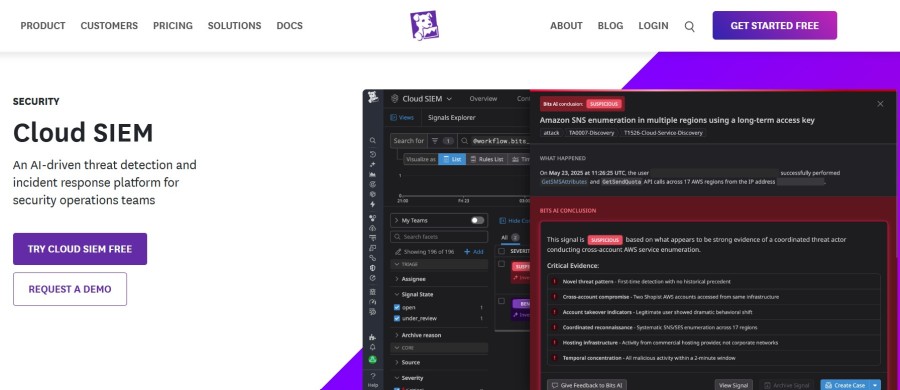
Datadog Cloud SIEM extends Datadog’s existing APM and log management platform with security event correlation and threat detection rules. Teams already using Datadog for observability can add SIEM functionality without introducing a separate tool, keeping all telemetry logs, metrics, traces, and security events in one unified platform.
Key Features:
- Unified platform for APM, infrastructure monitoring, logs, and security events
- Pre-built detection rules for common threats (brute force attempts, privilege escalation, data exfiltration)
- Automatic correlation between security events and application traces
- Integration with 700+ services including cloud platforms, containers, and third-party security tools
- Real-time threat detection with customizable alerting to Slack, PagerDuty, and other channels
Pricing:
Datadog Cloud SIEM charges $0.20/GB for analyzed logs, on top of base log ingestion costs ($0.10/GB). A 15 TB/month deployment costs approximately $4,500/month for analyzed security logs, plus infrastructure monitoring host fees ($15–$31/host/month for 60 hosts adds another $900–$1,860/month).
Pros:
- Unified telemetry; security events, APM traces, logs, and metrics in one platform
- Fast deployment for existing Datadog customers; no new agents or integrations required
- Strong cloud native support; understands Kubernetes, Lambda, and ephemeral workloads
Cons:
- Pricing compounds at scale; analyzed logs + hosts + custom metrics adds up quickly
- Less mature than dedicated SIEM platforms; lacks advanced threat hunting features
- SaaS only deployment; not an option for teams requiring on-prem data residency
Best for:
Teams already using Datadog for observability wanting to add security event correlation without introducing a separate SIEM tool.
6. Rapid7 InsightIDR
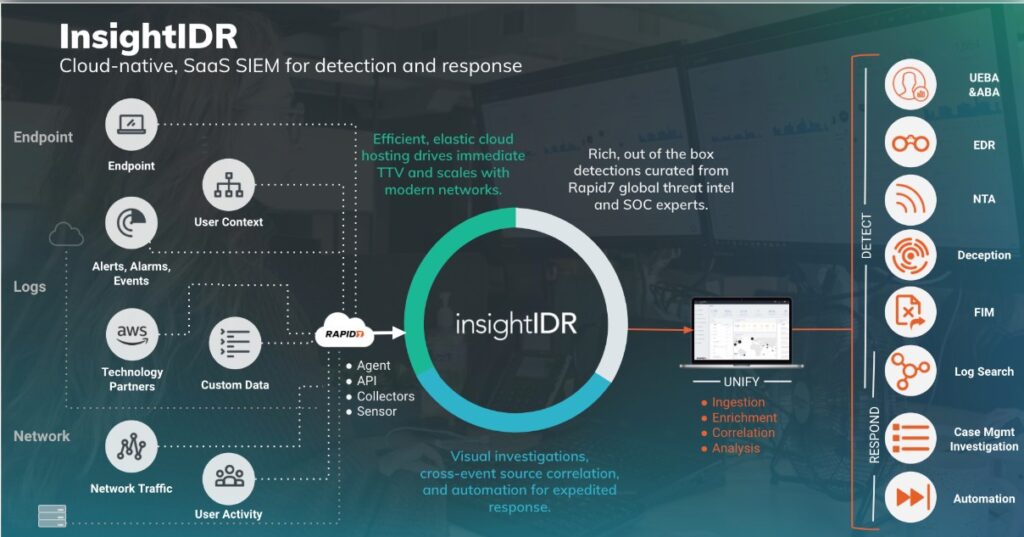
Rapid7 InsightIDR is a cloud native SIEM focused on endpoint visibility and user behavior analytics. It combines log aggregation, endpoint detection, and automated investigation workflows in one platform. InsightIDR is commonly used by mid-market SOC teams that need strong endpoint threat detection without the operational overhead of deploying traditional SIEM infrastructure.
Key Features:
- Endpoint detection and response (EDR) integration for user and asset behavior tracking
- Pre-built detection rules for common attack patterns (lateral movement, credential theft, ransomware)
- Automated investigation timelines that reconstruct attacker activity across endpoints and logs
- Built-in deception technology (honeytokens and decoys) to detect attackers early
- Cloud-delivered platform; no infrastructure to deploy or manage
Pricing:
InsightIDR pricing starts at approximately $2,500/month for base deployment, with additional per-asset fees as coverage expands. A mid-market deployment covering 500 endpoints typically costs $5,000–$8,000/month.
Pros:
- Strong endpoint visibility; tracks user activity and lateral movement across assets
- Fast time to value; pre-configured detection rules reduce manual tuning
- Automated investigation timelines speed up incident response
Cons:
- Per asset pricing compounds as infrastructure grows
- Less flexible than query-driven SIEMs like Splunk or Sentinel for custom detection logic
- Cloud-only deployment; not an option for on-prem data residency requirements
Best for:
Mid market SOC teams needing endpoint-focused SIEM with automated investigation workflows and minimal operational overhead.
7. CrowdStrike Falcon Next Gen SIEM
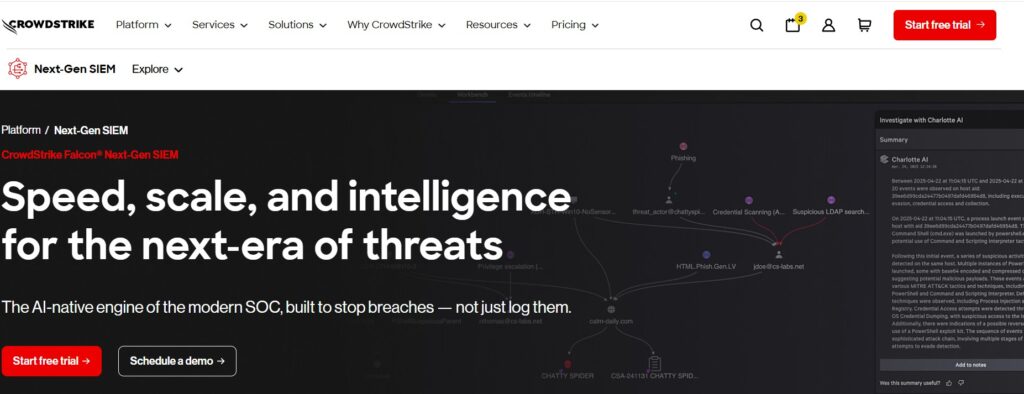
CrowdStrike Falcon Next Gen SIEM extends CrowdStrike’s endpoint protection platform into a full SIEM by correlating endpoint telemetry with logs from cloud platforms, network devices, and third-party security tools. It is designed for organizations already using CrowdStrike for endpoint detection and response (EDR) who want to unify security telemetry in one platform.
Key Features:
- Native integration with CrowdStrike Falcon endpoint telemetry; correlates EDR events with broader infrastructure logs
- Pre-built detection rules tuned to CrowdStrike’s threat intelligence feeds
- Cloud native architecture; scales automatically with data volume
- Automated threat hunting workflows using CrowdStrike’s AI models
- Integration with third-party tools via APIs and log forwarders
Pricing:
CrowdStrike Falcon SIEM pricing is typically bundled with endpoint licenses. Estimated cost is $8–$15/endpoint/month depending on feature tier and commitment. A 500-endpoint deployment costs approximately $4,000–$7,500/month.
For enterprise pricing, contact CrowdStrike sales.
Pros:
- Deep endpoint visibility; correlates EDR telemetry with broader infrastructure logs in one platform
- Fast deployment for existing CrowdStrike customers; leverages existing agents and integrations
- Strong threat intelligence integration from CrowdStrike’s research team
Cons:
- High cost at scale; per endpoint pricing compounds for large deployments
- Best value for teams already using CrowdStrike EDR; less attractive as a standalone SIEM
- SaaS only deployment; not suitable for on-prem data residency requirements
Best for:
Organizations already using CrowdStrike Falcon for endpoint security wanting to extend into full SIEM without introducing a separate platform.
8. Wazuh
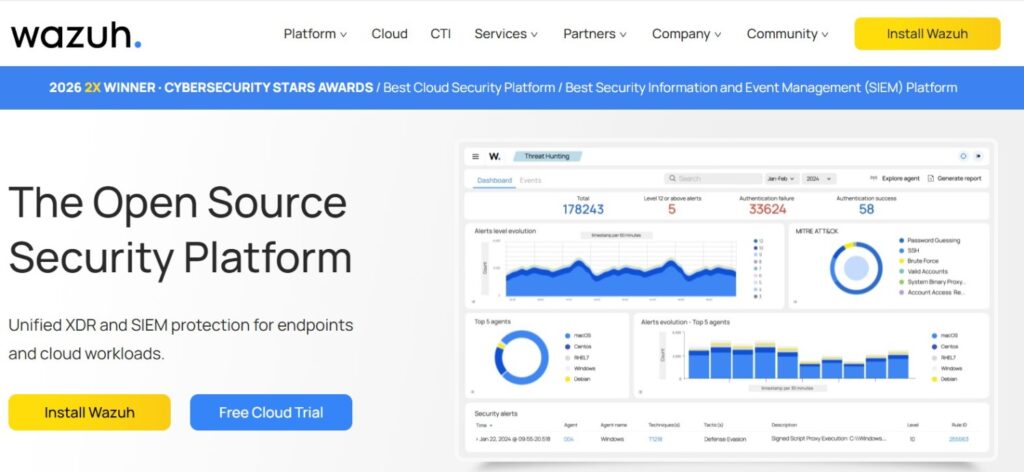
Wazuh is an open source SIEM and XDR platform that provides log analysis, intrusion detection, file integrity monitoring, and compliance reporting. It is built on OSSEC and integrates with the Elastic Stack for log storage and visualization. Wazuh is commonly deployed by security teams that have in-house engineering resources and want full control over their SIEM deployment without vendor lock-in.
Key Features:
- Open source and free to use; no licensing fees or vendor lock-in
- Built-in intrusion detection, file integrity monitoring, and vulnerability scanning
- Integration with Elastic Stack (Elasticsearch, Kibana) for log storage and dashboards
- Pre-built compliance dashboards for PCI DSS, HIPAA, GDPR, and NIST frameworks
- Agent-based log collection from Linux, Windows, macOS, and cloud platforms
Pricing:
Wazuh is free and open source. Total cost of ownership includes infrastructure hosting (compute, storage, network) and engineering time for deployment, tuning, and maintenance. A mid-market deployment handling 15 TB/month typically costs $1,500–$3,000/month in infrastructure, plus dedicated engineering resources for ongoing management.
For deployment documentation, see the Wazuh installation guide.
Pros:
- No licensing fees; lowest cost option for teams with in-house security engineering
- Full control over deployment, data, and customization
- Strong compliance support with pre-built dashboards for common frameworks
Cons:
- Requires dedicated engineering resources for deployment, tuning, and ongoing maintenance
- No vendor support; relies on community forums and documentation
- Scaling Elasticsearch backend for high volume log ingestion requires specialized expertise
Best for:
Security teams with in-house engineering resources wanting full control over their SIEM deployment without vendor licensing costs or lock-in.
9. Elastic Security
Elastic Security is a SIEM and endpoint security solution built on the Elastic Stack (Elasticsearch, Kibana, Logstash, Beats). It provides log aggregation, threat detection, and endpoint protection in one unified platform. Elastic Security is commonly used by teams already running the ELK stack for log management who want to add security event correlation without introducing a separate tool.
Key Features:
- Unified SIEM and endpoint protection in one platform
- Pre-built detection rules for common threats (malware, ransomware, lateral movement)
- Integration with MITRE ATT&CK framework for threat mapping
- Timeline analysis for reconstructing attacker activity across logs and endpoints
- Open source core with commercial add-ons for machine learning and alerting
Pricing:
Elastic Security is free for self-hosted deployments using the open source tier. Elastic Cloud (managed service) starts at $95/month for small deployments, scaling to $0.10–$0.15/GB ingestion for larger teams. A 15 TB/month deployment on Elastic Cloud costs approximately $2,250–$3,375/month.
For detailed pricing, see the Elastic Cloud pricing page.
Pros:
- Free open source option for teams with in-house Elasticsearch expertise
- Unified platform for logs, metrics, APM, and security; no separate SIEM tool needed
- Strong search and visualization capabilities using Kibana
Cons:
- Scaling Elasticsearch at high volume requires specialized expertise
- Commercial features (machine learning, alerting) require paid tier
- Self-hosted deployment requires dedicated engineering resources for maintenance and tuning
Best for:
Teams already using the Elastic Stack for log management wanting to add SIEM and endpoint security without introducing a separate platform.
10. SentinelOne Singularity
SentinelOne Singularity is an AI-driven SIEM and XDR platform designed for autonomous threat detection and response. It combines endpoint protection, log correlation, and automated investigation workflows in one cloud native platform. SentinelOne is known for its AI capabilities and low false positive rate, making it a strong fit for SOC teams prioritizing automation over manual tuning.
Key Features:
- AI-driven threat detection with autonomous response capabilities
- Unified endpoint protection, SIEM, and XDR in one platform
- Pre-built detection rules tuned to SentinelOne’s threat intelligence feeds
- Automated investigation timelines that reconstruct attacker activity without manual queries
- Cloud native architecture with real-time threat correlation across endpoints and infrastructure
Pricing:
SentinelOne pricing is custom and not publicly listed. Enterprise deployments typically cost $15,000–$30,000/month for mid-market teams (500 endpoints, 15 TB/month logs), with pricing varying by feature tier, commitment length, and support level.
For enterprise pricing, contact SentinelOne sales.
Pros:
- AI-driven detection reduces manual tuning and false positives
- Unified platform for endpoint protection, SIEM, and XDR; no separate tools needed
- Fast time to value with pre-configured detection rules and automated response
Cons:
- High cost; pricing is at the upper end of the market
- SaaS only deployment; not suitable for on-prem data residency requirements
- Vendor lock-in; proprietary AI models and detection logic are not portable
Best for:
Enterprise SOC teams prioritizing AI-driven automation, low false positive rates, and unified endpoint and SIEM capabilities in one platform.
How to Choose the Right SIEM Tool for Your Team
Choosing a SIEM tool depends on five factors: your team’s size and security maturity, deployment constraints (cloud vs on-prem), existing tooling, budget, and whether you need unified observability or security-only functionality.
For small to mid market teams (under 100 endpoints, lean SOC):
Start with a tool that minimizes operational overhead. Better Stack, Datadog Cloud SIEM, or Rapid7 InsightIDR give you pre-built detection rules and cloud deployment without requiring dedicated SIEM engineering resources. If you already use Datadog or the Elastic Stack for observability, adding their SIEM modules avoids introducing a separate platform.
For enterprise teams (500+ endpoints, dedicated security operations):
Evaluate based on integration breadth and advanced features. Splunk Enterprise Security and IBM QRadar lead for complex multi-vendor environments. Microsoft Sentinel is the clear choice if you are Azure and M365 heavy. CrowdStrike Falcon SIEM fits best if you already use CrowdStrike for endpoint protection.
For teams with data residency or compliance requirements:
Prioritize tools that support on-prem or BYOC deployment. CubeAPM, IBM QRadar, Wazuh, and Elastic Security all allow you to keep telemetry data within your own infrastructure. SaaS only platforms (Datadog, Sentinel, Rapid7) are not an option if regulatory constraints prevent sending logs outside your environment.
For teams wanting unified observability and security:
If you need APM, logs, infrastructure monitoring, and security event correlation in one platform, CubeAPM and Datadog Cloud SIEM are the strongest options. Elastic Security also fits here if you are already using the ELK stack for observability.
For cost-sensitive teams:
Wazuh is the lowest cost option if you have in-house engineering resources. CubeAPM offers the most predictable pricing at $0.20/GB with no seat fees or retention limits. Avoid per-host or per-endpoint pricing models (Splunk, Datadog, CrowdStrike) if your infrastructure auto-scales frequently, as costs compound unpredictably during traffic spikes.
Disclaimer: The information in this article reflects the latest details available at the time of publication and may change as technologies and products evolve. Features, pricing, and plan limits can change over time. Always verify the latest information directly with the vendor before making purchasing or deployment decisions.
Frequently Asked Questions
Which SIEM tool is mostly used?
Splunk Enterprise Security is the most widely deployed SIEM platform, especially in large enterprises, due to its deep integration ecosystem and proven scalability. Microsoft Sentinel is rapidly gaining adoption among Azure heavy organizations.
What is replacing SIEM?
SIEM is not being replaced but evolving into XDR (Extended Detection and Response), which adds automated response capabilities and correlates security events across endpoints, networks, and cloud platforms. Many modern SIEM tools now include XDR features.
Is SIEM still relevant?
Yes. SIEM remains critical for log aggregation, compliance reporting, and threat correlation. Modern SIEM platforms have evolved to support cloud native environments, Kubernetes workloads, and real time threat detection, making them more relevant than ever.
What are the top 5 EDR tools?
The top EDR tools in 2026 are CrowdStrike Falcon, SentinelOne, Microsoft Defender for Endpoint, Palo Alto Cortex XDR, and Carbon Black. Many of these now offer integrated SIEM capabilities.
How much does a SIEM cost for a mid size team?
For a team with 500 endpoints and 15 TB/month log ingestion, expect $4,000–$8,000/month for managed SaaS platforms (Datadog, Rapid7, Sentinel) or $1,500–$3,000/month for self hosted options (Wazuh, Elastic Security) plus engineering time.
Can I use a SIEM for compliance reporting?
Yes. Most SIEM tools include pre built dashboards and reports for common compliance frameworks including PCI DSS, HIPAA, GDPR, SOX, and NIST. Wazuh, IBM QRadar, and Splunk have particularly strong compliance features.
Do I need a SIEM if I already have an EDR tool?
It depends. EDR tools focus on endpoint threats. A SIEM correlates events across your entire infrastructure including cloud platforms, network devices, and applications. If you need broader visibility beyond endpoints, a SIEM is necessary.